





MODEL PORTFOLIO
THE GIST
NEWS AND FEATURES
Global Philippines Fine Living
INSIGHTS
INVESTMENT STRATEGY
Economy Stocks Bonds Currencies
THE BASICS
Investment Tips Explainers Retirement
WEBINARS
2024 Mid-Year Economi Briefing, economic growth in the Philippines
2024 Mid-Year Economic Briefing: Navigating the Easing Cycle
June 21, 2024
Investing with Love
Investing with Love: A Mother’s Guide to Putting Money to Work
May 15, 2024
retirement-ss-3
Investor Series: An Introduction to Estate Planning
September 1, 2023
View All Webinars
DOWNLOADS
grocery-2-aa
Inflation Update: Target breached
DOWNLOAD
Container ship carrying container boxes import export dock with quay crane. Business commercial trade global cargo freight shipping logistic and transportation worldwide oversea concept. Generative AI
Economic Updates
Philippines Trade Update: Wider deficit on strong imports
DOWNLOAD
Frick collection with palm trees 
Economic Updates
Policy Rate Updates: Policy rate updates to reassure 
DOWNLOAD
View all Reports
Metrobank.com.ph How To Sign Up
Follow us on our platforms.

How may we help you?

TOP SEARCHES
  • Where to put my investments
  • Reports about the pandemic and economy
  • Metrobank
  • Webinars
  • Economy
TRENDING ARTICLES
  • Investing for Beginners: Following your PATH
  • On government debt thresholds: How much is too much?
  • Philippines Stock Market Outlook for 2022
  • Deficit spending remains unabated

Login

Access Exclusive Content
Login to Wealth Manager
Visit us at metrobank.com.ph How To Sign Up
Access Exclusive Content Login to Wealth Manager
Search
MODEL PORTFOLIO THE GIST
NEWS AND FEATURES
Global Philippines Fine Living
INSIGHTS
INVESTMENT STRATEGY
Economy Stocks Bonds Currencies
THE BASICS
Investment Tips Explainers Retirement
WEBINARS
2024 Mid-Year Economi Briefing, economic growth in the Philippines
2024 Mid-Year Economic Briefing: Navigating the Easing Cycle
June 21, 2024
Investing with Love
Investing with Love: A Mother’s Guide to Putting Money to Work
May 15, 2024
retirement-ss-3
Investor Series: An Introduction to Estate Planning
September 1, 2023
View All Webinars
DOWNLOADS
grocery-2-aa
Inflation Update: Target breached
April 7, 2026 DOWNLOAD
Container ship carrying container boxes import export dock with quay crane. Business commercial trade global cargo freight shipping logistic and transportation worldwide oversea concept. Generative AI
Economic Updates
Philippines Trade Update: Wider deficit on strong imports
March 27, 2026 DOWNLOAD
Frick collection with palm trees 
Economic Updates
Policy Rate Updates: Policy rate updates to reassure 
March 26, 2026 DOWNLOAD
View all Reports

Archives: Reuters Articles

Wall Street closes down on slide in Apple shares, bank stocks

July 18 (Reuters) – Wall Street ended lower on Monday after bank stocks erased earlier gains and Apple (AAPL) shares fell on a report saying the company plans to slow hiring and spending growth next year.

After posting solid gains to start the session following earnings from Bank of America Corp. (BAC) and Goldman Sachs Group Inc. (GS), the S&P financial sector weakened into the close.

Apple shares reversed course to close down 2.1% at USD 147.1 on a Bloomberg report that said the company plans to slow hiring and spending growth next year in some units to cope with a potential economic downturn.

Goldman Sachs advanced 2.5% as it reported a smaller-than-expected 48% slump in second-quarter profit, helped by strength in its fixed-income trading.

Worries about a larger one percentage point rate hike at the end of July eased following remarks from Fed officials last week that the policymakers could stick to a 75 basis point hike.

“It’s really hard to sustain upward momentum,” said Ross Mayfield, investment strategy analyst at Baird in Louisville, Kentucky. “And that’s kind of the story of bear markets.”

The Dow Jones Industrial Average fell 215.65 points, or 0.69%, to 31,072.61, the S&P 500 lost 32.31 points, or 0.84%, to 3,830.85 and the Nasdaq Composite dropped 92.37 points, or 0.81%, to 11,360.05.

Nine of the 11 major sectors of the S&P 500 lost ground, with healthcare and utilities suffering the largest percentage drop, while energy took the biggest gain.

Earnings from big technology companies next week will be closely watched, after their shares came under immense selling pressure through much of this year.

Among other tech stocks, Google parent Alphabet fell 2.5%. IBM declined 1.3%.

Volume on US exchanges was 10.63 billion shares, compared with the 12.15 billion average for the full session over the last 20 trading days.

Advancing issues outnumbered declining ones on the NYSE by a 1.20-to-1 ratio; on Nasdaq, a 1.06-to-1 ratio favored decliners.

The S&P 500 posted one new 52-week high and 31 new lows; the Nasdaq Composite recorded 30 new highs and 78 new lows.

(Reporting by Echo Wang in New York; Additional reporting by Shreyashi Sanyal, Bansari Mayur Kamdar and Sruthi Shankar in Bengaluru; Editing by Shounak Dasgupta, Anil D’Silva and Deepa Babington)
Stocks edge up, dollar dips as Fed hike expectations lessened

NEW YORK, July 18 (Reuters) – A gauge of global stocks edged higher on Monday as a late-session sell-off in US equities trimmed earlier gains while the dollar slipped as investors tamped down expectations that the Federal Reserve will take a more aggressive approach in hiking interest rates next week.

Expectations for a 100 basis points rate hike by the Fed at its policy meeting next week stood at about 29%, according to CME’s FedWatch Tool after reaching as high as 80% last week.

Recent readings on inflation came in above expectations but showed tentative signs that higher prices may be starting to ease, giving the US central bank a possible cushion to raise rates at a smaller 75 basis points increment.

“As we as we entered into the quiet period, the Fed seems to be leaning more towards 75 basis points than to 100 basis points,” said Jim Barnes, director of fixed income at Bryn Mawr Trust.

“The more recent economic data that we got on Friday was more upbeat and today’s rising Treasury yields seem to be catching up with the market’s activity from Friday, as well as the equity market from today.”

A strong start to the trading session for stocks on Wall Street fizzled out, however, as a drop in Apple Inc. (AAPL) weighed following a Bloomberg report that the iPhone maker plans to slow hiring and spending growth next year in some units to cope with a potential economic downturn.

“We were starting to slide a little before then, just a little bit, and when that hit, obviously Apple slid a little quicker than the market did, so maybe it was an excuse to sell off,” said Joe Saluzzi, co-manager of trading at Themis Trading in Chatham, New Jersey.

US equities initially rose in part due to gains in bank stocks .SPXBK, which had risen about 3% on the heels of earnings from Goldman Sachs (GS), up 2.5% and Bank of America, up 0.05%, before fading.

The Dow Jones Industrial Average fell 216.51 points, or 0.69%, to 31,071.75; the S&P 500 lost 32.34 points, or 0.84%, to 3,830.82; and the Nasdaq Composite dropped 92.37 points, or 0.81%, to 11,360.05.

Of the 40 S&P 500 companies that have reported earnings through Monday morning, 80% have been above estimates, per Refinitiv data, tracking slightly below the 81% rate over the past four quarters.

The pan-European STOXX 600 index rose 0.93% and MSCI’s gauge of stocks across the globe gained 0.06%. European stocks closed off a three-week high hit earlier in the day on worries about the impact of an energy shortage in the region.

Benchmark 10-year US Treasury notes US10YT=RR last fell 12/32 in price to yield 2.9725%, from 2.93% late on Friday.

Before the Fed meeting next week, the European Central Bank is poised to raise rates for the first time in more than a decade on Thursday, with a hike of 25 basis points expected.

As the region deals with its own inflationary pressures, Russia’s Gazprom (GAZP) told customers in Europe it cannot guarantee gas supplies because of ‘extraordinary’ circumstances, according to a letter from Gazprom that will add to European fears of fuel shortages.

In light of the shifting view of next week’s Fed meeting, the US dollar retreated from the 20-year high hit last week, helping the euro move away from parity against the greenback.

The dollar index fell 0.38%, with the euro EUR= up 0.56% to USD 1.0143.

Oil prices jumped, boosted by mounting concerns over gas supply from Russia and the lower dollar, offsetting demand fears brought on by a possible recession and China lockdowns.

US crude settled up 5.13% at USD USD 102.60 per barrel and Brent settled at USD 106.27, up 5.05% on the day.

(Additional reporting by Rodrigo Campos; editing by Jonathan Oatis)

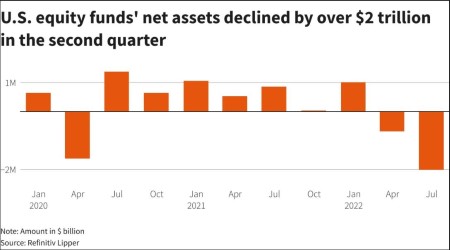
US equity funds’ net assets shrank by $2 trillion in second quarter

US equity funds’ net assets shrank by $2 trillion in second quarter

July 18 (Reuters) – US equity funds witnessed a record erosion in their net assets in the second quarter of this year, as stocks slumped due to soaring inflation and rising expectations of aggressive rate hikes by major central banks.

Data from Refinitiv Lipper showed US equity funds’ net assets shrank by USD 2.1 trillion to USD 9.2 trillion in the quarter ended June, the biggest quarterly drop ever.

The decliners were led by Vanguard Total Stock Market Index Fund and SPDR S&P 500 ETF Trust SPY which lost USD 77.5 billion and USD 70.5 billion of their net assets respectively, while Vanguard 500 Index Fund gave up USD 69.3 billion.

The tech-heavy Nasdaq Composite and the broader S&P 500 Composite index declined 22.4% and 16.45% respectively in the second quarter, marking their biggest January-June percentage drop since the financial crisis.

US equity mutual funds also registered an average fall of 15.3% in their net assets values between April and June this year.

The Federal Reserve has already lifted interest rates three times this year, and is expected to do another 75 basis points later this month.

Those expectations of aggressive rate hikes have given rise to fears of a global recession as corporates are hit by higher borrowing costs and lower profit margins.

Goldman Sachs said in a note a recession could cause the S&P 500 index to fall by 19% to 3,150 by the end of 2022, and a sharp contraction in the price-earnings ratio.

“This peak to trough price decline of 34% would be slightly more severe than the historical average recession decline of 30%.”

The weekly data from Lipper showed US equity funds witnessed outflows for the third week in a row in the week ended July 13.

(Reporting By Patturaja Murugaboopathy; Editing by Vidya Ranganathan)

Yellen: US talks with India on price cap on Russian oil ‘encouraging’

Yellen: US talks with India on price cap on Russian oil ‘encouraging’

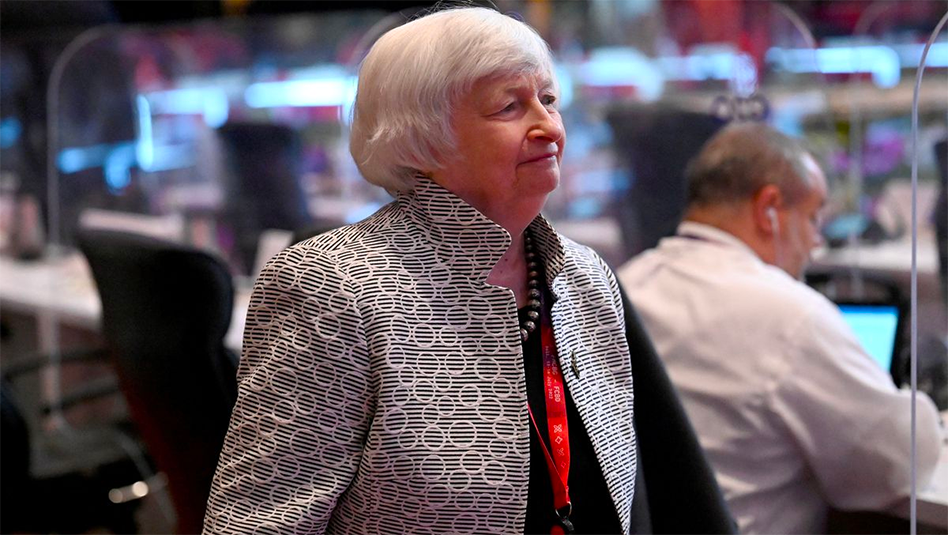
SEOUL, July 18 (Reuters) – US Treasury Secretary Janet Yellen described as “encouraging” talks with India about a proposed price cap on Russian oil that Washington is pushing to drive down oil prices and make it harder for Moscow to fund its war in Ukraine.

Yellen, who arrived in Seoul on Monday evening, told Reuters in an interview en route to the South Korean capital that she was feeling generally positive about the initiative.

“We’ll see where they come out. The conversations I’ve had have generally been encouraging,” Yellen said aboard a military aircraft on her way from Indonesia to South Korea.

A senior Treasury official said India had made no promises on the oil price cap, but was working with the United States and had not “expressed hostility to this idea”.

Yellen told reporters on Saturday that she had held productive bilateral meetings about the proposed price cap with more than six counterparts on the sidelines of a meeting of Group of 20 finance officials on the Indonesian island of Bali.

The Treasury said she met there with officials from Saudi Arabia, Australia, South Africa, Turkey and Singapore.

Yellen spoke with her Indian counterpart before leaving for Asia, but did not meet him in Bali, a senior Treasury official said. Other senior US Treasury officials have been in touch with lower-level Indian officials as well, the official said.

(Reporting by Andrea Shalal; Editing by Mark Heinrich)

Chinese central bank support boosts EM stocks; FX gain as dollar rally fades

July 18 (Reuters) – Emerging market shares rose nearly 2% on Monday, buoyed by Chinese central bank support pledges that sent the country’s mainland stocks leaping, while currencies saw modest gains as the greenback relaxed from multi-year highs.

China’s central bank stepped up cash injections by offering 12 billion yuan ($1.8 billion), while also vowing to increase implementation of prudent monetary policy to support the economy. Heavyweight stocks added more than 1% and Hong Kong’s Hang Seng index leaped 2.6%.

China’s yuan firmed 0.2%, its biggest jump in nearly a month.

“Investments in China – both direct investment and portfolio investments – are under pressure due to factors that were perceived as less relevant in the past,” said Ulrich Leuchtmann, head of FX and commodity research at Commerzbank.

“Free-flowing export revenue is supporting CNY, but if that eases, or when the West slides into a recession, the renminbi is likely to get under increasing pressure.”

MSCI’s index of emerging market (EM) stocks jumped 1.7% after dropping nearly 4% last week as worries over a looming downturn, China’s economic strains and faster U.S. interest rate hikes dented the appeal for riskier assets.

“It is unclear what the ‘new normal’ will look like following this inflation shock,” Leuchtmann added.

With U.S. Federal Reserve officials signalling a 75-basis-point rate hike at the upcoming meeting, rather than the 100 bps some feared, risk sentiment improved, and the safe-haven dollar nudged down to 107.86 from last week’s two-decade high of 109.290.

After selling off for six straight weeks, emerging market currencies got a breather, rising 0.3% with Mexico’s peso and South Africa’s rand rising upto 0.8%.

Russia’s rouble hit a near two-week high against the dollar, supported by a favorable tax payment period and capital controls as participants look ahead to a central bank rate decision this week where it is widely expected to cut the key rate from 9.5%.

Sri Lanka President Wickremesinghe declared a state of emergency in the country, according to a government notice.

Sovereign dollar bonds dipped up to 0.5 cents, after dropping to record lows last week.

At large, crashing currencies, 1,000 basis point bond spreads and burned forex reserves point to a record number of developing nations now in trouble.

Emerging market local currency bond funds suffered their 20th consecutive week of outflows last week in the longest streak since 2014, according to analysts at JPMorgan.

(Reporting by Anisha Sircar in Bengaluru; Editing by Rashmi Aich)

BSP ready to use available tools in inflation fight

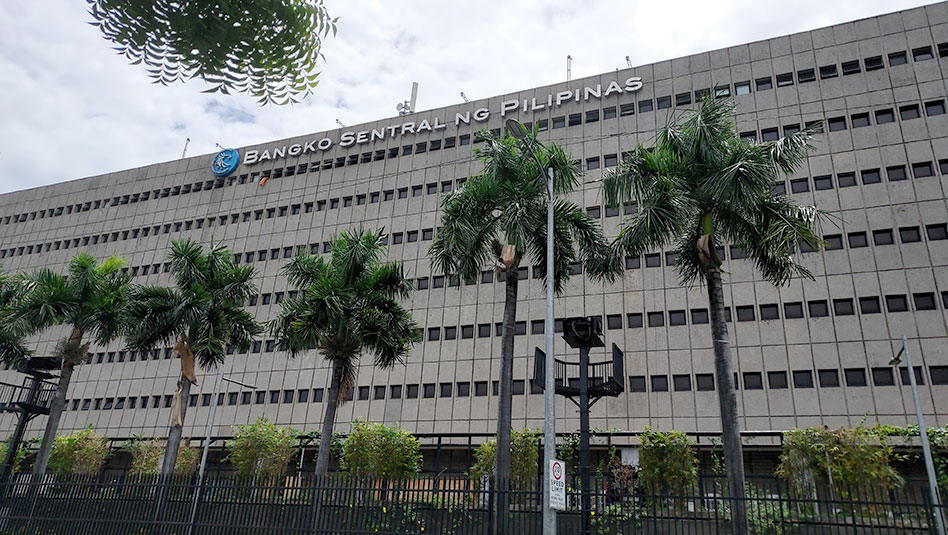
MANILA, July 18 (Reuters) – The Philippine central bank is ready to use available tools to bring inflation back within the official 2%-4% target range, its governor said on Monday, after last week’s surprise 75 basis points hike in key interest rates.

Bangko Sentral ng Pilipinas Governor Felipe Medalla also said the domestic economy, aside from red-hot inflation, also faces a risk from possible reimposition of COVID-19 restrictions.

(Reporting by Neil Jerome Morales and Enrico Dela Cruz; Editing by Martin Petty)

Oil jumps as soft dollar and tight supply supports

Oil jumps as soft dollar and tight supply supports

LONDON, July 18 (Reuters) – Oil prices extended gains on Monday, propped up by a weaker dollar and tight supplies that offset concerns about recession and the prospect of widespread COVID-19 lockdowns in China again reducing fuel demand.

Brent crude futures for September settlement rose USD 2.44, or 2.4%, to USD 103.60 a barrel by 0900 GMT, having advanced by 2.1% on Friday.

US West Texas Intermediate (WTI) crude futures for August delivery gained USD 2.17, or 2.2%, to USD 99.76 after rising by 1.9% in the previous session.

The US dollar retreated from multi-year highs on Monday, supporting prices of commodities ranging from gold to oil. A weaker dollar makes dollar-denominated commodities more affordable for holders of other currencies.

Both Brent and WTI last week registered their biggest weekly declines for about a month on fears of a recession that would hit oil demand. Mass COVID-testing exercises continue in parts of China this week, raising concerns over oil demand from the world’s second-largest oil consumer.

However, oil supplies remain tight. As expected, US President Joe Biden’s trip to Saudi Arabia failed to yield any pledge from the top OPEC producer to boost oil supply.

Biden wants Gulf oil producers to step up output to help to lower oil prices and drive down inflation.

Global markets are focused this week on the resumption of Russian gas flows to Europe via the Nord Stream 1 pipeline, which is scheduled to end maintenance on July 21. Governments, markets and companies fear the shutdown could be extended because of the war in Ukraine.

“Brent crude will find support at the end of the week if Russia does not turn the gas back on to Germany after Nord Stream 1 maintenance,” said OANDA senior analyst Jeffrey Halley.

Loss of that gas to Germany, the world’s fourth-largest economy, would hit it hard and heighten the risk of recession.

(Reporting by Noah Browning; Additional reporting by Sonali Paul in Melbourne and Florence Tan in Singapore; Editing by David Goodman)

Oil gains $5 on weaker dollar, tight supplies

July 18 (Reuters) – Oil prices rose more than USD 5 on Monday, boosted by dollar weakness and expectations that the US Federal Reserve won’t raise interest rates by a full percentage point at its next meeting to combat inflation.

Brent crude futures for September settlement gained USD 5.11, or 5.1%, to settle at USD 106.27 a barrel, after rising 2.1% on Friday.

US West Texas Intermediate (WTI) crude futures for August delivery settled up USD 5.01, or 5.1%, at USD 102.60 after rising by 1.9% in the previous session.

On Friday two US Federal Reserve officials indicated the central bank would likely only raise interest rates by 75 basis points at its July 26-27 meeting. Previous reports that the Fed was considering a 100 basis point decision sent markets lower late last week.

The US dollar retreated from multi-year highs on Monday, supporting commodities prices. A weaker dollar makes dollar-denominated commodities more affordable for holders of other currencies.

“Today’s strong advance resulted largely from a sizable and broad-based weakening in the US dollar that has been providing a key driver behind daily oil price swings during the past several weeks,” said Jim Ritterbusch, president of Ritterbusch and Associates LLC in Galena, Illinois.

Both Brent and WTI last week registered their biggest weekly declines in about a month.

Oil supplies remain tight. As expected, US President Joe Biden’s trip to Saudi Arabia did not yield any pledge from the top OPEC producer to boost oil supply.

Biden wants Gulf oil producers to step up output to help to lower oil prices.

Russian gas export monopoly Gazprom declared force majeure on gas supplies to Europe to at least one major customer, according to the letter seen by Reuters, potentially ratcheting up the conflict between Moscow and Europe.

That added support to oil prices, as traders saw it potentially as a precursor to actions by Russia to use energy as a weapon.

“The other clear risk …is that Russia will further slash energy supplies to Europe to try to raise the cost of supporting Ukraine and imposing sanctions,” said Helima Croft, head of global commodity strategy at RBC Capital Markets.

(Additional reporting by Noah Browning in London, Sonali Paul in Melbourne and Florence Tan in Singapore; Editing by David Goodman, Jonathan Oatis, Paul Simao and Cynthia Osterman)

Marcos wants to renegotiate loans on $4.9 billion China-backed rail projects

MANILA, July 16 (Reuters) – Philippine President Ferdinand Marcos Jr ordered the transport ministry to renegotiate loan agreements struck by his predecessor with China for railway projects worth USD 4.90 billion, an official said on Saturday.

Transportation Undersecretary Cesar Chavez said the official development assistance loan agreements for the three projects were considered “withdrawn” after the Chinese government “failed to act on the funding requests” made by the government of then-President Rodrigo Duterte.

Chavez said other funding options were also being considered for the projects worth 276 billion Philippine pesos: the Subic-Clark Railway Project, the Philippine National Railways South Long-Haul Project and the Davao-Digos segment of the Mindanao Railway Project.

Options include tapping private capital through a public private partnership, he said.

Asked for comment, a Chinese official said on condition of anonymity: “I can say China-Philippines cooperation over railways will continue. China is open for discussions with the Philippines.”

From more than 1,100 km (680 miles) before World War II, the Philippines had only 77 km of operational railway as of 2016, well behind other urban centers across Asia, government data shows.

Negotiations for the rail projects began in 2018, during the administration of Duterte, who pursued warmer ties with Beijing, setting aside a longstanding territorial spat over the South China Sea in exchange for billions of dollars of aid, loans and investment pledges, including for his infrastructure program.

Marcos has vowed to defend national sovereignty but has spoken strongly of the need to enhance ties with China in other areas.

(Reporting by Karen Lema; Editing by William Mallard)

US Navy conducts freedom of navigation operation in South China Sea

BEIJING, July 16 (Reuters) – The U.S. Navy on Saturday said in a statement the USS Benfold carried out what it calls a “freedom of navigation operation” in the South China Sea near the Spratly Islands.

“On July 16, USS Benfold (DDG 65) asserted navigational rights and freedoms in the South China Sea near the Spratly Islands, consistent with international law,” it said.

(Reporting by Albee Zhang and Tony Munroe; Editing by Tom Hogue)

Posts navigation

Older posts
Newer posts

Recent Posts

  • Metrobank US-Iran Risk Index: Fragile ceasefire 
  • Investment Ideas: April 10, 2026 
  • Metrobank US-Iran Risk Index: A new hope
  • A guide for your peso bond portfolio amid higher for longer rates
  • Investment Ideas: April 8, 2026

Recent Comments

No comments to show.

Archives

  • April 2026
  • March 2026
  • February 2026
  • January 2026
  • December 2025
  • November 2025
  • October 2025
  • September 2025
  • August 2025
  • July 2025
  • June 2025
  • May 2025
  • April 2025
  • March 2025
  • February 2025
  • January 2025
  • December 2024
  • November 2024
  • October 2024
  • September 2024
  • August 2024
  • July 2024
  • June 2024
  • May 2024
  • April 2024
  • March 2024
  • February 2024
  • January 2024
  • December 2023
  • November 2023
  • October 2023
  • September 2023
  • August 2023
  • July 2023
  • June 2023
  • May 2023
  • April 2023
  • March 2023
  • February 2023
  • January 2023
  • December 2022
  • November 2022
  • October 2022
  • September 2022
  • August 2022
  • July 2022
  • June 2022
  • May 2022
  • March 2022
  • December 2021
  • October 2021

Categories

  • Bonds
  • BusinessWorld
  • Currencies
  • Economy
  • Equities
  • Estate Planning
  • Explainer
  • Featured Insight
  • Fine Living
  • How To
  • Investment Tips
  • Markets
  • Portfolio Picks
  • Rates & Bonds
  • Retirement
  • Reuters
  • Spotlight
  • Stocks
  • Uncategorized

You are leaving Metrobank Wealth Insights

Please be aware that the external site policies may differ from our website Terms And Conditions and Privacy Policy. The next site will be opened in a new browser window or tab.

Cancel Proceed
Get in Touch

For inquiries, please call our Metrobank Contact Center at (02) 88-700-700 (domestic toll-free 1-800-1888-5775) or send an e-mail to customercare@metrobank.com.ph

Metrobank is regulated by the Bangko Sentral ng Pilipinas
Website: https://www.bsp.gov.ph

Quick Links
The Gist Webinars Wealth Manager Explainers
Markets
Currencies Rates & Bonds Equities Economy
Wealth
Investment Tips Fine Living Retirement
Portfolio Picks
Bonds Stocks
Others
Contact Us Privacy Notice Terms of Use
© 2026 Metrobank. All rights reserved.

Access this content:

If you are an existing investor, log in first to your Metrobank Wealth Manager account. ​

If you wish to start your wealth journey with us, click the “How To Sign Up” button. ​

Login HOW TO SIGN UP