





MODEL PORTFOLIO
THE GIST
NEWS AND FEATURES
Global Philippines Fine Living
INSIGHTS
INVESTMENT STRATEGY
Economy Stocks Bonds Currencies
THE BASICS
Investment Tips Explainers Retirement
WEBINARS
2024 Mid-Year Economi Briefing, economic growth in the Philippines
2024 Mid-Year Economic Briefing: Navigating the Easing Cycle
June 21, 2024
Investing with Love
Investing with Love: A Mother’s Guide to Putting Money to Work
May 15, 2024
retirement-ss-3
Investor Series: An Introduction to Estate Planning
September 1, 2023
View All Webinars
DOWNLOADS
Container ship carrying container boxes import export dock with quay crane. Business commercial trade global cargo freight shipping logistic and transportation worldwide oversea concept. Generative AI
Economic Updates
Philippines Trade Update: Wider deficit on strong imports
DOWNLOAD
Frick collection with palm trees 
Economic Updates
Policy Rate Updates: Policy rate updates to reassure 
DOWNLOAD
Man using his smartphone
Reports
Fed to cut just once 
DOWNLOAD
View all Reports
Metrobank.com.ph How To Sign Up
Follow us on our platforms.

How may we help you?

TOP SEARCHES
  • Where to put my investments
  • Reports about the pandemic and economy
  • Metrobank
  • Webinars
  • Economy
TRENDING ARTICLES
  • Investing for Beginners: Following your PATH
  • On government debt thresholds: How much is too much?
  • Philippines Stock Market Outlook for 2022
  • Deficit spending remains unabated

Login

Access Exclusive Content
Login to Wealth Manager
Visit us at metrobank.com.ph How To Sign Up
Access Exclusive Content Login to Wealth Manager
Search
MODEL PORTFOLIO THE GIST
NEWS AND FEATURES
Global Philippines Fine Living
INSIGHTS
INVESTMENT STRATEGY
Economy Stocks Bonds Currencies
THE BASICS
Investment Tips Explainers Retirement
WEBINARS
2024 Mid-Year Economi Briefing, economic growth in the Philippines
2024 Mid-Year Economic Briefing: Navigating the Easing Cycle
June 21, 2024
Investing with Love
Investing with Love: A Mother’s Guide to Putting Money to Work
May 15, 2024
retirement-ss-3
Investor Series: An Introduction to Estate Planning
September 1, 2023
View All Webinars
DOWNLOADS
Container ship carrying container boxes import export dock with quay crane. Business commercial trade global cargo freight shipping logistic and transportation worldwide oversea concept. Generative AI
Economic Updates
Philippines Trade Update: Wider deficit on strong imports
March 27, 2026 DOWNLOAD
Frick collection with palm trees 
Economic Updates
Policy Rate Updates: Policy rate updates to reassure 
March 26, 2026 DOWNLOAD
Man using his smartphone
Reports
Fed to cut just once 
March 19, 2026 DOWNLOAD
View all Reports

Archives: Business World Article

PSEi rebounds as market sentiment improves

PSEi rebounds as market sentiment improves

Philippine shares rebounded on Tuesday as investors bought bargains and on optimism ahead of the corporate results season in the United States and positive remittances data at home.

The Philippine Stock Exchange index (PSEi) went up by 82.07 points or 1.32% to close at 6,280.90 on Tuesday, while the broader all shares index added 31.48 points or 0.93% to end at 3,391.38.

“The index rose on the back of bargain hunting and better risk sentiment. The index tracked most Asian markets higher as the US earnings season started on a positive note and China injected fresh liquidity into the financial system,” China Bank Capital Corp. Managing Director Juan Paolo E. Colet said in a Viber message.

“The market was able to fully recoup [Monday’s] losses as it saw a broad-based rally, which we attribute to optimism ahead of the third quarter earnings season and positive spillovers from the overnight rally in Wall Street. Moreover, foreigners turned net buyers today, which provided added boost to the rally,” China Bank Securities Corp. Research Associate Lance U. Soledad said in an e-mail on Tuesday.

Net foreign buying stood at PHP 276.42 million on Tuesday versus the PHP 369.15 million in net selling recorded on Monday.

Futures for Wall Street’s main indexes edged higher on Monday ahead of this week’s corporate earnings and economic data that could offer clues on the state of the US economy, while tensions over Israel-Hamas conflict kept gains in check, Reuters reported.

Results from large banks Goldman Sachs, Bank of America, Morgan Stanley, pharmaceutical giant Johnson & Johnson, electric automaker Tesla, and video-streaming pioneer Netflix are due this week.

Mr. Colet added that market sentiment improved following the release of improved remittances data on Monday.

Cash remittances coursed through banks rose by 2.7% to USD 2.79 billion in August from USD 2.72 billion in the same month in 2022, central bank data showed.

The August growth was the fastest in three months or since the 2.8% in May, but slower than 4.3% in August last year.

For the first eight months of 2023, cash remittances increased by 2.8% to USD 21.58 billion from USD 20.99 billion in the previous year.

The central bank expects remittances to rise by 3% this year.

Almost all sectoral indices rose on Tuesday. Property climbed by 47.94 points or 1.82% to 2,673.19; services went up by 24.54 points or 1.61% to 1,548.56; holding firms rose by 85.06 points or 1.45% to 5,939.32; industrials increased by 60.72 points or 0.69% to 8,826.52; and financials inched up by 8.44 points or 0.47% to 1,797.52.

Meanwhile, mining and oil fell by 107.02 points or 0.97% to 10,930.38.

Value turnover went up to PHP 5.69 billion on Tuesday with 1.25 billion shares changing hands from the PHP 3.76 billion with 815.38 million issues seen on Monday.

Advancers outnumbered decliners, 110 versus 78, while 45 shares closed unchanged. — SJT with Reuters

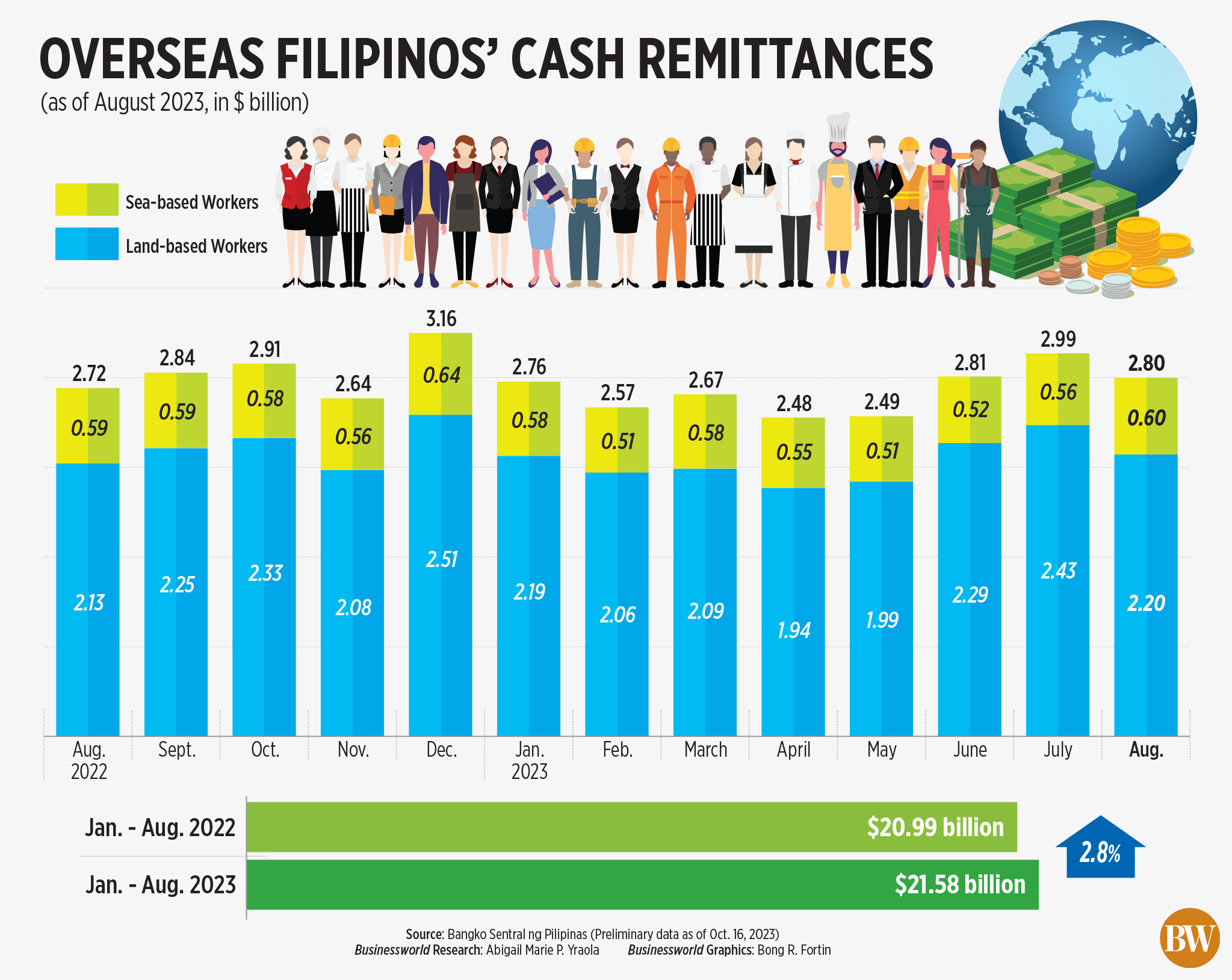
Remittances climb 2.7% in August

Remittances climb 2.7% in August

Money sent home by overseas Filipino workers (OFWs) increased by 2.7% year on year in August, the fastest pace since May, data from the Bangko Sentral ng Pilipinas (BSP) showed.

Cash remittances coursed through banks rose by 2.7% to USD 2.79 billion in August from USD 2.72 billion in the same month in 2022. This was the fastest rate in three months since the 2.8% seen in May, but slower than 4.3% in August 2022.

“The growth in cash remittances during the month was due primarily to increased receipts from both land- and sea-based workers,” the BSP said in a statement.

Overseas Filipinos’ Cash Remittances

However, cash remittances in August were the lowest since the USD 2.49 billion in May. Month on month, cash remittances fell by 6.5% from USD 2.99 billion in July.

Remittances from land-based workers jumped by 3.2% year on year to $2.2 billion in August, while cash sent by sea-based workers inched up by 1% to USD 600 million.

“The continued growth (in remittances) nevertheless is still a good signal/bright spot for the overall economy as a growth driver),” Rizal Commercial Banking Corp. Chief Economist Michael L. Ricafort said in a Viber message.

For the first eight months of 2023, cash remittances jumped by 2.8% to USD 21.58 billion from USD 20.99 billion a year ago.

“This is largely in line with expectations as remittances continue to be a consistent source of foreign exchange and once converted, a viable driver of domestic purchasing power,” ING Bank N.V. Manila Senior Economist Nicholas Antonio T. Mapa likewise said in a Viber message.

The bulk of the cash remittances or USD 17.71 billion came from land-based workers during the eight-month period, up by 3.1% year on year. Sea-based workers sent USD 4.41 billion during the January-to-August period, up by 1.9% year on year.

“The growth in cash remittances from the United States (US), Saudi Arabia, and Singapore contributed mainly to the increase in remittances in the first eight months of 2023,” the BSP said.

The US is the biggest source of cash remittances at 41.6% during the period ending August. It was followed by Singapore (6.9%), Saudi Arabia (5.9%), Japan (4.9%), United Kingdom (4.9%), United Arab Emirates (4.1%), Canada (3.5%), Qatar (2.8%), Taiwan (2.7%) and South Korea (2.6%).

Mr. Ricafort noted OFWs have been sending more money to take advantage of the favorable peso-dollar exchange rate.

“The US dollar/peso exchange already went up nearly PHP 6 or nearly 12% to PHP 56.80 levels currently versus PHP 51 levels since 2022 or before the start of the Russia-Ukraine war on Feb. 24, 2022,” he said.

“As OFW remittances have more peso equivalent for every US dollar sent, this is a source of consolation for OFWs and their families/dependents coping with higher prices/inflation and higher interest rate payments (on loans),” he added.

Headline inflation quickened for the first time in seven months to 5.3% in August, which marked the 17th month that inflation surpassed the BSP’s 2-4% target.

“As inflationary pressures remain such as higher rice and oil/petroleum prices that would lead to higher prices of other affected goods and services, OFW remittances could continue by a similar pace year on year, similar to GDP growth for the coming months,” Mr. Ricafort said.

The BSP sees inflation averaging 5.8% this year. Economic managers are targeting 6-7% gross domestic product (GDP) growth this year.

Remittances also typically accelerate in the fourth quarter ahead of the Christmas holidays, which could support the peso exchange rate, Mr. Ricafort added.

However, Mr. Ricafort noted that a possible global economic slowdown and a prolonged Israel-Hamas war could affect remittances.

Israel accounts for USD 74.4-million remittances during the eight-month period or 0.3% of the total remittances. In 2022, remittances from Israel reached USD 110.6 million.

Meanwhile, personal remittances, which include inflows in kind, went up by 2.8% to USD 3.1 billion in August from USD 3.02 billion in the same month a year ago. Month on month, personal remittances fell by 6.5% from USD 3.32 billion.

For the January-to-August period, personal remittances increased by 2.9% to USD 24.01 billion from USD 23.34 billion a year ago.

The central bank expects remittances to grow by 3% this year. — AMCS

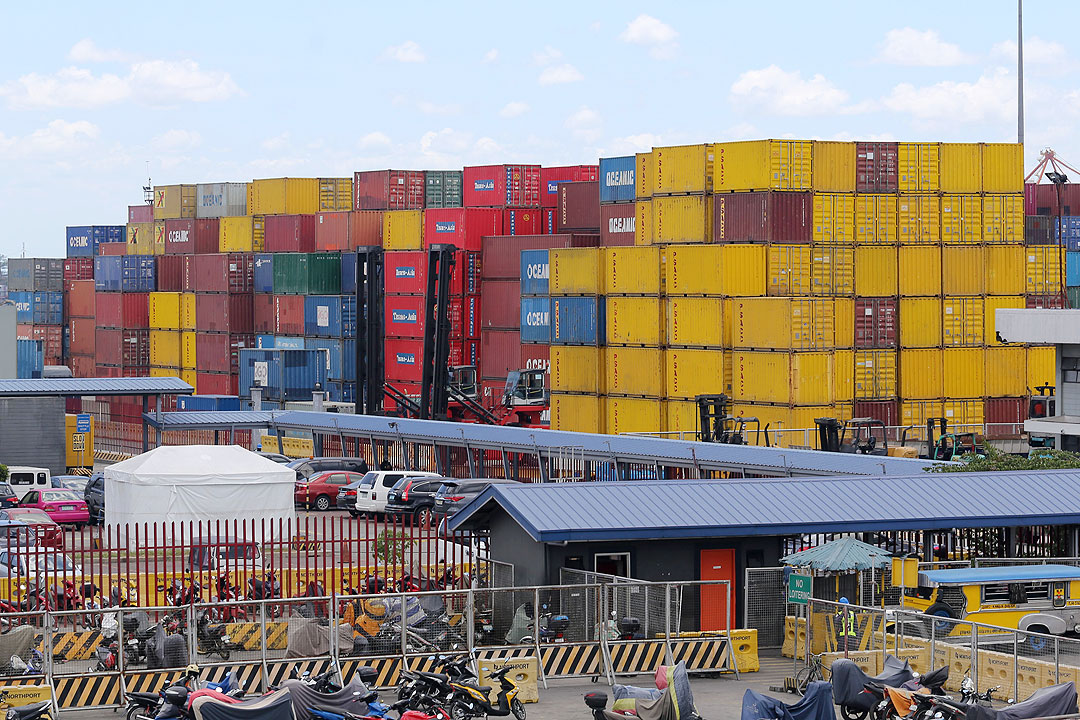
PH trade outlook dims as global economy slows

PH trade outlook dims as global economy slows

A global economic slowdown, elevated inflation and high interest rates may continue to dampen Philippine trade in the coming months, Moody’s Analytics said.

“Although exports held up well in August, a slowing global economy will keep a lid on demand from key markets,” Moody’s Analytics said in a report dated Oct. 13.

The Philippines’ trade deficit narrowed to USD 4.13 billion in August, its lowest level in two months as an increase in exports offset the drop in imports, data from the Philippine Statistics Authority (PSA) showed.

Exports jumped by 4.2% year on year to USD 6.7 billion in August, the fastest since November 2022. Imports contracted by 13.1% year on year to USD 10.83 billion in August.

For the first eight months of the year, the trade gap narrowed to USD 36.31 billion from the USD 41.86-billion deficit during the same period a year ago. Exports declined by 6.6% to USD 47.81 billion as of end-August, while imports fell by 9.6% to USD 84.12 billion.

Moody’s Analytics said that latest exports data from the Philippines showed that the global tech cycle has “bottomed.”

“The Philippines is a regional hub for the testing and final assembly of semiconductors, but its exports of electronic products have been vulnerable to the semiconductor downcycle over much of the last year,” it said.

Electronic products, which made up more than half of the total exports in August, rose by 6.1% to USD 3.88 billion.

“Strikingly, semiconductor exports jumped 14%, marking a fourth straight double-digit improvement,” it added.

The Semiconductor and Electronics Industries in the Philippines Foundation, Inc. earlier said it expects electronic export growth to be flat after a poor performance in the first half.

Moody’s Analytics said that the slowdown in China will also impact the Philippines’ trade outlook.

“The spluttering economic recovery in China again disappointed Filipinos, with exports to that market a smidgen lower than a year ago,” it said.

“Still, China remained the fourth-largest destination for exports for a second straight month (in August), ranking behind the US, Japan and Hong Kong. China ranked first in March, April and May and second in June,” it added.

The United States remained as the main destination of local goods in August, with export value reaching USD 1.1 billion or a 16.4% share of the total export receipts. Export value to China stood at USD 838 million in August.

Meanwhile, import growth will likely be constrained as household spending remains muted. 

“Imports will be kept in check as high borrowing costs and elevated inflation to the end of the year prompt households and businesses to be cautious about spending,” Moody’s Analytics said.

Inflation averaged 6.6% in the first nine months of the year, still above the Bangko Sentral ng Pilipinas’ (BSP) revised 5.8% full-year forecast.

Persistent inflation has prompted the BSP to keep its key interest rate at a near 16-year high of 6.25% for the last four meetings. The BSP governor has also signaled the possibility of a 25-basis-point hike at its Nov. 16 meeting.

For this year, the government is projecting 1% growth for exports and 2% growth for imports. — Luisa Maria Jacinta C. Jocson

BTr partially awards T-bills as rates go up

BTr partially awards T-bills as rates go up

The Bureau of the Treasury (BTr) partially awarded the Treasury bills (T-bills) it auctioned off on Monday at higher rates as investors expect the Philippine central bank to resume its tightening cycle next month.

The government raised just PHP 11.947 billion via the T-bills it auctioned off on Monday, short of the PHP 15-billion program, even as total bids reached PHP 19.371 billion, above the amount on offer.

Broken down, the Treasury borrowed only PHp 3.637 billion via the 91-day T-bills, below the PHP 5-billion offer, even as tenders for the tenor reached PHP 5.137 billion. The three-month paper was quoted at an average rate of 5.99%, 18.4 basis points (bps) higher than the 5.806% seen last week. Accepted rates ranged from 5.85% to 6.10%

The government raised just PHP 3.31 billion from the 182-day securities, short of the PHP 5-billion program, despite bids for the tenor reaching PHP 6.52 billion. The average rate for the six-month T-bill was at 6.207%, up by 9.2 bps from 6.115% quoted for last week, with accepted rates at 6.125% to 6.25%.

Meanwhile, the BTr made a full PHP 5-billion award of the 364-day debt papers as demand for the tenor reached P7.714 billion. The average rate of the one-year T-bill rose by 8.3 bps to 6.388% from the 6.305% quoted for last week’s partial award. Accepted yields were from 6.325% to 6.438%.

At the secondary market before Monday’s auction, the 91-, 182- and 364-day T-bills were quoted at 5.8711%, 6.1458%, and 6.3085%, respectively, based on PHP Bloomberg Valuation Service (BVAL) Reference Rates data provided by the Treasury.

T-bill rates rose due to weak demand as market players expect the Bangko Sentral ng Pilipinas (BSP) to raise borrowing costs at their Nov. 16 policy meeting, a trader said via phone call.

The government made a partial award of its T-bill offer as it rejected bids that were too high, Rizal Commercial Banking Corp. Chief Economist Michael L. Ricafort said in a Viber message.

“T-bill auction yields are already unusually higher than the comparable short-term PHP BVAL yields as of Oct. 13,” Mr. Ricafort said.

“Auction yields were higher after the latest signals from local monetary authorities on a possible 25-bp policy rate hike that cannot be ruled out in November 2023,” he added.

The central bank is open to raising its policy rate by 25 bps during their meeting next month after inflation picked up for a second month in a row in September, BSP Governor Eli M. Remolona, Jr. said last week.

Mr. Remolona said he “would not rule out” a 25-bp increase at the Monetary Board’s Nov. 16 meeting, adding there is still room for monetary tightening as the economy remains strong.

The Monetary Board has kept the policy rate at a near 16-year high of 6.25% at its last four meetings. It raised borrowing costs by 425 bps from May 2022 to March 2023 to help bring down inflation.

Headline inflation quickened for a second straight month to 6.1% in September from 5.3% in August. This brought the nine-month inflation average to 6.6%, still higher than the BSP’s 5.8% forecast and 2-4% target for the year.

On Tuesday, the BTr will offer PHP 30 billion in reissued seven-year Treasury bonds (T-bonds) with a remaining life of six years and nine months.

The Treasury wants to raise PHP 150 billion from the domestic market this month, or PHP 60 billion via T-bills and PHP 90 billion via T-bonds.

The government borrows from local and foreign sources to help fund its budget deficit, which is capped at 6.1% of gross domestic product this year. — AMCS

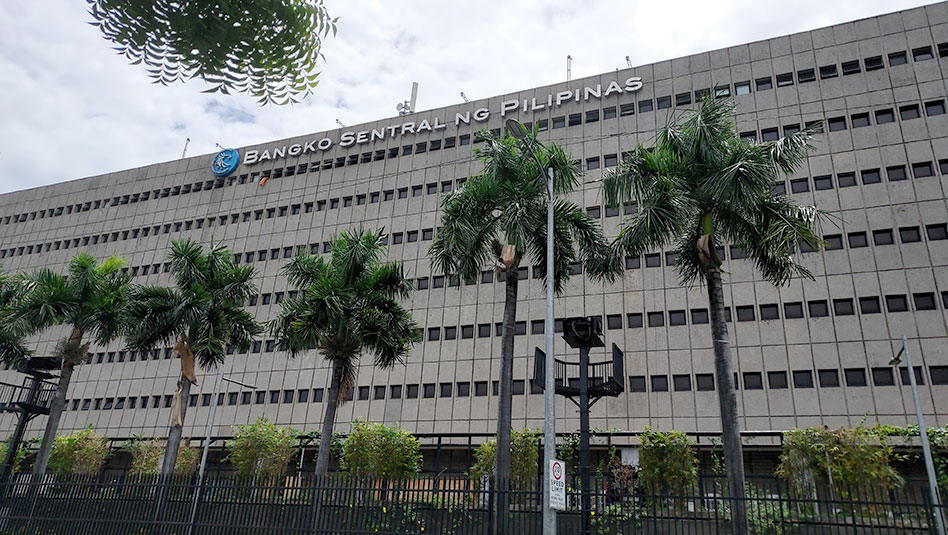
Peso inches higher vs dollar as oil prices ease after Friday’s surge

Peso inches higher vs dollar as oil prices ease after Friday’s surge

The peso appreciated slightly against the dollar on Monday as oil prices eased slightly following Friday’s surge amid the ongoing war in the Middle East.

The local currency closed at PHP 56.78 versus the dollar on Monday, strengthening by 3.1 centavos from Friday’s PHP 56.811 finish, data from the Bankers Association of the Philippines’ website showed.

The local unit opened Monday’s session at PHP 56.82 per dollar. Its intraday best was at its close of PHP 56.78, while its weakest showing was at PHP 56.88 against the greenback.

Dollars traded went down to USD 859.5 million on Monday from the USD 922.12 million on Friday.

“The peso appreciated in line with the decline in global oil prices amid concerns on global economic activity stemming from the ongoing Israel-Hamas conflict,” a trader said in an e-mail.

European stock indexes fell on Monday but oil prices pulled back on recent gains, as cautious markets watched for signs of escalation which could determine the financial fallout from the Israel-Hamas war, Reuters reported.

Oil prices rose last week as investors priced in the chance of escalation in the world’s top oil-producing region, while US Treasuries and gold prices rose as traders bought safe-haven assets.

Traders are waiting to see if the conflict draws in other countries, which would drive up oil prices further and deal a fresh blow to the global economy. They are keeping a particular eye on Iran, which said on Sunday that its armed forces would not engage militarily with Israel so long as Israel does not attack it, its interests or its citizens.

Oil prices eased after surging last week. Brent futures were last down 59 cents or 0.65% at USD 90.30 per barrel. US West Texas Intermediate crude fell by 0.7% or 59 cents to USD 87.06 a barrel.

The US dollar index slipped slightly, down 0.1% on the day at 106.47.

Top US officials warned on Sunday that the war could escalate into a wider conflict across the Middle East. US Secretary of State Antony Blinken arrived in Israel on Thursday and has also been to Qatar, Jordan, Bahrain, United Arab Emirates, Saudi Arabia and Egypt in a bid to limit the spread of the conflict.

For Tuesday, the trader said the peso could continue to rise against the dollar ahead of a likely softer US retail sales report.

The trader sees the peso moving between PHP 56.65 and PHP 56.85 per dollar on Tuesday. — with Reuters

PSEi falls to 6,100 level amid war in Middle East

PSEi falls to 6,100 level amid war in Middle East

The main index fell to the 6,100 level on Monday as investors stayed cautious amid the conflict in the Middle East that has affected global oil prices.

The Philippine Stock Exchange index (PSEi) slumped by 67.51 points or 1.07% to close at 6,198.83 on Monday, while the broader all shares index fell by 24.67 points or 0.72% to end at 3,359.90.

“Investors continued to stay on the sidelines as cautious sentiments prevailed today. This apprehension stemmed from the escalating Israel-Hamas conflict, with many market participants expressing concerns about its potential to spread to other Arab nations in turmoil,” AB Capital Securities, Inc. Vice-President Jovis L. Vistan said in a Viber message on Monday.

“The ongoing geopolitical unease exerted upward pressure on oil prices over the weekend, with both benchmark crude oil prices surging by nearly 6% on Friday. This substantial one-day increase marked their most significant percentage gains since April,” Mr. Vistan added.

Shares declined as investors continued to monitor developments in the Middle East, Regina Capital Development Corp. Head of Sales Luis A. Limlingan likewise said in a Viber message.

Crude oil hovered above USD 90 a barrel while equities were weak and the safe-haven dollar was firm on Monday as investors nervously watched whether escalating violence in Gaza would cause the conflict to spread beyond Israel and Hamas, Reuters reported.

Brent crude futures reached a new recent high of USD 91.20 on Monday before easing back slightly to USD 90.84, following Friday’s 5.7% surge.

The Philippines’ Department of Foreign Affairs placed Gaza under crisis warning Alert Level 4 over the weekend, making evacuation mandatory for all Filipinos in the area.

Almost all sectoral indices dropped on Monday. Holding firms declined by 91.12 points or 1.53% to 5,854.26; financials went down by 21.94 points or 1.21% to 1,789.08; industrials decreased by 78.48 points or 0.88% to 8,765.80; property dropped by 12.90 points or 0.48% to 2,625.25; and services lost 7.31 points or 0.47% to end at 1,524.02.

Meanwhile, mining and oil climbed by 31.93 points or 0.29% to 11,037.40.

Value turnover went down to PHP 3.76 billion on Monday with 815.38 million shares changing hands from the PHP 5.32 billion with 1.09 billion issues recorded on Friday.

Decliners outnumbered advancers, 116 versus 64, while 35 shares closed unchanged.

Net foreign selling stood at PHP 369.15 million on Monday versus the PHP 81.53 million in net buying seen on Friday.

For this week, Mr. Vistan placed the PSEi’s support at 6,160 and resistance at 6,350, while Mercantile Securities Corp. Head Trader Jeff Radley C. See put support between 6,087 and 6,157. — S.J. Talavera with Reuters

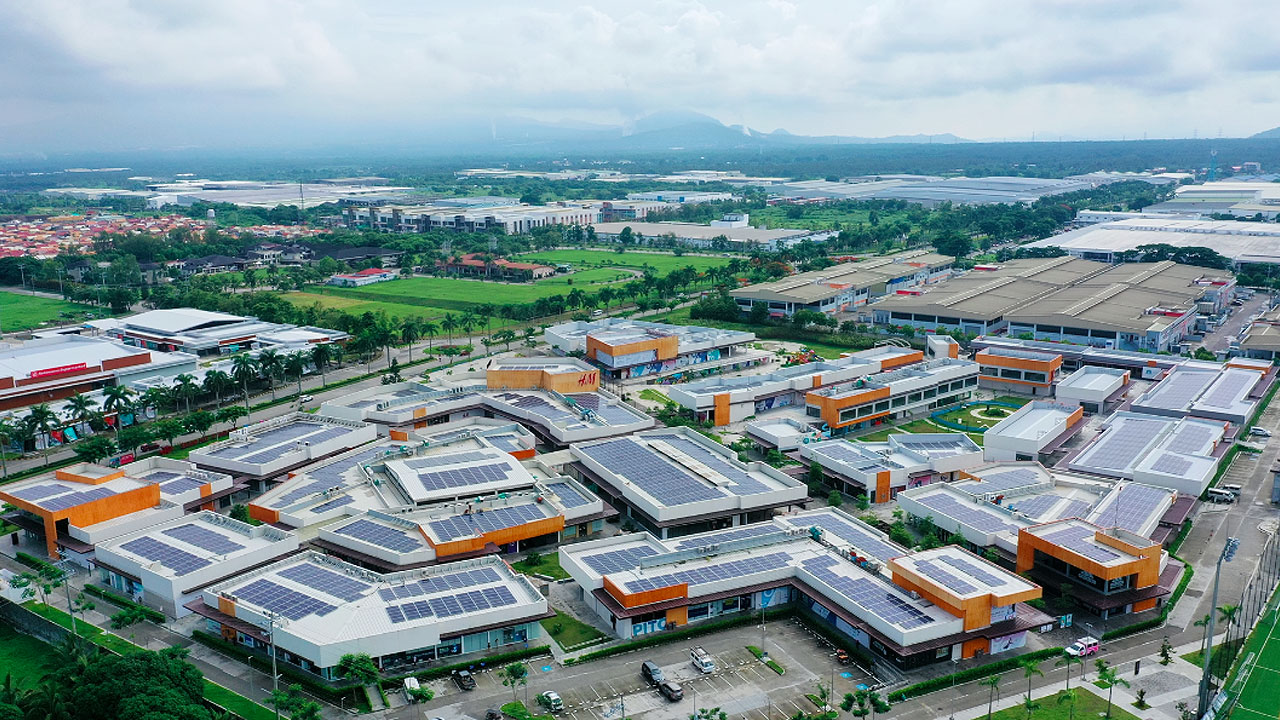
PEZA investment approvals hit PHP132B

PEZA investment approvals hit PHP132B

The Philippine Economic Zone Authority (PEZA) has approved PHP 131.76 billion worth of investments as of the first week of October, putting the investment promotion agency (IPA) on track to meet its PHP 154-billion full-year target.

At the same time, PEZA Director-General Tereso O. Panga said the agency will continue to push for amendments to the Corporate Recovery and Tax Incentives for Enterprises (CREATE) Act to attract more foreign and local investments, particularly in the information technology (IT) sector.

The PEZA Board of Directors on Oct. 6 greenlit 25 new projects worth a combined PHP 20.55 billion. This brought the total number of PEZA Board-approved projects to 169, 14% higher than the 148 projects worth PHP 39.63 billion approved a year ago.

“This is a tangible demonstration of our dedication to positioning our country as an attractive investment destination, thereby encouraging greater local and foreign investments in the Philippines,” Mr. Panga told reporters on Thursday.

Of the 25 newly approved projects, 13 are in the export sector, six are in the information technology sector and three are in logistics. Two projects involve the construction of facilities, while one is still in development.

These new projects are expected to have an export value of USD 643.32 million and generate 5,500 jobs.

Mr. Panga said the PEZA Board approved two big-ticket projects, one by Japan’s Murata Manufacturing Co., Ltd. and another by American company Analog Devices, Inc. Big-ticket projects are those with investments of PHP 1 billion and above.

Asked whether the agency will be able to surpass its PHP 154-billion approval target for this year, Mr. Panga said that PEZA has a “fearless target” of approving new investments worth as much as PHP 300 billion.

“Once the investment from Texas Instruments, Inc. enters, although that has been previously announced, that is already worth a billion dollars, and then we are also expecting more big projects that I am not at liberty to disclose,” he said.

In 2022, the PEZA approved PHP 140.7 billion worth of new investments.

Mr. Panga said the strong investment figures reflect investor confidence in the Philippine economy and its growing domestic market.

Economic managers are targeting 6-7% gross domestic product (GDP) growth this year.

The PEZA also expects four more economic zones, with a total investment of PHP 773.96 million, to be proclaimed before the end of the year.

To date, the PEZA hosts 422 economic zones and 4,352 locator companies and projects.

Create amendments
Meanwhile, Mr. Panga said the agency is working with several business groups on the proposed amendments to the CREATE law.

At the IT & Business Process Association of the Philippines (IBPAP) Infrastructure Series at LIMA Estate, he said that PEZA is still seeking to have work-from-home (WFH) eligibility for its locators.

“We need to do something about the WFH… We are asking for PEZA locators to be given the chance to do WFH,” said Mr. Panga. “But also, to support the IT developers putting up costly IT centers, our business model is 70% on-site and 30% WFH for our locators to be able to enjoy the incentives.”

Under Section 9 of the CREATE law, a qualified registered project or activity under an IPA administering an economic zone shall be exclusively operated within the geographical boundaries of the zone. Any project or activity conducted outside the geographical boundaries of the zone shall not be entitled to the incentives.   

Mr. Panga said that there is a need to update the CREATE law in order for PEZA to be given an “equal footing” as the Board of Investments (BoI) can provide incentives for IT and business process management firms with up to 100% WFH scheme.

From January to October, PEZA-approved locator investments under the IT sector reached PHP 7.13 billion which comprised 36 projects and 1.05 million direct employment. It also approved 13 developer projects under the IT sector with total investments worth PHP 36.07 billion.

Mr. Panga said PEZA is consulting the IBPAP, Semiconductor and Electronics Industries in the Philippines Foundation, Inc., and Philippine Ecozones Associations on the proposed CREATE amendments that will be given to Congress.

He said the proposed changes to the law would include a longer sunset period, separate Customs territory status, removal of the cap for tax- and duty-free importation and investment threshold of IPAs, and longer fiscal incentives period.

“The 10-year sunset period is so short for existing locators, even the 17 years for existing registered business enterprises,” Mr. Panga said.

“Imagine if that time comes, it will be graduated to the regular corporate income tax (CIT) rate and we are up against ASEAN (Association of Southeast Asian Nations) economies offering a much lower CIT rate. That would surely signal exodus of our existing locators,” he added.

On the investment threshold for IPAs, he said that PEZA has been approving projects with investments far bigger than the current cap.

“It is delaying the process, it takes longer to approve big-ticket projects, so these have to be addressed by the government,” he added. — Justine Irish D. Tabile

Contributions to Maharlika fund may threaten state lenders’ financial stability

Contributions to Maharlika fund may threaten state lenders’ financial stability

The contributions of state-run banks to the Maharlika Investment Fund (MIF) may threaten the lenders’ financial stability, analysts said.

“We warned that the Land Bank of the Philippines (LANDBANK) and Development Bank of the Philippines’ (DBP) capital contribution to the MIF will weaken their respective balance sheets and said that the Bangko Sentral ng Pilipinas (BSP) will erode its moral standing on disciplining banks if it gives regulatory forbearance to these two government financial institutions,” Calixto V. Chikiamco, Foundation for Economic Freedom (FEF) president, said in a Viber message.

The Philippines’ first sovereign wealth fund will be managed by the Maharlika Investment Corp. (MIC), which will have an authorized capital stock of PHP 500 billion. Under the law, the LANDBANK and DBP will contribute PHP 50 billion and PHP 25 billion, respectively, for the MIC’s initial funding.

BSP Governor Eli M. Remolona, Jr. last week said both banks are still compliant with regulations even after remitting their contributions to the MIC. But the contributions put these lenders at risk of being noncompliant with their capital requirements.

“With capital charge of 100% on their investment in MIF, the two GFIs (government financial institutions) must be in need of more time to build up their capital to be able to sustain their usual volume of lending,” GlobalSource Partners Country Analyst Diwa C. Guinigundo said in a note.

DBP President and Chief Executive Officer Michael O. de Jesus earlier said the lender and LANDBANK are seeking regulatory relief from the BSP for their contributions to the sovereign wealth fund.

Under BSP regulations, all investments of banks, be it to allied or non-allied undertakings, will be fully charged against a bank’s capital. This means the investment of DBP and LANDBANK in the MIF will be deducted from the banks’ capital when they compute their capital adequacy ratio.

This ratio compares the available capital that a bank has on hand to its risk-weighted assets, which measures the risk profile of the lender’s lending and investing activities. The more risk a bank is taking, the more capital it will be required to have to protect depositors.

“The MIF implementation is also starting on the wrong foot, with contributing GFIs already asking for capital relief this early in the game. It reflects the lack of foresight of government,” Enrico P. Villanueva, senior lecturer of economics at the University of the Philippines Los Baños said in a text message.

Filomeno S. Sta. Ana III, coordinator of Action for Economic Reforms, said that the consequences of the fund are now becoming apparent.

“Sound, prudential banking practice is sacrificed. National Government spending is sacrificed.  But how society will benefit from funds transferred to Maharlika remains muddled,” he said via Facebook Messenger chat.

Sonny A. Africa, executive director of think tank Ibon Foundation, said that requiring the state banks to contribute to the fund is “fundamentally problematic” since it diverts them from fulfilling their primary mandate of providing financing to rural producers and smaller enterprises.

“The promise of financial returns from the Maharlika fund is a specious justification that, moreover, raises the risk profile of these government financial institutions. It is unlikely that, before the Maharlika fund, they would have invested in similarly risky instruments. Their ability to absorb financial losses is being compromised,” Mr. Africa said in an e-mail.

In a statement on Sunday, the LANDBANK said it remains “strong, adequately capitalized, and compliant with regulatory requirements of the BSP.”

As of June, the bank’s capital adequacy ratio (CAR) stood at 16.61%. LANDBANK noted this was a “very healthy level” and above the 10% minimum requirement of the BSP.

LANDBANK also said that it will meet its CAR requirements even with its PHP 50-billion contribution to the MIC.

“Our Common Equity Tier 1 (CET 1) ratio stands at 15.73%, also compliant with the 10.25% CET 1 requirement,” it added.

Last week, President Ferdinand R. Marcos, Jr. signed an executive order slashing LANDBANK’s remittances to the National Government to 0% of its net earnings from 50% previously.

DBP’s Mr. De Jesus said that the bank is also requesting for a similar dividend relief.

“We need to reduce the mandated dividends to the National Government to 0% so we can use the funds to build up our capital position. This will allow us to book more loans and fulfill our mandate of developmental financing,” Mr. De Jesus said in a Viber message.

Finance Secretary Benjamin E. Diokno earlier said that the MIC is expected to be operational by the end of the year and will begin market activities by the first quarter of 2024. — By Luisa Maria Jacinta C. Jocson and Keisha B. Ta-asan, Reporters

MB greenlights USD2.7B in gov’t foreign borrowings

MB greenlights USD2.7B in gov’t foreign borrowings

The Monetary Board (MB)  has approved USD 2.7 billion of public sector foreign borrowings in the third quarter this year, which would fund the government’s programs on economic recovery and climate resilience, among others. 

The amount is significantly higher compared with the USD 178.1 million worth of foreign borrowings by the public sector that the Bangko Sentral ng Pilipinas (BSP) greenlit in the third quarter last year.

Quarter on quarter, it was lower by 1.09% than the USD 2.73 billion approved in the second quarter of 2023.

Broken down, the BSP approved four project loans totaling USD 1.95 billion and one program loan worth USD 750 million.

“These borrowings will fund the National Government’s (NG) program on economic recovery, environmental protection and climate resilience, as well as projects for the transport and agricultural sectors,” the BSP said in a statement late on Friday.

The 1987 Constitution requires the Monetary Board to approve any foreign loan agreement that is entered into by the National Government.

“The BSP promotes the judicious use of the resources and ensures that external debt requirements are at manageable levels, to support external debt sustainability,” the central bank added.

Latest data from the central bank showed the country’s outstanding external debt increased by 9.5% to USD 117.918 billion at end-June from USD 107.692 billion a year ago.

However, it dipped by 0.8% from the record USD 118.812 billion seen at the end of March.

This is equivalent to 28.5% of the country’s gross domestic product, easing from the 29% ratio as of end-March.

The government plans to borrow PHP 2.207 trillion this year, of which 75% will be sourced locally. Broken down, PHP 1.654 trillion will be sourced domestically and PHP 553.5 billion will come from overseas. — Keisha B. Ta-asan

T-bill, bond rates may go up on rising oil prices

T-bill, bond rates may go up on rising oil prices

Rates of Treasury bills (T-bills) and bonds on offer this week could climb further amid rising global crude oil prices due to the conflict in the Middle East.

The Bureau of the Treasury (BTr) will auction off PHP 15 billion in T-bills on Monday, or PHP 5 billion each in 91-, 182- and 364-day papers.

On Tuesday, it will offer PHP 30 billion in reissued seven-year Treasury bonds (T-bonds) with a remaining life of six years and nine months.

T-bill and bond yields may track the increases seen at the secondary market on Friday due to higher global crude oil prices caused by the conflict between Israel and Palestine, Rizal Commercial Banking Corp. Chief Economist Michael L. Ricafort said in a Viber message.

At the secondary market on Friday, the 91-, 182-, and 364-day T-bills went up by 15.92 basis points (bps), 13.52 bps, and 6.47 bps week on week to end at 5.8711%, 6.1458%, and 6.3085%, respectively, based on PHP Bloomberg Valuation Service Reference Rates data published on the Philippine Dealing System’s website.

The seven-year bond also rose by 3.67 bps week on week to yield 6.5122%.

Oil prices rose on Friday, with crude soaring nearly 6%, on safe-haven buying driven by the escalating Middle East conflict as Israel urged civilians to leave the northern Gaza Strip, Reuters reported.

Brent crude surged by 7.5% in the week since the conflict began, posting its highest weekly gain since February, as investors priced in a chance of escalation in the world’s top oil producing region.

Yields could also be affected by policy signals from the Bangko Sentral ng Pilipinas (BSP) and US Federal Reserve, a trader said in an e-mail.

BSP Governor Eli M. Remolona, Jr. last week said the Monetary Board is open to hiking borrowing costs by 25 bps in their meeting next month following faster-than-expected September inflation.

The Monetary Board has kept the benchmark interest rate at 6.25% for four straight meetings after it hiked borrowing costs by 425 bps from May 2022 to March 2023 to help tame inflation.

Its next meeting is on Nov. 16.

Meanwhile, the Fed kept its benchmark rate unchanged at the 5.25% to 5.5% range at its Sept. 19-20 meeting. It has hiked rates by a cumulative 525 bps since it began its tightening cycle in March last year.

The Federal Open Market Committee will hold its next policy review from Oct. 31 to Nov. 1.

Last week, the BTr raised just PHP 12.518 billion via the T-bills, short of the PHP 15-billion program, even as total bids reached PHP 22.564 billion.

Broken down, the Treasury borrowed only PHP 4.788 billion via the 91-day T-bills even as tenders for the tenor reached PHP 6.898 billion. The average rate of the three-month paper rose by 10 bps to 5.806%. Accepted rates ranged from 5.74% to 5.875%

The government raised just PHP 4.41 billion from the 182-day securities, despite bids for the tenor reaching PHP 7.646 billion. The average rate for the six-month T-bill was at 6.115%, up by 9.2 bps, with accepted rates at 6% to 6.175%.

Lastly, the BTr awarded PHP 3.32 billion in 364-day debt papers, below the PHP 5-billion plan, despite demand for the tenor reaching PHP 8.02 billion. The average rate of the one-year T-bill rose by 9 bps to 6.305%. Accepted yields were from 6.275% to 6.325%.

On the other hand, the reissued seven-year bonds to be offered on Tuesday were last auctioned off on Sept. 12, where the government raised just PHP 9.877 billion out of the planned P30 billion. The papers fetched an average rate of 6.37%.

The Treasury wants to raise PHP 150 billion from the domestic market this month, or PHP 60 billion via T-bills and PHP 90 billion via T-bonds. — AMCS with Reuters

Posts navigation

Older posts
Newer posts

Recent Posts

  • Investment Ideas: April 1, 2026
  • Metrobank US-Iran Risk Index: Signals of an end
  • Eye on Earnings: Demand for connection supports telcos
  • Inflation Preview: March madness
  • Investment Ideas: March 31, 2026

Recent Comments

No comments to show.

Archives

  • April 2026
  • March 2026
  • February 2026
  • January 2026
  • December 2025
  • November 2025
  • October 2025
  • September 2025
  • August 2025
  • July 2025
  • June 2025
  • May 2025
  • April 2025
  • March 2025
  • February 2025
  • January 2025
  • December 2024
  • November 2024
  • October 2024
  • September 2024
  • August 2024
  • July 2024
  • June 2024
  • May 2024
  • April 2024
  • March 2024
  • February 2024
  • January 2024
  • December 2023
  • November 2023
  • October 2023
  • September 2023
  • August 2023
  • July 2023
  • June 2023
  • May 2023
  • April 2023
  • March 2023
  • February 2023
  • January 2023
  • December 2022
  • November 2022
  • October 2022
  • September 2022
  • August 2022
  • July 2022
  • June 2022
  • May 2022
  • March 2022
  • December 2021
  • October 2021

Categories

  • Bonds
  • BusinessWorld
  • Currencies
  • Economy
  • Equities
  • Estate Planning
  • Explainer
  • Featured Insight
  • Fine Living
  • How To
  • Investment Tips
  • Markets
  • Portfolio Picks
  • Rates & Bonds
  • Retirement
  • Reuters
  • Spotlight
  • Stocks
  • Uncategorized

You are leaving Metrobank Wealth Insights

Please be aware that the external site policies may differ from our website Terms And Conditions and Privacy Policy. The next site will be opened in a new browser window or tab.

Cancel Proceed
Get in Touch

For inquiries, please call our Metrobank Contact Center at (02) 88-700-700 (domestic toll-free 1-800-1888-5775) or send an e-mail to customercare@metrobank.com.ph

Metrobank is regulated by the Bangko Sentral ng Pilipinas
Website: https://www.bsp.gov.ph

Quick Links
The Gist Webinars Wealth Manager Explainers
Markets
Currencies Rates & Bonds Equities Economy
Wealth
Investment Tips Fine Living Retirement
Portfolio Picks
Bonds Stocks
Others
Contact Us Privacy Notice Terms of Use
© 2026 Metrobank. All rights reserved.

Access this content:

If you are an existing investor, log in first to your Metrobank Wealth Manager account. ​

If you wish to start your wealth journey with us, click the “How To Sign Up” button. ​

Login HOW TO SIGN UP