



MODEL PORTFOLIO
THE GIST
NEWS AND FEATURES
Global Philippines Fine Living
INSIGHTS
INVESTMENT STRATEGY
Economy Stocks Bonds Currencies
THE BASICS
Investment Tips Explainers Retirement
WEBINARS
2024 Mid-Year Economi Briefing, economic growth in the Philippines
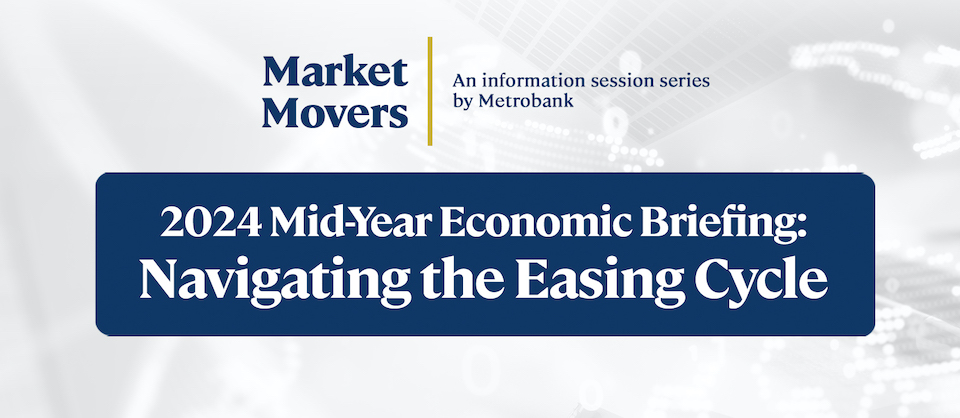
2024 Mid-Year Economic Briefing: Navigating the Easing Cycle
June 21, 2024
Investing with Love
Investing with Love: A Mother’s Guide to Putting Money to Work
May 15, 2024
retirement-ss-3
Investor Series: An Introduction to Estate Planning
September 1, 2023
View All Webinars
DOWNLOADS
grocery-2-aa
Economic Updates
Inflation Update: Target breached
DOWNLOAD
Container ship carrying container boxes import export dock with quay crane. Business commercial trade global cargo freight shipping logistic and transportation worldwide oversea concept. Generative AI
Economic Updates
Philippines Trade Update: Wider deficit on strong imports
DOWNLOAD
Frick collection with palm trees 
Economic Updates
Policy Rate Updates: Policy rate updates to reassure 
DOWNLOAD
View all Reports
Metrobank.com.ph How To Sign Up
Follow us on our platforms.

How may we help you?

TOP SEARCHES
  • Where to put my investments
  • Reports about the pandemic and economy
  • Metrobank
  • Webinars
  • Economy
TRENDING ARTICLES
  • Investing for Beginners: Following your PATH
  • On government debt thresholds: How much is too much?
  • Philippines Stock Market Outlook for 2022
  • Deficit spending remains unabated

Login

Access Exclusive Content
Login to Wealth Manager
Visit us at metrobank.com.ph How To Sign Up
Access Exclusive Content Login to Wealth Manager
Search
MODEL PORTFOLIO THE GIST
NEWS AND FEATURES
Global Philippines Fine Living
INSIGHTS
INVESTMENT STRATEGY
Economy Stocks Bonds Currencies
THE BASICS
Investment Tips Explainers Retirement
WEBINARS
2024 Mid-Year Economi Briefing, economic growth in the Philippines
2024 Mid-Year Economic Briefing: Navigating the Easing Cycle
June 21, 2024
Investing with Love
Investing with Love: A Mother’s Guide to Putting Money to Work
May 15, 2024
retirement-ss-3
Investor Series: An Introduction to Estate Planning
September 1, 2023
View All Webinars
DOWNLOADS
grocery-2-aa
Economic Updates
Inflation Update: Target breached
April 7, 2026 DOWNLOAD
Container ship carrying container boxes import export dock with quay crane. Business commercial trade global cargo freight shipping logistic and transportation worldwide oversea concept. Generative AI
Economic Updates
Philippines Trade Update: Wider deficit on strong imports
March 27, 2026 DOWNLOAD
Frick collection with palm trees 
Economic Updates
Policy Rate Updates: Policy rate updates to reassure 
March 26, 2026 DOWNLOAD
View all Reports

Archives: Business World Article

Government considering Samurai, dollar bonds this year

Government considering Samurai, dollar bonds this year

The government is looking to issue Japanese yen-denominated and US dollar-denominated bonds within the year, the Finance chief said.

“I expect both the dollar and possibly Samurai bonds this year. Both are being considered,” Finance Secretary Ralph G. Recto told reporters on the sidelines of the Economic Journalists Association of the Philippines-San Miguel Corp. economic forum.

The government plans to borrow $5 billion this year, of which $2 billion was raised from the issuance of global bonds last May. This leaves $3 billion that has yet to be raised.

“On the Samurai bonds, the first mandate of the Department of Finance and the Treasury is to ensure that if we have to borrow, we borrow at the lowest rate possible,” he said during the forum.

“Yes, we are considering Samurai bonds, but we’re timing the market, taking a look at the best time to do it, if at all we have to do it.”

The Philippines last issued Samurai bonds in April 2022, raising ¥70.1 billion.

Mr. Recto said the timing of the bond issuance will also depend on the US Federal Reserve’s easing path.

“It depends on the Fed or global markets. Once they start reducing the rates, then that will be an opportunity to borrow,” he added.

The Fed has earlier signaled it may push back the start of its easing cycle to December.

The National Government’s outstanding debt rose to a fresh high of P15.35 trillion as of end-May, with external debt accounting for 32% or P4.9 trillion of the total.

REVENUE COLLECTIONS
Meanwhile, Mr. Recto said revenue collections jumped to P2.13 trillion in the first half of the year, 14.5% higher than P1.86 trillion collected in the same period last year.

“With 50% of the revenue target already achieved in the first semester, we are on track to reach the P4.27-trillion revenue program for 2024,” the DoF said in a separate statement.

Preliminary data from the department showed that tax revenues rose by 8.8% to P1.81 trillion as of end-June from P1.67 trillion a year ago.

Bureau of Internal Revenue collections rose by 10.2% to P1.34 trillion in the six-month period. This was already 44% of the BIR’s P3.05-trillion target for the year.

In a separate statement, the Bureau of Customs said collections jumped by 5.22% to P456.04 billion in the January-to-June period.

It also surpassed its P442.62-billion target for the six-month period by 3.03%, the agency said.

The DoF said nontax revenues in the first half expanded by 64.5% to P316.52 billion.

While the DoF said it is not looking to introduce new taxes this year, there are six measures pending in Congress that are expected to generate P42 billion in annual revenues.

These include the Package 4 of Comprehensive Tax Reform Program, which includes an excise tax on pickup trucks, the value-added tax on digital service providers, excise tax on single-use plastics, the mining fiscal regime, the motor vehicle road user’s change, and amendments to the Corporate Recovery and Tax Incentives for Enterprises law.

Tax collections are expected to increase by an average of 11.8% yearly due to digitalization and plugging of leakages in the tax system, Mr. Recto said.

‘DISCONTINUE POGO’
Meanwhile, Mr. Recto said he is willing to recommend the closure of all Philippine offshore gaming operations to President Ferdinand R. Marcos, Jr.

“If they were not doing anything hanky panky, and they’re paying taxes, fine with me. But I think there are many issues surrounding the POGO (Philippine Offshore Gaming Operators) industry,” Mr. Recto told reporters.

“Because of that, I am willing to recommend to the President to discontinue POGOs,” he said in mixed English and Filipino.

The government could lose P20 billion in annual revenues if it decides to ban POGOs, the Philippine Amusement and Gaming Corp. said earlier. — B.M.D.Cruz

PHL told to boost manufacturing jobs to achieve high-income growth

PHL told to boost manufacturing jobs to achieve high-income growth

Economists flagged the declining employment share of the Philippine manufacturing sector, which they said is key to achieving a high-income status and meeting other development goals including bringing down poverty incidence to single digits at a faster rate.

A De La Salle University (DLSU) School of Economics report on Monday showed that most targets under the Philippines’ development plan for 2023 to 2028 will be met later than expected, and noted that the country would struggle to achieve high growth in the long-run in the absence of an industrial policy that has helped its Southeast Asian neighbors’ manufacturing industries climb the value chain.

Most Filipino workers are employed in sectors of “very low productivity,” the report said, adding the manufacturing sector’s employment share is only 8% and is expected to further decrease to 7% by 2030.

“Historically, countries that have achieved high-income status obtained employment shares in manufacturing from about 20-25%, sometimes even higher,” Mariel Monica Sauler, an economics professor at DLSU, said at the report’s launch in Makati City. “Our current manufacturing employment share is just 8%.”

For the Philippines to become an economic powerhouse, it needs to restructure its economy by taking workers out of the agriculture sector through mechanization and by significantly increasing the employment share of its manufacturing base, said Jesus Felipe, director of the Angelo King Institute for Economic and Business Studies at DLSU.

“We desperately need firms with high organizational capabilities and highly productive, that manufacture and export complex products, and that compete in the world economy,” he said during the event.

Mr. Felipe said the declining number of Filipinos leaving the country for job opportunities abroad — a phenomenon linked to an increase in wage rates locally — provides an opportunity for the country to expand its manufacturing base.

According to the report, the number of overseas Filipino workers (OFWs) will further decline to 1.91 million in 2025 from 1.97 million in 2023.

“We think that our wage rates are going to increase. Therefore, the incentive to leave the country declines,” Mr. Felipe said.

Even as the agriculture sector’s employment share has been on a decline, Ms. Sauler said the share of construction and transport and storage sectors, which have “low productivity” and “low wages,” have increased.

This means there are not enough manufacturing jobs locally, she added.

“Our ASEAN (Association of Southeast Asian Nations) neighbors seem to have always understood the importance of the manufacturing sector better than us.”

The economists said the government should shift its focus away from the agriculture sector, which “needs a solution but is not the solution” to the Philippines’ growth woes.

Achieving an upper middle-income status next year would not be possible if the Philippines’ economic expansion would be slower than expected, they said.

BELOW TARGETS
The DLSU report said the Philippine economy will likely hit 5.5-5.6% growth this year, lower than the government’s 6-7% target.

Under the Philippine Development Plan (PDP) 2023-2028, gross domestic product (GDP) annual growth target is set at 6.5-8% until 2028. However, the DLSU report said GDP growth is likely to be “below target until 2028.”

The Philippines is projected to hit its goal of having a gross national income (GNI) per capita of $6,044-$6,571 by 2029, instead of 2028.

According to the World Bank’s latest income classification data, the Philippines remained a lower-middle income country with a GNI per capita of $4,230 in 2023. To become an upper middle-income country, the Philippines now needs to have GNI per capita of $4,516 to $14,005.

Ms. Sauler said that while the Philippines could reach an upper middle-income status as early as this year, its real GDP will grow below the PDP 2023-2028 target rates.

“If we want to expedite development, the structure of the economy will need to change in the direction of industrialization,” she said. “Repeating the industrialization experience of our East Asian neighbors seems impossible but there is no other option.”

Mr. Felipe said the country needs an “industrial policy” centered on the creation of competitive firms that make high-quality products and jobs that require high skills.

While the number of middle-class Filipinos was increasing, Mr. Felipe said a huge chunk of them or 80% of Filipino workers were earning P15,000 per month at most.

“Only 15% of Filipino workers earned above P15,000. This is the reality of the country. This is the distribution of the structural economy from the point of view of output and from the point of view of employment,” he said.

The manufacturing sector accounted for 18% of the Philippine economy last year, while its employment share was only at 7.3%, he noted.

Mr. Felipe said Asian countries that have pursued the path of industrialization have overtaken the Philippines in terms of GNI per capita.

The GNI per capita of the Philippines is still $4,000, which means the country is “among the poorest countries in the world,” he said.

“All our neighbors have systematically, automatically caught up with us and overtaken us,” he said, citing Vietnam, whose GNI per capita was about eight times lower than that of the Philippines in the 1990s.

“Indonesia overtook the Philippines in about 2008 or 2009,” he added. “The same thing happened with China, and the same thing happened with Thailand. Malaysia has always been richer than the Philippines.”

‘UNNECESSARY’
At the same time, the DLSU report estimated the Philippines will only achieve its PDP target of a 3% deficit-to-GDP ratio by 2031, and the debt-to-GDP ratio of 48-53% by 2032.

Pedro Pascual, head of the Economic and Trade Office of Spain in Manila, said the Marcos administration’s fiscal consolidation plan is both “unnecessary” and ill-suited” in the current situation, which is marked by low GDP growth.

The government needs to run a larger budget deficit to build infrastructure needed to revamp its economy, he said.

Mr. Pascual noted that household spending remains subdued, as seen in the declining number of Filipinos traveling abroad for leisure.

Real wages had not fully recovered in 2023 to the pre-pandemic level due partly to inflation, he said. “They will in 2024 to 2025.”

But inflation should not be a major economic concern for the country since it’s mainly driven by rice prices, Mr. Pascual said, adding that it’s up to the government how it will lessen the country’s dependence on or find alternatives for the commodity.

Rice inflation eased for the straight month in June to 22.5% from 23% a month earlier.

“Overambitious disinflation can create a problem,” he added.

The DLSU report also projected that poverty incidence will likely go down to 8.8-9% only by 2035, instead of 2028.

The unemployment rate will settle within the 4-5% target range by 2028, the report showed. – Kyle Aristophere T. Atienza, Reporter

Treasury bill, bond rates may drop after key data

Treasury bill, bond rates may drop after key data

Rates of Treasury bills (T-bills) and bonds (T-bonds) to be auctioned off this week may go down after June Philippine headline inflation came out below market expectations.

The Bureau of the Treasury (BTr) will auction off PHP 20 billion in T-bills on Monday, or PHP 6.5 billion each in 91- and 182-day papers and PHP 7 billion in 364-day debt.

On Tuesday, the government will offer PHP 30 billion in reissued 20-year T-bonds with a remaining life of seven years and nine days.

Rates of T-bills and T-bonds to be offered this week could track the mixed movements in secondary market yields in the past few days in anticipation of the release of Philippine June inflation and US jobs data on Friday, Rizal Commercial Banking Corp. Chief Economist Michael L. Ricafort said in a Viber message.

Easing June inflation boosted chances of a rate cut by the Bangko Sentral ng Pilipinas (BSP) by next month, which could lead to lower yields on government debt, a trader said in an e-mail.

The soft US nonfarm payrolls report released on Friday, which also renewed expectations of the US Federal Reserve easing its policy stance within this year, may also cause T-bill and T-bond rates to go down this week, the trader added.

“We expect another well-bid seven-year auction with a current indicative range of 6.3-6.4%,” the trader said.

At the secondary market on Friday, the rates of the 91-day and 182-day T-bills went down by 2.81 basis points (bps) and 3.66 bps week on week to end at 5.7152% and 5.9669%, respectively, based on PHP Bloomberg Valuation Service Reference Rates data published on the Philippine Dealing System’s website. Meanwhile, the 364-day T-bill’s yield went up by 1.07 bps week on week to 6.0848%.

On the other hand, the rate of 20-year bond decreased by 4.77 bps week on week to 6.7718% on Friday, while the seven-year debt, the tenor closest to the remaining life of the T-bonds on offer this week, fell by 10.28 bps to yield 6.4364%.

Philippine headline inflation rose to 3.7% year on year in June, easing from 3.9% in May and 5.4% in the same month a year ago.

This was below the 3.9% median estimate in a BusinessWorld poll of 14 analysts.

The June consumer price index (CPI) was within the BSP’s 3.4-4.2% forecast for the month, and also marked the seventh straight month that inflation settled within the central bank’s 2-4% annual target.

For the first six months, the CPI averaged 3.5%, slightly faster than the central bank’s 3.3% full-year forecast.

BSP Governor Eli M. Remolona, Jr. has said the Monetary Board may kick off its easing cycle at its Aug. 15 review — the only policy meeting scheduled in the third quarter — as they expect inflation to continue easing this semester.

Meanwhile, US employment increased solidly in June, but government and healthcare services hiring made up about three-quarters of the payrolls gain and the unemployment rate hit a 2-1/2-year high of 4.1%, pointing to a slackening labor market that keeps the Fed on course to start cutting interest rates soon, Reuters reported.

Nonfarm payrolls increased by 206,000 jobs last month, lifted by government hiring, the Labor department’s Bureau of Labor Statistics said. Economists polled by Reuters had forecast payrolls would increase by 190,000 last month, with the unemployment rate unchanged at 4%.

When added to the moderation in prices in May, the report could boost Fed policy makers’ confidence in the inflation outlook after the disinflationary trend was disrupted in the first quarter. Financial markets expect the US central bank, which aggressively tightened monetary policy in 2022 and 2023, to start its easing cycle in September.

Last week, the government raised PHP 20 billion as planned from T-bills as total bids for its offer reached PHP 43.025 billion, or more than twice the amount placed on the auction block.

Broken down, the BTr borrowed PHP 6.5 billion as programmed from the 91-day T-bills as tenders for the tenor reached PHP 19.06 billion. The average rate for the three-month paper rose by 2 bps to 5.686% from the previous week. Accepted rates ranged from 5.668% to 5.698%.

The government likewise made a full PHP 6.5-billion award of the 183-day securities, with bids reaching PHP 11.81 billion. The average rate for the six-month T-bill stood at 5.959%, up by 2.9 bps, with accepted rates at 5.918% to 5.999%. The six-month tenor was adjusted from the usual 182-day maturity due to a holiday.

Lastly, the Treasury raised the planned PHP 7 billion via the 364-day debt papers as demand for the tenor totaled PHP 12.155 billion. The average rate of the one-year debt increased by 1.9 bps to 6.05%. Accepted yields were from 6.03% to 6.085%.

Meanwhile, the reissued 20-year bonds to be auctioned off on Tuesday were last offered on June 4, where the government made a full P30-billion award at an average rate of 6.624%.

The BTr wants to raise PHP 215 billion from the domestic market this month, or PHP 100 billion from T-bills and PHP 115 billion via T-bonds.

The government borrows from local and foreign sources to help fund its budget deficit, which is capped at PHP 1.48 trillion or 5.6% of gross domestic product for this year. — AMCS with Reuters

Peso may rise on rate cut view

Peso may rise on rate cut view

The peso may continue to rise against the dollar this week amid rate cut bets at home and abroad following slower-than-expected Philippine headline inflation in June and data showing a cooling US jobs market.

The local unit closed at PHP 58.53 per dollar on Friday, strengthening by five centavos from its PHP 58.58 finish on Thursday, Bankers Association of the Philippines data showed.

This was the peso’s strongest showing in almost a month or since its PHP 58.52-a-dollar finish on June 7.

Week on week, the peso likewise rose by eight centavos from its PHP 58.61-per-dollar close on June 28.

Slower Philippine June inflation supported the peso on Friday, Rizal Commercial Banking Corp. Chief Economist Michael L. Ricafort said in a Viber message.

The June consumer price index (CPI) print strengthened the case for a Bangko Sentral ng Pilipinas (BSP) rate cut by next month, Security Bank Corp. Chief Economist Robert Dan J. Roces said in a Viber message.

Headline inflation eased to 3.7% year on year in June, from 3.9% in May and 5.4% in the same month a year ago, the Philippine Statistics Authority reported on Friday.

This was within the BSP’s 3.4-4.2% forecast for the month and was slightly slower than the 3.9% median estimate in a BusinessWorld poll of 14 analysts. This also marked the seventh straight month that the CPI settled within the BSP’s 2-4% annual target.

The June CPI matched the 3.7% print in March and was the slowest in four months or since the 3.4% recorded in February.

For the first half, Philippine headline inflation averaged 3.5%, above the central bank’s 3.3% full-year forecast but still within its 2-4% annual goal.

BSP Governor Eli M. Remolona, Jr. earlier said the Monetary Board is “on track” and “somewhat more likely than before” to slash rates at its Aug. 15 policy meeting as he expects inflation to further ease this semester with the implementation of lower tariffs on rice.

For this week, the peso’s movement against the dollar will be driven by US nonfarm payrolls data released on Friday, Mr. Roces said.

US employment increased solidly in June, but government and healthcare services hiring made up about three-quarters of the payrolls gain and the unemployment rate hit a 2-1/2-year high of 4.1%, pointing to a slackening labor market that keeps the Federal Reserve on course to start cutting interest rates soon, Reuters reported.

Mr. Ricafort added that the market will also monitor June US consumer and producer inflation data to be released this week, as well as Fed Chair Jerome H. Powell’s semiannual testimony before the US Congress, which could provide hints on the US central bank’s policy path.

He expects the peso to move between PHP 58.40 and PHP 58.60 versus the dollar this week. — AMCS with Reuters

Dollar reserves slip to USD104.7 billion in June

Dollar reserves slip to USD104.7 billion in June

The Philippines’ gross international reserves (GIR) dipped by 0.3% month on month in June, which the Bangko Sentral ng Pilipinas (BSP) governor partly attributed to its intervention in the foreign exchange market amid the peso’s continued depreciation against the US dollar.

Preliminary data from the BSP showed gross dollar reserves settled at USD 104.7 billion at end-June, slightly lower than USD 105.02 billion at end-May.

Year on year, dollar reserves rose by 5.3% from USD 99.39 billion.

“The month-on-month decline in the GIR level reflected mainly the National Government’s (NG) payments of its foreign currency debt obligations and downward valuation adjustments in the BSP gold holdings due to the decrease in the price of gold in the international market,” the central bank said.

BSP Governor Eli M. Remolona, Jr. said that the decrease in the end-June GIR level was partly due to the central bank’s intervention in the foreign exchange market as the peso continued to weaken against the US dollar.

“It’s not all of it, but some of it,” he told reporters late on Friday. “As I said before, we don’t want the peso to depreciate very sharply. We don’t have a target level for the peso. We just don’t want it to depreciate sharply.”

The peso depreciated to PHP 58.61 against the dollar as of end-June from PHP 58.51 as of end-May. The local unit has been trading at the PHP 58-per-dollar since May.

As of end-June, the level of dollar reserves was enough to cover about 6.1 times the country’s short-term external debt based on original maturity and 3.8 times based on residual maturity.

It was also equivalent to 7.7 months’ worth of imports of goods and payments of services and primary income.

Ample foreign exchange buffers protect an economy from market volatility and ensure the country can pay its debts in the event of an economic downturn.

Broken down, the central bank’s foreign investments slipped by 0.04% to USD 89.49 billion at end-June from USD 89.52 billion in the previous month. On the other hand, investments increased by 7% year on year from USD 83.66 billion.

Reserves in the form of gold were valued at USD 9.9 billion, lower by 1.1% from USD 10.02 billion as of end-May and down by 1% from USD 10.01 billion a year ago.

Net foreign currency deposits declined by 17.8% to USD 790.6 million as of end-June from USD 962.3 million a month earlier. It likewise fell by 31.9% from USD 1.16 billion as of end-June in 2023.

Net international reserves slipped by 0.3% to USD 104.69 billion at end-June from USD 104.98 billion at end-May.

Net international reserves are the difference between the BSP’s reserve assets or GIR and reserve liabilities, such as short-term foreign debt and credit and loans from the International Monetary Fund (IMF).

Meanwhile, the country’s reserve position in the IMF edged up by 0.4% to USD 740.4 million at end-June from USD 737.2 million at end-May.

Special drawing rights, or the amount the country can tap from the IMF, was unchanged at USD 3.77 billion.

“The BSP has previously (said) that the agency is actively but not openly intervening in the market not only to stabilize the value of the Philippine currency but also to stem the inflation that is associated with the depreciation,” Leonardo A. Lanzona, Jr., an economics professor at the Ateneo de Manila University said in an e-mail.

Mr. Lanzona said the problem with this intervention is that it leads to greater dependency on imports.

“These can also lead to short-term speculative investments instead of long-term investments that can improve domestic productive capacity,” he added.

Meanwhile, Rizal Commercial Banking Corp. Chief Economist Michael L. Ricafort said that despite the month-on-month decline, the GIR level has stayed above the USD 100-billion mark for a ninth straight month, which is a “good signal.”

“For the coming months, the country’s GIR could still be supported by the continued growth in the country’s structural inflows from overseas Filipino worker remittances, business process outsourcing revenues, exports (though offset by imports), relatively fast recovery in foreign tourism revenues, as well as continued foreign investment/FDI inflows coming from among pre-pandemic highs,” he added.

The BSP expects the GIR level to settle at USD 104 billion by yearend. — Luisa Maria Jacinta C. Jocson

BSP still hints at rate cut in August

BSP still hints at rate cut in August

A possible breach in the inflation target this month will not derail the Bangko Sentral ng Pilipinas’ (BSP) planned rate cut by August, its top official said.

BSP Governor Eli M. Remolona, Jr. said July inflation overshooting the 2-4% target is “expected” and unlikely to affect the likelihood of a rate cut in August.

“We do expect it to breach in July. So, if it doesn’t breach, then it’s better than expected,” he told reporters on the sidelines of an event late on Friday.

Mr. Remolona said there is a 50-50 chance that July inflation could breach the 2-4% target.

The central bank earlier warned that inflation could temporarily accelerate to above target from May to July, but so far inflation has been below 4% in May and June.

Headline inflation eased to 3.7% in June from 3.9% in May, marking the seventh straight month that inflation settled within the 2-4% target band.

“This is a cause for reassurance because it seems to be going in the direction we expected. So, it’s reassuring, but we need a few more numbers. So, it’s not yet time to declare victory, as people say,” Mr. Remolona added.

Meanwhile, National Economic and Development Authority  Secretary Arsenio M. Balisacan said that the downtrend of inflation should continue in the coming months.

“I cannot say the worst is over, but I think that extreme situations are not likely anymore,” he told reporters on Friday evening.

“I think we expect (inflation) in the coming months to come down because the El Niño is over, hoping that the La Niña will not bring severe flooding and all that, and then I think prices will start to moderate. I think that it will enable us to achieve the target of 2-4%,” he added.

Mr. Balisacan said the outlook already takes into account the recently approved wage hike in the National Capital Region (NCR).

“More or less, that’s already anticipated. The wage increases are not unreasonable. They’re within the inflation experienced by our workers,” he added.

The Regional Tripartite Wages and Productivity Board has approved a P35 minimum wage hike for workers in NCR, bringing the daily wage to P645 starting July 17.

Meanwhile, Diwa C. Guinigundo, country analyst for the Philippines of GlobalSource Partners, said there is a “greater likelihood of an easing in 2024 especially if more of the downside risks materialize including the reduction in rice imports tariff.”

President Ferdinand R. Marcos, Jr. last month signed Executive Order No. 62, which introduces a lowered tariff regime for agricultural products until 2028, including rice. Tariffs on rice imports were slashed to 15% from 35% previously.

Bank of the Philippine Islands Lead Economist Emilio S. Neri, Jr. said that inflation may have already peaked for the year and will likely remain at the upper end of the 2-4% target in July before declining by August.

“With El Niño now over, rice production is expected to recover in the second half of the year, which could result in a drop in prices as supply improves,” Mr. Neri said in a report.

“The price decrease might be even more significant due to the rice tariff cut that the government will implement this month,” he added.

Mr. Neri said that when the Rice Tariffication Law was implemented in 2019, the “resulting decline in rice prices shaved off up to 1.2% from headline inflation.”

PESO ‘BEHAVING’
In a note, Chinabank Research said that the slower inflation in June and “upbeat” inflation outlook would support the BSP’s planned rate cut at its meeting in August.

“There is a higher chance of an August rate cut, with prices and the peso — which seems to be ‘behaving’ — a part of the decision point,” Security Bank Corp. Chief Economist Robert Dan J. Roces said in a Viber message.

“With the inflation outlook now improving, the BSP will likely start cutting interest rates in August,” Mr. Neri added.

Mr. Remolona noted that cutting by 75 basis points (bps) for the year may be too “aggressive” and may cause a “hard landing.” He earlier said the BSP could cut rates by 50 bps for the full year.

However, Mr. Roces warned that upside risks to inflation still remain.

“We agree with the Philippine Statistics Authority’s observation that there is no clear signal that inflation has peaked, which we attribute to the upside risks to food and fuel prices,” he said.

Mr. Guinigundo, a former central bank deputy governor, said that the BSP should monitor the potential uptick in power and transport costs as well as wage adjustments.

“Still on the supply side, if the delay in imports should be prolonged, that could push importers to delay their importation of rice and cause rice supply to dwindle and its price to surge again. The weakening trend in (the) peso could also have some inflationary impact if sharp and prolonged,” he said.

“If inflation should peak in July, that would just be a single point in the wider space of monetary policy assessment — like inflation forecasts and balance of risks,” he added.

Chinabank Research also noted the potential impact of the peso on the BSP’s easing cycle.

“Nevertheless, the persistent upside price pressures, along with the movement of the peso against the US dollar, could prompt the BSP to maintain a cautious stance with regard to its future monetary policy decisions,” it said.

The peso has been trading at the P58-per-dollar level since May.

On Friday, the peso closed at P58.53 against the greenback, strengthening by five centavos from its P58.58 finish on Thursday. This was its strongest finish in almost a month or since its P58.52-a-dollar close on June 7.

“The pass-through from the exchange rate to inflation appears to be manageable based on the analysis of the central bank and will only become a concern if the inflation target is at risk again,” Mr. Neri said.

“However, it’s still a limiting factor that will likely prevent the BSP from cutting interest rates aggressively, especially given the current account deficit that the country has,” he added.

Mr. Neri cited other risks such as the country’s external position.

“Cutting interest rates aggressively would make the buildup of (foreign exchange) reserves more challenging, which may lead to a further deterioration in the external position,” he added.

Mr. Guinigundo said the BSP should take into account the second-quarter gross domestic product data, which will come out on Aug. 8.

“Although difficult to estimate, a good idea of the output gap should be able to help guide the BSP in its decision to ease or maintain the policy rate and avoid premature or late adjustment, both of which could be costly to the economy,” he said. – Luisa Maria Jacinta C. Jocson, Reporter

Bad loan ratio soars to near two-year high

Bad loan ratio soars to near two-year high

The banking industry’s nonperforming loan (NPL) ratio soared to a near two-year high in May, data from the Bangko Sentral ng Pilipinas (BSP) showed.

The Philippine banking industry’s gross NPL ratio rose to 3.57% in May from 3.45% in April and 3.46% a year ago.

This matched the 3.57% ratio in July 2022. It was also the highest in 23 months or since 3.6% in June 2022.

Data from the BSP showed that soured loans rose by 3.1% to P495.67 billion in May from P480.65 billion a month earlier. Year on year, it jumped by 13.7% from P436.12 billion.

Loans are considered nonperforming once they remain unpaid for at least 90 days after the due date. These are deemed as risk assets since borrowers are unlikely to pay.

The loan portfolio of Philippine banks dipped by 0.3% to P13.89 trillion as of end-May from P13.94 trillion at end-April. However, it increased by 9.3% from P12.6 trillion a year ago.

Past due loans dropped 1.6% to P608.07 billion in May from P618.04 billion a month earlier but rose by 15.7% from P525.51 billion in the previous year.

This brought the past due ratio to 4.38%, lower than 4.43% in April but higher than 4.17% a year ago.

On the other hand, restructured loans stood at P295.89 billion, up by 1.9% from P290.37 billion in April but 4.6% lower than P310.3 billion a year ago.

These borrowings accounted for 2.13% of the industry’s total loan portfolio, higher than 2.08% a month ago but lower than the 2.46% in May 2023.

Banks’ loan loss reserves inched up by 0.7% to P474.88 billion in May from P471.35 billion in April and rose by 6.9% from P444.03 billion a year ago.

This brought the loan loss reserve ratio to 3.42%, up from 3.38% last month but lower than 3.52% a year ago.

Lenders’ NPL coverage ratio, which gauges the allowance for potential losses due to bad loans, slipped to 95.81% from 98.07% in April and 101.81% in May 2023.

Rizal Commercial Banking Corp. Chief Economist Michael L. Ricafort said the higher NPL ratio was due to elevated interest rates.

The Monetary Board has kept its benchmark rate at 6.5%, the highest in over 17 years, since October 2023.

Mr. Ricafort also cited the weaker peso, which sank to the P58-per-dollar level in May. The local currency has been inching closer to its record low of P59 against the dollar in recent weeks.

“For the coming months, possible Fed and local rate cuts would help ease borrowing costs and spur greater demand for loans and other business activities, which would eventually help ease the NPL ratio going forward,” Mr. Ricafort said.

BSP Governor Eli M. Remolona, Jr. has said that the central bank could begin its policy easing by August. He has also signaled rate cuts of up to 50 basis points for the entire year.

The Monetary Board is set to meet on Aug. 15, its only meeting in the third quarter. The last two meetings this year are scheduled for Oct. 17 and Dec. 19.

US Federal Reserve officials at their last meeting said the US economy appeared to be slowing and that “price pressures were diminishing,” but still counseled a wait-and-see approach before committing to interest rate cuts, according to minutes of the June 11-12 session, Reuters reported.

Fed officials earlier signaled cutting rates as late as December and priced in just one cut from three previously. – Luisa Maria Jacinta C. Jocson, Reporter

PHL unlikely to breach upper end of growth goal

PHL unlikely to breach upper end of growth goal

The Philippines may have difficulty achieving the upper end of the government’s 6-7% gross domestic product (GDP) growth target this year amid expectations of weaker consumption and investment, Fitch Solutions’ unit BMI said.

“The economy will find it hard to breach the upper half of the 6-7% growth target which the government has set. Headwinds stemming from restrictive financial conditions alongside a weaker external sector will keep a lid on growth,” it said in a report.

BMI forecasts GDP to expand by 6.2% this year, within the government’s target.

In the first quarter, the Philippines posted 5.7% GDP growth, faster than the 5.5% a quarter ago.

However, BMI noted that while first-quarter GDP showed an annual increase, this is still “by no means an accurate representation of the economy’s health.”

“A more detailed breakdown suggests that underlying domestic demand has softened even though the external sector showed some tentative signs of rebound. That said, we think there are still reasons to be optimistic even when downside risks dominate,” it said.

Household spending, which typically accounts for three-fourths of GDP, rose by 4.6% in the first quarter. This was its slowest since the 4.8% drop in the first quarter of 2021.

“Risk to our growth outlook hinges largely on the recovery in private consumption. In our current forecast, we have taken April’s robust import growth figures to indicate early signs of a rebound in household spending.”

“But if May and June data disappoint, this anticipated recovery in private consumption will not materialize,” it added.

Meanwhile, BMI said sluggish investments will also weigh on the Philippine growth outlook.

“Investment activity will stay muted against the backdrop of high interest rates. Indeed, the contribution of fixed capital to growth has been very weak, most recently coming in at just 0.5 percentage point (pp).”

The Bangko Sentral ng Pilipinas (BSP) has kept its key rate at a 17-year high of 6.5% since October 2023.

While BSP Governor Eli M. Remolona, Jr. has hinted at the possibility of policy easing as early as August, BMI said this is “improbable” at the moment due to the peso’s weakness and expectations of a delay in the US Federal Reserve’s easing.

The peso has been trading at the P58-per-dollar range since May, slowly inching to the record low P59 level.

BMI expects the central bank to only start cutting rates by October and in step with the Fed.

“However, the lagged impact of policy easing means that its impact will likely only be felt in 2025. Indeed, business sentiment towards the economy has notably diminished,” it said.

BMI said the external sector would also provide “less support” in the next few quarters as the rebound in exports will be difficult to sustain.

“Several key trading partners are due for an economic slowdown, after a strong showing in the first quarter. For instance, we believe that growth in mainland China has reached its peak and will diminish in the following quarters,” BMI said.

“The strong start to the year for the US economy is also expected to succumb to the pressures of tight monetary policy and a less supportive fiscal backdrop. Japan, Hong Kong, China and Singapore are no exceptions. Together, they account for about 73% of total Philippine merchandise exports.” — Luisa Maria Jacinta C. Jocson

NG debt hits record PHP 15.35 trillion

NG debt hits record PHP 15.35 trillion

The National Government’s (NG) outstanding debt rose to a fresh high of P15.35 trillion as of end-May, reflecting the impact of the peso weakness on foreign currency-denominated debt, the Bureau of the Treasury (BTr) said.

Data from the BTr on Thursday showed that outstanding debt increased by 2.2% from P15.02 trillion as of end-April. Debt jumped by 8.4% from P14.15 trillion a year ago.

“Total debt increased by P330.39 billion or 2.2% from the end-April 2024 level primarily due to the impact of local currency depreciation on the valuation of foreign currency-denominated debt,” the BTr said in a press release.

National Government outstanding debtThe peso closed at P58.52 against the dollar at end-May, depreciating by P0.94 from its P57.58 finish as of end-April.

The BTr said the bulk or 68% of the total debt stock came from domestic sources.

As of end-May, outstanding domestic debt inched up by 1.3% to P10.44 trillion from P10.31 trillion in the previous month. Year on year, it jumped by 8.9% from P9.59 trillion.

“The increase resulted from the P131.66-billion net issuance of government securities and P2.68-billion effect of peso depreciation on foreign currency-denominated domestic debt,” BTr said.

Government securities accounted for nearly all of domestic debt at P10.44 trillion, BTr data showed.

Meanwhile, external debt accounted for 31.96% of the total outstanding debt.

As of end-May, external debt rose by 4.2% to P4.9 trillion from P4.71 trillion as of end-April. It was also higher by 7.4% from P4.57 trillion a year earlier.

“For May, the increase in external debt can be attributed to P122.04 billion in net foreign loan availment and P76.94 billion in upward revaluation of US dollar-denominated debt,” the BTr said.

“Meanwhile, favorable third-currency movement provided a P2.94-billion downward revaluation effect.”

External debt was composed of P2.29 trillion in loans and P2.62 trillion in debt securities

Debt securities consisted of P2.22 trillion in US dollar bonds, P219 billion in euro bonds, P64 billion in Japanese yen bonds, P58 billion in Islamic certificates and P54 billion in peso global bonds.

Meanwhile, the NG’s guaranteed obligations decreased by 1.6% to P350 billion as of May, from P356 billion in April. It also dropped by 7.8% from P379 billion in the same period in 2023.

“The decline in NG guarantees was due to net repayment on both domestic and external guarantees amounting to P4.36 billion and P3.55 billion, respectively,” BTr said.

Rizal Commercial Banking Corp. Chief Economist Michael L. Ricafort attributed the rise in NG debt to the recent global bond issuance.

“The latest increase is largely due to the $2-billion global bond issuance in early May 2024,” he said in a Facebook Messenger chat.

The Philippines raised $2 billion (P114.7 billion) from its dual-tranche dollar bond issuance in May.

Mr. Ricafort also noted elevated interest rates drove up borrowing costs.

The central bank has kept its key policy rate at an over 17-year-high of 6.5% since October 2023.

The peso’s recent depreciation also contributed to the higher debt stock, Mr. Ricafort said. In May, the peso sank to the P58 level for the first time since November 2022.

Stronger tax collections and other fiscal reform measures would help reduce the country’s debt, Mr. Ricafort said, but added that introducing new taxes should be the last option.

“The need for sustainable revenue is much needed. It comes at a time when interest rates are rising too,” Jonathan L. Ravelas, senior adviser at professional service firm Reyes Tacandong & Co., said in a Viber message.

The government plans to borrow P2.57 trillion this year, 75% of which will come from domestic sources and the rest from foreign sources.

As of the first quarter, the NG’s debt as a share of the gross domestic product (GDP) stood at 60.2%. This was below 61.1% a year ago but higher than 60.1% at the end of 2023.

The government is targeting a 60.3% debt-to-GDP ratio by yearend, slightly above the 60% threshold deemed manageable for developing economies. It seeks to bring this down further to 55.9% by 2028. –Beatriz Marie D. Cruz, Reporter

PHL banks’ nonperforming loans likely past peak, Fitch says

PHL banks’ nonperforming loans likely past peak, Fitch says

Philippine banks’ nonperforming loans (NPL) may have already peaked amid an improving operating environment and expectations of benchmark interest rate cuts in the near term, Fitch Ratings said on Thursday.

“We believe that NPLs have already peaked in the Philippines. We’re actually forecasting for the major banks, for the impaired loan ratios to fall flattish this year for some of them,” Fitch Ratings Head of South and Southeast Asia Banks Tania Gold said in a webinar.

Ms. Gold said this outlook is mainly due to the “economic environment and then ratios declining next year on the back of lower interest rates.”

The latest data from the Bangko Sentral ng Pilipinas (BSP) showed that the banking industry’s gross NPL ratio rose to 3.57% in May from 3.45% in April. This was also its highest in 23 months or since the 3.6% ratio in June 2022.

Soured loans rose by 3.1% to P495.67 billion in May from PHP 480.65 billion a month earlier. Year on year, it jumped by 13.7% from PHP 436.12 billion.

“Certain segments of the loan portfolio do have higher NPL ratios, but overall, we think that they think that they’ve been trending down with strong credit growth,” Fitch Ratings Head of Asia-Pacific Banks Jonathan Cornish said.

Fitch Ratings last month revised its outlook on the Philippine banking sector to “improving” from “neutral.”

“We revised the banking sector outlook to ‘improving’ from ‘neutral’ quite recently. This is really on the back of higher-for-longer interest rates, which means margin and interest income should hold up for longer than we previously expected,” Ms. Gold said.

Fitch also sees high net interest margins (NIM) amid increased unsecured lending.

“There’s even further upside if BSP reduces the deposit reserve requirements. To put some color on this, when we put the ‘neutral’ outlook for 2024 in the banking sector late last year, we were expecting a 7-basis-point (bp) NIM contraction, we’re now expecting a 7-bp increase,” she added.

BSP Governor Eli M. Remolona, Jr. earlier said they want to reduce big banks’ reserve requirement ratio to 5% from the current 9.5%.

The government’s infrastructure thrust will also drive loan growth, Fitch said.

Latest data from the BSP showed that bank lending grew by 9.6% to PHP 11.91 trillion as of end-April from PHP 10.87 trillion a year ago, its fastest pace of growth in 12 months.

“We saw some high NPLs during COVID, even on the mortgage side, so we’re watching to see how these unsecured loans season. However, all our issuer default ratings in the Philippines are driven by government support rather than the standalone ratings,” Ms. Gold added. — Luisa Maria Jacinta C. Jocson

Posts navigation

Older posts
Newer posts

Recent Posts

  • Peso GS Weekly: Geopolitics drive a volatile curve
  • Ask Your Advisor: Can my portfolio survive a market crash?
  • Stock Market Weekly: Middle East stalemate weighs on market 
  • Investment Ideas: April 13, 2026 
  • Metrobank US-Iran Risk Index: Fragile ceasefire 

Recent Comments

No comments to show.

Archives

  • April 2026
  • March 2026
  • February 2026
  • January 2026
  • December 2025
  • November 2025
  • October 2025
  • September 2025
  • August 2025
  • July 2025
  • June 2025
  • May 2025
  • April 2025
  • March 2025
  • February 2025
  • January 2025
  • December 2024
  • November 2024
  • October 2024
  • September 2024
  • August 2024
  • July 2024
  • June 2024
  • May 2024
  • April 2024
  • March 2024
  • February 2024
  • January 2024
  • December 2023
  • November 2023
  • October 2023
  • September 2023
  • August 2023
  • July 2023
  • June 2023
  • May 2023
  • April 2023
  • March 2023
  • February 2023
  • January 2023
  • December 2022
  • November 2022
  • October 2022
  • September 2022
  • August 2022
  • July 2022
  • June 2022
  • May 2022
  • March 2022
  • December 2021
  • October 2021

Categories

  • Bonds
  • BusinessWorld
  • Currencies
  • Economy
  • Equities
  • Estate Planning
  • Explainer
  • Featured Insight
  • Fine Living
  • How To
  • Investment Tips
  • Markets
  • Portfolio Picks
  • Rates & Bonds
  • Retirement
  • Reuters
  • Spotlight
  • Stocks
  • Uncategorized

You are leaving Metrobank Wealth Insights

Please be aware that the external site policies may differ from our website Terms And Conditions and Privacy Policy. The next site will be opened in a new browser window or tab.

Cancel Proceed
Get in Touch

For inquiries, please call our Metrobank Contact Center at (02) 88-700-700 (domestic toll-free 1-800-1888-5775) or send an e-mail to customercare@metrobank.com.ph

Metrobank is regulated by the Bangko Sentral ng Pilipinas
Website: https://www.bsp.gov.ph

Quick Links
The Gist Webinars Wealth Manager Explainers
Markets
Currencies Rates & Bonds Equities Economy
Wealth
Investment Tips Fine Living Retirement
Portfolio Picks
Bonds Stocks
Others
Contact Us Privacy Notice Terms of Use
© 2026 Metrobank. All rights reserved.

Access this content:

If you are an existing investor, log in first to your Metrobank Wealth Manager account. ​

If you wish to start your wealth journey with us, click the “How To Sign Up” button. ​

Login HOW TO SIGN UP