MODEL PORTFOLIO
THE GIST
NEWS AND FEATURES
Global Philippines Fine Living
INSIGHTS
INVESTMENT STRATEGY
Economy Stocks Bonds Currencies
THE BASICS
Investment Tips Explainers Retirement
WEBINARS
2024 Mid-Year Economi Briefing, economic growth in the Philippines
2024 Mid-Year Economic Briefing: Navigating the Easing Cycle
June 21, 2024
Investing with Love
Investing with Love: A Mother’s Guide to Putting Money to Work
May 15, 2024
retirement-ss-3
Investor Series: An Introduction to Estate Planning
September 1, 2023
View All Webinars
DOWNLOADS
grocery-2-aa
Inflation Update: Target breached
DOWNLOAD
Container ship carrying container boxes import export dock with quay crane. Business commercial trade global cargo freight shipping logistic and transportation worldwide oversea concept. Generative AI
Economic Updates
Philippines Trade Update: Wider deficit on strong imports
DOWNLOAD
Frick collection with palm trees 
Economic Updates
Policy Rate Updates: Policy rate updates to reassure 
DOWNLOAD
View all Reports
Metrobank.com.ph How To Sign Up
Follow us on our platforms.

How may we help you?

TOP SEARCHES
  • Where to put my investments
  • Reports about the pandemic and economy
  • Metrobank
  • Webinars
  • Economy
TRENDING ARTICLES
  • Investing for Beginners: Following your PATH
  • On government debt thresholds: How much is too much?
  • Philippines Stock Market Outlook for 2022
  • Deficit spending remains unabated

Login

Access Exclusive Content
Login to Wealth Manager
Visit us at metrobank.com.ph How To Sign Up
Access Exclusive Content Login to Wealth Manager
Search
MODEL PORTFOLIO THE GIST
NEWS AND FEATURES
Global Philippines Fine Living
INSIGHTS
INVESTMENT STRATEGY
Economy Stocks Bonds Currencies
THE BASICS
Investment Tips Explainers Retirement
WEBINARS
2024 Mid-Year Economi Briefing, economic growth in the Philippines
2024 Mid-Year Economic Briefing: Navigating the Easing Cycle
June 21, 2024
Investing with Love
Investing with Love: A Mother’s Guide to Putting Money to Work
May 15, 2024
retirement-ss-3
Investor Series: An Introduction to Estate Planning
September 1, 2023
View All Webinars
DOWNLOADS
grocery-2-aa
Inflation Update: Target breached
April 7, 2026 DOWNLOAD
Container ship carrying container boxes import export dock with quay crane. Business commercial trade global cargo freight shipping logistic and transportation worldwide oversea concept. Generative AI
Economic Updates
Philippines Trade Update: Wider deficit on strong imports
March 27, 2026 DOWNLOAD
Frick collection with palm trees 
Economic Updates
Policy Rate Updates: Policy rate updates to reassure 
March 26, 2026 DOWNLOAD
View all Reports

Archives: Reuters Articles

Oil prices climb amid questions over scale of US rate hike

Oil prices climb amid questions over scale of US rate hike

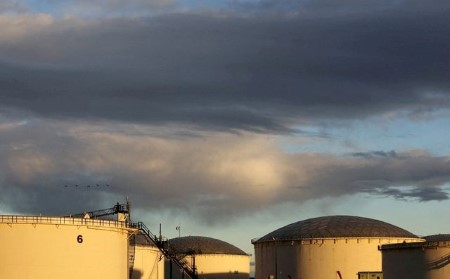
July 15 (Reuters) – Oil prices rose in early Asian trading on Friday amid uncertainty around how aggressive the U.S. Federal Reserve will be in hiking interest rates to combat rampant inflation.

Brent crude futures for September delivery rose 80 cents, or 0.8%, to $99.90 a barrel by 0007 GMT, while WTI crude rose 69 cents, or 0.7%, to $96.47 a barrel.

The Fed’s most hawkish policymakers on Thursday said they favoured another 75-basis-point interest rate increase at the U.S. central bank’s policy meeting this month, not the bigger rate raise that traders had raced to price in after a report Wednesday showed inflation was accelerating.

The Fed rate hike is expected to follow a similar move by the Bank of Canada, which surprised the market on Wednesday with a 100-basis-point increase.

The rate hike uncertainty, along with weak economic data, caused both benchmark contracts to drop at one stage on Thursday to below the Feb. 23 close, the day before Russia invaded Ukraine in what Moscow calls “a special military operation”. Still, both Brent and WTI had clawed back nearly all losses by the end of the trading session.

U.S. President Joe Biden will on Friday fly to Saudi Arabia, where he will attend a summit of Gulf allies and call for them to pump more oil.

However, spare capacity at members of the Organization of the Petroleum Exporting Countries is running low, with most producers pumping at maximum capacity, and it is unclear how much extra Saudi Arabia can bring into the market quickly.

(Reporting by Laura Sanicola; Editing by Kenneth Maxwell)

Gold sheds over 2% on rampant dollar as big Fed rate hike looms

Gold sheds over 2% on rampant dollar as big Fed rate hike looms

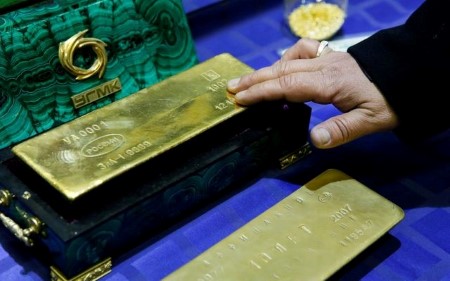
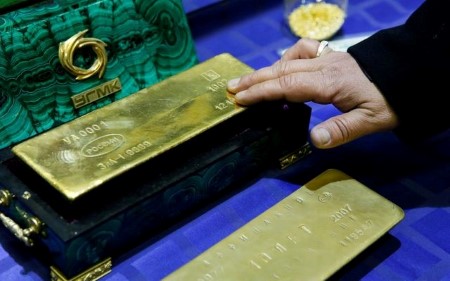
July 14 (Reuters) – Gold slumped more than 2% to a near one-year low on Thursday as the dollar extended its sharp rally, while expectations grew for a steep interest rate hike from the Federal Reserve.

Spot gold fell 1.5% to USD 1,710.02 per ounce by 2:02 p.m. ET (1802 GMT), after falling over 2% earlier in the session. US gold futures settled down 1.7% to USD 1,705.8.

The dollar soared to a 20-year high, emerging as a preferred save haven amid growing economic risks of late, at gold’s expense.

“The stronger dollar is pushing gold lower. After the consumer inflation data, traders have increased their expectations from a 75 bps rate hike to a 100 bps rate hike,” hurting gold, said Philip Streible, chief market strategist at Blue Line Futures in Chicago.

“Gold will unlikely see any upside unless inflation deteriorates enough to stop interest rate hikes or if other central banks start to be as aggressive as Fed, and that can weaken dollar,” Streible added.

Although it is considered an inflation hedge, gold’s appeal tends to dim amid elevated interest rates since bullion yields no interest.

Building the case for a steep rate hike to tame inflation, data on Wednesday showed US annual consumer prices surged, resulting in the largest annual increase in inflation in 40-1/2 years.

Meanwhile, the Fed’s Christopher Waller said “markets may have gotten ahead of themselves” in pricing in a 100 bps rate hike for July.

US weekly jobless claims rose for the second straight week, suggesting some cooling in the labor market. nL1N2YU24P

In the physical markets, second biggest bullion consumer India’s plain gold jewellery exports to the UAE jumped in May.

Spot silver dipped 4.2% to USD 18.38 per ounce, platinum was down 1.5% at USD 842.37, while palladium fell nearly 3% to USD 1,915.63.

(Reporting by Ashitha Shivaprasad and Brijesh Patel in Bengaluru; Editing by Jonathan Oatis and Shailesh Kuber)

Dollar climbs further pinning euro, yen at multi-decade lows

Dollar climbs further pinning euro, yen at multi-decade lows

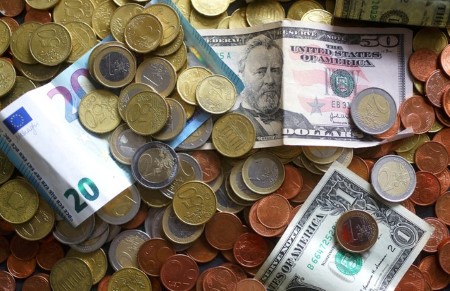
LONDON, July 14 (Reuters) – The dollar resumed its relentless rise on Thursday, charting new 24-year highs against the yen and pinning the euro close to parity, as investors bet on the Federal Reserve ratcheting up interest rates to combat soaring inflation.

Global economic turmoil has put a rocket under the safe haven dollar, pushing the dollar index that tracks the greenback against six counterparts up more than 13% this year. It was last up a fifth of a percent on the day at 108.500.

The dollar strengthened more than 1% against the yen, pushing it above 139 yen per dollar for the first time since 1998. It was last up 1.3% at 139.18 yen per dollar.

The euro was hovering just above parity with the dollar – a day after breaking below the key level for the first time in almost two decades. The single currency fell as much as 0.5% on the day and was last down 0.3% at USD 1.00310.

Another hot set of US inflation data on Wednesday and an aggressive 100 basis point rate hike by the Bank of Canada on the same day has stoked bets on swifter policy tightening by the Fed, currency analysts said.

“The price action reflects building fears that the Fed will strangle the life out of the US recovery by responding more aggressively to dampen upside inflation risks,” analysts at MUFG said in a note.

Traders have ramped up bets that the US central bank could raise rates by 100 basis points when it meets on July 26-27. A hike of at least 75 basis points is seen as almost certain.

Sterling slipped 0.3% to USD 1.18580, as concerns about prospects for the British economy dominated despite data on Wednesday showing output unexpectedly grew in May.

(Reporting by Iain Withers, Additional reporting by Kevin Buckland in Tokyo; Editing by Alex Richardson)

Stocks fall, dollar gains as US inflation prompts 100 bps hike bets

Stocks fall, dollar gains as US inflation prompts 100 bps hike bets

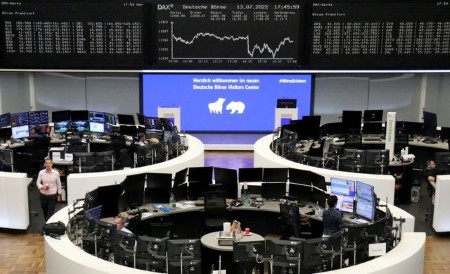
LONDON, July 14 (Reuters) – European shares dropped in early trading on Thursday and the safe-haven dollar was up after the latest red-hot US inflation reading increased investor caution about Federal Reserve rate hikes.

Wednesday’s data showed US consumer prices jumped 9.1% year-on-year in June, up from May’s 8.6% rise.

The data was seen as firming the case for the Federal Reserve to raise rates aggressively. Policymakers might consider a 100 basis point increase at the July meeting, Atlanta Federal Reserve Bank President Raphael Bostic said.

By early European trading, money markets were pricing in a 54% chance of a full percentage point hike at the July meeting and a 46% chance of a 75 basis point rise.

Asian shares were stuck at two-year lows and European indexes opened in the red. At 0735 GMT, Europe’s STOXX 600 and London’s FTSE 100 were both down 0.2% on the day.

“The Fed probably needs to temper people’s expectations in terms of what they can do,” said Eddie Cheng, head of international multi-asset investment at Allspring Global Investments.

“In the past hiking cycle, we have observed that inflation kept rising during the hiking cycle… it takes time for the monetary policy to affect inflation.”

Cheng said that riskier assets will be the “collateral damage” in the Fed’s attempts to reign in inflation.

The dollar index measuring its performance against a basket of currencies was up 0.2% at 108.43, while the dollar was up 1.1% against the yen, at its strongest since 1998.

The British pound was down 0.2% at USD 1.1865. In the first vote to choose who will succeed Boris Johnson as Conservative party leader, former finance minister Rishi Sunak won the biggest backing from Conservative lawmakers.

The euro was down 0.3% at USD 1.00325, having slipped below USD 1 on Wednesday for the first time since 2002.

The euro has been under pressure because of the European Central Bank lagging the Fed in ending its ultra-easy monetary policy of the past decade, as well as the economic risks from the euro zone’s dependence on Russian gas.

Germany’s benchmark 10-year government bond yield was up 8 basis points at 1.231%.

Italian yields rose sharply ahead of a parliamentary confidence vote which risks bringing the country’s government down.

The US 10-year yield was up around 7 basis points at 2.9817%. The 2-year, 10-year part of the Treasury yield curve is at its most inverted it has been at any point in this cycle, according to Deutsche Bank.

Yield curve inversion – which is when short-dated interest rates are higher than longer ones – is commonly seen as an indicator that markets are anticipating a recession.

Oil prices fell as traders saw a large US rate hike possibly reducing crude demand.

Overnight, the Monetary Authority of Singapore and the Bangko Sentral ng Pilipinas surprised markets by tightening monetary policy in off cycle moves.

(Reporting by Elizabeth Howcroft; Editing by Tomasz Janowski)

BSP says economy robust enough to absorb aggressive rate hike

MANILA, July 14 (Reuters) – The Philippine economy continues to be robust to absorb the 75 basis points increase in the central bank’s benchmark interest rates, given an expansion in economic activity early this year, the finance minister said on Thursday.

“The growth outlook is seen to be supported by the maintenance of loosened quarantine restrictions as well as the positive impact of structural reforms,” Benjamin Diokno said in a statement following the central bank’s surprise move.

(Reporting by Enrico Dela Cruz; Editing by Martin Petty)

Oil settles lower ahead of potential large U.S. rate hike

Oil settles lower ahead of potential large U.S. rate hike

NEW YORK, July 14 (Reuters) – Oil prices settled lower on Thursday, but pared nearly all losses after falling more than USD 4 earlier in the session as investors focused on the prospect of a large US rate hike later this month that could stem inflation but at the same time hit oil demand.

Brent crude futures for September settled down 47 cents, or 0.5% to USD 99.10 a barrel and finished a third session in a row below USD 100.

US West Texas Intermediate crude for August delivery settled down USD 95.78 a barrel, or 0.5%, down 52 cents.

Both contracts hit lows on Thursday which were below the Feb. 23 close, the day before Russia invaded Ukraine, with Brent reaching its lowest level since Feb. 21.

The US Federal Reserve is seen ramping up its battle with 40-year high inflation with a supersized 100 basis-point rate hike this month after a grim inflation report showed price pressures accelerating. The Fed policy meeting is scheduled for July 26-27.

The Fed rate hike is expected to follow a similar move by the Bank of Canada which surprised the market on Wednesday.

“Moves by the Fed will have an outsized impact on the market as we watch them try to digest new economic data about inflation,” said John Kilduff, partner at Again Capital LLC in New York.

Oil prices have tumbled in the past two weeks on recession concerns despite a drop in crude and refined products exports from Russia amid Western sanctions and supply disruption in Libya.

Investors also flocked to the dollar, often seen as a safe- haven asset. The dollar index hit a 20-year high on Wednesday, which makes oil purchases more expensive for non-US buyers, but retreated somewhat on Thursday.

“Technical indicators are suggesting another round of fresh lows as the US dollar continues to rule in driving oil price direction,” said Jim Ritterbusch, president of Ritterbusch and Associates LLC in Galena, Illinois.

In Europe, signals were also bearish for demand with the European Commission cutting its economic growth forecast and raising the expected inflation rate to 7.6%.

Worries of COVID-19 curbs in multiple Chinese cities to rein in new cases of a highly infectious subvariant have also kept a lid on oil prices.

China’s daily crude oil imports in June sank to their lowest level since July 2018, as refiners anticipated lockdown measures to curb demand, customs data showed on Wednesday.

Data from the US Energy Information Administration also point to slackening demand, with product supplied slumping to 18.7 million barrels per day, the lowest since June 2021. Crude inventories rose, bolstered by another big release from strategic reserves.

US President Joe Biden will on Friday fly to Saudi Arabia, where he will attend a summit of Gulf allies and call for them to pump more oil.

However, spare capacity at the Organization of the Petroleum Exporting Countries is running low, with most of the producers pumping at maximum capacity, and it is unclear how much extra Saudi Arabia can bring into the market quickly.

(Reporting by Laura Sanicola in New York; Additional eporting by Julia Payne in London and Florence Tan in Singapore; Editing by Jason Neely, Matthew Lewis and Diane Craft)

Gold falls as firm dollar, yields compound rate-hike woes

Gold falls as firm dollar, yields compound rate-hike woes

July 14 (Reuters) – Gold prices fell 1% on Thursday, as Treasury yields and the dollar rose, with bullion’s outlook already dented by fears the US Federal Reserve could opt for a more aggressive interest rate hike this month to tackle sky-rocketing inflation.

Spot gold retreated 1% to USD 1,718.69 per ounce by 0757 GMT. US gold futures also lost 1% to USD 1,717.70.

The dollar set a fresh 20-year high, hurting demand for greenback-priced gold among buyers holding other currencies.

Benchmark US 10-year Treasury yields rose, weighing on appetite for zero-yield gold.

Data released overnight showed US annual consumer prices jumped 9.1% in June, the sharpest spike in more than four decades.

“The CPI release generated volatility but not direction,” said Ilya Spivak, a currency strategist at DailyFX, reasoning that markets now likely expected the Fed to front-load rates more, and not necessarily tighten more overall, but said gold still had a bearish outlook.

A rallying dollar sent gold prices to a near one-year low on Wednesday following the inflation report, but a retreat in the greenback helped bullion make a sharp recovery and end the session higher.

Global markets swung wildly in the previous session. On Thursday, Asian shares struggled on fears the Fed’s aggressive monetary policy could trigger a recession.

The Fed is seen ramping up its battle to curb inflationary pressures with a supersized 100-basis-point rate hike at its upcoming policy meeting on July 26-27.

Although gold is seen as an inflation hedge, higher rates hurt the appeal of bullion, which bears no interest.

“It would be silly to say that 75 basis points is dovish, but there is a risk here that the Fed does something that’s objectively big, like 75, but gold rallies because it’s not 100,” Spivak said.

Spot silver dipped 1.1% to USD 18.98 per ounce, platinum slipped 1.5% to USD 841.96, and palladium dropped 1.3% to USD 1,949.43.

(Reporting by Bharat Govind Gautam in Bengaluru; Editing by Rashmi Aich and Sherry Jacob-Phillips)

Philippine central bank hastens interest rate rise, ready for more action

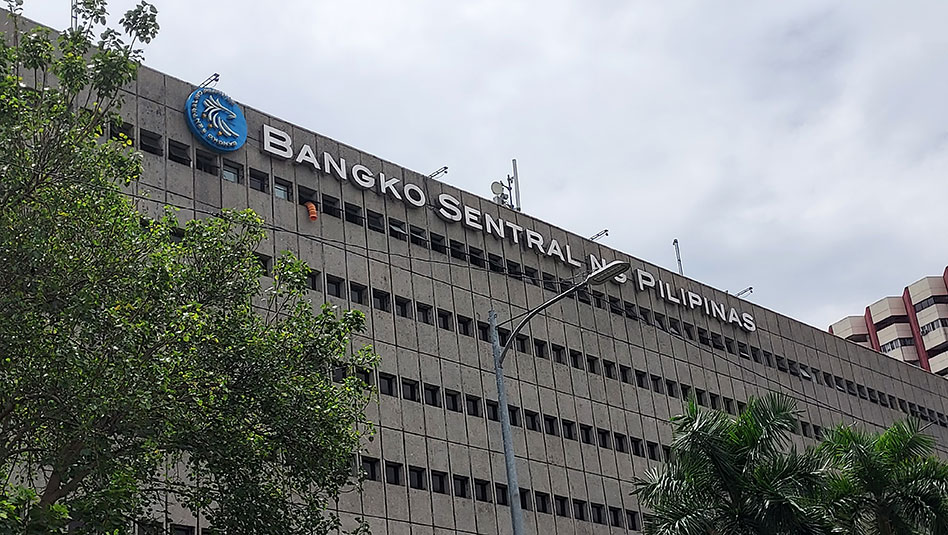
MANILA, July 14 (Reuters) – The Philippine central bank raised its key interest rates by 75 basis points in a surprise move on Thursday and kept the door open for further tightening as it rushed to contain broadening inflationary pressure and rescue a faltering peso.

Implemented outside the regular policy-meeting cycle, the tightening move was the most aggressive by the Bangko Sentral ng Pilipinas (BSP) since the central bank shifted to an inflation-targetting approach in 2002.

The rise in interest rates accompanied policy shifts effected by other central banks in Asia and elsewhere on Wednesday and Thursday. They included one in Singapore that was also an off-cycle move.

In the Philippines, the rate on the key overnight reverse repurchase facility rose to 3.25%, BSP Governor Felipe Medalla said in a statement.

“In raising the policy interest rate anew, the Monetary Board recognized that a significant further tightening of monetary policy was warranted by signs of sustained and broadening price pressures amid the ongoing normalization of monetary policy settings,” Medalla said.

The rates on the BSP’s overnight deposit and lending facilities were also raised by 75 basis points, to 2.75% and 3.75%, respectively.

No such move was expected on Thursday because the BSP did not have a regular policy meeting scheduled until Aug. 18. The central bank previously raised interest rates by 25 basis points in May and again in June.

Medalla said the BSP would still hold the Aug. 18 meeting, and policy moves remained data-dependent.

Inflation surged to the highest level in nearly four years in June, and is widely expected to remain elevated, pushing the full-year average beyond the target band of 2% to 4%.

Finance Secretary Benjamin Diokno said the economy remained robust and could thus absorb Thursday’s interest rate rise. It would remain supported by the easing of COVID-19 restrictions and structural reforms, he added.

The 6.5%-7.5% growth target for gross domestic product set for this year by the newly installed Marcos administration remains within reach, BSP Deputy Governor Francisco Dakila said in a media briefing.

The second-quarter GDP growth, which will be announced on Aug. 9, “is very likely (to be) strong or even stronger than first quarter numbers”, he said.

PESO RECOVERS

The Philippine peso, which had hit a record low early this week versus the U.S. dollar, recovered some lost ground and was last up 0.3%.

The peso is the worst-performing currency in Southeast Asia this year as the greenback continues to strengthen on expectations for faster Federal Reserve policy tightening.

The Fed is seen stepping up its tightening campaign with a supersized 100 basis point rate hike this month after a report showed inflation racing at four-decade highs.

The BSP’s move was meant to support or at least stabilize the peso exchange rate, said Michael Ricafort, economist at Rizal Commercial Banking Corp. in Manila.

A weak peso adds further pressure on inflation, threatening to derail recovery of the consumption-driven domestic economy.

“More rate hikes are still possible, if needed, as a function of any further Fed rate hikes to bring down elevated inflation,” Ricafort said.

FURTHER TIGHTENING POSSIBLE

Medalla said the BSP was ready “to take further necessary actions to steer inflation towards a target-consistent path over the medium term”.

The central banks of New Zealand and South Korea increased interest rates by 50 basis points on Wednesday, when Canada’s shocked markets by going for 100 basis points.

Singapore’s Thursday move was re-centring the mid-point of an exchange-rate policy band.

Malaysia’s central bank raised its benchmark interest rate for the second straight meeting last week.
Indonesia’s central bank may raise interest rates in the current quarter to contain future pressure on core inflation, but any rise will not be aggressive, its governor said on Friday.

(Reporting by Enrico Dela Cruz, Karen Lema and Neil Jerome Morales; Editing by Ed Davies and Bradley Perrett)

Philippine central bank makes surprise 75 bps hike in interest rates

Philippine central bank makes surprise 75 bps hike in interest rates

MANILA, July 14 (Reuters) – The Philippine central bank on Thursday raised its benchmark interest rates by 75 basis points in a surprise off-cycle move, and signalled its readiness to take further policy action to contain broadening inflationary pressures, its governor said.

That brings the key overnight borrowing rate to 3.25% effective Thursday, Bangko Sentral ng Pilipinas Governor Felipe Medalla said in its announcement via Facebook.

(Reporting by Enrico Dela Cruz, Karen Lema and Neil Jerome Morales; Editing by Ed Davies)

Asian shares bruised as US inflation data boosts recession fear

Asian shares bruised as US inflation data boosts recession fear

HONG KONG, July 14 (Reuters) – Asian shares struggled on Thursday and the safe haven dollar was strong as white-hot US inflation data drove fear the Federal Reserve will raise interest rates even more aggressively to slow price increases, potentially sending the economy into recession.

MSCI’s broadest index of Asia-Pacific shares outside Japan lost 0.1%, hovering just above the two-year low hit on Tuesday, while US Nasdaq futures shed 0.3%.

Japan’s Nikkei .N225 bucked the trend by rising 0.6%, helped by the yen’s weakness against the dollar boosting exporters.

Overnight US data showed rising costs of fuel, food and rent drove the consumer price index (CPI) up 9.1% last month, leading to worries that the Fed could raise rates by an enormous 100 basis points at its meeting next month rather than the 75 that had been expected.

“The concerning aspect in the CPI numbers was the breadth of increases,” said Shane Oliver, chief economist at AMP, who said nearly 90% of the US CPI components saw increases of more than 3%.

Market pricing on the CME’s Fedwatch tool currently indicates a 78% chance of a 100 basis increase, though Oliver said this could be a knee jerk reaction to the high CPI reading.

“I personally think the Fed will stick to 75 – which is still a high number – if they go to 100 it will look like they are panicking.”

“Only time will tell though, the Fed does have an unconditional commitment to get inflation back down.”

US two-year yields, which reflect interest rate expectations, were last at 3.121%, just off an overnight four-week high, increasing their lead on US benchmark 10 year yields which were at 2.9558%.

So-called yield curve inversion, when short-dated interest rates are higher than longer ones, is commonly seen as an indicator of a recession, and the gap between the two touched 25 basis points in early Asia.

This also is bad news for Asian economies and stocks.

Carlos Casanova, senior economist at UBP, said a recession in the US would mean less demand for Asian exports, with investors turning more “risk off” and moving money out of emerging markets, and forcing Asian central banks to raise rates themselves to avoid too currency depreciation.

“So far Bank of Korea and the Reserve Bank of New Zealand seem to be competing with each other to see who can be the most hawkish, but all the other central banks are lagging. We will see more rate hikes in Asia, which will lead to a deceleration in aggregate demand, credit growth, consumption and the like.”

Singapore’s central bank also tightened its monetary policy on Thursday, in an off-cycle move hoping to slow inflation, sending the local currency up 0.7%.

Elsewhere in currency markets, the euro was hovering back just above parity with the dollar at USD 1.00155. It briefly dipped to USD 0.9998 overnight, breaking below USD 1 for the first time since December 2002.

The European central bank faces a dilemma of whether to let the currency fall further, pushing up already record high inflation, or fighting back with more rapid interest rate hikes increasing the damage to an economy already hit hard by high energy costs.

The dollar was also firm against other majors, rising over 138 yen for the fist time since September 1998. The dollar index, which tracks the currency against six majors, was holding firm at 108.45.

Oil prices slightly extended their recent losses due to inflation concerns.

Brent crude futures for September fell 0.1%, to USD 99.49, and US West Texas Intermediate crude lost 0.15% to USD 96.17.

Gold faced heavy selling pressure as higher rates hurt the non-interest-bearing asset. The spot price was down 0.5% at USD 1,725 an ounce.

(Reporting by Alun John; Editing by Christopher Cushing)

Posts navigation

Older posts
Newer posts

Recent Posts

  • Metrobank US-Iran Risk Index: A new hope
  • A guide for your peso bond portfolio amid higher for longer rates
  • Investment Ideas: April 8, 2026
  • Inflation Update: The case to tighten
  • Investment Ideas: April 7, 2026

Recent Comments

No comments to show.

Archives

  • April 2026
  • March 2026
  • February 2026
  • January 2026
  • December 2025
  • November 2025
  • October 2025
  • September 2025
  • August 2025
  • July 2025
  • June 2025
  • May 2025
  • April 2025
  • March 2025
  • February 2025
  • January 2025
  • December 2024
  • November 2024
  • October 2024
  • September 2024
  • August 2024
  • July 2024
  • June 2024
  • May 2024
  • April 2024
  • March 2024
  • February 2024
  • January 2024
  • December 2023
  • November 2023
  • October 2023
  • September 2023
  • August 2023
  • July 2023
  • June 2023
  • May 2023
  • April 2023
  • March 2023
  • February 2023
  • January 2023
  • December 2022
  • November 2022
  • October 2022
  • September 2022
  • August 2022
  • July 2022
  • June 2022
  • May 2022
  • March 2022
  • December 2021
  • October 2021

Categories

  • Bonds
  • BusinessWorld
  • Currencies
  • Economy
  • Equities
  • Estate Planning
  • Explainer
  • Featured Insight
  • Fine Living
  • How To
  • Investment Tips
  • Markets
  • Portfolio Picks
  • Rates & Bonds
  • Retirement
  • Reuters
  • Spotlight
  • Stocks
  • Uncategorized

You are leaving Metrobank Wealth Insights

Please be aware that the external site policies may differ from our website Terms And Conditions and Privacy Policy. The next site will be opened in a new browser window or tab.

Cancel Proceed
Get in Touch

For inquiries, please call our Metrobank Contact Center at (02) 88-700-700 (domestic toll-free 1-800-1888-5775) or send an e-mail to customercare@metrobank.com.ph

Metrobank is regulated by the Bangko Sentral ng Pilipinas
Website: https://www.bsp.gov.ph

Quick Links
The Gist Webinars Wealth Manager Explainers
Markets
Currencies Rates & Bonds Equities Economy
Wealth
Investment Tips Fine Living Retirement
Portfolio Picks
Bonds Stocks
Others
Contact Us Privacy Notice Terms of Use
© 2026 Metrobank. All rights reserved.

Access this content:

If you are an existing investor, log in first to your Metrobank Wealth Manager account. ​

If you wish to start your wealth journey with us, click the “How To Sign Up” button. ​

Login HOW TO SIGN UP