MODEL PORTFOLIO
THE GIST
NEWS AND FEATURES
Global Philippines Fine Living
INSIGHTS
INVESTMENT STRATEGY
Economy Stocks Bonds Currencies
THE BASICS
Investment Tips Explainers Retirement
WEBINARS
2024 Mid-Year Economi Briefing, economic growth in the Philippines
2024 Mid-Year Economic Briefing: Navigating the Easing Cycle
June 21, 2024
Investing with Love
Investing with Love: A Mother’s Guide to Putting Money to Work
May 15, 2024
retirement-ss-3
Investor Series: An Introduction to Estate Planning
September 1, 2023
View All Webinars
DOWNLOADS
Container ship carrying container boxes import export dock with quay crane. Business commercial trade global cargo freight shipping logistic and transportation worldwide oversea concept. Generative AI
Economic Updates
Philippines Trade Update: Wider deficit on strong imports
DOWNLOAD
Frick collection with palm trees 
Economic Updates
Policy Rate Updates: Policy rate updates to reassure 
DOWNLOAD
Man using his smartphone
Reports
Fed to cut just once 
DOWNLOAD
View all Reports
Metrobank.com.ph How To Sign Up
Follow us on our platforms.

How may we help you?

TOP SEARCHES
  • Where to put my investments
  • Reports about the pandemic and economy
  • Metrobank
  • Webinars
  • Economy
TRENDING ARTICLES
  • Investing for Beginners: Following your PATH
  • On government debt thresholds: How much is too much?
  • Philippines Stock Market Outlook for 2022
  • Deficit spending remains unabated

Login

Access Exclusive Content
Login to Wealth Manager
Visit us at metrobank.com.ph How To Sign Up
Access Exclusive Content Login to Wealth Manager
Search
MODEL PORTFOLIO THE GIST
NEWS AND FEATURES
Global Philippines Fine Living
INSIGHTS
INVESTMENT STRATEGY
Economy Stocks Bonds Currencies
THE BASICS
Investment Tips Explainers Retirement
WEBINARS
2024 Mid-Year Economi Briefing, economic growth in the Philippines
2024 Mid-Year Economic Briefing: Navigating the Easing Cycle
June 21, 2024
Investing with Love
Investing with Love: A Mother’s Guide to Putting Money to Work
May 15, 2024
retirement-ss-3
Investor Series: An Introduction to Estate Planning
September 1, 2023
View All Webinars
DOWNLOADS
Container ship carrying container boxes import export dock with quay crane. Business commercial trade global cargo freight shipping logistic and transportation worldwide oversea concept. Generative AI
Economic Updates
Philippines Trade Update: Wider deficit on strong imports
March 27, 2026 DOWNLOAD
Frick collection with palm trees 
Economic Updates
Policy Rate Updates: Policy rate updates to reassure 
March 26, 2026 DOWNLOAD
Man using his smartphone
Reports
Fed to cut just once 
March 19, 2026 DOWNLOAD
View all Reports

Archives: Reuters Articles

Gold firms on dollar pullback, but hinges on rate-hike fears

Gold firms on dollar pullback, but hinges on rate-hike fears

Sept 27 (Reuters) – Gold prices rose on Tuesday as the dollar slipped, although the metal languished near a 2-1/2-year low as prospects of further aggressive rate hikes by the US Federal Reserve kept some investors on the sidelines.

Spot gold was up 0.6% at USD 1,631.39 per ounce, as of 0512 GMT, after hitting its lowest since April 2020 at USD 1,620.20 on Monday. US gold futures edged 0.3% higher to USD 1,638.70.

The dollar index dipped 0.1%, easing off a two-decade peak scaled in the previous session. The benchmark 10-year Treasury yield was also slightly off a 12-year peak marked on Monday.

Slightly lower US yields and dollar may have provided some room for gold prices to stabilise after its recent sell-off, said IG market strategist Yeap Jun Rong.

“The prevailing upside risk to inflation and, hence, monetary policy tightening, still remains a key obstacle limiting gold’s upside,” he said.

Fed officials on Monday sloughed off rising volatility in global markets and said their priority remained controlling inflation.

Gold prices have declined more than 20% since rising above the key USD 2,000 level in March, as rapid US rate hikes made the non-yielding bullion less attractive and also pushed the dollar to multi-year highs.

“Its (gold’s) status as a haven asset in times of economic distress has failed to stem the flow of selling,” analysts at ANZ said in a note.

Indicative of investor sentiment, holdings of SPDR Gold Trust GLD, the world’s largest gold-backed exchange-traded fund, fell to 30,333,443 ounces on Monday, its lowest since March 2020.

Spot gold may bounce further to USD 1,639 per ounce, as a wave 3 may have completed around a support of USD 1,619, according to Reuters technical analyst Wang Tao.

Spot silver rose 1% to USD 18.51 per ounce, platinum climbed 0.2% to USD 853.89 and palladium was up 0.2% at USD 2,049.10.


(Reporting by Eileen Soreng in Bengaluru; Editing by Rashmi Aich, Subhranshu Sahu and Sherry Jacob-Phillips)

Contrarian Chinese yuan bets may start to make sense

Contrarian Chinese yuan bets may start to make sense

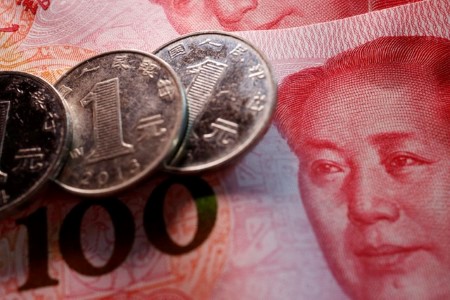
Sept 27 (Reuters) – China’s not trying too hard to correct the yuan’s depreciation versus the U.S. dollar, perhaps knowing it’s a losing battle due to external and domestic factors. Nonetheless, bullish bets on the yuan might soon make sense.

China on Monday announced a return of a 20% reserve requirement ratio on FX forwards, making it more expensive to short the yuan. The effect was barely noticeable as USD/CNY ripped back up after a brief dip. The pair is now close to notching a new 27-month high above 7.1690.

The People’s Bank of China has been consistently guiding the daily yuan midpoint stronger than most estimates, but it hasn’t managed to shift bearish sentiment, which might explain the reinstating of the FX RRR. Tuesday’s USD/CNY fix was again below forecasts but not as low as some adjusted estimates; the PBOC also injected the most short-term liquidity since February .

But that doesn’t alter the outlook for the renminbi; maybe nothing will, except a change in Beijing’s zero-COVID policy.

The World Bank on Tuesday slashed its 2022 forecast for China’s economic growth to 2.8% from its April estimate of 5.0%, and sees the behemoth burdening the region .

As economic data signals further slowing and youth unemployment threatens to sow social unrest , reopening China’s borders to revive consumption and the services sector would make sense. If this happens before the scheduled F1 race in Shanghai in April, yuan bears might be forced to reconsider.


(Ewen Chew is a Reuters market analyst. The views expressed are his own. Editing by Sonali Desai)

BOJ steps in to curb rising yields with special buying operation

BOJ steps in to curb rising yields with special buying operation

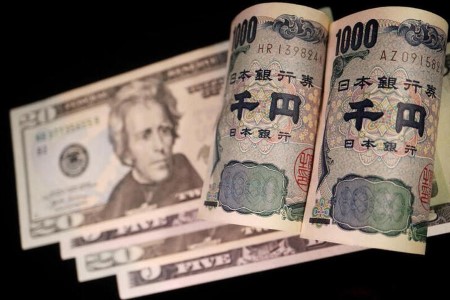
TOKYO, Sept 27 (Reuters) – The Bank of Japan said it would conduct a special purchase operation of Japanese government bonds on Tuesday, with the yield on the benchmark 10-year note brushing against the 0.25% policy ceiling for the first time in the past fortnight.

The BOJ will purchase debt with 10- to 25-year maturities worth 100 billion yen (USD 692.28 million), and securities with 5- to 10-year maturities worth 150 billion yen.

The 10-year JGB yield was up 0.5 basis point at 0.25%, as of 0225 GMT, a level not seen since Sept. 16. The central bank pins the yield at +/- 25 basis points around zero under its yield curve control policy.

Japanese yields are under pressure amid a broad climb in global yields as major central banks including the US Federal Reserve and the European Central Bank race to hike interest rates to rein in superheated inflation.

The BOJ stood alone among developed markets in keeping the short-term policy rate negative, in addition to the zero long-term yield, as tepid wage inflation and relatively benign core inflation keep Japanese policymakers cautious amid a fragile economic recovery.

Japan’s central bank maintained its stance last week, despite growing policy divergence pushing the yen to 24-year lows. Japanese authorities intervened in the foreign exchange market for the first time since 1998 to shore up the battered currency.

“The BOJ is trying to calm down speculation that it could be forced to change policy,” said Masayuki Kichikawa, chief macro strategist at Sumitomo Mitsui Asset Management in Tokyo.

“It makes very clear that it has no intention to change monetary policy for the foreseeable future.”

Benchmark 10-year JGB futures fell 0.29 point to 147.71, and earlier touched a three-month low of 147.62.

The yield on the 30-year rose 6 bps to 1.435% for the first time since September 2015, and the 20-year yield advanced 4 bps to 1.03% for the first time since December 2015.

The five-year yield added 1 bp to 0.08%, a three-month high.

Two-year notes  were yet to trade.

(USD 1 = 144.4500 yen)


(Reporting by Kevin Buckland; Editing by Sherry Jacob-Phillips)

Runaway dollar pauses for breath as bears stalk stocks

Runaway dollar pauses for breath as bears stalk stocks

HONG KONG, Sept 27 (Reuters) – Asian markets attempted to stabilise on Tuesday after a wild few days of stumbling stocks, crumbling bonds, a plunging pound and soaring dollar, with the dollar easing a bit and stocks flat.

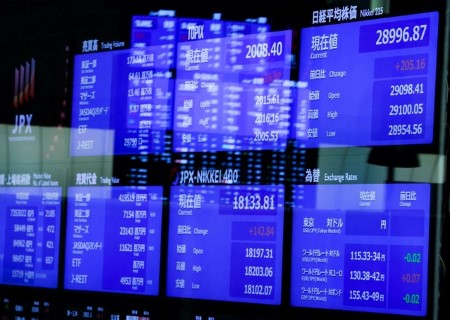
Sterling, which collapsed to a record low USD 1.0327 on Monday, recovered to USD 1.0742. S&P 500 futures rose 0.7%, and MSCI’s broadest index of Asia-Pacific shares outside Japan fell 0.1%. Japan’s Nikkei .N225 rose 0.7%.

Analysts were doubtful about the outlook, however, as markets – already jittery at the prospect of US interest rates staying higher for longer – have been further unnerved by an upheaval in British assets in response to government spending plans.

Britain plans tax cuts on top of huge energy subsidies, and a lack of confidence in the strategy and its funding hammered gilts and the pound on Friday and again on Monday.

The yield on five-year gilts is up a stunning 100 basis points in two trading days.

“(It) is definitely something that’s unfolding…probably we’re only at a certain initial stage of seeing how the market digests that kind of information,” said Yuting Shao, macro strategist at State Street Global Markets.

“Of course the tax cut plan itself was really aimed to stimulate growth, reduce household burdens, but it does raise the question of what the implications are in terms of the monetary policies.”

After the pound’s plunge, the Bank of England said it would not hesitate to change interest rates and was monitoring markets “very closely”.

Spillover to US markets drove Wall Street deeper into a bear market, lifted benchmark 10-year Treasury yields more than 20 bps to a 12-year high of 3.933%, and has kept the greenback bid.

After two weeks of mostly steady losses on the U.S. stock market, the Dow Jones Industrial Average .DJI confirmed on Monday that it was in a bear market, tracing its start to declines in early January.

The S&P 500 index .SPX confirmed in June it was in a bear market, and on Monday it ended the session below its mid-June closing low, extending this year’s overall selloff.

State Street’s Shao said uncertainty is rippling through the market and weighing on investor sentiment.

“We are already entering a bit of a slowing down when it comes to global recovery. And the continual tightening of central banks will of course bring more pain in terms of their domestic economic recovery,” she said.

The dollar index on Tuesday eased 0.1% to 113.8, after earlier touching 114.58, its strongest against a basket of peer currencies since May 2002.

The European single currency  was up 0.3% on the day at USD 0.9634 after hitting a 20-year low a day ago.

Oil and gold nursed losses. Gold, which hit a 2-1/2 year low on Monday rose 0.5% to USD 1,629 an ounce. Oil lifted slightly from its lowest levels since January.

US crude ticked up 0.66% to USD 77.22 a barrel. Brent crude rose to USD 84.71 per barrel.


(Reporting by Xie Yu; Editing by Edmund Klamann)


Crowd of dollar bulls raises risk of violent pullback

Crowd of dollar bulls raises risk of violent pullback

NEW YORK, Sept 26 (Reuters) – Some investors are growing concerned the dollar’s meteoric rise is setting the stage for a rapid reversal, which would bruise those who have sought refuge in the US currency in recent months.

Soaring US interest rates, a comparatively strong American economy and demand for a haven from wild gyrations in asset prices have lured investors to the dollar, driving it up about 22% against a basket of currencies in the past year.

Some investors worry the dollar trade has become excessively crowded, raising the risk of a sharp unwind if the case for owning the currency changes and investors try to exit their positions all at once.

“Positioning is crowded,” said Calvin Tse, head of global macro strategy, Americas, at BNP Paribas. “If we get a catalyst, the dollar can turn, and turn very aggressively,” he said.

International Monetary Market speculators held a net long US dollar position of USD 10.23 billion for the week ended Sept. 20. That is lower than a recent high of nearly USD 20 billion in July but marks the third-longest streak since 1999 in traders holding bullish positions on the greenback, with 62 straight weeks of long positioning.

Barring a brief period of peak pandemic-related uncertainty, broad net options positioning data going back to 2014 shows US dollar long positions are the most stretched ever, according to Morgan Stanley.

Some 56% of participants in BofA’s global fund manager survey in September named being long the dollar as the most “crowded trade,” the third straight month the greenback has held that position in the survey.

Investors may have already had a taste of what a reversal could look like when the dollar index retreated nearly 3% over the course of two weeks, starting in mid-July, as some investors bet US inflation might be set to moderate enough to allow the Fed room to pivot away from its path of aggressive interest rate hikes.

While a hotter-than-expected US inflation report in August dashed those hopes and sent the dollar higher, the dangers stemming from the crowded dollar trade have only grown, investors said.

“Undoubtedly, when you have a crowded trade, where you have investors all seeking the same thing, when perceptions do change, the reaction is a violent one,” said Eric Leve, chief investment officer at wealth and investment management firm Bailard.

“We could easily see a 10%-15% move the other way in the dollar vs euro or yen,” he said.

In 2015 and 2009, the last two instances when the dollar index rose more than 20% during a one-year period, the index subsequently logged a two-month drop of 6.7% and 7.7%, respectively, once the greenback peaked.

REVERSAL CATALYST

While crowded positioning can aggravate any potential reversal for the dollar, it would take a big fundamental change to cause that reversal, investors said.

Falling US interest rate volatility, normalizing European energy prices and China abandoning its zero-COVID policy are three prerequisites for the dollar to enter into a structural bear market, BNP’s Tse said.

“When those three are all checked off, it provides us more of a runway to see the dollar enter a bear market, but I don’t see these happening any time soon,” he said.

While US interest rates are above those in many other economies, almost every major central bank, including the European Central Bank and the Bank of England, has hiked rates as they step up their fight against high inflation, helping boost the allure of their battered currencies.

Any signs that US inflation could be easing might help revive expectations for a dovish pivot by the Fed, robbing the greenback of a crucial driving force.

A serious blow to the US economic outlook could also hurt the dollar, said Jack McIntyre, a portfolio manager at Brandywine Global.

The Fed’s aggressive policy tightening has boosted worries that the US economy could be headed for a recession next year.

The world’s three largest economies – the United States, China, and the euro zone – have been slowing sharply, and even a “moderate hit to the global economy over the next year could tip it into recession,” the World Bank said in a recent study.

“I think what weakens the dollar is increasing likelihood that the US goes into a recession, and that is not discounted in the dollar,” McIntyre said.

But with the dollar scaling new multi-decade highs, positioning for a pullback can be painful. “We have been fighting it a little bit, but it’s tough,” McIntyre said.


(Reporting by Saqib Iqbal Ahmed; editing by Ira Iosebashvili, Megan Davies and Paul Simao)


The Dow is in a bear market. What does that mean?

The Dow is in a bear market. What does that mean?

Sept 26 (Reuters) – The Dow Jones Industrial Average, the oldest of Wall Street’s three main stock indexes, dropped 1.1% on Monday, extending the decline from its January peak to more than 20%, meeting a common definition for a bear market.

Worries that the Federal Reserve’s war against decades-high inflation is pushing the US economy into a downturn have sent the US stock market tumbling in 2022.

With the S&P 500 and Nasdaq already down some 23% and 32%, respectively, from their record highs, confirmation the Dow is also in a bear market is just the latest milestone in 2022’s market turmoil.

While the Dow, with only 30 large-cap companies, is a much narrower index than the other two, it is historically the one Main Street watches most closely.

On Wall Street, the terms “bull” and “bear” markets are often used to characterize broad upward or downward trends in asset prices. Many investors use the terms loosely, and analysts don’t always share the same specific definitions, particularly about when to call the end of a bear market.

Indeed, for professionals these are just labels that are less important than fundamentals like company earnings and valuations, interest rates and economic conditions.

Some investors define a bear market specifically as a decline of at least 20% in a stock or index from its previous peak, with the peak defining the beginning of the bear market, which is only recognized in hindsight following the 20% decline.

Similarly, some define a bull market as a 20% rise from a previous low. However, S&P Dow Jones Indices, which administers the S&P 500 and Dow Jones Industrial Average, has an even more nuanced definition.

A drop of 20% or more from a high, followed by a 20% gain from that lower level, would leave an index still below its previous peak, a situation S&P Dow Jones Indices Senior Index Analyst Howard Silverblatt describes as a “bull rally in a bear market.”

Indeed, investors can only be sure they are in a new bull market once a new record high has been reached, and at that point, the previous low would mark the end of the bear market and beginning of the new bull market, according to S&P Dow Jones Indices.

(Reporting by Noel Randewich; Editing by Alden Bentley and Nick Zieminski)


US STOCKS-Wall Street ends lower, sinks deeper into bear market

US STOCKS-Wall Street ends lower, sinks deeper into bear market

For a Reuters live blog on U.S., UK and European stock markets, click LIVE/ or type LIVE/ in a news window

Fed rate hikes have investors ‘throwing in the towel’

Casinos jump as Macau allows tour groups after nearly 3 years

New throughout, updates prices and market activity to close

By Noel Randewich and Shreyashi Sanyal

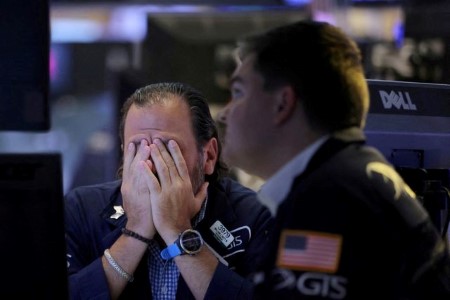
Sept 26 (Reuters) – Wall Street slid deeper into bear market territory on Monday, with the S&P 500 and Dow closing lower as investors fretted that the Federal Reserve’s aggressive campaign against inflation could throw the U.S. economy into a sharp downturn.

After two weeks of mostly steady losses on the U.S. stock market, the Dow Jones Industrial Average .DJI confirmed it has been in a bear market since early January. The S&P 500 index .SPX confirmed in June it was in a bear market, and on Monday it ended the session below its mid-June closing low, extending this year’s overall selloff.

With the Fed signaling last Wednesday that high interest rates could last through 2023, the S&P 500 has relinquished the last of its gains made in a summer rally.

“Investors are just throwing in the towel,” said Jake Dollarhide, Chief Executive Officer of Longbow Asset Management in Tulsa, Oklahoma. “It’s the uncertainty about the high-water mark for the Fed funds rate. Is it 4.6%, is it 5%? Is it sometime in 2023?”

Confidence among stock traders was also shaken by dramatic moves in the global foreign exchange market as sterling GBP=D3 hit an all-time low on worries that the new British government’s fiscal plan released Friday threatened to stretch the country’s finances. MKTS/GLOB nL1N30X0RU

That added an extra layer of volatility to markets worried about a global recession amid decades-high inflation. The CBOE Volatility index .VIX, hovered near three-month highs.

The Dow is now down about 20% from its record high close on Jan. 4. According to a widely used definition, ending the session down 20% or more from its record high close confirms the Dow has been in a bear market since hitting its January peak.

According to preliminary data, the S&P 500 .SPX lost 37.24 points, or 1.01%, to end at 3,655.99 points, while the Nasdaq Composite .IXIC lost 65.39 points, or 0.60%, to 10,802.53. The Dow Jones Industrial Average .DJI fell 319.16 points, or 1.08%, to 29,271.25.

Gains in high-growth stocks including Amazon AMZN.O, Apple AAPL.O and Tesla TSLA.O helped limit losses in the Nasdaq.

Shares of casino operators Wynn Resorts WYNN.O, Las Vegas Sands Corp LVS.N and Melco Resorts & Entertainment MLCO.O jumped between 12% and 30% for much of the session after Macau planned to open to mainland Chinese tour groups in November for the first time in almost three years. nL4N30X24N

Every S&P 500 stock’s performance in 2022https://tmsnrt.rs/3rfOvaB

(Reporting by Shreyashi Sanyal and Ankika Biswas in Bengaluru; Editing by Anil D’Silva, Shounak Dasgupta and David Gregoro)

((Shreyashi.Sanyal@thomsonreuters.com; +1 646 223 8780; +91 961 144 3740; Twitter: https://twitter.com/s_shreyashi))

Lowered profit forecasts raise concerns on shaky Wall Street

Lowered profit forecasts raise concerns on shaky Wall Street

NEW YORK, Sept 26 (Reuters) – Recent profit warnings from bellwether companies like Ford Motor Co, may signal more challenges ahead for corporate America, increasing wariness for investors as the stock market deepens its sell-off.

Investors are increasingly pricing in a US economic downturn next year. The US Federal Reserve raised interest rates by three-quarters of a percentage point for a third straight time on Wednesday in its fight to combat inflation, and some analysts think the aggressive hikes could tip the economy into recession.

With that, concern about earnings has been rising as companies face higher inflation and possibly weakening demand.

Ford Motor (F) warned last Monday that inflation-related supplier costs will run about USD 1 billion higher than expected in the current quarter, while FedEx Corp. (FDX) outlined on Thursday cost cuts of up to USD 2.7 billion after falling demand hammered first-quarter profits.

The announcements are “very important, especially if there is a spate of future warnings,” said Quincy Krosby, chief global strategist, LPL Financial in Charlotte, North Carolina.

“The market is most worried about demand slowing in the US and demand slowing globally,” she said.

Analysts have cut their S&P 500 earnings estimates for the third and fourth quarters, and for all of 2022.

For the third quarter, analysts expect overall S&P 500 earnings to have increased just 4.6% over the year-ago period, compared with growth of 11.1% expected at the start of July, while they see earnings for all of 2022 growing by 7.7% versus 9.5% seen on July 1, according to IBES data from Refinitiv as of Friday.

“Really up until maybe a month or two ago, we didn’t see much in the way of earnings downgrades. That is now changing, and it is playing catch-up,” said Paul Nolte, portfolio manager at Kingsview Investment Management in Chicago. “It is more fallout, and it is expected.”

Third-quarter results start coming by mid-October, marking one of the next big events for stock investors.

Upbeat corporate earnings had helped support the rebound in US stocks over the summer.

But the respite appears over, with the Dow Jones industrial average .DJI dropped below its June low to its lowest since November 2020 on Friday, narrowly missing a close more than 20% below its Jan. 4 record all-time closing peak of 36,799.64 points.

That would have confirmed a bear market that began from Jan. 4, according to a conventional definition. The Dow is the only one of the three major indexes not to have bear market status. The S&P 500 is down 23% for the year so far, while the Nasdaq is down 31%. Both are also within close reach of the bottoms reached in June.

Rick Meckler, partner at Cherry Lane Investments, a family investment office in New Vernon, New Jersey, said US companies have a tendency to surprise Wall Street with earnings that are stronger than expected.

“Companies have shown an ability to navigate these kinds of situations before,” he said. “There will be a surprise as to how well earnings can hold up.”

Companies are being hit with a wide range of issues right now. On top of inflation and rising rates, there is Russia’s invasion of Ukraine.

“For now, as an investor, you’re getting hit on every side,” Meckler said. Estimates for earnings “are being reduced at the same time that the multiple is being reduced, and that’s part of what’s causing such a big sell-off.”

The S&P 500’s forward 12-month price-to-earnings ratio is now at 16.3, down from 22 at the end of December and near its long-term average of about 16, according to Refinitiv data.

(Reporting by Caroline Valetkevitch; Editing by Alden Bentley and Nick Zieminski)


Gold hovers near 2-1/2-year low on interest rate fears

Gold hovers near 2-1/2-year low on interest rate fears

Sept 26 (Reuters) – Gold prices hovered near a 2-1/2-year low on Monday, on higher Treasury yields and a stronger dollar, while jitters over rising US interest rates dented appeal for non-yielding bullion.

Spot gold fell 1.2% to USD 1,623.79 per ounce by 2:35 p.m. EDT (1835 GMT), after dropping to USD 1,620.85, its lowest price since April 2020.

US gold futures settled 1.3% lower at USD 1,633.40.

“Gold is not the only game in town when it comes to safety. Money is also going into US Treasuries,” said Bob Haberkorn, senior market strategist at RJO Futures.

The outlook for gold is contingent on the Federal Reserve, Haberkorn said, adding that “it’s kind of a storm that you have to weather right now if you’re a gold investor.”

Higher US interest rates dull zero-yielding bullion’s appeal, while bolstering the dollar and bond yields.

Gold has lost more than USD 400, or over 20%, since scaling above the key USD 2,000 per ounce level in March as major central banks raised interest rates.

Making gold more expensive for overseas buyers, the dollar hit its highest level since 2002.

“The move in the dollar is not over and that should keep the pressure on bullion,” Edward Moya, senior analyst with OANDA, said in a note.

While the prospect of more rate increases dampens sentiment towards gold in the present, some analysts say bullion still remains supported by recession risks and geopolitical tensions.

“We’ve got dollar strength and an increase in the US Treasury yields, which typically would push gold lower. However, broadly speaking, gold isn’t doing too badly in the scheme of things,” said Ross Norman, an independent analyst.

In the physical market, China’s net gold imports via Hong Kong jumped nearly 40% to more than a four-year high in August, data showed on Monday.

Elsewhere, spot silver shed 2.5% to USD 18.37 per ounce.

Platinum fell 0.4% to USD 850.43 and palladium lost 0.8% to USD 2,050.79.

(Reporting by Arundhati Sarkar and Kavya Guduru in Bengaluru; Editing by Paul Simao, Shailesh Kuber and Krishna Chandra Eluri)


Sterling’s drop is worse than a flash crash

Sterling’s drop is worse than a flash crash

Sept 26 (Reuters) – Sterling’s drop is worse than a flash crash, two of which have been seen since the term “Brexit” first spread in 2015 and were followed by rapid recoveries. It’s unlikely pound will sustain any recovery in the near-term with a drop below parity set to exacerbate bearish sentiment exponentially.

Flash crashes occur in thin liquidity, and it is the reaction of traders and investors who are largely absent during the crash that matters.

They have been present throughout sterling’s current decline, however, which is happening under normal conditions. There won’t be a rebound until the factors undermining sterling change.

The pound’s rapid decline in the last few days followed the UK’s mini budget but has its roots in the changing US monetary policy which triggered a drop from 1.4250 last year when taper talk first emerged.

The drop in sterling’s value will fuel fears about the extent of the damage Brexit and COVID-19 have wreaked on the economy but have been masked by massive spending during the pandemic.

The extent of sterling’s drop will force anyone with interest in its value to adjust to hedge for a deeper fall and there is a high probability of enduring weakness.

(Jeremy Boulton is a Reuters market analyst. The views expressed are his own.)


Posts navigation

Older posts
Newer posts

Recent Posts

  • Peso GS Weekly: Risk relief drives curve‑wide rally
  • Metrobank US-Iran Risk Index: Dire straits
  • Investment Ideas: April 6, 2026
  • Investment Ideas: April 1, 2026
  • Metrobank US-Iran Risk Index: Signals of an end

Recent Comments

No comments to show.

Archives

  • April 2026
  • March 2026
  • February 2026
  • January 2026
  • December 2025
  • November 2025
  • October 2025
  • September 2025
  • August 2025
  • July 2025
  • June 2025
  • May 2025
  • April 2025
  • March 2025
  • February 2025
  • January 2025
  • December 2024
  • November 2024
  • October 2024
  • September 2024
  • August 2024
  • July 2024
  • June 2024
  • May 2024
  • April 2024
  • March 2024
  • February 2024
  • January 2024
  • December 2023
  • November 2023
  • October 2023
  • September 2023
  • August 2023
  • July 2023
  • June 2023
  • May 2023
  • April 2023
  • March 2023
  • February 2023
  • January 2023
  • December 2022
  • November 2022
  • October 2022
  • September 2022
  • August 2022
  • July 2022
  • June 2022
  • May 2022
  • March 2022
  • December 2021
  • October 2021

Categories

  • Bonds
  • BusinessWorld
  • Currencies
  • Economy
  • Equities
  • Estate Planning
  • Explainer
  • Featured Insight
  • Fine Living
  • How To
  • Investment Tips
  • Markets
  • Portfolio Picks
  • Rates & Bonds
  • Retirement
  • Reuters
  • Spotlight
  • Stocks
  • Uncategorized

You are leaving Metrobank Wealth Insights

Please be aware that the external site policies may differ from our website Terms And Conditions and Privacy Policy. The next site will be opened in a new browser window or tab.

Cancel Proceed
Get in Touch

For inquiries, please call our Metrobank Contact Center at (02) 88-700-700 (domestic toll-free 1-800-1888-5775) or send an e-mail to customercare@metrobank.com.ph

Metrobank is regulated by the Bangko Sentral ng Pilipinas
Website: https://www.bsp.gov.ph

Quick Links
The Gist Webinars Wealth Manager Explainers
Markets
Currencies Rates & Bonds Equities Economy
Wealth
Investment Tips Fine Living Retirement
Portfolio Picks
Bonds Stocks
Others
Contact Us Privacy Notice Terms of Use
© 2026 Metrobank. All rights reserved.

Access this content:

If you are an existing investor, log in first to your Metrobank Wealth Manager account. ​

If you wish to start your wealth journey with us, click the “How To Sign Up” button. ​

Login HOW TO SIGN UP