MODEL PORTFOLIO
THE GIST
NEWS AND FEATURES
Global Philippines Fine Living
INSIGHTS
INVESTMENT STRATEGY
Economy Stocks Bonds Currencies
THE BASICS
Investment Tips Explainers Retirement
WEBINARS
2024 Mid-Year Economi Briefing, economic growth in the Philippines
2024 Mid-Year Economic Briefing: Navigating the Easing Cycle
June 21, 2024
Investing with Love
Investing with Love: A Mother’s Guide to Putting Money to Work
May 15, 2024
retirement-ss-3
Investor Series: An Introduction to Estate Planning
September 1, 2023
View All Webinars
DOWNLOADS
Container ship carrying container boxes import export dock with quay crane. Business commercial trade global cargo freight shipping logistic and transportation worldwide oversea concept. Generative AI
Economic Updates
Philippines Trade Update: Wider deficit on strong imports
DOWNLOAD
Frick collection with palm trees 
Economic Updates
Policy Rate Updates: Policy rate updates to reassure 
DOWNLOAD
Man using his smartphone
Reports
Fed to cut just once 
DOWNLOAD
View all Reports
Metrobank.com.ph How To Sign Up
Follow us on our platforms.

How may we help you?

TOP SEARCHES
  • Where to put my investments
  • Reports about the pandemic and economy
  • Metrobank
  • Webinars
  • Economy
TRENDING ARTICLES
  • Investing for Beginners: Following your PATH
  • On government debt thresholds: How much is too much?
  • Philippines Stock Market Outlook for 2022
  • Deficit spending remains unabated

Login

Access Exclusive Content
Login to Wealth Manager
Visit us at metrobank.com.ph How To Sign Up
Access Exclusive Content Login to Wealth Manager
Search
MODEL PORTFOLIO THE GIST
NEWS AND FEATURES
Global Philippines Fine Living
INSIGHTS
INVESTMENT STRATEGY
Economy Stocks Bonds Currencies
THE BASICS
Investment Tips Explainers Retirement
WEBINARS
2024 Mid-Year Economi Briefing, economic growth in the Philippines
2024 Mid-Year Economic Briefing: Navigating the Easing Cycle
June 21, 2024
Investing with Love
Investing with Love: A Mother’s Guide to Putting Money to Work
May 15, 2024
retirement-ss-3
Investor Series: An Introduction to Estate Planning
September 1, 2023
View All Webinars
DOWNLOADS
Container ship carrying container boxes import export dock with quay crane. Business commercial trade global cargo freight shipping logistic and transportation worldwide oversea concept. Generative AI
Economic Updates
Philippines Trade Update: Wider deficit on strong imports
March 27, 2026 DOWNLOAD
Frick collection with palm trees 
Economic Updates
Policy Rate Updates: Policy rate updates to reassure 
March 26, 2026 DOWNLOAD
Man using his smartphone
Reports
Fed to cut just once 
March 19, 2026 DOWNLOAD
View all Reports

Archives: Business World Article

BSP likely to keep hawkish hold for rest of the year

BSP likely to keep hawkish hold for rest of the year

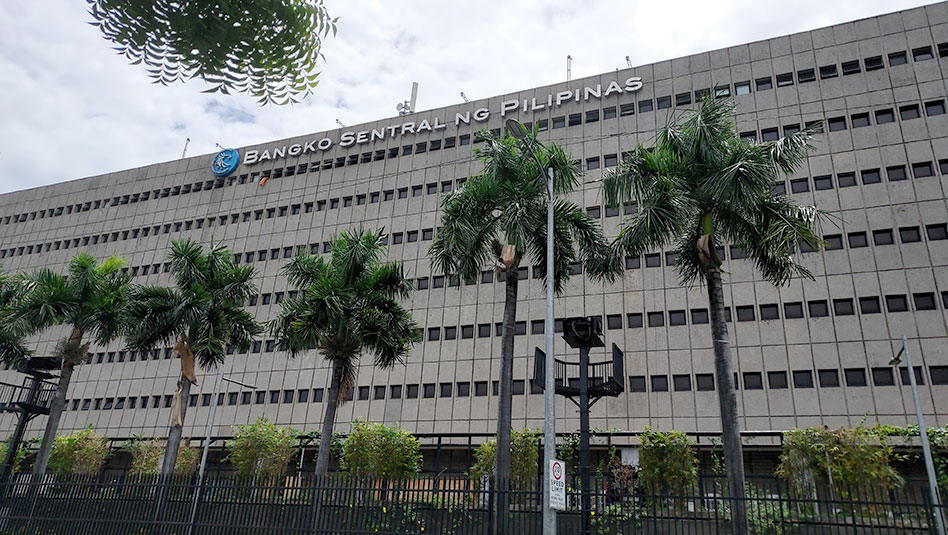
The Bangko Sentral ng Pilipinas (BSP) is likely to maintain a hawkish hold for the rest of the year to support the economy, analysts said.

Diwa C. Guinigundo, the new country analyst for the Philippines of GlobalSource Partners, said consumer prices should not move beyond an average of 3.4% in the fourth quarter to achieve the BSP’s 5.8% full-year forecast. 

“This is going to be tough on both the BSP, which has correctly ruled out any policy rate easing for the rest of the year, and the National Government, which cannot seem to grab the ongoing rice crisis by the horns,” he said in a report dated Oct. 5.

Inflation soared to 6.1% in September, the fastest in five months, from 5.3% in August. Year to date, inflation averaged 6.6%, higher than 5.1% in the same period a year ago and still above the BSP’s recently revised 5.8% forecast for 2023.

“With this latest inflation outturn, and the BSP’s elevated inflation forecasts for this year and the next, we don’t see monetary policy shifting out of a pause, at least not this year,” Mr. Guinigundo said.

He noted that if risks to inflation continue to materialize, it is possible that inflation may go above the BSP’s revised 3.5% forecast for 2024 and could even breach the 2-4% target.

“Supply shocks may be persistent — and this is what we are seeing today. The failure to put in place non-monetary measures lifted the lid, and inflation returned with a vengeance,” he said. 

The Monetary Board has kept the benchmark interest rate at 6.25% since March after hiking borrowing costs by 425 basis points (bps) since May 2022 to tame inflation.

Asked if the Monetary Board would deliver an off-cycle rate increase due to the faster-than-expected September print, BSP Governor Eli M. Remolona, Jr. said in a Viber message on Thursday: “We haven’t decided. We’re still analyzing the data.”

Jeepney fare hike
The implementation of a PHP 1 provisional jeepney fare hike starting on Sunday is seen to add to inflationary pressures.

China Banking Corp. Chief Economist Domini S. Velasquez said the PHP 1 increase in jeepney fares will add about 0.17 percentage point to headline inflation.

“Since oil prices corrected, we hope that this would be the last of the fare hikes. The government can provide well-targeted subsidies to drivers and operators instead so that consumers need not worry of additional fare hikes,” she said.

If non-monetary measures are not enough to bring down headline inflation, the BSP could possibly opt for another rate increase this year, Ms. Velasquez said.

“However, we still think that actions to address supply and not curb demand would be more appropriate. Especially given a modest growth environment,” she said.

She added that the inflation data for October and the third-quarter gross domestic product (GDP) data will be the “deciding factors” at the Monetary Board’s next policy review on Nov. 16. 

Pantheon Macroeconomics Chief Emerging Asia Economist Miguel Chanco said the BSP may pause next month if the third-quarter GDP report would reflect a “technical recession.”   

“Our new base case on rates sees 50-bp worth of cuts in the first quarter of 2024, followed by another 25-bp (cut) in the second quarter,” he said.

Third-quarter GDP data will be released on Nov. 9.

On the other hand, MUFG Global Markets Research Senior Currency Analyst Michael Wan said the higher-than-expected inflation print likely means that the BSP will hike at its next meeting “or even earlier in an off-cycle meeting, on the back of the BSP governor’s forward guidance.”

The Bank of America (BofA) also raised its inflation forecasts for this year to 6.1% (from 5.5% previously) and for 2024 to 3.5% (from 2.8%).

BofA Global Research said in a note dated Oct. 5 the BSP may opt for an off-cycle increase depending on the outcome of the US Federal Reserve’s meeting on Nov. 2 (Manila time), and the October inflation print to be released on Nov. 6.

“In our revised forecasts, a policy rate cut may not happen until the second quarter of 2024 and our year-end 2024 policy rate expectation is now higher at 5.5%, from previously 5.25%,” it added. — Keisha B. Ta-asan

PH raises USD1.26B from retail dollar bonds

PH raises USD1.26B from retail dollar bonds

The Philippine government raised USD 1.26 billion from the first retail dollar bond (RDB) offering under the Marcos administration, the Department of Finance (DoF) said.

“So, we upsized (the offer) from USD 1 billion to USD 1.26 billion and now it’s closed,” Finance Secretary Benjamin E. Diokno said in mixed English and Filipino during a press briefing on Friday.

This was much higher than the minimum issue size of USD 200 million but below the USD 1.6 billion raised at the maiden retail dollar bond auction in 2021, under the administration of then-President Rodrigo R. Duterte.

“I think this is a very good turnout considering the current market conditions. And the fact that we were able to upsize from the initial target of USD 1 billion is actually a very good signal,” Deputy Treasurer Erwin D. Sta. Ana said.

Mr. Diokno said there was a “little bit of a premium” because the government wanted to encourage more overseas Filipino workers (OFW) to invest.

The dollar-denominated five-and-a-half-year bonds fetched a coupon rate of 5.75% and were awarded at rates ranging from 5% to 5.75%, bringing the average to 5.509%.

The coupon was 437.5 basis points (bps) higher than the 1.375% rate of the five-year retail dollar bonds and 350 bps higher than the 2.25% set for the 10-year bonds offered in 2021.

Mr. Sta Ana said that demand for the bonds reached $1.28 billion but the Treasury did not make a full award as it did not accept tenders that went beyond the coupon rate.

“In the auction, we have a cut-off rate. It’s a Dutch auction, so the moment that you cut it at that rate, there goes the corresponding volume,” he said in mixed English and Filipino.

“We did not entertain a higher yield because the other excess demand would actually be beyond the 5.75% coupon. But we priced it at 5.75%, so anything that goes within that volume would be accepted. It was the excess that we did not accept,” he added.

Mr. Sta Ana also noted that the BTr will be able to determine the number of retail investors on the issue date (Oct. 11).

In the last RDB, around 9% of the buyers were retail investors.

The offer period for the retail dollar bonds ran from Sept. 27 to Oct. 6, while the settlement is on Oct. 11 (Wednesday).

The bonds will mature on April 11, 2029 and are also payable every quarter until its maturity.

The government is also planning to launch Sukuk bonds by end-November.   

It is targeting to raise around $1 billion from the Islamic bonds, which will have a minimum denomination of at least $200,000.

This year, the government plans to borrow PHP 2.207 trillion, consisting of PHP 1.654 trillion from domestic and PHP 553.5 billion from foreign sources. — Luisa Maria Jacinta C. Jocson

T-bill, bond rates may climb on BSP bets

T-bill, bond rates may climb on BSP bets

Rates of Treasury bills (T-bills) and bonds on offer this week could rise on expectations of further tightening from the Bangko Sentral ng Pilipinas (BSP) due to faster-than-expected September inflation.

The Bureau of the Treasury (BTr) will auction off PHP 15 billion in T-bills on Monday or PHP 5 billion each in 91-, 182- and 364-day papers.

On Tuesday, it will offer PHP 30 billion in reissued 10-year Treasury bonds (T-bonds) with a remaining life of five years and three months.

T-bill and bond yields may track the increases seen at the secondary market on Friday due to the central bank’s hawkish tone after inflation picked up to a three-month high in September, Rizal Commercial Banking Corp. Chief Economist Michael L. Ricafort said in a Viber message.

At the secondary market on Friday, the 91-, 182-, and 364-day T-bills went up by 0.7 basis point (bp), 2.78 bps, and 4.97 bps week on week to end at 5.7119%, 6.0106%, and 6.2438%, respectively, based on PHP BVAL Reference Rates data published on the Philippine Dealing System’s website.

The five-year bond also rose by 6.68 bps week on week to end at 6.4113%.

“Further unwinding was seen in the GS (government securities) market as players repositioned amid concerns regarding the BSP’s policy move in November and in early 2024 due to a renewed broadening of price pressures,” a trader said in an e-mail.

The trader sees the rate for the five-year T-bond ranging from 6.5% to 6.7%.

Headline inflation picked up a three-month high of 6.1% in September from 5.3% in August, data released by the Philippine Statistics Authority last week showed.

This was slower than the 6.9% print in September 2022, but matched the high end of the BSP’s 5.3-6.1% forecast for the month.

The September consumer price index (CPI) was also above the 5.4% median estimate in a BusinessWorld poll of 17 analysts and marked the 18th consecutive month that inflation exceeded the 2-4% target for the year.

For the first nine months, the CPI averaged 6.6%, above the central bank’s 5.8% forecast for the year.

Following the data release, the BSP said it “stands ready to resume monetary policy tightening as necessary to prevent the renewed broadening of price pressures.”

The central bank last month kept its policy rate unchanged at 6.25% for a fourth straight meeting after raising borrowing costs by 425 bps from May 2022 to March 2023.

The Monetary Board will hold its next policy meeting on Nov. 16. BSP Governor Eli M. Remolona, Jr. earlier said he is open to an off-cycle interest rate hike before next month’s review if inflation risks grow.

T-bond rates could also be affected by latest US jobs data, the trader added.

Nonfarm payrolls increased by 336,000 jobs last month, the US Labor department said on Friday, while data for August was revised higher to show 227,000 jobs were added instead of the previously reported 187,000, Reuters reported.

September’s job numbers were almost double the 170,000 forecast of economists polled by Reuters and shocked a market trying to understand how the US Federal Reserve will address a strong economy and its mission to lower rates to its 2% target.

Last week, the BTr raised just PHP 12.916 billion via the T-bills, short of the PHP 15-billion program, even as total bids reached PHP 27.574 billion.

Broken down, the Treasury made a full PHP 5-billion award of the 91-day T-bills as tenders for the tenor reached PHP 10.01 billion. The average rate of the three-month paper rose by 10.3 bps to 5.698%. Accepted rates ranged from 5.68% to 5.725%

The government also raised PHP 5 billion as planned from the 182-day securities as bids for the tenor reached PHP 9.106 billion. The average rate for the six-month T-bill was at 6.023%, up by 5.5 bps from the previous week, with accepted rates at 5.975% to 6.054%.

Meanwhile, the BTr borrowed only PHP 2.916 billion via the 364-day debt papers, below the PHP 5-billion plan, despite demand for the tenor reaching PHP 8.458 billion. The average rate of the one-year T-bill rose by 9.6 bps to 6.215%. Accepted yields were from 6.15% to 6.25%.

On the other hand, the reissued 10-year bonds to be offered on Tuesday were last auctioned off on Aug. 30, where the government raised PHP 30 billion as planned. The papers fetched an average rate of 6.22%.

The Treasury wants to raise PHP 150 billion from the domestic market this month, or PHP 60 billion via T-bills and PHP 90 billion via T-bonds.

The government borrows from local and foreign sources to help fund its budget deficit, which is capped at 6.1% of gross domestic product this year. — AMCS with Reuters

Peso may strengthen vs dollar

Peso may strengthen vs dollar

The peso could strengthen slightly against the dollar this week on bets of a rate hike from the Bangko Sentral ng Pilipinas’ (BSP) hawkish stance following faster September inflation.

The local unit closed at PHP 56.62 per dollar on Friday, strengthening by five centavos from its PHP 56.67 finish on Thursday, data from the Bankers Association of the Philippines showed.

Week on week, however, the peso weakened by 4.5 centavos from its PHP 56.575 per dollar finish on Sept. 29.

The local currency opened Friday’s session at PHP 56.64 against the dollar. Its weakest showing was at PHP 56.66 while its intraday best was at PHP 56.56 versus the greenback.

Dollars exchanged went down to USD 1.08 billion on Friday from USD 1.23 billion on Thursday.

The peso strengthened on Friday after global crude oil prices continued to decline to new one-month lows, Rizal Commercial Banking Corp. Chief Economist Michael L. Ricafort said in a Viber message.

For this week, the peso could inch up against the dollar amid hawkish BSP bets, Mr. Ricafort said.

BSP Governor Eli M. Remolona, Jr. previously said he is open to an off-cycle rate hike before the Monetary Board’s Nov. 16 meeting if inflation risks persist.

Headline inflation picked up to a three-month high of 6.1% in September from 5.3% in August, but was slower than the 6.9% print in the same month last year.

For the first nine months, the consumer price index averaged 6.6%, above the BSP’s 5.8% forecast for the year.

For this week, Mr. Ricafort sees the peso ranging from PHP 56.45 to PHP 56.85 per dollar. — AMCS

Cautious trading seen amid tightening concerns

Cautious trading seen amid tightening concerns

Trading could be volatile at the Philippine stock market this week amid concerns over possible monetary tightening after headline inflation quickened in September.

The Philippine Stock Exchange index (PSEi) went up by 81.35 points or 1.31% to close at 6,259.95 on Friday, while the broader all shares index added 30.52 points or 0.91% to end at 3,379.27.

Week on week, however, the PSEi dropped by 61.29 points or 0.97% from its close of 6,321.24 on Sept. 29.

For this week, the market is expected to be on a defensive mood following faster September inflation, AB Capital Securities, Inc. Vice-President Jovis L. Vistan said in a Viber message.

“This data may serve as a justification for the Bangko Sentral ng Pilipinas (BSP) to contemplate interest rate hikes, a move closely watched by market participants,” Mr. Vistan said.

Weak macroeconomic indicators could affect the profitability of companies, he added.

Headline inflation quickened to 6.1% in September from 5.3% in August, data released by the Philippine Statistics Authority last week showed.

This was slower than the 6.9% print in September 2022, but matched the high end of the central bank’s 5.3-6.1% forecast.

The September consumer price index (CPI) was also above the 5.4% median estimate in a BusinessWorld poll of 17 analysts and marked the 18th consecutive month that inflation exceeded the 2-4% target for the year.

For the first nine months, the CPI averaged 6.6%, above the central bank’s 5.8% forecast for the year.

Following the data release, the BSP said it “stands ready to resume monetary policy tightening as necessary to prevent the renewed broadening of price pressures.”

The Monetary Board will hold its next policy meeting on Nov. 16.

“While Friday’s move leads us to think that the market may eke out further gains early [this] week, we remain cognizant of potential reactive moves following the release of the September US jobs report,” China Bank Securities Corp. Research Associate Lance U. Soledad said in an e-mail.

Nonfarm payrolls increased by 336,000 jobs last month, the US Labor department said on Friday, while data for August was revised higher to show 227,000 jobs were added instead of the previously reported 187,000, Reuters reported.

September’s job numbers were almost double the 170,000 forecast of economists polled by Reuters and shocked a market trying to understand how the US Federal Reserve will address a strong economy and its mission to lower rates to its 2% target.

“Notwithstanding, we think that potential gains, if any, could be limited ahead of the release of the US inflation reports later in the week,” Mr. Soledad added.

US producer price index data will be released on Oct. 11 and US CPI will come out on Oct. 12.

For this week, Mr. Soledad placed the PSEi’s support at 6,150 and resistance at 6,370-6,420. — SJT with Reuters

Inflation soars to 6.1% in Sept.

Inflation soars  to 6.1% in Sept.

Inflation quickened for a second straight month in September due to a double-digit increase in rice prices, putting pressure on the Bangko Sentral ng Pilipinas (BSP) to resume monetary tightening.

“I think a hike in November is possible but we’re still analyzing the (inflation) data,” BSP Governor Eli M. Remolona, Jr. said in a Viber message.

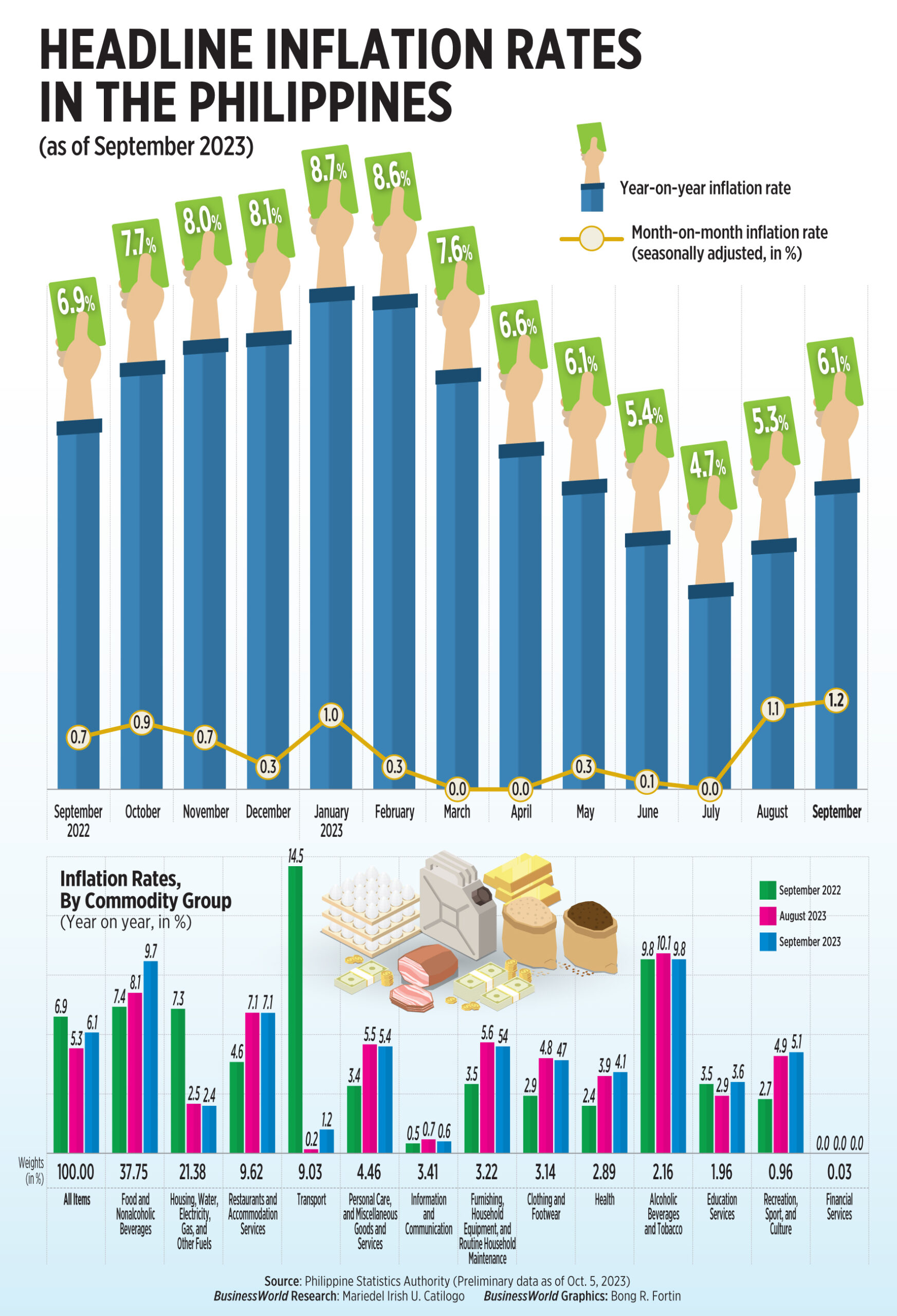
Preliminary data from the Philippine Statistics Authority (PSA) showed headline inflation accelerated to 6.1% in September from 5.3% in August but slowed from 6.9% in September 2022.
The September print was above the 5.4% median in a BusinessWorld poll conducted last week, and also at the upper end of the BSP’s 5.3-6.1% forecast.

The latest consumer price index (CPI) was also the fastest in five months or since the 6.6% in April 2023, and matched the 6.1% logged in May.

September marked the 18th straight month that inflation breached the BSP’s 2-4% target this year.

On a monthly basis, headline inflation inched up by 1.2% in September from 1.1% in August.

This brought nine-month average inflation to 6.6%, higher than 5.1% a year ago and still above the BSP’s recently revised 5.8% forecast for 2023.

The government’s imposition of a price cap on rice starting Sept. 5 appeared to have failed to tame overall inflation in September.

The heavily weighted food and non-alcoholic beverages index rose to a seven-month high of 9.7% in September from 8.1% in August. Food inflation alone soared to 10% from 8.2% a month ago.

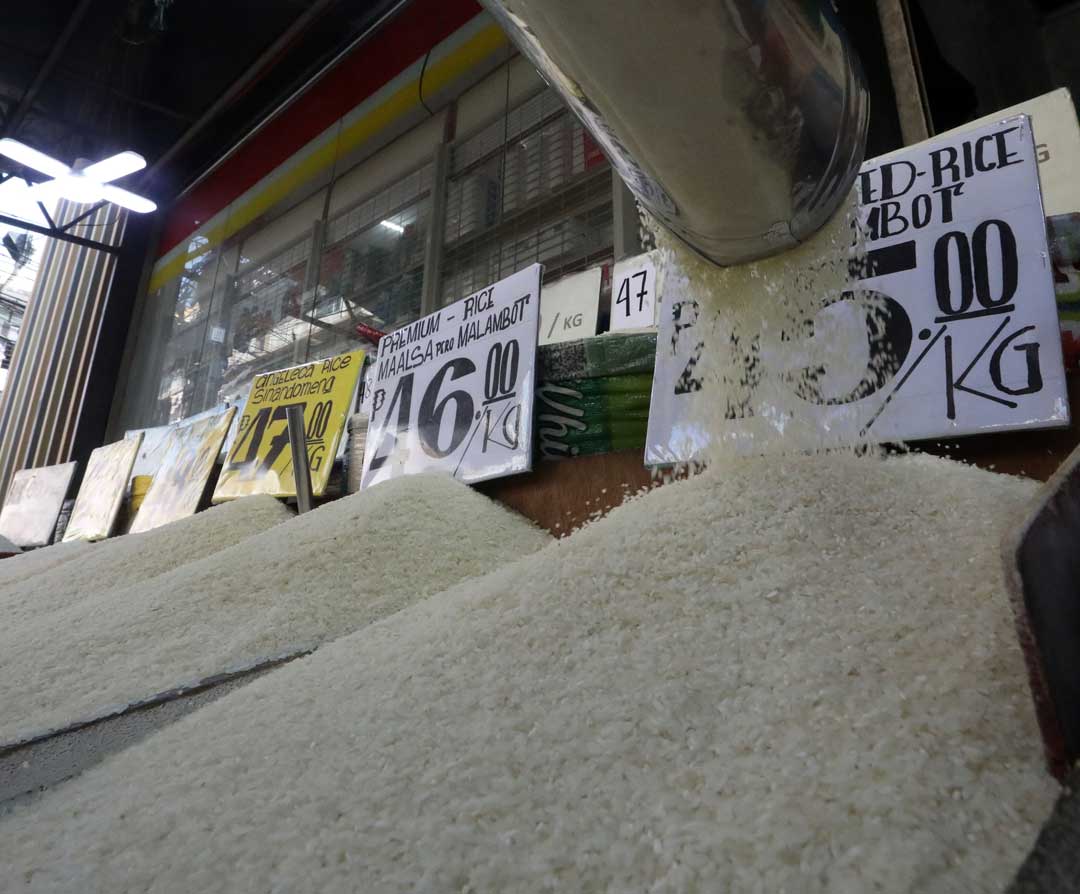
Rice inflation surged to 17.9% in September from 8.7% in August. This is the highest print since March 2009, when rice inflation rose to 22.9%. Rice has the biggest weight in the overall CPI basket at 8.87%.

National Statistician Claire Dennis S. Mapa said at a briefing that rice prices may have increased as many retailers appeared unable to comply with the price ceiling of PHP 41 for regular milled and PHP 45 for well-milled rice.

“The PSA was able to collect (data on) 2,601 regular milled rice varieties in September and we saw that only 640 of these varieties were priced at PHP 41 or below. For well-milled rice, the total number of varieties that we got was 3,498, and 687 or about 20% followed the PHP 45 cap or less,” he said in mixed English and Filipino.

In September, he said the average price of regular milled rice rose to PHP 47.50 per kilogram from PHP 43.30 in August. The average price of well-milled rice also went up to PHP 52.70 per kilogram from an average of PHP 47.63 a month earlier.

ING Bank N.V. Manila Senior Economist Nicholas Antonio T. Mapa said in an e-mail that he expected rice inflation to be “modest” due to the price cap.

“However, it appears that price caps were largely ineffective in keeping a cap on the all-important rice price,” he said,

President Ferdinand R. Marcos, Jr. on Wednesday announced the lifting of the ceiling on domestic rice prices.

Bank of the Philippine Islands (BPI) Lead Economist Emilio S. Neri, Jr. said the contribution of rice to headline inflation doubled to 1.6% in September, accounting for the majority of the jump in inflation.

“The upcoming harvest season for rice may help in stabilizing the price of the commodity. However, local production can only cover around 85% of rice consumption and the country needs to import the rest from abroad,” he said.

Mr. Neri noted that global rice prices have not shown any signs of slowing down so far.

“With the rice export ban of India still in place, the global supply of rice might remain tight in the near term,” he said.

“There is also a spillover impact on other food items whenever the price of rice goes up significantly. It seems other food items tend to follow the price behavior of rice especially those that are considered as substitute for the said staple.”

Meanwhile, core inflation, which discounts volatile prices of food and fuel, eased to 5.9% year on year in September from 6.1% a month ago but still faster than the 5% a year earlier.

Year to date, core inflation averaged 7.2%.

PSA’s Mr. Mapa said headline inflation was also driven by faster increases in transport (1.2% in September from 0.2% in August), health (4.1% from 3.9%), recreation, sport and culture (5.1% from 4.9%), and education services (3.6% from 2.9%).

Inflation in the National Capital Region (NCR) jumped to 6.1% in September, from 5.9% in August, while inflation in the areas outside Metro Manila surged to 6% from 5.2% in the prior month.

Similarly, inflation as experienced by the bottom 30% income households climbed to 6.9% in September from 5.6% in August. It averaged 7.3% in the nine months to September.

The National Economic and Development Authority (NEDA) said the government will continue to support the most vulnerable sectors while implementing measures to mitigate rising prices.

“The government is committed to providing targeted assistance to affected vulnerable segments of the population while food prices remain elevated,” NEDA Secretary Arsenio M. Balisacan was quoted in the statement as saying.

Finance Secretary Benjamin E. Diokno in a statement said the government is “redoubling its efforts” to stabilize inflation.

“The Philippine government is all-hands on deck in ensuring that we have the right policy measures, programs, and monitoring mechanisms in place to arrest rising commodity prices,” he said.

Still within target by end-2023

According to the BSP, inflation is expected to “remain elevated in the coming months” amid supply shocks on food and oil.


“Nonetheless, inflation is still projected to decelerate back to within the inflation target by end-2023 in the absence of further supply shocks,” the central bank said.

However, risks to inflation remain for 2023 to 2025.

“The potential impact of new petitions for transport fare adjustments, higher domestic prices of key food items facing persistent supply constraints, higher-than-expected minimum wage adjustment in areas outside NCR, impact of El Niño weather conditions on food prices and utility rates, and higher electricity rates are the major upside risks to the inflation outlook,” it said.

PSA’s Mr. Mapa said October inflation may be affected by the PHP 1 provisional jeepney fare hike that will be implemented starting Sunday (Oct. 8).

He noted fare hikes directly impact transport inflation as jeepney fare has a weight of 3.5% to the overall CPI basket.

Pantheon Macroeconomics Chief Emerging Asia Economist Miguel Chanco said he raised his 2023 average inflation forecast to 6% from 5.6% previously, in light of September’s “hot print.”

“Our revised near-term outlook now implies that inflation is unlikely to return to the BSP’s 2-4% target range until December, at the earliest, so our call for the start of an easing in policy in the fourth quarter no longer applies,” he said.

“Crucially, the (Monetary) Board won’t be digesting target inflation until its first meeting in Q1 next year. To be clear, we doubt that fresh hikes will be on the table next month either, especially if we’re right about the Q3 gross domestic product (GDP) report revealing a technical recession.”

The PSA will release its third-quarter GDP data on Nov. 9.

The BSP said it is ready to resume monetary policy tightening as necessary “to prevent the renewed broadening of price pressures as well as the emergence of additional second order effects in view of the persistent upside risks to the inflation outlook.”

The BSP has kept its key interest rate at a near 16-year high of 6.25% since March this year. Mr. Remolona earlier said the BSP is considering hiking policy rates if inflationary pressures continue, even hinting at an off-cycle rate hike.

For ING’s Mr. Mapa, the BSP may likely be forced to hike borrowing costs anew.

“We expect the BSP to be monitoring the actions of the Fed closely with a potential off-cycle rate hike carried out but only if the Fed hikes in early November,” he said.

“If the Fed stands pat, the BSP could consider further tightening should their own inflation forecast point to inflation in 2024 threatening the upper end target of 4%,” he said.

The US Federal Reserve kept the target Fed funds rate unchanged at 5.25-5.5% at its meeting last month, but earlier said it would keep rates higher for longer.

The Fed’s next meeting is from Oct. 31 to Nov. 1, while the BSP is scheduled to discuss policy on Nov. 16. — Keisha B. Ta-asan, Reporter


ADB approves USD300M loan to boost financial inclusion

ADB approves USD300M loan to boost financial inclusion

The Asian Development Bank (ADB) on Thursday said it approved a $300-million loan to fund the Philippine government’s initiatives to boost vulnerable sectors’ access to financial services.

In a statement, the multilateral lender said its Inclusive Finance Development Program (Subprogram 3) supports reforms to expand financial inclusion in the Philippines by improving financial infrastructure.

The program also aims to boost the capacity of financial service providers, including rural banks and nonbank financial institutions.

“Through this loan, ADB is expanding its partnership with the Philippines in ensuring all Filipinos will have access to financial products and services, including via digital platforms, to help improve their lives and livelihoods,” ADB Senior Financial Sector Specialist Kelly Hattel was quoted as saying in the statement.

Mr. Hattel said the reforms supported by the ADB loan will ensure the government can extend assistance to the most vulnerable segments during times of crises and emergencies, as well as raise climate resilience of farmers and mi-cro-, small-, and medium-scale businesses through expanded insurance.

Based on the 2021 Global Findex Database, the number of Filipino adults with accounts with financial institutions or mobile money providers stood at 51% of the population in 2021 from 34% in 2017.

The Philippine government wants to raise the number of Filipinos holding an account with financial institutions or mobile money providers to 70% by 2024.

As of Sept. 1, almost 88% of Filipinos are registered under the Philippine Identification System (PhilSys).

The newly approved ADB loan is a continuation of the first and second subprograms of the ADB’s Inclusive Finance Development Program launched in October 2018 and August 2020, respectively.

The ADB is earmarking up to $4 billion worth of loan financing for the Philippines, focused on eight projects and programs.

In 2022, the ADB was the country’s top provider of active official development assistance. This accounted for 33.47% of the total, equivalent to USD 10.85 billion. — L.M.J.C.Jocson

Philippines inflation quickens in September, opens door to further rate hike

Philippines inflation quickens in September, opens door to further rate hike

Philippine inflation quickened for a second straight month in September due to increases in food and transport costs, the statistics agency said on Thursday, opening the door to further central bank interest rate hikes.

The consumer price index rose to 6.1% in September, blowing past the 5.3% forecast in a Reuters poll, and hit the top end of the central bank’s 5.3% to 6.1% projection for the month.

That brought year-to-date average inflation to 6.6%, still outside the central bank’s 2% to 4% target for the year.
Core inflation, which strips out volatile food and fuel items, eased to 5.9% from 6.1% in August.

Ahead of Thursday’s data, Philippine President Ferdinand Marcos Jr lifted a cap on the price of rice, the staple in a country dependent on imports of the grain.

ING Economist Nicholas Mapa said on platform X the central bank would hike rates further in the near term after inflation surpassed expectations.

The central bank, which next meets on Nov. 16, has kept interest rates steady at its last two meetings, but left the door open to further rate hikes to bring inflation back to its target for the year.

The economic planning agency on Thursday said it would recommend extending the lowered tariff rates on rice until December 2024. — Reuters

Peso strengthens on hawkish BSP bets

Peso strengthens on hawkish BSP bets

The peso appreciated against the dollar on Thursday following expectations of a hawkish stance from the Bangko Sentral ng Pilipinas (BSP) after inflation quickened for a second straight month in September.

The local currency closed at PHP 56.67 versus the dollar on Thursday, strengthening by four centavos from Wednesday’s PHP 56.71 finish, data from the Bankers Association of the Philippines’ website showed.

The local unit opened Thursday’s session stronger at PHP 56.60 per dollar. Its intraday best was at PHP 56.59, while its weakest showing was at PHP 56.695 against the greenback.

Dollars traded went down to USD 1.23 billion on Thursday from the USD 1.53 billion on Wednesday.

The peso rose against the dollar on Thursday as faster-than-expected September inflation renewed hawkish BSP bets, Rizal Commercial Banking Corp. Chief Economist Michael L. Ricafort said in a Viber message.

“The peso appreciated as the stronger-than-expected domestic inflation spurred views of potential BSP rate hikes within the year,” a trader likewise said in an e-mail.

Headline inflation picked up a three-month high of 6.1% in September from 5.3% in August, data released by the Philippine Statistics Authority on Thursday showed.

This was slower than the 6.9% print in September 2022, but matched the high end of the BSP’s 5.3-6.1% forecast for the month.

The September consumer price index (CPI) was also above the 5.4% median estimate in a BusinessWorld poll of 17 analysts conducted last week and marked the 18th consecutive month that inflation ex-ceeded the 2-4% target for the year.

For the first nine months, the CPI averaged 6.6%, above the central bank’s 5.8% forecast for the year.

Following the data release, the BSP on Thursday said it “stands ready to resume monetary policy tightening as necessary to prevent the renewed broadening of price pressures.”

The BSP last month kept its policy rate unchanged at 6.25% for a fourth straight meeting after raising borrowing costs by 425 basis points from May 2022 to March 2023.

The central bank will hold its next policy meeting on Nov. 16. BSP Governor Eli M. Remolona, Jr. earlier said he is open to an off-cycle interest rate hike before next month’s review if inflation risks grow.

The peso also appreciated after the dollar weakened from 10-month highs further against other major currencies, Mr. Ricafort added.

For Friday, the trader said the peso could strengthen further against the dollar due to likely weak US nonfarm payrolls data.

The trader sees the peso moving between PHP 55.50 and PHP 55.75 per dollar on Friday, while Mr. Ricafort expects it to range from PHP 56.55 to PHP 56.75. — AMCS

Stocks sink as inflation picks up sharply in Sept.

Stocks sink as inflation picks up sharply in Sept.

Philippine shares slumped on Thursday as headline inflation picked up sharply in September, which could cause the central bank to hike benchmark rates anew.

The Philippine Stock Exchange index (PSEi) went down by 119.60 points or 1.89% to end at 6,178.60 on Thursday, while the broader all shares index dropped by 49.81 points or 1.46% to 3,348.75.

“The unexpectedly high September inflation print poured cold water on investor sentiment and sank the index to its lowest close in over a week,” China Bank Capital Corp. Managing Director Juan Paolo E. Colet said in a Viber message.

“This negative surprise brought selling pressure throughout the trading session and was in stark contrast to the positive performance of most Asian stock markets,” Mr. Colet said.

Philstocks Financial, Inc. Research and Engagement Officer Mikhail Philippe Q. Plopenio noted that this was the second straight month that inflation rose year on year.

“This heightened worries over the local economy as it raised the chances that the BSP (Bangko Sentral ng Pilipinas) will hike rates further,” Mr. Plopenio said in a Viber message.

Headline inflation picked up a three-month high of 6.1% in September from 5.3% in August, data released by the Philippine Statistics Authority on Thursday showed.

This was slower than the 6.9% print in September 2022, but matched the high end of the BSP’s 5.3-6.1% forecast for the month.

The September consumer price index was also above the 5.4% median estimate in a BusinessWorld poll of 17 analysts conducted last week and marked the 18th consecutive month that inflation exceeded the 2-4% target for the year.

For the first nine months, inflation averaged 6.6%, above the central bank’s 5.8% forecast for the year.

The BSP last month kept its policy rate unchanged at 6.25% for a fourth straight meeting after raising borrowing costs by 425 basis points from May 2022 to March 2023.

The central bank will hold its next policy meeting on Nov. 16. BSP Governor Eli M. Remolona earlier said he is open to an off-cycle interest rate hike before next month’s meeting if inflation risks grow.

All sectoral indices dropped on Thursday. Property fell by 64.06 points or 2.44% to 2,555.09; industrials went down by 155.12 points or 1.72% to 8,831.61; mining and oil dropped by 184.98 points or 1.71% to 10,601.28; financials lost 29.52 points or 1.6% to end at 1,810.17; holding firms shed 93.86 points or 1.56% to 5,887.76; and services decreased by 23.67 points or 1.56% to 1,492.

Value turnover went up to PHP 5.43 billion on Thursday with 676.78 million shares changing hands from the PHP 4.68 billion with 733.61 million shares seen on Wednesday.

Decliners outnumbered advancers, 119 versus 67, while 45 shares closed unchanged.

Net foreign selling dropped to PHP 475.80 million on Thursday from PHP 669.83 million on Wednesday. — SJT

Posts navigation

Older posts
Newer posts

Recent Posts

  • Investment Ideas: April 1, 2026
  • Metrobank US-Iran Risk Index: Signals of an end
  • Eye on Earnings: Demand for connection supports telcos
  • Inflation Preview: March madness
  • Investment Ideas: March 31, 2026

Recent Comments

No comments to show.

Archives

  • April 2026
  • March 2026
  • February 2026
  • January 2026
  • December 2025
  • November 2025
  • October 2025
  • September 2025
  • August 2025
  • July 2025
  • June 2025
  • May 2025
  • April 2025
  • March 2025
  • February 2025
  • January 2025
  • December 2024
  • November 2024
  • October 2024
  • September 2024
  • August 2024
  • July 2024
  • June 2024
  • May 2024
  • April 2024
  • March 2024
  • February 2024
  • January 2024
  • December 2023
  • November 2023
  • October 2023
  • September 2023
  • August 2023
  • July 2023
  • June 2023
  • May 2023
  • April 2023
  • March 2023
  • February 2023
  • January 2023
  • December 2022
  • November 2022
  • October 2022
  • September 2022
  • August 2022
  • July 2022
  • June 2022
  • May 2022
  • March 2022
  • December 2021
  • October 2021

Categories

  • Bonds
  • BusinessWorld
  • Currencies
  • Economy
  • Equities
  • Estate Planning
  • Explainer
  • Featured Insight
  • Fine Living
  • How To
  • Investment Tips
  • Markets
  • Portfolio Picks
  • Rates & Bonds
  • Retirement
  • Reuters
  • Spotlight
  • Stocks
  • Uncategorized

You are leaving Metrobank Wealth Insights

Please be aware that the external site policies may differ from our website Terms And Conditions and Privacy Policy. The next site will be opened in a new browser window or tab.

Cancel Proceed
Get in Touch

For inquiries, please call our Metrobank Contact Center at (02) 88-700-700 (domestic toll-free 1-800-1888-5775) or send an e-mail to customercare@metrobank.com.ph

Metrobank is regulated by the Bangko Sentral ng Pilipinas
Website: https://www.bsp.gov.ph

Quick Links
The Gist Webinars Wealth Manager Explainers
Markets
Currencies Rates & Bonds Equities Economy
Wealth
Investment Tips Fine Living Retirement
Portfolio Picks
Bonds Stocks
Others
Contact Us Privacy Notice Terms of Use
© 2026 Metrobank. All rights reserved.

Access this content:

If you are an existing investor, log in first to your Metrobank Wealth Manager account. ​

If you wish to start your wealth journey with us, click the “How To Sign Up” button. ​

Login HOW TO SIGN UP