



MODEL PORTFOLIO
THE GIST
NEWS AND FEATURES
Global Philippines Fine Living
INSIGHTS
INVESTMENT STRATEGY
Economy Stocks Bonds Currencies
THE BASICS
Investment Tips Explainers Retirement
WEBINARS
2024 Mid-Year Economi Briefing, economic growth in the Philippines
2024 Mid-Year Economic Briefing: Navigating the Easing Cycle
June 21, 2024
Investing with Love
Investing with Love: A Mother’s Guide to Putting Money to Work
May 15, 2024
retirement-ss-3
Investor Series: An Introduction to Estate Planning
September 1, 2023
View All Webinars
DOWNLOADS
grocery-2-aa
Inflation Update: Target breached
DOWNLOAD
Container ship carrying container boxes import export dock with quay crane. Business commercial trade global cargo freight shipping logistic and transportation worldwide oversea concept. Generative AI
Economic Updates
Philippines Trade Update: Wider deficit on strong imports
DOWNLOAD
Frick collection with palm trees 
Economic Updates
Policy Rate Updates: Policy rate updates to reassure 
DOWNLOAD
View all Reports
Metrobank.com.ph How To Sign Up
Follow us on our platforms.

How may we help you?

TOP SEARCHES
  • Where to put my investments
  • Reports about the pandemic and economy
  • Metrobank
  • Webinars
  • Economy
TRENDING ARTICLES
  • Investing for Beginners: Following your PATH
  • On government debt thresholds: How much is too much?
  • Philippines Stock Market Outlook for 2022
  • Deficit spending remains unabated

Login

Access Exclusive Content
Login to Wealth Manager
Visit us at metrobank.com.ph How To Sign Up
Access Exclusive Content Login to Wealth Manager
Search
MODEL PORTFOLIO THE GIST
NEWS AND FEATURES
Global Philippines Fine Living
INSIGHTS
INVESTMENT STRATEGY
Economy Stocks Bonds Currencies
THE BASICS
Investment Tips Explainers Retirement
WEBINARS
2024 Mid-Year Economi Briefing, economic growth in the Philippines
2024 Mid-Year Economic Briefing: Navigating the Easing Cycle
June 21, 2024
Investing with Love
Investing with Love: A Mother’s Guide to Putting Money to Work
May 15, 2024
retirement-ss-3
Investor Series: An Introduction to Estate Planning
September 1, 2023
View All Webinars
DOWNLOADS
grocery-2-aa
Inflation Update: Target breached
April 7, 2026 DOWNLOAD
Container ship carrying container boxes import export dock with quay crane. Business commercial trade global cargo freight shipping logistic and transportation worldwide oversea concept. Generative AI
Economic Updates
Philippines Trade Update: Wider deficit on strong imports
March 27, 2026 DOWNLOAD
Frick collection with palm trees 
Economic Updates
Policy Rate Updates: Policy rate updates to reassure 
March 26, 2026 DOWNLOAD
View all Reports

Archives: Business World Article

GDP growth likely slowed in Q4 — poll

GDP growth likely slowed in Q4 — poll

The Philippine economy may have slowed in the fourth quarter of 2023, which likely resulted in gross domestic product (GDP) growth falling below the government’s full-year target, according to analysts.

GDP likely expanded by 5.7% in the October-to-December period in 2023, based on a median forecast of 20 economists polled by BusinessWorld, slower than the 5.9% growth in the third quarter and the 7.1% expansion in the same period in 2022.

The poll also yielded a median estimate growth of 5.5% for the full year of 2023, missing the Development Budget Coordination Committee’s 6-7% GDP growth target.
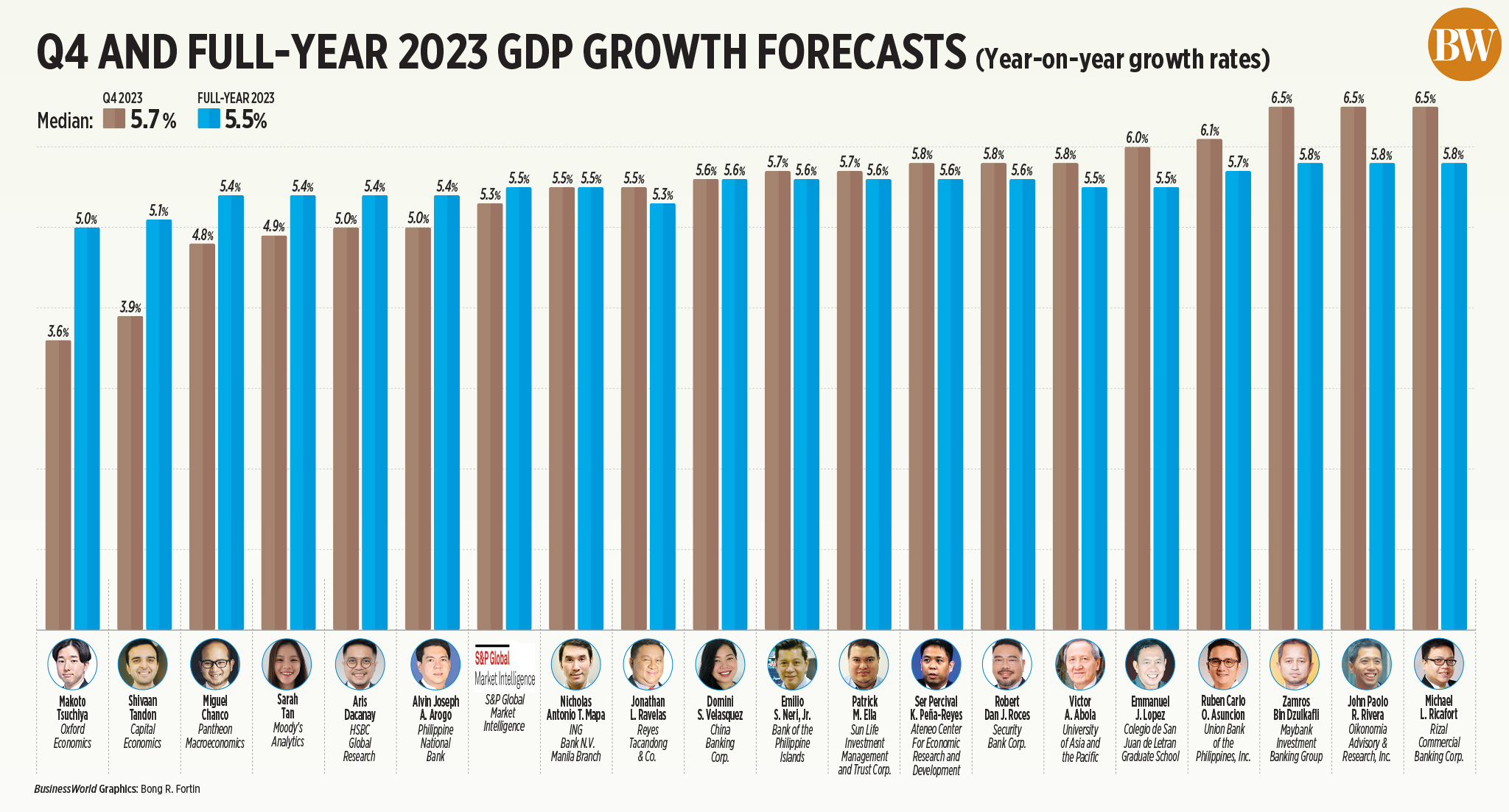
Q4 and Full-year 2023 GDP Growth Forecasts

If realized, the full-year growth estimate for 2023 would be slower than the 7.6% expansion in 2022 and the slowest since the 9.5% contraction in 2020.

The BusinessWorld poll’s 5.5% GDP median estimate for 2023 is lower than the World Bank’s estimate of 5.6% and the Asian Development Bank’s estimate of 5.7% but higher than the International Monetary Fund’s estimate of 5.3%.

The Philippine Statistics Authority (PSA) will release the fourth-quarter and full-year 2023 GDP data on Wednesday (Jan. 31).

Economists said that slower growth in the last three months of 2023 was primarily due to reduced domestic demand and consumer spending.

“The slowdown from the previous quarter was likely due to lower consumer spending and export growth,” Makoto Tsuchiya, economist at Oxford Economics said.

He noted the pent-up demand in certain service sectors is fading, while soft global growth and maturing recovery in the tourism sector led to an export slowdown.

For Zamros Bin Dzulkafli, economist at Maybank Investment Banking Group, the fourth-quarter GDP growth was driven by domestic demand due to ongoing infrastructure projects, a pickup in government spending, and low unemployment rate.

HSBC ASEAN (Association of Southeast Asian Nations) economist Aris Dacanay said that the country is still exposed to a slump in global demand but is expected to be among the fastest-growing economies in the region even with risks tilted to the upside, thanks to the robust and resilient labor force.

In the third quarter of 2023, GDP expanded by 5.9%, due to the pickup in government spending which ended three straight quarters of slowing growth.

Meanwhile, merchandise exports dropped by 0.5% to USD 5.78 billion in December, slower than the 7.5% decline in December 2022. This resulted in exports contracting by 7.6% to USD 73.52 billion in 2023.

Similarly, imports fell by 5.1% to USD 9.79 billion in December, bringing the full-year import haul down by 8.2% to USD 125.95 billion.

This brought the full-year trade deficit to USD 52.42 billion from the USD 57.65-billion gap in 2022, narrowing by 9.1%.

Meanwhile, latest PSA data showed that the unemployment rate slipped to 3.6% in November 2023. This marked the lowest rate of unemployment since April 2005, when the statistics agency revised its definition of unemployment to refer to people aged 15 years and older, who do not have a job, are available for work, and are actively seeking employment.

In November, the number of unemployed Filipinos decreased by 12.3% or 257,000 to 1.83 million from 2.09 million in October 2023.

“We believe that the unhealthy rise in consumer prices and a sharp increase in interest rates weighed down household spending and fixed capital formation,” Alvin Joseph A. Arogo, economist at Philippine National Bank, said in an e-mail.

He also added that government spending and reduced imports cannot sustainably drive a strong rate of economic expansion due to fiscal constraints.

Headline inflation slowed to 3.9% in December bringing the full-year 2023 average to 6%, the highest reading since the 8.2% posted in 2008.

Meanwhile, the central bank kept its benchmark interest rate at a 16-year high of 6.5% in its latest policy meeting. The central bank hiked interest rates by a cumulative of 450 basis points between May 2022 and October 2023 in its efforts to tame inflation.

Due to broad-based weakness, the Philippine economy slowed from the third quarter, said Shivaan Tandon, economist at Capital Economics.

“Admittedly, price pressures eased in the last quarter, which will have supported real incomes. But this is likely to have been partially offset by other factors… Elevated interest rates are also likely to have weighed on domestic demand,” he said in an e-mail exchange.

Sarah Tan, an economist from Moody’s Analytics, said the economy likely expanded by 4.9% in the fourth quarter, supported by the improvement in private consumption due to easing inflation, a tight labor market, and robust remittances.

She added that government agencies ramped up spending by yearend, while a softening global economy likely moderated private investment and trade.

Cash remittances coursed through banks during the January-to-November period grew by 2.8% to USD 30.211 billion, falling below the Bangko Sentral ng Pilipinas’ (BSP) remittance growth projection of 3% for 2023.

Global slowdown
In 2023, Ms. Tan said monetary tightening and the global economic slowdown impacted the Philippine economy.

“High borrowing costs kept Philippine households and businesses cautious in their spending through 2023, capping private consumption and investment growth,” she added.

Miguel Chanco, chief emerging Asia economist at Pantheon Macroeconomics, said that the economy seems to have suffered a general reduction in domestic demand in the fourth quarter, but this may have been offset by a boost in net trade due to a pullback in imports.

He also added that external developments impacted exports, but the main concern was the slowdown in private consumption growth throughout the entire year.

“Monetary policy affects the economy with a lag, and the BSP’s overly aggressive rate hiking cycle, in our view, will continue to depress domestic demand this year, as it did in the last 12 months,” he said.

For Nicholas Antonio T. Mapa, senior economist at ING Bank N.V. Manila, the economy is less reliant on global developments and more driven by domestic factors. He noted GDP could have expanded at a faster pace if the BSP had not hiked interest rates aggressively.

This could have also resulted in a negligible and negative contribution from capital formation during the second and third quarters of 2023.

Gross capital formation — the investment component of the economy — fell by 1.6% in the third quarter of 2023, ending nine straight quarters of growth.

OUTLOOK
For this year, economists expect slower economic growth due to the global slowdown, decelerating inflation, and declining interest rates, among others.

Economic managers target GDP growth to settle within 6.5%-7.5% in 2024.

“We think most of the headwinds will likely persist into 2024. Particularly, the impact of past monetary tightening will continue to weigh on domestic demand even if the BSP pivots to rate cuts during the year, as monetary policy works with lags,” Oxford Economics’ Mr. Tsuchiya said.

He also added that the global economic slowdown will weigh on external demand.

Maybank’s Mr. Dzulkafli said he expects slower growth in the first quarter of 2024 due to elevated food inflation, high-interest rates, and global uncertainty. However, growth is expected to pick up in the second half of the year as the central bank is seen to start cutting policy interest rates.

Ser Percival K. Peña-Reyes, director of the Ateneo Center for Economic Research and Development, said he has a cautious outlook for 2024, adding the economy’s performance would depend on the ability to attract investments.

Domini S. Velasquez, chief economist at China Banking Corp., said that the economy will improve in 2024 due to slowing inflation, monetary easing in the second half of the year, and an increased government budget.

“However, we note that the economy would still have to contend with headwinds such as a global economic slowdown and heightened geopolitical tensions,” she added.

Diwa Guinigundo, Philippines analyst at GlobalSource Partners said that there are still risks to economic growth this year, adding that if geopolitical tensions persist, supply chains may not be mitigated while the drift towards geo-economic fragmentation could weaken international trade.

Resource-wise, he said that the current level of public debt could cause a diversion of public funds from the provision of infrastructure and social services to debt servicing. — By Abigail Marie P. Yraola, Researcher
BSP says ready to hike rates if Q4 growth remained ‘strong’

BSP says ready to hike rates if Q4 growth remained ‘strong’

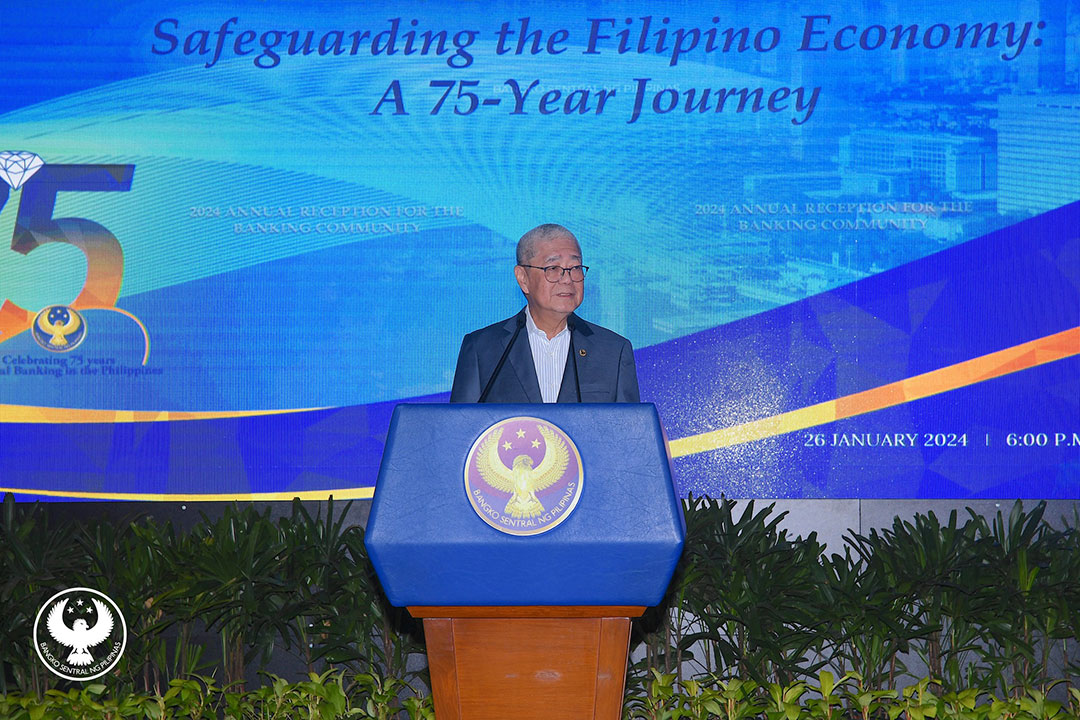
The Bangko Sentral ng Pilipinas (BSP) is ready to deliver more policy rate hikes this year if economic growth picked up in the last quarter of 2023, its governor said on Friday.

BSP Governor Eli M. Remolona, Jr. said fourth-quarter gross domestic product (GDP) may be higher than the 5.9% growth in the third quarter.

“If the growth is strong, that gives us a bit more room to hike,” he told reporters on the sidelines of the 2024 Annual Reception for the Banking Community.

Mr. Remolona said the Philippine central bank is still hawkish despite easing inflation and talks about rate cuts this year.

He noted the Philippine economy could still take on further monetary policy tightening by the BSP.

“But the natural rate, we estimate… is very imprecise. Which means, we could hike and it’s still okay, but we’re not sure because it’s an imprecise (estimate),” he said.

However, gross domestic product (GDP) growth may have slowed down in the fourth quarter of 2023, as a BusinessWorld poll of 20 economists yielded a median forecast of 5.7%.

If realized, this would be slower than the 5.9% growth in the third quarter and the 7.1% expansion in the same period in 2022.

The BusinessWorld poll also yielded a median estimate of 5.5% GDP growth for the entire 2023, missing the Development Budget Coordination Committee’s 6-7% full-year target. This is slower than the 7.6% expansion in 2022 and the slowest since the 9.5% contraction in 2020.

The Philippine Statistics Authority (PSA) will release the fourth-quarter and full-year 2023 GDP data on Jan. 31.

Meanwhile, Mr. Remolona said that a rate cut is possible this year amid easing inflation.

“Yes, it’s possible within the year. But maybe the first semester is too soon. We’ll see,” he said in mixed English and Filipino.

He also noted that inflation will continue to be low in January due to base effects, but inflation may still pick up in the second quarter of this year.   

Based on PSA data, headline inflation eased to a 22-month low of 3.9% in December from 4.1% in November. It marked the first time that inflation eased within the BSP’s 2-4% target after 20 straight months, from a peak of 8.7% in January 2023.

For the full-year, inflation accelerated to 6% in 2023 from 5.8% in 2022. It breached the 2-4% target band for the second straight year amid soaring food and oil prices.

Finance Secretary Ralph G. Recto said borrowing costs may go down this year in the Philippines and in the United States but “nothing is set in stone.”

“We expect interest rates to go down in the second half, but that will depend on the external environment. So far, the market consensus is inflation and interest rates will go down globally, in the US, and in the Philippines,” he said in mixed English and Filipino.

Mr. Recto said policy rate cuts would not only lower the government’s borrowing costs, but it would also be easier for investments to come into the country.

The newly appointed finance chief took his oath as a member of the Monetary Board last week, representing President Ferdinand R. Marcos, Jr.’s Cabinet at the BSP’s highest policy-making body.

The central bank also said the full impact of the Monetary Board’s aggressive tightening may be felt this year, but authorities are still ready to adjust borrowing costs if necessary.

In an open letter to Mr. Marcos, Mr. Remolona said the BSP paused its tightening in the second half last year due to the slowdown in headline and core inflation.

However, when prices and inflation expectations picked up, the BSP responded with an off-cycle rate hike in October 2023. Since then, the Monetary Board has held fire and kept borrowing costs steady.

“The pause in policy interest rate adjustments has allowed the BSP to further observe and assess how firms and households continue to respond to tighter monetary policy conditions, as lagged effects of prior policy interest rate adjustments are expected to manifest fully in 2024,” he said.

The central bank’s key interest rate currently stands at 6.5%, the highest in 16 years. This was after the BSP emerged as the most aggressive central bank in the region after raising key policy rates by 450 basis points (bps) from May 2022 to October 2023.

Mr. Remolona said inflation may settle within the 2-4% of the government in 2024 and 2025, as shown by the central bank’s baseline forecast. The central bank sees inflation averaging 3.7% this year and 3.2% in 2025.

“However, the balance of risks to the inflation outlook continues to be significantly skewed towards the upside for 2024 and 2025,” he said.

The BSP chief said higher transport fares, increased electricity rates, upticks in oil and food prices due to supply constraints, and the impact of a strong El Niño weather event until the second quarter this year are upside risks to the inflation outlook.

“Should these risks materialize, the BSP’s risk-adjusted forecasts indicate that inflation could settle above target at 4.2% in 2024 before reverting towards the target band at 3.4% in 2025,” he said.

Thus, it is crucial for the government to implement non-monetary measures given the upside risks to food and transport prices, Mr. Remolona said.

“On the part of the BSP, we stand ready to adjust monetary policy settings as necessary to mitigate second-round effects and better anchor inflation expectations, as we continue to prioritize safeguarding price stability in line with our primary mandate,” he added.

The BSP will hold its first policy meeting this year on Feb. 15. — By Keisha B. Ta-asan, Reporter

Trade gap narrows by 9% in 2023

Trade gap narrows by 9% in 2023

The country’s trade-in-goods deficit narrowed by 9% in 2023 as exports and imports declined faster than government projections amid slowing demand.

Preliminary data from the Philippine Statistics Authority (PSA) on Friday showed merchandise exports dropped by 7.6% to $73.52 billion, more the revised 4% decline projected by the Development Budget and Coordination Committee (DBCC) for 2023. This was a reversal of the 6.5% growth in 2022.

Imports fell by 8.2% year on year to USD 125.95 billion in 2023, also below the 3% drop expected by the DBCC. It ended two straight years of annual growth in imports.

The full-year trade balance — the difference between the values of exports and imports — narrowed by 9.1% year on year to a USD 52.42-billion deficit from the USD 57.65-billion gap in 2022.

It was the lowest trade gap since the USD 42.19-billion gap recorded in 2021.

“Economic conditions were harder for the country last year. All major economies were moving on a lower growth trajectory and geopolitical tensions were at an escalating stage,” University of Asia and the Pacific (UA&P) Senior Economist Cid L. Terosa said in an email interview.

In December, the trade-in-goods deficit narrowed to USD 4.01 billion from the USD 4.51 billion deficit in the same month in 2022. This was the smallest gap in three months or since the USD 3.57 billion trade balance in September.

Union Bank of the Philippines, Inc. Chief Economist Ruben Carlo O. Asuncion said in a Viber message that the December trade shortfall was better than they expected.

“We expected a deficit of USD 4.6 billion, but actual December data yielded only USD 4 billion,” he said.

This as merchandise exports contracted by 0.5% year on year to USD 5.78 billion, slower than the 7.5% decline seen in the same month in 2022.This was the smallest contraction in four months.

By value, December export haul was the lowest in eight months or since the USD 4.91 billion recorded in April 2023.

Meanwhile, imports contracted by 5.1% to USD 9.79 billion in December, slower than the 9.4% decline in December 2022. The drop in imports December was the fastest in three months or since the 14.1% decline in September.

The import value was the lowest in eight months or since the USD 9.75 billion in April 2023.

“Although exports decline was at a slower pace year-on-year, seasonally adjusted data (month-on-month) was still a sequential decline, confirming persistent external trade weakness. Import performance was also weaker from the revised November print of +1.3% (previously 0%),” Mr. Asuncion said.

On a month-on-month seasonally adjusted basis, exports fell by 2.3% to USD 6.14 billion in December, making it the fourth straight month of contraction, matching the decline in September and the lowest since 10.1% decline in April 2023.

Imports contracted by 4.5% month on month to USD 10.33 billion, the lowest since the 3.3% contraction in September last year.

“December is usually a month when industries and firms close annual production, which makes demand for imported capital goods slower,” Mr. Terosa said.

By commodity, electronic products, which accounted for more than half of total exports, declined by 9.2% to USD 41.90 billion last year.

Semiconductors, which accounted for the bulk of electronic product sales, slipped by 6.4% to USD 33.67 billion.

Meanwhile, other manufactured goods inched up by 1.2% last year to USD 3.97 billion, followed by ignition wiring set and other wiring sets used in vehicles, aircraft and ships (up by 11.8% to USD 2.66 billion).

By import commodities, electronic products also slid by 18.7% to USD 26.63 billion in 2023, with semiconductors down by 21.6% to USD 18.83 billion.

Mineral fuels, lubricants and related materials fell by 16.3% to USD 19.92 billion.

On the other hand, transport equipment went up by 13.9% to USD 12.43 billion last year from USD 10.92 billion in 2022.

The United States was the top export destination for locally made products last year with a 15.7% share worth USD 11.54 billion. Exports to China accounted for a 14.8% share, followed by Japan (14.2%), and Hong Kong (12%).

On the other hand, China remained the country’s biggest source of imports with a 23.3% share worth USD 29.38 billion. Indonesia followed with a 9.1% share (USD 11.51 billion), and Japan with an 8.1% share (USD 10.26 billion).

“[Geopolitical] issues are definite factors largely affecting overall trade sentiment. At this point, our economic players are what you call in economics as ‘price-takers’ and we usually do not have much choice in the international market dynamics, specifically in trade of goods,” Union Bankís Mr. Asuncion said.

Mr. Terosa said the Philippines should continue to pursue trade and market diversification. “I believe diversification is key to successful trade, more than building our competitive and comparative advantages,” he said.

Mr. Asuncion does not see a fast recovery for trade in the short-term as the impact of high interest rates continue to be felt.
“However, we expect the trade balance in 2024 to improve on the back of potential cheaper borrowing costs from a more dovish global central banks including our own,” he added.

The DBCC penciled in 5% and 7% growth for exports and imports, respectively, this year. — B.T.M. Gadon

T-bill, bond rates may rise before Fed meet

T-bill, bond rates may rise before Fed meet

Rates of Treasury bills (T-bills) and Treasury bonds (T-bonds) on offer this week could rise as the market awaits the US Federal Reserve’s policy meeting.

The Bureau of the Treasury (BTr) will auction off PHP 15 billion in T-bills on Monday, or PHP 5 billion each in 91-, 182-, and 364-day papers.

On Tuesday, it will offer PHP 30 billion in reissued three-year T-bonds with a remaining life of two years and 11 months.

Rates of T-bills and T-bonds could track the increases seen at the secondary market last week after the Bangko Sentral ng Pilipinas (BSP) chief said they could keep benchmark borrowing costs steady at their meeting next month, Rizal Commercial Banking Corp. Chief Economist Michael L. Ricafort said in a Viber message.

At the secondary market on Friday, rates of the 91-, 182-, and 364-day T-bills went up by 6.33 basis points (bps), 8.53 bps, and 4.17 bps week on week to end at 5.422%, 5.7508%, and 6.0408% respectively, based on PHP Bloomberg Valuation Service Reference Rates data published on the Philippine Dealing System’s website.

The yield for the three-year bond likewise rose by 6.46 bps to 6.0046%.

BSP Governor Eli M. Remolona, Jr. said last week that the central bank is unlikely to cut rates at their first policy meeting of the year amid lingering upside risks to inflation.

“At this point, a rate cut is not likely (on) Feb. 15,” Mr. Remolona said in mixed English and Filipino, adding that the “numbers we are seeing” show the need to keep policy settings sufficiently tight for some time.   

The Monetary Board hiked borrowing costs by 450 bps from May 2022 to October 2023, bringing the policy rate to a 16-year high of 6.5%.

Meanwhile, the three-year bonds could see good demand as the market awaits the Fed’s policy decision this week, a trader said in an e-mail.

The trader sees the T-bonds on offer fetching rates from 5.95% to 6.05%.

The US central bank is widely expected to keep benchmark rates at the 5.25-5.5% range for a fourth straight meeting during its Jan. 30-31 review.

The Federal Open Market Committee raised borrowing costs by a cumulative 525 bps from March 2022 to July 2023.

Last week, the BTr raised PHP 15 billion as planned via its offering of T-bills as total bids reached PHP 34.985 billion or more than twice the amount on the auction block.

Broken down, the Treasury made a full PHP 5-billion award of the 91-day T-bills as tenders for the tenor reached PHP 11.94 billion. The average rate for the three-month paper went up by 8 bps to 5.306% from the previous week. Accepted rates ranged from 5.275% to 5.5.35%.

The government also raised the programmed PHP 5 billion from the 182-day securities as bids for the tenor reached PHP 10.97 billion. The average rate for the six-month T-bill was at 5.766%, up by 8.1 bps from the prior week’s auction, with accepted rates at 5.743% to 5.795%.

Lastly, the BTr borrowed the programmed PHP 5 billion via the 364-day debt paper as demand for the tenor stood at PHP 12.075 billion. The average rate of the one-year T-bill rose by 3.8 bps to 6.037%. Accepted yields were from 6% to 6.075%.

Meanwhile, the reissued T-bonds to be offered on Tuesday were first offered on Jan. 3, where the government raised PHP 30 billion as planned at a coupon rate of 6% and an average rate of 5.9%.

The Treasury plans to raise PHP 195 billion from the domestic market this month, or PHP 75 billion via T-bills and PHP 120 billion through T-bonds.

Last week’s T-bond auction was the last for January. It raised PHP 130 billion through bonds this month, higher than the PHP 120-billion program, as it held tap facility auctions to accommodate strong demand for long-tenored papers.

Meanwhile, this week’s T-bills offering will be the last one for this month. The BTr has so far raised PHP 66 billion out of the PHp 75-billion borrowing program for T-bills.

For February, the BTr plans to raise PHP 210 billion from the domestic market, or PHP 60 billion in T-bills and PHP 150 billion through T-bonds.

The government borrows from local and foreign sources to help fund its budget deficit, which is capped at 5.1% of gross domestic product this year or PHP 1.39 trillion. — A.M.C. Sy

Yields on government debt end mixed after US GDP

Yields on government debt end mixed after US GDP

Yields on government securities (GS) were mixed last week after the Treasury said it plans to issue retail bonds and following the release of US gross domestic product (GDP) data.

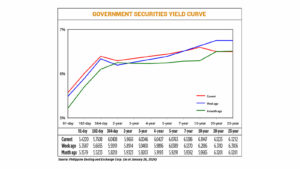
GS yields, which move opposite to prices, went up by an average of 0.18 basis point (bp) week on week, according to the PHP Bloomberg Valuation Service reference Rates as of Jan. 26 published on the Philippine Dealing System’s website.

Rates at the short-end of the curve increased as yields on the 91-, 182-, and 364-day Treasury bills (T-bills) went up by 6.33 bps (to 5.422%), 8.53 bps (5.7508%), and 4.17 bps (6.0408%), respectively.

Yields at the belly likewise climbed, with the two-, three-, four-, five-, and seven-year Treasury bonds (T-bonds) rising by 7.47 bps (to 5.9661%), 6.46 bps (6.0046%), 5.31 bps (6.0427%), 3.74 bps (6.0763%), and 0.16 bp (6.1286%), respectively.

Meanwhile, tenors at the long end saw their rates decline. Rates of the 10-, 20-, and 25-year debt papers fell by 2.39 bps (to 6.1947%), 18.85 bps (6.1225%), and 18.94 bps (6.1212%), respectively.

Total GS volume reached PHP 19.39 billion on Friday, higher than the PHP 12.43 billion on Jan. 19.

“We saw mainly sideways trading [last] week, with traders grappling between the timing of possible rate cuts here and abroad as well as overall expectation of an RTB (retail Treasury bond) issuance after the DoF (Department of Finance) announced its intention to issue,” a bond trader said in a text message.

DoF Secretary Ralph G. Recto said the government plans to issue the 30th tranche of RTBs within this quarter.

In February 2023, the government raised PHP 283.711 billion from its offering of the 29th tranche of 5.5-year RTBs with a coupon rate of 6.125%.

Lower US Treasury yields due to better-than-expected GDP data there affected GS trading last week, Rizal Commercial Banking Corp. Chief Economist Michael L. Ricafort said.

“The benchmark 10-year US Treasury bond yields corrected lower to 4.1%, still among 1.5-month highs, down from the week’s high of 4.2% posted on Jan. 19,” Mr. Ricafort said in a Viber message.

The US economy grew faster than expected in the fourth quarter amid strong consumer spending, and shrugged off dire predictions of a recession after the Federal Reserve aggressively raised interest rates, with growth for the full year coming in at 2.5%, Reuters reported.

Gross domestic product increased at a 3.3% annualized rate last quarter after advancing at a 4.9% pace in the third quarter, the Commerce Department’s Bureau of Economic Analysis said.

Economists polled by Reuters had forecast GDP rising at a 2% rate. Estimates ranged from a 0.8% rate to a 2.8% pace. The economy is expanding at a pace above what Fed officials regard as the non-inflationary growth rate of 1.8%.

Growth last year accelerated from 1.9% in 2022, and was the fastest in two years. From the fourth quarter of 2022 through the fourth quarter of 2023, the economy grew 3.1%, blowing away economists’ estimates for a 0.1% contraction back in December 2022.

For this week, the market will continue to digest the US GDP data as these could affect the Fed’s next move, the trader said.

Market traders are expecting an 89% chance of rate cut in May as the Fed is believed to keep its rates at its policy meeting on Jan. 30-31, according to the CME FedWatch Tool.

The Fed raised borrowing costs by 525 bps to 5.25-5.5% from March 2022 to July 2023.

The release of Philippine GDP data this week may affect GS yield movements, Mr. Ricafort added.

“If GDP data [is] softer, then there is need for earlier and more local policy rate cuts amid easing inflation data and triggered by Fed rate cuts that would be matched locally,” he added.

The Philippine Statistics Authority is set to release fourth quarter and full-year 2023 GDP data on Wednesday. — M.I.U. Catilogo with Reuters

Peso to stay at PHP56 level ahead of PH GDP data

Peso to stay at PHP56 level ahead of PH GDP data

The peso is expected to remain at the PHP 56-per-dollar level this week as the market awaits the release of Philippine gross domestic product (GDP) data and the US Federal Reserve’s policy decision.

The local unit closed at PHP 56.29 per dollar on Friday, strengthening by 24 centavos from its PHp 56.53 finish on Thursday, Bankers Association of the Philippines data showed.

Week on week, the peso weakened by 32 centavos from its PHP 55.97 finish on Jan. 19.

The peso opened Friday’s session at PHP 56.50 against the dollar. Its intraday best was at PHP 56.29, while its weakest showing was at PHP 56.54 versus the greenback.

Dollars exchanged went down to USD 1.38 billion on Friday from USD 1.47 billion on Thursday.

The peso strengthened against the dollar on Friday amid hawkish signals from the Bangko Sentral ng Pilipinas (BSP) chief, Rizal Commercial Banking Corp. Chief Economist Michael L. Ricafort said in a Viber message.

BSP Governor Eli M. Remolona, Jr. said last week that the central bank is unlikely to cut rates at its Feb. 15 meeting amid lingering risks to inflation.

“At this point, a rate cut is not likely (on) Feb. 15,” Mr. Remolona said in mixed English and Filipino, adding that the “numbers we are seeing” show the need to keep policy settings sufficiently tight for some time.   

The Monetary Board hiked borrowing costs by 450 basis points (bps) from May 2022 to October 2023, bringing the key interest rate to a 16-year high of 6.5%.

“[The peso-dollar] pair was supported on dips today, following the robust US GDP data overnight,” Security Bank Corp. Chief Economist Robert Dan J. Roces said in a Viber message on Friday.

The US economy grew faster than expected in the fourth quarter amid strong consumer spending, and shrugged off dire predictions of a recession after the Federal Reserve aggressively raised interest rates, with growth for the full year coming in at 2.5%, Reuters reported.

Gross domestic product increased at a 3.3% annualized rate last quarter after advancing at a 4.9% pace in the third quarter, the Commerce Department’s Bureau of Economic Analysis said.

Economists polled by Reuters had forecast GDP rising at a 2.0% rate. Estimates ranged from a 0.8% rate to a 2.8% pace. The economy is expanding at a pace above what Fed officials regard as the non-inflationary growth rate of 1.8%.

Growth last year accelerated from 1.9% in 2022, and was the fastest in two years. From the fourth quarter of 2022 through the fourth quarter of 2023, the economy grew 3.1%, blowing away economists’ estimates for a 0.1% contraction back in December 2022.

For this week, the peso could stay at the PHP 56 level as the market awaits the release of fourth quarter and full-year 2023 Philippine GDP data, Mr. Roces said.

Philippine economic growth likely slowed in the fourth quarter of 2023 to bring the full-year expansion below the government’s target, analysts polled by BusinessWorld said.

GDP likely grew by 5.7% in the fourth quarter of 2023, based on the median estimate of 20 economists polled by BusinessWorld.

This would be slower than the 5.9% growth logged in the third quarter of 2023 and the 7.1% expansion seen in the same period in 2022.

For 2023, GDP growth may have averaged 5.5%, short of the government’s 6-7% target. This would be well below the 7.6% expansion in 2022.

The market will also await the Fed’s policy decision this week, Mr. Ricafort added.

The US central bank is widely expected to keep the fed funds rate steady at the 5.25-5.5% range during its Jan. 30-31 meeting.

The Federal Open Market Committee raised borrowing costs by a total of 525 bps from March 2022 to July 2023.

Mr. Roces expects the peso to move between PHP 56.20 and PHP 56.80 per dollar this week, while Mr. Ricafort sees it ranging from PHP 56 to PHP 56.50 against the greenback. — A.M.C. Sy with Reuters

BSP to further ease FX transactions

BSP to further ease FX transactions

THE PHILIPPINE central bank is considering further easing documentary requirements for foreign exchange (FX) transactions through changes to its FX manual.

Under a draft circular posted on its website, processing of foreign currency loans, inward investments and other FX transactions filed with the Bangko Sentral ng Pilipinas-International Operations Department will be free of charge.

The central bank may verify if foreign exchange transactions and reports comply with the manual. “A violation of any of the provisions of the FX manual and/or the conditions imposed on the approval/registration/authority issued by the BSP may be grounds for cancellation,” it said.

Stakeholders have until Feb. 2 to comment on the circular.

The BSP monitors foreign portfolio investments registered with it through authorized agent banks and foreign exchange corporations.

Investments need not be registered unless the investor buys foreign currency from banks for conversion to pesos or earnings for remittances.

A BSP registration document must be produced as evidence of the registration of investments to the BSP.

In the draft circular, the central bank revised 15 appendices and annexes of the FX manual and removed the report on interim peso deposits of registered foreign investments.

Authorized agent banks must submit to the central bank a list of existing and valid registration documents within two weeks, the BSP said.

The central bank will give banks until Sept. 30 to continue reporting the transactions of registered investments using the old report forms.

Banks should also “make the necessary preparations and adjustments to their systems and processes to ensure compliance with the new reporting guidelines.”

The central bank is also considering allowing the sale of foreign exchange without the need for BSP approval for nontrade current account transactions.

Other changes include allowing banks and FX companies to sell foreign exchange to tourists or migrant workers returning to the Philippines, called “balikbayan” in Filipino.

“Departing nonresident tourists and balikbayans may reconvert at airports or other ports of exit unspent pesos up to a maximum of USD 10,000 (PHP 565,000) or its equivalent in other foreign currency, calculated at prevailing exchange rates, without showing proof of previous sale of FX for pesos,” the BSP said.

It will also require the registration of debt securities issued by private sector residents.

This investment instrument falls under foreign direct or foreign portfolio investments depending on the degree of control or influence of the investor in the investee firm, the central bank said.

Debt securities are negotiable instruments such as notes, bonds, and convertible notes that serve as evidence of a debt, it said.

“Nonparticipating preferred shares that pay a fixed income but do not provide for participation in the distribution of the residual value of an incorporated enterprise on dissolution, are also classified as debt securities,” it added.

The BSP has undertaken various liberalization measures to ease foreign exchange rules to facilitate transactions of banks, public and private companies, small and medium enterprises, overseas Filipinos, and the public in general, it said earlier.

The liberalization is being undertaken in a well-calibrated manner, giving due consideration to prevailing domestic and international economic and financial conditions, while ensuring that timely prudential mechanisms such as documentary requirements and safeguard measures are in place, it added.

The Philippine central bank has approved and completed 12 rounds of FX policy liberalization since 2007. — Keisha B. Ta-asan

2023 PHL ‘hot money’ swings to net outflow amid high key rates

2023 PHL ‘hot money’ swings to net outflow amid high key rates

FOREIGN PORTFOLIO INVESTMENTS that left the Philippines outweighed those entering in 2023, as rising interest rates and elevated inflation dampened investor sentiment.

Data from the Bangko Sentral ng Pilipinas (BSP) released on Thursday showed foreign portfolio investments registered with the central bank through authorized agent banks posted a net outflow balance of USD 247.3 million (PHP 14 billion) last year, from a net inflow of $886.7 million in 2022.

In December, the so-called “hot money” balance was a USD 205.18-million net outflow, a reversal of the USD 672.86-million net inflow a month earlier and USD 92.95-million net inflow a year ago.

Foreign portfolio investment is called “hot money” because of the ease with which they can enter or leave a jurisdiction, as opposed to foreign direct investment, which is considered less fickle.

Rising borrowing costs globally to combat inflation resulted in hot money outflows last year, particularly due to rate increases from the US Federal Reserve, Robert Dan J. Roces, chief economist at Security Bank Corp. said in a Viber message.

“This made holding assets in emerging markets like the Philippines less attractive to foreign investors, who could get higher returns in developed markets,” he added.

The US central bank hiked the Fed fund rate by 525 basis points (bps) from March 2022 to July 2023 to quell inflation. This brought the Fed’s key rate to 5.25-5.5%.

Concerns over a global recession, supply chain disruptions, geopolitical tensions and slower China growth also dampened investor sentiment last year, which deterred investments in emerging markets, Mr. Roces said. “Domestically, we had elevated inflation as the main challenge,” he said.

Inflation slowed to 3.9% in December from 4.1% in November, settling within the central bank’s 2-4% target for the first time in nearly two years.

But it averaged 6% last year from 5.8% in 2022, the second straight year that inflation breached the BSP’s 2-4% target.

“Add to this the widening current account deficit, which ballooned in 2023, reflecting strong import demand against weaker export earnings,” Mr. Roces said. “This raised concerns about the country’s external balance and potential currency depreciation, leading to some capital flight.”

The BSP posted a current account deficit of USD 10.9 billion in the nine months to September, equivalent to 3.5% of economic output.

BSP data showed gross inflows in December hitting USD 1.07 billion, 1.8% lower year on year, and 31.8% lower than a month earlier.

Over the full year, gross inflows increased by 4.5% to $12.89 billion.

Five countries accounted for 83.3% of short-term foreign investments in December — the United Kingdom, Singapore, the US, Luxembourg and Hong Kong.

About 53% of their investments went to Philippine Stock Exchange-listed shares of banks, holding firms, property, transportation and food producers. The remaining 47.1% was invested in government securities.

In December, gross outflows totaled $1.27 billion, up by 27.1% year on year and by 40.8% higher than November. This brought the full-year gross outflow to $13.13 billion, rising by 14.6% from a year ago.

While continued outflows are possible in the first half of 2024, a return to net inflows could occur if the global economic environment stabilizes and interest rate hikes slow down, Mr. Roces said. Net inflows are also possible if domestic inflation is brought under control and the current account deficit narrows, he added.

The BSP hiked borrowing costs by 450 bps from May 2022 to October 2023, bringing the key interest rate to a 16-year high of 6.5% to tame inflation.

BSP Governor Eli M. Remolona, Jr. earlier said the central bank is unlikely to cut borrowing costs at its meeting on Feb. 15 because rates need to be sufficiently tight amid evolving risks to inflation.

At the December meeting, the BSP’s risk-adjusted inflation forecast stood at 4.2% this year and 3.4% for 2025. Its average inflation baseline forecast is 3.7% for 2024 and 3.2% for next year.

The BSP expects hot money to post a USD 1.7-billion net inflow this year. — Keisha B. Ta-asan

Peso sinks to near 3-month low before US GDP

Peso sinks to near 3-month low before US GDP

THE PESO declined to a near three-month low versus the dollar on Thursday ahead of the release of US gross domestic product (GDP) data.

The local unit closed at PHP 56.53 per dollar on Thursday, weakening by 23 centavos from its PHP 56.30 finish on Wednesday, based on Bankers Association of the Philippines data.

This was the peso’s weakest close since its PHP 56.73 finish on Oct. 31, 2023.

The peso opened Thursday’s session stronger at PHP 56.22 against the dollar. Its intraday best was at PHP 56.16, while its weakest showing was at PHP 56.57 versus the greenback.

Dollars exchanged went up to USD 1.47 billion on Thursday from USD 1.38 billion on Wednesday.

“The peso weakened anew due to some caution ahead of the US GDP report,” a trader said in an e-mail.

Fourth-quarter and full-year 2023 US GDP data were set to be released overnight.

The peso declined amid weak hot money data, Rizal Commercial Banking Corp. Chief Economist Michael L. Ricafort said in a Viber message.

Foreign portfolio investments posted a net outflow of USD 247.3 million last year versus the net inflow of USD 886.7 million in 2022, data from the Bangko Sentral ng Pilipinas showed.

Stronger-than-expected US manufacturing data also weighed on the peso as it reduced expectations of an early rate cut by the US Federal Reserve, Mr. Ricafort added.

For Friday, the trader sees the peso moving between PHP 56.30 and PHP 56.55 versus the dollar, while Mr. Ricafort expects it to range from PHP 56.40 to PHP 56.60.

Shares snap winning run as investors pocket gains

Shares snap winning run as investors pocket gains

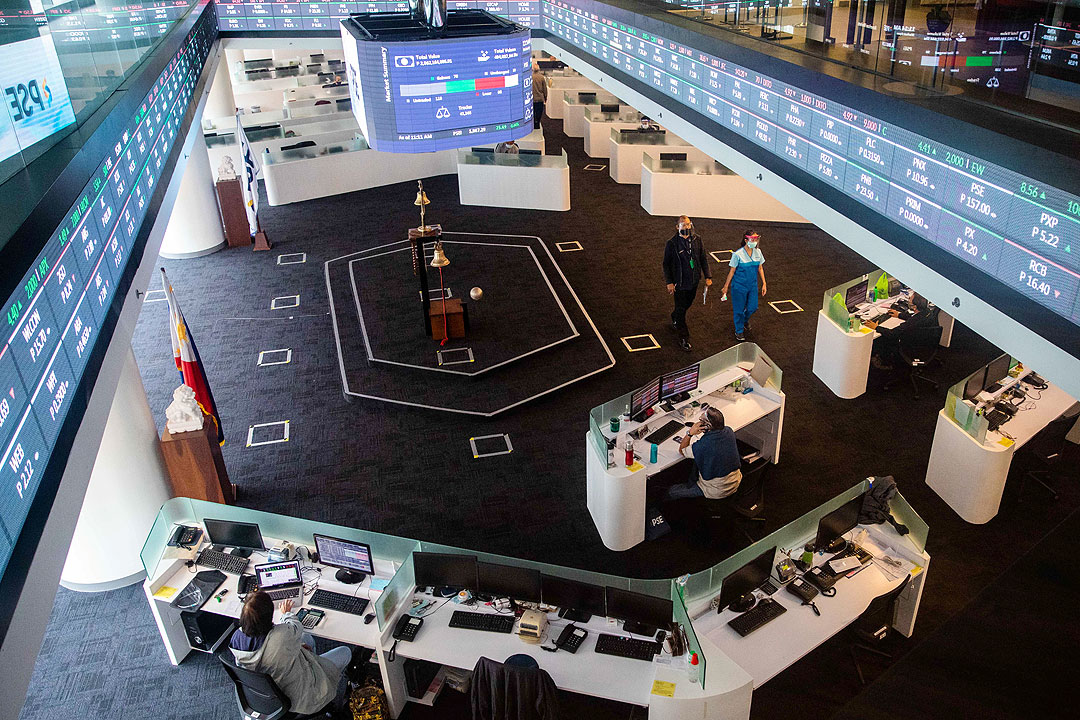
PHILIPPINE SHARES halted their winning run on Thursday as investors pocketed their profits from the rally while awaiting more trading drivers.

The benchmark Philippine Stock Exchange index (PSEi) slipped by 6.46 points or 0.09% to end at 6,673.50 on Thursday, while the broader all shares dropped by 3.25 points or 0.09% to close at 3,508.19.

“This Thursday, the local market inched down by 6.46 points to 6,673.50 as investors took profits after a three-day rally,” Philstocks Financial, Inc. Research and Engagement Officer Mikhail Philippe Q. Plopenio said in a Viber message.

“The bourse seems to have a hard time as it nears the 6,700 resistance level, which may indicate that investors are not yet prepared to get past the said level as reflected by this session’s low net market value turnover…  Also, many are still waiting for a catalyst to emerge,” Mr. Plopenio added. 

Value turnover decreased to PHP 4.88 billion on Thursday with 684.77 million issues switching hands from the PHP 5.64 billion with 343.17 million shares seen the prior day.

The local bourse ended in negative territory as investors looked ahead to the release of the fourth quarter and full-year 2023 US gross domestic product data overnight, Regina Capital Development Corp. Head of Sales Luis A. Limlingan said in a Viber message.

“The world’s largest economy is expected to show growth at a 2% seasonally adjusted annualized pace. That will reflect a slowing from the 4.9% reading in the third quarter of 2023. The results could be a key catalyst for stocks as investors try to glean details on the state of the economy heading into the new year,” Mr. Limlingan said. 

The majority of sectoral indices closed lower on Thursday. Mining and oil went down by 89.88 points or 0.96% to 9,200.41; services retreated by 4.96 points or 0.3% to 1,621.45; holding firms dropped by 18.31 points or 0.28% to 6,352.02; and property declined by 8.14 points or 0.27% to 2,906.88.

On the other hand, industrials rose by 26.97 points or 0.29% to 9,149.35, and financials climbed by 1.33 points or 0.07% to end at 1,885.48.

“Among the index members, Bloomberry Resorts Corp. was at the top, climbing 5.95% to PHP 11.40. International Container Terminal Services, Inc. lost the most, dropping 2.03% to PHP 241,” Mr. Plopenio said. 

Decliners outnumbered advancers, 105 versus 67, while 51 names ended unchanged.

Net foreign buying fell to PHP 80.13 million on Thursday from the PHP 341.09 million recorded on Wednesday.

“Immediate minor support levels are expected at the 6,400-6,510 levels, while immediate major support ranges from 6,215 to 6,310, which could help keep intact the underlying momentum seen over the past two months,” Rizal Commercial Banking Corp. Chief Economist Michael L. Ricafort said in a Viber message. — R.M.D. Ochave

Posts navigation

Older posts
Newer posts

Recent Posts

  • Peso GS Weekly: Geopolitics drive a volatile curve
  • Ask Your Advisor: Can my portfolio survive a market crash?
  • Stock Market Weekly: Middle East stalemate weighs on market 
  • Investment Ideas: April 13, 2026 
  • Metrobank US-Iran Risk Index: Fragile ceasefire 

Recent Comments

No comments to show.

Archives

  • April 2026
  • March 2026
  • February 2026
  • January 2026
  • December 2025
  • November 2025
  • October 2025
  • September 2025
  • August 2025
  • July 2025
  • June 2025
  • May 2025
  • April 2025
  • March 2025
  • February 2025
  • January 2025
  • December 2024
  • November 2024
  • October 2024
  • September 2024
  • August 2024
  • July 2024
  • June 2024
  • May 2024
  • April 2024
  • March 2024
  • February 2024
  • January 2024
  • December 2023
  • November 2023
  • October 2023
  • September 2023
  • August 2023
  • July 2023
  • June 2023
  • May 2023
  • April 2023
  • March 2023
  • February 2023
  • January 2023
  • December 2022
  • November 2022
  • October 2022
  • September 2022
  • August 2022
  • July 2022
  • June 2022
  • May 2022
  • March 2022
  • December 2021
  • October 2021

Categories

  • Bonds
  • BusinessWorld
  • Currencies
  • Economy
  • Equities
  • Estate Planning
  • Explainer
  • Featured Insight
  • Fine Living
  • How To
  • Investment Tips
  • Markets
  • Portfolio Picks
  • Rates & Bonds
  • Retirement
  • Reuters
  • Spotlight
  • Stocks
  • Uncategorized

You are leaving Metrobank Wealth Insights

Please be aware that the external site policies may differ from our website Terms And Conditions and Privacy Policy. The next site will be opened in a new browser window or tab.

Cancel Proceed
Get in Touch

For inquiries, please call our Metrobank Contact Center at (02) 88-700-700 (domestic toll-free 1-800-1888-5775) or send an e-mail to customercare@metrobank.com.ph

Metrobank is regulated by the Bangko Sentral ng Pilipinas
Website: https://www.bsp.gov.ph

Quick Links
The Gist Webinars Wealth Manager Explainers
Markets
Currencies Rates & Bonds Equities Economy
Wealth
Investment Tips Fine Living Retirement
Portfolio Picks
Bonds Stocks
Others
Contact Us Privacy Notice Terms of Use
© 2026 Metrobank. All rights reserved.

Access this content:

If you are an existing investor, log in first to your Metrobank Wealth Manager account. ​

If you wish to start your wealth journey with us, click the “How To Sign Up” button. ​

Login HOW TO SIGN UP