



MODEL PORTFOLIO
THE GIST
NEWS AND FEATURES
Global Philippines Fine Living
INSIGHTS
INVESTMENT STRATEGY
Economy Stocks Bonds Currencies
THE BASICS
Investment Tips Explainers Retirement
WEBINARS
2024 Mid-Year Economi Briefing, economic growth in the Philippines
2024 Mid-Year Economic Briefing: Navigating the Easing Cycle
June 21, 2024
Investing with Love
Investing with Love: A Mother’s Guide to Putting Money to Work
May 15, 2024
retirement-ss-3
Investor Series: An Introduction to Estate Planning
September 1, 2023
View All Webinars
DOWNLOADS
grocery-2-aa
Inflation Update: Target breached
DOWNLOAD
Container ship carrying container boxes import export dock with quay crane. Business commercial trade global cargo freight shipping logistic and transportation worldwide oversea concept. Generative AI
Economic Updates
Philippines Trade Update: Wider deficit on strong imports
DOWNLOAD
Frick collection with palm trees 
Economic Updates
Policy Rate Updates: Policy rate updates to reassure 
DOWNLOAD
View all Reports
Metrobank.com.ph How To Sign Up
Follow us on our platforms.

How may we help you?

TOP SEARCHES
  • Where to put my investments
  • Reports about the pandemic and economy
  • Metrobank
  • Webinars
  • Economy
TRENDING ARTICLES
  • Investing for Beginners: Following your PATH
  • On government debt thresholds: How much is too much?
  • Philippines Stock Market Outlook for 2022
  • Deficit spending remains unabated

Login

Access Exclusive Content
Login to Wealth Manager
Visit us at metrobank.com.ph How To Sign Up
Access Exclusive Content Login to Wealth Manager
Search
MODEL PORTFOLIO THE GIST
NEWS AND FEATURES
Global Philippines Fine Living
INSIGHTS
INVESTMENT STRATEGY
Economy Stocks Bonds Currencies
THE BASICS
Investment Tips Explainers Retirement
WEBINARS
2024 Mid-Year Economi Briefing, economic growth in the Philippines
2024 Mid-Year Economic Briefing: Navigating the Easing Cycle
June 21, 2024
Investing with Love
Investing with Love: A Mother’s Guide to Putting Money to Work
May 15, 2024
retirement-ss-3
Investor Series: An Introduction to Estate Planning
September 1, 2023
View All Webinars
DOWNLOADS
grocery-2-aa
Inflation Update: Target breached
April 7, 2026 DOWNLOAD
Container ship carrying container boxes import export dock with quay crane. Business commercial trade global cargo freight shipping logistic and transportation worldwide oversea concept. Generative AI
Economic Updates
Philippines Trade Update: Wider deficit on strong imports
March 27, 2026 DOWNLOAD
Frick collection with palm trees 
Economic Updates
Policy Rate Updates: Policy rate updates to reassure 
March 26, 2026 DOWNLOAD
View all Reports

Archives: Reuters Articles

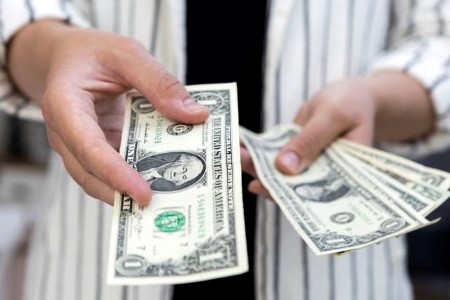
Dollar rises as hot US inflation data seen keeping Fed hawkish

Dollar rises as hot US inflation data seen keeping Fed hawkish

NEW YORK, June 10 (Reuters) – The dollar climbed to a near four-week high against a basket of currencies on Friday, after data showed US consumer prices accelerated in May, strengthening expectations the Federal Reserve may have to continue with interest rate hikes through September to combat inflation.

In the 12 months through May, the CPI increased 8.6% after rising 8.3% in April. Economists had hoped that the annual CPI rate peaked in April.

The inflation report was published ahead of an anticipated second 50 basis points rate hike from the Fed next Wednesday. The US central bank is expected to raise its policy interest rate by an additional half a percentage point in July. It has hiked the overnight rate by 75 basis points since March.

“Inflation is now at a 40-year high with little evidence that it has peaked,” said John Doyle, vice president of dealing and trading at Monex USA.

“Stocks are extending losses on the expectation the Fed could find the scope to speed up rate hikes. The greenback is gaining on policy divergence and risk-off trading,” Doyle said.

The US Dollar Currency Index, which tracks the greenback against six other major currencies, was 0.8% higher at 104.16, its highest since May 17, and within sight of 105.01, the two-decade high touched in mid-May.

For the week, the index was up nearly 2%, its best weekly performance in 6 weeks.

The dollar was up 0.79% against the Swiss franc at 0.9881 francs after the US Treasury Department on Friday said Switzerland continued to exceed its thresholds for possible currency manipulation under a 2015 US trade law, but refrained from branding it a currency manipulator.

With the US inflation data knocking investors’ risk appetite, the risk-sensitive Australian dollar reversed direction to trade down 0.58% on the day.

Sterling fell 1.5% to USD 1.2315 and was set for a second consecutive week of declines as Britain’s gloomy economic outlook left investors on edge.

In cryptocurrencies, bitcoin slipped 3.7% to USD 28,984.33, as the world’s largest digital currency by market value continued to struggle to overcome a bout of selling pressure that has taken it below the USD 30,000 level in recent sessions.

(Reporting by Saqib Iqbal Ahmed; editing by David Evans and Chizu Nomiyama)
 

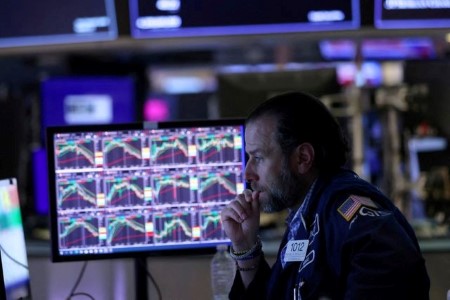
Wall Street unnerved as hot inflation sparks fears of more combative Fed policy

Wall Street unnerved as hot inflation sparks fears of more combative Fed policy

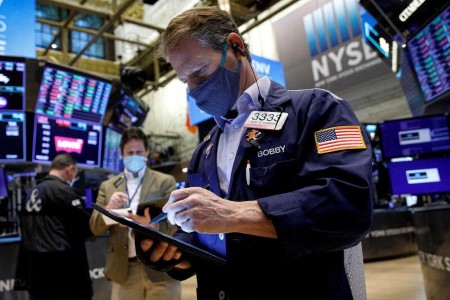
June 10 (Reuters) – US stock indexes slid on Friday as consumer prices rose more than expected in May, dashing hopes that inflation is peaking and fanning worries about more aggressive steps by the Federal Reserve to tame it.

All the 11 major S&P sectors traded lower. Communication services, technology and consumer discretionary sectors declined between 2.5% and 3.2%. Financials and banks lost 2.8%.

The Labor Department’s report showed US consumer price index (CPI) accelerated to 1% in May from 0.3% in April, while on an annual basis it surged 8.6% as gasoline prices hit a record high and the cost of services rose further.

Economists polled by Reuters had forecast the monthly CPI picking up 0.7%.

Core CPI prices, which exclude volatile food and energy products, climbed 6% after a 6.2% rise in April on an annual basis.

“What this likely does is change the calculus for what the Fed might do in September versus what they might do next week,” said Art Hogan, chief market strategist at National Securities, New York.

“By that I mean, you have most-assuredly a 50-basis points (bps) rate hike coming next week … but the wagering on September had been a 50-50 between a 25 bps to a 50 bps hike, and now this has definitely shifted to 50 bps.”

The US Federal Reserve’s policy meeting is due on June 14-15. Investors fear a tight labor market coupled with persistently high inflation could force the Fed to quicken the pace of its pandemic-era policy support withdrawal.

Money markets are now pricing in 50 bps rise in rates by the U.S central bank next week, July and September. A Reuters poll also found economists see no pause in rate rises until next year.

US stocks have sold off sharply this year amid heightened uncertainty around the outlook of Fed’s policy moves, a war in Ukraine, prolonged supply-chain snarls and pandemic-related lockdowns in China.

For the week, all the three major indexes are down between 4.2% and 5.2% as rate-sensitive growth stocks came under pressure from elevated Treasury yields.

At 10:04 a.m. ET, the Dow Jones Industrial Average was down 739.63 points, or 2.29%, at 31,533.16, the S&P 500 .SPX was down 101.07 points, or 2.52%, at 3,916.75, and the Nasdaq Composite was down 346.72 points, or 2.95%, at 11,407.51.

Microsoft Corp. (MSFT) and Apple Inc. (AAPL) dipped 3.6% and 3.3%, respectively, to weigh the most on all the three indexes.

Netflix Inc. (NFLX) slid 5.9% after Goldman Sachs downgraded the streaming giant’s stock to “sell” from “neutral” due to a possibly weaker macro environment.

The CBOE volatility index spiked to 28.41 points, its highest level since May 26.

Declining issues outnumbered advancers for a 10.03-to-1 ratio on the NYSE and for a 5.61-to-1 ratio on the Nasdaq.

The S&P index recorded one new 52-week highs and 38 new lows, while the Nasdaq recorded five new highs and 172 new lows.

(Reporting by Devik Jain, Mehnaz Yasmin and Shreyashi Sanyal in Bengaluru; Editing by Arun Koyyur)


European shares slip ahead of US inflation data

European shares slip ahead of US inflation data

June 10 (Reuters) – European shares on Friday extended losses to a fourth consecutive session, ahead of US inflation data that could spur more speculation about the Federal Reserve’s policy decision next week.

All sectors were trading in red with banks weighing the most in the pan-European STOXX 600 index, which lost 0.7% by 0704 GMT, on course to end the week about 2% lower.

The US Labor Department’s Consumer Price Index is expected to have accelerated to 0.7% last month from 0.3% in April. But when stripped of volatile food and energy products, it is seen cooling a nominal 0.1 percentage point to 0.5%.

The data is due at 1230 GMT on Friday, with growing bets that the US Fed will increase beyond the two 50 bps hike it plans for next week and July.

This comes a day after equities were hammered following the European Central Bank’s clues that it would deliver next month its first interest rate hike since 2011, and a potentially larger move in September.

Among individual stocks, GSK (GSK) jumped 2.4% after the drugmaker said its vaccine for respiratory syncytial virus was successful in a late-stage trial involving older adults.

(Reporting by Susan Mathew in Bengaluru; Editing by Sherry Jacob-Phillips)


Wall Street drops as investor jitters climb before CPI data Friday

NEW YORK, June 9 (Reuters) – US stocks sold off sharply Thursday as investor anxiety heightened ahead of data on Friday that is expected to show consumer prices remained elevated in May.

Selling picked up toward the end of the session. Mega-cap growth stocks led the drop, with Apple Inc. (AAPL) and Amazon.com Inc. (AMZN) falling 3.6% and 4.2%, respectively, and putting the most pressure on the S&P 500 and the Nasdaq.

Communication services and technology had the biggest declines among sectors, although all 11 S&P 500 sectors ended lower on the day.

Adding to nervousness, the benchmark US 10-year Treasury yield climbed to as much as 3.073%, its highest level since May 11.

Recent sharp gains in oil prices also weighed on sentiment before Friday’s US consumer price index report.

“We’re getting prepared for what the news might be regarding inflation tomorrow,” said Peter Tuz, president of Chase Investment Counsel in Charlottesville, Virginia.

“I view it as mixed. If the total is high and the core number shows some sort of drop, I actually think the markets could rally on that because it’ll show that things are kind of rolling over a bit.”

The data is expected to show that consumer prices rose 0.7% in May, while the core consumer price index (CPI), which excludes the volatile food and energy sectors, rose 0.5% in the month.

The Dow Jones Industrial Average fell 638.11 points, or 1.94%, to 32,272.79; the S&P 500 lost 97.95 points, or 2.38%, to 4,017.82; and the Nasdaq Composite dropped 332.05 points, or 2.75%, to 11,754.23.

All three of the major indexes registered their biggest daily percentage declines since mid-May. The S&P 500 is down 15.7% for the year so far and the Nasdaq is down about 25%.

Higher-than-expected inflation readings could increase fears that the US Federal Reserve will raise interest rates more aggressively than previously expected.

The central bank has raised its short-term interest rate by three-quarters of a percentage point this year and intends to keep at it with 50 basis points increases at its meeting next week and again in July.

Alibaba Group (BABA) shares slid 8.1% after its affiliate Ant Group said it has no plan to initiate an initial public offering.

Declining issues outnumbered advancing ones on the NYSE by a 5.51-to-1 ratio; on Nasdaq, a 2.79-to-1 ratio favored decliners.

The S&P 500 posted one new 52-week high and 31 new lows; the Nasdaq Composite recorded 18 new highs and 127 new lows.

Volume on US exchanges was 11.50 billion shares, compared with the 12.07 billion-share average for the full session over the last 20 trading days.

(Additional reporting by Devik Jain and Mehnaz Yasmin in Bengaluru; Editing by Jonathan Oatis)


TIMELINE-China takes steps to ease up on regulatory crackdown as economy slows

July 21 (Reuters) – Chinese authorities imposed a $1.2 billion fine on ride-hailing firm Didi Global Inc, a move that signalled an end to a year-long probe into the ride-hailing firm’s cybersecurity practices. nB9N2XF02H

Here is a timeline of key events underscoring the easing of China’s regulatory crackdown since the beginning of this year:

Feb. 10: China’s cyberspace watchdog said it had held a symposium with domestic technology giants in January which had given the industry a “clearer understanding” of how to pursue development and confidence amid a new regulatory landscape. nL8N2UL0DJ

March 16: Vice-Premier Liu He, China’s economic tsar, urged the introduction of market-friendly policies to support the economy and expressed caution about measures that risked hurting markets. The comments boosted battered shares in China and Hong Kong. nL2N2VJ0Y6

April 11: China’s gaming regulator granted publishing licences for 45 games from developers including Baidu Inc 9888.HK and XD Inc 2400.HK, ending a nine-month freeze.

April 29: China’s powerful Politburo, in a meeting chaired by President Xi Jinping, said it will step up policy support for the economy, including its so-called platform economy – referring to internet platforms such as online marketplaces. nL2N2WR0UQ

May 15: Chinese financial authorities allowed a further cut in mortgage loan interest rates for some home buyers, in another push to prop up its property market and revive a flagging engine of the world’s second-largest economy. nL2N2X70LX

May 16: Authorities asked three financially healthy major private Chinese property developers to issue bonds to help boost market sentiment, two people with direct knowledge of the matter told Reuters. nL2N2X809G

May 24: Financial regulators pledged to keep credit growth stable in the property sector and help home buyers affected by COVID-19 outbreaks to defer mortgage payments, the central bank said in a statement. nB9N2X101L

May 17: Vice-Premier Liu told a meeting convened by China’s top political consultative body that the government supported the development of the technology sector and public listings for such companies. Tech executives who attended the meeting included founders of search engine company Baidu and mobile security software maker 360 Security Technology Inc 601360.SS, known as Qihoo 360. nL2N2X903A

June 7: China’s gaming regulator granted publishing licences for 60 games. nL1N2XU0UZ

June 8: Reuters reported, citing sources, that Didi is in talks with state-backed Sinomach Automobile Co Ltd 600335.SS to buy a third of its electric vehicle unit, signalling the ride-hailer’s regulatory troubles are in the rear view mirror as it focuses on growth. nL8N2XU1XR

June 9: The government gave tentative approval for Ant Group, an affiliate of e-commerce behemoth Alibaba, to revive its initial public offering in Shanghai and Hong Kong, two people told Reuters, the biggest sign yet of a cooling of Beijing’s tough stance on the technology sector. nL1N2XW160

EXCLUSIVE-Beijing gives initial nod to reviving Ant IPO plans in Shanghai, Hong Kong-sourcesnL1N2XW160

QUOTES-China gives Ant Group’s IPO tentative go-aheadnL1N2XW0WM

FACTBOX-Key events in run up to and after Ant Group’s IPO suspensionnL8N2XW2HL

BREAKINGVIEWS-Ant’s board revamp is a promising sign of rehabnL4N2XP0R9

(Reporting by Selena Li in Hong Kong; Editing by Matthew Lewis, Anshuman Daga and Christopher Cushing)

((Selena.Li@thomsonreuters.com; +852 39525868;))

Top US official meets Philippines’ Marcos to boost “longstanding alliance”

MANILA, June 9 (Reuters) – Philippine President-elect Ferdinand Marcos met with a top US official in Manila on Thursday, underscoring efforts to preserve an alliance strained by incumbent leader Rodrigo Duterte’s animosity toward Washington and his embrace of Beijing.

The Philippines is a fulcrum of the geopolitical rivalry between the United States and China. Though the Southeast Asian country has a defence treaty with the United States, their ties were left shaken by Duterte’s recent overtures to China.

Analysts also see Marcos as more favorable to Beijing than Washington, but last month he said he would defend sovereign territory and stand up to Chinese encroachment, in his strongest comments yet on foreign policy.

The Philippines and China have nonetheless clashed over overlapping territorial claims in the South China Sea, a strategic waterway that sees about USD 3 trillion worth of trade pass through it every year.

On Thursday, the Philippines’ foreign affairs ministry protested more than 100 Chinese vessels operating illegally in the waters in and around Julian Felipe Reef, or the Whitsun Reef, located within its 200-mile exclusive economic zone.

Manila called on Beijing to “cease and desist from displaying illegal and irresponsible behaviour, avoid further escalating tensions at sea and immediately withdraw all of its vessels from Philippine maritime zones.”

It came a week after the Philippines announced a diplomatic protest against China unilaterally declaring a South China Sea fishing ban, and nearly two months after Manila complained of harassment and violations of its jurisdiction by Beijing’s coastguard.

China’s embassy in Manila did not immediately respond to a request for comment.

Several countries including the United States have raised concerns over what they see as China’s assertiveness in the region.

US Deputy Secretary of State Wendy Sherman and Marcos discussed regional security, and human rights and the rule of law in the Philippines, the US Embassy in Manila said in a statement.

“We discussed strengthening our longstanding alliance, expanding people-to-people ties, deepening our economic relationship, advancing human rights and preserving a free and open Indo-Pacific,” Sherman said on Twitter.

Marcos, who is set to take office on June 30, has described the Philippines’ relationship with United States as special and “very important.”

But his own relations with it are complicated by a contempt of court order for his refusal to co-operate with the District Court of Hawaii, which in 1995 ordered the Marcos family to pay USD 2 billion of plundered wealth to victims of his namesake father’s rule. He and his mother, Imelda Marcos, also face a USD 353 million fine.

Marcos hasn’t visited the United States for 15 years.

The US Embassy in Manila, without directly addressing Marcos’ case, said: “Under international law, a sitting head of state is granted comprehensive immunity from foreign jurisdiction. Therefore, a president will have immunity from US jurisdiction, including when travelling in the United States.”

(Reporting by Karen Lema and Neil Jerome Morales; Editing by Kanupriya Kapoor)


ADB approves up to USD 4.3 billion loan for Philippine railway project

MANILA, June 9 (Reuters) – The Asian Development Bank (ADB) said on Thursday it has approved a loan of up to USD 4.3 billion for a railway project in the Philippines, a much-needed boost for its ageing rail infrastructure.

From more than 1,100 kilometers (683.5 miles) prior to World War II, the Philippines had only 77 km of operational railway as of 2016, well behind other urban centers across Asia, government data shows.

The 55-kilometer South Commuter Railway project is ADB’s largest infrastructure financing in the Asia and Pacific region to date, the bank’s vice president Ahmed Saeed said in a statement.

The project will halve travel time between Manila and Calamba city in Laguna province, from the current 2.5 hours. The Japan International Cooperation Agency is funding the rolling stock and railway systems.

All ADB-financed infrastructure like civil works for the railway viaduct, 18 stations, bridges, tunnels, and depot buildings will be designed to be disaster-resilient and able to withstand typhoons and earthquakes, according to the statement.

In 2019, the Manila-based lender committed to fund a USD 2.5 billion railway line north of the capital that is currently under construction.

Two railway projects were completed under President Rodrigo Duterte while six are underway and six more have yet to start construction. Upon completion, the Philippines will have 1,209km of railways.

(Reporting by Neil Jerome Morales; Editing by Kanupriya Kapoor)

European shares fall ahead of ECB decision

June 9 (Reuters) – European shares slipped on Thursday ahead of the European Central Bank’s meeting later in the day, with investors awaiting clues on the central bank’s policy tightening plans.

The pan-European STOXX 600 index fell 0.5% by 0709 GMT. The index is set to mark its third straight session of losses.

Money markets have now priced in 75 basis points of hikes from the ECB by October, from earlier expectations of 25 bps hikes at each meeting, as euro zone inflation hit record highs. Data showing strong first-quarter economic growth in the euro zone lent weight to the hawkish bets.

Markets globally weakened ahead of the decision, with new COVID-19 curbs in Shanghai adding to recession worries. Asian shares slipped, US Treasuries fell as did US stock futures, while the safe-haven dollar surged to two-decade highs.

The ECB decision is due at 1145 GMT, followed by a press conference at 1230 GMT.

Losses in Europe were largely broad-based and led by miners, while the energy sector was the sole gainer, up 0.4%. Oil prices cheered China’s stronger-than-expected exports in May but soon gave up gains.

Among stocks, British American Tobacco (BATS) rose 0.8% after it said it was confident in delivering its financial targets irrespective of how long it takes to offload its Russian unit.

(Reporting by Susan Mathew in Bengaluru; editing by Uttaresh.V)


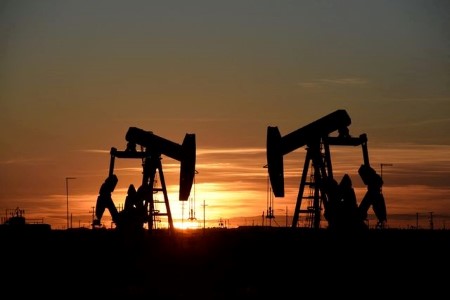
Oil pares gains as new China lockdown measures emerge

Oil pares gains as new China lockdown measures emerge

SINGAPORE, June 9 (Reuters) – Oil prices gave up early gains on Thursday after parts of Shanghai imposed new COVID-19 lockdown measures, outweighing news of China’s stronger-than-expected exports in May.

Brent crude futures for August dipped 15 cents, or 0.1%, to USD 123.43 a barrel at 0630 GMT, while US West Texas Intermediate crude for July was at USD 121.91 a barrel, down 20 cents, or 0.2%.

Both benchmarks closed on Wednesday at their highest since March 8, matching levels seen in 2008.

China’s May exports jumped 16.9% from a year earlier as easing COVID curbs allowed some factories to restart, the fastest growth since January this year and more than double analysts’ expectations.

But while the Chinese trade figures were upbeat, they failed to lift oil prices for long.

“Of far greater importance is news that a district of Shanghai has been locked down today, reviving fears of another leg of China weakness due to its covid-zero policies. That is capping any gains in Asia today,” said Jeffrey Halley, OANDA’s senior market analyst for Asia Pacific.

Parts of Shanghai began imposing new lockdown restrictions on Thursday, with residents of sprawling Minhang district ordered to stay home for two days in a bid to control COVID transmission risks.

“The export performance is impressive in the context of the country’s multi-city lockdowns in the month,” Stephen Innes, managing partner at SPI Asset Management, said in a note Thursday.

“Still, the apparent negative feedback loop is there is less incentive for the authorities to move away from ‘zero COVID’ soon,” Innes said, adding that this was a bit of a saw-off for oil markets.

Meanwhile, peak summer gasoline demand in the United States continued to provide a floor to prices.

The US posted a record fall in strategic crude reserves even as commercial stocks rose last week, data from the Energy Information Administration (EIA) showed on Wednesday.

US gasoline stocks unexpectedly dropped, indicating resilience in demand for the motor fuel during peak summer despite sky-high pump prices.

“It’s hard to see significant downside in the coming months, with the gasoline market likely to only tighten further as we move deeper into driving season,” said ING’s head of commodities research Warren Patterson.

EIA’s data showed that apparent demand for all oil products in the United States rose to 19.5 million barrels per day (bpd) while gasoline demand rose to 8.98 million bpd, ANZ analysts said in a note.

(Reporting by Florence Tan and Jeslyn Lerh; Editing by Shri Navaratnam and Kim Coghill)


S&P 500, Dow fall as Intel slides

S&P 500, Dow fall as Intel slides

June 8 (Reuters) – The Dow and the S&P 500 index slipped in choppy trading on Wednesday, pulled lower by shares of Intel after a bearish brokerage report, while the Nasdaq was propped up by gains in Tesla and Apple.

Eight of the 11 major S&P sectors were lower, with industrials, real estate and consumer staples down between 0.7% and 0.9%, respectively.

Intel (INTC) fell 3.8% and was the biggest drag on the blue-chip and benchmark indexes after Citi Research analysts cautioned that the chipmaker could pre-announce weaker-than-expected earnings for the second quarter.

Altria MO.N, which was also a big drag on the S&P 500, slid 6.7% after a report that Morgan Stanley cut the tobacco company’s stock to “underweight” on competition concerns.

The energy sector was among the gainers, as Brent crude hovered near USD 122 a barrel. The sector has soared 65% this year and is on track for a bumper 2022.

“Investors are concerned with where energy prices are headed. All you’re seeing is people rearranging some positions and to some extent waiting for a better indication that perhaps inflation will come off in recent times,” said Rick Meckler, a partner at Cherry Lane Investments.

“You are just going to see more choppiness, there isn’t really any breakthrough news in the market, both in terms of earnings and economics.”

Against the backdrop of rising borrowing costs, focus this week will be squarely on consumer price index data due on Friday.

A hot reading would likely spook markets already worried about how the US Federal Reserve will balance growth and inflation as it withdraws its pandemic-era policy support to the economy.

The benchmark S&P 500 index has climbed 9% since May 20 after falling as much 20.05% so far this year. It was last down 12.9% for the year. The blue-chip Dow is down 9% and the tech-heavy Nasdaq has shed 22%.

The CBOE volatility index was last trading at 24.20 points, above its long-term average of about 20 points.

At 10:02 a.m. ET, the Dow Jones Industrial Average was down 103.37 points, or 0.31%, at 33,076.77 and the S&P 500 was down 8.79 points, or 0.21%, at 4,151.89.

The Nasdaq Composite was up 28.08 points, or 0.23%, at 12,203.31, boosted by a 4.3% rise in Tesla Inc. (TSLA) shares.

Apple Inc. (AAPL) rose 0.6%, up for the third straight session.

Western Digital Corp (WDC) gained 1.6% after the memory storage devices maker said it was reviewing options, including splitting its flash-memory and HDD businesses.

Declining issues outnumbered advancers for a 1.88-to-1 ratio on the NYSE. Advancing issues outnumbered decliners by a 1.20-to-1 ratio on the Nasdaq.

The S&P index recorded three new 52-week highs and 29 new lows, while the Nasdaq recorded 21 new highs and 31 new lows.

(Reporting by Devik Jain and Mehnaz Yasmin in Bengaluru; Editing by Arun Koyyur)


Posts navigation

Older posts
Newer posts

Recent Posts

  • Metrobank US-Iran Risk Index: Fragile ceasefire 
  • Investment Ideas: April 10, 2026 
  • Metrobank US-Iran Risk Index: A new hope
  • A guide for your peso bond portfolio amid higher for longer rates
  • Investment Ideas: April 8, 2026

Recent Comments

No comments to show.

Archives

  • April 2026
  • March 2026
  • February 2026
  • January 2026
  • December 2025
  • November 2025
  • October 2025
  • September 2025
  • August 2025
  • July 2025
  • June 2025
  • May 2025
  • April 2025
  • March 2025
  • February 2025
  • January 2025
  • December 2024
  • November 2024
  • October 2024
  • September 2024
  • August 2024
  • July 2024
  • June 2024
  • May 2024
  • April 2024
  • March 2024
  • February 2024
  • January 2024
  • December 2023
  • November 2023
  • October 2023
  • September 2023
  • August 2023
  • July 2023
  • June 2023
  • May 2023
  • April 2023
  • March 2023
  • February 2023
  • January 2023
  • December 2022
  • November 2022
  • October 2022
  • September 2022
  • August 2022
  • July 2022
  • June 2022
  • May 2022
  • March 2022
  • December 2021
  • October 2021

Categories

  • Bonds
  • BusinessWorld
  • Currencies
  • Economy
  • Equities
  • Estate Planning
  • Explainer
  • Featured Insight
  • Fine Living
  • How To
  • Investment Tips
  • Markets
  • Portfolio Picks
  • Rates & Bonds
  • Retirement
  • Reuters
  • Spotlight
  • Stocks
  • Uncategorized

You are leaving Metrobank Wealth Insights

Please be aware that the external site policies may differ from our website Terms And Conditions and Privacy Policy. The next site will be opened in a new browser window or tab.

Cancel Proceed
Get in Touch

For inquiries, please call our Metrobank Contact Center at (02) 88-700-700 (domestic toll-free 1-800-1888-5775) or send an e-mail to customercare@metrobank.com.ph

Metrobank is regulated by the Bangko Sentral ng Pilipinas
Website: https://www.bsp.gov.ph

Quick Links
The Gist Webinars Wealth Manager Explainers
Markets
Currencies Rates & Bonds Equities Economy
Wealth
Investment Tips Fine Living Retirement
Portfolio Picks
Bonds Stocks
Others
Contact Us Privacy Notice Terms of Use
© 2026 Metrobank. All rights reserved.

Access this content:

If you are an existing investor, log in first to your Metrobank Wealth Manager account. ​

If you wish to start your wealth journey with us, click the “How To Sign Up” button. ​

Login HOW TO SIGN UP