



MODEL PORTFOLIO
THE GIST
NEWS AND FEATURES
Global Philippines Fine Living
INSIGHTS
INVESTMENT STRATEGY
Economy Stocks Bonds Currencies
THE BASICS
Investment Tips Explainers Retirement
WEBINARS
2024 Mid-Year Economi Briefing, economic growth in the Philippines
2024 Mid-Year Economic Briefing: Navigating the Easing Cycle
June 21, 2024
Investing with Love
Investing with Love: A Mother’s Guide to Putting Money to Work
May 15, 2024
retirement-ss-3
Investor Series: An Introduction to Estate Planning
September 1, 2023
View All Webinars
DOWNLOADS
grocery-2-aa
Inflation Update: Target breached
DOWNLOAD
Container ship carrying container boxes import export dock with quay crane. Business commercial trade global cargo freight shipping logistic and transportation worldwide oversea concept. Generative AI
Economic Updates
Philippines Trade Update: Wider deficit on strong imports
DOWNLOAD
Frick collection with palm trees 
Economic Updates
Policy Rate Updates: Policy rate updates to reassure 
DOWNLOAD
View all Reports
Metrobank.com.ph How To Sign Up
Follow us on our platforms.

How may we help you?

TOP SEARCHES
  • Where to put my investments
  • Reports about the pandemic and economy
  • Metrobank
  • Webinars
  • Economy
TRENDING ARTICLES
  • Investing for Beginners: Following your PATH
  • On government debt thresholds: How much is too much?
  • Philippines Stock Market Outlook for 2022
  • Deficit spending remains unabated

Login

Access Exclusive Content
Login to Wealth Manager
Visit us at metrobank.com.ph How To Sign Up
Access Exclusive Content Login to Wealth Manager
Search
MODEL PORTFOLIO THE GIST
NEWS AND FEATURES
Global Philippines Fine Living
INSIGHTS
INVESTMENT STRATEGY
Economy Stocks Bonds Currencies
THE BASICS
Investment Tips Explainers Retirement
WEBINARS
2024 Mid-Year Economi Briefing, economic growth in the Philippines
2024 Mid-Year Economic Briefing: Navigating the Easing Cycle
June 21, 2024
Investing with Love
Investing with Love: A Mother’s Guide to Putting Money to Work
May 15, 2024
retirement-ss-3
Investor Series: An Introduction to Estate Planning
September 1, 2023
View All Webinars
DOWNLOADS
grocery-2-aa
Inflation Update: Target breached
April 7, 2026 DOWNLOAD
Container ship carrying container boxes import export dock with quay crane. Business commercial trade global cargo freight shipping logistic and transportation worldwide oversea concept. Generative AI
Economic Updates
Philippines Trade Update: Wider deficit on strong imports
March 27, 2026 DOWNLOAD
Frick collection with palm trees 
Economic Updates
Policy Rate Updates: Policy rate updates to reassure 
March 26, 2026 DOWNLOAD
View all Reports

Archives: Reuters Articles

Wall Street mints big gains to end strong week

Wall Street mints big gains to end strong week

June 24 (Reuters) – Wall Street’s main indexes soared on Friday in a broad rally as signs of slowing economic growth and a recent pullback in commodity prices tempered expectations for the Federal Reserve’s rate-hike plans.

The S&P 500 rose over 3% for its biggest one-day percentage rise since May 2020. All 11 of the benchmark index’s sectors ended at least 1.5% higher.

Stocks rebounded this week as financial markets have been roiled over worries that rapid rate hikes by the Fed to rein in 40-year-high inflation could cause a recession.

Still, investors have been gauging when the market might hit its bottom after the benchmark S&P 500 earlier this month recorded a 20% drop from its January closing peak, confirming the common definition of a bear market.

“Some of the moves, the sellers just get exhausted so you don’t have as much capital moving out,” said Shawn Cruz, head trading strategist at TD Ameritrade.

“This might be a little bit of a relief rally,” Cruz said. “But I think I would not encourage anyone to start going in with both hands at the moment, because we have seen this repeatedly where these things can reverse themselves pretty quickly.”

The Dow Jones Industrial Average rose 823.32 points, or 2.68%, to 31,500.68, the S&P 500 gained 116.01 points, or 3.06%, to 3,911.74 and the Nasdaq Composite added 375.43 points, or 3.34%, to 11,607.62.

For the week, the S&P 500 rose 6.4%, the Dow added 5.4%, the Nasdaq gained 7.5%.

Volume surged towards the end of the session as the close of trading marked the completion of FTSE Russell’s reconstitution of its indexes that are tracked by trillions of dollars in investor funds.

US consumer sentiment fell to a record low in June, but Americans saw a marginal improvement in the outlook for inflation, a survey showed on Friday. Data on Thursday pointed to slowing US business activity in June.

Helping ease inflation fears was a sharp drop in commodity prices this week. The Refinitiv/CoreCommodity Index, which measures prices for energy, agriculture, metals and other commodities, fell to a roughly two-month low on Thursday after hitting a multi-year peak earlier in June.

Fed funds futures traders are now pricing for the benchmark rate to rise to about 3.5% by March, down from expectations last week that it would increase to around 4%.

“The expectation of future rate hikes coming down is part of the equation that makes today’s equity market so strong,” said Peter Tuz, president of Chase Investment Counsel in Charlottesville, Virginia.

Bank stocks rallied, with the S&P 500 banks index rising 3.7%, after the Fed’s annual “stress test” exercise showed that the lenders have enough capital to weather a severe economic downturn.

In company news, FedEx Corp. (FDX) shares jumped 7.2% after the parcel delivery company issued a stronger-than-expected full-year profit forecast.

Advancing issues outnumbered declining ones on the NYSE by a 4.66-to-1 ratio; on Nasdaq, a 2.15-to-1 ratio favored advancers.

The S&P 500 posted 1 new 52-week high and 29 new lows; the Nasdaq Composite recorded 34 new highs and 86 new lows.

More than 19 billion shares changed hands in US exchanges, compared with the 12.9 billion daily average over the last 20 sessions.

(Reporting by Lewis Krauskopf and Chuck Mikolajczak in New York, Sruthi Shankar and Anisha Sircar in Bengaluru; Editing by Sriraj Kalluvila and Grant McCool)

 

Oil settles up but posts weekly decline on recession fears

Oil settles up but posts weekly decline on recession fears

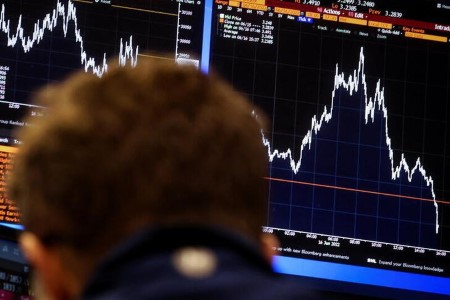
June 24 (Reuters) – Oil prices settled up by more than USD 3 a barrel on Friday, supported by tight supply, but they notched their second weekly decline on concern that rising interest rates could push the world economy into recession.

Brent crude settled up USD 3.07, or 2.8%, at USD 113.12 a barrel by 12:10 p.m. EDT (1610 GMT). US West Texas Intermediate (WTI) crude settled up USD 3.35, or 3.2%, at USD 107.62.

The US Federal Reserve “was talking very hawkish which was undermining the oil rally, but sentiment is changing a little especially on strong economic data,” said John Kilduff, partner at Again Capital LLC in New York.

On Thursday, Fed Chair Jerome Powell said the central bank’s focus on curbing inflation was “unconditional”, adding to fears about more interest rate hikes.

A survey on Friday showed US consumer sentiment hit a record low in June even as the outlook for inflation improved slightly.

Russia’s invasion of Ukraine exacerbated tight supplies this year just as demand has been recovering from the COVID pandemic, and oil came close to an all-time high of USD 147 reached in 2008.

Crude has gained support from the almost total shutdown of output in OPEC member Libya due to unrest. On Thursday, the Libyan oil minister said the National Oil Corporation chairman was withholding production data from him, raising doubts over figures issued last week.

Stephen Brennock of oil broker PVM said recession fears dominated sentiment, yet “the consensus remains that the oil market will see high demand and tight supply over the summer months, thereby limiting the downside.”

The Organization of the Petroleum Exporting Countries and its allies, known as OPEC+, meet on June 30 and are expected to stick to a plan to only slightly accelerate hikes in oil production in July and August.

US energy firms this week added oil and natural gas rigs for a second week in a row in a record 23-month streak of increases, as high crude prices and prodding by the government prompted drillers to return to the wellpad, energy services firm Baker Hughes Co BKR.N said in its closely followed report on Friday.

The latest weekly US oil inventory figures, which will give a snapshot of supply tightness in the top consumer, have been delayed to next week due to technical issues.

(Additional reporting by Alex Lawler in London, Jeslyn Lerh in Singapore; Editing by Marguerita Choy, Jason Neely and David Gregorio)


Wall Street posts solid gains, as defensives, tech shine

Wall Street posts solid gains, as defensives, tech shine

June 23 (Reuters) – Wall Street’s main indexes posted solid gains on Thursday, fueled by strong performance from defensive and tech shares that outweighed declines for economically sensitive groups as worries persisted about a potential recession.

The benchmark S&P 500 swung between positive and negative during the session, but stocks picked up steam heading into the market’s close. Benchmark US Treasury yields fell to two-week lows, supporting tech and other rate-sensitive growth stocks.

Trading has remained volatile in the wake of the S&P 500 last week logging its biggest weekly percentage drop since March 2020. Investors are weighing how far stocks could fall after the index earlier this month fell over 20% from its January all-time high, confirming the common definition of a bear market.

“There is a tremendous amount of uncertainty about the outlook and so the market is confused,” said Walter Todd, chief investment officer at Greenwood Capital in South Carolina.

The Dow Jones Industrial Average rose 194.23 points, or 0.64%, to 30,677.36, the S&P 500 gained 35.84 points, or 0.95%, to 3,795.73 and the Nasdaq Composite added 179.11 points, or 1.62%, to 11,232.19.

In his second day of testifying before Congress, US central bank chief Jerome Powell said the Fed’s commitment to reining in 40-year-high inflation is “unconditional” but also comes with the risk of higher unemployment.

US business activity slowed considerably in June as high inflation and declining consumer confidence dampened demand across the board, a survey on Thursday showed.

“The Fed wants to see things start to slow and the data is starting to reflect that,” said James Ragan, director of wealth management research at D.A. Davidson.

Citigroup analysts are forecasting a near 50% probability of a global recession.

“Economic growth is slowing. Is it going to slow enough to go into a recession, that’s the big question,” Ragan said.

Defensive groups considered safer bets in rocky economic times were the top-performing S&P 500 sectors. Among them, utilities gained 2.4%, healthcare rose 2.2% and real estate added 2%.

The heavyweight tech sector rose 1.4%, with Microsoft (MSFT) gaining 2.3% and Apple (AAPL) up 2.2%.

The energy sector slumped 3.8%, continuing its recent pullback after soundly outperforming the market for most of 2022. Declines in Exxon Mobil XOM.N and Chevron (CVX) were the biggest individual drags on the S&P 500, with Exxon dropping 3% and Chevron falling 3.7%.

Other economically sensitive sectors also fell. Materials lost 1.4%, while industrials and financials dipped about 0.5% each.

Advancing issues outnumbered declining ones on the NYSE by a 1.41-to-1 ratio; on Nasdaq, a 1.67-to-1 ratio favored advancers.

The S&P 500 posted one new 52-week high and 40 new lows; the Nasdaq Composite recorded 32 new highs and 194 new lows.

About 12.4 billion shares changed hands in US exchanges, compared with the 12.5 billion daily average over the last 20 sessions.

(Reporting by Lewis Krauskopf in New York, Devik Jain and Sruthi Shankar in Bengaluru and Boleslaw Lasocki in Gdansk; Editing by Arun Koyyur and Cynthia Osterman)


European stocks skid on gloomy business activity data, German energy troubles

European stocks skid on gloomy business activity data, German energy troubles

June 23 (Reuters) – European shares hit more than one-year lows on Thursday as slowing euro zone business activity heightened growth worries, while German shares dropped 1.8% after the country triggered the “alarm stage” of its emergency gas plan.

The continent-wide STOXX 600 index dropped 0.8%, with euro zone banks shedding 4.5%. Euro zone bond yields also slid as did the euro.

The German DAX slid to over three-month lows as falling Russian supplies prompted Thursday’s move – the latest escalation in a standoff between Europe and Moscow since the Russian invasion of Ukraine that has exposed the bloc’s dependence on Russian gas supplies.

A S&P Global survey showed euro zone business growth significantly slowed this month, and by much more than expected, as consumers concerned about soaring bills opted to stay at home and defer purchases to save money. A PMI covering the bloc’s dominant services industry sank to 52.8 from 56.1.

“There was this underlying expectation that services are still doing well. The PMI’s poured some cold water on that belief,” said Andrea Cicione, head of strategy at TS Lombard.

Other economically sensitive sectors including automakers, miners and oil & gas stocks slipped between 2% and 3.6%.

Healthcare, utilities, and some luxury names were the only gainers on Thursday.

“Until central banks get some signal to pivot towards a more dovish stance, the market will continue to focus on downside risks to growth,” Ciicone said.

The European Central Bank is set to raise its deposit rate above zero next month, while US Federal Reserve Chair Jerome Powell reiterated the US central bank’s commitment to control inflation even at the risk of an economic downturn.

Norway’s central bank raised its benchmark interest rate by 50 basis points on Thursday, its largest single hike since 2002.

But traders are scaling back their bets on how far central banks will be able to lift interest rates this cycle, as recession fears grip.

European shares had briefly cut session losses to edge up tracking a rally in US stock futures before moving back into the red even after a strong open on Wall Street.

The benchmark STOXX 600 has shed nearly 19% since hitting a record closing high on Jan. 5, and if losses continue, the index could confirm a bear market, or 20%, decline from a recent peak.

In company news, Valneva VLS.PA surged 19.6% after its COVID-19 vaccine was endorsed by the European Medicines Agency on Thursday.

(Reporting by Sruthi Shankar in Bengaluru; Editing by Rashmi Aich and Alison Williams)


Foreigners big sellers in Japanese stocks in the week to June 17

Foreigners big sellers in Japanese stocks in the week to June 17

June 23 (Reuters) – Japanese stocks faced massive foreign outflows in the week ending June 17 on rising worries over a recession, with global central banks adopting aggressive monetary tightening measures to fight against inflation.

Foreigners sold Japanese stocks worth a net 1.72 trillion yen ($12.67 billion), which was their biggest disposal since Oct. 1, data from exchanges showed.

They offloaded derivatives worth 913.67 billion yen and 804.5 billion yen in cash equities.

Last week, the U.S. Federal Reserve raised interest rates by 75 basis points in its biggest increase since 1994.

The Nikkei share average .N225 plunged 6.7% last week, which marked its steepest decline since early-April 2020, while the Topix index saw a 5.5% fall.

Meanwhile, cross-border investors disposed of Japanese bonds worth a net 3.51 trillion yen, which marked their biggest net selling in 12 weeks, finance ministry data showed.

Domestic investors also withdrew 497.8 billion yen out of overseas bonds in a fourth consecutive week of net selling, but they had minute purchases in foreign equities, amounting 9.7 billion yen.

(Reporting by Gaurav Dogra and Patturaja Murugaboopathy in Bengaluru; Editing by Tomasz Janowski)

Oil prices slump as investors fear Fed rate hikes will hurt demand

Oil prices slump as investors fear Fed rate hikes will hurt demand

NEW YORK, June 23 (Reuters) – Oil prices dropped by nearly USD 2 a barrel on Thursday after another round of remarks from Federal Reserve Chair Jerome Powell fanned worries US interest rate hikes would slow economic growth.

Brent crude futures settled at USD 110.05 a barrel, falling USD 1.69, or 1.5%. US West Texas Intermediate (WTI) crude futures settled at USD 104.27 a barrel, down USD 1.92, or 1.8%.

Powell said the Fed’s focus on curbing inflation was “unconditional” and the labor market was unsustainably strong, comments that stoked fears of more rate hikes.

Investors have been paring positions in risky assets as they assess whether inflation-fighting central banks could push the world economy into recession with higher interest rates.

“If the US, and the rest of the world goes into a recession, you can significantly impact demand,” said Houston oil consultant Andrew Lipow.

Also, high gasoline prices could be starting to slow demand, said Robert Yawger, director of energy futures at Mizuho in New York.

“That’s definitely worked its way into the conversation,” said Yawger, adding he thought gasoline still had room to rise. US retail prices are currently averaging USD 4.94 a gallon, down about 10 cents from the peak, according to AAA.

Major US oil refiners and Energy Secretary Jennifer Granholm emerged from an emergency meeting over the issue with no concrete solutions to lower prices, according to a source familiar with the discussions, but the two sides agreed to work together.

The most recent estimates by the American Petroleum Institute, according to market sources, showed US crude and gasoline inventories rising last week, which also weighed on prices, Yawger said.

Official weekly estimates for US oil inventories were scheduled to be released on Thursday but technical problems will delay those figures until next week, the US Energy Information Administration said, without giving a specific timeline.

OPEC and allied producing countries including Russia will likely stick to a plan for accelerated output increases in August in hopes of easing crude prices and inflation as US President Joe Biden plans to visit Saudi Arabia, sources said.

The group known as OPEC+ agreed at its last meeting on June 2 to boost output by 648,000 barrels a day in July, or 7% of global demand, and by the same amount in August, up from the initial plan to add 432,000 bpd a month over three months until September.

(By Laila Kearney. Additional reporting by Ahmad Ghaddar in London, Yuka Obayashi in Tokyo and Muyu Xu in Singapore; Editing by David Goodman, Barbara Lewis and David Gregorio)


Oil extends losses as recession fears mount

Oil extends losses as recession fears mount

TOKYO, June 23 (Reuters) – Oil prices fell 2% in early trade on Thursday, extending losses from the previous day, as investors worried that aggressive US interest rate hikes could trigger a recession and dent fuel demand.

US West Texas Intermediate (WTI) crude futures fell USD 2.39, or 2.3%, to USD 103.80 a barrel by 0031 GMT. Brent crude futures dropped USD 2.24, or 2.0%, to USD 109.50 a barrel.

Both benchmarks tumbled around 3% on Wednesday to hit their lowest levels since mid-May.

Investors are continuing to assess how worried they need to be about central banks potentially pushing the world economy into recession as they attempt to curb inflation with interest rate increases.

“Oil markets remained under pressure as investors were concerned that US rate hikes would stall an economic recovery and dampen fuel demand,” said Kazuhiko Saito, chief analyst at Fujitomi Securities Co Ltd.

“The US and European hedge funds have been selling off their positions ahead of the end of the second quarter, which is also cooling investor sentiment,” he said, predicting the WTI could fall below USD 100 a barrel before the July 4 holiday in the United States.

The Federal Reserve is not trying to engineer a recession to stop inflation but is fully committed to bringing prices under control even if doing so risks an economic downturn, US central bank chief Jerome Powell said on Wednesday.

US President Joe Biden, meanwhile, called on Congress to pass a three-month suspension of the federal gasoline tax to help combat record pump prices and provide temporary relief for American families this summer.

“The news temporarily boosted the oil product prices, but it was later viewed that even if the gasoline tax was suspended, retail prices would remain high, making it difficult to stimulate demand,” Fujitomi’s Saito said.

The US Energy Information Administration said its weekly oil data, which was scheduled for release on Thursday, will be delayed due to systems issues until at least next week.

(Reporting by Yuka Obayashi; editing by Richard Pullin)

Why is there a worldwide oil-refining crunch?

June 22 (Reuters) – Drivers around the world are feeling pain at the pump with fuel prices soaring, and costs are surging for heating buildings, power generation and industrial production.

Prices were already elevated before Russia invaded Ukraine on Feb. 24. But since mid-March, fuel costs have surged while crude prices are up only modestly. Much of the reason is a lack of adequate refining capacity to process crude into gasoline and diesel to meet high global demand.

HOW MUCH CAN THE WORLD REFINERIES PRODUCE DAILY?

Overall, there is enough capacity to refine about 100 million barrels of oil a day, according to the International Energy Agency, but about 20% of that capacity is not useable. Much of that unusable capacity is in Latin America and other places where there is a lack of investment. That leaves somewhere around 82-83 million bpd in projected capacity.

HOW MANY REFINERIES HAVE CLOSED?

The refining industry estimates that the world lost a total of 3.3 million barrels of daily refining capacity since the start of 2020. About a third of these losses occurred in the United States, with the rest in Russia, China, and Europe. Fuel demand crashed early in the pandemic when lockdowns and remote work were widespread. Before that, refining capacity had not declined in any year for at least three decades.

WILL REFINING PICK UP?

Global refining capacity is set to expand by 1 million bpd per day in 2022 and 1.6 million bpd in 2023.

HOW MUCH HAS REFINING DECLINED SINCE BEFORE THE PANDEMIC?

In April, 78 million barrels were processed daily, down sharply from the pre-pandemic average of 82.1 million bpd. The IEA expects refining to rebound during the summer to 81.9 million bpd as Chinese refiners come back online.

WHERE IS MOST REFINING CAPACITY OFFLINE, AND WHY?

The United States, China, Russia and Europe are all operating refineries at lower capacity than before the pandemic. US refiners shut nearly one million bpd of capacity since 2019 for various reasons.

Nearly 30% of Russia’s refining capacity was idled in May, sources told Reuters. Many Western nations are rejecting Russian fuel.

China has the most spare refining capacity, refined product exports are only allowed under official quotas, mainly granted to large state-owned refining companies and not to smaller independent companies that hold much of China’s spare capacity.

As of last week, run rates at China’s state-backed refineries averaged around 71.3% and independent refineries were around 65.5%. That was up from earlier in the year, but low by historic standards.

WHAT ELSE IS CONTRIBUTING TO HIGH PRICES?

The cost to carry products on vessels overseas has risen due to high global demand, as well as sanctions on Russian vessels. In Europe, refineries are constrained by high prices for natural gas, which powers their operations.

Some refiners also depend on vacuum gasoil as an intermediate fuel. Loss of Russian vacuum gasoil has prevented certain from restarting certain gasoline-producing units.

WHO IS BENEFITING FROM THE CURRENT SITUATION?

Refiners, especially those that export a lot of fuel to other countries, such as US refiners. Global fuel shortages have boosted refining margins to historic highs, with the key 3-2-1 crack spread nearing USD 60 a barrel. That has driven big profits for US-based Valero and India-based Reliance Industries (RELI).

India, which refines more than 5 million bpd, according to the IEA, has been importing cheap Russian crude for domestic use and export. It is expected to boost output by 450,000 by year-end, the IEA said.

More refining capacity is set to come online in the Middle East and Asia to meet growing demand.

(Reporting by Laura Sanicola; Editing by David Gregorio)

China’s yuan weakens ahead of Fed Chair Powell’s testimony

SHANGHAI, June 22 (Reuters) – China’s yuan weakened on Wednesday ahead of Federal Reserve Chair Jerome Powell’s testimony to Congress later in the day, with traders looking for further clues on how aggressively the Fed will hike rates at its July meeting and beyond.

The People’s Bank of China set the midpoint rate at 6.7109 per dollar prior to the market open, weaker than the previous fix 6.6851.

In the spot market, the yuan opened at 6.6946 per dollar and was changing hands at 6.7160 at midday, 250 pips or 0.37% weaker than the previous late session close.

“Any hawkish deviation from previous communicated messaging could un-nerve sentiment and send UST yields and USD rising again,” Maybank analysts said in a note, referring to Powell’s testimony.

The yuan has stabilized over the past month, following a slump in April and early May on concerns over the economic damage from China’s widespread COVID-19 lockdowns and the fallout from the Russia-Ukraine crisis.

“While there could be some relief for the yuan on signs that the Covid situation may be under control, the overarching zero-Covid strategy could continue to hurt the recovery of private consumption and investment,” Maybank analysts said.

“Gains may be capped in the face of recovery uncertainties,” they added, expecting the currency may continue to remain within the 6.60-6.80 range.

“There is still some depreciation room for the yuan due to the negative China-US yield spread, and China’s exports are also slowing with the slowing US PMI,” said Max Luo, Director of Asset Allocation China at UBS Asset Management.

“In the mid-term, the yuan will gradually depreciate owing to those two reasons, while the market’s focus is on COVID recently.”

US President Joe Biden is considering scrapping tariffs on a range of Chinese goods to curb inflation, but no decision is likely before next week’s Group of Seven summit, people familiar with the matter said.

The global dollar index rose to 104.597 from the previous close of 104.435. The offshore yuan was trading at 6.718 per dollar.

(Reporting by Shanghai Newsroom; Editing by Kim Coghill)

US stocks jump 2% after recent selloff; yen drops vs dollar

NEW YORK, June 21 (Reuters) – Stocks on global indexes rose sharply on Tuesday, with major US stock indexes each ending up more than 2% following a recent selloff, while the Japanese yen fell against the US dollar to its lowest level since October 1998.

Wall Street climbed as participants returned from a long weekend, with investors buying up shares of megacap growth and energy companies hit last week by global economic worries.

“After back-to-back weeks of 5% declines, you’ve pushed the ball under the water far enough now that we’re getting a bounce,” said Paul Nolte, portfolio manager at Kingsview Investment Management in Chicago.

But, Nolte said, “interest rates are still going higher. Oil is still going higher.”

Energy shares climbed along with oil prices. Oil gained on high summer fuel demand. nL1N2Y8038 The S&P 500 energy index jumped 5.1%.

Last week, the S&P 500 confirmed it is in a bear market as investors sold stocks amid worries over whether the Federal Reserve will be able to tame inflation without triggering a recession.

Investors expect interest rate hikes from other major central banks as well.

The Dow Jones Industrial Average rose 641.47 points, or 2.15%, to 30,530.25, the S&P 500 .SPX gained 89.95 points, or 2.45%, to 3,764.79 and the Nasdaq Composite added 270.95 points, or 2.51%, to 11,069.30.

The pan-European STOXX 600 index rose 0.35% and MSCI’s gauge of stocks across the globe gained 1.91%.

US Treasury yields were higher as the risk-off mode that weighed on US markets last week took a breather.

Benchmark 10-year yields climbed to 3.303% from their 3.239% close at the end of last week.

All eyes are now on Fed Chair Jerome Powell’s testimony to the Senate Banking Committee on Wednesday for clues on rates.

Goldman Sachs has said it now thinks there is a 30% chance of the US economy tipping into a recession over the next year, up from its previous forecast of 15%.

In the foreign exchange market, the yen dropped to a new 24-year low.

Japanese Prime Minister Fumio Kishida said the central bank should maintain its current ultra-loose monetary policy. This makes it an outlier among other major central banks.

The dollar index was little changed at 104.41 =USD, but it was supported overall by the expectations of rate hikes at upcoming Fed meetings.

Brent crude futures rose 52 cents, or 0.5%, to settle at USD 114.65 a barrel. The US West Texas Intermediate (WTI) crude contract for July expired on Tuesday, closing at USD 110.65, with a gain of USD 1.09, or 1%. The more active August contract was up USD 1.53 at USD 109.52.

Spot gold dropped 0.3% to USD 1,832.77 an ounce.

Bitcoin last rose 1.56% to USD 20,876.57.

(Additional reporting by Elizabeth Howcroft in London; also by Devik Jain and Anisha Sircar; Editing by Louise Heavens, Chizu Nomiyama, Will Dunham, Mark Heinrich and Deepa Babington)

Posts navigation

Older posts
Newer posts

Recent Posts

  • Metrobank US-Iran Risk Index: A new hope
  • A guide for your peso bond portfolio amid higher for longer rates
  • Investment Ideas: April 8, 2026
  • Inflation Update: The case to tighten
  • Investment Ideas: April 7, 2026

Recent Comments

No comments to show.

Archives

  • April 2026
  • March 2026
  • February 2026
  • January 2026
  • December 2025
  • November 2025
  • October 2025
  • September 2025
  • August 2025
  • July 2025
  • June 2025
  • May 2025
  • April 2025
  • March 2025
  • February 2025
  • January 2025
  • December 2024
  • November 2024
  • October 2024
  • September 2024
  • August 2024
  • July 2024
  • June 2024
  • May 2024
  • April 2024
  • March 2024
  • February 2024
  • January 2024
  • December 2023
  • November 2023
  • October 2023
  • September 2023
  • August 2023
  • July 2023
  • June 2023
  • May 2023
  • April 2023
  • March 2023
  • February 2023
  • January 2023
  • December 2022
  • November 2022
  • October 2022
  • September 2022
  • August 2022
  • July 2022
  • June 2022
  • May 2022
  • March 2022
  • December 2021
  • October 2021

Categories

  • Bonds
  • BusinessWorld
  • Currencies
  • Economy
  • Equities
  • Estate Planning
  • Explainer
  • Featured Insight
  • Fine Living
  • How To
  • Investment Tips
  • Markets
  • Portfolio Picks
  • Rates & Bonds
  • Retirement
  • Reuters
  • Spotlight
  • Stocks
  • Uncategorized

You are leaving Metrobank Wealth Insights

Please be aware that the external site policies may differ from our website Terms And Conditions and Privacy Policy. The next site will be opened in a new browser window or tab.

Cancel Proceed
Get in Touch

For inquiries, please call our Metrobank Contact Center at (02) 88-700-700 (domestic toll-free 1-800-1888-5775) or send an e-mail to customercare@metrobank.com.ph

Metrobank is regulated by the Bangko Sentral ng Pilipinas
Website: https://www.bsp.gov.ph

Quick Links
The Gist Webinars Wealth Manager Explainers
Markets
Currencies Rates & Bonds Equities Economy
Wealth
Investment Tips Fine Living Retirement
Portfolio Picks
Bonds Stocks
Others
Contact Us Privacy Notice Terms of Use
© 2026 Metrobank. All rights reserved.

Access this content:

If you are an existing investor, log in first to your Metrobank Wealth Manager account. ​

If you wish to start your wealth journey with us, click the “How To Sign Up” button. ​

Login HOW TO SIGN UP