


MODEL PORTFOLIO
THE GIST
NEWS AND FEATURES
Global Philippines Fine Living
INSIGHTS
INVESTMENT STRATEGY
Economy Stocks Bonds Currencies
THE BASICS
Investment Tips Explainers Retirement
WEBINARS
2024 Mid-Year Economi Briefing, economic growth in the Philippines
2024 Mid-Year Economic Briefing: Navigating the Easing Cycle
June 21, 2024
Investing with Love
Investing with Love: A Mother’s Guide to Putting Money to Work
May 15, 2024
retirement-ss-3
Investor Series: An Introduction to Estate Planning
September 1, 2023
View All Webinars
DOWNLOADS
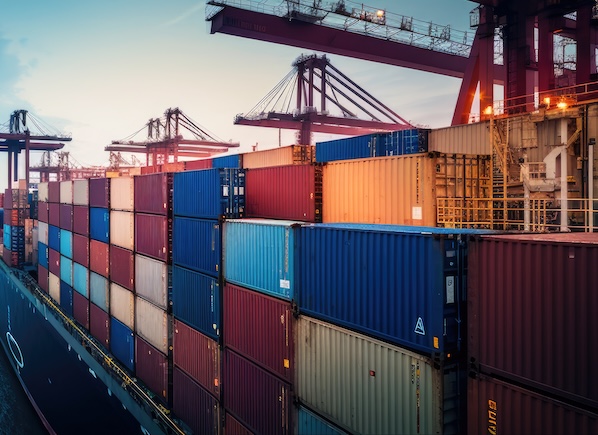
Container ship carrying container boxes import export dock with quay crane. Business commercial trade global cargo freight shipping logistic and transportation worldwide oversea concept. Generative AI
Economic Updates
Philippines Trade Update: Wider deficit on strong imports
DOWNLOAD
Frick collection with palm trees 
Economic Updates
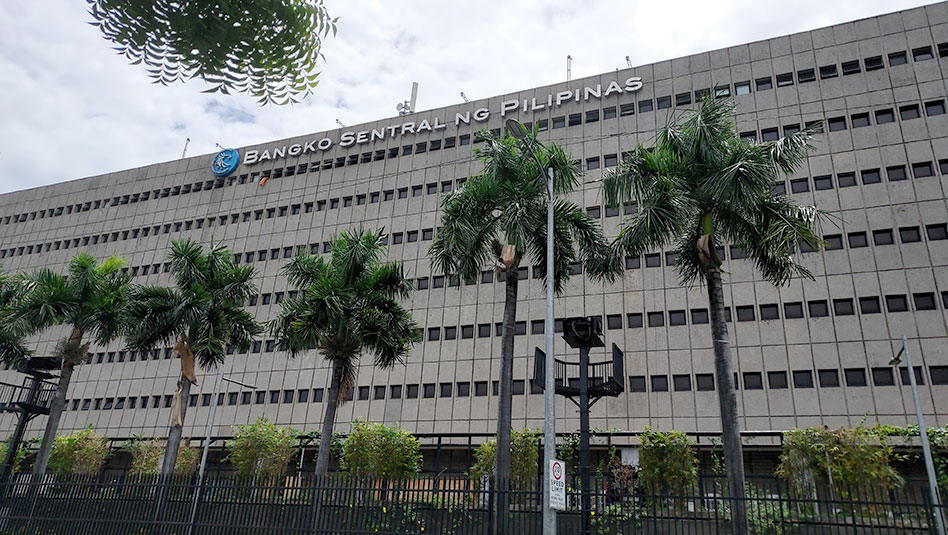
Policy Rate Updates: Policy rate updates to reassure 
DOWNLOAD
Man using his smartphone
Reports
Fed to cut just once 
DOWNLOAD
View all Reports
Metrobank.com.ph How To Sign Up
Follow us on our platforms.

How may we help you?

TOP SEARCHES
  • Where to put my investments
  • Reports about the pandemic and economy
  • Metrobank
  • Webinars
  • Economy
TRENDING ARTICLES
  • Investing for Beginners: Following your PATH
  • On government debt thresholds: How much is too much?
  • Philippines Stock Market Outlook for 2022
  • Deficit spending remains unabated

Login

Access Exclusive Content
Login to Wealth Manager
Visit us at metrobank.com.ph How To Sign Up
Access Exclusive Content Login to Wealth Manager
Search
MODEL PORTFOLIO THE GIST
NEWS AND FEATURES
Global Philippines Fine Living
INSIGHTS
INVESTMENT STRATEGY
Economy Stocks Bonds Currencies
THE BASICS
Investment Tips Explainers Retirement
WEBINARS
2024 Mid-Year Economi Briefing, economic growth in the Philippines
2024 Mid-Year Economic Briefing: Navigating the Easing Cycle
June 21, 2024
Investing with Love
Investing with Love: A Mother’s Guide to Putting Money to Work
May 15, 2024
retirement-ss-3
Investor Series: An Introduction to Estate Planning
September 1, 2023
View All Webinars
DOWNLOADS
Container ship carrying container boxes import export dock with quay crane. Business commercial trade global cargo freight shipping logistic and transportation worldwide oversea concept. Generative AI
Economic Updates
Philippines Trade Update: Wider deficit on strong imports
March 27, 2026 DOWNLOAD
Frick collection with palm trees 
Economic Updates
Policy Rate Updates: Policy rate updates to reassure 
March 26, 2026 DOWNLOAD
Man using his smartphone
Reports
Fed to cut just once 
March 19, 2026 DOWNLOAD
View all Reports

Archives: Business World Article

Oil shock to bring inflation above 4%

Oil shock to bring inflation above 4%

The Iran war could trim 0.2-0.3% from the Philippines’ gross domestic product (GDP) growth this year, as the oil shock could drive inflation to above 4% this year, Department of Economy, Planning, and Development (DEPDev) Secretary Arsenio M. Balisacan said on Tuesday,

At the same time, the House Ways and Means Committee passed a proposal authorizing President Ferdinand R. Marcos, Jr. to suspend excise taxes on fuel products, advancing a proposal aimed at cushioning the impact of volatile oil prices on consumers.

“The suspension of excise taxes… could reduce the inflationary effects of oil prices and global oil price escalation,” Mr. Balisacan told lawmakers at a congressional hearing. “Oil prices affect practically all goods and services produced in this economy, so the effect is considerable.”

He said the soaring pump prices will stoke inflation, eroding Filipinos’ purchasing power and weighing on economic activity.

As a net importer of oil, the Philippines is highly sensitive to sharp fluctuations in global oil prices.

While fuel retailers agreed to stagger this week’s big-time price adjustments, the surging prices risk reigniting inflation.

According to its baseline scenario presented to the House Energy Committee, the DEPDev projected inflation could quicken to 4.5-5.1% this month, and 4.5-4.8% in April, with full-year inflation seen settling at 4-4.2%, above the central bank’s target band.

In a worst-case scenario where oil prices hit USD 140 this month and stay above USD 80 until September, DEPDev said inflation could accelerate to 6.3-7.5% in March and 6.4-7.5% in April, bringing the full-year print to 4.5-4.8%.

Inflation could settle at 3.5-3.6% in 2027 under its baseline scenario, and at 3.6-3.7% under the  second scenario, according to DEPDev’s presentation.

“With this kind of inflation, if you don’t do anything, that’s going to hit hard the consumers and substantially reduce household consumption spending, affecting our economy,” Mr. Balisacan said.   

Unchecked inflation could drag the country’s full-year growth “back below 5%,” he said, adding that the Development Budget Coordination Committee is still targeting 2026 growth of 5-6% and 5.5-6.5% for 2027.

“We are assessing the situation when the new number comes in May. But with the impact we are seeing, that could push us back below 5%,” he said.

Philippine GDP growth slowed to 4.4% in 2025, the slowest in five years, as the flood control scandal weighed on government spending, investments and consumer spending.

Excise tax suspension

Mr. Balisacan said the economic impact of continuous increases in gas prices could be tempered by suspending excise taxes, which would help ease the burden on consumers.

“A temporary suspension of excise tax collections could restore part of the purchasing power,” he said.

The House Ways and Means Committee on Tuesday approved an unnumbered consolidated bill that would give the President special powers to suspend or reduce excise taxes of petrol during national and global emergencies for no more than six months.

Any suspension or cut in the fuel excise tax rate could be extended beyond six months through a joint congressional resolution.

Any extension cannot last longer than a year, according to Ways and Means Committee Chair and Marikina Rep. Romero “Miro” S. Quimbo.

He said the bill also requires the President to submit to Congress a report backing his decision to cut the excise tax, including estimates of foregone revenue and the impact on inflation, fuel prices and economic activity.

“We are dependent on the international market. Whatever happens there, we do not have leverage,” Mr. Quimbo told reporters. “The only thing that we can leverage to reduce fuel prices is by removing excise taxes.”

Moves to suspend the collection of petrol duties have gained traction in Congress after successive fuel price hikes that will likely drive consumer prices higher.

The Philippine Chamber of Commerce and Industry (PCCI) said it supported efforts to empower Mr. Marcos “to implement measures that will absorb and stabilize prices” amid fuel hikes. 

“Our request to government is to absorb temporarily the fuel price increases,” PCCI President Perry A. Ferrer said in a statement. “Hopefully, the President will be given the authority to exercise and use other means that will help cushion potential shocks this week or next week.”

A 2017 law previously allowed the government to suspend the collection of excise tax on petroleum products when world oil prices reach USD 80 per barrel for three straight months, but the provision lapsed six years ago.

Mr. Balisacan said revenue losses from the suspension of excise taxes on petrol could reach PHP 43.3 billion if the suspension lasts three months, and PHP 106 billion if extended until September.

“If you suspend excise taxes, that would mean less revenue collection for the government. That would impact our projects and programs and mean less fiscal resources,” he said. 

Projections from the Department of Finance showed suspending excise tax collections could lead to PHP 136 billion in foregone revenue, which the department said could widen the government’s budget deficit and raise the country’s debt.

“While the effects on the revenue is quite a bit, the net effect on the economy of not doing anything about it is even worse,” said Mr. Balisacan.

Temporarily halting excise tax collections on fuel products could lead to cheaper fuel and ease inflation, he added.

According to the DEPDev, suspending excise taxes from March to May could help inflation ease to 3.6-4.2% in March and 3.6-3.9% in April. This could bring full-year inflation at 3.9-4.1% by end-2026, under the baseline scenario.

On the other hand, if global prices remain elevated and excise taxes are suspended from March to September, inflation could settle at 5.4-6.6% in March and 5.5-6.5% in April, with full-year inflation at 4.-4.3%.

For 2027, DEPDev sees inflation settling at 3.5-3.6% under the baseline scenario, and  3.6-3.7% under the worst-case scenario.

Deployment ban?

Mr. Balisacan said remittances from overseas Filipino workers (OFWs) could also be affected if the government decides to impose a ban on deployment to the Middle East.

The local economy could lose between PHP 226.6 billion and PHP 232 billion if about 550,000 Filipinos are repatriated, he said. 

“If you assume a total deployment ban… this reduction represents about 65% of the remittances from the region,” he said. “It’s quite a significant impact on our OFWs… and also the economy.”

There are an estimated 2.41 million Filipinos in Middle Eastern countries. More than 975,000 are stationed in the United Arab Emirates, while others are in Saudi Arabia (813,000), Qatar (250,000), and Kuwait (211,000). There are about 800 Filipinos in Iran and 31,000 in Israel, according to data from the Foreign Affairs department. — Kenneth Christiane L. Basilio, Reporter
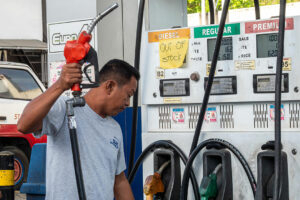
Peso, stocks sink as oil prices surge

Peso, stocks sink as oil prices surge

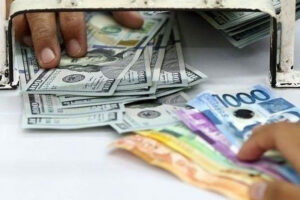
The Philippine peso plunged to a new record low against the dollar on Monday while the main stock benchmark recorded its steepest single-day drop since 2020 as global oil prices spiked, threatening to drive up inflation as the war in the Middle East rages on.

The local unit fell by 50 centavos to close at a new all-time low of PHP 59.50 against the greenback from its PHP 59 finish on Friday, data from the Bankers Association of the Philippines showed. This surpassed the previous record-low close of PHP 59.46 logged on Jan. 15.

Year to date, the peso is now down by 1.19% or 71 centavos from its end-2025 close of PHP 58.79.

The peso opened Monday’s trading session sharply weaker at PHP 59.25 per dollar, which was already its peak for the day. Its weakest showing was at PHP 59.71, which is now the lowest intraday level the local unit has touched.

Dollars traded surged to USD 2.597 billion from USD 1.847 billion on Friday.

The peso’s intraday low was likely a knee-jerk reaction to oil prices hitting USD 100 per barrel early in the trading day, the first trader said in a Viber message.

The peso’s decline on Monday was driven by global risk-off sentiment and stronger dollar demand amid the conflict in the Middle East, Philippine Institute for Development Studies Senior Research Fellow John Paolo R. Rivera said in a Viber message.

“Heightened geopolitical tensions, particularly the conflict in the Middle East, have pushed investors toward safe-haven assets like the US dollar, putting pressure on emerging-market currencies including the peso. At the same time, higher global oil prices raise concerns about the Philippines’ import bill since the country is a net energy importer, increasing demand for dollars in the local market,” he said.

“Also, expectations that US interest rates may stay higher for longer tend to strengthen the US dollar relative to regional currencies. When these external factors coincide with thin market liquidity or speculative positioning, the Philippine peso can experience sharper intraday moves.”

The US dollar jumped on Monday as soaring oil prices sent investors scrambling for cash on worries that a protracted Middle East war could severely disrupt energy supplies and hurt global growth, Reuters reported.

It pared some gains in the Asian afternoon on a Financial Times report that the Group of Seven finance ministers will discuss on Monday a joint release of oil from emergency reserves coordinated by the International Energy Agency. The report sent oil prices retreating slightly after they earlier spiked to just shy of USD 120 per barrel.

Analysts have said Asia could bear the brunt of the energy price shock, due to the region’s heavy reliance on oil and gas from the Middle East.

Rizal Commercial Banking Corp. Chief Economist Michael L. Ricafort added in a Viber message that the peso was also dragged by signals of potential monetary tightening from Bangko Sentral ng Pilipinas (BSP) Governor Eli M. Remolona, Jr.

Mr. Remolona said Philippine inflation could breach 4% if oil prices surge past USD 100 per barrel, which could force them to hike rates again.

For Tuesday, the first trader expects the peso to move between PHP 59.40 and PHP 59.65 per dollar, while Mr. Ricafort sees it ranging from PHP 59.35 to PHP 59.60.

In the near term, Mr. Rivera said the peso may remain under pressure due to persisting external pressures and range from PHP 59 to PHP 60 per dollar before the BSP’s next policy meeting on April 23. He added that the country’s gross international reserves are sufficient to manage short-term pressures without significantly weakening the country’s external position.

“At current levels, we are expecting the peso to test the key P60 level but as the recent movement in the peso has been driven by a sudden event, BSP intervention cannot be ruled out as this sudden FX (foreign exchange) movement could endanger domestic inflation expectations,” the first trader added.

The second trader said the peso will likely track other Asian currencies in the near term, but will likely continue to be one of the worst performers in the region as the conflict could also affect remittances.

Stocks

Worsening sentiment due to the prolonged conflict also affected the equities market, with the Philippine Stock Exchange index (PSEi) plunging 4.97% or 314.19 points to close at 6,006.22, while the broader all shares index went down by 4.24% or 148.24 points to end at 3,346.75.

This was the bellwether’s largest single-day drop since April 16, 2020, when it went down by 7.07% or 420.45 points to 5,525.60. This was also its lowest finish in almost three months or since it closed at 5,920.87 on Dec. 19, 2025.

The PSEi opened Monday’s session at 6,198.45, dropping 1.93% from Friday’s finish of 6,320.41 and already its high for the day. It crashed to an intraday low of 5,938.39, down 6.04% versus Friday’s level, but managed to climb back above the 6,000 mark before the closing bell.

“Financial markets are now in full risk-off mode in the face of USD 100 oil and the prospect of a prolonged war in the Middle East,” China Bank Capital Corp. Managing Director Juan Paolo E. Colet said in a Viber message.

Unicapital Securities Research Head Wendy B. Estacio-Cruz said the spike in crude oil prices presents short-term inflation threats for the Philippines, a net oil importer, which would affect the BSP’s easing cycle and further erode investor sentiment.

“For equities, higher oil effectively acts as a tax on consumption and corporate margins, weighing on consumer, property, and transport-related sectors that dominate the PSEi, while global risk aversion could trigger foreign outflows from emerging markets, putting additional pressure on valuations and the peso,” she said in a Viber message.

“In this environment, defensive sectors such as utilities, power producers, and telecommunications may prove more resilient given their stable cash flows and pricing pass-through mechanisms, while companies with dollar revenues or export exposure could also benefit from potential peso weakness.”

F. Yap Securities Investment Analyst Marky Carunungan likewise said that rising oil prices could drive up inflation expectations and lead to tighter financial conditions.

“If the conflict leads to a sustained spike in oil prices, the main macro risks would be higher inflation and a delayed easing cycle from the BSP. That could keep interest rates elevated for longer, which historically weighs on equity valuations.”

“The near-term impact centers on rising inflation and growth concerns. With oil prices surging, fears are mounting that the cost of goods and services could accelerate, as transportation and logistics rely heavily on fuel. At the same time, with GDP (gross domestic product) growth already at relatively modest levels, the risk of stagflation — slowing growth combined with rising prices — could begin to emerge,” DragonFi Securities analyst Jarrod Leighton M. Tin added. — Aaron Michael C. Sy and Alexandria Grace C. Magno

Big-time fuel price hikes set as war throttles supply

Big-time fuel price hikes set as war throttles supply

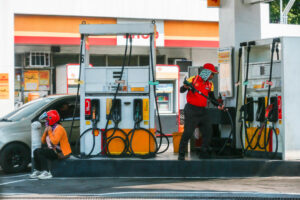
Several oil companies have agreed to spread out this week’s increases in fuel costs to temper the big-time adjustments reaching as much as PHP 38.50 per liter as a widening war in the Middle East continues to threaten oil supply, driving up global prices.

Motorists should brace for a sharp spike in pump prices starting on Tuesday, March 10, ranging from PHP 7 to PHP 38.50 per liter, data from the Department of Energy (DoE) showed. Gasoline prices are set to increase by PHP 7 to PHP 13 per liter, diesel prices will rise by PHP 17.50 to PHP 24.25 per liter, while kerosene is expected to go up by PHP 32 to PHP 38.50 per liter.

The hikes will result in pump prices ranging from PHP 53.10-PHP 73.40 per liter for gasoline, PHP 63-PHP 87.44 per liter for diesel, and PHP 92.17-PHP 125.17 per liter for kerosene.

At a press briefing on Monday, Energy Secretary Sharon S. Garin said several oil companies agreed to stagger the implementation of increases instead of imposing one-time hikes. This is as Energy Undersecretary Alessandro O. Sales said that this week’s price increases would be “the largest single-week adjustment” in fuel costs.

Some of the major oil companies that will implement a gradual rollout of price hikes over periods of two to seven days are Shell Pilipinas Corp.; Petron Corp.; Total (Philippines) Corp.; Chevron Philippines, Inc.; Jetti Petroleum, Inc.; and Seaoil Philippines, Inc.

Seaoil and Total will split the increases in gasoline and diesel prices over March 10-11, while Shell and Petron will implement a three-day rollout of increases.

For its part, Jetti implemented a staggered increase in gasoline and diesel prices as early as March 8, which will continue until March 13, as acknowledged by the DoE.

Meanwhile, Chevron will have the slowest movement in price adjustments as it plans to spread the increases from March 10-16.

Fuel retailers have implemented several rounds of price increases this year as global oil prices continue to climb. This week’s price adjustments mark the 11th consecutive weekly increase for diesel and kerosene prices and the ninth straight week for gasoline.

“We do not dictate the companies what price they will charge the public. What DoE can do is monitor and have them explain why their prices are like that, but we cannot impose in that sense,” Ms. Garin said.

Under the revised guidelines for the monitoring of prices in the sale of petroleum products issued by the DoE in 2019, price adjustments for liquid fuel should be implemented beginning every Tuesday of the week.

The DoE has flagged several fuel stations for allegedly implementing unscheduled or unauthorized price adjustments. Of over 80 reports reviewed, Ms. Garin said the department will issue 55 show-cause orders to the fuel stations.

“(We are) giving them 24 hours to answer DoE if there is a valid reason not to cancel their permits,” she said.

Fuel shipments are currently disrupted following the closure of the Strait of Hormuz, where about 20% of the world’s oil and liquefied natural gas pass through, amid the conflict involving Iran, the United States, and Israel.

As a net importer of crude oil, the Philippines is vulnerable to global crude price swings, which geopolitical tensions often trigger. Around 98% of Philippine crude imports come from the Middle East. The remaining 2% is sourced from Brunei and Malaysia.

Ms. Garin assured the public that the country has enough supply until the end of April and enough time to order for more.

Currently, oil companies are required to maintain at least a 30-day inventory of crude oil and a 15-day inventory of finished petroleum products.

The Energy chief said that some fuel retailers have secured enough stockpile that could cover 50 days of consumption.

Mr. Sales added that the DoE is currently monitoring the threshold level of Dubai crude prices, as hitting USD 80 per barrel over a period of one month would trigger the release of fuel subsidies allocated for various beneficiaries.

“As per our calculation, the average 30-day is close to USD 75 per barrel already. So, we’re keeping a watch on this,” he said.

Fuel price cap?

Meanwhile, asked if the Philippines can cap prices as a relief measure, Ms. Garin said Republic Act No. 8479, or the Oil Deregulation Law, which liberalized the country’s downstream oil industry, prevents them from doing this.

“We are constrained by the law and the deregulation that we do not have the power to control the prices, unless maybe they give us authority or an amendment of the law or emergency powers,” she said.

Enacted in 1998, the law allows oil companies to set and adjust pump prices based on global oil prices and other market factors, instead of awaiting government approval. It aims to promote competition among oil companies and ensure adequate and continuous supply of petroleum products.

Ms. Garin said the department is open to discuss with the Congress any potential amendments to the law.

“If there’s a change, then I think it would be a welcome change also for us to be able to scrutinize more how the prices are computed and if we should limit or make a uniform pricing. That’s something that they can discuss and consider,” she said.

This, as governments in Asia are scrambling to limit the impact on economies and consumers from the widening Iran war, which fueled a record surge in oil prices on Monday after key producers cut output and Tehran signaled that hardliners will remain in charge, Reuters reported.

In South Korea, which buys 70% of its oil from the Middle East, President Lee Jae Myung said Seoul would cap fuel prices for the first time in nearly 30 years and warned against panic buying.

A senior Japanese parliament member said on Sunday that the government had instructed a national oil reserve storage site to prepare for a possible crude release, although the country’s chief Cabinet secretary said on Monday that no decision had been made to release stockpiles.

Elsewhere, Vietnam removed import tariffs on fuels and Bangladesh shut universities to conserve electricity and fuel, while China last week asked refiners to halt fuel exports and try to cancel shipments already committed.

Oil jumped 25%, with Brent on track for a record one-day gain, after Iran on Monday named Mojtaba Khamenei to succeed his father Ayatollah Ali Khamenei as supreme leader, while Organization of the Petroleum Exporting Countries producers Kuwait and Iraq cut oil output during the weekend as the crucial Strait of Hormuz remained effectively shut. — Sheldeen Joy Talavera, Reporter with Reuters

House panel eyes approval of bill letting Marcos suspend fuel excise taxes this week

House panel eyes approval of bill letting Marcos suspend fuel excise taxes this week

A House of Representatives committee will take up on Wednesday a proposal to suspend excise tax collections on petrol, a congressman said on Monday, seeking its swift approval to pave the way for plenary passage before Congress goes on a month-long break next week.

The House Ways and Means Committee will discuss measures to suspend excise tax collections on fuel products and is expected to pass them the same day, said Marikina Rep. Romero “Miro” S. Quimbo, who heads the panel, as lawmakers aim to quickly authorize President Ferdinand R. Marcos, Jr. to cut petrol duties and ease rising fuel costs that threaten to drive up living expenses.

“There will be a break next week and we won’t be able to pass it if we don’t finish it by Wednesday,” he told reporters in Filipino. “Unless an emergency session is called, the President will have no tools, equipment or weapons to address rising gas prices.”

“What we’re facing is economic contraction.”

Proposals to suspend or scrap petrol duties have gained traction in Congress as expected fuel hikes loom, with the Iran war entering its second week after initial US and Israeli strikes on Iranian targets throttled energy exports from the Middle East, home to five of the world’s top 10 oil producers.

The expanding war has severely disrupted global oil trade as energy shipments through the Strait of Hormuz remain subdued after Iran closed access to the critical chokepoint where roughly a fifth of the world’s oil and gas shipments pass, stoking concerns over the conflict and raising fears of higher living costs.

The Philippines is a net importer of oil and is highly sensitive to sharp fluctuations in global oil prices. About 98% of the country’s crude oil imports come from the Middle East, according to Department of Energy data.

Energy Secretary Sharon S. Garin said Philippine petrol companies have agreed to spread out fuel hikes this week, she told lawmakers at a congressional hearing.

Temporarily halting the collections of excise tax on fuel products would benefit the public, she said. “Any excise tax reduction is helpful.”

A 2017 law previously allowed the government to suspend the collection of excise tax on petroleum products when world oil prices reach USD 80 per barrel for three months, but the provision lapsed six years ago.

Revenue losses

Finance Undersecretary Karlo Fermin S. Adriano said suspending excise tax collections may lead to PHP 136 billion in foregone revenue if implemented from May to December. The move could widen the government’s budget deficit and raise the country’s debt, according to a Department of Finance (DoF) presentation.

“This can be higher if we start in March or April,” Mr. Adriano told lawmakers.

Mr. Quimbo said revenue losses are inevitable under the proposal but argued the move must be taken despite the hit, warning that keeping the levy in place would continue to stoke price increases that threaten economic activity.

“It could be offset by value-added tax collections,” he said. The Finance department forecasts the government could collect an additional PHP 16 billion if Dubai crude oil hits USD 80 per barrel, PHP 25.4 billion at USD 85, PHP 26.6 billion at USD 90 and PHP 37 billion if prices reach USD 100 per barrel.

DoF data presented during the congressional briefing showed that the government collected an average of PHP 116 billion in value-added tax from fuel products from 2021 to 2025.

“If you don’t do anything, it’s going to be worse,” Mr. Quimbo said. “If you don’t remove the tax, prices will climb even higher, and no one will buy commodities anymore, and taxes won’t be collected if that happens.”

The purchasing power of the Philippine peso could be shaved by PHP 1 for every P100 if oil prices stay at USD 100 a barrel in March, Department of Economy, Planning, and Development (DEPDev) Undersecretary Rosemarie G. Edillon said, adding that scrapping the excise tax could soften the impact but would not be enough to offset the blow to consumer spending power.

“We recommended a full package of interventions to the President,” she told lawmakers, advising the need to conserve fuel and provide targeted subsidies for the agriculture sector.

The Iran war could also push inflation higher if hostilities persist, she added, noting that March inflation could range from 4.5% to 5.1% under the agency’s baseline projection and rise as high as 6.3% to 7.5% in its “extreme case” scenario.

April inflation could reach 4.5% to 4.8% under the agency’s baseline scenario and climb to 6.4% to 7.5% in its worst‑case projection, Ms. Edillon said. The full-year consumer price index could breach the 2%-4% target of the central bank, settling at 4% to 4.2% for its baseline projection, she said.

She added that DEPDev projected 2026 inflation could reach 4.5% to 4.8% under its worst‑case scenario.

Prices of electricity could increase by 16% if the Iran war persists, Ms. Edillon said. “That’s significant if this keeps on going and if we don’t intervene.”

She added diesel prices could climb to as high as PHP 96.76 per liter this month under the agency’s worst-case scenario and PHP 91.19 per liter in April. For its baseline scenario, diesel could hit PHP 74.22 per liter in March and PHP 67.33 in April.

Meanwhile, gasoline prices could reach PHP 70.20 per liter this month and PHP 64.59 in April under its baseline scenario, she added.

Ms. Garin said the Philippines is exploring direct talks with foreign governments and local oil companies are seeking alternative suppliers as the conflict in Iran enters its second week, noting that current stockpiles are sufficient to last until April.

The country’s petrol stockpile and inbound shipments could withstand weeks of disruption if unrest in the Middle East drags on, and the government is continually preparing to prevent shortages that could weigh on economic activity.

“We are hoping it’s just one more week,” Ms. Garin said, warning that a continuous fuel increase may affect economic output. “A price change of two weeks will have a longer effect on our economy because prices will readjust and fares will go up.”

US President Donald J. Trump has signaled that military action against Iran would continue “as long as necessary” to curb Tehran’s nuclear ambitions and pursue regime change. White House Press Secretary Karoline Leavitt on Saturday said achieving Washington’s objectives could take “four to six weeks.”

Ms. Edillon told BusinessWorld that DEPDev is updating its assessment of the Iran war’s impact on gross domestic product.

Meanwhile, Mr. Quimbo said he will also push for the regulation of the oil industry, which has been deregulated since 1988.

“What’s worrying is the lack of power of the government to try and control gasoline prices,” he said in Filipino. “I’m going to take it up with the House leadership so we can have a bipartisan initiative to bring it back.”

He said government agencies such as the Energy department have “no real power” to penalize oil companies profiting from higher oil prices. — Kenneth Christiane L. Basilio, Reporter
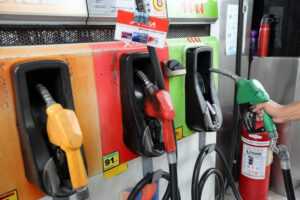
 

Agriculture department expects faster farm output growth in Q1

Agriculture department expects faster farm output growth in Q1

Farm output is expected to grow faster this quarter, building on the 2% expansion posted in the same period last year, the Agriculture chief said.

“It should be a bit higher than last year, as long as there are no adverse weather conditions,” Agriculture Secretary Francisco P. Tiu Laurel, Jr. told BusinessWorld via WhatsApp.

Mr. Laurel said improved production in poultry and crops, particularly corn and onions, is expected to support the sector’s performance during the quarter.

He added that higher output in rice and fisheries is likely to strengthen the agriculture sector’s second-quarter performance.

Mr. Laurel, however, did not specify a target as he said the Department of Agriculture (DA) is still finalizing its forecasts due to recent developments in the Middle East.

“We are recalibrating [our projections] due to the effects of the war on fuel and logistics,” he said.

The DA earlier said it expects the impact of the Iran crisis to reflect in the cost of synthetic fertilizers, which are largely petroleum-based, as well as in fuel used by farmers and fisherfolk.

Freight costs may also increase due to higher risk premiums on shipments from the Persian Gulf.

In the first quarter of 2025, farm output grew 2% year on year to PHP 438.02 billion from PHP 429.62 billion, supported by strong poultry production, which expanded 9.8%.

Crop production during the period grew 1%, while fisheries output rose 1.5%. Meanwhile, livestock production declined 2.8%, largely due to a drop in the hog population caused by the spread of African Swine Fever (ASF).

The DA said that it expects further recovery in the swine sector this year as it implements repopulation and ASF vaccination programs. — Vonn Andrei E. Villamiel, Reporter

Peso may weaken on prolonged Middle East war

Peso may weaken on prolonged Middle East war

The Philippine peso could weaken further this week as escalating war in the Middle East boosts demand for safe-haven assets such as the dollar.

The local currency closed at PHP 59 a dollar on Friday, weakening by 37 centavos from its PHP 58.63 finish a day earlier, according to data from the Bankers Association of the Philippines. It was the peso’s weakest close in more than a month.

Week on week, the currency dropped sharply from PHP 57.665 on Feb. 20.

A trader said the peso’s decline reflected persistent demand for the dollar amid geopolitical uncertainty and rising oil prices.

“The dollar-peso rate continued its strong uptrend and closed at its intraday high amid persistent demand for safe-haven assets due  to the escalating Middle East tension and soaring oil prices,” a trader said by telephone on Friday.

Concerns about higher energy prices could also complicate the monetary policy outlook for the Bangko Sentral ng Pilipinas (BSP).

BSP Governor Eli M. Remolona, Jr. said the central bank could consider raising interest rates if global oil prices climb above $100 per barrel and push inflation beyond the BSP’s 2% to 4% target.

“When the price of oil begins to have effects on the prices of many commodities, that tends to be something we have to worry about when it comes to inflation,” he told Bloomberg TV on Friday.

The central bank last month cut its benchmark interest rate by 25 basis points to 4.25%, the lowest in more than three years. The move extended the easing cycle that began in August 2024.

Mr. Remolona also said the BSP intervenes in the foreign exchange market only to limit excessive volatility in the peso.

The trader expects the peso to remain under pressure this week as markets monitor developments in the Middle East and movements in global oil prices.

The trader expects the peso to move at PHP 58.80 to PHP 59.20 a dollar, while Rizal Commercial Banking Corp. Chief Economist Michael L. Ricafort sees a slightly wider range of PHP 58.75 to PHP 59.25. — Aaron Michael C. Sy

Factory output slows in January

Factory output slows in January

Manufacturing output eased to a two-month low in January dragged by contractions in food and transport equipment as well as sluggish growth in other non-metallic mineral products, the Philippine Statistics Authority (PSA) reported on Friday.

Preliminary results of the PSA’s latest Monthly Integrated Survey of Selected Industries (MISSI) showed factory output, as measured by the volume of production index, slowed by 1.2% year on year in January.

This was slower than the 3.2% growth in January 2025 and the revised 2% increase recorded last December.

It was also the weakest growth in two months or since the 0.6% uptick in November last year.

The sector’s output has been in positive territory for nine straight months.

Month on month, January’s output grew by 4.7%, from a 3.6% decline in December. Stripping out seasonal factors, it inched up by 2.8% from 1.1%.

In comparison, the Philippines in S&P Global Manufacturing Purchasing Managers’ Index (PMI) expanded 52.9 in January from 50.2 in December. It was the fastest pace in nine months or since the 53 expansion logged in April 2025.

PMIs are a leading indicator for factory activity, reflecting the volume of materials purchased in advance of manufacturing operations weeks or months down the line. A reading above 50 separates expansion from contraction.

Marco Antonio C. Agonia, an economist at the University of Asia and the Pacific, said that the slip in manufacturing activity points to the “muddling through” narrative of 2026.

“While we expect economic activity to slightly recover this year, the absence of concerted efforts to restore business confidence and improve business operations appears to continue weighing on industrial activity,” he said in an e-mail.

Data from the Bangko Sentral ng Pilipinas’ inaugural monthly business expectations survey (BES) showed that businesses had a current-month confidence index (CI) of 0.9% in January.

While the positive value indicated business optimism, the figure was a crash from the quarterly CI of 29.7% seen in the fourth quarter of 2025.

Rizal Commercial Banking Corp. Chief Economist Michael L. Ricafort said that the industrial production slowdown in January is largely attributed to political scandal last year that curbed infrastructure spending, with anti-corruption reforms dampening demand across supply chains and weighing down on manufacturers.

“Higher tariffs could have weighed on global trade, adversely affecting manufacturers that are part of the global supply chains of exporters,” Mr. Ricafort said in an e-mail.

In a phone interview, Philippine Chamber of Commerce and Industry Honorary Chairman Sergio R. Ortiz-Luis, Jr. said that business uncertainty caused by further potential US tariffs contributed to the slip.

According to the PSA, the slowdown in factory output in January was due to the sharp annual declines in the heavily weighted food index.

Food manufacturing’s VoPI dipped by 0.5% in January from the 14.9% growth in December and a reversal from the revised 15.5% growth a year earlier.

The food products index accounted for 18.7% of manufacturing activity.

Meanwhile, slowdowns were recorded in other non-metallic mineral products (6.8% in January from 32.4%in December), and transport equipment (-1.9% from 5.8%).

Eight other divisions logged declines while the remaining 11 posted expansion.

Additionally, the PSA said that the top three industry divisions that contributed to the overall year-on-year growth in the VoPI were computer, electronic and optical products (23.6% from 14.1%), beverages (21.1% from 4.8%), and electrical equipment (16.7% from 11.4%).

Mr. Agonia said that the sudden plunge in food manufacturing growth may be attributed to seasonal adjustments and manufacturing conditions.

“Food manufacturers likely scaled down production after the holiday season, while cost pressures continue to build. We note that growth in the Producer Price Index (PPI) has been accelerating since November last year, largely driven by the food products segment,” he said.

Year on year, the PPI grew by 1.5% in January 2026, from the 0.9% posted in the same period last year, and the 0.8% in December, PSA data showed.

Its food subindex grew by 1.3%, higher than the 0.4% in January 2025 and reversing the 0.1% contraction last December.

For the following months, Mr. Agonia said that people are monitoring movements in global oil prices following conflict escalation in the Middle East.

“These higher oil prices are expected to raise production costs for most economic sectors, leading to deterioration in manufacturing conditions and higher retail prices.”

Mr. Ortiz-Luis said that that continued discussions with the US is necessary to improve factory outputs.

“It’s like we have no leverage with them. And [we’re pushing them to] define what exactly the applicable tariffs are,” he said.

Average capacity utilization — the extent industry resources are used in producing goods — averaged 77.8% in January, slightly higher from the 77.6% in December and 76.2% in January 2025.

All industry divisions reported capacity utilization rates above 60%, with coke and refined petroleum products reporting the highest rate at 84.5%. — Pierce Oel A. Montalvo

Inflation quickens to 13-month high

Inflation quickens to 13-month high

Philippine inflation accelerated to a 13-month high in February as rising costs for rice, fuel, electricity and other utilities added pressure on household budgets, the Philippine Statistics Authority said on Thursday.

The consumer price index (CPI) picked up to 2.4% from 2% in January and 2.1% in February 2025. It was the fastest since January 2025, when inflation hit 2.9%.

February inflation fell within the Bangko Sentral ng Pilipinas’ (BSP) 2.3%-3.1% forecast and matched the 2.4% median estimate in a BusinessWorld poll of 17 analysts.

February also marked the second straight month that inflation stayed within the central bank’s 2%-4% target, bringing the two-month average inflation rate to 2.2%.

“Overall price conditions remain stable,” Economy Secretary Arsenio M. Balisacan said in a statement. “However, we are mindful of recent geopolitical developments, which we are closely monitoring, along with domestic supply conditions of key commodities.”

The peso’s purchasing power remained at PHP 0.76 for every PHP 100 worth of goods and services in 2018, the same level recorded in January and the lowest since the base year was adopted.

National Statistician Claire Dennis S. Mapa said faster price increases in food and nonalcoholic beverages, housing and utilities and restaurants and accommodation services pushed inflation higher last month.

Inflation for food and nonalcoholic beverages accelerated to 1.8% from 1.1% in January, driven by faster price increases for vegetables, fish and seafood, as well as a slower decline in cereals and cereal products.

Inflation for restaurants and accommodation services also quickened to 4.4% from 4% a month earlier. Prices for restaurants, cafés and similar establishments rose 4.5% from 4.1% pace in January.

Core inflation, which strips out volatile food and fuel prices, edged up to 2.9% in February from 2.8% in January and 2.4% a year earlier. This was the fastest  since June 2024.

Energy costs

Inflation for housing, water, electricity, gas and other fuels, which accounted for almost 30% of the headline CPI, rose to 3.5% in February from 3.3% a month earlier.

Fuel prices have been rising steadily in recent weeks, with diesel and kerosene marking 10 consecutive weekly increases and gasoline climbing for eight straight weeks.

In February alone, pump price adjustments led to a net increase of PHP 3.20 a liter for gasoline, PHP 4.40 for diesel and P3.50 for kerosene.

Liquefied petroleum gas (LPG) prices also increased after oil companies implemented a PHP 1.50- to PHP 1.55-per-kilo hike, bringing the price of a standard 11-kilo household tank to PHP 836.50 to PHP 1,137.05.

Rising tensions in the Middle East have raised concerns about possible disruptions in global oil supply, which could further push up energy costs for net oil importers such as the Philippines.

The Department of Economy, Planning and Development said authorities are monitoring domestic fuel price movements and could intervene if global oil prices rise sharply.

“Further, the government will implement measures to reduce fuel consumption, first by government offices, and we encourage the private sector to do the same,” Mr. Balisacan said.

These measures include the use of shuttle buses, encouraging carpooling and adopting flexible work arrangements such as work-from-home or compressed workweeks.

Electricity costs also rose after Manila Electric Co. increased its rate by 22.26 centavos per kilowatt-hour (kWh) in February to PHP 13.1734 per kWh from January. Electricity inflation climbed to 6.7% from 6.5%.

Rental inflation also edged higher to 3% from 2.9%, while inflation for water supply rose to 4% from 3.5%.

Rice prices, a key driver of Philippine inflation, showed signs of firming in February.

Rice inflation remained negative at -3.4%, but this was a slower decline than -8.5% in January, indicating a gradual rebound in prices.

Regular milled rice prices fell 2.5% year on year to an average of PHP 46.01 per kilo but rose 5.14% compared with January levels.

Mr. Mapa said rice inflation could move closer to zero — or even turn positive — if month-on-month price increases persist in March.

Meanwhile, inflation for the bottom 30% of income households accelerated to 2.5% in February from 1.6% in January and 1.5% a year earlier, the fastest in more than a year.

Inflation outlook

The BSP said inflation expectations remain well anchored despite the February uptick, although authorities are assessing the potential impact of Middle East tensions on the domestic economy.

“The BSP will ensure that policy settings remain in line with its pursuit of price stability conducive to sustainable growth and employment,” it said in a statement.

Jonathan L. Ravelas, a senior adviser at Reyes Tacandong & Co., said the latest data point to rising risks, particularly from global oil markets.

“While inflation remains manageable, the third straight monthly uptick tells us upside risks are building — especially if global oil supply disruptions persist,” he said via Viber.

Chinabank Research said inflation might average around 3.6% this year, near the upper end of the BSP’s target, though the outlook could worsen if geopolitical tensions persist.

Morningstar DBRS also warned that net oil-importing economies such as the Philippines remain vulnerable to rising energy costs and potential supply disruptions stemming from the war in the Middle East.

The Bangko Sentral ng Pilipinas (BSP) should hold interest rates steady, rather than cut or raise, amid rising global oil price pressures from the Middle East war, according to the Institute for Risk and Strategic Studies, Inc. (Salceda Research).

In a report released on Wednesday, the think tank said further rate adjustments might be unwise amid uncertainties over crude prices stemming from disruptions linked to the war between Israel and Iran.

“The appropriate response is a pause, not a hike — the inflation is supply-driven and rate hikes would not reduce oil prices,” Salceda Research said. “The BSP should communicate clearly that the easing cycle is on hold, not reversed, to avoid market overreaction.”

The Strait of Hormuz, a critical oil transit point, has become a flashpoint after Israeli and US military strikes on Iran. Roughly one-fifth of the world’s oil supply passes through the strait, and any disruption could push global oil prices higher, squeezing import-dependent economies such as the Philippines.

Salceda Research estimated that sustained crude prices above $80 per barrel for more than a month could push Philippine inflation toward 4%, near the upper limit of the central bank’s target band. “Second-round consumer price index effects will push inflation toward the 4% upper target boundary within two quarters,” it added.

At its first policy review of 2026, the BSP cut the key interest rate by 25 basis points (bps) to 4.25%, the sixth consecutive reduction and a total easing of 225 bps since August 2024.

BSP Governor Eli M. Remolona, Jr. has noted that easing alone might not stimulate an economy constrained by weak sentiment and lingering governance issues.

Salceda Research also cautioned that the Philippine peso could come under renewed pressure, potentially testing PHP 59.50 to PHP 65 a dollar.

The peso briefly recovered to around PHP 57 a dollar last month after record lows in January but has remained above PHP 58 amid geopolitical uncertainty.

“The BSP should allow the peso to depreciate within the PHP 59.50-PHP 61 band… intervening [only] to prevent disorderly overshooting beyond P62,” the think tank said.

Rapid moves past PHP 62 could front-load inflation and trigger capital outflows, it said. “Graduated, transparent intervention is preferable to defending a fixed level. — Katherine K. Chan, Reporter

Philippines plans diesel stockpile amid Middle East war

Philippines plans diesel stockpile amid Middle East war

The Philippine goverment plans to procure at least a million barrels of diesel to secure domestic fuel supply as tensions in the Middle East threaten global oil trade and China moves to curb refined fuel exports.

The Department of Energy (DoE) is studying a proposal to direct state-run Philippine National Oil Co. (PNOC) to buy the diesel for a strategic stockpile that could cover about five days of domestic consumption, Oil Industry Management Bureau Director Rino E. Abad told reporters on Thursday.

The planned purchase is equivalent to roughly 200,000 barrels a day, or about 33 million liters of diesel consumption daily in the Philippines.

Mr. Abad said the volume could be increased to as much as 3 million barrels, which would be enough to cover up to 15 days of supply, especially after reports that China is asking refiners to halt new export contracts for refined fuel.

“That’s a game changer,” he said, noting that about 30% of the Philippines’ diesel imports come from China. “Hopefully, South Korea will not follow because about 40% of our imports come from South Korea,” he added in mixed English and Filipino.

China has asked companies to stop signing new contracts to export refined fuel and attempt to cancel shipments already committed, according to a Reuters report, citing industry sources.

Mr. Abad said PNOC could buy diesel from nearby suppliers such as South Korea, Japan, Singapore, Malaysia and Indonesia if Chinese shipments are disrupted.

The fuel purchased by PNOC would still be sold to domestic oil companies to ensure continued supply in the local market, he said.

“At best, PNOC may sell the fuel at cost,” Mr. Abad said. “It will simply recover the procurement expenses and distribute the supply to domestic oil companies.”

Global oil supply chains have come under pressure after the closure of the Strait of Hormuz, a critical chokepoint through which roughly a fifth of the world’s oil and liquefied natural gas shipments pass.

The disruption stems from escalating hostilities involving Iran, the US and Israel.

As a net oil importer, the Philippines is particularly vulnerable to fluctuations in global oil supply and prices.

About 98% of the country’s crude oil imports come from the Middle East, according to DoE data, with the remainder obtained from nearby producers such as Brunei and Malaysia.

Fuel retailers have implemented several rounds of price increases this year as global oil prices climbed.

On Monday, oil companies raised gasoline prices by PHP 1.90 a liter, diesel by PHP 1.20 and kerosene by PHP 1.50.

The adjustments marked the 10th consecutive weekly increase for diesel and kerosene prices and the eighth straight week for gasoline.

Since January, gasoline prices have increased by PHP 6.70 a liter, diesel by PHP 9.40 a liter and kerosene by PHP 7.70 a liter.

Staggered increasese

Energy Secretary Sharon S. Garin said some oil firms have agreed to implement potential increases in pump prices on a staggered basis next week to cushion the impact on consumers.

Oil companies assured the DoE during a meeting on Wednesday that existing fuel inventories remain adequate and that additional shipments previously ordered were on the way, Ms. Garin told DZMM radio.

“We also talked about staggering the increases and the discounts. They seem amenable,” she said.

Tanya Samillano, president of the Independent Philippine Petroleum Companies Association, said oil companies briefed the DoE on their plans for price adjustments and inventory levels.

“We discussed how we plan to implement our price adjustments this coming week and updated the department on our inventories,” she said in a Viber message.

Leo P. Bellas, president of Jetti Petroleum, Inc., said many independent fuel retailers had agreed to stagger price increases if global oil costs continue to climb.

“Almost all nonmajor players agreed to implement the potential increase on a staggered basis,” he told BusinessWorld.

Brigitte Carmel C. Lim, senior vice-president and chief operating officer of Cebu-based Top Line Business Development Corp., said the company supports the DoE’s call for measures that could soften the impact of rising oil prices.

“We will continue to monitor global price movements and regulatory advisories,” she said in a Viber message.

Ms. Garin said the government would determine the scale and timing of fuel price adjustments after assessing global market movements over a full five-day trading cycle.

“We will determine by the weekend because we need five days of simulation to estimate the increase,” she said.

Economists said even staggered fuel price increases could weigh on household spending.

Foundation for Economic Freedom President Calixto V. Chikiamco said spreading out price increases might reduce the shock to consumers but would still erode purchasing power.

“Staggering the increases is slightly better than a one-time price shock,” he said via Viber. “But the total increase is still large and will cut deeply into disposable income.”

IBON Foundation Executive Director Jose Enrique “Sonny” A. Africa said gradual adjustments might soften the immediate impact but would not reduce the overall burden on households.

“The increase is paced but households will still eventually pay the same higher prices,” he told BusinessWorld. — Sheldeen Joy Talavera, Reporter

Shares recover on bargain hunting after sell-off

Philippine stocks rebounded on Thursday as investors took advantage of lower valuations following the market’s slide amid the ongoing conflict in the Middle East.

The Philippine Stock Exchange index (PSEi) jumped by 1.15% or 72.69 points to close at 6,380.53, while the broader all shares index went up by 1.15% or 40.37 points to end at 3,525.99.

“The local market bounced back as investors hunted for bargains with hopes that the government would be able to implement measures that would mitigate the impact of the conflict in the Middle East, primarily the rise in oil prices, on the Philippine economy. The positive cues from Wall Street also helped in the climb,” Philstocks Financial, Inc. Research Manager Japhet Louis O. Tantiangco said in a Viber message.

“The PSEi rebounded after yesterday’s sharp sell-off as investor sentiment improved on hopes of possible talks between Iran and the US, reducing some of the geopolitical concerns,” Regina Capital Development Corp. Head of Sales Luis A. Limlingan said in a Viber message.

Israel launched a large wave of strikes on Tehran on Thursday, targeting what it said was infrastructure belonging to the Iranian authorities, after Iranian missiles sent millions of Israelis rushing into bomb shelters, Reuters reported.

Asian shares rallied on Thursday after days of sharp losses, in line with a rebound in US stocks on hopes the war might end soon. Some traders said the improved sentiment followed a New York Times report that Iranian intelligence had contacted the US Central Intelligence Agency early in the war about a path towards ending it.

But a source from the Iranian intelligence ministry rejected the article as “absolute lies and psychological warfare in the midst of war,” Iran’s semi-official news agency Tasnim reported.

“Sentiment was further supported after inflation data came in largely in line with expectations, helping calm worries over price pressures,” Mr. Limlingan added.

Headline inflation accelerated to 2.4% in February from 2% in January, the government reported on Thursday. This was the fastest clip in over a year or since the 2.9% in January 2025.

Still, this was within the Bangko Sentral ng Pilipinas’ 2.3%-3.1% forecast for the month and its 2%-4% annual target and matched the 2.4% median estimate in a BusinessWorld poll of 17 analysts.

All sectoral indices closed higher on Thursday. Mining and oil jumped by 1.91% or 350.08 points to 18,603.04; services increased by 1.87% or 52.45 points to 2,852.50; industrials went up by 1.32% or 117.59 points to 9,009.68; financials rose by 0.9% or 18.63 points to 2,068.81; property advanced by 0.71% or 15.07 points to 2,123.23; and holding firms climbed by 0.43% or 21.44 points to 4,951.34.

Advancers beat decliners, 125 to 72, while 59 names closed unchanged.

Value turnover fell to PHP 6.25 billion on Thursday with 1.91 billion shares traded from the PHP 8.67 billion with 4.5 billion issues that changed hands on Wednesday.

Net foreign selling went down to PHP 198.09 million from PHP 1.31 billion. — A.G.C. Magno with Reuters

Posts navigation

Older posts
Newer posts

Recent Posts

  • Peso GS Weekly: Risk relief drives curve‑wide rally
  • Metrobank US-Iran Risk Index: Dire straits
  • Investment Ideas: April 6, 2026
  • Investment Ideas: April 1, 2026
  • Metrobank US-Iran Risk Index: Signals of an end

Recent Comments

No comments to show.

Archives

  • April 2026
  • March 2026
  • February 2026
  • January 2026
  • December 2025
  • November 2025
  • October 2025
  • September 2025
  • August 2025
  • July 2025
  • June 2025
  • May 2025
  • April 2025
  • March 2025
  • February 2025
  • January 2025
  • December 2024
  • November 2024
  • October 2024
  • September 2024
  • August 2024
  • July 2024
  • June 2024
  • May 2024
  • April 2024
  • March 2024
  • February 2024
  • January 2024
  • December 2023
  • November 2023
  • October 2023
  • September 2023
  • August 2023
  • July 2023
  • June 2023
  • May 2023
  • April 2023
  • March 2023
  • February 2023
  • January 2023
  • December 2022
  • November 2022
  • October 2022
  • September 2022
  • August 2022
  • July 2022
  • June 2022
  • May 2022
  • March 2022
  • December 2021
  • October 2021

Categories

  • Bonds
  • BusinessWorld
  • Currencies
  • Economy
  • Equities
  • Estate Planning
  • Explainer
  • Featured Insight
  • Fine Living
  • How To
  • Investment Tips
  • Markets
  • Portfolio Picks
  • Rates & Bonds
  • Retirement
  • Reuters
  • Spotlight
  • Stocks
  • Uncategorized

You are leaving Metrobank Wealth Insights

Please be aware that the external site policies may differ from our website Terms And Conditions and Privacy Policy. The next site will be opened in a new browser window or tab.

Cancel Proceed
Get in Touch

For inquiries, please call our Metrobank Contact Center at (02) 88-700-700 (domestic toll-free 1-800-1888-5775) or send an e-mail to customercare@metrobank.com.ph

Metrobank is regulated by the Bangko Sentral ng Pilipinas
Website: https://www.bsp.gov.ph

Quick Links
The Gist Webinars Wealth Manager Explainers
Markets
Currencies Rates & Bonds Equities Economy
Wealth
Investment Tips Fine Living Retirement
Portfolio Picks
Bonds Stocks
Others
Contact Us Privacy Notice Terms of Use
© 2026 Metrobank. All rights reserved.

Access this content:

If you are an existing investor, log in first to your Metrobank Wealth Manager account. ​

If you wish to start your wealth journey with us, click the “How To Sign Up” button. ​

Login HOW TO SIGN UP