


MODEL PORTFOLIO
THE GIST
NEWS AND FEATURES
Global Philippines Fine Living
INSIGHTS
INVESTMENT STRATEGY
Economy Stocks Bonds Currencies
THE BASICS
Investment Tips Explainers Retirement
WEBINARS
2024 Mid-Year Economi Briefing, economic growth in the Philippines
2024 Mid-Year Economic Briefing: Navigating the Easing Cycle
June 21, 2024
Investing with Love
Investing with Love: A Mother’s Guide to Putting Money to Work
May 15, 2024
retirement-ss-3
Investor Series: An Introduction to Estate Planning
September 1, 2023
View All Webinars
DOWNLOADS
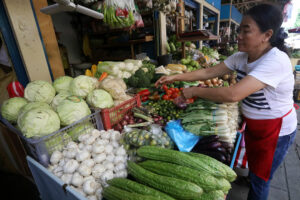
grocery-2-aa
Inflation Update: Target breached
DOWNLOAD
Container ship carrying container boxes import export dock with quay crane. Business commercial trade global cargo freight shipping logistic and transportation worldwide oversea concept. Generative AI
Economic Updates
Philippines Trade Update: Wider deficit on strong imports
DOWNLOAD
Frick collection with palm trees 
Economic Updates
Policy Rate Updates: Policy rate updates to reassure 
DOWNLOAD
View all Reports
Metrobank.com.ph How To Sign Up
Follow us on our platforms.

How may we help you?

TOP SEARCHES
  • Where to put my investments
  • Reports about the pandemic and economy
  • Metrobank
  • Webinars
  • Economy
TRENDING ARTICLES
  • Investing for Beginners: Following your PATH
  • On government debt thresholds: How much is too much?
  • Philippines Stock Market Outlook for 2022
  • Deficit spending remains unabated

Login

Access Exclusive Content
Login to Wealth Manager
Visit us at metrobank.com.ph How To Sign Up
Access Exclusive Content Login to Wealth Manager
Search
MODEL PORTFOLIO THE GIST
NEWS AND FEATURES
Global Philippines Fine Living
INSIGHTS
INVESTMENT STRATEGY
Economy Stocks Bonds Currencies
THE BASICS
Investment Tips Explainers Retirement
WEBINARS
2024 Mid-Year Economi Briefing, economic growth in the Philippines
2024 Mid-Year Economic Briefing: Navigating the Easing Cycle
June 21, 2024
Investing with Love
Investing with Love: A Mother’s Guide to Putting Money to Work
May 15, 2024
retirement-ss-3
Investor Series: An Introduction to Estate Planning
September 1, 2023
View All Webinars
DOWNLOADS
grocery-2-aa
Inflation Update: Target breached
April 7, 2026 DOWNLOAD
Container ship carrying container boxes import export dock with quay crane. Business commercial trade global cargo freight shipping logistic and transportation worldwide oversea concept. Generative AI
Economic Updates
Philippines Trade Update: Wider deficit on strong imports
March 27, 2026 DOWNLOAD
Frick collection with palm trees 
Economic Updates
Policy Rate Updates: Policy rate updates to reassure 
March 26, 2026 DOWNLOAD
View all Reports

Archives: Business World Article

More support needed for infrastructure’s post-pandemic recovery

More support needed for infrastructure’s post-pandemic recovery

By Luisa Maria Jacinta C. Jocson, Reporter

THE government will need to create a more enabling environment for investments to support the infrastructure sector’s post-pandemic recovery, analysts said.

“On the national front, hard-earned gains might still be lost and global opportunities missed. For instance, our failure to build the manufacturing sector, made worse by the government’s inability to lower energy costs and cut the bureaucratic red tape, has made a lot of investors look elsewhere for opportunities,” Megaworld Corp. First Vice-President for Marketing and Sales Noli D. Hernandez said in a Viber message.

Infrastructure development is one of the Marcos administration’s priority areas. The government is targeting to spend 5-6% of gross domestic product (GDP) on infrastructure annually.
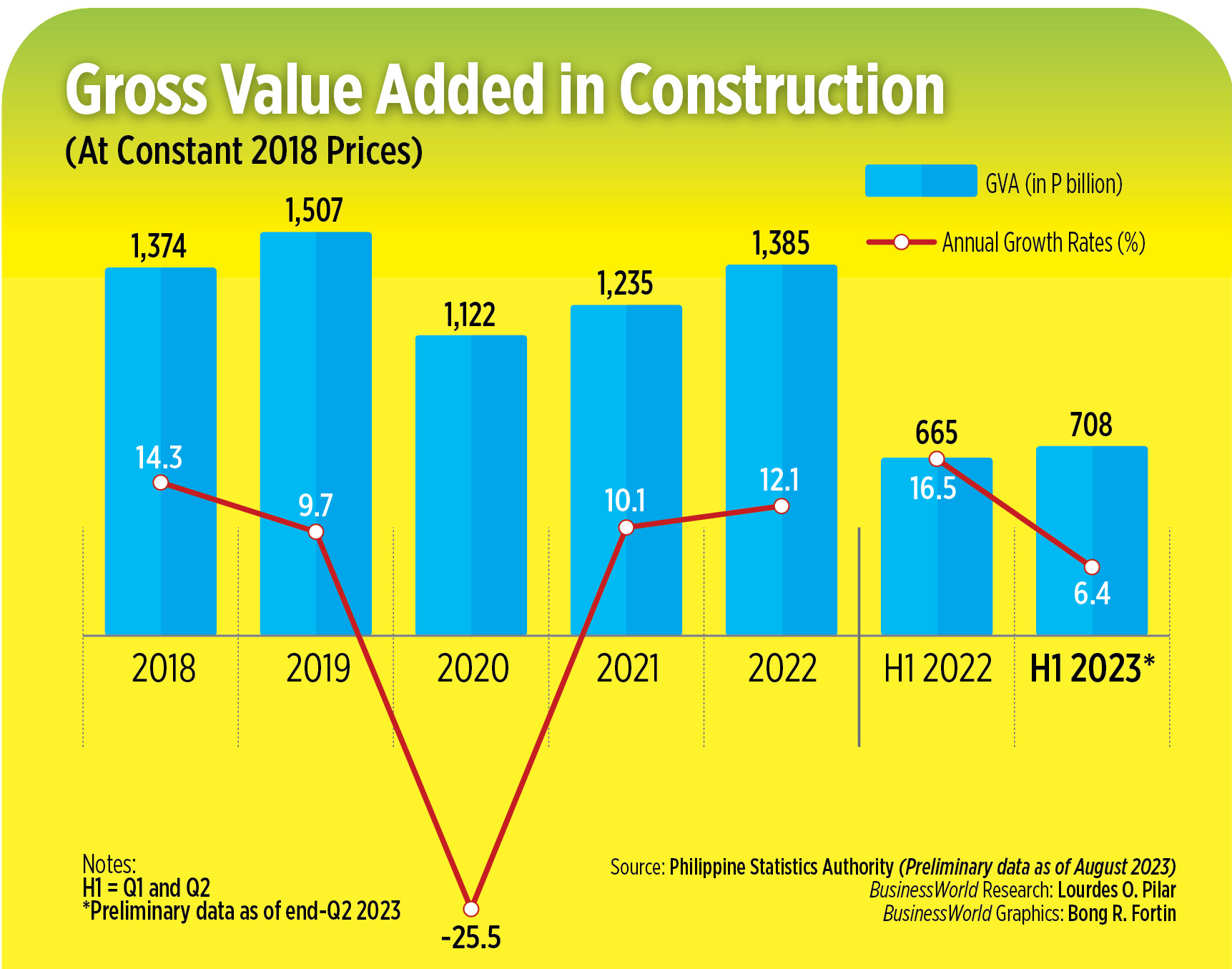
This year, the government plans to spend 5.3% of GDP on infrastructure, equivalent to about P1.29 trillion.

From 2010 to 2018, developing countries used only about 70% of infrastructure investment budgets, according to the World Bank.
A recent note by Nomura Global Markets Research said Philippine infrastructure development is seen to accelerate in the medium term.

“We remain optimistic that infrastructure development in these countries will accelerate in the next few years. Despite the recent improvement, there remains substantial scope for more progress, and governments are setting more ambitious targets to narrow this gap, building on earlier successes,” Nomura said.

Colliers Philippines Research Director Joey Roi H. Bondoc said the construction sector has yet to return completely to pre-pandemic levels.

“Construction activities have yet to revert to pre-pandemic levels but we are definitely seeing glimmers of hope. In our view, return to pre-pandemic construction levels will likely hinge on interest rate movements, prices of construction materials,” he said in an e-mail.

Mr. Bondoc said that external headwinds will also continue to have an impact on the recovery of construction activities.

“Colliers also believes that overall recovery in demand will also partly rely on sustained business and consumer confidence across the Philippines. The country’s growth trajectory presents enormous opportunities for developers with office, residential, retail, and leisure footprint,” he added.

SUPPORT NEEDED
Sustained growth in government spending will be crucial for the rebound for the sector.

“The most important underlying reason for the recovery of the infrastructure sector has been the sustained and broadening government spending on public infrastructure in the last few years,” Terry L. Ridon, a public investment analyst and convenor of think tank InfraWatch PH, said in an e-mail.

Infrastructure spending rose by an annual 7.8% to P507.2 billion in the first half. Overall infrastructure disbursements in the first six months were equivalent to 5.3% of GDP.

“Despite the coronavirus pandemic and economic headwinds, the government has continued to spend on new roads, bridges and flood control projects in various parts of the country,” he added.

Under the proposed 2024 National Expenditure Plan, the “Build, Better, More” program has been allocated P1.418 trillion. The bulk will go to physical connectivity infrastructure such as seaports, airports, and mass transport.

The National Economic and Development Authority (NEDA) Board has approved 197 flagship infrastructure projects worth P8.71 trillion.

“The government’s massive infrastructure program should benefit the Philippine property market and developers should seize opportunities by strategically launching more office projects, residential enclaves, and hotels in major growth areas,” Mr. Bondoc said.

However, the government’s massive infrastructure commitments are not enough to support the rest of the construction sector.

There is still a need to expedite permitting processes, cut red tape, and create a more enabling environment for investments.

“The challenge of the government is not about allocating the budget, but I think it’s implementation of projects. Some of the projects we are doing today were approved even during Marcos Sr.’s time, and we’re only doing it now,” Phinma Corp. Executive Vice-President Eduardo A. Sahagun said in a Zoom call interview.

“If it takes the same amount of time to do it, we will lag behind. I hope that’s where the bottlenecks must be addressed, how to speed up implementation of projects,” he added.

MORE PPP PROJECTS
The government should pursue more public-private partnerships (PPPs) and joint ventures (JVs) to accelerate the implementation of projects.

“The openness towards public-private partnerships has been an important reform in the infrastructure sector. It is bearing fruit today with the decision to implement a P170-billion solicited bidding for the rehabilitation of the Ninoy Aquino International Airport (NAIA),” Mr. Ridon said.

The government recently invited local and foreign investors to bid for the PPP project to upgrade and operate the NAIA. This will be under a rehabilitate-operate-expand-transfer arrangement, as provided for under the Build-Operate-Transfer Law.

“Local developers should explore firming up JVs with other homegrown players or even foreign property firms. In our view foreign players benefit from their partnership with local players given the latter’s experience in tapping and catering to the preferences of the domestic market,” Mr. Bondoc said.

“What’s notable is that these JVs are likely to result in a more competitive Philippine property landscape, eventually benefiting Filipino investors and end-users,” he added.

The government is hoping to attract more foreign investments after recent economic reforms allowed full foreign ownership in telecommunications, airlines, railways and renewable energy projects.

POST-PANDEMIC STRATEGIES
Meanwhile, companies involved in infrastructure are looking to revamp their internal processes to integrate post-pandemic strategies.

“One of the lessons we’ve learned coming out of the recent downturn, indeed coming out of all the previous downturns, is the primacy of a resilient, innovative, customer-centric and forward-thinking company culture, which fosters not just the aggressive seeking of opportunities but the creation of those opportunities where they seem nonexistent,” Megaworld’s Mr. Hernandez said.

Phinma’s Mr. Sahagun said firms should decentralize their decisions.

“We have to develop internal capabilities. As a company, we have to be agile in adapting to change. The first thing we did was to delegate authorities in different areas so they could make decisions on their own. If you’re just centralized in (one) office, you have no people on the ground, it will be difficult for you to continue doing business,” he added.

The shift to digitalization is also key in the post-pandemic recovery.

“Like most companies, we believe that the only way forward is to leverage our strengths with more human innovation and technological adoption and advances, either by leaps or small increments,” Mr. Hernandez said.

“The advent of artificial intelligence (AI) will definitely and definitively revolutionize and transform not just the way we do things, but ultimately determine exactly what things we are able to do and to what degree of sophistication. In the end however, AI or any other systems or technologies will only always be a tool. The key will always be the company’s culture,” he added.

CLIMATE RESILIENCE
The impact of climate change should also be considered in infrastructure planning, according to Institute for Climate and Sustainable Cities Director for Urban Development Maria Golda P. Hilario.

“The Philippine infrastructure industry must proactively address the risks and projected impact of climate change in its entire supply and value chain. It is important to not only acknowledge the threats posed by extreme weather events — such as typhoons — but also to factor in the creeping impacts of slow onset events — such as sea level rise and increasing temperature,” she said in an e-mail.

The Philippines is among the most disaster-prone countries in the world, experiencing typhoons, flash floods, earthquakes and volcanic eruptions. The Philippines ranked first globally in terms of disaster risk, based on the World Risk Index 2022.

A study by the Asian Development Bank (ADB) showed that developing Asia will need to invest $26 trillion from 2016 to 2030, or $1.7 trillion annually in infrastructure to maintain its growth momentum, eradicate poverty, and adapt to climate change.

“Infrastructure designs especially in urban areas must also be responsive to the risks and projected creeping impacts of slow onset events. Infrastructure development must already look at innovative and sustainable solutions such as green and energy efficient buildings and build around nature-based solutions, such as trees as temperature regulators to trap urban heat, and sinks to arrest flooding,” Ms. Hilario added.

The public, particularly the most at-risk and vulnerable to climate change, should also be included in the process of designing resilient infrastructure.

“The industry must also welcome the voice and participation of the public, especially the most vulnerable and most affected sector in the design, as well as be more responsive in ensuring that infrastructure projects contribute to the broader goal of connecting more people, rather than creating barriers,” she said.

“Sustainability can only be fostered through partnerships not just between the industry, private sector, and the government, but with the buy-in of the Filipino public, who are the main users of infrastructure projects in the long-run,” she added.

Budget deficit shrinks 45% in July

Budget deficit shrinks 45% in July

THE NATIONAL Government’s (NG) budget deficit shrank by 44.89% in July, amid double-digit growth in revenues and expenditures, the Bureau of the Treasury (BTr) said.

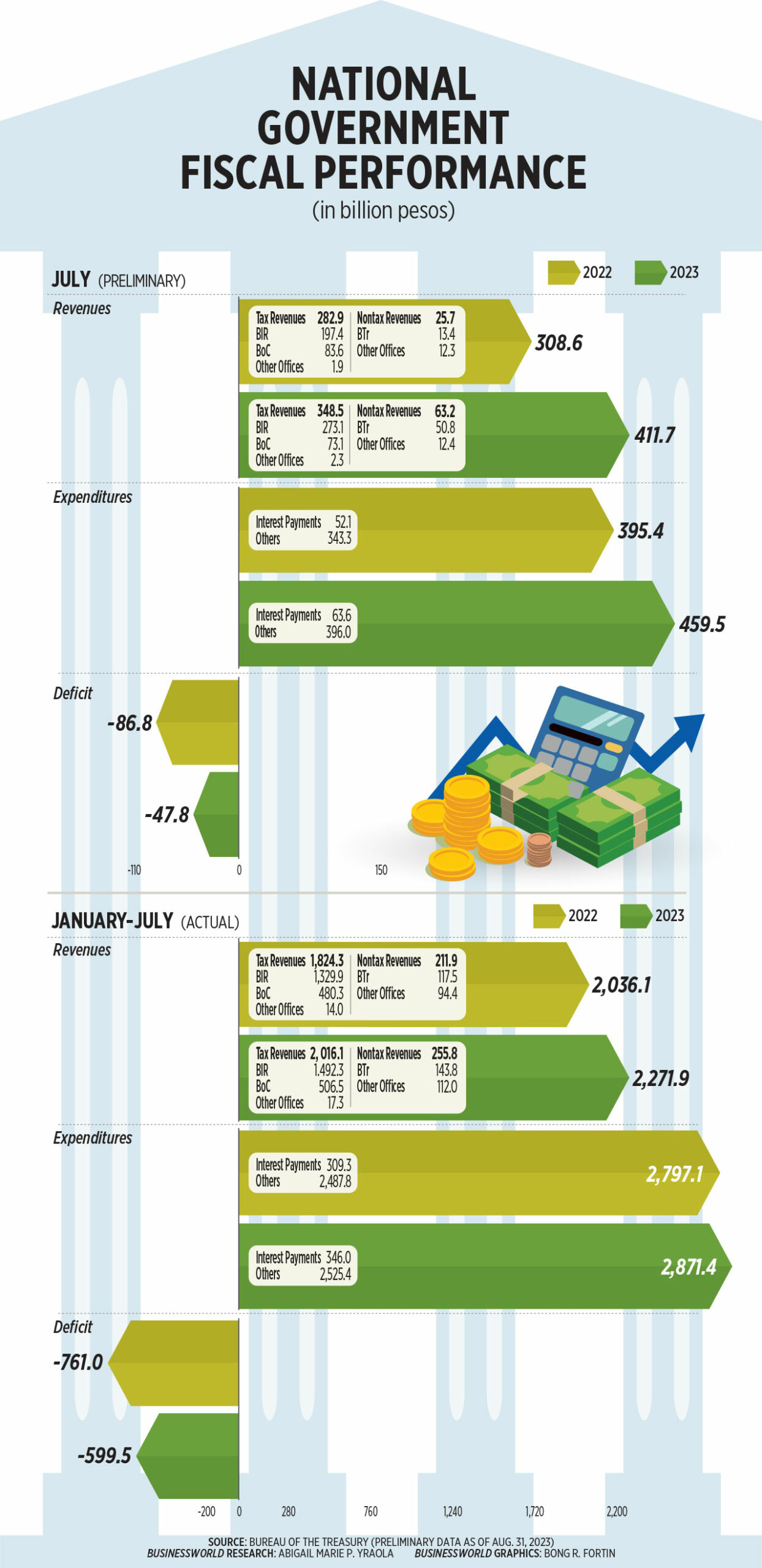
Data from the BTr showed the fiscal gap narrowed by 44.89% to PHP 47.8 billion in July from P86.8 billion in the same month a year ago.

“The NG’s budget deficit for July declined from a year ago on the back of 33.4% higher growth in revenue collection versus the 16.22% increase in government expenditures,” the BTr said.

In July, revenue collection rose to PHP 411.7 billion from P308.6 billion in the same month a year ago.

Tax revenues increased by 23.18% to PHP 348.5 billion in July, despite a double-digit decline in Customs collection.

The Bureau of Customs’ (BoC) collection declined by 12.61% year on year to PHP 73.1 billion, but this was offset by the 38.37% increase in Bureau of Internal Revenue (BIR) collection to PHP 273.1 billion.

Nontax revenues more than doubled to PHP 63.2 billion in July from PHP 25.7 billion in the same month a year ago. This was mainly due to the surge in BTr revenues to PHP 50.8 billion in July from PHP 13.4 billion a year ago. Revenues from other offices inched up by 0.58% to PHP 12.4 billion.

Meanwhile, state spending went up by 16.22% to PHP 459.5 billion during the month from PHP 395.4 billion a year ago.

The BTr said the increase in expenditures was mainly due to higher disbursements by the Social Welfare, Health and Agriculture departments.

“Spending in July also expanded on the back of significant infrastructure outlays of the Department of Public Works and Highways for its road network development program and the Department of Transportation for rail transport projects,” it added.

Primary expenditures, which refer to spending net of interest payments, rose by 15.35% to PHP 396 billion in July.

Interest payments jumped by 22% to PHP 63.6 billion during the month.

ING Bank N.V. Manila Senior Economist Nicholas Antonio T. Mapa said that July was a “strong month” for both revenues and spending.

“This resulted in a narrower budget which would improve overall fiscal metrics. We’ll need to see more of this in the coming months with healthy spending complemented by a sustained increase in revenue collections,” he said in a Viber message.

China Banking Corp. Chief Economist Domini S. Velasquez said the “better-than-expected” deficit was mainly due to the increase in revenues that were likely helped by improvements in tax administration.

“Spending also greatly improved, which grew by 16.2% as the government ramps up spending,” she said.

The Philippine economy grew by a weaker-than-expected 4.3% in the second quarter, partly due to the 7.1% decline in government spending. Government agencies were flagged for their low budget utilization and slow spending in the first half.

“Given the red flag from government underspending in the second quarter, we expect this uptick in spending to continue. Revenues will likely taper off due to a slowdown in economic activities. Overall, we still expect the National Government to reach its target this year,” Ms. Velasquez added.

YEAR-TO-DATE DEFICIT

For the first seven months of the year, the budget gap narrowed by 21.22% to PHP 599.5 billion from the PHP 761-billion shortfall a year ago.

Government revenues in the January-July period rose by 11.58% to PHP 2.271 trillion from PHP 2.036 trillion a year ago.

Tax revenues, which accounted for 88.74% of the total revenues, grew by 10.52% to PHP 2.016 trillion from PHP 1.824 trillion in the previous year.

BIR collection increased by 12.21% to PHP 1.492 trillion, while BoC collection went up by 5.45% to PHP 506.5 billion.

Nontax revenues jumped by 20.72% to PHP 255.8 billion, as the BTr’s income climbed by 22.4% to PHP 143.8 billion.

“The BTr’s collection for the seven-month period (is) higher than the 2022 comparable performance and has already exceeded the full-year target of PHP 58.3 billion largely due to higher dividend remittances, income from managed funds and government deposits, as well as NG share from PAGCOR (Philippine Amusement and Gaming Corp.) profit,” it added.

Nontax revenues from other offices rose by 18.63% to PHP 112 billion, partly due to one-time remittances from Philippine Charity Sweepstakes Office, Department of Foreign Affairs, and Bases Conversion and Development Authority.

Meanwhile, government expenditures inched up by 2.66% to PHP 2.871 trillion in the January-to-July period from PHP 2.797 trillion a year ago.

Primary spending rose by 1.51% to PHP 2.525 trillion, while interest payments increased by 11.87% to PHP 346 billion year on year.

“January-July interest payments comprised 12.05% of the total expenditure, higher than last year’s 11.06%. Meanwhile, interest payments as a percentage of total revenues inched up to 15.23% from 15.19% in 2022,” the BTr said.

This year, the government has set a budget deficit ceiling of PHP 1.499 trillion, equivalent to 6.1% of the gross domestic product (GDP).

As of end-June, the NG’s deficit-to-GDP ratio stood at 4.8%, lower than the 6.5% ratio in the same period in 2022.

The government is targeting to further reduce the deficit-to-GDP ratio to 3% by 2028. – Luisa Maria Jacinta C. Jocson, Reporter

Inflation likely settled within 4.8%-5.6% in Aug.

Inflation likely settled within 4.8%-5.6% in Aug.

HEADLINE INFLATION likely settled within the range of 4.8% to 5.6% in August amid a sharp increase in rice and fuel prices, the Bangko Sentral ng Pilipinas (BSP) said on Thursday.

If realized, August inflation would exceed the central bank’s 2-4% target band for the 17th straight month.

It would also be faster than the 4.7% print in July, which would end six straight months of slowing inflation.

The Philippine Statistics Authority (PSA) will release August consumer price index (CPI) data on Sept. 5.

“Higher prices of rice and other agricultural commodities due to weather disturbances, sharp rise in fuel prices as well as increased transport costs owing to higher train fares and toll rates, and the peso depreciation are the primary sources of upward price pressures in August,” the BSP said.

In August alone, oil companies raised pump prices by PHP 5.90 per liter for gasoline, PHP 9.90 per liter for diesel and PHP 10 per liter for kerosene.

Higher fares at the Light Rail Transit Lines 1 and 2 took effect on Aug. 2. The minimum boarding fee was increased from PHP 11 to PHP 13.29, while distance fare was hiked to PHP 1.21 from PHP 1 per kilometer.

The peso closed at PHP 56.595 on Thursday, depreciating by 3% or PHP 1.715 from the PHP 54.88 finish on July 31. Year to date, the peso depreciated by 1.5% or PHP 0.84 from its PHP 55.755 close on Dec. 29.

“Meanwhile, lower electricity rates from major providers could contribute to downward price pressures for the month,” the central bank said.

Manila Electric Co. (Meralco) lowered rates by P0.29 per kilowatt-hour (kWh) to P10.90 per kWh in August from P11.19 per kWh in July.

Debalika Sarkar, an economist from ANZ Research, expects 4.7% inflation in August due to base effects. Headline inflation was at 6.3% in August 2022. 

However, a large increase in rice prices may add to food inflation last month, she said in an e-mail.

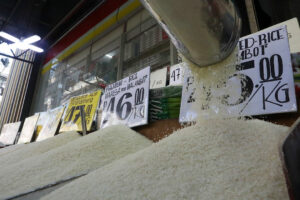
The average price of a kilogram of local well-milled rice ranged from PHP 47-PHP 56 as of Aug. 30, higher than the PHP 41-PHP 49 range as of Aug. 1

“A sharp rise in rice prices in the domestic market, following India’s ban on rice exports in late July, will be reflected in August inflation data. We are expecting a rebound in food prices following six consecutive months of deceleration,” Ms. Sarkar said.

In July, India banned the export of non-basmati white rice to control rising domestic prices. India accounts for more than 40% of world rice exports.   

Based on PSA data, food inflation further eased to 6.3% in July from 6.7% in June and 7.1% a year ago.

“Food prices in the Philippines are again on the radar with rising global rice prices and fears of agricultural production loss due to El Niño. Food makes up around 35% of the Philippines’ CPI basket, therefore a decoupling trend (food prices rising but headline falling) may not last once the base effects fade,” Ms. Sarkar said.

Meanwhile, Metrobank Research in a note cut its full-year inflation outlook to 5.6% from 5.8% previously. This matched the BSP’s average inflation forecast for 2023.

“Metrobank Research expects (the downward)  trend to persist in the succeeding months sans supply shocks. However, the bank also recognizes looming upside risks emerging from higher rice prices which may feed into the headline inflation by yearend and until the following year,” it said.

The BSP sees inflation returning to the 2-4% target band by the fourth quarter this year. It projects inflation to settle at 5.6% in 2023, before easing to 3.2% in 2024.   

“While price pressures have significantly tempered for 2023, we see these upside risks to be a major consideration for the BSP that may push currently stable inflation expectations higher,” Metrobank Research said.

The research firm said the BSP may keep interest rates steady at 6.25% for the rest of the year, before cutting by 100 basis points (bps) to 5.25% in 2024.

The Monetary Board raised borrowing costs by 425 bps from May 2022 to March 2023 to tame inflation.

“The continued slowdown in inflation which may return within the BSP’s target range towards yearend is anticipated to prompt rate cuts in the following year which will then push growth to rebound in 2024,” it said.

Metrobank Research also slashed its Philippine growth forecasts to 5.5% from 6% previously due to the second-quarter figures. This is below the government’s 6-7% target for the year.

The Philippine economy expanded by just 4.3% in the second quarter, bringing the first-half average to 5.3%. — Keisha B. Ta-asan

Net ‘hot money’ inflows surge to USD 962 million in July

Net ‘hot money’ inflows surge to USD 962 million in July

FOREIGN PORTFOLIO investments registered a net inflow for the second straight month in July, the Bangko Sentral ng Pilipinas (BSP) said on Thursday.

Transactions on short-term foreign investments registered with the BSP through authorized agent banks posted a net inflow of USD 962 million in July, a turnaround from the USD 103.14-million outflow in the same month in 2022.

The net inflow in July was also significantly higher than the revised USD 280,000 net inflow in June.

These foreign investments are also known as “hot money” — called as such due to the ease by which these funds enter and exit an economy.

Based on BSP data, gross inflows hit $1.58 billion in July, 77.2% up from the $889.4 million in June. It was also more than double the USD 680.7 million in the same month last year.

The top five investor economies were the United Kingdom, the United States, Singapore, Luxembourg, and Germany, accounting for 85.7% of total foreign portfolio investment inflows.

About USD 996 million or 63.2% were invested in peso government securities, while about 36.8% went into Philippine Stock Exchange-listed securities of companies involved in banks, property, food, beverage and tobacco, holding firms, and transportation services.

On the other hand, gross outflows declined by 30.9% to USD 614.5 million in July from USD 889.1 million a month prior. Year on year, net outflows fell by 21.6% from USD 784 million. 

The BSP said the United States received USD 400 million or 65% of total outward remittances.

The surge in hot money inflows in July may be due to bullish investor sentiment in the country.

“Net inflows in July may be supported by increased interest in the country due to various reforms such as the passage of the Maharlika Investment Fund (MIF) and proposed green lanes for investments,” China Banking Corp. Chief Economist Domini S. Velasquez said in a Viber message.

In July, President Ferdinand R. Marcos, Jr. signed the law creating the MIF, which is the country’s first sovereign wealth fund.

Ms. Velasquez also said that easing inflation in the US drew more investments.

“This information likely encouraged investors to flock to emerging markets like the Philippines,” she added. 

For the first seven months of the year, BSP-registered foreign investments yielded a net inflow of USD 81.71 million, significantly lower than the USD 715-million net inflow in the same period last year.

“Moving forward though, we expected hot money to remain weak due to a very thin interest rate band with the Fed and live possibility of further interest rate hikes domestically and abroad,” Ms. Velasquez said.

ING Bank N.V. Manila Senior Economist Nicholas Antonio T. Mapa said concerns over the pace of the Fed’s tightening may continue to impact the direction of hot money flows for the rest of the year.

The BSP expects hot money to yield a net inflow of USD 2.5 billion this year. — Keisha B. Ta-asan

Domestic liquidity grows by 5.9% in June — BSP data

Domestic liquidity grows by 5.9% in June — BSP data

GROWTH in money supply further eased in June as high borrowing costs weighed on credit demand.

Data from the Bangko Sentral ng Pilipinas (BSP) showed that domestic liquidity, as measured by M3, expanded by 5.9% to PHP 16.4 trillion in June, slower than the 6.6% growth in May.

On a month-on-month seasonally adjusted basis, M3 increased by 0.2%.

Rizal Commercial Banking Corp. Chief Economist Michael L. Ricafort said the June domestic liquidity growth was among the slowest in nearly two years or since July 2021.

He attributed this to the “restrictive monetary policy measures” as the BSP sought to mop up excess liquidity from the financial markets to curb inflation and stabilize the peso.

The Monetary Board raised borrowing costs by 425 basis points (bps) from May 2022 to March 2023, bringing the key interest rate to a near 16-year high of 6.25%.

Based on BSP data, domestic claims jumped by an annual 10.1% in June, slightly slower than 11.4% in May.

Claims on the private sector rose by 7.9% in June, easing from the 9.4% growth a month ago. The growth was driven by continued expansion in bank lending to nonfinancial private corporations and households.

Meanwhile, net claims on the central government rose by 17.2% in June, a tad slower from 18.3% in May, on the sustained borrowings by the National Government.

Net foreign assets (NFA) in peso terms slid by 2.8% in June, reversing the 2.7% expansion in May.

“The BSP’s NFA position declined by 0.6% in June after increasing by 4.2% in the previous month. Meanwhile, the NFA of banks declined on account of higher bills payable,” the central bank said.

The BSP added that it will continue to ensure domestic liquidity conditions are consistent with price and financial stability.

“For the coming months, M3 growth could remain tempered as long as inflationary pressures remain and monetary policy remains restrictive to bring down inflation further to BSP’s targets,” Mr. Ricafort said. 

Headline inflation likely settled within the 4.8%-to-5.6% range in August, according to the BSP.  If realized, this would be higher than the 4.7% print in July. It would also mark the 17th straight month inflation breached the 2-4% target.

The BSP sees inflation returning to the 2-4% target range by the fourth quarter this year. It projects full-year inflation to reach 5.6% in 2023, before easing to 3.2% in 2024.

Earlier BSP data showed outstanding loans of big banks expanded by 7.8% to PHP 10.99 trillion in June from PHP 10.19 trillion a year ago. Bank lending growth in June was slower than 9.4% seen in May and 12.1% in June 2022. — K.B. Ta-asan

Domestic trade declines in second quarter

Domestic trade declines in second quarter

The domestic trade in goods declined by an annual 36.2% in the second quarter, the Philippine Statistics Authority (PSA) said on Tuesday.

Preliminary data from the PSA’s Commodity Flow in the Philippines report showed the value of goods traded in the three months to June dropped by a third to PHP 171.54 billion from PHP 268.7 billion in the same period in 2022.

Quarter on quarter, domestic trade fell by 35% from PHP 265.51 billion in the first quarter this year.

The second-quarter decline was a reversal from the 29.9% growth in the same period in 2022, and the 14.5% growth in the previous quarter.

In terms of volume, domestic trade inched up to 5.79 million tons in the second quarter from 5.73 million tons in the same period in 2022. Quarter on quarter, it fell by 10% from 6.45 million tons in the January-to-March period.

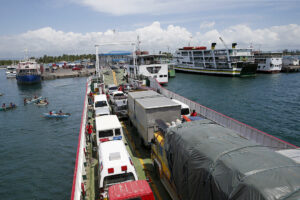
Commodity flow includes all goods transported by water, air, and rail transport. Nearly all (99.96%) of the commodities were transported through water.

ING Bank N.V. Manila Senior Economist Nicholas Antonio T. Mapa attributed the decline due to base effects.

“We’re now likely seeing more normalized levels of trade. This mirrors the negative quarter-on-quarter gross domestic product (GDP) growth posted in the second quarter suggesting economic activity is slowing,” Mr. Mapa said in an e-mail.

In the second quarter, GDP expanded by 4.3% in the second quarter, weaker than the 6.4% growth in the first quarter and the 7.5% print a year ago. This was also the slowest in over two years.

Quarter on quarter, GDP shrank by 0.9% in the April-to-June period, a reversal of the 1.1% growth in the first quarter.

PSA data showed the trade value of eight out of the 10 commodity categories fell year on year in the second quarter.

The trade value of animal and vegetable oils, fats and waxes recorded the biggest annual decline (-90.8% from -47.2%), followed by beverages and tobacco (-82.9% from 4.1%), miscellaneous manufactured articles (-67% from 14.6%), chemicals and related products (-62.1% from 20.3%), food and live animals (-58.5% from 14.3%).

Other categories that recorded declines were machinery and transport equipment (-26.1% from 27.4%), manufactured goods classified chiefly by material (-20.6% from 1.1%), and commodities and transactions not classified elsewhere in the PSCC (-19.7% from -1.5%).

Meanwhile, the trade value of crude materials (inedible except fuel) jumped by 171.2% in the second quarter, while mineral fuels, lubricants and related materials rose by 13.2%.

In the second quarter, machinery and transport recorded the biggest value of traded commodities at PHP 61.51 billion, but this was 26% lower than the PHP 83.27 billion recorded a year ago.

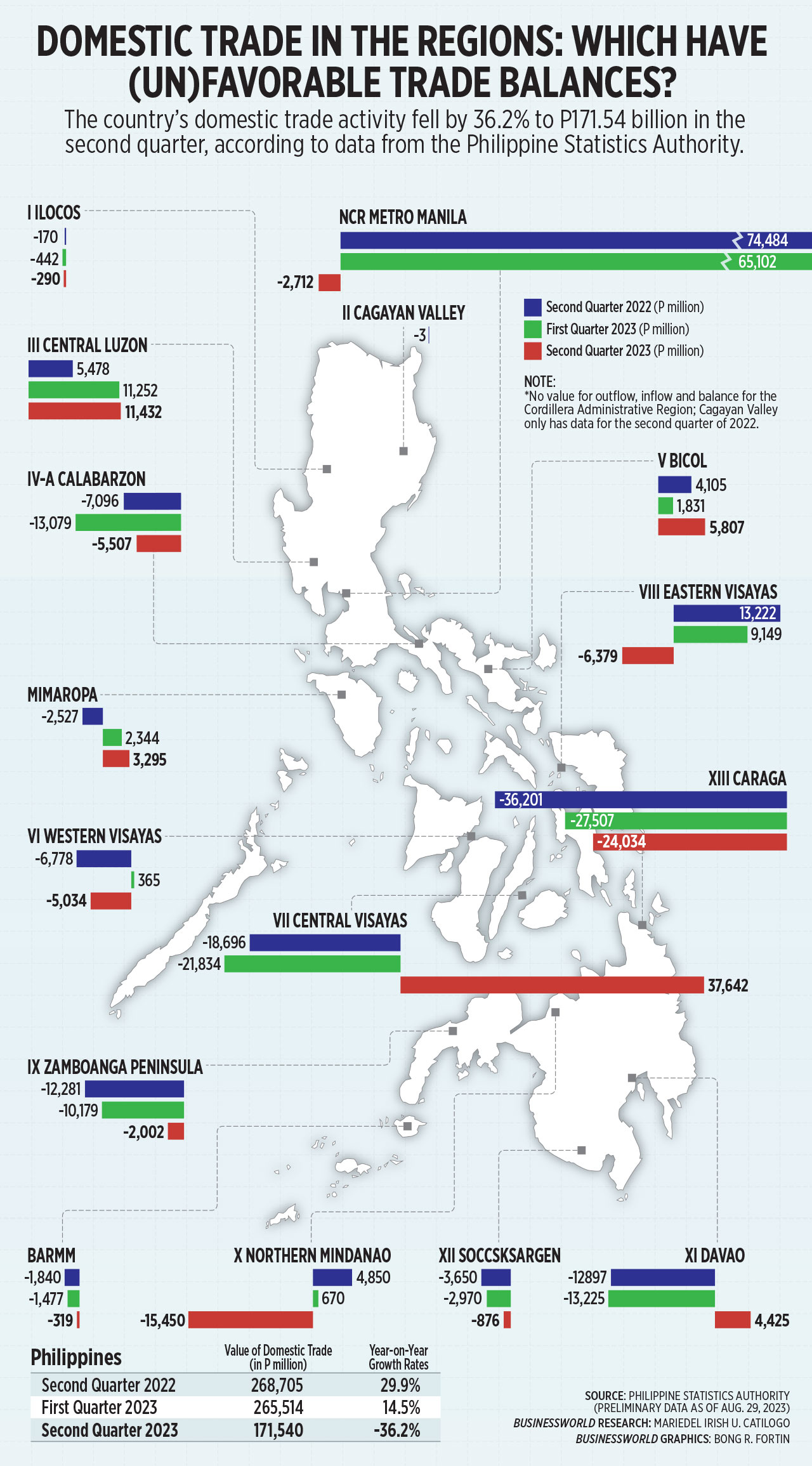
Central Visayas was the top source and destination of traded commodities in the April-to-June period with total outflows amounting to PHP 95.61 billion and inflows worth PHP 57.97 billion.

Central Visayas also had the largest trade balance in the second quarter with PHP 37.64 billion, followed by Central Luzon with PHP 11.43 billion and Bicol with PHP 5.81 billion.

Three regions had the biggest negative trade balance, led by Caraga (-PHP 24.03 billion), Northern Mindanao (-PHP 15.45 billion) and Eastern Visayas (-PHP 6.38 billion). — MIUC

Electronics exports seen to fall flat

Electronics exports seen to fall flat

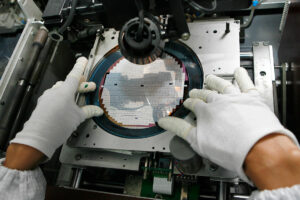
The semiconductor and Electronics Industries in the Philippines Foundation, Inc. (SEIPI) said on Wednesday it now expects electronics exports to be flat after seeing a sharp decline in the first semester.

“We have revised our growth forecast from 5% for the year to flat, zero because realistically we’re down 7% (in the first six months). But we see a recovery in the third and fourth quarters. So that’s why we’re aiming for at least flat,” SEIPI President Danilo C. Lachica told reporters on Wednesday.

SEIPI data showed total electronics exports dropped by 7% to USD 21.19 billion in the January-to-June period from USD 22.78 billion in the same period in 2022.

Six sectors showed a decline in exports in the first half. This was led by automotive electronics which plunged 70.4% to USD 18.7 million, followed by office equipment (-44%), electronic data processing (-32.2%), telecommunication (-25.8%), semiconductor components/devices (-4.4%), and control and instrumentation (-0.9%).

On the other hand, some sectors recorded an improvement in exports, such as communication/radar (23.4%), medical/industrial instrumentation (20.1%), and consumer electronics (17.4%).

Mr. Lachica attributed the exports decline mainly due to geopolitical tensions, such as the US-China trade war.

“In the last quarter or so, we’ve been clobbered in terms of our electronics exports. In fact, at one point, we were 15% down compared to last year,” he said, noting that exports recovered in June.

Data from SEIPI showed that total electronics exports rose by 11.8% to USD 4.25 billion in the month of June.

Four sectors reported year-on-year growth led by medical/industrial instrumentation (34.9%), semiconductor components/devices (22.3%), communication/radar (19.6%), and consumer electronics (8.4%).

On the other hand, five sectors posted declines in June, namely automotive electronics (-54%), office equipment (-36.4%), telecommunication (-29.9%), electronic data processing (-29.2%), and control and instrumentation (-12.5%).

Mr. Lachica said SEIPI is still hopeful of a recovery in electronics exports in the second half.

“The demand is still there. We are hoping that the Thanksgiving demand and the Christmas demand will propel the recovery of the industry,” he said.

For the rest of the year, SEIPI expects most of its exports to go to neighboring countries, particularly in China and Hong Kong.

Mr. Lachica noted that the Netherlands replaced Germany as the top destination of Philippine electronics exports.

“In Europe, the biggest destination is now the Netherlands followed by Germany,” he said. — Justine Irish D. Tabile

Inflationary pressures remain elevated in PH

Inflationary pressures remain elevated in PH

Inflationary pressures in the Philippines remain one of the highest in Asia as food prices continue to rise, according to Nomura Global Markets Research.

Nomura Global Markets Research in a note dated Aug. 30 said the Philippines recorded the second-highest aggregate score of 103.3 in its ranking of inflationary pressures in Asia.

Singapore faces the highest inflationary pressures with a score of 104.

In Nomura’s scorecard, the Philippines is the only emerging market in Asia that still faces elevated risks to inflation.

“(This is) because of the (country’s) higher vulnerability to supply-side inflationary shocks that have spilled over more broadly and will likely unwind only gradually, in our view,” Nomura said.

Headline inflation slowed for a sixth straight month to 4.7% in July but marked the 16th straight month it exceeded the central bank’s 2-4% target.

Inflation averaged 6.8% in the first seven months of the year, still above the central bank’s revised 5.6% full-year forecast.

Nomura noted inflationary pressures were most under control in Indonesia (96.5) and Thailand (96.8).

“Philippines appears most exposed to higher food prices, especially rice (which has an 8.9% weighting in its consumer price index basket). Higher food prices could result in higher headline inflation and a wider current account deficit, as it resorts to importation,” Nomura said. 

Rice inflation rose to 4.2% in July from 3.6% in June.

According to Nomura, the bar for all Asian central banks to resume rate hikes is “quite high.”

The BSP earlier this month extended its policy hold for a third straight meeting, keeping the benchmark interest rate at a near 16-year high of 6.25%.

“However, we expect the BSP to leave policy rates unchanged, taking comfort from the sharp drop in core inflation momentum and also due to the weakening growth outlook,” it said.

Nomura expects the BSP to cut rates starting March 2024.

Meanwhile, the Philippine central bank may be “encouraged” to start its policy easing if inflation falls within the 2-4% target range this year, Moody’s Analytics said.

Moody’s Analytics in a report dated Aug. 29 said Asian central banks are “walking on a tightrope” this year as inflation further decelerates but policy movements in the US and in Europe hinder them from cutting down borrowing costs.

“In economies that have slowed recently and where inflation has rapidly moderated, such as in the Philippines and South Korea, central banks may be encouraged to lower their policy rates as soon as inflation reaches their target range,” Moody’s said.

The BSP expects inflation to return to the 2-4% target band in the fourth quarter this year.

“On the other hand, they must watch the policy rate of the US and Europe so as not to allow interest rate gaps to rise further, risking volatility in foreign exchange rates — as seen in recent weeks in Southeast Asia as the yield on the US 10-year bond has risen,” Moody’s said.

The peso closed at PHP 56.725 against the dollar on Wednesday, up by 2.50 centavos from its previous close. Year to date, the peso depreciated by 1.71% or 97 centavos from its PHP 55.755 close on December 29.

“We expect central banks in Asia-Pacific to hold their policy interest rates steady at least through the end of this year, and probably longer, depending upon the stability of domestic demand and their respective currencies and how quickly external demand improves from China and from the European and North American economies,” Moody’s added. 

BSP Governor Eli M. Remolona, Jr. earlier said the Philippine central bank remains hawkish, and rate cuts are far off as inflation is still elevated.

The BSP will hold its next policy meeting on September 21. — Keisha B. Ta-asan

Maharlika fund allowed to invest in JVs, infrastructure projects

Maharlika fund allowed to invest in JVs, infrastructure projects

The Maharlika Investment Corp. (MIC), which will manage the country’s first sovereign wealth fund, can invest in joint ventures (JVs), infrastructure projects, and sustainable development programs, as well as extend loans.

Under the implementing rules and regulations of Republic Act No. 11954 or the Maharlika Investment Fund (MIF) law, the MIC can invest in joint ventures or co-investments, mergers and acquisitions; and mutual and exchange-traded funds invested in underlying assets.

The MIC can also invest in real estate and infrastructure projects. However, investments in infrastructure projects should be “directed towards the fulfillment of national priorities such as the national infrastructure program of the Department of Public Works and Highways and other infrastructure agencies, the inclusive innovation industry strategy of the Department of Trade and Industry, and the public investment programs of the National Economic and Development Authority.”

Investments in real estate should also be limited to “high-impact projects, those contained in the Strategic Investment Priority Plan, as well as other projects that are approved by the appropriate approving body to ensure that these are in line with the socioeconomic development program of the government.”

The MIC can also pour funds into health, education, research and innovation projects, as well as sustainable development programs.

It can extend “loans and guarantees to, or participation into joint ventures or consortiums with Filipino and foreign investors, whether in the majority or minority position in commercial, industrial, mining, agricultural, housing, energy, and other enterprises, which may be necessary or contributory to the economic development of the country, or important to the public interest.”

The board of directors must also make sure that allowable investments are in line with the “principle of sustainability.”

The MIC is also authorized to invest in cash, foreign currencies, metals, and other tradable commodities; fixed-income instruments issued by sovereigns, quasi-sovereigns and supranationals; domestic and foreign corporate bonds; listed or unlisted equities, whether common, preferred, or hybrids; and Islamic investments, such as Sukuk bonds.

Board directors
Meanwhile, the list of nominees for the MIC’s president and chief executive officer (CEO), regular directors, and independent directors must be presented to the President by October.

“The solicitation of nominees and applications, for purposes of initial appointment, may be made immediately upon the publication of the IRR, the closing date of which shall not exceed 15 days from the effectivity of the IRR,” it said. The IRR will take effect on Sept. 12.

Under the rules, the MIC president and CEO must have an advanced degree (MBA, MA, MSc, PhD) in finance, economics, business administration, or any related field from a reputable university.

The MIC president and CEO must also show “exceptional experience and expertise in corporate management, financial planning strategy, strategic planning and vision, market and business development, budget development,” and have work experience in a finance or investment-related field for at least 10 years.

A minimum of 10 years in a senior leadership role in a “reputable financial institution or public or private sector organization” is also required.

The president and CEO will direct and supervise the operations and internal administration of the MIC. They will also be charged with the risk management, financial performance, human resources, as well as the accounting and legal affairs of the MIC.

Meanwhile, regular directors must be Filipino citizens, at least 35 years old and must be of “good moral standing and reputation, of recognized probity and independence and have substantial experience and expertise in corporate governance and administration, investment in financial assets, and/or management of investments in the global and local markets.”

The independent directors must have “probity, competence, expertise and experience in finance, economics, investments, business management, or law, and are highly capable to contribute to the attainment of the objectives and purposes of the MIF.”

Both regular and independent directors are required to have a master’s degree in finance, economics, business administration. They must also have at least 10 years of experience in finance, investments, economics, business, or any related field. — Luisa Maria Jacinta C. Jocson

Stakeholders’ comment sought on proposed eSECURE platform  

Stakeholders’ comment sought on proposed eSECURE platform  

The Securities and Exchange Commission (SEC) is seeking comments from stakeholders on a proposed memorandum circular covering its electronic SEC universal registration environment (eSECURE) platform.

The eSECURE is a platform that allows users to manage their SEC account and online transactions in one place, the commission said in the proposed circular posted on Aug. 29.

“The eSECURE creates a digital passport of an individual which grants the user access to the different online services provided by the commission,” it said.

According to the proposed circular, individuals seeking to use eSECURE are required to create an account to improve the security of online transactions with the commission. 

The SEC added that a credentialing process or electronic know-your-customer (eKYC) is needed for sensitive and critical services where verification and establishment of the user’s identity is required.

“It enables risk-based credentialing procedure. At the basic level, it implements repeatable eKYC to determine authenticity of identity and establish reachability of persons transacting online with the Commission. At higher levels, other identity verification methods such as courier-based customer visit and remote retail on-customer-premise biometrics capture may be implemented,” the SEC said.

The SEC added that a PHP 400 fee will be charged for initiating the credentialing process for the first time, while a P100 fee will be paid when the user initiates another credentialing process due to information changes, and a PHP 250 fee will be paid for the renewal of the credentialing account.

Once an account is created, the user will have access to online services such as the SEC electronic simplified processing of an application for company registration, one-day submission and e-registration of companies, automated certification examination system, and electronic SEC education, analysis, and research computing hub.

Other services that could be accessed by the user include the SEC application program interface marketplace. SEC electronic registry application for market participants, SEC eFAST alternative submission environment, SEC amendment system, SEC appointment system, and SEC iMessage.

“The commission reserves the right to cancel any account, without prior notice, which has been found to have violated any of the terms of service or to have engaged in the conduct of inappropriate activities using the eSECURE account,” the SEC said.

It said a canceled account will no longer be allowed to log in and use the online services of the commission. An account can no longer be reactivated once it is canceled,” it added.

Comments on the proposed draft circular may be submitted to the SEC on or before Sept. 8. — Revin Mikhael D. Ochave

Posts navigation

Older posts
Newer posts

Recent Posts

  • Peso GS Weekly: Geopolitics drive a volatile curve
  • Ask Your Advisor: Can my portfolio survive a market crash?
  • Stock Market Weekly: Middle East stalemate weighs on market 
  • Investment Ideas: April 13, 2026 
  • Metrobank US-Iran Risk Index: Fragile ceasefire 

Recent Comments

No comments to show.

Archives

  • April 2026
  • March 2026
  • February 2026
  • January 2026
  • December 2025
  • November 2025
  • October 2025
  • September 2025
  • August 2025
  • July 2025
  • June 2025
  • May 2025
  • April 2025
  • March 2025
  • February 2025
  • January 2025
  • December 2024
  • November 2024
  • October 2024
  • September 2024
  • August 2024
  • July 2024
  • June 2024
  • May 2024
  • April 2024
  • March 2024
  • February 2024
  • January 2024
  • December 2023
  • November 2023
  • October 2023
  • September 2023
  • August 2023
  • July 2023
  • June 2023
  • May 2023
  • April 2023
  • March 2023
  • February 2023
  • January 2023
  • December 2022
  • November 2022
  • October 2022
  • September 2022
  • August 2022
  • July 2022
  • June 2022
  • May 2022
  • March 2022
  • December 2021
  • October 2021

Categories

  • Bonds
  • BusinessWorld
  • Currencies
  • Economy
  • Equities
  • Estate Planning
  • Explainer
  • Featured Insight
  • Fine Living
  • How To
  • Investment Tips
  • Markets
  • Portfolio Picks
  • Rates & Bonds
  • Retirement
  • Reuters
  • Spotlight
  • Stocks
  • Uncategorized

You are leaving Metrobank Wealth Insights

Please be aware that the external site policies may differ from our website Terms And Conditions and Privacy Policy. The next site will be opened in a new browser window or tab.

Cancel Proceed
Get in Touch

For inquiries, please call our Metrobank Contact Center at (02) 88-700-700 (domestic toll-free 1-800-1888-5775) or send an e-mail to customercare@metrobank.com.ph

Metrobank is regulated by the Bangko Sentral ng Pilipinas
Website: https://www.bsp.gov.ph

Quick Links
The Gist Webinars Wealth Manager Explainers
Markets
Currencies Rates & Bonds Equities Economy
Wealth
Investment Tips Fine Living Retirement
Portfolio Picks
Bonds Stocks
Others
Contact Us Privacy Notice Terms of Use
© 2026 Metrobank. All rights reserved.

Access this content:

If you are an existing investor, log in first to your Metrobank Wealth Manager account. ​

If you wish to start your wealth journey with us, click the “How To Sign Up” button. ​

Login HOW TO SIGN UP