MODEL PORTFOLIO
THE GIST
NEWS AND FEATURES
Global Philippines Fine Living
INSIGHTS
INVESTMENT STRATEGY
Economy Stocks Bonds Currencies
THE BASICS
Investment Tips Explainers Retirement
WEBINARS
2024 Mid-Year Economi Briefing, economic growth in the Philippines
2024 Mid-Year Economic Briefing: Navigating the Easing Cycle
June 21, 2024
Investing with Love
Investing with Love: A Mother’s Guide to Putting Money to Work
May 15, 2024
retirement-ss-3
Investor Series: An Introduction to Estate Planning
September 1, 2023
View All Webinars
DOWNLOADS
grocery-2-aa
Inflation Update: Target breached
DOWNLOAD
Container ship carrying container boxes import export dock with quay crane. Business commercial trade global cargo freight shipping logistic and transportation worldwide oversea concept. Generative AI
Economic Updates
Philippines Trade Update: Wider deficit on strong imports
DOWNLOAD
Frick collection with palm trees 
Economic Updates
Policy Rate Updates: Policy rate updates to reassure 
DOWNLOAD
View all Reports
Metrobank.com.ph How To Sign Up
Follow us on our platforms.

How may we help you?

TOP SEARCHES
  • Where to put my investments
  • Reports about the pandemic and economy
  • Metrobank
  • Webinars
  • Economy
TRENDING ARTICLES
  • Investing for Beginners: Following your PATH
  • On government debt thresholds: How much is too much?
  • Philippines Stock Market Outlook for 2022
  • Deficit spending remains unabated

Login

Access Exclusive Content
Login to Wealth Manager
Visit us at metrobank.com.ph How To Sign Up
Access Exclusive Content Login to Wealth Manager
Search
MODEL PORTFOLIO THE GIST
NEWS AND FEATURES
Global Philippines Fine Living
INSIGHTS
INVESTMENT STRATEGY
Economy Stocks Bonds Currencies
THE BASICS
Investment Tips Explainers Retirement
WEBINARS
2024 Mid-Year Economi Briefing, economic growth in the Philippines
2024 Mid-Year Economic Briefing: Navigating the Easing Cycle
June 21, 2024
Investing with Love
Investing with Love: A Mother’s Guide to Putting Money to Work
May 15, 2024
retirement-ss-3
Investor Series: An Introduction to Estate Planning
September 1, 2023
View All Webinars
DOWNLOADS
grocery-2-aa
Inflation Update: Target breached
April 7, 2026 DOWNLOAD
Container ship carrying container boxes import export dock with quay crane. Business commercial trade global cargo freight shipping logistic and transportation worldwide oversea concept. Generative AI
Economic Updates
Philippines Trade Update: Wider deficit on strong imports
March 27, 2026 DOWNLOAD
Frick collection with palm trees 
Economic Updates
Policy Rate Updates: Policy rate updates to reassure 
March 26, 2026 DOWNLOAD
View all Reports

Archives: Business World Article

SEC to align with Asian markets on short-selling

SEC to align with Asian markets on short-selling

The Securities and Exchange Commission (SEC) is aligning the country’s short-selling environment with other markets in Asia to boost the local equities market.

“We are pushing to align the short selling environment with the major Asian markets, which has the potential to promote liquidity, stabilize the market, protect investors, and further unlock the value of shares of Philippine corporations,” SEC Chairperson Emilio B. Aquino said in a statement on Monday.

The commission said it had looked at the adoption or non-adoption of existing practices in other markets to advance short-selling in the Philippines.

Short-selling — or betting on the decline of a stock’s price to make a profit — is allowed in other Southeast Asian countries such as Singapore, Hong Kong, Malaysia, Thailand, and Indonesia.

The SEC said it is looking at requiring the submission of a regular report on activities relating to short-selling and securities borrowing and lending (SBL), and their compliance with existing rules and policies to guide future policies. 

“We will balance our role as regulator and market innovator, imposing the necessary restrictions and safeguards while ensuring that they will not stifle investors and trading participants from fully taking advantage of this trading strategy,” Mr. Aquino said.

Short-selling happens when an investor sells a security that he or she does not own, the SEC explained. It is consummated by the delivery of a borrowed security, “with a commitment to return the borrowed security or its equivalent on a determined or determinable future date.” 

In 2018, the SEC approved the guidelines of the Philippine Stock Exchange (PSE) on short-selling transactions. The rules mandate that only the PSE index and exchange-traded funds are eligible for short-selling. Companies should also maintain a ratio of short interest to outstanding shares of at least 10%.

The SEC also approved the Capital Markets Integrity Corp. (CMIC) implementing guidelines on SBL and short-selling in 2019, which cover the recording of SBL and short-selling transactions on trading participants’ books and records. The guidelines call for trading participants to ascertain transacting parties have entered into the necessary borrowing arrangements prior to entering a short sale transaction.

Meanwhile, the SEC said in a separate statement that there is a need for digital transformation to improve the ease of doing business in the country.

“Over the years, we have adopted — and we continue to explore more — innovations in the way we receive, process and approve applications for company registration and corporate filings, as well as in the way we offer our other services to the public,” Mr. Aquino said during a seminar in Davao City on August 30. 

The SEC said it is focused on digitalizing and streamlining its internal systems and direct interfaces with the transacting public and boosting digital external links with partner agencies and the private sector.

“Our digital transformation has been calibrated and tempered to the requirements of the transacting public and stakeholders,” Mr. Aquino said. “We need to adjust to our customers.” — Revin Mikhael D. Ochave

Gov’t fully awards Treasury bills at lower rates

Gov’t fully awards Treasury bills at lower rates

The government made a full award of the Treasury bills (T-bills) it offered on Monday at lower rates before the release of August inflation data.

The Bureau of the Treasury (BTr) raised PHP 15 billion as planned via the T-bills it auctioned off on Monday as total bids reached PHP 47.56 billion, or more than thrice the amount on offer.

Broken down, the Treasury made a full PHP 5-billion award of the 91-day T-bills as tenders for the tenor reached PHP 13.242 billion. The three-month paper was quoted at an average rate of 5.552%, 2.1 basis points (bps) below the 5.573% seen last week, with accepted rates ranging from 5.5% to 5.6%.

The government also raised PHP 5 billion as planned from the 182-day securities as bids for the tenor reached PHP 15.043 billion. The average rate for the six-month T-bill was at 5.966%, down by 2.7 bps from 5.993% seen last week, with accepted rates at 5.948% to 5.985%.

Lastly, the BTr borrowed the programmed PHP 5 billion via the 364-day debt papers as demand for the tenor stood at PHP 19.275 billion. The average rate of the one-year T-bill declined by 9.9 bps to 6.198% from the 6.297% quoted last week. Accepted yields were from 6.17% to 6.22%.

At the secondary market before Monday’s auction, the 91-, 182- and 364-day T-bills were quoted at 5.7081%, 5.9878%, and 6.2632%, respectively, based on PHP Bloomberg Valuation Reference Rates data provided by the Treasury.

“The Auction Committee fully awarded bids for Treasury bills (T-bills) at today’s auction. The 91-, 182-, and 364-day T-bills fetched average rates of 5.552%, 5.966% and 6.198%, respectively, all lower than previous auction results and secondary market rates,” the BTr said in a statement on Monday.

“The auction was 3.2 times oversubscribed, attracting PHP 47.6 billion in total tenders. With its decision, the Committee raised the full program of PHP 15 billion for the auction,” it added.

The result of Monday’s auction was in line with expectations as the market awaited the release of August inflation data, a trader said in a phone interview.

August consumer price index data will be released on Tuesday.

A BusinessWorld poll of 18 analysts yielded a median estimate of 4.9% for August inflation, near the lower end of the Bangko Sentral ng Pilipinas’ (BSP) 4.8-5.6% forecast for the month.

If realized, this would be faster than the 4.7% seen in July, but lower than the 6.3% print in August 2022.

It would mark the 17th straight month of inflation exceeding the BSP’s 2-4% target.

T-bill yields tracked the recent decline in rates of US Treasuries amid bets that the US Federal Reserve will not hike rates at its Sept. 19-20 meeting, Rizal Commercial Banking Corp. Chief Economist Michael L. Ricafort said in a Viber message.

Benchmark Treasury yields rebounded on Friday after a US jobs report showed an uptick in unemployment, cementing expectations that the Fed will let interest rates stand at its September meeting, Reuters reported.

US 10-year Treasury yields reversed earlier declines following the employment report, as investors pared positions ahead of the Labor Day weekend.

The Fed in July hiked borrowing costs by 25 bps to the 5.25%-5.5% range. Since March 2022, the US central bank has raised its policy rate by 525 bps.

On Tuesday, the BTr will offer PHP 30 billion in fresh three-year Treasury bonds (T-bonds).

The BTr wants to raise PHP 180 billion from the domestic market this month or PHP 60 billion via T-bills and PHP 120 billion via T-bonds.

The government borrows to help fund its budget deficit, which is capped at 6.1% of gross domestic product this year. — AMCS with Reuters

Peso weakens against dollar as market awaits August inflation report

Peso weakens against dollar as market awaits August inflation report

The peso inched down against the dollar on Monday as the market awaited the release of the August consumer price index report on Tuesday.

The local currency closed at PHP 56.62 versus the dollar on Monday, weakening by 2.50 centavos from Thursday’s PHP 56.595 finish, data from the Bankers Association of the Philippines’ website showed.

The local unit opened Monday’s session weaker at PHP 56.65 per dollar. Its intraday best was at PHP 56.49, while its worst showing was at PHP 56.66 against the greenback.

Dollars traded went up to USD 1.59 billion on Monday from the USD 1.48 billion on Thursday.

The peso weakened ahead of the release of August inflation data, Rizal Commercial Banking Corp. Chief Economist Michael L. Ricafort said in a Viber message.

“[On Tuesday], we’ll get domestic inflation, which could hint at the BSP’s (Bangko Sentral ng Pilipinas) own policy path,” ING Bank N.V. Manila Senior Economist Nicholas Antonio T. Mapa said in a Viber message.

A BusinessWorld poll of 18 analysts yielded a median estimate of 4.9% for August inflation, near the lower end of the central bank’s 4.8-5.6% forecast for the month.

If realized, this would be faster than the 4.7% in July, but lower than the 6.3% print in August 2022.

It would also mark the 17th straight month that inflation exceeded the central bank’s 2-4% target.

The BSP last month kept benchmark interest rates steady for a third straight meeting, but signaled it is prepared to resume tightening if needed amid risks to inflation.

The Monetary Board left its overnight reverse repurchase rate unchanged at a near 16-year high of 6.25%. Interest rates on the overnight deposit and lending facilities were maintained at 5.75% and 6.75%, respectively.

The BSP has raised borrowing costs by 425 basis points (bps) from May 2022 to March 2023 to help bring down elevated inflation.

The Monetary Board will hold its next policy meeting on Sept. 21.

“We did note some inflows, possibly from remittances, over the long weekend helping offset anxiety over the outlook for the Fed policy stance,” Mr. Mapa added.

The US Federal Reserve raised interest rates by 25 bps in July, bringing its benchmark overnight rate to a range between 5.25% and 5.5%.

It has hiked rates by a cumulative 525 bps since it began its tightening cycle in March last year.

The Federal Open Market Committee will next meet on Sept. 19-20 to review policy.

The market expects the Fed to keep rates steady and possibly end its tightening cycle this month following soft economic data.

For Tuesday, Mr. Ricafort sees the peso trading from PHP 56.50 to PHP 56.70 against the dollar. — AMCS

Peso drops further following faster Aug. US consumer inflation

Peso drops further following faster Aug. US consumer inflation

The peso declined further against the dollar on Thursday as the US consumer price index (CPI) continued to pick up in August.

The local currency closed at PHP 56.765 versus the dollar on Thursday, weakened by 4.50 centavos from Wednesday’s PHP 56.72 finish, data from the Bankers Association of the Philippines’ website showed.

The local unit opened Thursday’s session stronger at PHP 56.665 per dollar. Its intraday best was at PHp 56.65, while its weakest showing was at PHP 56.78 against the greenback.

Dollars traded went up to USD 1.17 billion on Thursday from  USD 1.02 billion on Wednesday.

The peso was dragged down by faster-than-expected August US consumer inflation, Rizal Commercial Banking Corp. Chief Economist Michael L. Ricafort said in a Viber message.

“The peso weakened after US core inflation came in hotter than market expectations,” a trader likewise said.

US consumer prices increased by the most in 14 months in August as the cost of gasoline surged, but the annual rise in underlying inflation was the smallest in nearly two years, likely giving the US Federal Reserve cover to leave interest rates unchanged next Wednesday, Reuters reported.

The mixed report from the Labor Department on Wednesday was published a week before the Fed’s policy meeting and followed data this month showing an easing in labor market conditions in August. Economists, however, believe officials at the US central bank will continue to signal an additional rate hike this year given the stickiness in services inflation.

The US CPI went up by 0.6% in August after rising by 0.2% in the last two months.

In the 12 months through August, consumer prices picked up by 3.7% after rising by 3.2% in July.

For Friday, the trader said the peso could rebound ahead of a potentially softer US retail sales report.

The trader sees the peso ranging from PHP 56.60 and PHP 56.85 a dollar on Friday, while Mr. Ricafort expects it to move from PHp 56.65 to PHP 56.85. — AMCS with Reuters

Inflation uptick seen in August — poll

Inflation uptick seen in August — poll

Headline inflation may have seen an uptick in August, ending six months of steady decline due to rising prices of fuel and key food items.

A BusinessWorld poll of 18 analysts yielded a median estimate of 4.9% for August inflation, settling within the 4.8% to 5.6% forecast by the Bangko Sentral ng Pilipinas (BSP).

If realized, this would be faster than the 4.7% in July, but slower than the 6.3% print in August 2022. It would also mark the 17th straight month of inflation exceeding the BSP’s 2-4% target.
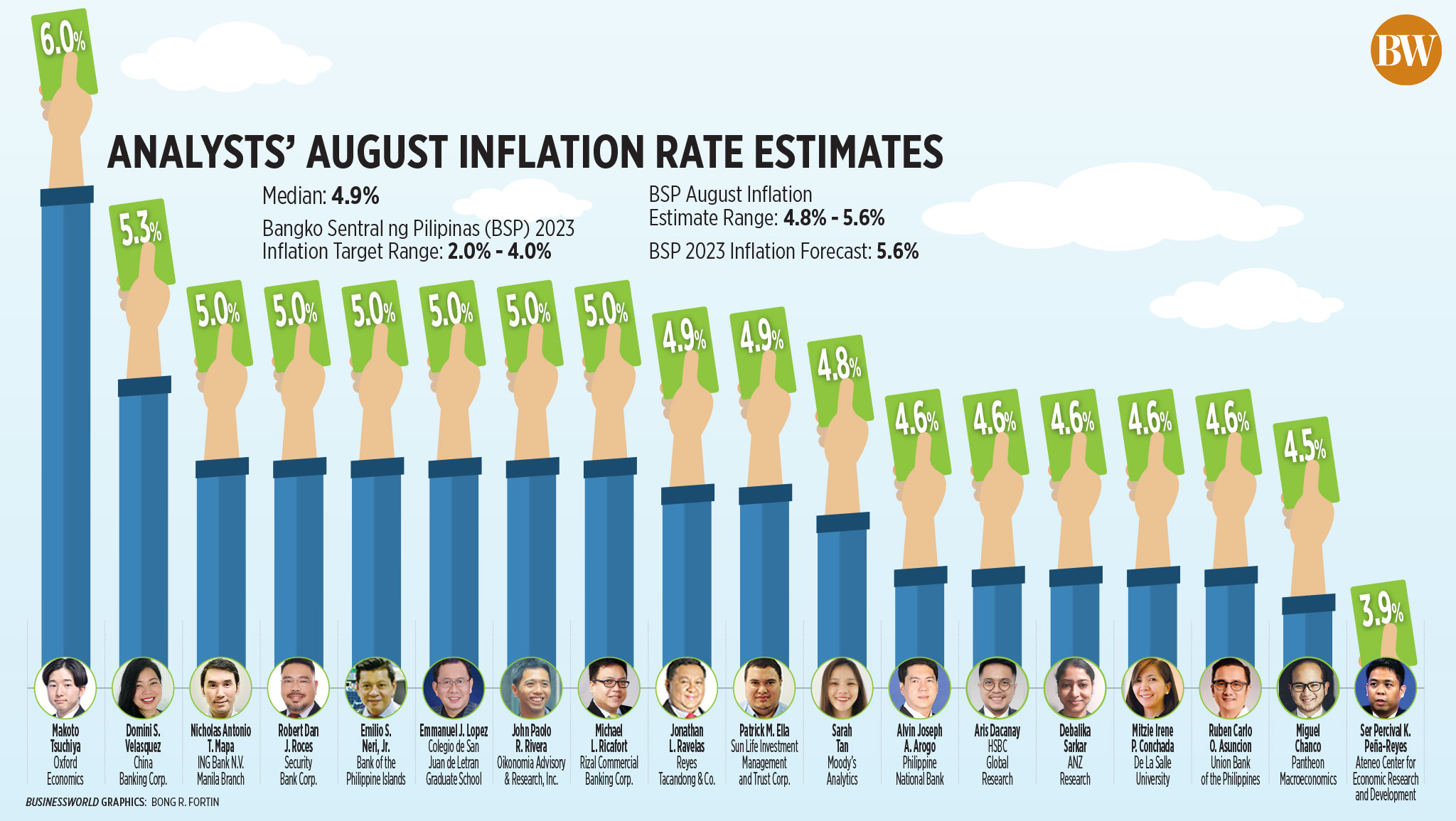
August inflation data will be released on Sept. 5 (Tuesday).

Moody’s Analytics economist Sarah Tan said inflation likely inched up from July, reversing the downtrend seen in the last six months.

“For starters, prices of palay and rice have risen as local and global farmgate prices soared due to lower domestic harvests and rising import costs,” Ms. Tan said in an e-mail.

Rice is a staple food in the Philippines, accounting for a significant component in the country’s food inflation. Rice accounts for about 8.9% of the country’s consumer price index (CPI) basket.

Based on data from the Department of Agriculture (DA), the average price of a kilogram of local well-milled rice ranged from PHP 47 to PHP 56 as of Aug. 30, higher than the PHP 41-PHP 49 range as of August 1.

“Adding to the pain, Super Typhoon Saola (local name: Goring) swept through much of the Northern provinces in late August and damaged agricultural produce such as rice and corn,” Ms. Tan said.

According to the DA, agricultural damage caused by Super Typhoon Goring was estimated at PHP 898.4 million as of Sept. 2, with rice losses amounting to PHP 751.5 million, while corn damage stood at PHP 139.2 million.   

“Sequential typhoons since the end of July pushed up food prices. Imported rice was also significantly higher due to India’s exports curbs and reported hoarding in Thailand,” China Banking Corp. Chief Economist Domini S. Velasquez said in an e-mail. 

Global rice prices have jumped since India on July 20 banned the export of non-basmati white rice to curb the spike in local prices. The Philippines is one of the world’s biggest rice importers, with nearly 90% coming from Vietnam.

Ms. Velasquez said the peso depreciation could have also made rice imports more expensive.

Jonathan L. Ravelas, senior adviser at Reyes Tacandong & Co., likewise said August inflation could “surprise to the upside” due to higher prices of rice and oil, as well as a weaker peso.

The peso closed at PHP 56.595 on August 31, depreciating by 3% or PHP 1.715 from the PHP 54.88 finish on July 31. Year to date, the peso depreciated by 1.5% or PHP 0.84 from its PHP 55.755 close on Dec. 29.

Makoto Tsuchiya, assistant economist from Oxford Economics Japan, noted that domestic pump prices have been rising since mid-July, and this will be reflected in the August inflation data.

In August alone, oil companies raised pump prices by PHP 5.90 per liter for gasoline, PHP 9.90 per liter for diesel and PHP 10 per liter for kerosene.

“Although the current diesel pump price is significantly lower than the PHP 75 per liter average recorded in June of the previous year, food and fuel prices continue to be the main drivers of inflation,” Security Bank Corp. Chief Economist Robert Dan J. Roces said in an e-mail. 

HSBC economist for ASEAN (Association of Southeast Asian Nations) Aris Dacanay attributed the sharp increase in local pump prices to the supply output cuts done by the Organization of the Petroleum Exporting Countries (OPEC). 

OPEC and its allies (OPEC+) earlier said it plans to extend its oil production cuts, with top exporter Saudi Arabia expected to extend its one-million-barrel-per-day voluntary supply cut for another month.

“Additionally, the price of LPG (liquefied petroleum gas) also ticked up in August,” Ms. Velasquez said.

Cooking gas prices rose by PHP 4.55 per kilogram in August, while prices of AutoLPG were up by PHP 2.54 per liter.

The implementation of higher toll fees in key expressways may have contributed to food inflation as these added to transport costs of agricultural commodities.

“Offsetting these increases was a sizeable 2.5% downward adjustment in electricity rates and a continued normalization of vegetable prices such as that of onions,” Mr. Dacanay said.

Manila Electric Co. lowered rates by PHP 0.29 per kilowatt-hour (kWh) to PHP 10.90 per kWh in August from PHP 11.19 per kWh in July.

“Despite the projected higher headline rate in August, core inflation is expected to continue its downtrend to around 6% in August,” Ms. Velasquez said.

Core inflation, which excludes volatile items of food and fuel prices, slowed to 6.7% in July from 7.4% in June. For the first half, core inflation averaged 7.6%. 

Mr. Roces also noted that the increase in August inflation is more moderate compared with the inflation spike from December 2022 to February 2023.

“While there is a noticeable increase in the price of rice, the overall inflation rate for August 2023 remains within a reasonable area and is significantly lower than the surge experienced earlier this year,” Mr. Roces said. 

Disinflation to resume
Despite the uptick in August, analysts expect consumer prices to continue easing for the rest of the year due to base effects.

“Beyond August, we expect disinflation to resume, reaching the BSP’s 2%-4% target by the end of the year. However, supply-side developments are highly uncertain, and so this outlook comes with risks,” Mr. Tsuchiya said.

According to Ms. Tan, El Niño is one of the key risks that could keep inflation higher for longer.

“Top of the list is the potential El Niño weather pattern which brings about a dry spell to the country and damage local agricultural produce. This will add stress to the already tight supply,” she said. 

Pantheon Chief Emerging Asia Economist Miguel Chanco said inflation may return to the central bank’s 2-4% target in October, but downside risks are increasing due to the El Niño.

“The direct impact of this year’s hotter-than-expected temperatures is still unclear, but governments around the region are already taking preemptive measures to secure food supplies — largely by restricting exports of key foods — posing an indirect inflation risk to net food importers like the Philippines,” he said.

If inflation rose in August from its 4.7% clip in July, the Monetary Board may not immediately react with higher policy rates, Ms. Velasquez said.

“Shocks for the month of August were largely supply side but has not, so far, detailed the inflation path towards the target range in the fourth quarter. We still expect inflation to fall within the BSP’s target by November,” she said.

The BSP currently sees inflation returning to the 2-4% target band by the fourth quarter. It sees inflation averaging 5.6% in 2023 before easing to 3.2% in 2024.

“Looking ahead, we still see that inflation will fall into the BSP’s target range of 2-4% by the fourth quarter of this year, barring sustained spikes in rice and fuel in the remaining months of 2023; these remain considerable upside risks to the inflation projections,” Mr. Roces said.

ING Bank N.V. Manila Senior Economist Nicholas Antonio T. Mapa said any sharp upticks in rice, electricity, and transport could “spell a renewed flareup for Philippine inflation.”

“We had originally penciled in a BSP rate cut by the first quarter of next year given the disappointing second-quarter GDP (gross domestic product) report,” Mr. Mapa said. 

The Philippine economy grew by 4.3% in the second quarter, weaker than the 6.4% growth in the first quarter and 7.5% a year ago.

“However, if we continue to see rice and energy prices tick higher in the coming months, we could see BSP delaying its planned easing to mid-2024,” Mr. Mapa said.

To tame inflation, the BSP hiked benchmark interest rates by 425 basis points from May 2022 to March 2023. This brought the key policy rate to 6.25%, its highest level in nearly 16 years. 

The Monetary Board will have its next policy review on September 21. — By Keisha B. Ta-asan

OECD trims PH growth forecast for this year

OECD trims PH growth forecast for this year

Tthe Organisation for Economic Co-operation and Development (OECD) trimmed its gross domestic product (GDP) growth forecast for the Philippines for this year.

In its latest Economic Outlook for Southeast Asia, China, and India update, the OECD said it now expects Philippine GDP to expand by 5.6% this year, slightly lower than the 5.7% projection in March. This is below the government’s 6-7% GDP growth target for this year.

The OECD kept its 2024 growth projection at 6.1%, which is still below the government’s 6.5-8% target.

“A key growth driver in the second half of 2023 will be a strong rebound in government spending, from its 7.1% contraction in the recent quarter, executed through catch-up plans and frontloading of programs and projects,” the OECD said.

“Fiscal stimulus activities are also being implemented which should fuel activities of both the public and private sectors,” it added.

The Philippine economy grew by 4.3% in the second quarter, slower than the 6.4% growth in the first quarter and 7.5% in the second quarter of 2022. In the first half, GDP growth averaged 5.3%.

The OECD said elevated inflation and higher borrowing costs dragged private consumption and investments in the second quarter. The slowdown was also amplified by the contraction in government spending, it added.

For the rest of the year, the OECD said that domestic demand is expected to drive growth, “supported by labor market expansion, personal income tax cuts, stable inflows of remittances and the steady recovery of tourism.”

“On the supply side, the services sector will continue its steady upward trajectory and will remain a reliable source of economic activity, boosting GDP growth, due to the improved outlook of tourism as well as rapid growth of the business process outsourcing industry,” it added.

With fiscal consolidation “underway,” the OECD expects the Philippines’ budget deficit to narrow from this year to 2025.

On the other hand, the OECD said that trade prospects in the next few months may be bleak.

“Prolonged weak external demand from the United States and China, the country’s top trading partners, will continue to drag down exports in the coming months,” it said.

The Philippines’ lack of diversification of exports leaves it vulnerable to sector-specific risks.

“For example, the Philippines recorded a decline in exports in the first and second quarter of this year owing to its heavy reliance on electronics products and dependence on the United States and China as major trading partners,” the OECD said.

The Semiconductor and Electronics Industries in the Philippines Foundation, Inc. (SEIPI) expects electronics exports growth to be flat this year. Data from SEIPI showed total electronics exports declined by 7% to USD 21.19 billion in the six-month period.

The OECD noted that private investment is also expected to slow due to high interest rates and a weaker global economy. On the other hand, landmark reforms and improving investor sentiment could help the country attract more foreign direct investments.

Meanwhile, the OECD said high borrowing costs will continue to weigh on growth.

“The Philippine central bank is likely to maintain a high interest rate regime, which will dampen GDP growth should pent-up demand ease,” it said.

To curb inflation, the BSP raised borrowing costs by 425 basis points (bps) from May 2022 to March 2023, bringing its key rate to a near 16-year high of 6.25%.

Another downside risk to the Philippine growth outlook is the still elevated global inflation, which could prompt further tightening from central banks in advanced economies and may trigger capital outflows, the OECD said.

“This could push down the value of the Philippine peso, which is forecast to recover mildly from a sharp depreciation episode in 2022. The persistent global financial turmoil could translate into higher borrowing costs for the government, adding pressure to its public debt,” it said. — Luisa Maria Jacinta C. Jocson

Rates of Treasury bills, bonds likely to go down

Rates of Treasury bills, bonds likely to go down

Rates of Treasury bills (T-bills) and bonds on offer this week could decline to track secondary market yields amid dovish expectations on the US Federal Reserve’s next move.

The Bureau of the Treasury (BTr) will auction off PHP 15 billion in T-bills on Monday or PHP 5 billion each in 91-, 182- and 364-day papers.

On Tuesday, it will offer PHP 30 billion in fresh three-year Treasury bonds (T-bonds).

T-bill and T-bond rates may track the decline seen in secondary market rates following lower 10-year US Treasury yields due to expectations that the Fed may be done with its tightening cycle, Rizal Commercial Banking Corp. Chief Economist Michael L. Ricafort said in a Viber message.

At the secondary market on Thursday, the 91-, 182-, and 364-day T-bills went down by 4.41 basis points (bps), 1.15 bps, and 4.11 bps week on week to end at 5.7081%, 5.9878%, and 6.2632% respectively, based on the PHP Bloomberg Valuation Service Reference Rates data published on the Philippine Dealing System’s website.

Meanwhile, the three-year bond went down by 3.86 bps to end at 6.1969% on Thursday.

US 10-year Treasury yields reversed earlier declines following the employment report on Thursday, as investors pared positions ahead of the Labor Day weekend, Reuters reported.

Benchmark 10-year notes last fell 23/32 in price to yield 4.1788% from 4.091% late on Thursday.

Financial markets are pricing in a 93% likelihood of a Fed pause this month after the release of softer labor data last week, according to CME’s FedWatch tool.

The US central bank raised interest rates by 25 bps last month, bringing its benchmark overnight rate to a range between 5.25% and 5.5%. It has hiked rates by a cumulative 525 bps since it began its tightening cycle in March last year.

The Federal Open Market Committee will meet on Septe mber 19-20 to review policy.

Expectations of faster August inflation also contributed to the decline in secondary market yields, Mr. Ricafort added.

A BusinessWorld poll of 18 analysts yielded a median estimate of 4.9% for August inflation, near the lower end of the Bangko Sentral ng Pilipinas’ (BSP) 4.8% to 5.6% forecast for the month.

If realized, this would be faster than the 4.7% in July, but lower than the 6.3% print in August 2022. It would also mark the 17th straight month that inflation exceeded the BSP’s 2-4% target.

August inflation data will be released on September 5, Tuesday.

Last week, the BTr raised PHP 15 billion as planned via the T-bills it auctioned off as total bids reached PHP 49.125 billion or more than thrice the amount on offer.

Broken down, the Treasury made a full PHP 5-billion award of the 91-day T-bills as tenders for the tenor reached PHP 18.625 billion. The average rate of the three-month paper went down by 9.8 bps to 5.573%, with accepted rates ranging from 5.56% to 5.62%.

The government also raised PHP 5 billion as planned from the 182-day securities as bids for the tenor reached PHP 13.46 billion. The average rate for the six-month T-bill was at 5.993%, inching up by 0.7 bp from the previous week, with accepted rates at 5.95% to 6.038%.

Lastly, the BTr borrowed the programmed PHP 5 billion via the 364-day debt papers as demand stood at PHP 17.04 billion. The average rate of the one-year T-bill went down by 3.7 bp to 6.297%. Accepted yields were from 6.25% to 6.325%.

The BTr wants to raise PHP 180 billion from the domestic market this month or PHP 60 billion via T-bills and PHP 120 billion via T-bonds.

The government borrows from local and foreign sources to help fund its budget deficit, which is capped at 6.1% of gross domestic product this year. — A.M.C. Sy with Reuters

Yields on government debt decline ahead of key economic data

Yields on government debt decline ahead of key economic data

Rates of government securities (GS) fell last week following US Treasury yields as the market awaits the release of key data.

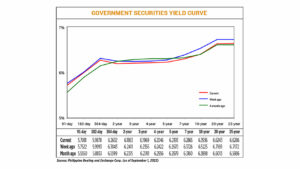
GS yields, which move opposite to prices, dropped by an average of 6.11 basis points (bps) week on week, according to the PHP Bloomberg Valuation Service Reference Rates as of Aug. 31 published on the Philippine Dealing System’s website.

Yields fell across the board, with rates of the 91-, 182-, and 364-day Treasury bills (T-bills) going down by 4.41 bps (to 5.7081%), 1.15 bps (5.9878%), and 4.11 bps (6.2632%), respectively.

At the belly, rates of the two-, three-, four-, five-, and seven-year Treasury bonds (T-bonds) decreased by 5.48 bps (to 6.1863%), 3.86 bps (6.1969%), 3.76 bps (6.2046%), 4.77 bps (6.2193%), and 8.61 bps (6.2865%).

Yields at the long end also dropped. The rate of the 10-year papers went down by 12.89 bps to 6.3936%, followed by the 20- and 25-year T-bonds, which declined by 9.26 bps and 8.86 bps to 6.6243% and 6.6286%, respectively.

Total GS volume reached PHP 31.13 billion on Thursday, up from PHP 10.26 billion on August 25.

Yields declined for a third consecutive week as the market took cues from US Treasuries’ movements after data showed slower economic growth for the second quarter and lower ADP employment in August, analysts said.

Benchmark Treasury yields rebounded after a US jobs report showed an uptick in unemployment, cementing expectations that the US Federal Reserve will let interest rates stand at its September meeting, Reuters reported.

US 10-year Treasury yields reversed earlier declines following the employment report, as investors pared positions ahead of the Labor Day weekend.

Benchmark 10-year notes last fell 23/32 in price to yield 4.1788% from 4.091% late on Thursday.

The 30-year bond last fell 48/32 in price to yield 4.2945% from 4.204% late on Thursday.

“On auction, the [five-year] reissuance was well absorbed by the market as it cleared at 6.22%, within the indicative range and bid to cover reached 1.8 [times]. Post auction, the market continued to buy GS from the belly to the long end pushing yields lower by another 3.5 bps,” ATRAM Trust Corp. Chief Investment Officer Alessandra P. Araullo added in a Viber message.

The release of the Bureau of the Treasury’s September borrowing plan last week also caused the market to be cautious as some anticipate supply risks, with two bond maturities due this quarter, prompting speculations of a “jumbo” retail Treasury bond offer in the few next months, Ms. Araullo said.

For this week, the T-bond offer scheduled on Tuesday could affect yield movements, she said.

“There will be an original issue for a [three-year] bond with early indications of 6.125-6.25%. Investors might look to reposition as they shorten their duration ahead of the jumbo supply being speculated,” Ms. Araullo added.

Yields are also expected to tread higher amid the release of August Philippine inflation data on Tuesday, Rizal Commercial Banking Corp. Chief Economist Michael L. Ricafort said in an e-mail.

Mr. Ricafort added that expectations of rate cuts from the Bangko Sentral ng Pilipinas in the first quarter of 2024 could also affect yield movements, as well as the upcoming Fed Beige Book Report on Wednesday. — BTMG with Reuters

Peso may move sideways before August inflation data

Peso may move sideways before August inflation data

The peso could trade sideways against the dollar this week ahead of the release of August inflation data.

The local unit closed at PHP 56.595 versus the dollar on Thursday, strengthening by 13 centavos from Wednesday’s PHP 56.725 finish, data from the Bankers Association of the Philippines’ website showed.

Week on week, however, the peso dropped by 2.50 centavos from its PHP 56.57 per dollar finish on August 25.

Trading was suspended on Friday as Malacañang suspended work in government offices due to inclement weather.

For this week, the peso could stay at the PHP 56-per-dollar level ahead of the release of the August consumer price index (CPI) report, Rizal Commercial Banking Corp. Chief Economist Michael L. Ricafort said in a Viber message.

A BusinessWorld poll of 18 analysts yielded a median estimate of 4.9% for August headline inflation, close to the lower end of the central bank’s 4.8% to 5.6% forecast for the month.

If realized, this would be faster than the 4.7% print in July, but lower than the 6.3% seen in August 2022.

It would mark the 17th straight month of inflation exceeding the Bangko Sentral ng Pilipinas’ (BSP) 2-4% target.

August inflation data will be released on September 5, Tuesday.

Bets on the US Federal Reserve’s next move could also affect the peso’s movement, as this could be matched by the BSP, Mr. Ricafort added.

Financial markets are now betting the central bank is done raising rates and may start cutting them next year, according to CME Group’s FedWatch Tool, Reuters reported. Futures tied to the Fed’s policy rate show only a slight chance of a rate hike at the Sept. 19-20 meeting.

Since March 2022, the Fed has raised its policy rate by 525 basis points (bps) to the current 5.25%-5.5% range.

Meanwhile, the BSP kept its policy rate at a near 16-year high of 6.25% for a third straight meeting last month.

The BSP raised borrowing costs by 425 bps from May 2022 to March 2023 to tame inflation.

The Monetary Board will next meet on September 21 to review policy.

Mr. Ricafort expects the peso to range from PHP 56.30 to PHP 56.80 per dollar this week. — AMCS with Reuters

Stocks to move sideways before inflation report

Stocks to move sideways before inflation report

Philippine stocks may move sideways this week ahead of the release of August inflation report and amid hopes that the US Federal Reserve is done hiking rates following soft US data that came out last week.

The Philippine Stock Exchange index (PSEi) inched up by 0.09 point or 5.81% to close at 6,181.06 on Friday, while the broader all shares index went up by 0.21 point or 7.19% to 3,341.97.

Week on week, the PSEi also gained 20.45 points or 0.33% from its close of 6,160.61 on Aug. 25.

For this week, trading will be driven by economic data, analysts said.

“This week’s market direction will be shaped by investors’ reaction to the latest US jobs report, China’s efforts to prop up its economy, and the Philippine August inflation print,” China Bank Securities Corp. Research Director Rastine Mackie D. Mercado said in an e-mail.

The market’s movement will be affected by US and local data releases, China Bank Capital Corp. Managing Director Juan Paolo E. Colet likewise said in a Viber message.

“Domestic inflation data for August will be top of mind for most investors. The expectation is that this will be higher than July’s 4.7%, but a steep jump could introduce fresh volatility to the market,” Mr. Colet said.

US job growth picked up in August, but the unemployment rate jumped to 3.8% and wage gains moderated, suggesting that labor market conditions were easing and cementing expectations that the Federal Reserve will not raise interest rates this month, Reuters reported.

The economy created 110,000 fewer jobs than previously reported in June and July, which some economists said suggested there had been business closures that were not previously captured.

The labor market is slowing in response to the US central bank’s hefty rate hikes to cool demand in the economy.

Meanwhile, a BusinessWorld poll of 18 analysts yielded a median estimate of 4.9% for August Philippine headline inflation, close to the lower end of the central bank’s 4.8% to 5.6% forecast for the month.

If realized, this would be faster than the 4.7% print in July, but lower than the 6.3% seen in August 2022.

It would mark the 17th straight month of inflation exceeding the Bangko Sentral ng Pilipinas’ 2-4% target for the year.

August inflation data will be released on Sept. 5, Tuesday.

“We also see the index possibly retesting the 6,150 support level after last week’s oversold rally fizzled out. A successful retest of a support level is an important indicator that the recent downtrend could be reaching a trough,” Mr. Mercado said.

For this week, Mr. Mercado placed the PSEi’s support at 6,150 and resistance at 6,370-6,420, while Mr. Colet put support at 6,150 and resistance at 6,350. — S.J. Talavera with Reuters

Posts navigation

Older posts
Newer posts

Recent Posts

  • Metrobank US-Iran Risk Index: Fragile ceasefire 
  • Investment Ideas: April 10, 2026 
  • Metrobank US-Iran Risk Index: A new hope
  • A guide for your peso bond portfolio amid higher for longer rates
  • Investment Ideas: April 8, 2026

Recent Comments

No comments to show.

Archives

  • April 2026
  • March 2026
  • February 2026
  • January 2026
  • December 2025
  • November 2025
  • October 2025
  • September 2025
  • August 2025
  • July 2025
  • June 2025
  • May 2025
  • April 2025
  • March 2025
  • February 2025
  • January 2025
  • December 2024
  • November 2024
  • October 2024
  • September 2024
  • August 2024
  • July 2024
  • June 2024
  • May 2024
  • April 2024
  • March 2024
  • February 2024
  • January 2024
  • December 2023
  • November 2023
  • October 2023
  • September 2023
  • August 2023
  • July 2023
  • June 2023
  • May 2023
  • April 2023
  • March 2023
  • February 2023
  • January 2023
  • December 2022
  • November 2022
  • October 2022
  • September 2022
  • August 2022
  • July 2022
  • June 2022
  • May 2022
  • March 2022
  • December 2021
  • October 2021

Categories

  • Bonds
  • BusinessWorld
  • Currencies
  • Economy
  • Equities
  • Estate Planning
  • Explainer
  • Featured Insight
  • Fine Living
  • How To
  • Investment Tips
  • Markets
  • Portfolio Picks
  • Rates & Bonds
  • Retirement
  • Reuters
  • Spotlight
  • Stocks
  • Uncategorized

You are leaving Metrobank Wealth Insights

Please be aware that the external site policies may differ from our website Terms And Conditions and Privacy Policy. The next site will be opened in a new browser window or tab.

Cancel Proceed
Get in Touch

For inquiries, please call our Metrobank Contact Center at (02) 88-700-700 (domestic toll-free 1-800-1888-5775) or send an e-mail to customercare@metrobank.com.ph

Metrobank is regulated by the Bangko Sentral ng Pilipinas
Website: https://www.bsp.gov.ph

Quick Links
The Gist Webinars Wealth Manager Explainers
Markets
Currencies Rates & Bonds Equities Economy
Wealth
Investment Tips Fine Living Retirement
Portfolio Picks
Bonds Stocks
Others
Contact Us Privacy Notice Terms of Use
© 2026 Metrobank. All rights reserved.

Access this content:

If you are an existing investor, log in first to your Metrobank Wealth Manager account. ​

If you wish to start your wealth journey with us, click the “How To Sign Up” button. ​

Login HOW TO SIGN UP