MODEL PORTFOLIO
THE GIST
NEWS AND FEATURES
Global Philippines Fine Living
INSIGHTS
INVESTMENT STRATEGY
Economy Stocks Bonds Currencies
THE BASICS
Investment Tips Explainers Retirement
WEBINARS
2024 Mid-Year Economi Briefing, economic growth in the Philippines
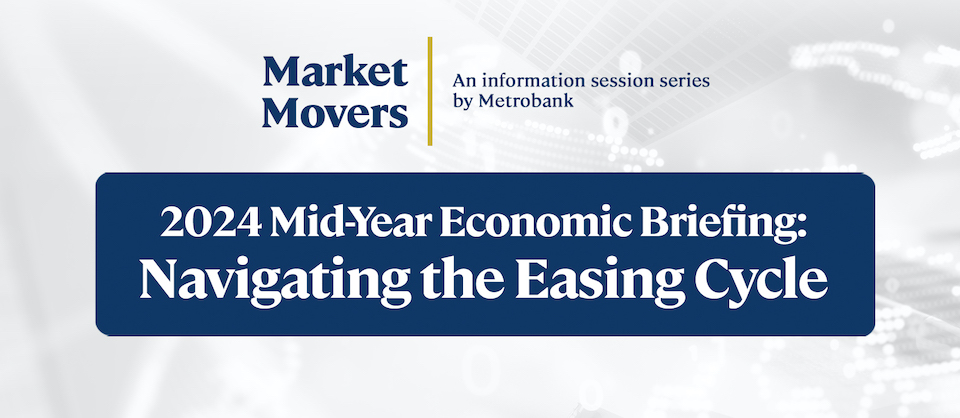
2024 Mid-Year Economic Briefing: Navigating the Easing Cycle
June 21, 2024
Investing with Love
Investing with Love: A Mother’s Guide to Putting Money to Work
May 15, 2024
retirement-ss-3
Investor Series: An Introduction to Estate Planning
September 1, 2023
View All Webinars
DOWNLOADS
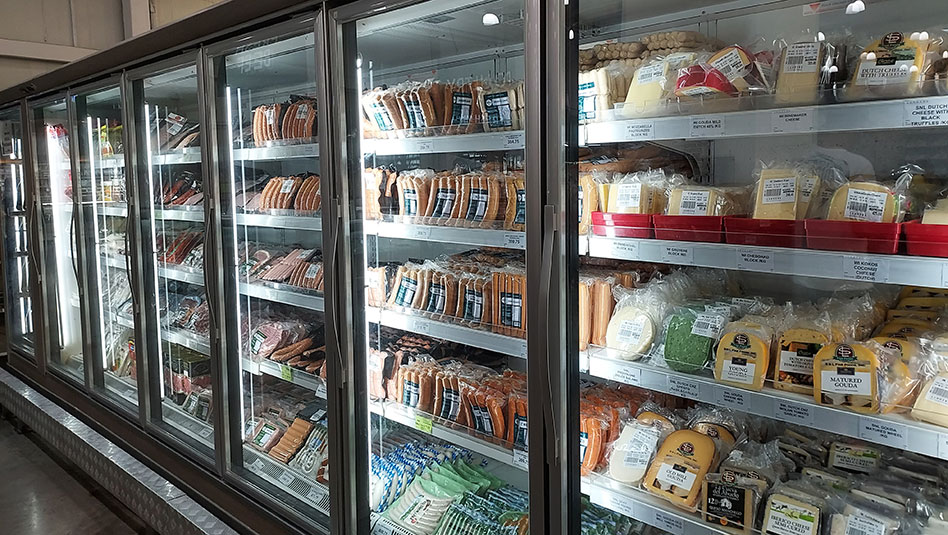
grocery-2-aa
Inflation Update: Target breached
DOWNLOAD
Container ship carrying container boxes import export dock with quay crane. Business commercial trade global cargo freight shipping logistic and transportation worldwide oversea concept. Generative AI
Economic Updates
Philippines Trade Update: Wider deficit on strong imports
DOWNLOAD
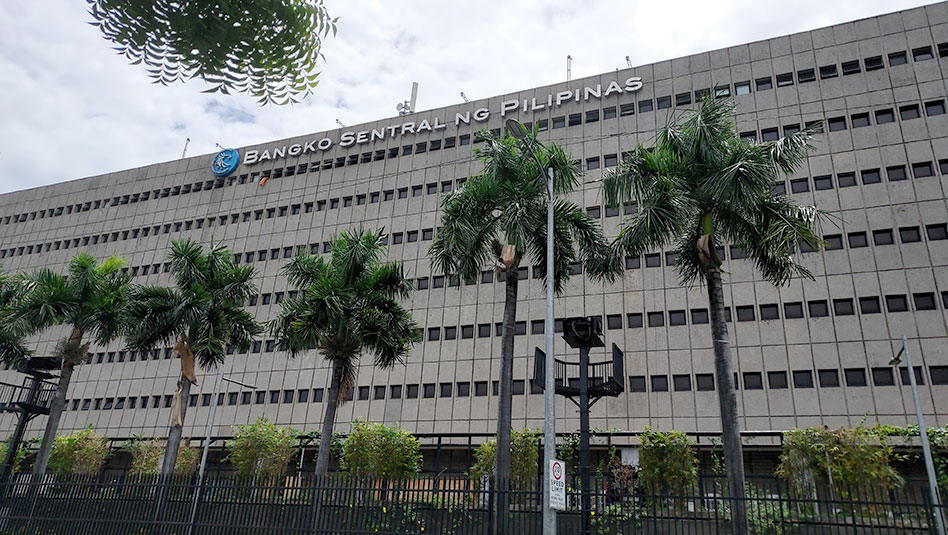
Frick collection with palm trees 
Economic Updates
Policy Rate Updates: Policy rate updates to reassure 
DOWNLOAD
View all Reports
Metrobank.com.ph How To Sign Up
Follow us on our platforms.

How may we help you?

TOP SEARCHES
  • Where to put my investments
  • Reports about the pandemic and economy
  • Metrobank
  • Webinars
  • Economy
TRENDING ARTICLES
  • Investing for Beginners: Following your PATH
  • On government debt thresholds: How much is too much?
  • Philippines Stock Market Outlook for 2022
  • Deficit spending remains unabated

Login

Access Exclusive Content
Login to Wealth Manager
Visit us at metrobank.com.ph How To Sign Up
Access Exclusive Content Login to Wealth Manager
Search
MODEL PORTFOLIO THE GIST
NEWS AND FEATURES
Global Philippines Fine Living
INSIGHTS
INVESTMENT STRATEGY
Economy Stocks Bonds Currencies
THE BASICS
Investment Tips Explainers Retirement
WEBINARS
2024 Mid-Year Economi Briefing, economic growth in the Philippines
2024 Mid-Year Economic Briefing: Navigating the Easing Cycle
June 21, 2024
Investing with Love
Investing with Love: A Mother’s Guide to Putting Money to Work
May 15, 2024
retirement-ss-3
Investor Series: An Introduction to Estate Planning
September 1, 2023
View All Webinars
DOWNLOADS
grocery-2-aa
Inflation Update: Target breached
April 7, 2026 DOWNLOAD
Container ship carrying container boxes import export dock with quay crane. Business commercial trade global cargo freight shipping logistic and transportation worldwide oversea concept. Generative AI
Economic Updates
Philippines Trade Update: Wider deficit on strong imports
March 27, 2026 DOWNLOAD
Frick collection with palm trees 
Economic Updates
Policy Rate Updates: Policy rate updates to reassure 
March 26, 2026 DOWNLOAD
View all Reports

Archives: Business World Article

Full impact of tightening has not yet ‘run its full course’ — FSCC

Full impact of tightening has not yet ‘run its full course’ — FSCC

The full impact of the Bangko Sentral ng Pilipinas’ (BSP) aggressive monetary tightening since last year has not yet “run its full course,” the Financial Stability Coordination Council (FSCC) said in a statement on Tuesday.

The interagency body said global growth prospects are more positive compared with several months ago, although pressures from advanced economies are still evident.

“The Council’s Systemic Risk Review highlighted that the growth prospects of the Philippines’ major trading partners are expected to diverge. As market rates have swung from a lower-for-longer to a high-for-now environment, its full impact may not have yet run its full course,” it said.

To tame inflation, the BSP hiked benchmark interest rates by 425 basis points (bps) from May 2022 to March 2023. This brought the key policy rate to 6.25%, its highest level in nearly 16 years.

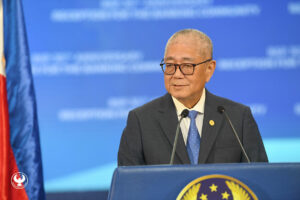
BSP Governor and FSCC Chairman Eli M. Remolona, Jr. said authorities must continue to be vigilant against risks even if there are no immediate signs of sector-wide pressures among corporates.

“While the high-level indicators are notable, there are many developments that we should still monitor,” he said. “This is where systemic risk surveillance is critical because we need to assess if and how changing conditions in the global and regional markets mesh with our own domestic situation.”

According to the FSCC, the interagency body has approved a broad range of actions to enhance the resiliency of the Philippine financial system to combat systemic risks.

These actions cover communication to the capital and contingent markets, as well as using the right tools and better data to manage possible contagion risks more effectively. 

“In managing systemic risks, we prepare for viable possibilities rather than forecast the most likely outcome,” Mr. Remolona added.

The FSCC is an interagency body composed of representatives of the BSP, the Department of Finance, the Insurance Commission, the Philippine Deposit Insurance Corp., and the Securities and Exchange Commission.

In July 2021, Executive Order 144 institutionalized the FSCC to focus on assessing and implementing policies to prevent systemic risk factors or company- and industry-level events that have the potential to trigger severe instability within entire industries, or even the economy.

The FSCC convenes on a quarterly basis. The regularity of their meetings may be increased “when market conditions warrant.” — Keisha B. Ta-asan

Gov’t partially awards new 3-year Treasury bonds

Gov’t partially awards new 3-year Treasury bonds

The government made a partial award of the new three-year Treasury bonds (T-bonds) it offered on Tuesday at a coupon rate higher than secondary market levels after inflation accelerated for the first time in seven months in August.

The Bureau of the Treasury (BTr) raised just PHP 21.187 billion via the fresh three-year bonds it auctioned off on Tuesday versus the PHP 30-billion program, as the offer was undersubscribed, with total bids at just PHP 28.987 billion.

The bonds were awarded at a coupon rate of 6.25%. Accepted yields ranged from 6.11% to 6.373% for an average of 6.222%.

The coupon fetched for the tenor was 4.6 basis points (bps) higher than the 6.204% quoted for the three-year bond at the secondary market before the auction, based on PHP Bloomberg Valuation Service Reference Rates data provided by the Treasury.

The bonds fetched higher yields following the release of data showing that inflation picked up in August, Rizal Commercial Banking Corp. Chief Economist Michael L. Ricafort said in a Viber message.

The coupon rate fetched for the papers was at the “higher end of market expectations” due to faster-than-expected inflation last month, a trader likewise said in a phone interview.

Headline inflation picked up to a two-month high of 5.3% in August from 4.7% in July, data released by the Philippine Statistics Authority on Tuesday showed.

August was the first time headline inflation quickened year on year in seven months, or since it quickened to 8.7% in January from 8.1% in December 2022.

Still, this was below the 6.3% print in August 2022, and was within the 4.8-5.6% forecast of the Bangko Sentral ng Pilipinas (BSP) for the month.

However, this was above the 4.9% median estimate in a BusinessWorld poll of 18 analysts conducted last week.

August also marked the 17th consecutive month that the consumer price index (CPI) was above the BSP’s 2-4% target for the year.

For the first seven months, inflation averaged 6.6%, well above the central bank’s 5.6% forecast for the year.

The BSP expects inflation to return to its target range by the end of the year, but its chief said policy easing remains far off amid lingering price risks.

Following the release of inflation data, the central bank said it “stands ready to adjust the monetary policy stance as necessary to prevent the further broadening of price pressures as well as the emergence of additional second round effects.”

The BSP last month kept benchmark interest rates steady for the third straight meeting in a “hawkish pause.”

The BTr wants to raise PHP 180 billion from the domestic market this month, or PHP 60 billion via T-bills and PHP 120 billion via T-bonds.

The government borrows from local and foreign sources to help fund its budget deficit, which is capped at 6.1% of gross domestic product this year. — AMCS

Banks’ assets climb in the first semester

Banks’ assets climb in the first semester

The total assets of the Philippine banking sector rose in the first half of the year compared with a year ago, reflecting the continued recovery of the economy from the impact of the coronavirus pandemic.

Preliminary data from the Bangko Sentral ng Pilipinas (BSP) showed banks’ assets rose by 9.03% to PHP 23.28 trillion as of end-June, from PHP 21.35 trillion in the same period a year ago.

Deposits, loans, and investments mainly support banks’ assets.

The banking industry’s total loans inclusive of interbank loans receivable (IBL) and reverse repurchase (RRP) reached PHP 12.29 trillion as of end-June, 8.6% higher than the PHP 11.31 trillion in the same period in 2022.

Net investments climbed by 9.7% to PHP 6.77 trillion from PHP 6.17 trillion a year ago. These are financial assets and equity investments in subsidiaries.

Cash and due from banks inched up by 0.7% to PHP 2.87 trillion in the first half of 2023 against the PHP 2.85 trillion last year.

Net real and other properties acquired (ROPA) also increased by 1.9% to PHP 101.58 billion from PHP 99.67 billion in the same period in 2022.

Other assets amounted to PHP 1.25 trillion, 36.5% higher than the PHP 916.63 billion last year.

Meanwhile, the total liabilities of the banking system grew by 8.7% to PHP 20.42 trillion in the first semester, from PHP 18.77 trillion in the comparable year-ago period.

Rizal Commercial Banking Corp. Chief Economist Michael L. Ricafort said the continued growth in banks’ assets and overall business reflect the continued reopening of the economy following the pandemic, even though bank lending slowed due to high prices and borrowing costs.

“Nevertheless, continued growth in overall business/revenues and earnings of banks would further bolster capitalization, amid improved asset quality in terms of relatively lower NPLs (nonperforming loans) amid the economic reopening narrative,” Mr. Ricafort said.

The banking industry recorded a higher net profit in the first half of the year amid increased net interest income and loan growth, separate BSP data showed.

The cumulative net income of the banking system grew by 24.7% to PHP 178.51 billion as of June from PHP 143.12 billion in the same period in 2022.

Meanwhile, the gross NPL ratio of the Philippine banking industry slid to 3.42% in June, from 3.46% in May and 3.6% a year ago. It was the lowest since 3.41% in April. — Keisha B. Ta-asan

Peso sinks to three-week low on faster-than-expected inflation

Peso sinks to three-week low on faster-than-expected inflation

The peso weakened to a three-week low against the dollar on Tuesday as headline inflation picked up in August after six months of decline.

The local currency closed at PHP 56.80 versus the dollar on Tuesday, weakening by 18 centavos from Monday’s PHP 56.62 finish, data from the Bankers Association of the Philippines’ website showed.

This was the peso’s lowest close in three weeks or since it ended at PHP 56.84-per-dollar on Aug. 15.

The local unit opened Tuesday’s session weaker at PHP 56.70 per dollar. Its intraday best was at PHP 56.68, while its worst showing was at PHP 56.90 against the greenback.

Dollars traded went down to USD 1.52 billion on Tuesday from the USD 1.59 billion on Monday.

The peso depreciated versus the dollar due to faster-than-expected August inflation, Rizal Commercial Banking Corp. Chief Economist Michael L. Ricafort said in a Viber message.

“The peso depreciated today following the upside surprise in Philippine headline inflation for August 2023,” a trader said in an e-mail.

Inflation picked up to a two-month high of 5.3% in August from 4.7% in July, data released by the Philippine Statistics Authority on Tuesday showed.

This was the first time in seven months that inflation quickened year on year. Still, this was below the 6.3% print in August 2022, and was within the 4.8-5.6% forecast of the Bangko Sentral ng Pilipinas (BSP) for the month.

However, this was above the 4.9% median estimate in a BusinessWorld poll of 18 analysts conducted last week.

August marked the 17th consecutive month that inflation was higher than the BSP’s 2-4% target for the year.

For the first seven months, inflation averaged 6.6%, above the central bank’s 5.6% forecast.

The stronger dollar also affected the exchange rate, Mr. Ricafort added.

Jitters about global growth caused the dollar to rise on Tuesday, sending the euro to its lowest in nearly three months and the Aussie down over 1%, not helped by underwhelming data in China and the Reserve Bank of Australia keeping rates steady, Reuters reported.

The euro was down 0.45% at 1.0747, while sterling fell 0.6% to $1.2555, with both their lowest levels since mid-June after poor activity data in China and Europe drove a risk off tone across asset classes.

The dollar was strong across the board, climbing against China’s currency, and was last up 0.47% at 7.3096 against the yuan traded offshore and up nearly as much in onshore markets.

The greenback also rose 0.56% against the Canadian dollar to USD 1.3669, its highest since late March, and up 0.85% against the Swedish crown at 11.10, its highest since November 2022.

For Wednesday, the peso could recover ahead of a likely softer US services purchasing managers’ index report, the trader said.

The trader sees the peso moving between PHP 56.65 and PHP 56.85 per dollar on Wednesday, while Mr. Ricafort expects it to range from PHP 56.70 to PHP 56.90. — AMCS with Reuters

Stocks inch higher despite faster August inflation

Stocks inch higher despite faster August inflation

PHILIPPINE SHARES continued to climb on Tuesday following the approval of a measure proposing the reduction of the stock transaction tax, which helped offset losses due to faster-than-expected August inflation.

The Philippine Stock Exchange index (PSEi) rose by 10.32 points or 0.16% to end at 6,225 on Tuesday, while the broader all shares index went up by 3.70 points or 0.11% to close at 3,360.14.

“Shares on the Philippine Stock Exchange edged higher as the proposed bill lowering taxes on stock transactions has been approved by the House Ways and Means Committee but sputtered at the end after August inflation quickened after a six-month downtrend,” Globalinks Securities and Stocks, Inc. Head of Sales Trading Toby Allan C. Arce said in a Viber message.

“In the early part of the trading session, the market was in the red as the Philippine August inflation rate rose 5.3%, higher than July’s 4.7%. Bargain hunters saved the market from the red territory,” Philstocks Financial, Inc. Research Analyst Claire T. Alviar said in a Viber message.

The House Committee on Ways and Means on Tuesday approved the substitute bill to House Bill 8958 or the proposed “Capital Markets Efficiency Promotion Act” that provides for the immediate reduction of the stock transaction tax to 0.1% from 0.6%. A debt transaction tax of 0.1% of the gross selling price of the instrument will also be imposed.

Meanwhile, headline inflation picked up to a two-month high of 5.3% in August from 4.7% in July, data released by the Philippine Statistics Authority on Tuesday showed.

This was the first time in seven months that inflation quickened year on year. Still, this was below the 6.3% print in August 2022, and was within the 4.8-5.6% forecast of the Bangko Sentral ng Pilipinas (BSP) for the month.

However, this was above the 4.9% median estimate in a BusinessWorld poll of 18 analysts conducted last week.

August also marked the 17th consecutive month that the consumer price index was above the BSP’s 2-4% target for the year.

For the first seven months, inflation averaged 6.6%, above the central bank’s 5.6% forecast for the year.

Most sectoral indices went up on Tuesday. Holding firms increased by 73.90 points or 1.25% to 5,984.45; mining and oil rose by 113.19 points or 1.11% to 10,245.91; industrials climbed by 59.76 points or 0.68% to 8,819.65; and services inched up by 3.92 points or 0.26% to 1,511.22.

Meanwhile, property dropped by 23.85 points or 0.91% to 2,581.01 and financials declined by 14.98 points or 0.81% to 1,818.83.

Value turnover went down to P3.41 billion on Tuesday with 437.48 million shares changing hands from the P11.32 billion with 2.30 million issues seen on Monday.

Decliners narrowly outnumbered advancers, 87 to 85, while 56 names closed unchanged.

Net foreign selling declined to P669.21 million on Tuesday from P1.20 billion on Monday. — SJT

Rice retailers set to receive subsidies

Rice retailers set to receive subsidies

The government will extend financial assistance to retailers affected by price ceilings on rice, President Ferdinand R. Marcos, Jr. said on Monday.

The goal is to compensate rice retailers who are expected to lose income due to the price ceilings on regular and well-milled rice, he said in a speech before flying to Indonesia for a summit of Southeast Asian leaders. 

The President said the Agriculture and Trade agencies are now preparing the list of rice retailers and their associations, as well as identify the amount of assistance needed to compensate them for their losses.

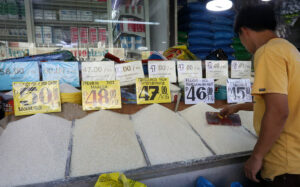
An executive order setting a nationwide price ceiling on rice will take effect today, September 5. The order mandates a maximum price of PHP 41 per kilo for regular milled rice and PHP 45 for well-milled rice, as part of government efforts to protect consumers amid a surge in the food staple’s retail prices.

“We’ll have to consider how authorities can first afford to do this and how they will fund the subsidy,” ING Bank N.V. Manila Senior Economist Nicholas Antonio T. Mapa said in a Viber message.

He said the government needs to ensure that there will be “a clear method for all retailers to enjoy the support and not just a few.”

“If not all retailers receive support, we may see inefficiencies surface anew,” he said.

House Speaker Ferdinand Martin G. Romualdez, Mr. Marcos’ cousin, said he had instructed the Committee on Appropriations to look for ways to allocate PHP 2 billion for the subsidy program.

“Our goal is to ensure that we can extend assistance to rice retailers who may be affected by this rice price ceiling, as it is a directive from our President aimed at protecting consumers,” he said.

Ako Bicol Party-list Rep. Elizaldy “Zaldy” Co, chairman of the House Appropriations panel, said the committee would work with the Department of Budget and Management to expedite the release of the PHP 2 billion.

However, the move to provide subsidies is unsustainable given that there are thousands of small retailers nationwide, said Enrico P. Villanueva, a senior lecturer at the University of the Philippines Los Baños.

“It is inefficient, hard to implement and unsustainable,” he said via Messenger chat, noting that the government should instead lower rice tariffs.

In his departure speech, Mr. Marcos said the Department of Agriculture and other agencies have found no acceptable reasons behind the spike in rice prices, which are now above PHP 50 per kilogram.

He said the government does not want to intervene in the market as much as possible but has been forced to impose price ceilings on rice due to alleged smugglers and hoarders’ disruption of the basic law of supply and demand.

“The people have suffered already, that’s why the government has been forced to impose price controls,” he said in Filipino. “This is a temporary measure; the rice supply will be coming in the second week of September.”

Social Welfare Secretary Rexlon T. Gatchalian described the price control as “a temporary stop-gap measure.”

“We don’t expect it to be long,” he told reporters on the sidelines of the departure ceremony for Mr. Marcos.

He said the department would implement a sustainable livelihood program for small-scale rice retailers.

The imposition of price control has been heavily criticized by economists, who said the order could limit the supply of the food staple and lead to black-market trading.

They also said traders might hesitate to buy rice from farmers, who will be left with no choice but to lower farmgate prices.

Mr. Marcos met with officials of the Trade department and other agencies hours before his departure speech.

The Presidential Communications Office said that aside from assistance, loan programs for rice retailers were also considered during the meeting.

“Instead of using the limited resources, we have to modernize our agricultural production and distribution system, we are going to use funds to give loans to retailers who themselves are embroiled in a messy and inefficient distribution system,” said Leonardo A. Lanzona, who teaches economics at the Ateneo de Manila University.

“For what purpose?  To save face after making campaign promises to produce rice at PHP 20 per kilo?” he asked.

The economist reiterated his call for the government to revoke the price control order and “instead, develop systems and mechanisms to reduce transaction costs by matching the needs of farmers and the demands of consumers.”

Earlier, Mr. Lanzona said that if the government sees hoarding and smuggling as the key drivers of the surge in rice prices, it should encourage more players to enter the market, such as micro, small and medium enterprises and farmers, who can transact directly with consumers.

The Palace said the government is also eyeing logistics support “like providing government transportation for transferring sacks of rice from traders to retailers/wholesalers.”

It said programs that could link local rice farmers with supermarket chains and other retailers were also discussed during the Monday meeting.

In a separate statement, the Palace said Trade Secretary Alfredo E. Pascual has ordered the creation of a special task force that will profile and validate the list of rice retailers.

The task force’s official list “shall be the basis for the distribution of financial aid by the Department of Social Welfare and Development as early as next week,” Trade Assistant Secretary Teodoro Uvero said.

He said the task force will conduct visits in warehouses in various locations to ensure that there is enough supply and discourage hoarding.   

“The task force will ensure that consumers are protected and retailers will receive the assistance they need as the executive order takes effect,” he added. — Kyle Aristophere T. Atienza


BSP shifts to variable rate repo auction

BSP shifts to variable rate repo auction

The Bangko Sentral ng Pilipinas (BSP) will shift to a variable rate format in the auction for the overnight reverse repurchase (RRP) facility starting Friday (Sept. 8), as well as introduce a formal operational target called the “Overnight (ON) RRP Rate.”

Similar to the existing BSP securities facility or the BSP bill auction, the variable rate format for the RRP will have a pre-determined offer volume.

BSP Governor Eli M. Remolona, Jr. in a statement on Monday said  an operational target is a market-determined, short-term interest rate that a central bank can “guide” on a daily basis to reflect the current monetary policy stance.

“For the BSP, the shift to variable rate RRP auction format will yield a market-determined rate for overnight funds, the ON RRP Rate, that conveys the results of the daily RRP auctions,” he said.

The BSP chief noted that the ON RRP Rate is an appropriate operational target due to the regularity of RRP auctions and market players’ familiarity with the instrument.   

Earlier in June, the BSP created the overnight rate as the benchmark for determining short-term interest rates amid the phaseout of the London Interbank Offered Rate (LIBOR).

Meanwhile, Mr. Remolona said that in the shift to a variable rate auction format, the BSP’s monetary policy rate would now be called the “Target RRP Rate.”

He said the BSP would signal its monetary policy stance through the Target RRP Rate. The rate will also be set after each policy review of the Monetary Board, similar to the central bank’s prevailing practices.

The RRP facility will also remain as the BSP’s primary monetary policy instrument, Mr. Remolona said.

“The ON RRP Rate is expected to move closely around the Target RRP Rate. Deviations of the ON RRP Rate from the Target RRP Rate will reflect changes in liquidity conditions from time to time, or when deviations from the liquidity forecasts occur,” he said.

Still, the ON RRP Rate should revert and move in accordance with the policy rate over time, as the RRP auction size is adjusted based on observed demand, he said.

“As the market familiarizes itself with the operational target, the ON RRP Rate will carry useful information on liquidity conditions and how they relate to the prevailing stance of monetary policy,” Mr. Remolona said.

“Thus, the introduction of an explicit operational target will provide monetary authorities an important market-based indicator that can help in assessing the effective stance of monetary policy,” he said.

ING Bank N.V. Manila Senior Economist Nicholas Antonio T. Mapa said the BSP would now set the Target RRP Rate based on their preferred stance. It will then report a prevailing daily rate that reflects liquidity conditions and demand.

“If the ON RRP Rate is lower than the Target RRP Rate, the BSP may look to increase auction volumes to drain more liquidity that leads to tighter financial market conditions, which would cause rates to rise,” he said. 

“But if the ON RRP Rate is higher than the Target RRP Rate, the BSP may look to downsize auction volumes to allow liquidity buildup, which in turn will push rates closer to the Target RRP.”

The BSP also noted that the changes in the RRP facility are part of the central bank’s set of planned reforms during the adoption of the interest rate corridor (IRC) framework in 2016. 

These changes are largely operational and do not constitute any shift in the BSP’s monetary policy stance, Mr. Remolona said. It will also enhance the transmission of monetary policy.

“The shift to the variable rate auction format will also help strengthen the price discovery process by providing market participants and monetary authorities alike a market-determined interest rate that conveys the prevailing cost of and demand for overnight funds in the financial system,” he said.

Rizal Commercial Banking Corp. Chief Economist Michael L. Ricafort said the changes are part of the development of a credible, market-determined funding rate that will be determined by market forces daily.

“The yield curve (should be) more realistic and credible for market players, instead of being distorted and artificially priced, thereby making the IRC system implemented since 2016 more dynamic and effective,” he said. 

This may also lead to a more effective and transparent transmission of monetary policy rates coursed through banks and financial markets. — Keisha B. Ta-asan

PH external debt service up 160% as of end-May

PH external debt service up 160% as of end-May

The Philippines debt service burden on its external debt more than doubled as of end-May amid high global interest rates.

Data from the Bangko Sentral ng Pilipinas (BSP) showed the Philippines’ debt service burden on its external debt increased by 160% to USD 6.5 billion from USD 2.5 billion a year ago. 

The debt service burden refers to the amount of money a country needs to pay back to its foreign creditors. It includes both the principal and interest payments on its external debt. 

BSP data showed principal payments climbed by 164.3% to USD 3.7 billion from USD 1.4 billion a year ago.

Interest payments jumped by 145% to USD 2.7 billion in the first five months of the year from USD 1.1 billion a year earlier.

Principal external debt service is mostly fixed medium- to long-term credits, while interest payments are on fixed and revolving short-term credits of banks and nonbanks.

“Increased bond issuance by the National Government, which is part of the borrowing program, may have pushed up the principal payments to USD 3.7 billion,” ING Bank N.V. Manila Senior Economist Nicholas Antonio T. Mapa said in an e-mail.

He said the recent spike in global interest rates is the likely reason behind the 145% increase in interest payments.

Central banks across the world have tightened monetary policy to curb inflation.

“Higher external debt service burden may be attributed to higher prices/inflation that increased government expenditures, increased budget deficits and foreign borrowings,” Rizal Commercial Banking Corp. Chief Economist Michael L. Ricafort said, adding that the weaker peso could also be a factor.

Headline inflation eased to 6.1% in May from 6.6% in April and brought the five-month average to 7.5%. May also marked the 14th straight month inflation breached the BSP’s 2-4% target.

Based on the latest central bank data, the Philippines’ outstanding external debt rose by 8.25% to USD 118.8 billion as of end-March from the USD 109.75-billion level a year earlier.

External debt refers to all types of borrowings by Philippine residents from nonresidents, following the residency criterion for international statistics.

The external debt as of end-March was equivalent to 29% of gross domestic product, higher than 27.5% from end-December and end-March 2022.

The debt service ratio also increased to 12.9% as of end-March from 4% a year ago. — KBT

SEC to align with Asian markets on short-selling

SEC to align with Asian markets on short-selling

The Securities and Exchange Commission (SEC) is aligning the country’s short-selling environment with other markets in Asia to boost the local equities market.

“We are pushing to align the short selling environment with the major Asian markets, which has the potential to promote liquidity, stabilize the market, protect investors, and further unlock the value of shares of Philippine corporations,” SEC Chairperson Emilio B. Aquino said in a statement on Monday.

The commission said it had looked at the adoption or non-adoption of existing practices in other markets to advance short-selling in the Philippines.

Short-selling — or betting on the decline of a stock’s price to make a profit — is allowed in other Southeast Asian countries such as Singapore, Hong Kong, Malaysia, Thailand, and Indonesia.

The SEC said it is looking at requiring the submission of a regular report on activities relating to short-selling and securities borrowing and lending (SBL), and their compliance with existing rules and policies to guide future policies. 

“We will balance our role as regulator and market innovator, imposing the necessary restrictions and safeguards while ensuring that they will not stifle investors and trading participants from fully taking advantage of this trading strategy,” Mr. Aquino said.

Short-selling happens when an investor sells a security that he or she does not own, the SEC explained. It is consummated by the delivery of a borrowed security, “with a commitment to return the borrowed security or its equivalent on a determined or determinable future date.” 

In 2018, the SEC approved the guidelines of the Philippine Stock Exchange (PSE) on short-selling transactions. The rules mandate that only the PSE index and exchange-traded funds are eligible for short-selling. Companies should also maintain a ratio of short interest to outstanding shares of at least 10%.

The SEC also approved the Capital Markets Integrity Corp. (CMIC) implementing guidelines on SBL and short-selling in 2019, which cover the recording of SBL and short-selling transactions on trading participants’ books and records. The guidelines call for trading participants to ascertain transacting parties have entered into the necessary borrowing arrangements prior to entering a short sale transaction.

Meanwhile, the SEC said in a separate statement that there is a need for digital transformation to improve the ease of doing business in the country.

“Over the years, we have adopted — and we continue to explore more — innovations in the way we receive, process and approve applications for company registration and corporate filings, as well as in the way we offer our other services to the public,” Mr. Aquino said during a seminar in Davao City on August 30. 

The SEC said it is focused on digitalizing and streamlining its internal systems and direct interfaces with the transacting public and boosting digital external links with partner agencies and the private sector.

“Our digital transformation has been calibrated and tempered to the requirements of the transacting public and stakeholders,” Mr. Aquino said. “We need to adjust to our customers.” — Revin Mikhael D. Ochave

Gov’t fully awards Treasury bills at lower rates

Gov’t fully awards Treasury bills at lower rates

The government made a full award of the Treasury bills (T-bills) it offered on Monday at lower rates before the release of August inflation data.

The Bureau of the Treasury (BTr) raised PHP 15 billion as planned via the T-bills it auctioned off on Monday as total bids reached PHP 47.56 billion, or more than thrice the amount on offer.

Broken down, the Treasury made a full PHP 5-billion award of the 91-day T-bills as tenders for the tenor reached PHP 13.242 billion. The three-month paper was quoted at an average rate of 5.552%, 2.1 basis points (bps) below the 5.573% seen last week, with accepted rates ranging from 5.5% to 5.6%.

The government also raised PHP 5 billion as planned from the 182-day securities as bids for the tenor reached PHP 15.043 billion. The average rate for the six-month T-bill was at 5.966%, down by 2.7 bps from 5.993% seen last week, with accepted rates at 5.948% to 5.985%.

Lastly, the BTr borrowed the programmed PHP 5 billion via the 364-day debt papers as demand for the tenor stood at PHP 19.275 billion. The average rate of the one-year T-bill declined by 9.9 bps to 6.198% from the 6.297% quoted last week. Accepted yields were from 6.17% to 6.22%.

At the secondary market before Monday’s auction, the 91-, 182- and 364-day T-bills were quoted at 5.7081%, 5.9878%, and 6.2632%, respectively, based on PHP Bloomberg Valuation Reference Rates data provided by the Treasury.

“The Auction Committee fully awarded bids for Treasury bills (T-bills) at today’s auction. The 91-, 182-, and 364-day T-bills fetched average rates of 5.552%, 5.966% and 6.198%, respectively, all lower than previous auction results and secondary market rates,” the BTr said in a statement on Monday.

“The auction was 3.2 times oversubscribed, attracting PHP 47.6 billion in total tenders. With its decision, the Committee raised the full program of PHP 15 billion for the auction,” it added.

The result of Monday’s auction was in line with expectations as the market awaited the release of August inflation data, a trader said in a phone interview.

August consumer price index data will be released on Tuesday.

A BusinessWorld poll of 18 analysts yielded a median estimate of 4.9% for August inflation, near the lower end of the Bangko Sentral ng Pilipinas’ (BSP) 4.8-5.6% forecast for the month.

If realized, this would be faster than the 4.7% seen in July, but lower than the 6.3% print in August 2022.

It would mark the 17th straight month of inflation exceeding the BSP’s 2-4% target.

T-bill yields tracked the recent decline in rates of US Treasuries amid bets that the US Federal Reserve will not hike rates at its Sept. 19-20 meeting, Rizal Commercial Banking Corp. Chief Economist Michael L. Ricafort said in a Viber message.

Benchmark Treasury yields rebounded on Friday after a US jobs report showed an uptick in unemployment, cementing expectations that the Fed will let interest rates stand at its September meeting, Reuters reported.

US 10-year Treasury yields reversed earlier declines following the employment report, as investors pared positions ahead of the Labor Day weekend.

The Fed in July hiked borrowing costs by 25 bps to the 5.25%-5.5% range. Since March 2022, the US central bank has raised its policy rate by 525 bps.

On Tuesday, the BTr will offer PHP 30 billion in fresh three-year Treasury bonds (T-bonds).

The BTr wants to raise PHP 180 billion from the domestic market this month or PHP 60 billion via T-bills and PHP 120 billion via T-bonds.

The government borrows to help fund its budget deficit, which is capped at 6.1% of gross domestic product this year. — AMCS with Reuters

Posts navigation

Older posts
Newer posts

Recent Posts

  • Metrobank US-Iran Risk Index: Fragile ceasefire 
  • Investment Ideas: April 10, 2026 
  • Metrobank US-Iran Risk Index: A new hope
  • A guide for your peso bond portfolio amid higher for longer rates
  • Investment Ideas: April 8, 2026

Recent Comments

No comments to show.

Archives

  • April 2026
  • March 2026
  • February 2026
  • January 2026
  • December 2025
  • November 2025
  • October 2025
  • September 2025
  • August 2025
  • July 2025
  • June 2025
  • May 2025
  • April 2025
  • March 2025
  • February 2025
  • January 2025
  • December 2024
  • November 2024
  • October 2024
  • September 2024
  • August 2024
  • July 2024
  • June 2024
  • May 2024
  • April 2024
  • March 2024
  • February 2024
  • January 2024
  • December 2023
  • November 2023
  • October 2023
  • September 2023
  • August 2023
  • July 2023
  • June 2023
  • May 2023
  • April 2023
  • March 2023
  • February 2023
  • January 2023
  • December 2022
  • November 2022
  • October 2022
  • September 2022
  • August 2022
  • July 2022
  • June 2022
  • May 2022
  • March 2022
  • December 2021
  • October 2021

Categories

  • Bonds
  • BusinessWorld
  • Currencies
  • Economy
  • Equities
  • Estate Planning
  • Explainer
  • Featured Insight
  • Fine Living
  • How To
  • Investment Tips
  • Markets
  • Portfolio Picks
  • Rates & Bonds
  • Retirement
  • Reuters
  • Spotlight
  • Stocks
  • Uncategorized

You are leaving Metrobank Wealth Insights

Please be aware that the external site policies may differ from our website Terms And Conditions and Privacy Policy. The next site will be opened in a new browser window or tab.

Cancel Proceed
Get in Touch

For inquiries, please call our Metrobank Contact Center at (02) 88-700-700 (domestic toll-free 1-800-1888-5775) or send an e-mail to customercare@metrobank.com.ph

Metrobank is regulated by the Bangko Sentral ng Pilipinas
Website: https://www.bsp.gov.ph

Quick Links
The Gist Webinars Wealth Manager Explainers
Markets
Currencies Rates & Bonds Equities Economy
Wealth
Investment Tips Fine Living Retirement
Portfolio Picks
Bonds Stocks
Others
Contact Us Privacy Notice Terms of Use
© 2026 Metrobank. All rights reserved.

Access this content:

If you are an existing investor, log in first to your Metrobank Wealth Manager account. ​

If you wish to start your wealth journey with us, click the “How To Sign Up” button. ​

Login HOW TO SIGN UP