MODEL PORTFOLIO
THE GIST
NEWS AND FEATURES
Global Philippines Fine Living
INSIGHTS
INVESTMENT STRATEGY
Economy Stocks Bonds Currencies
THE BASICS
Investment Tips Explainers Retirement
WEBINARS
2024 Mid-Year Economi Briefing, economic growth in the Philippines
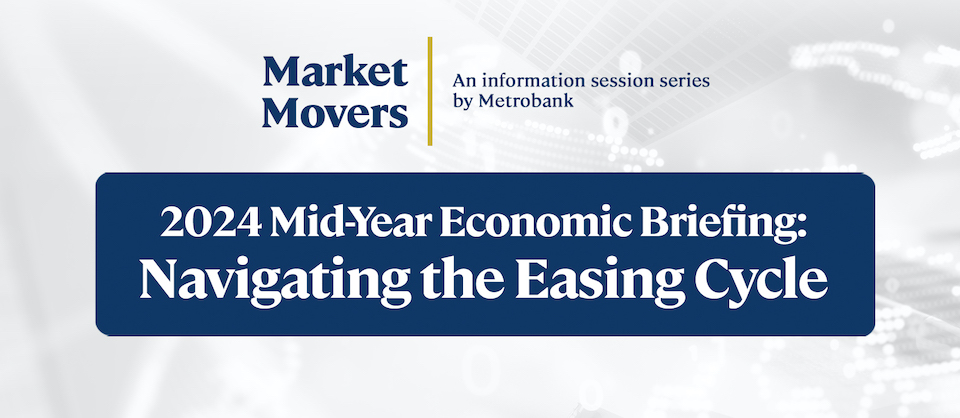
2024 Mid-Year Economic Briefing: Navigating the Easing Cycle
June 21, 2024
Investing with Love
Investing with Love: A Mother’s Guide to Putting Money to Work
May 15, 2024
retirement-ss-3
Investor Series: An Introduction to Estate Planning
September 1, 2023
View All Webinars
DOWNLOADS
grocery-2-aa
Inflation Update: Target breached
DOWNLOAD
Container ship carrying container boxes import export dock with quay crane. Business commercial trade global cargo freight shipping logistic and transportation worldwide oversea concept. Generative AI
Economic Updates
Philippines Trade Update: Wider deficit on strong imports
DOWNLOAD
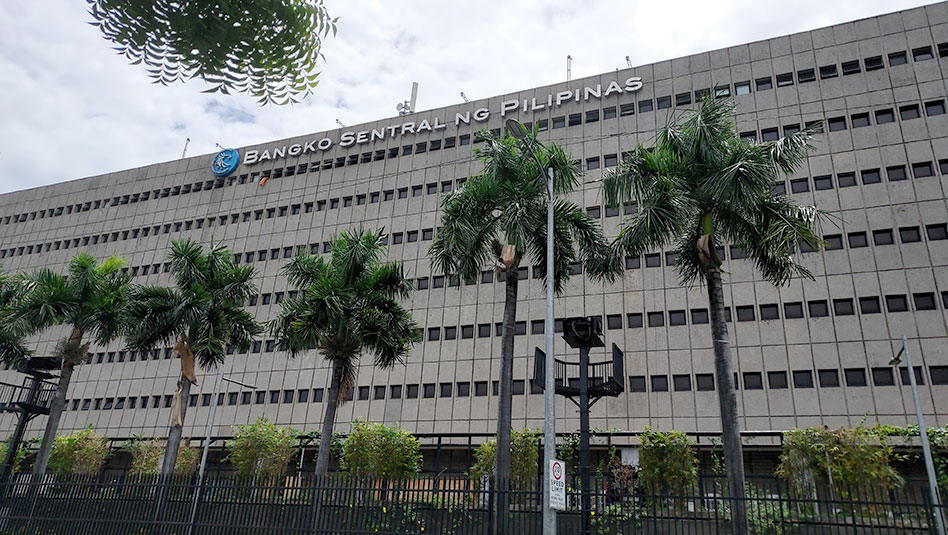
Frick collection with palm trees 
Economic Updates
Policy Rate Updates: Policy rate updates to reassure 
DOWNLOAD
View all Reports
Metrobank.com.ph How To Sign Up
Follow us on our platforms.

How may we help you?

TOP SEARCHES
  • Where to put my investments
  • Reports about the pandemic and economy
  • Metrobank
  • Webinars
  • Economy
TRENDING ARTICLES
  • Investing for Beginners: Following your PATH
  • On government debt thresholds: How much is too much?
  • Philippines Stock Market Outlook for 2022
  • Deficit spending remains unabated

Login

Access Exclusive Content
Login to Wealth Manager
Visit us at metrobank.com.ph How To Sign Up
Access Exclusive Content Login to Wealth Manager
Search
MODEL PORTFOLIO THE GIST
NEWS AND FEATURES
Global Philippines Fine Living
INSIGHTS
INVESTMENT STRATEGY
Economy Stocks Bonds Currencies
THE BASICS
Investment Tips Explainers Retirement
WEBINARS
2024 Mid-Year Economi Briefing, economic growth in the Philippines
2024 Mid-Year Economic Briefing: Navigating the Easing Cycle
June 21, 2024
Investing with Love
Investing with Love: A Mother’s Guide to Putting Money to Work
May 15, 2024
retirement-ss-3
Investor Series: An Introduction to Estate Planning
September 1, 2023
View All Webinars
DOWNLOADS
grocery-2-aa
Inflation Update: Target breached
April 7, 2026 DOWNLOAD
Container ship carrying container boxes import export dock with quay crane. Business commercial trade global cargo freight shipping logistic and transportation worldwide oversea concept. Generative AI
Economic Updates
Philippines Trade Update: Wider deficit on strong imports
March 27, 2026 DOWNLOAD
Frick collection with palm trees 
Economic Updates
Policy Rate Updates: Policy rate updates to reassure 
March 26, 2026 DOWNLOAD
View all Reports

Archives: Business World Article

Peso inches lower vs dollar

Peso inches lower vs dollar

The peso inched down against the dollar on Monday as investors were cautious ahead of the release of August US consumer price index (CPI) data this week.

The local currency closed at PHP 56.69 versus the dollar on Monday, weakening by six centavos from Friday’s PHP 56.63 finish, data from the Bankers Association of the Philippines’ website showed.

The local unit opened Monday’s session flat at PHP 56.63 per dollar. Its intraday best was at PHP 56.53, while its weakest showing was at PHP 56.695 against the greenback.

Dollars traded went down to USD 1.19 billion on Monday from the USD 1.62 billion on Friday.

“The peso weakened amid market caution prior to the release of the US consumer inflation report for August 2023,” a trader said in an e-mail.

August US CPI data will be released on Wednesday.

The peso inched down due to signals from the Bangko Sentral ng Pilipinas (BSP) that inflation could return to its 2-4% target in the first quarter next year instead of this year, Rizal Commercial Banking Corp. Chief Economist Michael L. Ricafort said in a Viber message.

BSP Governor Eli M. Remolona, Jr. last week said he expects inflation to be back within its target range early next year amid lingering price risks.

He added that the BSP could upwardly revise its full-year inflation forecast of 5.6% for 2023 at their Sept. 21 policy meeting.

For Tuesday, the trader said the peso could depreciate further ahead of key US data releases.

The trader sees the peso moving between USD 56.60 and USD 56.85 per dollar on Tuesday, while Mr. Ricafort sees it ranging from PHP 56.60 to PHP 56.80. — AMCS

Shares inch higher as market awaits key US data

Shares inch higher as market awaits key US data

Philippine shares inched up on Monday ahead of the release of August US consumer price index (CPI) data that could affect the US Federal Reserve’s policy decision this month.

The benchmark Philippine Stock Exchange index (PSEi) went up by 10.80 points or 0.17% to end at 6,233.74 on Monday, while the broader all shares index rose by 3.22 points or 0.09% to close at 3,363.45.

“Philippine shares were bought up as investors look to a fresh new batch of economic data that could influence price action activity. For the week ahead in the US, investors are looking forward to key inflation data,” Regina Capital Development Corp. Head of Sales Luis A. Limlingan said in a Viber message.

“Local stocks moved sideways with no major catalyst to move the market either way. Investors also opted to stay on the sidelines, anticipating the release of US CPI data, which is expected to provide clearer insights into the direction of US monetary policy,” AB Capital Securities, Inc. Vice-President Jovis L. Vistan said in a Viber message.

August US CPI data will be released on Wednesday.

The US CPI rose 0.2% in July, matching June’s gain. On an annual basis, the CPI advanced by 3.2%.

The US central bank raised borrowing costs by 25 basis points (bps) in July, bringing its target rate to a range between 5.25% and 5.5%.

It has hiked rates by 525 bps since it began its tightening cycle in March last year.

The Federal Open Market Committee will hold its policy meeting on Sept. 19-20.

“Meanwhile, it’s going to be a relatively quiet week for us here in the Philippines. The only economic data due for this week is the remittances [report],” Mr. Limlingan added.

The Bangko Sentral ng Pilipinas (BSP) is scheduled to release July remittance data on Friday.

In June, cash remittances coursed through banks inched up by 2.1% to USD 2.81 billion from USD 2.75 billion in the same month last year, BSP data showed.

For the first six months of 2023, cash remittances rose by 2.9% to USD 15.79 billion.

Sectoral indices were split on Monday. Mining and oil climbed by 188.54 points or 1.87% to 10,266.96; industrials went up by 94.04 points or 1.06% to 8,910.16; and services rose by 4.17 points or 0.27% to 1,538.10.

Meanwhile, financials fell by 5.20 points or 0.29% to 1,788.26; property declined by 2.77 points or 0.1% to 2,586.13; and holding firms dropped by 4.32 points or 0.07% to 5,979.78.

Value turnover went down to PHP 3.62 billion on Monday with 639.89 million shares changing hands from the PHP 3.85 billion with 445.34 million issues seen on Friday.

Decliners outnumbered advancers, 103 to 95, while 41 names closed unchanged.

Net foreign selling rose to PHP 504.93 million on Monday from PHP 347.89 million on Friday.

For this week, Mr. Vistan placed the PSEi’s support at 6,120 and resistance at 6,350. — S.J. Talavera

DoF eyes temporary zero tariffs on rice

DoF eyes temporary zero tariffs on rice

The Department of Finance (DoF) is proposing to temporarily slash the tariff rates for rice imports to zero to curb the spike in retail prices of the national staple.

“We need to adopt a comprehensive approach to help ensure that rice supply remains sufficient at reduced prices,” Finance Secretary Benjamin E. Diokno said in a press chat on Friday.

He said the DoF proposed the “reduction of the 35% rice import tariff rates, both ASEAN (Association of Southeast Asian Nations) and MFN (Most Favored Nation) rates, temporarily to zero percent or maximum of 10% to arrest the surge in rice prices.”

This as inflation unexpectedly quickened to 5.3% in August from 4.7% in July, driven by the rise in pump prices and food costs, particularly rice.

The government began implementing a nationwide price ceiling on rice last week, as part of efforts to address increasing prices of the national staple amid reports of hoarding and price manipulation by cartels.

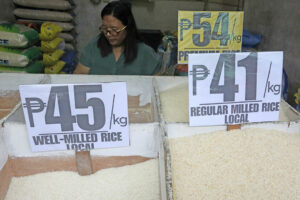
The ceiling is at PHP 41 per kilo for regular milled rice and PHP 45 per kilo for well-milled rice.

Mr. Diokno said price ceiling on rice would likely last only a month. He noted that price controls, if “closely implemented,” are effective in the near term.

“However, the government recognizes that it also has adverse effects if allowed to linger for a longer period. The President has directed the economic team to implement measures that will mitigate the negative impact of the price controls on rice retailers and farmers,” he said.

The Finance chief admitted he was “surprised” when Mr. Marcos first announced the price cap on rice on Sept. 1. At that time, Mr. Diokno was in Tokyo with National Economic and Development Authority Secretary Arsenio M. Balisacan, and Budget Secretary Amenah F. Pangandaman for the Philippines-Japan High-Level Joint Committee Meeting.

“We were in Japan when that was announced. I was beside Arsi (Mr. Balisacan). We were surprised, of course,” he said in mixed English and Filipino.

On the proposed cut in rice tariffs, Mr. Diokno said this can only be approved when Congress is in recess. Congress is set to adjourn on Sept. 30 and resume session on Nov. 6.

The tariff reduction will also only require an executive order (EO) for its implementation.

“There’s no need for Congress… The President may adjust the tariff when Congress is not in session,” he said. “There is just a hearing, then the Tariff Commission will recommend, it needs an EO. The Tariff Commission will draft an EO to the President.”

Mr. Diokno said the temporary tariff cut will only be applied to rice and not include the other MFN rates for pork, corn and coal.

“The relaxing of the tariff is forward-looking because the price of rice is going up globally… rice is really, I think, the biggest contributor to inflation,” he said.

Food inflation quickened to 8.2% in August from 6.3% in the previous month. This was partly driven by rice inflation, which surged to 8.7% in August from 4.2% in July.

Apart from the tariff cut, Mr. Diokno said the government is seeking “cooperation with tollway concessionaires and operators for the temporary exemption of trucks that cater to agricultural goods from the increase in toll fees.”

Mr. Diokno noted that this would mean trucks would still pay the regular toll, but not the recently adjusted increases.

“The private concessionaires agreed with the proposal, they’re just trying to define the guidelines on how to identify these delivery trucks,” Finance Undersecretary Zeno Ronald R. Abenoja said.

The Toll Regulatory Board (TRB) will be in charge of issuing the guidelines for the toll exemption, he added.

To curb rice price increases, Mr. Diokno said the government will encourage the timely importation of rice by the private sector and fully implement the Super Green Lane to expedite rice imports.

“There is also a need to curb noncompetitive behavior in the rice industry by aggressively pursuing cases of hoarding, smuggling, and economic sabotage; strictly monitoring the prices of imported rice in the logistics chain; and encouraging the public, including retailers, to report individuals violating price caps on rice,” Mr. Diokno said.

“At the same time, we have to pursue programs to protect vulnerable sectors by safeguarding our farmers from the effect of the price ceiling; provide targeted subsidies to small traders and retailers of rice; and provide support to low-income households to address the impact of the surge in rice prices,” he added.

The Department of Social Welfare and Development began distributing a PHP 15,000 cash subsidy to small rice retailers on Saturday.

Mr. Diokno said that there is a need for “timely, granular and accurate information on the status of the rice industry.”

“In this regard, the government must also devote more resources to satellite-based technology and data analytics to complement the dashboard,” he added.

Inflation unlikely to overshoot target in Q1

Inflation unlikely to overshoot target in Q1

Inflation is on track to return to the central bank’s 2-4% target range in the fourth quarter, but unlikely to overshoot the target in the first quarter of 2024, Finance Secretary Benjamin E. Diokno said.

“By the first quarter of next year, instead of overshooting — because we expect overshooting before — we will be right smack in the middle of the 2-4% range,” he told reporters on Friday.

Inflation unexpectedly quickened for the first time in seven months in August, as food and transport costs jumped. Headline inflation accelerated to 5.3% in August from 4.7% in July, ending six months of decline.

For the first eight months of the year, inflation averaged 6.6%. This is still higher than the central bank’s revised 5.6% inflation forecast for this year.

Despite the faster August inflation, Mr. Diokno noted that the Bangko Sentral ng Pilipinas (BSP) still sees inflation falling within the 2-4% target range by the fourth quarter.

“While there was a spike in the inflation rate for (August), the continued decline in the year-to-date inflation rate suggests our (Development Budget Coordination Committee) full-year 2023 inflation rate assumption of 5-6% remains doable,” he said.

BSP Governor Eli M. Remolona, Jr. last week said the central bank will likely revise its full-year inflation forecast for 2023 at its Sept. 21 policy meeting.

Mr. Remolona has also said that inflation will likely return to the 2-4% target in the first quarter of 2024.

Meanwhile, former BSP Governor Felipe M. Medalla said inflation is now likely to remain above the target band for up to 22 straight months or until January 2024.

August marked the 17th consecutive month that inflation went above the BSP’s 2-4% target range.

“My original forecast was that inflation will be higher than target in 20 consecutive months (or November 2023) — the previous longest period wherein that was the case was 15 months. With the global rice price shocks, we could end up with 22 consecutive months of higher-than-target inflation,” he said in a text message.

Global rice prices soared after India banned the export on non-basmati white rice in July. India accounts for over 40% of global trade.

Even as inflation remains above the target range, Mr. Medalla said the BSP’s credibility will not be at risk.

“We have always said that the forecast of when inflation will be back within target was based on the assumption that there will be no new major shock. And clearly what happened to global rice prices was a surprise to anyone without a crystal ball,” he said. 

University of Asia and the Pacific (UA&P) Senior Economist Cid L. Terosa in an e-mail said that it will be difficult for inflation to ease to the 2-4% target in the fourth quarter due to supply-side constraints. 

Supply constraints contribute significantly to inflation, but “are not susceptible to change in monetary policy,” he noted.

“Moreover, the BSP does not have direct control over the actions of wholesalers and retailers, who are critical conduits of increases in prices,” he said.

Mr. Terosa also noted that the August headline inflation rate of 5.3% was expected due to high food and energy prices.

August inflation was mainly driven by the faster annual increase in the heavily weighted index for food and nonalcoholic beverages, which rose to 8.1% in August from 6.3% in the previous month.

Rice inflation surged to 8.7% in August from 4.2% in July due to tight supply, marking the fastest pace since the 9% print in November 2018.

Transport inflation quickened to 0.2% in August from -4.7% in July, ending three months of decline.

China Banking Corp. Chief Economist Domini S. Velasquez said the price cap on rice imposed by the government may cause inflation to ease in September, and return to within the 2-4% target in November.

The government on Sept. 5 began implementing a price ceiling on rice at PHP 41 per kilogram for regular milled rice and PHP 45 per kilogram for well-milled rice.

“The reaction of traders to the rice price ceiling merits close attention and monitoring,” Mr. Terosa said.

The Foundation for Economic Freedom earlier said the rice price cap may cause harm to retailers, farmers, and even consumers, as it will only “aggravate the current tight rice supply situation into a full-blown rice crisis.”

Meanwhile, Ms. Velasquez noted that upside risks to inflation have emerged in recent months.

“Vegetable prices are at risk due to consecutive typhoons, sometimes hitting northern Luzon. Oil prices will likely stay elevated especially with the recent production cuts of Saudi Arabia and Russia,” she said.

“Lastly, this month we expect the regional wage board decisions that could fan demand-side inflation.

Last week, the Regional Tripartite Wages and Productivity Board in Region IV-A (Calabarzon) issued a wage order which provides a 9-11% increase from the current daily minimum wage rates, ranging from PHP 35 to PHP 50 depending on the geographical area and labor sector. The higher daily minimum wage for the region, which is considered a manufacturing hub, will take effect on September 24.

For his part, Mr. Terosa said supply shortages in agricultural products, higher fuel prices and the start of holiday-related spending may stoke inflation in the coming months.

“Nonetheless, I believe the BSP is still on top of things since it continues to mindfully address what it can control,” he said.

“Unfortunately, there are several external conditions that the BSP cannot influence or control such as weather disturbances, supply chain disruptions, policy actions of foreign governments, and geopolitical events, which have tightened supply of various commodities considerably,” he added. 

To tame inflation, the Monetary Board has raised borrowing costs by 425 basis points, bringing the benchmark interest rate to a near 16-year high of 6.25%.

Ms. Velasquez said the BSP may not respond with another rate hike in September. “For now, we expect BSP to stand pat at 6.25% but remain hawkish if inflationary expectations become de-anchored.”

Mr. Medalla also said that the BSP is unlikely to cut policy rates this year. 

“It is also worth noting that the current policy rate will be higher than the forecasted monthly headline inflation rates in the last four months of 2023 and average inflation in 2024,” he said. — Keisha B. Ta-asan with inputs from Luisa Maria Jacinta C. Jocson


Gov’t may launch dollar RTB offer this month

Gov’t may launch dollar RTB offer this month

The government may push through with the launch of its US dollar retail Treasury bond (RTB) offer this month, National Treasurer Rosalia V. de Leon said.

“We’re monitoring the markets right now. We’re conducting financial literacy (seminars), including in Doha and Dubai. So, we’re looking at the interest of overseas Filipino workers (OFWs),” Ms. De Leon said in a press chat on Friday.

“So maybe at the end of the month, we’re looking. We will see, we’re not officially saying we are going to launch,” she added.

Earlier in July, Ms. De Leon said that they were planning to launch the retail dollar bond offering by September.

The government then said it was targeting an offer size of USD 2 billion.

The Philippines’ last retail dollar bond sale was in 2021, when it raised almost USD 1.6 billion.

In January, the government also raised USD 3 billion from its second global bond offering under the Marcos administration.

Ms. De Leon earlier said that the retail dollar bonds can be marketed through platforms such as the Bonds.PH app, the Land Bank of the Philippines mobile app and selling agents. The government is also working on coordinating with banks to waive the fees for opening dollar accounts.

This year, the government plans to borrow PHP 2.207 trillion, of which 75% will be sourced locally. Broken down, PHP 1.654 trillion will be sourced domestically and PHP 553.5 billion will come from overseas.

As of end-July, the National Government’s (NG) outstanding debt stood at PHP 14.24 trillion.

External debt rose by 9.3% to PHP 4.43 trillion at the end of July, which consisted of PHP 2.42 trillion in global bonds and PHP 2.02 trillion in loans.

Unused loan proceeds
Meanwhile, Finance Secretary Benjamin E. Diokno said that the Philippines is returning unused loan proceeds worth USD 320 million to the World Bank.

Last week, the World Bank held a high-level meeting with the heads of the departments of Finance and Health, as well as the National Economic and Development Authority.

“The USD 320 million was excess from the pandemic. The World Bank advised us to return that and come up with a new program,” Mr. Diokno said in mixed English and Filipino.

The loan proceeds were supposed to be used to purchase coronavirus disease 2019 (COVID-19) vaccines. However, Mr. Diokno said the funds were not utilized as the country is already recovering from the pandemic and there were enough donations of the COVID-19 vaccines.

Mr. Diokno said that the government is working on another health-related loan program focusing on “strengthening local health (and) preparing for the next pandemic.”

From 2020 until July 2023, the World Bank has provided over USD 7 billion for COVID-19 programs for the Philippines. — Luisa Maria Jacinta C. Jocson

Rates of Treasury bills, bonds likely to decline

Rates of Treasury bills, bonds likely to decline

Rates of Treasury bills (T-bills) and bonds on offer this week could track secondary market movements after faster-than-expected inflation last month.

The Bureau of the Treasury (BTr) will auction off PHP 15 billion in T-bills on Monday or PHP 5 billion each in 91-, 182- and 364-day papers.

On Tuesday, it will offer PHP 30 billion in reissued seven-year Treasury bonds (T-bonds) with a remaining life of six years and 10 months.

“The upcoming Treasury bill auction yields could again decline week on week, after the comparable short-term PHP BVAL (Bloomberg Valuation Service) yields were lower by up to 0.05-0.07 basis point (bp) week on week,” Rizal Commercial Banking Corp. Chief Economist Michael L. Ricafort said in a Viber message.

“The upcoming seven-year Treasury bond auction yield could be similar to the comparable seven-year PHP BVAL yield at 6.42% as of Sept. 8,” Mr. Ricafort added.

At the secondary market on Friday, the 91-, 182-, and 364-day T-bills went down by 5.28 bps, 0.11 bp, and 7.02 bps week on week to end at 5.6553%, 5.9867%, and 6.193% respectively, based on PHP BVAL Reference Rates data published on the Philippine Dealing System’s website.

The seven-year bond likewise dropped by 12.89 bps week on week to end at 6.4154% on Friday.

“The seven-year bond auction should see a range of 6.35-6.45%, and is a good measure of risk appetite given the current backdrop of high inflation,” a trader said in an e-mail.

Headline inflation picked up to a two-month high of 5.3% in August from 4.7% in July, data released by the Philippine Statistics Authority last week showed.

Still, this was below the 6.3% print in August 2022, and was within the 4.8-5.6% forecast of the Bangko Sentral ng Pilipinas (BSP) for the month.

However, this was above the 4.9% median estimate in a BusinessWorld poll of 18 analysts.

August also marked the 17th consecutive month that the consumer price index (CPI) was above the BSP’s 2-4% target for the year.

For the first eight months, the CPI averaged 6.6%, above the central bank’s full-year forecast of 5.6%.

Last week, the BTr raised PHP 15 billion as planned via the T-bills it auctioned off on Monday as total bids reached PHP 47.56 billion, or more than thrice the amount on offer.

Broken down, the Treasury made a full PHP 5-billion award of the 91-day T-bills as tenders for the tenor reached PHP 13.242 billion. The average rate of the three-month paper went down by 2.1 bps for an average rate of 5.552%, with accepted rates ranging from 5.5% to 5.6%.

The government also raised PHP 5 billion as planned from the 182-day securities as bids for the tenor reached PHP 15.043 billion. The average rate for the six-month T-bill was at 5.966%, down by 2.7 bps, with accepted rates at 5.948% to 5.985%.

Lastly, the BTr borrowed the programmed PHP 5 billion via the 364-day debt papers as demand for the tenor stood at PHP 19.275 billion. The average rate of the one-year T-bill declined by 9.9 bps to 6.198%. Accepted yields were from 6.17% to 6.22%.

Meanwhile, the reissued seven-year bonds to be offered on Tuesday were first auctioned off on July 26, where the government raised PHP 24.793 billion, short of the PHP 30-billion program, at a coupon rate of 6.375% and an average rate of 6.328%.

The Treasury wants to raise PHP 180 billion from the domestic market this month, or PHP 60 billion via T-bills and PHP 120 billion via T-bonds.

The government borrows from local and foreign sources to help fund its budget deficit, which is capped at 6.1% of gross domestic product this year. — A.M.C. Sy

Yields on gov’t debt rise

Yields on gov’t debt rise

Yields on government securities (GS) traded in the secondary market increased last week as inflation accelerated last month, pushing yields higher.

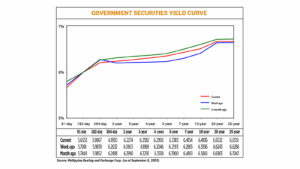
GS yields, which move opposite to prices, climbed by 4.29 basis points (bps) on average week on week, based on PHP Bloomberg Valuation Service Reference Rates as of Sept. 8 published on the Philippine Dealing System’s website.

Rates were mixed last week as yields on the 91-, 182- and 364-day Treasury bills (T-bills) declined by 5.28 bps, 0.11 bp and 7.02 bps to 5.6553%, 5.9867%, and 6.193%, respectively. 

Meanwhile, the belly of the curve went up as yields on the two-, three-, four-, five-, and seven-year Treasury bonds (T-bonds) rose by 4.11 bps (6.2274%), 6.13 bps (6.2582%), 9.04 bps (6.2950%), 11.9 bps (6.3383%), and 12.89 bps (6.4154%), respectively.

At the long end, the rates of the 10-, 20-, and 25-year debt papers also increased by 10 bps (6.4936%), 2.89 bps (6.6532%) and 2.65 bps (6.6551%), respectively.

Total GS volume traded on Friday fell to PHP 13.63 billion from PHP 31.13 billion a week earlier.

Yield movements last week were mostly inflation-related, a bond trader said in a Viber message.

“The market sentiment shifted last week after the BSP (Bangko Sentral ng Pilipinas) released its inflation range of 4.8% to 5.6%, representing a lower bound that was already higher than July and indicated a higher month on month figure as well,” the bond trader said.

Globally, yields remained elevated with US Federal Reserve officials still uncertain on their policy path, the bond trader added.

“The market reverted to defensiveness through the week as it digested what the August inflation figure implies moving forward and [that the BSP governor] has already indicated that inflation will likely stay above the target range for the fourth quarter,” the bond trader said.

Noel S. Reyes, chief investment officer for Trust and Asset Management Group at Security Bank Corp., said the market started the week defensively given higher global yields.

“Latest CPI (consumer price index) data, which was worse than consensus and further increases in global yields,… added to the defensive tone,” Mr. Reyes said in an e-mail.

Headline inflation quickened for the first time in seven months to 5.3% in August, up from 4.7% in July but slower compared with the 6.3% print a year earlier.   

The CPI settled within the BSP’s 4.8-5.6% forecast range and marked the 17th consecutive month that inflation surpassed the central bank’s 2-4% target.

Year to date, inflation averaged 6.6%, still above the BSP’s full-year forecast of 5.6%.

BSP Governor Eli M. Remolona, Jr. last week said inflation is expected to return within the central bank’s target by the first quarter of 2024.

He added that the central bank may hike its inflation forecast of 5.6% for 2023 at their Sept. 21 meeting.

“GS yields will likely remain elevated for an extended period of time since higher inflation expectations will probably push back the BSP’s timeframe to start cutting rates,” the bond trader said.

The trader added that the Monetary Board will likely keep rates unchanged at its meeting, but continue to signal a readiness to tighten if inflation will continue to persist.

For this week, the bond trader expects the market to trade sideways and take its cue from the result of this week’s bond auction.

The government will offer PHP 30 billion in reissued seven-year bonds on Tuesday that have a remaining life of six years and 10 months.

“Although inflation remains a concern, market participants have become used to that already and will just try and ride out the volatility for now,” the bond trader added.

Mr. Reyes said yields may continue to move sideways as the market awaits the Fed’s Sept. 19-20 meeting and the BSP’s own review a day after.

“Recent inflation was supply-side driven and should not be a factor for MB (Monetary Board) to turn on a hawkish bias during the meeting. Core inflation was lower and supports keeping the policy unchanged. If ever the MB moves, it will be to guard against pressures on the peso if the Fed raises another time,” he added. — A.M.P. Yraola

Peso may trade sideways

Peso may trade sideways

The peso could trade sideways against the dollar this week ahead of the release of US inflation data that could affect the US Federal Reserve’s next policy move.

The local unit closed at PHP 56.63 versus the dollar on Friday, strengthening by 16 centavos from Thursday’s PHP 56.79 finish, data from the Bankers Association of the Philippines’ website showed.

Week on week, however, the peso inched down by 3.50 centavos from its P56.595 close on Aug. 30.

The local unit opened Friday’s session at PHP 56.74 per dollar. Its weakest showing was at PHP 56.785, while its intraday best was at PHP 56.56 against the greenback.

Dollars traded rose to USD 1.62 billion on Friday from USD 1.45 billion on Thursday.

The peso appreciated on Friday following the dollar’s slight decline in Asian trading, Rizal Commercial Banking Corp. Chief Economist Michael L. Ricafort said in a Viber message.

For this week, the peso could move sideways against the dollar as the market awaits the release of August US consumer and producer inflation data, which could affect the Fed’s decision this month, Mr. Ricafort said.

The US central bank raised borrowing costs by 25 basis points (bps) last month, bringing its target rate to a range between 5.25% and 5.5%.

It has hiked rates by 525 bps since it began its tightening cycle in March last year.

The Federal Open Market Committee will hold its policy meeting on Sept. 19-20.

For this week, Mr. Ricafort expects the peso to range from PHP 56.30 to PHP 56.80 per dollar. — AMCS

BSP sees within-target inflation by Q1

BSP sees within-target inflation by Q1

Inflation is now likely to land within the Bangko Sentral ng Pilipinas’ (BSP) target by the first quarter of 2024, not the fourth quarter of this year, BSP Governor Eli M. Remolona, Jr. said.

“We’re not quite clear about the fourth quarter (of 2023) yet. We’re still looking at the way our tightening measures have been working their way through the economy on the demand side. We’re not sure about the fourth quarter because if there are further supply shocks, then the numbers will be different,” Mr. Remolona said in an interview with BusinessWorld Editor-in-Chief Wilfredo G. Reyes on Sept. 4, a day before the government reported a faster-than-expected 5.3% inflation for August.

BusinessWorld’s one-on-one interview with Mr. Remolona will be streamed on BusinessWorld and The Philippine Star’s Facebook pages, as well as the BusinessWorldTV YouTube page, at 11 a.m. today (Sept. 8).

“My best guess is it will be the first quarter of 2024, before we get into the (2-4%) target range,” Mr. Remolona said.

The BSP will likely upwardly revise its full-year forecast of 5.6% for 2023 at the next policy meeting on Sept. 21, he said.

Inflation unexpectedly accelerated for the first time in seven months in August, as food and transport costs rose. The consumer price index (CPI) quickened to 5.3% in August from 4.7% in July, above the 4.9% median estimate in a BusinessWorld poll conducted last week.

August marked the 17th consecutive month that inflation surpassed the central bank’s 2-4% target range. 

For the first eight months of 2023, inflation averaged 6.6%.

Mr. Remolona said the central bank still has space for further tightening.

“If inflation continues to be an issue, then we could raise policy rate from 6.25% to a higher policy rate. If we think the tightening is already very effective, then we wouldn’t need to increase further,” he said.

The BSP has kept its key policy rate at a near 16-year high of 6.25% for the last three meetings. It has hiked benchmark interest rates by 425 basis points (bps) from May 2022 to March 2023 to curb inflation.

Aside from inflation, Mr. Remolona said the Monetary Board will also be taking into account recent economic output data at its next policy-setting meeting on Sept. 21.

“That (output data) for us is an indicator of how much we’ve done on the demand side to compensate for the pressures from the supply side,” he said.

“We could still hike. We have a sense of how high we can hike before growth becomes an issue, we compute what we call the natural rate and we’re still below the natural rate. We have room to hike because of our calculations.”

Mr. Remolona said the Philippine economy can still grow by 6% this year, the lower end of the 6-7% growth target for 2023, if the government ramps up spending.

Gross domestic product grew by a slower-than-expected 4.3% in the second quarter, partly due to government underspending. This brought the six-month average to 5.3%, still below the government’s 6-7% target this year.

Meanwhile, Mr. Remolona said the US Federal Reserve is still hawkish, but the Jackson Hole speech by Chairman Jerome H. Powell in August had more uncertainty compared with the previous Federal Open Market Committee (FOMC) statement.

“But I think, in my opinion, they’re slightly behind the curve in terms of tightening. I think we’re closer to being on track in terms of tightening,” he added. 

The US Federal Reserve hiked borrowing costs by 25 bps at its meeting in July. This brought the Fed funds rate to 5.25-5.5%, its highest level in 22 years.

The next meeting of the FOMC is scheduled for Sept. 19-20.

Mr. Remolona, however, noted that several financial crises occurred after the Fed raised its policy rate “very sharply.”

“In November 1994 for example, for the first time the FOMC raised its policy rate by 75 bps, within a few months we saw the Tequila crisis. And within the two years we saw the Asian (financial) crisis,” he said.

“This time, the FOMC has been even more aggressive than it was in 1994, so this makes me worried about what might happen down the road,” he said.

Earlier this year, markets around the world were rattled by the back-to-back collapse of Silicon Valley Bank (SVB) and New York’s Signature Bank. A crisis of confidence also hit Credit Suisse, which resulted in a state-led rescue by its Swiss rival UBS Group. 

“We already saw SVB, we already saw Credit Suisse, I’m concerned that there may be further financial accidents in the future. I think what high levels of interest rates do is they make the floor more slippery for banks and so they make accidents, or slips, more likely to happen,” Mr. Remolona added. — Keisha B. Ta-asan

Dollar reserves slip to USD99.8B as of end-Aug.

Dollar reserves slip to USD99.8B as of end-Aug.

The Philippines’ dollar reserves dipped as of end-August, as the National Government (NG) paid some of its foreign debt obligations and the value of the central bank’s gold holdings fell.

Data released by the Bangko Sentral ng Pilipinas (BSP) on Thursday showed gross international reserves (GIR) slipped by 0.14% to USD 99.81 billion as of end-August from USD 99.95 billion as of end-July.

This was the lowest dollar reserve level since the USD 99.39 billion seen in June.

However, the GIR was 2.4% higher than USD 97.44 billion as of end-August 2022.

“The month-on-month decrease in the GIR level reflected mainly the NG’s payments of its foreign currency debt obligations and the downward adjustments in the value of BSP’s gold holdings due to the decrease in the price of gold in the international market,” the central bank said. 

As of end-August, the dollar reserves were enough to cover 5.9 times the country’s short-term external debt based on original maturity and 4.1 times based on residual maturity.

It is also equivalent to 7.4 months’ worth of imports of goods and payments of services and primary income.

Ample foreign exchange buffers protect the country from market volatility and serve as a guarantee for the economy’s ability to pay its debts in the event of an economic downturn.

“The slight decrease in the GIR in August 2023 was due to a number of factors, including the payment of maturing foreign currency obligations, some ‘hot money’ outflows, and the decline in the value of the Philippine peso against the US dollar, among others,” Security Bank Corp. Chief Economist Robert Dan J. Roces said.   

Based on BSP data, foreign currency deposits fell by 52.5% to $648 million at end-August from USD 1.367 billion a month earlier and by 63.5% from USD 1.777 billion a year ago.

Rizal Commercial Banking Corp. Chief Economist Michael L. Ricafort attributed the decrease in foreign currency holdings “partly due to some foreign exchange operations (possible foreign exchange intervention activities, as an option signaled by local monetary authorities during the month).”

The peso closed at PHP 56.595 on Aug. 31, depreciating by 3% or P1.715 from the PHP 54.88 finish on July 31.

Meanwhile, buffers in the form of gold were valued at USD 10.23 billion as of end-August, slipping by 0.7% from USD 10.3 billion as of end-July. However, it was up by 19.9% from USD 8.53 billion a year earlier.

The decline in foreign currency deposits and gold buffers were offset by an increase in foreign investments, Mr. Ricafort said.

The BSP’s foreign investments rose by 0.7% to USD 84.33 billion as of end-August from USD 83.68 billion a month earlier. This was also 1.9% higher than USD 82.73 billion a year earlier.

According to the BSP, net international reserves slipped by 0.1% to USD 99.8 billion as of end-August from USD 99.9 billion from end-July.

Net international reserves are the difference between the BSP’s reserve assets (GIR) and reserve liabilities such as short-term foreign debt, and credit and loans from the International Monetary Fund (IMF).

The Philippines’ reserve position in the IMF also declined by 1.4% to USD 790.4 million from USD 801.9 million in July but rose by 6.7% from USD 740.8 million as of end-August 2022.

Special drawing rights (SDRs) — the amount the country can tap from the IMF — inched up by 0.5% to USD 3.81 billion as of end-August from USD 3.79 billion in the month prior. This was 4% higher than USD 3.66 billion a year earlier.

China Banking Corp. Chief Economist Domini S. Velasquez said the country’s GIR as of end-August remains sufficient in terms of its imports and external debt cover.

“We think there is a risk that the GIR will fall in September due to the depreciation pressure on the peso. Moreover, we will likely see higher imports as oil prices continue to climb. This will squeeze the import cover ratio of the GIR,” she said.

The local currency closed at PHP 56.79 versus the dollar on Thursday, strengthening by 15 centavos from its previous finish of PHP 56.94, data from the Bankers Association of the Philippines’ website showed.

Year to date, the peso depreciated by 1.8% or PHP 1.035 from its PHP 55.755 finish on Dec. 29, 2022.

Meanwhile, Mr. Roces said the slight decrease in August GIR is not a “cause for alarm.”

“The outlook for the country’s dollar reserves in the coming months is positive with remittances from BPOs (business process outsourcing) and OFWs (overseas Filipino workers) incoming,” Mr. Roces said.

The BSP is expecting to end the year with USD 100 billion in dollar reserves and $102 billion by end-2024. — Keisha B. Ta-asan

Posts navigation

Older posts
Newer posts

Recent Posts

  • Metrobank US-Iran Risk Index: Fragile ceasefire 
  • Investment Ideas: April 10, 2026 
  • Metrobank US-Iran Risk Index: A new hope
  • A guide for your peso bond portfolio amid higher for longer rates
  • Investment Ideas: April 8, 2026

Recent Comments

No comments to show.

Archives

  • April 2026
  • March 2026
  • February 2026
  • January 2026
  • December 2025
  • November 2025
  • October 2025
  • September 2025
  • August 2025
  • July 2025
  • June 2025
  • May 2025
  • April 2025
  • March 2025
  • February 2025
  • January 2025
  • December 2024
  • November 2024
  • October 2024
  • September 2024
  • August 2024
  • July 2024
  • June 2024
  • May 2024
  • April 2024
  • March 2024
  • February 2024
  • January 2024
  • December 2023
  • November 2023
  • October 2023
  • September 2023
  • August 2023
  • July 2023
  • June 2023
  • May 2023
  • April 2023
  • March 2023
  • February 2023
  • January 2023
  • December 2022
  • November 2022
  • October 2022
  • September 2022
  • August 2022
  • July 2022
  • June 2022
  • May 2022
  • March 2022
  • December 2021
  • October 2021

Categories

  • Bonds
  • BusinessWorld
  • Currencies
  • Economy
  • Equities
  • Estate Planning
  • Explainer
  • Featured Insight
  • Fine Living
  • How To
  • Investment Tips
  • Markets
  • Portfolio Picks
  • Rates & Bonds
  • Retirement
  • Reuters
  • Spotlight
  • Stocks
  • Uncategorized

You are leaving Metrobank Wealth Insights

Please be aware that the external site policies may differ from our website Terms And Conditions and Privacy Policy. The next site will be opened in a new browser window or tab.

Cancel Proceed
Get in Touch

For inquiries, please call our Metrobank Contact Center at (02) 88-700-700 (domestic toll-free 1-800-1888-5775) or send an e-mail to customercare@metrobank.com.ph

Metrobank is regulated by the Bangko Sentral ng Pilipinas
Website: https://www.bsp.gov.ph

Quick Links
The Gist Webinars Wealth Manager Explainers
Markets
Currencies Rates & Bonds Equities Economy
Wealth
Investment Tips Fine Living Retirement
Portfolio Picks
Bonds Stocks
Others
Contact Us Privacy Notice Terms of Use
© 2026 Metrobank. All rights reserved.

Access this content:

If you are an existing investor, log in first to your Metrobank Wealth Manager account. ​

If you wish to start your wealth journey with us, click the “How To Sign Up” button. ​

Login HOW TO SIGN UP