



MODEL PORTFOLIO
THE GIST
NEWS AND FEATURES
Global Philippines Fine Living
INSIGHTS
INVESTMENT STRATEGY
Economy Stocks Bonds Currencies
THE BASICS
Investment Tips Explainers Retirement
WEBINARS
2024 Mid-Year Economi Briefing, economic growth in the Philippines
2024 Mid-Year Economic Briefing: Navigating the Easing Cycle
June 21, 2024
Investing with Love
Investing with Love: A Mother’s Guide to Putting Money to Work
May 15, 2024
retirement-ss-3
Investor Series: An Introduction to Estate Planning
September 1, 2023
View All Webinars
DOWNLOADS
grocery-2-aa
Inflation Update: Target breached
DOWNLOAD
Container ship carrying container boxes import export dock with quay crane. Business commercial trade global cargo freight shipping logistic and transportation worldwide oversea concept. Generative AI
Economic Updates
Philippines Trade Update: Wider deficit on strong imports
DOWNLOAD
Frick collection with palm trees 
Economic Updates
Policy Rate Updates: Policy rate updates to reassure 
DOWNLOAD
View all Reports
Metrobank.com.ph How To Sign Up
Follow us on our platforms.

How may we help you?

TOP SEARCHES
  • Where to put my investments
  • Reports about the pandemic and economy
  • Metrobank
  • Webinars
  • Economy
TRENDING ARTICLES
  • Investing for Beginners: Following your PATH
  • On government debt thresholds: How much is too much?
  • Philippines Stock Market Outlook for 2022
  • Deficit spending remains unabated

Login

Access Exclusive Content
Login to Wealth Manager
Visit us at metrobank.com.ph How To Sign Up
Access Exclusive Content Login to Wealth Manager
Search
MODEL PORTFOLIO THE GIST
NEWS AND FEATURES
Global Philippines Fine Living
INSIGHTS
INVESTMENT STRATEGY
Economy Stocks Bonds Currencies
THE BASICS
Investment Tips Explainers Retirement
WEBINARS
2024 Mid-Year Economi Briefing, economic growth in the Philippines
2024 Mid-Year Economic Briefing: Navigating the Easing Cycle
June 21, 2024
Investing with Love
Investing with Love: A Mother’s Guide to Putting Money to Work
May 15, 2024
retirement-ss-3
Investor Series: An Introduction to Estate Planning
September 1, 2023
View All Webinars
DOWNLOADS
grocery-2-aa
Inflation Update: Target breached
April 7, 2026 DOWNLOAD
Container ship carrying container boxes import export dock with quay crane. Business commercial trade global cargo freight shipping logistic and transportation worldwide oversea concept. Generative AI
Economic Updates
Philippines Trade Update: Wider deficit on strong imports
March 27, 2026 DOWNLOAD
Frick collection with palm trees 
Economic Updates
Policy Rate Updates: Policy rate updates to reassure 
March 26, 2026 DOWNLOAD
View all Reports

Archives: Business World Article

Vehicle sales jump by annual 22% in August

Vehicle sales jump by annual 22% in August

Automobiles sales in the Philippines registered a double-digit annual growth in August but saw a month-on-month sales decline amid elevated inflation.

A joint report by the Chamber of Automotive Manufacturers of the Philippines, Inc. (CAMPI) and the Truck Manufacturers Association (TMA) showed new vehicle sales rose by 21.6% to 36,714 units in August from 30,185 units in the same month a year ago.

“Consumer demand drives the auto sales further… from an already considered pre-pandemic performance a year prior amidst the above inflation target recorded anew in the same period,” CAMPI President Rommel R. Gutierrez said in a statement.
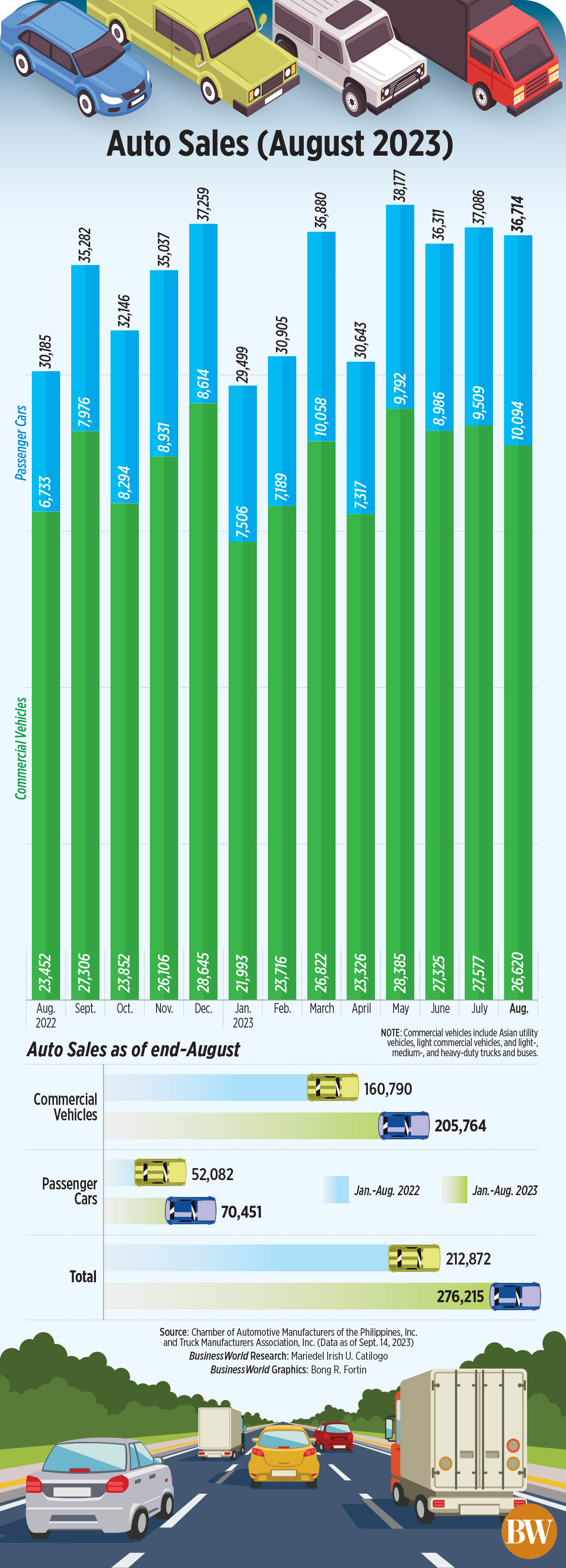
Auto Sales (August 2023)However, vehicle sales slipped by 1% from 37,086 units that were sold in July, reflecting the impact of rising prices.

Headline inflation unexpectedly picked up to 5.3% in August from 4.7% in July amid rising costs of fuel and food.

CAMPI-TMA data showed commercial vehicles accounted for the bulk of the August sales. Sales of commercial vehicles rose by 13.5% to 26,620 units in August from 23,452 in the same month in 2022.

Month on month, commercial vehicle sales declined by 3.5% from 27,577 units in July.

In particular, light commercial vehicles (LCV) climbed by 16.8% to 20,991 during the month. Month on month, sales of LCVs fell by 2.9%.

Sales of Asian utility vehicles (AUV) dipped by 0.3% year on year to 4,576 in August. AUV sales slumped by 8.3% month on month.

Sales of light trucks increased by an annual 29.5% to 597 in August, while heavy truck sales surged by 50.6% to 128. However, sales of medium trucks went down by 4.7% to 328 units.

Meanwhile, passenger car sales accelerated by an annual 49.9% to 10,094 units in August from 6,733 units a year ago. Month on month, sales of passenger cars rose by 6.15% from 9,509 units in July.

For the first eight months of the year, CAMPI-TMA members sold 276,215 units, increasing by 29.8% from 212,872 a year ago.

“The 276,215 units year-to-date sales of CAMPI-TMA, up by 30% from the same period a year ago — equivalent to 70% of the 395,000 sales forecast is certainly giving optimism of a sustained and even stronger post-pandemic recovery for the auto industry,” Mr. Gutierrez said.

Commercial vehicles, which accounted for 75% of the total industry sales, reported a 28% increase in sales to 205,764 units in the January-to-August period.

Passenger car sales jumped by 35.3% to 70,451 in the eight-month period.

“The auto industry is mindful of the challenges brought by high inflation and its effect on the overall consumer confidence particularly for big-ticket items — not welcome news to the consumers and industry alike if it will persist,” Mr. Gutierrez said.

For the eight-month period, inflation averaged 6.6%. The Philippine central bank is projecting inflation to average 5.6% this year.

Toyota Motor Philippines Corp. (TMP) remained the market leader with a 45.9% share as eight-month sales rose by 16.6% to 126,795.

Mitsubishi Motors Philippines Corp. came in second spot with a 67% surge in sales to 50,439 in the January-to-August period.

In third spot is Ford Motor Company Phils., Inc. as its sales jumped by 47.6% to 19,700 units in the period ending in August.

Rounding out the top five are Nissan Philippines, Inc., which saw a 23.4% increase in sales to 17,873 units, and Suzuki Phils., Inc. whose sales dropped by 7.9% to 11,821 units.

In 2022, CAMPI-TMA members sold a total of 352,596 units. — Justine Irish D. Tabile

More banks urged to remove fees on small transfers

More banks urged to remove fees on small transfers

The Philippines central bank is looking to formalize the removal of fees for electronic fund transfers on small-value transactions to encourage more Filipinos to use digital payments, its chief said.

BSP Governor Eli M. Remolona, Jr. said three big banks have already removed fees on small fund transfers.

“(Fund transfers of) up to PHP 1,000 I think are free for these three major banks and we’re trying to shame the other major banks into following the same policy,” he said on the sidelines of the 2023 Alliance for Financial Inclusion (AFI) Global Policy Forum in Pasay City.

Bank of the Philippine Islands (BPI), Metropolitan Bank & Trust Co. (Metrobank), and Union Bank of the Philippines (UnionBank) are currently the only banks that have temporarily waived charges for InstaPay transactions. 

For BPI customers, Instapay transfers of up to PHP 1,000 made using the mobile app will be free until September 30. Customers of UnionBank and Metrobank will be able to make similar transfers for free until November 11 and December 31, respectively.

Mr. Remolona said the BSP is currently using moral suasion to persuade the Bankers Association of the Philippines (BAP) to remove or lower the transfer charges for small-value transactions.

“(Moral suasion) works to a large extent, but we’re formalizing it into a whole payments framework,” he said. “So, we’re talking to the BAP on Friday about payments in general. We have some discussions and out of that we expect something more formal to come out.” 

Aside from the BAP, the central bank is also in discussions with digital payment providers GCash and Maya Bank to reduce fund transfer fees.

Sought for comment, the BAP was unable to send a statement as of press time.

Earlier this year, then-BSP governor Felipe M. Medalla proposed to remove the transaction fees for small-value online transfers among banks and other financial institutions.

Based on BSP data as of end-July, some banks and non-lenders offer free InstaPay service while others charge a rate of P8 to PHP 25 per transaction.

There are currently 82 BSP-supervised financial institutions that participate in InstaPay. This includes 22 big banks, 19 thrift banks, 17 rural banks, and five digital banks.

There are also 19 e-money issuers in InstaPay.

As of July, the value of transactions done through InstaPay surged by 40.8% year on year to PHP 2.69 trillion from PHP 1.91 trillion a year prior, separate data from the BSP showed. 

The volume of InstaPay transactions rose by 41.6% to 425.07 million as of end-July from 300.18 million a year ago.

InstaPay is a real-time, low-value electronic fund transfer facility for transactions up to PHP 50,000 and is currently being handled by BancNet, Inc.

PESONet and InstaPay are automated clearing houses launched under the BSP’s National Retail Payment System that was rolled out in December 2015 to promote a safe, efficient, affordable, inclusive and reliable retail payment system.

Meanwhile, Mr. Remolona said the Philippine central bank is pushing for more transparency in the country’s payment system.

“In general, when it comes to payments, you want to make sure that the poor don’t subsidize the rich. If you have a credit card and if you’re a big spender using credit cards you get rewards, right? Who pays for those rewards? The small guys who only charge a small amount,” he said.

“We also want the system to be transparent. If you’re going to be charged for something, you want to know what you are being charged for,” he added. — Keisha B. Ta-asan

SEC clarifies required comparative periods for companies filing their registration statements

SEC clarifies required comparative periods for companies filing their registration statements

Companies registering their shares with the Securities and Exchange Commission (SEC) are required to submit two comparative periods for the past three fiscal years to show changes in their financial condition, the regulator said.

The commission issued the clarification amid mixed interpretations of a specific provision under the Securities Regulations Code (SRC).

In Memorandum Circular No. 13 signed by SEC Chairperson Emilio B. Aquino on Sept. 12, the securities regulator clarified Part III, paragraph A, subparagraph 2 (a) of Annex C of the SRC regarding the comparative periods required in the management’s discussion and analysis in a company’s prospectus. 

Annex C of Rule 12 contains details for the non-financial disclosure requirements in the registration statements that should be filed with the SEC.

The circular clarified that a registrant should provide the following disclosure comprising two comparative periods for the last three fiscal years in the management’s discussion and analysis portion of its prospectus.

“The foregoing portion of Annex C gave rise to conflicting views and varying interpretations as to the number of fiscal years required to be disclosed in the management’s discussion and analysis portion of the prospectus,” the circular said.

The SEC’s markets and securities regulation department sought guidance from the commission en banc on the interpretation of the phrase “for each of the last three fiscal years” as provided in Annex C, which was subsequently clarified during an en banc meeting on Sept. 5.

According to the circular, the interpretation will apply prospectively to registrants required to file registration statements and other reportorial documents, which include disclosure of a management’s discussion and analysis.

Sought for further comment, SEC Commissioner Kelvin Lester K. Lee said the circular aims to allow easier ways to raise capital. 

“The rationale is to make it easier to file registration statements and as a result make it easier to raise capital.  This covers registration statements and/or other reportorial documents, which include a disclosure of a management’s discussion and analysis,” Mr. Lee told BusinessWorld in a Viber message.

“This is for those that intend to file registration statements,” he added.

The SEC said the interpretation under the circular would take effect 15 days from its publication. — Revin Mikhael D. Ochave

Green bond issuances in PH reach USD2.8M in last 10 years

Green bond issuances in PH reach USD2.8M in last 10 years

The Philippines issued USD 230,000 worth of green bonds last year, data from the International Finance Corp. (IFC) and Amundi showed.

The rise in green and sustainability markets in Asian countries outside China are “likely to be further strengthened by recent policy efforts,” IFC and Amundi said in their “Emerging Market Green Bonds” report.

“Following the publication of a taxonomy for the region, several countries are in advanced stages of developing their own guidelines or classification systems detailing which economic activities qualify for environmental or sustainable investment,” it added.

Among Association of Southeast Asian Nations countries with available data, Indonesia issued the highest volume of green bonds (USD 2.58 million), followed by Malaysia (USD 250,000), the Philippines, and Vietnam (USD 40,000).

From 2012 to 2022, the cumulative volume of green bonds issued by the Philippines amounted to USD 2.8 million.

The IFC and Amundi said green bonds and other sustainable debt instruments are key to “ensuring enough capital is channeled from international investors toward funding the energy transition in emerging markets.”

“Demand for funding to finance energy transitions as developing-country governments and corporates pursue environmental goals set by the Paris Agreement will drive growth in issuance of green, social, sustainability, and sustainability-linked (GSSS) bonds,” the report said.

IFC and Amundi’s forecast is that green bond issuances in emerging markets outside China will grow by 14% this year, before easing to about 11% in 2024.

Last year, global GSSS bond issuances fell 13%, the first annual decline, indicating the “fragility of private investment flows.”

The report said governments and multilateral institutions must make it a priority to boost the GSSS bond market in developing countries.

“The asset class is crucial for channeling private investment toward green transitions and the need for this type of funding is especially acute in emerging markets where fiscal resources are scarcer than in developed economies. Failure to underpin these markets will leave them struggling to meet climate targets,” it said.

It also called to address “greenwashing,” which means that issuers wrongly state the extent a project or activity meets the sustainability criteria.

Central banks will also be key to pushing financial markets to support the green transition.

“In terms of monetary policy, they could also face a challenge to price stability from ‘greenflation,’ or the rising prices associated with overhauling economies and implementing green transitions. In any case, they will need to incorporate climate risks into regulatory and supervisory frameworks,” the report said.

“These, in turn, could shape the data disclosure and risk management practices required by regulators of the financial institutions that they supervise. In addition, they could also actively support the greening of economies by adapting their lending operations, collateral frameworks, and asset purchase programs to favor green assets, thereby underpinning GSSS demand,” it added.

IFC and Amundi said financial technology (fintech) can also enhance the development of GSSS issuance in emerging markets by “improving transparency, enhancing data collection, and enabling comparability across markets.”

“This would increase these markets’ appeal to international money managers as they assess potential allocations for their funds,” it said. — L.M.J.C. Jocson

Stocks up on bargain hunting, Fed pause hopes

Stocks up on bargain hunting, Fed pause hopes

Philippine shares rose on Thursday on bargain hunting and as markets expect the US Federal Reserve to keep rates steady next week, even after US consumer inflation picked up in August.

The benchmark Philippine Stock Exchange index (PSEi) went up by 59.22 points or 0.96% to end at 6,208.40 on Thursday, while the broader all shares index increased by 22.50 points or 0.67% to close at 3,353.31.

“Stocks rebounded as bargain hunters came in when the local equities market became technically oversold,” AB Capital Securities, Inc. Vice-President Jovis L. Vistan said in a Viber message.

“Aiding market sentiment was the hope that the US Fed is unlikely to raise their benchmark rate this month. This, despite higher August inflation reported last night,” he added.

Philstocks Financial, Inc. Research and Engagement Officer Mikhail Philippe Q. Plopenio said in a Viber message that investors saw bargain-hunting opportunities after the PSEi dropped to the 6,100 level on Wednesday.

“Helping in the climb were the expectations that the Federal Reserve would keep policy rates unchanged in its next meeting after the US August core inflation rate continued to decline to 4.3% from 4.7% in the preceding month,” he said.

US consumer prices increased by the most in 14 months in August as the cost of gasoline surged, but the annual rise in underlying inflation was the smallest in nearly two years, likely giving the Federal Reserve cover to leave interest rates unchanged next Wednesday, Reuters reported.

The mixed report from the Labor department on Wednesday was published a week before the Fed’s policy meeting and followed data this month showing an easing in labor market conditions in August. Economists, however, believe officials at the US central bank will continue to signal an additional rate hike this year given the stickiness in services inflation.

The US CPI went up by 0.6% in August after rising by 0.2% in the last two months.

In the 12 months through August, consumer prices picked up by 3.7% after rising by 3.2% in July.

“At home, many cheered the local banking industry’s nonperforming loan ratio for July as it remained steady at 3.43% on a month-on-month basis and was lower than the same period of last year’s 3.57% despite a high interest rate environment,” Mr. Plopenio added.

All sectoral indices went up on Thursday. Holding firms rose by 84.75 points or 1.44% to 5,942.05; mining and oil climbed by 108.42 points or 1.04% to 10,502.07; services went up by 14.14 points or 0.93% to 1,523.15; property increased by 19.99 points or 0.78% to 2,566.62; financials gained 5.68 points or 0.31% to end at 1,795.72; and industrials added 26.23 points or 0.29% to close at 8,843.82.

Value turnover declined to PHP 3.81 billion on Thursday with 411.99 million shares changing hands from the PHP 4.73 billion with 740.94 million issues seen on Wednesday.

Decliners and advancers ended at 92 each, while 35 names closed unchanged.

Net foreign selling dropped to PHP 11.74 million on Thursday from PHP 436.53 million on Wednesday. — SJT with Reuters

Credit growth further slows in July

Credit growth further slows in July

CREDIT GROWTH slowed for a fourth straight month in July, as high interest rates took their toll, Bangko Sentral ng Pilipinas (BSP) data showed.

Data from the BSP showed outstanding loans of universal and commercial banks, net of reverse repurchase (RRP) placements with the central bank, rose by 7.7% to PHP 11 trillion in July, from P10.21 trillion a year earlier.

The 7.7% bank lending growth in July was slower than 7.8% in June, and the 11.9% expansion in July 2022. It was also the weakest increase since April.

China Banking Corp. Chief Economist Domini S. Velasquez said the slower credit growth reflects the cumulative impact of the aggressive monetary policy tightening of the central bank.

The BSP hiked borrowing costs by 425 basis points from May 2022 to March 2023 to curb inflation, bringing the key policy rate to a near 16-year high of 6.25%.

“This is compounded by a slowdown of economic activities, with spending moderating from the highs of revenge spending post-pandemic,” Ms. Velasquez said.

Philippine gross domestic product (GDP) expanded by a slower-than-expected 4.3% in the second quarter, as household consumption growth slowed. For the first six months, GDP growth averaged 5.3%, still below the government’s 6-7% target this year.

Security Bank Corp. Chief Economist Robert Dan J. Roces said consumers and businesses are more cautious in borrowing as inflation remains elevated and interest rates remain high.

Inflation eased to 4.7% in July but marked the 16th straight month that inflation exceeded the BSP’s 2-4% target band. For the first seven months, inflation averaged 6.8%.

“Additionally, anticipation of future monetary policy shifts by the BSP, with the stance of a hawkish hold, could influence borrowing decisions,” Mr. Roces said.

The BSP has kept policy rates unchanged for a third meeting in August. However, stubborn inflation has increased pressure on the central bank to maintain its hawkish stance.

BSP data showed outstanding loans to residents, net of RRPs, expanded by 7.8% to PHP 10.69 trillion in July, from PHP 9.92 trillion in the same month last year. The pace of annual expansion was a tad lower from 7.9% in June.

Borrowings for productive activities jumped by 6.2% to PHP 9.54 trillion in July from PHP 8.98 trillion a year ago. This was slower than the 6.3% growth in June.

Borrowings increased for sectors such as information and communication (10.8%); electricity, gas, steam and air-conditioning supply (10.5%); wholesale and retail trade, and repair of motor vehicles and motorcycles (9.4%); as well as real estate activities (5%).

However, annual declines were seen in loans for professional, scientific and technical activities (-12.5%); education (-7.6%); and arts, entertainment and recreation (-0.8%).

“On a positive note, consumer lending continues to hold up with growth still in the 20% rates, consistent with previous months. Consumer loans continue to buck the trend, remaining robust amidst a period of high interest rates,” Ms. Velasquez said.

Consumer credit jumped by 22.6% to PHP 1.15 trillion from PHP 934.7 billion a year ago. However, consumer loan growth was slightly slower than the 23.7% growth in June.

Double-digit increases were seen for credit card loans (29.8%) and salary-based general purpose consumption loans (24.4%), while motor vehicle loans rose by 8.7%.

Outstanding loans to nonresidents jumped by 6.2% in July, faster than 4.8% in June.

“Moving forward, if the BSP maintains its stance and inflation remains high, we might observe a continued moderation in loan growth. Elevated inflation can deter borrowing, as it erodes the real value of money and can make both consumers and businesses hesitant to take on new debt,” Mr. Roces said.

BSP Governor Eli M. Remolona, Jr. earlier said the central bank still has space for further policy tightening this year, as risks to the inflation outlook are on the upside.

Ms. Velasquez said bank lending may continue to moderate in the coming months until the BSP starts to loosen monetary policy.

“We have not yet likely felt the full effect of tightening due to the lag of monetary policy transmission (about 12 months),” she said.

Mr. Remolona earlier said a rate cut is not on the table, at least not at the Monetary Board’s Sept. 21 meeting. – Keisha B. Ta-asan, Reporter

Banks’ bad loan ratio steady in July

Banks’ bad loan ratio steady in July

THE BANKING INDUSTRY’S nonperforming loan (NPL) ratio remained steady in July despite high borrowing costs and elevated inflation.

Based on data from the Bangko Sentral ng Pilipinas (BSP), the Philippine banking sector’s gross NPL ratio stood at 3.43% as of end-July, unchanged from end-June. It is also lower compared with the 3.57% NPL ratio in July 2022.

The July ratio was the lowest in three months or since 3.41% in April. The NPL ratio was on the rise in the first five months of the year to 3.46% as of end-May but declined to 3.43% in June.

Bad loans rose by 4.5% to PHP 439.328 billion as of July from PHP 420.255 billion a year earlier. It also inched up by 0.68% from PHP 436.371 billion seen as of end-June.

Meanwhile, banks’ total loan portfolio increased by 8.8% to PHP 12.81 trillion as of end-July from PHP 11.77 trillion a year ago. It was also up by 0.6% from PHP 12.73 trillion at end-June.

Loans are considered nonperforming once they remain unpaid for at least 90 days after the due date. They are deemed as risk assets given borrowers are unlikely to settle such loans.

“We’re pleased to see that despite slower economic growth in the second quarter, still elevated inflation, and sustained rapid expansion in consumer credit growth, that overall industry bad loan ratios continue to be muted,” Bank of the Philippine Islands Lead Economist Emilio S. Neri, Jr. said.

The Philippines’ gross domestic product (GDP) expanded by 4.3% in the second quarter, weaker than 6.4% in the first quarter and 7.5% in the second quarter a year ago. In the first half, GDP growth averaged 5.3%, still below the government’s 6-7% target for 2023.

Headline inflation averaged 6.8% in the first seven months of the year. While inflation eased to 4.7% in July, this still marked the 16th consecutive month that it surpassed the BSP’s 2-4% target range.

To tame inflation, the BSP has raised rates by 425 basis points from May 2022 to March 2023, bringing the benchmark interest rate to a near 16-year high of 6.25%.

Based on BSP data, banks’ past due loans increased by 7.5% to PHP 528.404 billion as of end-July from PHP 491.289 billion a year ago. This brought the past due loans’ share in total loans to 4.12% as of July, from 4.17% a year ago.

Restructured loans fell by 11.1% to PHP 304.175 billion from PHP 341.972 billion in the same month in 2022. These accounted for 2.37% of the banking system’s loan portfolio.

Meanwhile, banks continued to boost their loan loss reserves to PHP 449.748 billion in July from PHP 416.733 billion a year ago. This brought the loan loss reserves to the total loan portfolio ratio to 3.51% from 3.54% a year earlier.

The industry’s NPL coverage ratio also improved to 102.37% from 99.16% the year before.

Separate BSP data showed outstanding loans of universal and commercial banks rose by 7.7% to PHP 11 trillion in July, slower than the 7.8% growth a month prior.

Consumer credit jumped by 22.6% to PHP 1.15 trillion in July from PHP 934.7 billion a year ago.

“We’re hoping that sustained improvements in Philippine employment metrics combined with the public sector’s commitment to step up on the execution of their spending programs that in the second half, NPL ratios will continue to remain subdued,” Mr. Neri said.

The government has ordered departments to come up with catch-up spending plans to address underspending in the first half. — Keisha B. Ta-asan

Board approves PHP 33 hike in daily wages in Central Visayas

Board approves PHP 33 hike in daily wages in Central Visayas

A REGIONAL wage board has approved a PHP 33 hike in the daily minimum wages of private sector workers in Central Visayas, the Department of Labor and Employment (DoLE) said on Wednesday.

The Regional Tripartite Wages and Productivity Board (RTWPB) in Region VII issued a wage order on Sept. 5 that will provide a 7.6% to 8.6% increase in the region’s daily minimum wages. The pay hike will take effect in the Central Visayas Region on Oct. 1.

DoLE said in a statement that around 346,946 minimum wage workers will directly benefit from the wage increase, while 399,572 employees earning above minimum wage will also benefit as companies are expected to correct the wage distortion.

Nonagriculture workers in Class A areas will see their minimum wage increase to PHP 468 from the current PHP 435, while those in Class B will see wages go up to PHP 430 from PHP 397. Workers in Class C areas will receive a minimum wage of PHP 420 from PHP 387.

Meanwhile, workers in agriculture and nonagriculture establishments with less than 10 workers living in Class A areas will receive a daily wage of PHP 458 from the current PHP 425. Workers in Class B areas will get a daily wage of PHP 425 from PHP 392, while those in Class C will receive a minimum wage of PHP 415 from PHP 382.

Class A covers the cities of Carcar, Cebu, Danao, Lapu-Lapu, Mandaue, Naga; including municipalities of Compostela, Consolacion, Cordova, Lilo-an, Minglanilla and San Fernando. 

Class B areas include the cities of Bais, Bayawan, Bogo, Canlaon, Dumaguete, Guihulngan, Tagbiliran, Talisay, Tanjay and Toledo.

Class C is composed of the rest of the region’s municipalities not clustered under the previous two classifications.

The Central Visayas Region is considered a major transportation hub as it is home to the Mactan Cebu International Airport, the country’s second-busiest airport next to the Ninoy Aquino International Airport.

Cebu City-based labor groups earlier sought a more substantial across-the-board increase of PHP 292.50 to the region’s daily minimum wages.

Last year, the Central Visayas wage board implemented a PHP 31 increase for all private sector workers, which took effect on June 14, 2022. Wage boards can only act on wage petitions a year after a region’s last wage order.

On Sept. 5, the wage board in Region IV-A (Calabarzon) approved increases, ranging from PHP 35 to PHP 50, to the daily minimum wages of workers in the Cavite, Laguna, Batangas, Rizal, and Quezon (Calabarzon) provinces.

The higher daily minimum wage will take effect in Calabarzon on Sept. 24, DoLE said.

In March, the Worker’s Initiative for Wage Increase (Win for Win) filed a petition asking the Calabarzon wage board to increase the region’s daily minimum wage to PHP 750 to help workers cope with the soaring prices of basic goods. 

The National Capital Region Tripartite Wages and Productivity Board on June 29 approved a PHP 40 increase in the daily minimum wage, bringing the daily minimum wage to PHP 610 a day from PHP 570 for those in nonagriculture sectors.

This is much lower than what the Unity for Wage Increase Now’s petition sought for, a PHP 570 increase that would bring Metro Manila’s daily minimum wage to PHP 1,100.

Labor Undersecretary Benedicto Ernesto R. Bitonio in July said the regional wage boards of Central Luzon and Western Visayas are also likely to decide on pending wage petitions this month.

The Central Luzon Workers for Wage Increase in June asked the Central Luzon RTWPB for a PHP 640 increase to the current PHP 460 daily minimum pay.

In March, Iloilo City trade unions sought a PHP 100 increase in the daily minimum pay for private workers in Western Visayas.

Under the Labor Code, wage boards must consider the demand for a living wage, wage adjustment in the consumer price index, the changes in the cost of living in the region, and the needs of workers and their families among others.

Labor groups have called for legislated wage increases and for lawmakers to review the existing regional setting system, saying the meager wage increases will not help workers.

In March, Senate President Juan Miguel “Migz” F. Zubiri filed a bill that seeks to increase wages of all workers by PHP 150.

The Employers Confederation of the Philippines has said a legislated wage hike should also consider workers in less formal employment, noting that private sector workers only make up 16% of the labor force. — John Victor D. Ordoñez

PSEi sinks to 6,100 level amid inflation concerns

PSEi sinks to 6,100 level amid inflation concerns

THE MAIN INDEX dropped to the 6,100 level on Wednesday as investors remained cautious ahead of the release of August US consumer price index (CPI) data and amid rising oil prices.

The Philippine Stock Exchange index (PSEi) went down by 81.02 points or 1.3% to end at 6,149.18 on Wednesday, while the broader all shares index dropped by 28.62 points or 0.85% to close at 3,330.81.

“The market fell to its lowest close since October 2022, triggered by heightened investor caution ahead of the US August inflation print as well as worries about rising oil prices,” Juan Paolo E. Colet, managing director at China Bank Capital Corp., said in a Viber message.

“Everyone’s attention will be on the US consumer price index report, and the data will determine whether our market rebounds or continues its descent in the coming days,” Mr. Colet added.

The PSEi declined as investors pocketed gains ahead of the release of US CPI data overnight, Luis A. Limlingan, head of sales at Regina Capital Development Corp., said in a Viber message.

US consumer prices likely increased by the most in 14 months in August amid a surge in the cost of gasoline, but an expected moderate rise in underlying inflation could encourage the US Federal Reserve to keep interest rates on hold next Wednesday, Reuters reported.

The consumer price report from the Labor department on Wednesday will be published a week before the Fed’s rate decision. It would follow on the heels of data this month showing an easing in labor market conditions in August.

The consumer price index likely increased by 0.6% last month, according to a Reuters survey of economists. That would be the largest gain since June 2022 and would follow two straight monthly advances of 0.2%.

Meanwhile, oil prices rose by 2% on Tuesday amid tighter supply outlook and as the Organization of the Petroleum Exporting Countries projected the global oil demand to rise by 2.25 million barrels per day in 2024, Reuters reported.

Brent crude was up by 1.6% or $1.42 to $92.06 a barrel, while US West Texas Intermediate crude increased by 1.8% or $1.55 to $88.84 a barrel. Both benchmarks closed at their highest levels since November 2022.

Back home, almost all sectoral indices dropped on Wednesday, except for mining and oil, which rose by 4.52 points or 0.04% to 10,393.65.

Meanwhile, holding firms declined by 90.71 points or 1.52% to 5,857.30; property fell by 37.06 points or 1.43% to 2,546.63; industrials dropped by 123.28 points or 1.37% to 8,817.59; services decreased by 13.71 points or 0.9% to 1,509.01; and financials lost 13.49 points or 0.74% to end at 1,790.04.

Value turnover went up to P4.73 billion on Wednesday with 740.94 million shares changing hands from the P3.97 billion with 535.63 million issues seen on Tuesday.

Decliners outnumbered advancers, 100 to 70, while 47 names closed unchanged.

Net foreign selling dropped to P436.53 million on Wednesday from P961.49 million on Tuesday. — SJT with Reuters

Diokno optimistic rice tariff cut will get presidential approval

Diokno optimistic rice tariff cut will get presidential approval

DUBAI — The Philippines’ finance minister on Tuesday expressed optimism that President Ferdinand Marcos Jr. will approve a proposal to cut tariffs on imported rice and that the measure could be implemented as soon as next month.

The finance and economic planning departments are proposing a tariff reduction to between zero and 10%, from the current 35% level, for rice imports as the government seeks to ease pressure on inflation. The country is one of the world’s biggest buyers of the grain.

Retail prices of rice further climbed in August, pushing up Philippine inflation, which accelerated for the first time in seven months to 5.3% year-on-year.

Asked if he thinks the tariff cut proposal will be approved, Finance Secretary Benjamin Diokno said: “I think so.”

Mr. Diokno was speaking to Reuters in an interview in Dubai, where he together with other Philippine economic officials held a briefing on the country’s economic growth prospects.

The briefing, organized by a group of local and global banks including HSBC, was part of the Philippine delegation’s broader aim to gauge investor interest from the United Arab Emirates in infrastructure and other opportunities in the Southeast Asian nation.

According to Mr. Diokno, Marcos can cut tariffs only when Congress, which is scheduled to adjourn by the end of this month, is not in session.

“I think in a week or two Congress will be out of session so that will be the perfect time (to cut tariffs),” he said.

National Economic and Development Authority Secretary Arsenio Balisacan, during the briefing, said inflation was the government’s “most immediate concern”, and efforts were being undertaken to bring it down.

The Philippine economy grew 4.3% in the second quarter from a year earlier, its slowest expansion pace in nearly 12 years, as high inflation and interest rates hurt consumer demand. That brought first-half growth to 5.3%, below the government’s 6.0%-7.0% target for the year.

Mr. Balisacan, however, said the government remained confident of hitting “at least the lower point of that range”. — Reuters

Posts navigation

Older posts
Newer posts

Recent Posts

  • Metrobank US-Iran Risk Index: Fragile ceasefire 
  • Investment Ideas: April 10, 2026 
  • Metrobank US-Iran Risk Index: A new hope
  • A guide for your peso bond portfolio amid higher for longer rates
  • Investment Ideas: April 8, 2026

Recent Comments

No comments to show.

Archives

  • April 2026
  • March 2026
  • February 2026
  • January 2026
  • December 2025
  • November 2025
  • October 2025
  • September 2025
  • August 2025
  • July 2025
  • June 2025
  • May 2025
  • April 2025
  • March 2025
  • February 2025
  • January 2025
  • December 2024
  • November 2024
  • October 2024
  • September 2024
  • August 2024
  • July 2024
  • June 2024
  • May 2024
  • April 2024
  • March 2024
  • February 2024
  • January 2024
  • December 2023
  • November 2023
  • October 2023
  • September 2023
  • August 2023
  • July 2023
  • June 2023
  • May 2023
  • April 2023
  • March 2023
  • February 2023
  • January 2023
  • December 2022
  • November 2022
  • October 2022
  • September 2022
  • August 2022
  • July 2022
  • June 2022
  • May 2022
  • March 2022
  • December 2021
  • October 2021

Categories

  • Bonds
  • BusinessWorld
  • Currencies
  • Economy
  • Equities
  • Estate Planning
  • Explainer
  • Featured Insight
  • Fine Living
  • How To
  • Investment Tips
  • Markets
  • Portfolio Picks
  • Rates & Bonds
  • Retirement
  • Reuters
  • Spotlight
  • Stocks
  • Uncategorized

You are leaving Metrobank Wealth Insights

Please be aware that the external site policies may differ from our website Terms And Conditions and Privacy Policy. The next site will be opened in a new browser window or tab.

Cancel Proceed
Get in Touch

For inquiries, please call our Metrobank Contact Center at (02) 88-700-700 (domestic toll-free 1-800-1888-5775) or send an e-mail to customercare@metrobank.com.ph

Metrobank is regulated by the Bangko Sentral ng Pilipinas
Website: https://www.bsp.gov.ph

Quick Links
The Gist Webinars Wealth Manager Explainers
Markets
Currencies Rates & Bonds Equities Economy
Wealth
Investment Tips Fine Living Retirement
Portfolio Picks
Bonds Stocks
Others
Contact Us Privacy Notice Terms of Use
© 2026 Metrobank. All rights reserved.

Access this content:

If you are an existing investor, log in first to your Metrobank Wealth Manager account. ​

If you wish to start your wealth journey with us, click the “How To Sign Up” button. ​

Login HOW TO SIGN UP