



MODEL PORTFOLIO
THE GIST
NEWS AND FEATURES
Global Philippines Fine Living
INSIGHTS
INVESTMENT STRATEGY
Economy Stocks Bonds Currencies
THE BASICS
Investment Tips Explainers Retirement
WEBINARS
2024 Mid-Year Economi Briefing, economic growth in the Philippines
2024 Mid-Year Economic Briefing: Navigating the Easing Cycle
June 21, 2024
Investing with Love
Investing with Love: A Mother’s Guide to Putting Money to Work
May 15, 2024
retirement-ss-3
Investor Series: An Introduction to Estate Planning
September 1, 2023
View All Webinars
DOWNLOADS
grocery-2-aa
Inflation Update: Target breached
DOWNLOAD
Container ship carrying container boxes import export dock with quay crane. Business commercial trade global cargo freight shipping logistic and transportation worldwide oversea concept. Generative AI
Economic Updates
Philippines Trade Update: Wider deficit on strong imports
DOWNLOAD
Frick collection with palm trees 
Economic Updates
Policy Rate Updates: Policy rate updates to reassure 
DOWNLOAD
View all Reports
Metrobank.com.ph How To Sign Up
Follow us on our platforms.

How may we help you?

TOP SEARCHES
  • Where to put my investments
  • Reports about the pandemic and economy
  • Metrobank
  • Webinars
  • Economy
TRENDING ARTICLES
  • Investing for Beginners: Following your PATH
  • On government debt thresholds: How much is too much?
  • Philippines Stock Market Outlook for 2022
  • Deficit spending remains unabated

Login

Access Exclusive Content
Login to Wealth Manager
Visit us at metrobank.com.ph How To Sign Up
Access Exclusive Content Login to Wealth Manager
Search
MODEL PORTFOLIO THE GIST
NEWS AND FEATURES
Global Philippines Fine Living
INSIGHTS
INVESTMENT STRATEGY
Economy Stocks Bonds Currencies
THE BASICS
Investment Tips Explainers Retirement
WEBINARS
2024 Mid-Year Economi Briefing, economic growth in the Philippines
2024 Mid-Year Economic Briefing: Navigating the Easing Cycle
June 21, 2024
Investing with Love
Investing with Love: A Mother’s Guide to Putting Money to Work
May 15, 2024
retirement-ss-3
Investor Series: An Introduction to Estate Planning
September 1, 2023
View All Webinars
DOWNLOADS
grocery-2-aa
Inflation Update: Target breached
April 7, 2026 DOWNLOAD
Container ship carrying container boxes import export dock with quay crane. Business commercial trade global cargo freight shipping logistic and transportation worldwide oversea concept. Generative AI
Economic Updates
Philippines Trade Update: Wider deficit on strong imports
March 27, 2026 DOWNLOAD
Frick collection with palm trees 
Economic Updates
Policy Rate Updates: Policy rate updates to reassure 
March 26, 2026 DOWNLOAD
View all Reports

Archives: Business World Article

Banks’ assets climb nearly 8% to PHP23T as of end-July

Banks’ assets climb nearly 8% to PHP23T as of end-July

The Philippine banking sector’s total assets as of end-July rose by 7.9% from a year ago, amid the continued growth in loans and deposits. 

Preliminary data from the Bangko Sentral ng Pilipinas (BSP) showed banks’ assets reached PHP 23.09 trillion as of July from PHP 21.4 trillion a year ago.

“The latest year-on-year growth in banks’ assets or total resources may be attributed to the growth in bank loans, as well as the continued growth in deposits that partly fund banks’ loans,” Rizal Commercial Banking Corp. Chief Economist Michael L. Ricafort said.

Banks’ assets are mainly supported by deposits, loans, and investments. These include cash and due from banks as well as interbank loans receivable (IBL) and reverse repurchase (RRP), net of allowances for credit losses. 

The banking industry’s total loan portfolio inclusive of IBL and RRP went up by 8.8% to PHP 12.36 trillion as of end-July from PHP 11.36 trillion in the comparable year-ago period.

Net investments — or financial assets and equity investments in subsidiaries — rose by 9.6% to PHP 6.83 trillion from PHP 6.23 trillion a year ago. 

However, cash and due from banks declined by 10.4% to PHP 2.48 trillion in the first seven months of 2023 against PHP 2.77 trillion last year.

Net real and other properties acquired (ROPA) inched up by 4.7% to PHP 105.1 billion from PHP 100.32 billion in the same period in 2022.

Other assets stood at PHP 1.31 trillion, rising by 38% from PHP 941.249 billion last year.

Meanwhile, the total liabilities of the banking system increased by 7.2% to PHP 20.17 trillion in the first semester from PHP 18.8 trillion in the comparable year-ago period.

“The continued profitability of banks may have also added to the growth in capital and total assets,” Mr. Ricafort said. 

Based on the latest data from the BSP, the cumulative net income of the banking system grew by 24.7% to PHP 178.51 billion as of June from PHP 143.12 billion in the same period in 2022.

Mr. Ricafort also said some banks raised additional capital from the financial markets and strategic investors that boosted the lenders’ finances. This enabled them to extend more loans and make other investments, which boosted their balance sheet. 

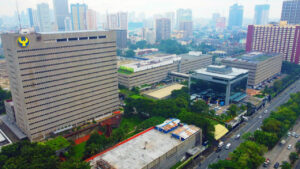
By banking group, universal and commercial banks had PHP 21.69 trillion of total assets as of the end of July, while the thrift banks accounted for PHP 950.28 billion.

As of the first quarter of 2023, the BSP counted 45 big banks, 43 thrift banks, and 395 rural and cooperative banks under its supervision. Last year, the BSP approved six digital banks under a new bank category.

BDO Unibank, Inc. has the highest number of total assets in Philippine banks, which stood at PHP 3.92 trillion in the first quarter. This was followed by Land Bank of the Philippines with PHP 3.11 trillion, and Bank of the Philippine Islands with PHP 2.66 trillion. 

Other lenders in the BSP’s top 10 in terms of asset size are Metropolitan Bank and Trust Co., Rizal Commercial Banking Corp., Philippine National Bank, Development Bank of the Philippines, Union Bank of the Philippines, and Security Bank Corp. 

“For the coming months, the economic reopening narrative would still sustain the growth in banks’ loans despite higher interest rates,” Mr. Ricafort said.

The Monetary Board raised borrowing costs by 425 basis points, bringing the target RRP rate to 6.25%.

A  poll conducted last week showed 14 of 17 analysts expect the board to further extend its policy hold on Thursday, Sept. 21. – Keisha B. Ta-asan

Peso down vs dollar on bets for US Fed holding key rate

Peso down vs dollar on bets for US Fed holding key rate

The peso depreciated against the dollar on Monday on expectations that the US Federal Reserve will hold its key rate at its meeting this week.

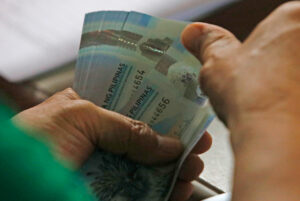
The local currency closed at PHP 56.866 versus the dollar on Monday, weakening by 5.1 centavos from Friday’s PHP 56.815 finish, data from the Bankers Association of the Philippines’ website showed.

The local unit opened Monday’s session at PHP 56.80 per dollar. Its intraday best was at PHP 56.74, while its weakest showing was at PHP 56.875 against the greenback.

Dollars traded fell to USD 821.1 million on Monday from the USD 1.06 billion on Friday.

The peso weakened due to expectations that the Fed will keep its benchmark rate steady in its meeting this week, Rizal Commercial Banking Corp. Chief Economist Michael L. Ricafort said in a Viber message.

“The peso weakened further amid expectations of hawkish policy cues from the US Federal Reserve in their meeting this week,” a trader likewise said in an e-mail.

A Reuters poll of 97 economists conducted on Sept. 7-12 showed 95%, or 94 economists, predicted the US central bank would hold the federal funds rate at the current 5.25%-5.5% during its Sept. 19-20 meeting.

The Fed raised interest rates by 25 basis points (bps) last month, bringing its benchmark overnight rate to a range between 5.25% and 5.5%.

It has hiked rates by a cumulative 525 bps since it began its tightening cycle in March last year.

The peso was also dragged down by higher global crude oil prices on Monday, Mr. Ricafort added.

Reuters reported Brent crude futures rose 71 cents or 0.8% to USD 94.64 a barrel by 0622 GMT while US West Texas Intermediate crude futures were at USD 91.55 a barrel, up 78 cents or 0.9%.

Both benchmarks have climbed for three consecutive weeks to touch their highest levels since November and are on track for their biggest quarterly increase since Russia’s invasion of Ukraine in the first quarter of 2022.

For Tuesday, the trader said the peso could recover due to a potentially stronger euro zone inflation report.

The trader sees the peso moving between PHP 56.70 and PHP 56.90 per dollar on Tuesday, while Mr. Ricafort expects it to range from PHP 56.75 to PHP 56.95. — Aaron Michael C. Sy

Shares dip as investors await key policy meetings

Shares dip as investors await key policy meetings

Local stocks losed lower on Monday as investors await fresh leads ahead of the policy meetings of the US Federal Reserve and the Bangko Sentral ng Pilipinas (BSP) later in the week.

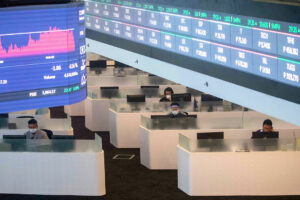
The Philippine Stock Exchange index (PSEi) went down by 1.77 points or 0.02% to end at 6,124.57 on Monday, while the broader all shares index dropped by 10.94 points or 0.33% to close at 3,309.24.

“The local bourse saw a slight decline,” Philstocks Financial, Inc. Research Analyst Claire T. Alviar said in a Viber message, citing “a lack of a strong catalyst” while investors wait for the BSP and Fed meetings.

“Philippines shares traded quietly to start the week, as investors await the main event this week, which is the [Monetary Board’s] policy-setting meeting on Sept. 21,” Regina Capital Development Corp. Head of Sales Luis A. Limlingan said in a Viber message.

BSP Governor Eli M. Remolona, Jr. said on Thursday that a policy rate hike might be unlikely if there were no further supply shocks after the acceleration in August inflation.

Previously, the BSP extended its policy hold for three straight meetings, keeping the key policy rate at 6.25%.

A BusinessWorld poll last week showed 14 of 17 analysts expecting the Monetary Board to keep benchmark rates steady during its sixth policy meeting for the year on Thursday.

Meanwhile, Mercantile Securities Corp. Head Trader Jeff Radley C. See said in a Viber message that “investors continue to stay on the sidelines and increase their cash position until the announcement of the Federal Reserve.”

The Federal Open Market Committee will hold its policy review on Sept. 19-20, a week after the release of the US consumer price index (CPI) report.

The Federal Reserve raised borrowing costs by 25 basis points (bps) in July, bringing the US central bank’s target to the range of 5.25% to 5.5%, Reuters reported.

It has hiked rates by a total of 525 bps since it began its tightening cycle in March last year.

Back home, sectoral indices were split on Monday. Mining and oil went down by 89.53 points or 0.85% to 10,396.08; financials dropped by 13.12 points or 0.73% to 1,773.81; and services lost 4.22 points or 0.28% to 1,490.34.

Meanwhile, property gained 10.18 points or 0.4% to 2,512.77; holding firms rose by 6.01 points or 0.1% to 5,865.33; and industrials increased by 2.51 points or 0.02% to 8,792.39.

Value turnover declined to PHP 3.64 billion on Monday with 549.70 million shares changing hands from the PHP 9.07 billion with 1.55 billion issues seen on Friday.

Decliners outnumbered advances, 121 versus 58, while 52 names closed unchanged.

Net foreign selling dropped to PHP 419.26 million on Monday from PHP 2.48 billion on Friday. — Sheldeen Joy Talavera with Reuters

BSP likely to maintain pause — poll

BSP likely to maintain pause — poll

The Bangko Sentral ng Pilipinas (BSP) will likely hold interest rates steady for a fourth straight meeting on Thursday, amid slowing economic growth.

A BusinessWorld poll conducted last week showed 14 of 17 analysts expect the Monetary Board (MB) to maintain the policy rate at a near 16-year high of 6.25% despite the inflation uptick in August.

On the other hand, three analysts see the BSP raising borrowing costs by 25 basis points (bps) at the Sept. 17 meeting to preemptively ward off inflationary pressures. If realized, this would bring the target reverse repurchase (RRP) rate to 6.5%.

Analysts’ Expectations on Policy Rates (September 2023)“I’m expecting the MB to hold (this week), despite the surprise uptick in inflation in August. I highly doubt the latest print will spook members into further action (i.e. another hike); it was well within their target range and their official response to the actual data was fairly nuanced and reasonable, expecting disinflation to resume going forward,” Pantheon Chief Emerging Asia Economist Miguel Chanco said.

Headline inflation unexpectedly quickened for the first time in seven months to 5.3% in August, but within the BSP’s 4.8-5.6% forecast range for the month. Inflation averaged 6.6% in the eight-month period.

“We expect the BSP to keep its policy rate steady at 6.25%. Concerns on growth will likely be front and center,” HSBC Global Research Association of Southeast Asian Nations (ASEAN) economist Aris Dacanay said in an e-mail.

Philippine gross domestic product (GDP) grew by a slower-than-expected 4.3% in the second quarter from the 7.5% a year ago.

For the first semester, GDP growth averaged 5.3%. This was well below the government’s 6-7% target for the year.

Mr. Dacanay said bank lending has also been growing at its slowest pace since the global financial crisis in 2009, barring the coronavirus pandemic in 2020.

BSP data showed outstanding loans of universal and commercial banks, net of RRP placements with the central bank, rose by 7.7% to PHP 11 trillion in July. Loan growth in July was the weakest increase since April.

Patrick M. Ella, economist at Sun Life Investment Management and Trust Corp., said the temporary spike in prices last month is “transitory” and should not prompt another rate hike from the BSP.

China Banking Corp. Chief Economist Domini S. Velasquez said inflation expectations are still well anchored.

“We estimate that inflation could still be on track to reach the BSP’s 2-4% target range by the fourth quarter if domestic supply pressures are addressed in a timely manner,” she said.

Ms. Velasquez said the price ceiling on rice will likely help ease inflationary pressures for September. “Hopefully, the expected delivery of imported rice and harvest this end-September should help ease price pressures,” she added. 

A recent spike in rice prices prompted the Marcos administration to impose a price ceiling on regular milled and well-milled rice at PHP 41 and PHP 45, respectively, starting Sept. 5.

EYE ON FED
University of Asia and the Pacific (UA&P) Senior Economist Cid L. Terosa said the MB will also keep in mind the US Federal Reserve’s next policy decision.

The US central bank is widely expected to keep rates unchanged at the conclusion of its two-day meeting on Sept. 20.

Ms. Velasquez said the Fed could potentially bring its aggressive monetary tightening cycle to an end.

“If realized, this would maintain the current 75 bps interest rate gap and alleviate downward pressure on the peso,” she said.

The peso closed at PHP 56.815 on Friday, depreciated by five centavos from its previous finish of PHP 56.765 against the dollar. Year to date, the peso weakened by 1.8% or PHP 1.06 from its PHP 55.755 close on Dec. 29, 2022. 

“Nonetheless, the policy call will likely be a tough one. Risks to inflation are significantly tilted to the upside with global rice prices rising almost vertically by more than 20%,” HSBC’s Mr. Dacanay said. 

While food inflation may ease in September due to the rice price ceiling, he said the policy response after that is still uncertain.

“We think the BSP will first monitor what the final policy will be before considering a continuation of its tightening cycle. Nonetheless, there is a risk that the BSP preempts any second-round effects by hiking policy rates in anticipation of the price pressures ahead,” he said.

Meanwhile, Jonathan L. Ravelas, senior adviser at Reyes Tacandong & Co. said a 25-bp rate hike on Thursday will be a “calibrated preemptive response to inflation headwinds.”

Colegio de San Juan de Letran Graduate School Associate Professor Emmanuel J. Lopez also expects a 25-bp rate hike due to rising prices of basic commodities, particularly agricultural products, as well as fuel.

From the second week of July to September, oil firms have raised fuel prices by PHP 9.85 per liter for gasoline, PHP 14.05 per liter for diesel and PHP 13.45 per liter for kerosene.

“Not to mention the impending surge in demand brought about by the forthcoming holiday spending. The increase in prices has affected not only food products but across all commodities in the market,” Mr. Lopez added.

Extended pause?
Alvin Joseph A. Arogo, an economist from the Philippine National Bank, said the BSP will likely keep borrowing costs steady for the rest of the year.

“This is appropriate given the relatively weaker economic growth outlook and inflation can still fall below 4% by the fourth quarter of 2023,” he said.

The BSP sees inflation averaging 5.6% in 2023, before easing within the 2-4% target to 3.3% in 2024 and 3.4% in 2025.

“If the currency continues to substantially weaken, however, then the central bank may need to temporarily sacrifice supporting expansion until the peso stabilizes. As such, a final 25-bp hike this year still has a fair chance of happening, whereas a rate cut is very unlikely,” Mr. Arogo said. 

Mr. Terosa said the BSP may take its cue from the US central bank’s next moves.

“Of course, unexpected policy decisions by the Fed in the remaining months of the year can pressure the BSP to change its policy stance,” he said.

Mr. Dacanay said the dollar may experience renewed strength in the coming months, putting pressure on the BSP to keep policy rates high for a longer period to support the peso.

“We continue to expect the BSP to only cut its policy rate only after the Fed cuts its own,” he said. 

Meanwhile, Mr. Chanco said there is still a “decent chance” the BSP will start cutting policy rates within the fourth quarter to support the economy.

“This is, however, contingent on inflation returning to the BSP’s target range in October or November,” he said.

After the Sept. 21 meeting, the MB’s next policy reviews are scheduled for Nov. 16 and Dec. 14. — Keisha B. Ta-asan, Reporter

Further drop expected for T-bill, bond rates

Further drop expected for T-bill, bond rates

Rates of Treasury bills (T-bills) and bonds on offer this week could continue to decline as they track the secondary market ahead of the US Federal Reserve and the Bangko Sentral ng Pilipinas (BSP) rate-setting meetings.

The Bureau of the Treasury (BTr) will auction off PHP 15 billion in T-bills on Monday or PHP 5 billion each in 91-, 182- and 364-day papers.

On Tuesday, it will offer PHP 30 billion in reissued 10-year Treasury bonds (T-bonds) with a remaining life of nine years and 11 months.

T-bill and bond yields may track the declines seen at the secondary market due to signals from the BSP that it might pause at its next meeting despite inflation potentially easing to the 2-4% target later than expected, Rizal Commercial Banking Corp. Chief Economist Michael L. Ricafort said in a Viber message.

At the secondary market on Friday, the 91-, 182-, and 364-day T-bills went down by 3.28 basis points (bps), 2.26 bps, and 2.94 bps week on week to end at 5.6225%, 5.9641%, and 6.1636,  respectively, based on PHP BVAL Reference Rates data published on the Philippine Dealing System’s website.

The 10-year bond likewise dropped by 4.96 bps week on week to end at 6.444% on Friday.

“Data calendar is light to end the week and focus is now directed towards the FOMC (Federal Open Market Committee) and BSP rate meetings next week. Both central banks are expected to stay neutral which could actually spur buying interest in the local bond market,” a trader said in an e-mail.

The Fed raised interest rates by 25 bps last month, bringing its benchmark overnight rate to a range between 5.25% and 5.5%. It has hiked rates by a cumulative 525 bps since it began its tightening cycle in March last year.

The FOMC will next meet on Sept. 19-20 to review policy.

Meanwhile, the BSP extended its policy pause for a third straight time at its Aug. 17 meeting, keeping the benchmark interest rate at a near 16-year high of 6.25%.

The central bank has raised borrowing costs by 425 bps from May 2022 to March 2023 to tame inflation.

The Monetary Board will next meet on Sept. 21 to review policy.

BSP Governor Eli M. Remolona, Jr. told reporters on Thursday that the acceleration in August inflation was caused by supply shocks in food and fuel, which dissipate “fairly quickly.”

“If that’s all there is, if there are no further supply shocks beyond that uptick in August, then it won’t be necessary to hike the policy rate…It won’t justify an easing, (but) it won’t be necessary to raise the policy rate,” he said.

Last week, the BTr raised PHP 15 billion as planned via the T-bills it auctioned off on Monday as total bids reached PHP 51.814 billion, or more than thrice the amount on offer.

Broken down, the Treasury made a full PHP 5-billion award of the 91-day T-bills as tenders for the tenor reached PHP 14.715 billion. The average rate for the three-month paper went up by 2.3 bps to 5.575%, with accepted rates ranging from 5.543% to 5.59%.

The government also raised PHP 5 billion as planned from the 182-day securities as bids for the tenor reached PHP 15.983 billion. The average rate for the six-month T-bill was down by 0.6 bp to 5.96%, with accepted rates at 5.938% to 5.974%.

Lastly, the BTr borrowed the programmed PHP 5 billion via the 364-day debt papers as demand for the tenor stood at PHP 21.116 billion. The average rate of the one-year T-bill inched down by 0.8 bp to 6.19%. Accepted yields were from 6.15% to 6.2%. 

Meanwhile, the reissued 10-year bonds to be offered on Tuesday were last auctioned off on Aug. 15, where the government raised PHP 30 billion as planned for an average rate of 6.558%.

The Treasury wants to raise PHP 180 billion from the domestic market this month, or PHP 60 billion via T-bills and PHP 120 billion via T-bonds.

The government borrows from local and foreign sources to help fund its budget deficit, which is capped at 6.1% of gross domestic product this year. — Aaron Michael C. Sy

BSP posts double-digit drop in first-half net income 

BSP posts double-digit drop in first-half net income 

The Bangko Sentral ng Pilipinas (BSP) recorded a lower net income in the first half of the year as expenses and revenues went up compared with a year ago.

Preliminary data posted on the BSP’s website showed the central bank’s net income fell by 63.6% to PHP 19.86 billion in the January-to-June period from PHP 54.62 billion in the same period last year.

The BSP’s expenses surged by 78.3% to PHP 102.58 billion from PHP 57.53 billion a year ago. Interest expenses more than doubled (171%) to PHP 80.15 billion, while other central bank expenses went down by 19.9% to PHP 22.43 billion.

Revenues edged higher by 6.7% to PHP 90.63 billion in the first semester from PHP 84.96 billion in the comparable year-ago period. Interest income rose by 31.7% to PHP 93.41 billion.

However, the central bank posted a PHP 2.78-billion loss from miscellaneous sources, which include trading gains, fees, and penalties. This is a reversal of the PHP 4.07-billion gain a year earlier.

Still, the central bank swung to a net income in the second quarter after posting a net loss of PHP 1.4 billion in the first quarter of the year.

The BSP’s net gains from foreign exchange (FX) rate fluctuations in the first half of the year reached PHP 31.81 billion, 16.9% higher than the PHP 27.21 billion seen in the comparable period in 2022.

According to the BSP, these are realized gains from fluctuations in FX rates arising from its foreign currency-denominated transactions.

The BSP’s assets hit PHP 7.294 trillion as of end-June, decreasing by 2.1% from the PHP 7.449 trillion a year earlier. Total liabilities inched down by 3.3% to PHP 7.127 trillion as of June from PHP 7.373 trillion in the previous year.

With this, the BSP’s net worth climbed by 119% to PHP 167.34 billion at end-June, more than double from PHP 76.36 billion a year ago. — Keisha B. Ta-asan 

Peso seen to trade sideways ahead of rate-setting moves

Peso seen to trade sideways ahead of rate-setting moves

The peso could trade sideways versus the dollar this week ahead of the rate-setting meetings by the US Federal Reserve and by the Bangko Sentral ng Pilipinas (BSP).

The local unit closed at PHP 56.815 versus the dollar on Friday, weakening by five centavos from Thursday’s PHP 56.765 finish, data from the Bankers Association of the Philippines’ website showed.

Week on week, the peso likewise fell by 18.50 centavos from its PHP 56.63 close on Sept. 8.

The local unit opened Friday’s session at PHP 56.78 per dollar, which was also its intraday best. Its weakest showing was at PhP 56.90 against the greenback.

Dollars traded rose to USD 1.06 billion on Friday from USD 1.17 billion on Thursday.

The peso weakened against the dollar on Friday “after mostly stronger US retail sales and US producer price index (PPI) data that could support the higher-for-longer Fed rates narrative,” Rizal Commercial Banking Corp. Chief Economist Michael L. Ricafort said in a Viber message.

“[The] US dollar strengthened against most currencies [on Friday] following resilient US economic data,” a trader added in a Viber message.

The dollar index surged to a six-month high on Thursday as economic data was mostly stronger than expected, hitting the 105.43 level earlier in the day, its highest since March 9.

The index was on track for its biggest one-day percentage gain in just over a week, Reuters reported.

Retail sales rose by 0.6% last month. Data for July was revised lower to show sales advancing 0.5% instead of the previously reported 0.7%. Economists polled by Reuters had forecast retail sales gaining 0.2%. Retail sales are mostly goods and are not adjusted for inflation. They rose 2.5% on a year-on-year basis.

Meanwhile, the producer price index (PPI) for final demand rose 0.7% last month, the largest gain since June 2022, the Labor department said on Thursday. Data for July was revised slightly to show the PPI advancing 0.4% instead of the previously reported 0.3%.

Higher global crude oil prices recently and losses at the local stock market also dragged down the peso, Mr. Ricafort added.

Brent crude futures rose by 23 cents or 0.3% to settle at USD 93.93 a barrel, while US West Texas Intermediate futures were up 61 cents or 0.7% to close at USD 90.77 a barrel. Both contracts traded at 10-month highs on Tuesday for the fifth consecutive session and gained about 4% on a weekly basis.

Meanwhile, the benchmark Philippine Stock Exchange index (PSEi) went down by 82.06 points or 1.32% to end at 6,126.34 on Friday, while the broader all shares index dipped by 33.13 points or 0.99% to close at 3,320.18.

The PSEi on Wednesday sank to the 6,100 level due to concerns about US inflation. This was its lowest level in 10 months or since October 2022.

For this week, Mr. Ricafort said the peso could trade sideways ahead of the rate-setting meetings by central banks.

The Fed raised interest rates by 25 basis points (bps) last month, bringing its benchmark overnight rate to a range between 5.25% and 5.5%.

It has hiked rates by a cumulative 525 bps since it began its tightening cycle in March last year.

The Federal Open Market Committee will next meet on Sept. 19-20 to review policy.

Meanwhile, the BSP extended its policy pause for a third straight time at its Aug. 17 meeting, keeping the benchmark interest rate at a near 16-year high of 6.25%.

The central bank has raised borrowing costs by 425 bps from May 2022 to March 2023 to tame inflation.

The Monetary Board will next meet on Sept. 21 to review policy.

The trader said the peso is likely to remain below the PHP 57-per-dollar level due to a potential intervention from the BSP.

The trader sees the peso moving between PHP 56.50 and PHP 57 per dollar this week, while Mr. Ricafort sees it ranging from PHP 56.50 to PHP 56.95. — Aaron Michael C. Sy with Reuters

PH stocks to take cue from BSP, Fed meetings

PH stocks to take cue from BSP, Fed meetings

Stock market investors are expected to keep a close eye on the policy meetings of the US Federal Reserve and the Bangko Sentral ng Pilipinas (BSP) this week.

The benchmark Philippine Stock Exchange index (PSEi) lost 82.06 points or 1.32% to end at 6,126.34 on Friday, while the broader all shares index slipped by 33.13 points or 0.98% to 3,320.18.

Week on week, the PSEi went down by 96.60 points or 1.55% from its close of 6,222.94 on Sept. 8.

“Hopes that both the Fed and the BSP will keep their policy rates unchanged may somehow give market sentiment a boost,” Philstocks Financial, Inc. Senior Research Analyst Japhet Louis O. Tantiangco said in a Viber message. 

“Dovish signals are seen to lift the market while hawkish signals may pull the market down.”

The Federal Open Market Committee (FOMC) is widely expected to keep rates unchanged at the end of its two-day policy meeting on Sept. 20. The US central bank raised borrowing costs by 25 basis points (bps) in July, bringing the Fed Funds target rate at 5.25% and 5.5%.

Meanwhile, the Monetary Board (MB) is scheduled to hold a policy-setting meeting on Thursday. The MB has kept rates unchanged at a near 16-year high of 6.25% during its last three meetings.

BSP Governor Eli M. Remolona, Jr. on Thursday said a policy rate hike is unlikely despite the uptick in August inflation.

A BusinessWorld poll last week showed 14 of 17 analysts see the Monetary Board keeping benchmark rates steady, while three analysts expect a 25-bp rate hike.

“Post-monetary policy meeting price action could drive longer-term trend. We may see the market start (this week) with gains, given the removal of selling pressure from FTSE (Financial Times Stock Exchange) rebalancing-related flows,” China Bank Securities Corp. Research Associate Lance U. Soledad said in an e-mail on Friday.

Mr. Tantiangco said investors may also take their cues from the release of the BSP’s Business and Consumer Expectations Surveys on Friday.

For the rest of the week, Mr. Soledad said volatility is expected to be elevated ahead of and following the FOMC and the MB’s policy meetings.

“Should we see upbeat price action after these key events, then that could indicate that a near-term trough had been reached and could significantly improve buying appetite — warranting more active accumulation in index heavyweights,” Mr. Soledad said.

The PSEi is expected to test the 6,150 level.

“If the market is able to get back above the said line, it is seen to continue trading within 6,150-6,400. If it fails to do so, however, the market’s new trading range is seen from 6,000-6,150,” Mr. Tantiangco said.

For this week, Mr. Soledad placed PSEi’s resistance at 6,350-6,370. — S.J.Talavera   

Gross borrowings down 25% in July

Gross borrowings down 25% in July

The National Government (NG) gross borrowings fell by 25% in July amid a decline in domestic debt, data from the Bureau of the Treasury (BTr) showed.    

In July, gross borrowings dropped by a fourth to PHP 131.937 billion from PHP 174.951 billion in the same month a year ago.

Month on month, gross borrowings slid by 20.8% from PHP 166.487 billion in June.

Domestic debt accounted for the bulk or 83.75% of total gross borrowings in July.

Gross domestic borrowings fell by 34.2% to PHP 110.498 billion during the month from PHP 167.81 billion a year ago.

Broken down, domestic debt was made up of PHP 108.379 billion in fixed-rate Treasury bonds and PHP 2.119 billion in Treasury bills.

Meanwhile, external gross borrowings, mostly composed of new project loans, more than tripled to PHP 21.439 billion from PHP 7.141 billion.

For the first seven months of 2023, gross borrowings jumped by 24.8% to PHP 1.55 trillion from PHP 1.25 trillion a year ago.

Gross domestic debt stood at PHP 1.17 trillion in the January-to-July period, up by 28.4% from PHP 909.073 billion a year earlier.

This accounted for 75.5% of total gross borrowings in the first seven months.

Domestic debt during the seven-month period was composed of PHP 794.529 billion in fixed-rate Treasury bonds, PHP 283.763 billion in retail Treasury bonds, and PHP 88.703 billion in Treasury bills.

External debt went up by 15.3% to PHP 387.88 billion as of end-July from PHP 336.477 billion a year ago.

This consisted of PHP 163.607 billion in global bonds, PHP 145.059 billion in program loans, and PHP 79.214 billion in new project loans.

“The decrease in gross borrowings could be attributed to relatively lower amount of maturing government bonds/debt during the month,” Rizal Commercial Banking Corp. Chief Economist Michael L. Ricafort said in a Viber message.

The narrower budget deficit in July reflected higher government revenue collections, which meant less borrowings were needed, he added.

The National Government’s fiscal deficit shrank by 44.89% to PHP 47.8 billion in July. For the first seven months of the year, the budget gap narrowed by 21.22% to PHP 599.5 billion.

Mr. Ricafort said risk factors like elevated inflation and high interest rates could drive up borrowings.

The National Government has set its borrowing program at PHP 2.207 trillion this year, consisting of PHP 1.654 trillion from domestic sources and PHP 553.5 billion from foreign creditors. — Luisa Maria Jacinta C. Jocson

Remolona sees no need for rate hike if there are no new supply shocks

Remolona sees no need for rate hike if there are no new supply shocks

The Bangko Sentral ng Pilipinas (BSP) does not see the need to resume monetary tightening if there are no more supply shocks such as those that fueled the uptick in August inflation.

BSP Governor Eli M. Remolona, Jr. told reporters on Thursday that the acceleration in August inflation was caused by supply shocks in food and fuel, which dissipate “fairly quickly.”

“If that’s all there is, if there are no further supply shocks beyond that uptick in August, then it won’t be necessary to hike the policy rate,” he said in a press briefing during the Alliance for Financial Inclusion (AFI) Global Policy Forum. “It won’t justify an easing, (but) it won’t be necessary to raise the policy rate.”

The BSP has kept its key policy rate at a near 16-year high of 6.25% for the last three meetings. It has hiked borrowing costs by 425 basis points (bps) from May 2022 to March 2023.

Headline inflation quickened for the first time in seven months in August, hitting an annual 5.3%. It marked the 17th consecutive month that inflation surpassed the BSP’s 2-4% target range. Inflation averaged 6.6% in the eight-month period.

“I think we should hit the (2-4%) target range by October if there are no further supply shocks. But hitting the target range is not enough. We want to be comfortably within the target range for the year,” Mr. Remolona said.

The BSP projects inflation to hit 5.6% in 2023, before easing within the target to 3.3% in 2024 and 3.5% in 2025.   

Makoto Tsuchiya, assistant economist from Oxford Economics Japan, said the Philippine central bank is expected to maintain its pause despite the quicker inflation in August.

“The central bank is likely to see through the transitory rise in prices. Inflation is still too high to pivot to easing, but the weakening growth picture means a hike is also undesirable,” he said.

Mr. Tsuchiya said inflation could settle within the 2-4% target range by the end of the year, bringing the full-year average to 5.8%. This will allow the Monetary Board to start cutting rates in the first quarter of 2024, he added.

Security Bank Corp. Chief Economist Robert Dan J. Roces in a note said the central bank will consider inflation, economic growth, and other external factors at next week’s policy-setting meeting.

“The recent uptick in the August inflation alone is unlikely to prompt the BSP to resume tightening, recognizing the supply-side nature of the uptick and the fact that there would only be so much that monetary policy can do in such a situation, which requires fiscal complement,” he said.   

Mr. Roces said the BSP will likely keep interest rates unchanged on Sept. 21.   

Nicholas Antonio T. Mapa, senior economist at ING Bank N.V. Manila, also expects the BSP to keep rates untouched at its next meeting.

“We believe the hurdle for additional rate hikes will be quite high given the glaring slowdown in growth momentum. BSP admits that tightening efforts have yet to be fully felt with the lagged impact still feeding through to bank lending,” Mr. Mapa said.   

The Philippine economy expanded by 4.3% in the second quarter, the slowest in two years. This was slower than the 6.4% growth in the first quarter and 7.5% in the same period last year. For the first half, economic growth averaged 5.3%, lower than the government’s 6-7% target. 

Mr. Mapa noted recent price shocks to inflation are supply side in nature and is best dealt with non-monetary measures.   

“BSP will only hike should inflation expectations become disanchored or to steady the currency,” he said, adding that the Philippine central bank will likely consider the policy decision of the US Federal Reserve.   

The Federal Open Market Committee is scheduled to meet on Sept. 19 and 20.

The Monetary Board will be having its sixth policy review of the year on Sept. 21.

Mr. Remolona told reporters that the new Monetary Board members will be participating in next week’s meeting.

National Treasurer Rosalia V. de Leon and former Finance undersecretary Romeo L. Bernardo were recently appointed as the new members of the policy-making body of the BSP. — Keisha B. Ta-asan,  Reporter

Posts navigation

Older posts
Newer posts

Recent Posts

  • Metrobank US-Iran Risk Index: Fragile ceasefire 
  • Investment Ideas: April 10, 2026 
  • Metrobank US-Iran Risk Index: A new hope
  • A guide for your peso bond portfolio amid higher for longer rates
  • Investment Ideas: April 8, 2026

Recent Comments

No comments to show.

Archives

  • April 2026
  • March 2026
  • February 2026
  • January 2026
  • December 2025
  • November 2025
  • October 2025
  • September 2025
  • August 2025
  • July 2025
  • June 2025
  • May 2025
  • April 2025
  • March 2025
  • February 2025
  • January 2025
  • December 2024
  • November 2024
  • October 2024
  • September 2024
  • August 2024
  • July 2024
  • June 2024
  • May 2024
  • April 2024
  • March 2024
  • February 2024
  • January 2024
  • December 2023
  • November 2023
  • October 2023
  • September 2023
  • August 2023
  • July 2023
  • June 2023
  • May 2023
  • April 2023
  • March 2023
  • February 2023
  • January 2023
  • December 2022
  • November 2022
  • October 2022
  • September 2022
  • August 2022
  • July 2022
  • June 2022
  • May 2022
  • March 2022
  • December 2021
  • October 2021

Categories

  • Bonds
  • BusinessWorld
  • Currencies
  • Economy
  • Equities
  • Estate Planning
  • Explainer
  • Featured Insight
  • Fine Living
  • How To
  • Investment Tips
  • Markets
  • Portfolio Picks
  • Rates & Bonds
  • Retirement
  • Reuters
  • Spotlight
  • Stocks
  • Uncategorized

You are leaving Metrobank Wealth Insights

Please be aware that the external site policies may differ from our website Terms And Conditions and Privacy Policy. The next site will be opened in a new browser window or tab.

Cancel Proceed
Get in Touch

For inquiries, please call our Metrobank Contact Center at (02) 88-700-700 (domestic toll-free 1-800-1888-5775) or send an e-mail to customercare@metrobank.com.ph

Metrobank is regulated by the Bangko Sentral ng Pilipinas
Website: https://www.bsp.gov.ph

Quick Links
The Gist Webinars Wealth Manager Explainers
Markets
Currencies Rates & Bonds Equities Economy
Wealth
Investment Tips Fine Living Retirement
Portfolio Picks
Bonds Stocks
Others
Contact Us Privacy Notice Terms of Use
© 2026 Metrobank. All rights reserved.

Access this content:

If you are an existing investor, log in first to your Metrobank Wealth Manager account. ​

If you wish to start your wealth journey with us, click the “How To Sign Up” button. ​

Login HOW TO SIGN UP