




MODEL PORTFOLIO
THE GIST
NEWS AND FEATURES
Global Philippines Fine Living
INSIGHTS
INVESTMENT STRATEGY
Economy Stocks Bonds Currencies
THE BASICS
Investment Tips Explainers Retirement
WEBINARS
2024 Mid-Year Economi Briefing, economic growth in the Philippines
2024 Mid-Year Economic Briefing: Navigating the Easing Cycle
June 21, 2024
Investing with Love
Investing with Love: A Mother’s Guide to Putting Money to Work
May 15, 2024
retirement-ss-3
Investor Series: An Introduction to Estate Planning
September 1, 2023
View All Webinars
DOWNLOADS
Container ship carrying container boxes import export dock with quay crane. Business commercial trade global cargo freight shipping logistic and transportation worldwide oversea concept. Generative AI
Economic Updates
Philippines Trade Update: Wider deficit on strong imports
DOWNLOAD
Frick collection with palm trees 
Economic Updates
Policy Rate Updates: Policy rate updates to reassure 
DOWNLOAD
Man using his smartphone
Reports
Fed to cut just once 
DOWNLOAD
View all Reports
Metrobank.com.ph How To Sign Up
Follow us on our platforms.

How may we help you?

TOP SEARCHES
  • Where to put my investments
  • Reports about the pandemic and economy
  • Metrobank
  • Webinars
  • Economy
TRENDING ARTICLES
  • Investing for Beginners: Following your PATH
  • On government debt thresholds: How much is too much?
  • Philippines Stock Market Outlook for 2022
  • Deficit spending remains unabated

Login

Access Exclusive Content
Login to Wealth Manager
Visit us at metrobank.com.ph How To Sign Up
Access Exclusive Content Login to Wealth Manager
Search
MODEL PORTFOLIO THE GIST
NEWS AND FEATURES
Global Philippines Fine Living
INSIGHTS
INVESTMENT STRATEGY
Economy Stocks Bonds Currencies
THE BASICS
Investment Tips Explainers Retirement
WEBINARS
2024 Mid-Year Economi Briefing, economic growth in the Philippines
2024 Mid-Year Economic Briefing: Navigating the Easing Cycle
June 21, 2024
Investing with Love
Investing with Love: A Mother’s Guide to Putting Money to Work
May 15, 2024
retirement-ss-3
Investor Series: An Introduction to Estate Planning
September 1, 2023
View All Webinars
DOWNLOADS
Container ship carrying container boxes import export dock with quay crane. Business commercial trade global cargo freight shipping logistic and transportation worldwide oversea concept. Generative AI
Economic Updates
Philippines Trade Update: Wider deficit on strong imports
March 27, 2026 DOWNLOAD
Frick collection with palm trees 
Economic Updates
Policy Rate Updates: Policy rate updates to reassure 
March 26, 2026 DOWNLOAD
Man using his smartphone
Reports
Fed to cut just once 
March 19, 2026 DOWNLOAD
View all Reports

Archives: Business World Article

Manufacturing PMI expands in September

Manufacturing PMI expands in September

Manufacturing activity in the Philippines expanded in September, driven by resilient domestic demand and growth in new orders, S&P Global said.

The S&P Global Philippines Manufacturing Purchasing Managers’ Index (PMI) rose to 50.6 in September, a turnaround from the 49.7 contraction in August, reflecting an improvement in the health of the manufacturing sector.

“September PMI data signaled renewed growth across the Filipino manufacturing sector as new orders emerged out of contraction territory, thereby supporting a quicker expansion in output and a fresh rise in staffing levels,” Maryam Baluch, economist at S&P Global Market Intelligence, said in a statement.

Manufacturing Purchasing Managers’ Index (PMI) of Select ASEAN economies, September 2023A PMI reading above the 50 mark denotes improvement in operating conditions, while a reading below 50 signals deterioration.

However, Ms. Baluch noted the pace of growth is still “historically subdued,” indicating the sector remains weak.

“Moreover, latest data suggested that growth was supported by the domestic market as export sales fell for the first time in nine months,” she added.

In September, the Philippines had the second-highest PMI reading among Southeast Asian countries with available data. It was just behind Indonesia (52.3) but ahead of Myanmar (50.1). Meanwhile, Vietnam (49.7), Thailand (47.8) and Malaysia (46.8) all recorded contractions in September.

The headline PMI measures manufacturing conditions through the weighted average of five indices: new orders (30%), output (25%), employment (20%), suppliers’ delivery times (15%), and stocks of purchases (10%).

S&P Global noted the latest PMI survey data showed a renewed expansion among Filipino manufacturers at the end of the third quarter.

A modest rise in new orders was seen in September, thanks to improved demand conditions and new clients.

“However, latest data also revealed a fall in new business from abroad, thereby marking the first month of contraction in the year-to-date. Moreover, the rate of decrease was solid overall and faster than the historical average,” S&P Global said.

The increase in factory orders was mainly driven by domestic demand, with the pace of growth accelerating from the 12-month low seen in August.

S&P Global noted manufacturers also ramped up hiring in September, ending three months of job cuts. However, the pace of job creation remained “marginal,” it added.

“Despite firms seeing their business requirements rise and in turn increasing their workforce numbers, backlogs of work fell for the third month running in September, and to the greatest extent in seven months. The data thus suggested that there is still spare capacity within the sector,” S&P Global said.

Manufacturers in the Philippines also showed “diverging trends in inventory holdings” in September.

“While stocks of finished goods increased amid anticipation of greater demand in the coming months, pre-production inventories fell in September, with companies often utilizing their stocks to meet current demand requirements,” S&P Global said.

It noted that stocks were depleted at the fastest rate in nearly three years. “The fall in stocks of purchases also aligned with a stagnation in purchasing activity, thereby ending the period of expansion in input buying that began in September 2022,” it added.

The latest data also showed that cost pressures were generally subdued despite selling prices rising at the fastest pace in four months.

“Despite increasing material, fuel and supplier costs exerting pressure on operating expenses and pushing up selling prices at a faster pace, both input prices and output charges rose at historically muted rates,” Ms. Baluch said.

Manufacturing firms reported weaker sentiment for the next 12 months, although they were still generally optimistic.

“Looking ahead, sentiment slipped to a 15-month low in September and was historically muted amid some concerns of whether demand can be sustained. Nonetheless, 40% of panelists anticipate growth in output in the year ahead,” it added.

Ms. Baluch noted that global headwinds weighed on overall growth in September, with many firms concerned over the sustainability of future demand.

ING Bank N.V. Manila Senior Economist Nicholas Antonio T. Mapa said that the uptick in domestic orders helped push the Philippines’ PMI back into expansion mode.

“Domestic demand helped offset slowing exports orders. Another positive was the pickup in employment as manufacturers geared up for upcoming holiday demand,” he said in a Viber message.

Rizal Commercial Banking Corp. Chief Economist Michael L. Ricafort also noted that the improvement in output was due to the “seasonal increase in manufacturing, production, and importation activities in the third quarter in preparation for the holiday season.”

However, Mr. Ricafort noted that persistent inflation and high interest rates weighed on manufacturing firms’ operations.

Headline inflation may have settled at 5.4% in September, according to a BusinessWorld poll of 17 analysts. This is at the low end of the 5.3-6.1% forecast range of the Bangko Sentral ng Pilipinas (BSP).

The local statistics authority is set to release September inflation data on Oct. 5, Thursday.

From May 2022 to March 2023, the Monetary Board has raised rates by 425 basis points. It kept its benchmark policy rate at a near 16-year high 6.25% for four straight meetings. — By Luisa Maria Jacinta C. Jocson, Reporter

NG debt hits record PHP14.35T as of end-Aug.

NG debt hits record PHP14.35T as of end-Aug.

The National Government (NG) outstanding debt reached a record PHP 14.35 trillion as of end-August, mainly due to the peso depreciation against the US dollar, the Bureau of the Treasury (BTr) said on Monday.

Outstanding debt inched up by 0.7% from PHP 14.24 trillion as of end-July, data from the BTr showed.

“The PHP 105.28 billion or 0.7% increment from the previous month’s level was primarily due to the peso depreciating from PHP 54.834 to PHP 56.651 against the US dollar over the reference period,” the BTr said in a statement.

National Government outstanding debtThe debt stock rose by 10.2% year on year from PHP 13.02 trillion as of end-August 2022.

Year to date, outstanding debt went up by 6.9% from PHP 13.42 trillion as of end-December 2022.

More than two-thirds or 68.2% of the NG’s debt portfolio came from domestic sources, while the rest were from foreign borrowings.

As of end-August, domestic debt increased by 9.5% to PHP 9.79 trillion from PHP 8.94 trillion a year ago.

However, domestic borrowings slipped by 0.2% from PHP 9.81 trillion in July, due to “large retail bond maturities.”

“New domestic debt issued during the month totaled PHP 229.29 billion with debt redemption of PHP 253.43 billion, resulting in a net repayment of PHP 24.14 billion,” the BTr said.

“This was partially offset by the PHP 2.9-billion incremental value caused by peso depreciation on foreign currency-denominated domestic securities,” it added.

Data from the Treasury showed that the peso closed at PHP 56.651 versus the greenback as of end-August, depreciating by 3.2% from PHP 54.834 as of end-July.

In the eight months to August, the domestic debt mix consisted almost entirely of government securities.

On the other hand, external debt stood at PHP 4.56 trillion at the end of August, up by 11.8% from PHP 4.08 trillion in the same month a year ago.

Month on month, it rose by 2.9% from PHP 4.43 trillion as of end-July.

“Peso depreciation against the US dollar caused a PHP 146.85-billion upward revaluation of US dollar-denominated debt in August, although partially offset by the PHP 22.11-billion downward revaluation of the third-currency debt component,” the BTr said.

“Net availment of foreign loans also added PHP 1.78 billion to the reference month’s external debt stock,” it added.

Broken down, foreign debt consisted of PHP 2.07 trillion in loans and PHP 2.48 trillion in global bonds.

As of end August, the NG’s overall guaranteed obligations inched up by 0.9% to PHP 366.58 billion from PHP 363.4 billion as of end-July.

“The higher level of guaranteed debt is attributed to the net availment of domestic guarantees amounting to PHP 2.44 billion and the PHP 4.03-billion revaluation effect of peso depreciation on external guarantees surpassing the PHP 3.29 billion in repayments,” the BTr added.

Year on year, guaranteed debt dropped by 6.7% from PHP 392.76 billion.

Rizal Commercial Banking Corp. Chief Economist Michael L. Ricafort said the higher NG outstanding debt as of end-August was mainly due to the weaker peso.

The local currency almost breached the PHP 57-level during the month, depreciating to as low as PHP 56.84 on Aug. 15.

Mr. Ricafort said that elevated inflation and interest rates also pushed borrowings higher.

“The new record high in the outstanding National Government debt may be attributed to wider budget deficits amid higher prices that also bloated government expenditures,” he said in an e-mail.

Headline inflation spiked to 5.3% in August, the first time it accelerated in seven months. It was also the 17th consecutive month that inflation surpassed the central bank’s 2-4% target range.

For the first eight months of 2023, inflation averaged 6.6%, still above the revised 5.8% full-year forecast of the Bangko Sentral ng Pilipinas (BSP).

The BSP has raised borrowing costs by a total of 425 basis points from May 2022 to March 2023. This brought the key policy rate to 6.25%, the highest in almost 16 years.

The NG’s debt as a share of gross domestic product (GDP) stood at 61% at the end of June. This remained above the 60% threshold considered by multilateral lenders to be manageable for developing economies.

The government aims to cut the debt-to-GDP ratio to less than 60% by 2025. — Luisa Maria Jacinta C. Jocson

World Bank expects Philippine growth to be fastest in SE Asia

World Bank expects Philippine growth to be fastest in SE Asia

The World Bank expects the Philippines to be the fastest-growing economy in Southeast Asia this year, despite trimming its gross domestic product (GDP) growth projection due to persistent inflation and global headwinds.

In its East Asia and the Pacific Economic Update released on Monday, the World Bank cut its GDP growth forecast for the Philippines to 5.6%, from the 6% projection given in June. The latest forecast is the same as the GDP outlook it gave in April.

Aaditya Mattoo, World Bank Chief Economist for East Asia and the Pacific, said the global economic slowdown is a major concern for countries like the Philippines.

World Bank GDP growth forecasts for select East Asia and Southeast Asia economies

“The Philippines, like other countries in the region, depends on the rest of the world for exports (of) goods and especially services. A lot of Filipinos work abroad and send remittances back. All those factors are tied to the state of the global economy,” Mr. Mattoo said during a briefing on Monday.

World Bank Senior Economist for East Asia and the Pacific Ergys Islamaj said Philippine economic growth this year will moderate from the 7.6% GDP expansion in 2022 due to elevated inflation, tighter financial conditions, and a weak external environment.

“High inflation, tight fiscal and monetary policies, budget execution delays, and subdued global growth dampened the Philippines’ growth momentum,” the World Bank said.

The Philippine economy expanded by 4.3% in the second quarter, its slowest growth in over two years. For the first half, economic growth averaged 5.3%, below the government’s 6-7% target.

Despite the lower growth projection, the World Bank expects the Philippines to post the fastest expansion among Southeast Asian countries this year. At 5.6%, this is also above the 5% GDP growth average for East Asia and the Pacific.

Philippine growth will likely outpace Cambodia (5.5%), Indonesia (5%), Vietnam (4.7%), Malaysia (3.9%), Laos (3.7%), Thailand (3.4%), and Myanmar (3%).

At the same time, the World Bank trimmed its growth forecast for the Philippines to 5.8% for 2024 from 5.9% previously. This was below the government’s 6.5-8% target for next year.

If realized, the Philippines would be the second-fastest growing economy in Southeast Asia in 2024, behind only Cambodia’s 6.1%.

According to the World Bank, Philippine GDP growth is also projected to average 5.7% from 2023 through 2025.

“The good news for the Philippines, I should say, is that we expect economic activity to be supported by domestic demand, led by private consumption and declining inflation,” Mr. Mattoo said.

Recent economic reforms like the amended Public Service Act (PSA) would help ramp up investments, he added.

The amended PSA, which took effect in April, allows full foreign ownership in more public services such as telecommunications, airlines, and railways.

Inflation
In its Macro Poverty Outlook analysis, the World Bank projects Philippine inflation to average 5.9% this year, before easing to 3.6% in 2024.

Both forecasts are a tad higher than the  Bangko Sentral ng Pilipinas’ (BSP) 5.8% and 3.5% projections for 2023 and 2024, respectively.

“Inflation will increase marginally in 2023 due to the materialization of risks to food inflation, before returning to within the target range in 2024 amid improvements in food supply and lower global commodity prices,” the World Bank said.

The World Bank also sees inflation further easing to 3% by 2025, below the 3.4% estimate of the BSP.

“In the near term, essential factors for boosting growth include containing price pressures and improving budget utilization,” the World Bank added.

Meanwhile, the World Bank also urged economies to take advantage of opportunities in the services sector, which will be central to the region’s development.

“Services now account for at least about half of employment and value added in most East Asia and the Pacific economies,” Mr. Mattoo said.

In the Philippines, Mr. Mattoo said that service-oriented firms are more likely to use digital technologies if they are foreign-owned and especially if they have access to fiber broadband.

“The services firms that adopt these technologies have seen a big increase in productivity,” he added.

The World Bank recommended promoting reforms to pursue liberalization and regulation of services trade; address the infrastructure and skill gaps; and maximize cooperative international action. — Luisa Maria Jacinta C. Jocson

Short-selling transactions to take effect immediately — PSE  

Short-selling transactions to take effect immediately — PSE  

The Philippine Stock Exchange, Inc. (PSE) said the guidelines on short-selling transactions are to take effect immediately after securing approval from government regulators.

In a statement on Monday, the bourse operator said “critical components” of securities borrowing and lending (SBL) had been cleared by regulators. Short selling can only function once an SBL regulation is in place. 

“We are grateful to the Securities and Exchange Commission (SEC) and Bureau of Internal Revenue (BIR) for their approvals on important regulatory aspects of SBL and short selling. This development brings us a step closer to the full adoption and implementation of these much-awaited programs,” PSE President and Chief Executive Officer Ramon S. Monzon said.

The PSE said it would have a separate announcement on the official launch date of the short-selling program.

Short selling involves betting on the decline of a stock’s price to make a profit. It is permitted in other Asian countries such as Singapore, Hong Kong, Malaysia, Thailand, and Indonesia.

In May, the PSE announced the SEC’s approval of offshore collateral for SBL, while the BIR accepted the filing and registration of the Global Master Securities Lending Agreement in September. 

Meanwhile, the PSE said it has included the members of the PSE MidCap and PSE Dividend Yield indices as eligible securities under the short-selling guidelines.

Previously, only securities comprising the PSE index and exchange-traded funds were deemed eligible securities for short selling.

The SEC said last month that it is aligning the country’s short-selling environment with other Asian markets to strengthen the local equities market.

“We are pushing to align the short-selling environment with the major Asian markets, which has the potential to promote liquidity, stabilize the market, protect investors, and further unlock the value of shares of Philippine corporations,” SEC Chairperson Emilio B. Aquino said in a previous statement. — Revin Mikhael D. Ochave

Gov’t partially awards T-bills as rates rise

Gov’t partially awards T-bills as rates rise

The government made a partial award of the Treasury bills (T-bills) it auctioned off on Monday at higher yields on expectations that inflation picked up last month.

The Bureau of the Treasury (BTr) raised just PHP 12.916 billion via the T-bills on Monday, short of the PHP 15-billion program, even as total bids reached PHP 27.574 billion, higher than the amount on the auction block.

Broken down, the Treasury made a full PHP 5-billion award of the 91-day T-bills as tenders for the tenor reached PHP 10.01 billion. The three-month paper was quoted at an average rate of 5.698%, 10.3 basis points (bps) above the 5.595% seen last week. Accepted rates ranged from 5.68% to 5.725%

The government also raised PHP 5 billion as planned from the 182-day securities as bids for the tenor reached PHP 9.106 billion. The average rate for the six-month T-bill was at 6.023%, up by 5.5 bps from 5.968% seen last week, with accepted rates at 5.975% to 6.054%.

Meanwhile, the BTr borrowed just PHP 2.916 billion via the 364-day debt papers, below the PHP 5-billion plan, despite demand for the tenor reaching PHP 8.458 billion. The average rate of the one-year T-bill rose by 9.6 bps to 6.215% from the 6.119% quoted for a full award last week. Accepted yields were from 6.15% to 6.25%.

At the secondary market before Monday’s auction, the 91-, 182- and 364-day T-bills were quoted at 5.7049%, 5.9828%, and 6.1941%, respectively, based on PHP Bloomberg Valuation Reference Rates data provided by the Treasury.

T-bill yields rose ahead of the release of September inflation data on Thursday, Rizal Commercial Banking Corp. Chief Economist Michael L. Ricafort said in a Viber message.

“The higher awarded T-bill rates today reflected market expectations for a higher inflation rate in September,” a trader added in an e-mail on Monday.

Inflation likely quickened in September due to higher pump prices and electricity rates and the peso’s depreciation against the dollar, analysts said.

A BusinessWorld poll of 17 analysts yielded a median estimate of 5.4% for September inflation, near the low end of the Bangko Sentral ng Pilipinas’ (BSP) 5.3-6.1% forecast for the month.

If realized, September inflation would pick up from the 5.3% print in August but would be lower than 6.9% in the same month in 2022.

September will also be the 18th straight month that inflation was above the BSP’s 2-4% target for the year.

The government will not auction off Treasury bonds (T-bonds) on Tuesday due to its ongoing public offering of retail dollar bonds (RDBs) set to end on Oct. 6. The RDBs will be issued on Oct. 11.

The Treasury wants to raise PHP 150 billion from the domestic market this month, or PHP 60 billion via T-bills and PHP 90 billion via T-bonds.

The government borrows from local and foreign sources to help fund its budget deficit, which is capped at 6.1% of gross domestic product this year. — A.M.C. Sy

Peso drops vs dollar as market expects faster September inflation

Peso drops vs dollar as market expects faster September inflation

The peso depreciated against the dollar on Monday due to expectation of faster September inflation.

The local currency closed at PHP 56.775 versus the dollar on Monday, weakening by 20 centavos from Friday’s PHP 56.575 finish, data from the Bankers Association of the Philippines’ website showed.

The local unit opened Monday’s session stronger at PHP 56.70 per dollar. Its intraday best was at PHP 56.67, while its weakest showing was at PHP 56.80 against the greenback.

Dollars traded went down to USD 1.15 billion on Monday from the USD 1.19 billion on Friday.

“The peso weakened amid market expectations of a potential uptick in domestic inflation for September,” a trader said in a text message.

A BusinessWorld poll of 17 analysts yielded a median estimate of 5.4% for September inflation, near the low end of the Bangko Sentral ng Pilipinas’ (BSP) 5.3-6.1% forecast for the month.

If realized, September inflation would pick up from the 5.3% print in August but would be lower than 6.9% in the same month in 2022.

September will also be the 18th straight month that inflation was above the BSP’s 2-4% target for the year.

The Philippine Statistics Authority will release September inflation data on Thursday.

The peso weakened due to broad dollar strength, Rizal Commercial Banking Corp. Chief Economist Michael L. Ricafort added in a Viber message.

The US dollar index edged back from its recent 10-month high and was last at 106.21, after clocking its best quarterly performance in a year thanks to persistently hawkish US Federal Reserve rhetoric and a surge in US Treasury yields, Reuters reported.

For Tuesday, the trader said the peso could weaken further due to potentially hawkish signals from US Federal Reserve Chair Jerome H. Powell.

The trader sees the peso moving between PHP 56.65 and PHP 56.90 per dollar on Tuesday, while Mr. Ricafort sees it ranging from PHP 56.65 to PHP 56.85. — AMCS with Reuters

Stocks decline as market awaits inflation report

Stocks decline as market awaits inflation report

Stocks dropped on Monday as investors remained cautious as they await the release of September inflation data this week.

The Philippine Stock Exchange index (PSEi) went down by 16.71 points or 0.26% to end at 6,304.53 on Monday, while the broader all shares index shed 1.71 points or 0.05% to 3,399.12.

“The PSEi ended lower as several index names continued to take a breather after last week’s rally, which was driven by the extra liquidity resulting from the index rebalancing and MPIC’s (Metro Pacific Investments Corp.) tender offer,” Unicapital Securities, Inc. Senior Equity Research Analyst Carlos Angelo O. Temporal said.

“Investors may have also taken profit ahead of key inflation reports this week,” Mr. Temporal added.

Investors “adopted a cautious stance and stayed on the sidelines” before the release of September inflation data, AB Capital Securities, Inc. Vice-President Jovis L. Vistan likewise said in a Viber message.

“The significance of this data release lies in its potential to influence the Bangko Sentral ng Pilipinas’ (BSP) decisions regarding interest rates,” Mr. Vistan said.

September consumer price index (CPI) data will be released on Thursday.

A BusinessWorld poll of 17 analysts yielded a median estimate of 5.4% for September inflation, near the low end of the BSP’s 5.3-6.1% forecast for the month.

If realized, the September CPI would pick up from the 5.3% print in August but would be lower than 6.9% in the same month in 2022.

September will also be the 18th straight month that inflation was above the BSP’s 2-4% annual target.

The majority of sectoral indices dropped on Monday. Mining and oil went down by 48.71 points or 0.45% to 10,745.38; property fell by 13.61 points or 0.52% to 2,600; financials dropped by 9.40 points or 0.5% to 1,852.38; and holding firms declined by 9.86 points or 0.16% to 6,023.71.

Meanwhile, industrials rose by 27.78 points or 0.31% to 8,943.44 and services climbed by 1.61 points or 0.1% to 1,509.90.

Value turnover went down to PHP 3.86 billion on Monday with 591.37 million shares changing hands from the PHP 13.11 billion with 1.71 billion shares seen on Friday.

Advancers outnumbered decliners, 92 versus 75, while 63 shares closed unchanged.

Net foreign selling stood at PHP 402 million on Monday versus the PHP 5.49 billion in net buying recorded on Friday.

For the rest of the week, Mr. Vistan placed the PSEi’s support at 6,100 and resistance at 6,400.

MPIC is one of the three key Philippine units of Hong-Kong based First Pacific Co. Ltd., the others being Philex Mining Corp. and PLDT Inc.

Hastings Holdings, Inc., a unit of PLDT Beneficial Trust Fund subsidiary MediaQuest Holdings, Inc., has a majority share in BusinessWorld through the Philippine Star Group, which it controls. — SJT

Slight inflation uptick seen in September

Slight inflation uptick seen in September

Inflation likely quickened in September due to pump price hikes, higher electricity rates, and the peso depreciation against the dollar, analysts said.

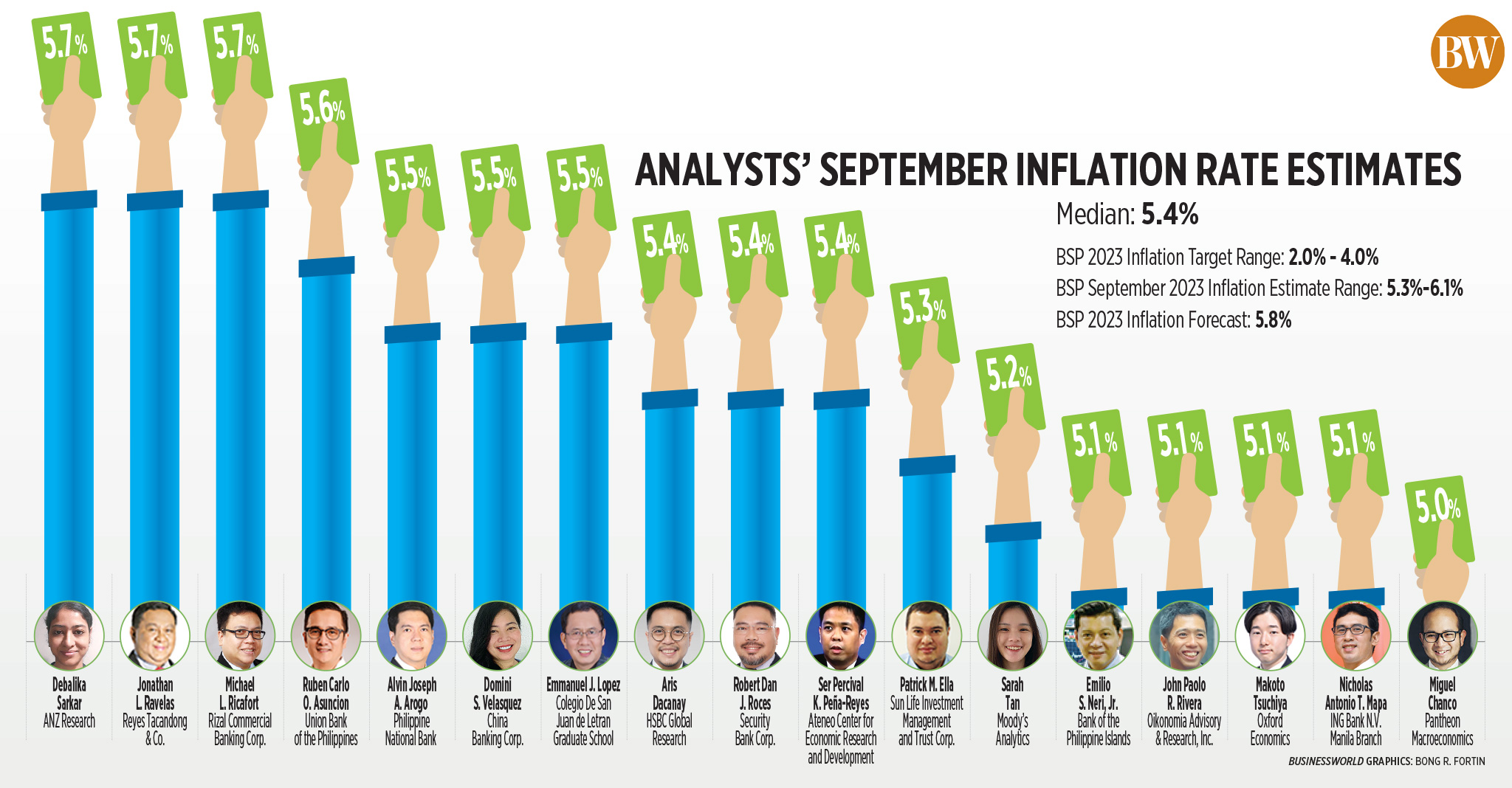
A BusinessWorld poll of 17 analysts yielded a median estimate of 5.4% for September inflation, at the low end of the 5.3-6.1% forecast of the Bangko Sentral ng Pilipinas (BSP).

If realized, September inflation would be  slightly faster than the 5.3% print in August, but lower than 6.9% in the same month in 2022. It would also be the highest print in four months or since 6.1% in June.

Analysts’ September inflation rate estimates

Inflation in September will likely breach the central bank’s 2-4% target range for the 18th straight month.

The Philippine Statistics Authority (PSA) is scheduled to release the latest consumer price index (CPI) data on Oct. 5 (Thursday).

“Higher prices of fuel, electricity, and key agricultural commodities, as well as the peso depreciation are the primary sources of upward price pressures in September,” the BSP said in a statement on Friday.    

“Meanwhile, lower rice and meat prices could contribute to downward price pressures for the month,” it added.     

In September alone, oil companies raised pump prices for gasoline by PHP 2.50 per liter, diesel by PHP 3.90 per liter, and kerosene by PHP 0.80 per liter.

Customers of Manila Electric Co. (Meralco) saw higher electricity bills in September after the overall rate went up by PHP 0.5006 per kilowatt-hour (kWh) to PHP 11.3997 per kWh.   

HSBC economist for ASEAN (Association of Southeast Asian Nations) Aris Dacanay said electricity rates rose more than 4% in September, reflecting the higher energy import bill due to the depreciation of the peso against the dollar.

The peso finished trading at PHP 56.575 per dollar on Friday, gaining 40.5 centavos from its previous close of PHP 56.98. In September alone, the peso has slightly strengthened by two centavos or 0.03% from its Aug. 31 finish of PHP 56.595.

However, China Banking Corp. Chief Economist Domini S. Velasquez said higher electricity rates from Meralco may have been offset by lower rates in other provinces like Batangas, Pampanga, and Bohol.

She noted that prices of fish and fruits remained elevated last month and increases in cooking gas prices may have also added to upward inflationary pressures in September. 

Cooking gas prices rose by PHP 6.65 per kilogram in September, marking the second straight month of price hikes.

“On a positive note, rice and vegetable prices, which were the primary drivers of food inflation in August, eased due to the mandated rice price cap and relatively favorable weather (i.e., no strong typhoons this month),” Ms. Velasquez said.

Sarah Tan, an economist from Moody’s Analytics, noted that rice prices have cooled due to the imposition of a price ceiling in early September. The spike in rice prices was one of the main drivers of inflation in August.

“Notably, the average price of locally produced regular milled rice in Metro Manila has fallen about 20% from its end-August peak,” Ms. Tan said.

Starting Sept. 5, the Marcos administration imposed a price ceiling of PHP 41 per kilo for regular milled rice and PHP 45 per kilo for well-milled rice.

Meanwhile, core inflation may have settled at 5.9% in September, Ms. Velasquez said.

If realized, this would be lower than the 6.1% print in August. It would also be the first-time core inflation fell below the 6% level since the 5.9% print in October 2022. 

“We won’t be surprised if higher oil prices have spilled over to core (inflation) already,” Bank of the Philippine Islands Lead Economist Emilio S. Neri, Jr. said.

For the rest of the year, ANZ Research economist Debalika Sarkar said global oil prices may remain elevated amid tight supply.

“While some effort has been made to stabilize domestic food prices, domestic retail pump prices continue to adjust to global oil price movements,” she said. “The low oil inventory also implies a faster pass-through in the absence of adequate fiscal controls.” 

Ms. Sarkar said another round of transport fare hikes, which may be implemented in November, could further add upward pressure on inflation.

“Overall, we do not see the monthly inflation print falling back below 4% year on year this year,” she said.

The BSP earlier said it still sees inflation falling within the 2-4% target in November, but raised its average inflation forecast for 2023 to 5.8% (from 5.6% previously).

Philippine National Bank economist Alvin Joseph A. Arogo said it is still possible for the headline print to fall within the target by fourth quarter if inflation will not accelerate past 5.5% in September.

“However, the risk to this view is elevated due to El Niño, typhoons, oil production cuts, and prolonged Russia-Ukraine war,” Mr. Arogo said.

On the other hand, Patrick M. Ella, economist at Sun Life Investment Management and Trust Corp., said inflation may return to the 2-4% target range by the first quarter next year instead, and not in the fourth quarter as previously expected.

A surge in consumer spending ahead of the holiday season in the fourth quarter may put the 2-4% target range out of reach, Colegio de San Juan de Letran Graduate School Associate Professor Emmanuel J. Lopez said.

Barring any new shocks, Ms. Velasquez said inflation is still on track to return to the 2-4% target band in the fourth quarter.

“Hence, we think that the BSP can still keep its policy rate on hold at 6.25% this year, especially if third-quarter GDP (gross domestic product) comes out weaker than anticipated,” she said.

The PSA will release the third-quarter GDP data on Nov. 9.

The Monetary Board has kept its key interest rate at 6.25% for a fourth straight meeting last month. This was after it hiked policy rates by 425 basis points from May 2022 to March 2023.

Ms. Velasquez noted that recent supply shocks to inflation could be addressed by non-monetary measures.

“However, we are cognizant that another rate hike in November is a live possibility if the peso weakens further given another Fed rate hike,” she added.

The US Federal Reserve earlier signaled it would keep rates higher for longer, even as it opted to keep the target Fed funds rate unchanged at 5.25-5.5% at its meeting last month.

The Fed’s next meeting is from Oct. 31 to Nov. 1, while the BSP is scheduled to discuss policy on Nov. 16. — Keisha B. Ta-asan, Reporter

Retail dollar bond sale may exceed USD1B

Retail dollar bond sale may exceed USD1B

The government’s retail dollar bond (RDB) sale will likely exceed USD 1 billion amid strong demand, the Bureau of the Treasury (BTr) said.

“We’re seeing the demand, we’re close to the USD 1 billion initially that we targeted. We are confident that until next week we’ll be able to raise more than USD 1 billion,” BTr Officer-in-Charge Sharon P. Almanza said in a briefing on Friday.

The government on Wednesday raised USD 611.2 million from the auction of its onshore retail dollar bonds. The minimum issue size of the offer was set at USD 200 million.

This is the Philippines’ second retail dollar bond issuance, but the first under the Marcos administration. In 2021, the Philippines raised USD 1.6 billion from its maiden retail dollar bond offering.

Finance Secretary Benjamin E. Diokno said on Friday that it is possible to upsize the offer due to the high demand.

“Actually, the initial offering was USD 200 (million), because we really wanted to limit our indebtedness. But you know, demand is close to a billion as of (Friday)… and maybe we can even raise (the size) because this bond is considered domestic, so that’s okay. We have some leeway in domestic borrowing,” he said in mixed English and Filipino.

Ms. Almanza noted the government has not completed its domestic borrowing program this year, “so we can still accommodate even if we reach the USD 1 billion during the offer period.”

The government is planning to borrow PHP 2.207 trillion this year. Broken down, this consists of PHP 1.654 trillion from domestic sources and PHP 553.5 billion from foreign sources.

In the first seven months, gross domestic borrowings reached PHP 1.17 trillion, data from the BTr showed.

Ms. Almanza said the government may possibly cut short the offer period for the bond offering. “As we said during the launch, it’s possible that we may (cut), but for now, there is no plan to,” she said in mixed English and Filipino.

The offer period for the RDBs started on Sept. 27 and is scheduled to end on Oct. 6. The issue date is on Oct. 11.

The five-and-a-half-year bonds fetched a coupon rate of 5.75%. It was also awarded at rates ranging from 5% to 5.75%, bringing the average to 5.509%. The bonds are also payable every quarter until its maturity on April 11, 2029.

Sukuk bonds
Meanwhile, the government is planning to launch Sukuk bonds before the end of the year.

“We’ll go back to the Middle East to sell our Sukuk bonds. At the end of November,” Mr. Diokno said.

The offer size for the bonds is “more or less, initially USD 1 billion,” he added.

Ms. Almanza said that the minimum denomination for the Sukuk bonds is at least USD 200,000.

Mr. Diokno noted that these are not retail bonds and will mainly be for institutions.

“As of today, we have chosen our lead managers, six. So I think that will complete our borrowing,” he added.

Also Mr. Diokno said that the government’s planned Euro bonds will likely be launched by next year.

“We were going around, there is demand for Euro bonds,” he added.

In April 2021, the government raised €2.1 billion from a triple-tranche offering of euro-denominated bonds.

ADB earmarks USD4B for PH lending program for 2024

ADB earmarks USD4B for PH lending program for 2024

The Asian Development Bank (ADB) is allocating as much as USD 4 billion worth of loan financing for the Philippines annually starting next year through 2029 to support its development projects.

ADB Country Director for the Philippines Pavit Ramachandran said the multilateral lender is looking to earmark between USD 3.5 billion and USD 4 billion for the lending program in 2024.

“This year, we’re looking at about anywhere from USD 3.5 billion to USD 4 billion in terms of our lending. Next year, we expect a similar allocation and a lot of this is on infrastructure, not only urban mobility and connectivity, but also flood resilience,” he told reporters on the sidelines of a forum last week.

For next year’s lending program, Mr. Ramachandran said they already know which projects will be included.

“We just have to lock in the exact amounts and timelines with the government,” he added.

Mr. Ramachandran said the USD 3.5 billion to USD 4 billion range would likely be the earmarked lending program per year under the ADB’s new Country Partnership Strategy (CPS) from 2024 to 2029.

“I think we’re looking at that being the lending. It’s also consistent with what we’ve been doing now for the last two or three years, because these are large, complex infrastructure projects but also some budget support mixed in on some strategic areas. That will be about 30% of the overall program, the share of budget support (then) the remainder will be largely project investments,” he said.

The ADB is currently working on its CPS 2024-2029 for the Philippines. The current partnership strategy for 2018-2023 focuses on “policy reforms, institutional capacity development, and financing investments that promote high and inclusive growth.”

Mr. Ramachandran said the new CPS will likely be released by the second half of 2024, adding that consultations are currently ongoing.

The CPS will also have a strong focus on climate change and social protection.

“There will be a climate resilient infrastructure pillar, this is very much aligned with the flagship projects. We are supporting the preparation and development of a number of these on urban mobility, flood resilience, and connectivity,” Mr. Ramachandran said.

He said the ADB is supporting the Philippines’ transition to upper middle-income country by investing in health, education and social protection projects.

“We’re really trying to ramp up private sector engagement, both PPPs (public-private partnerships) which are very much part of the government’s agenda as well, in terms of delivery of infrastructure programs, but also dedicated private sector investment in green energy, digital development, and affordable housing,” Mr. Ramachandran said.

The ADB’s 2023 lending program is focused on eight projects and programs, four of which are policy-based loans aimed to support post-pandemic business recovery, reforms in the agriculture sector, and inclusive finance.

Before the end of the year, Mr. Ramachandran said he is hopeful that the $1.95-billion loan for the Bataan-Cavite Interlink Bridge Project will be approved by the ADB board.

“We are making good progress with it, one of the projects is of course the Bataan-Cavite interlink bridge over Manila Bay… we are trying to have it approved, it’s on a tight timeline,” he said.

Data from the ADB showed that the 32-kilometer bridge will “provide a permanent road link between the provinces of Bataan and Cavite, the key missing link in the road network of the National Capital Region, Central Luzon and Calabarzon regions.”

Mr. Ramachandran also noted that the ADB is working on supporting the government’s 197 infrastructure flagship projects (IFPs).

Meanwhile, the World Bank approved USD 600 million worth of financing for the Philippines to support the government’s digitalization efforts.

The multilateral lender said the country’s first Digital Transformation Development Policy Loan aims to support digital infrastructure policies, expand financial inclusion and boost growth of digital services.

“Greater adoption of digital technology can improve the efficiency and transparency of government services, empowering individuals who were previously far away from decision-making centers,” Ndiamé Diop, World Bank country director for the Philippines, said in a statement. — Luisa Maria Jacinta C. Jocson

Posts navigation

Older posts
Newer posts

Recent Posts

  • Investment Ideas: April 1, 2026
  • Metrobank US-Iran Risk Index: Signals of an end
  • Eye on Earnings: Demand for connection supports telcos
  • Inflation Preview: March madness
  • Investment Ideas: March 31, 2026

Recent Comments

No comments to show.

Archives

  • April 2026
  • March 2026
  • February 2026
  • January 2026
  • December 2025
  • November 2025
  • October 2025
  • September 2025
  • August 2025
  • July 2025
  • June 2025
  • May 2025
  • April 2025
  • March 2025
  • February 2025
  • January 2025
  • December 2024
  • November 2024
  • October 2024
  • September 2024
  • August 2024
  • July 2024
  • June 2024
  • May 2024
  • April 2024
  • March 2024
  • February 2024
  • January 2024
  • December 2023
  • November 2023
  • October 2023
  • September 2023
  • August 2023
  • July 2023
  • June 2023
  • May 2023
  • April 2023
  • March 2023
  • February 2023
  • January 2023
  • December 2022
  • November 2022
  • October 2022
  • September 2022
  • August 2022
  • July 2022
  • June 2022
  • May 2022
  • March 2022
  • December 2021
  • October 2021

Categories

  • Bonds
  • BusinessWorld
  • Currencies
  • Economy
  • Equities
  • Estate Planning
  • Explainer
  • Featured Insight
  • Fine Living
  • How To
  • Investment Tips
  • Markets
  • Portfolio Picks
  • Rates & Bonds
  • Retirement
  • Reuters
  • Spotlight
  • Stocks
  • Uncategorized

You are leaving Metrobank Wealth Insights

Please be aware that the external site policies may differ from our website Terms And Conditions and Privacy Policy. The next site will be opened in a new browser window or tab.

Cancel Proceed
Get in Touch

For inquiries, please call our Metrobank Contact Center at (02) 88-700-700 (domestic toll-free 1-800-1888-5775) or send an e-mail to customercare@metrobank.com.ph

Metrobank is regulated by the Bangko Sentral ng Pilipinas
Website: https://www.bsp.gov.ph

Quick Links
The Gist Webinars Wealth Manager Explainers
Markets
Currencies Rates & Bonds Equities Economy
Wealth
Investment Tips Fine Living Retirement
Portfolio Picks
Bonds Stocks
Others
Contact Us Privacy Notice Terms of Use
© 2026 Metrobank. All rights reserved.

Access this content:

If you are an existing investor, log in first to your Metrobank Wealth Manager account. ​

If you wish to start your wealth journey with us, click the “How To Sign Up” button. ​

Login HOW TO SIGN UP