




MODEL PORTFOLIO
THE GIST
NEWS AND FEATURES
Global Philippines Fine Living
INSIGHTS
INVESTMENT STRATEGY
Economy Stocks Bonds Currencies
THE BASICS
Investment Tips Explainers Retirement
WEBINARS
2024 Mid-Year Economi Briefing, economic growth in the Philippines
2024 Mid-Year Economic Briefing: Navigating the Easing Cycle
June 21, 2024
Investing with Love
Investing with Love: A Mother’s Guide to Putting Money to Work
May 15, 2024
retirement-ss-3
Investor Series: An Introduction to Estate Planning
September 1, 2023
View All Webinars
DOWNLOADS
Container ship carrying container boxes import export dock with quay crane. Business commercial trade global cargo freight shipping logistic and transportation worldwide oversea concept. Generative AI
Economic Updates
Philippines Trade Update: Wider deficit on strong imports
DOWNLOAD
Frick collection with palm trees 
Economic Updates
Policy Rate Updates: Policy rate updates to reassure 
DOWNLOAD
Man using his smartphone
Reports
Fed to cut just once 
DOWNLOAD
View all Reports
Metrobank.com.ph How To Sign Up
Follow us on our platforms.

How may we help you?

TOP SEARCHES
  • Where to put my investments
  • Reports about the pandemic and economy
  • Metrobank
  • Webinars
  • Economy
TRENDING ARTICLES
  • Investing for Beginners: Following your PATH
  • On government debt thresholds: How much is too much?
  • Philippines Stock Market Outlook for 2022
  • Deficit spending remains unabated

Login

Access Exclusive Content
Login to Wealth Manager
Visit us at metrobank.com.ph How To Sign Up
Access Exclusive Content Login to Wealth Manager
Search
MODEL PORTFOLIO THE GIST
NEWS AND FEATURES
Global Philippines Fine Living
INSIGHTS
INVESTMENT STRATEGY
Economy Stocks Bonds Currencies
THE BASICS
Investment Tips Explainers Retirement
WEBINARS
2024 Mid-Year Economi Briefing, economic growth in the Philippines
2024 Mid-Year Economic Briefing: Navigating the Easing Cycle
June 21, 2024
Investing with Love
Investing with Love: A Mother’s Guide to Putting Money to Work
May 15, 2024
retirement-ss-3
Investor Series: An Introduction to Estate Planning
September 1, 2023
View All Webinars
DOWNLOADS
Container ship carrying container boxes import export dock with quay crane. Business commercial trade global cargo freight shipping logistic and transportation worldwide oversea concept. Generative AI
Economic Updates
Philippines Trade Update: Wider deficit on strong imports
March 27, 2026 DOWNLOAD
Frick collection with palm trees 
Economic Updates
Policy Rate Updates: Policy rate updates to reassure 
March 26, 2026 DOWNLOAD
Man using his smartphone
Reports
Fed to cut just once 
March 19, 2026 DOWNLOAD
View all Reports

Archives: Business World Article

PH on track to hit medium-term targets — Diokno  

PH on track to hit medium-term targets — Diokno  

The Philippines is on track to achieve its growth and fiscal targets in the Medium-Term Fiscal Framework (MTFF) due to the “better-than-expected” revenue and spending performance, Finance Secretary Benjamin E. Diokno said.

“Specifically, the debt-to-GDP and deficit-to-GDP ratios are likely to be less than forecasted in the MTFF,” he said in a statement on Sunday.

As of end-June, the government’s debt as a share of GDP stood at 61%, still above the 60% threshold considered by multilateral lenders to be manageable for developing economies. The government targets to end the year with a 61.2% debt-to-GDP ratio and bring it below 60% by 2025.

Meanwhile, the deficit-to-GDP ratio stood at 4.8% as of end-June. The government has set a budget deficit ceiling of PHP 1.499 trillion for 2023, equivalent to 6.1% of the GDP.

The Development Budget Coordination Committee (DBCC) said on Friday it “maintains optimism” on reaching its macroeconomic goals this year.

The DBCC held a special meeting on Friday but did not make any changes to its macroeconomic assumptions or growth targets.

The Department of Budget and Management (DBM) said that the committee is scheduled to meet within the first week of December for a final review of its macroeconomic assumptions and fiscal program this year.

The DBCC said it expects to exceed its revenue target this year. “The emerging total revenue collection for 2023 is estimated to be PHP 3.84 trillion to PHP 3.9 trillion, which is above the PHp 3.73-trillion approved DBCC level for the year,” it said.

Government revenues rose by 6.79% to PHP 2.84 trillion in the January-to-September period, surpassing by 2.98% its PHP 2.76-trillion revenue program. As of end-September, revenue collections already accounted for 76.1% of the full-year program.

Meanwhile, the DBCC said that government expenditures are expected to improve in the fourth quarter due to agencies’ accelerated spending and implementation of projects.

The National Government disbursement rate rose to 98.9% as of September from 93.4% as of June.

Data from the Treasury showed that state spending increased by an annual 4.12% to PHP 3.82 trillion in the nine-month period. However, it missed its PHP 3.86-trillion target by 1.06%.

In July, agencies have been ordered to draft catch-up plans to address low budget utilization, after a 7.1% contraction in government spending contributed to the weaker-than-expected 4.3% gross domestic product growth in the second quarter.

Meanwhile, analysts said that while current macroeconomic targets are still doable, the government may need to introduce some reforms.

“If the reforms needed to bring inflation back to (2-4%) target and if the public sector spending commitments are delivered, the goals still look viable,” BPI Lead Economist Emilio S. Neri, Jr. said in a Viber message.

Reforms that will address regulatory bottlenecks and improve ease of doing business may boost private sector confidence, he added.

Rizal Commercial Banking Corp. Chief Economist Michael L. Ricafort said that any downward revisions made would only be slight, especially on economic growth.

Economic managers are currently targeting 6-7% GDP growth for this year.

“If a revision is made, I think full-year 2023 growth at 5.8% has a higher probability than 6%,” Bienvenido S. Oplas, Jr., president of a research consultancy and of the Minimal Government Thinkers think tank, said in a Viber message.

Mr. Ricafort said economic growth will be driven by improved labor market figures, overseas Filipino worker remittances, and manufacturing data. — Luisa Maria Jacinta C. Jocson


Two to three initial public offerings likely next year

Two to three initial public offerings likely next year

The Philippine Stock Exchange (PSE) could see two to three initial public offerings (IPOs) next year, the top official of an investment house said.

“Realistically, I see about two to three IPOs,” BDO Capital and Investment Corp. President Eduardo V. Francisco told BusinessWorld in a recent roundtable.   

“Five IPOs are already optimistic because the first half will be muted if rates are still high. If the rates don’t go down, no one would do an IPO… Those might all come in the second half of next year,” Mr. Francisco added.   

Three companies conducted IPOs this year, namely Alternergy Holdings Corp. in March, Upson International Corp. in April, and Repower Energy Development Corp. in July.

This is well below the PSE’s target of 14 IPOs this year amid unfavorable market conditions.

The PSE index closed at 5,989.27 on Nov. 3, down by 577.12 points or 8.79% from its Dec. 29 finish of 6,566.39.

Persistently elevated inflation has caused the Bangko Sentral ng Pilipinas (BSP) to keep its benchmark rates high.

In its first policy adjustment since March, the BSP on Oct. 26 raised its key rate by 25 basis points (bps) to a 16-year high of 6.5% in an “urgent” move to anchor inflation expectations.

Philippine headline inflation accelerated for a second straight month to 6.1% in September. This brought the nine-month average to 6.6%, still above the BSP’s 5.8% forecast and 2-4% target for the year.

Mr. Francisco said possible IPOs by next year include Maynilad Water Services, Inc., Citicore Renewable Energy Corp., and the local subsidiary of Australian-Canadian mining firm OceanaGold Corp. 

“For Citicore, it has a chance because there is demand from institutional investors. There are investors who might invest there regardless of the yield because they are looking at long-term pay rather than dividend yield,” he said.

“Maynilad’s IPO has a chance. It is required by law. For OceanaGold, it is also required by law and also they are very profitable, so there is a chance that it would push through,” he added.

Maynilad has to list on the local bourse by 2026 as part of the terms of its franchise and revised concession agreement with the government, Metro Pacific Investments Corp. (MPIC) Chairman, President, and Chief Executive Officer Manuel V. Pangilinan said in September.

Maynilad is managed by a joint venture among MPIC, DMCI Holdings, Inc., and Marubeni Corp. The water concessionaire provides water and wastewater service for Metro Manila’s west zone and nearby areas. 

OceanaGold is also mandated to list its local unit, OceanaGold Philippines, Inc. (OGPI), on the PSE under its 25-year Financial or Technical Assistance Agreement (FTAA) with the government. 

OGPI operates the Didipio gold and copper mine in Nueva Vizcaya. OceanaGold announced in July 2021 that its FTAA with the government had been renewed. 

Meanwhile, Citicore Renewable Energy President and Chief Executive Officer Oliver Y. Tan said in September that the company is aiming to go public by next year and is already preparing its registration statement. — Revin Mikhael D. Ochave

Rates of Treasury bills, bonds may climb

Rates of Treasury bills, bonds may climb

Yields on Treasury bills (T-bills) and Treasury bonds (T-bonds) to be offered this week could rise after the Bangko Sentral ng Pilipinas (BSP) resumed its tightening cycle and ahead of the release of October consumer price index (CPI) data.

The Bureau of the Treasury (BTr) will auction off PHP 15 billion in T-bills on Monday, or PHP 5 billion each in 91-, 182- and 364-day papers.

On Tuesday, it will offer PHP 30 billion in reissued seven-year Treasury bonds (T-bonds) with a remaining life of six years and eight months.

T-bill and T-bond rates may track the increases seen in secondary market yields after the BSP raised borrowing costs in an off-cycle move last month, Rizal Commercial Banking Corp. Chief Economist Michael L. Ricafort said in a Viber message.

At the secondary market on Friday, the 91-, 182-, and 364-day T-bill rates went up by 6.43 basis points (bps), 14.59 bps, and 7.7 bps week on week to end at 6.171%, 6.3968%, and 6.5828%, respectively, based on PHP Bloomberg Valuation Service Reference Rates data published on the Philippine Dealing System’s website.

The seven-year bond saw its yield rise by 5.84 bps week on week to 6.9131%.

The BSP on Oct. 26 delivered an off-cycle 25-bp hike due to growing inflationary pressures, bringing its policy rate to a 16-year high of 6.5%.

The increase came ahead of the Monetary Board’s scheduled meeting on Nov. 16.

Since May 2022, the central bank has hiked its key rate by a cumulative 450 bps.

Meanwhile, the yield of the seven-year T-bond may range from 6.9% to 7.05%, a trader said in an e-mail.

Investors are awaiting the release of October inflation data on Tuesday as this could affect the BSP’s policy decision this month, the trader said.

A BusinessWorld poll of 13 analysts conducted last week yielded a median estimate of 5.7% for October inflation.

If realized, this would mark the 19th straight month that the CPI exceeded the BSP’s 2-4% target but would be within the BSP’s 5.1-5.9% forecast for the month.

This would be below the 6.1% print in September and 7.7% in the same month last year and be the slowest in two months or since the 5.3% in August.

Last week, the BTr raised just PHP 12.75 billion via the T-bills it auctioned off on Tuesday, short of the PHP 15-billion program, even as total bids for the offer reached PHP 21.941 billion.

Broken down, the Treasury made a full PHP 5-billion award of the 89-day T-bills, with tenders for the tenor reaching PHP 7.836 billion. The average rate of the three-month paper rose by 198.4 bps to 6.343%. Accepted rates ranged from 6.185% to 6.42%.

Meanwhile, the government borrowed only PHP 3.96 billion through the 179-day securities, short of the PHP 5-billion program, despite bids for the paper reaching PHp 6.41 billion. The average rate for the six-month T-bill stood at 6.462%, up by 13.2 bps, with accepted yields ranging from 6.399% to 6.5%.

The government raised just PHp 3.8 billion via the 362-day debt papers, short of the P5-billion plan, despite bids reaching PHP 7.695 billion. The average rate of the one-year T-bill rose by 11.3 bps to 6.592%. Accepted yields were from 6.55% to 6.6%.

The T-bill tenors were adjusted from the usual 91-, 182- and 364-day maturities due to holidays last week.

Meanwhile, the reissued seven-year bonds to be offered on Tuesday were last auctioned off on Oct. 17, where the government raised P30 billion as planned. The papers fetched an average rate of 6.675%.

The government plans to borrow PHP 225 billion from the domestic market this month or PHP 75 billion via T-bills and PHP 150 billion via T-bonds.

The government borrows from local and foreign sources to help fund its budget deficit, which is capped at 6.1% of gross domestic product this year. — A.M.C. Sy

Yields on gov’t debt rise despite dovish central banks

Yields on gov’t debt rise despite dovish central banks

Yields on government securities (GS) rose last week even as global central banks kept benchmark rates steady.

Bond yields, which move opposite to prices, went up by an average of 6.18 basis points (bps) week on week, based on PHP Bloomberg Valuation Service Reference Rates as of Nov. 3 published on the Philippine Dealing System’s website.

Yields on the 91-, 182-, and 364-day Treasury bills (T-bills) rose by 6.43 bps (to 6.171%), 14.59 bps (6.3968%), and 7.7 bps (3.5828%), respectively.

At the belly of the curve, rates of the two-, three-, four-, five-, and seven-year Treasury bonds (T-bonds) increased by 9.76 bps (to 6.5926%), 8.19 bps (6.6399%), 6.91 bps (6.7016%), 6 bps (6.774%), and 5.84 bps (6.9131%), respectively.

At the long end, the 10- and 20-year papers increased by 5.73 bps (to 6.9978%) and 0.26 bp (6.9795%), respectively.

Only the 25-year T-bond declined, with its yield dropping by 3.42 bps to 6.9653%.

Total GS volume traded on Friday climbed to PHP 16.428 billion from PHP 13.694 billion on Oct. 27.

A bond trader said the GS market was generally quiet last week due to the shortened trading week. Financial markets were closed on Oct. 30, Nov. 1 and 2 for public holidays.

On Friday, some bargain hunting occurred for papers with long tenors as yields tracked the overnight movement in US Treasuries, the trader said.

Another bond trader attributed last week’s yield movements to the lower US Treasury rates as the European Central Bank (ECB), US Federal Reserve, and Bank of England (BoE) kept borrowing costs steady in their respective meetings.

“The pause in tightening should relieve the BSP (Bangko Sentral ng Pilipinas) of some pressure to tighten further after its out-of-cycle hike,” the second trader said.

“However, the focus will still be on the inflation print for October and the BSP has put itself in a situation where it can tighten further if necessary,” the trader added.

The Fed last week kept its target rate steady at the 5.25%-5.5% range for a second straight meeting and hinted at a possible end to its tightening campaign.

Meanwhile, the ECB and BoE had also maintained interest rates. ECB has kept its key rate at 4% after 10 straight rate hikes, while BoE paused twice in a row at 5.25% after its 14 back-to-back increases.

For its part, the BSP hiked its policy rate by 25 bps to a 16-year high of 6.5% in an off-cycle move on Oct. 26.

BSP Governor Eli M. Remolona, Jr. said another increase could be on the table at the Monetary Board’s Nov. 16 meeting, depending on upcoming data releases.

For this week, investors will stay cautious before the release of October inflation data on Tuesday, both traders said.

A BusinessWorld poll last week yielded a median estimate of 5.7% for October headline inflation. If realized, this would be slower than the 6.1% in September and the 7.7% in October last year.

“If headline inflation surprises on the upside, bargain hunting will pull back and yields will definitely rise,” the first bond trader said. — A.C. Abestano

Peso may strengthen further as Fed turns dovish

Peso may strengthen further as Fed turns dovish

The peso may appreciate against the dollar this week, supported by the seasonal increase in remittances during the holiday season and dovish signals from the US Federal Reserve.

The local unit closed at PHP 56.10 per dollar on Friday, strengthening by 63 centavos from its PHP 56.73 finish on Tuesday, based on Bankers Association of the Philippines data.

This was the peso’s best close in almost three months or since its PHP 56.02-per-dollar finish on Aug. 7.

Week on week, it gained 85.5 centavos from its PHP 56.955 close on Oct. 27.

The peso opened Friday’s session at PHP 56.60 against the dollar, which was also its weakest showing. Its intraday best was at PHP 55.93 versus the greenback.

Dollars exchanged rose to USD 1.84 billion on Friday from USD 860.9 million on Tuesday.

The peso rose against the dollar on Friday amid the seasonal increase in remittances due to last week’s holidays and after the US central bank signaled its tightening cycle could be nearing its end, Rizal Commercial Banking Corp. Chief Economist Michael L. Ricafort said in a Viber message.

The Federal Reserve held interest rates steady on Wednesday as policy makers struggled to determine whether financial conditions may be tight enough already to control inflation, or whether an economy that continues to outperform expectations may need still more restraint, Reuters reported.

Fed Chair Jerome Powell said the situation remained something of a riddle, with US central bank officials willing to raise rates again if progress on inflation stalls, wary that a rise in market-based interest rates may begin to weigh on the economy in a significant way, and trying not to disrupt, any more than necessary, an ongoing dynamic of steady job and wage growth.

At a press conference after the end of a two-day policy meeting Mr. Powell said the better course of action for now, given the uncertainties, was to maintain the Fed’s benchmark overnight interest rate in the current 5.25%-5.5% range, and see how job and price data evolve between now and the next policy meeting in December.

For this week, the peso could continue to find support from the expected seasonal increase in remittances and the Fed’s dovish rhetoric, Mr. Ricafort said.

“The peso is likely to get support from inflows and favorable sentiment due to the likely Fed pivot, which was the impetus for [Friday’s] close,” Security Bank Corp. Chief Economist Robert Dan J. Roces likewise said in a Viber message on Friday.

The market could also get leads from the release of October inflation data on Tuesday, Mr. Ricafort added.

A BusinessWorld poll of 13 analysts conducted last week yielded a median estimate of 5.7% for October inflation, within the Bangko Sentral ng Pilipinas’ (BSP) 5.1-5.9% forecast.

If realized, October inflation would be slower than 6.1% in September and 7.7% in the same month last year. It would also be the lowest rate in two months or since 5.3% in August.

However, October would mark the 19th straight month that inflation was above the central bank’s 2-4% target.    

For this week, Mr. Ricafort sees the peso ranging from PHP 55.85 to PHP 56.35 per dollar, while Mr. Roces expects it to move between PHP 56 and PHP 56.40. — A.M.C. Sy with Reuters

PSEi may return to 6,000 level on CPI, GDP data

PSEi may return to 6,000 level on CPI, GDP data

The main index could return to the 6,000 level this week after staying at the 5,900 range in the last three trading days, depending on October inflation and third quarter gross domestic product (GDP) data to be released in the coming days.

The Philippine Stock Exchange index (PSEi) went up by 15.49 points or 0.25% to close at 5,989.27 on Friday, while the broader all shares index rose by 8.88 points or 0.27% to end at 3,263.05.

Week on week, the PSEi climbed by 27.28 points or 0.46% from its close of 5,961.99 on Oct. 27.

“Stocks are set for a technical rebound in the coming week, with shares having dipped into oversold territory. Philippine stocks are projected to rebound after an extended hiatus,” AB Capital Securities, Inc. Vice-President Jovis L. Vistan said in a Viber message.

“The market’s failed attempt to bounce back atop the critical 6,000 resistance level [last] week despite the upbeat price action in offshore markets indicates continued softness in buying appetite, which could lead to a retest of deeper support levels if upcoming data releases disappoint relative to expectations,” China Bank Securities Corp. Research Associate Lance U. Soledad said in an e-mail on Friday.

The market may rise if Philippine inflation and GDP data are positive, China Bank Capital Corp. Managing Director Juan Paolo E. Colet said in a Viber message.

“Investors will have their eyes on important Philippine economic data this week to assess whether our local market can rally above the 6,000 resistance… After a good trading week in the US spurred by views that the Federal Reserve is potentially done with its rate hike campaign, we may see a bullish spillover to domestic stocks if the October inflation print on Tuesday shows an easing of consumer price pressures and the third quarter GDP release on Thursday paints a better growth picture for the economy,” Mr. Colet said.

October consumer price index (CPI) data will be released on Tuesday and the GDP report will be out on Thursday.

A BusinessWorld poll of 13 analysts yielded a median estimate of 5.7% for October CPI, within the 5.1-5.9% forecast of the Bangko Sentral ng Pilipinas (BSP).

If realized, October inflation would be slower than the 6.1% in September and 7.7% in the same month last year. Still, this would be the 19th straight month that inflation was above the BSP’s 2-4% target.

Meanwhile, a separate poll of 17 economists and analysts last week yielded a median estimate of 4.9% for third quarter GDP growth, faster than the preliminary 4.3% expansion recorded in the second quarter.

However, this would be slower than the 7.7% growth logged in the same period last year.

If realized, this would bring the nine-month average for GDP growth to 5.2%, below the government’s 6-7% full-year target.

For this week, Mr. Vistan placed the PSEi’s support at 5,800 and resistance at 6,200, while Mr. Colet put support at 5,900 and resistance at 6,150. Mr. Soledad placed the PSEi’s immediate support at 5,830. — SJT

Inflation likely eased in October — poll

Inflation likely eased in October — poll

Headline inflation likely eased to below 6% in October due to lower prices of some food items and a rollback in pump prices, analysts said.

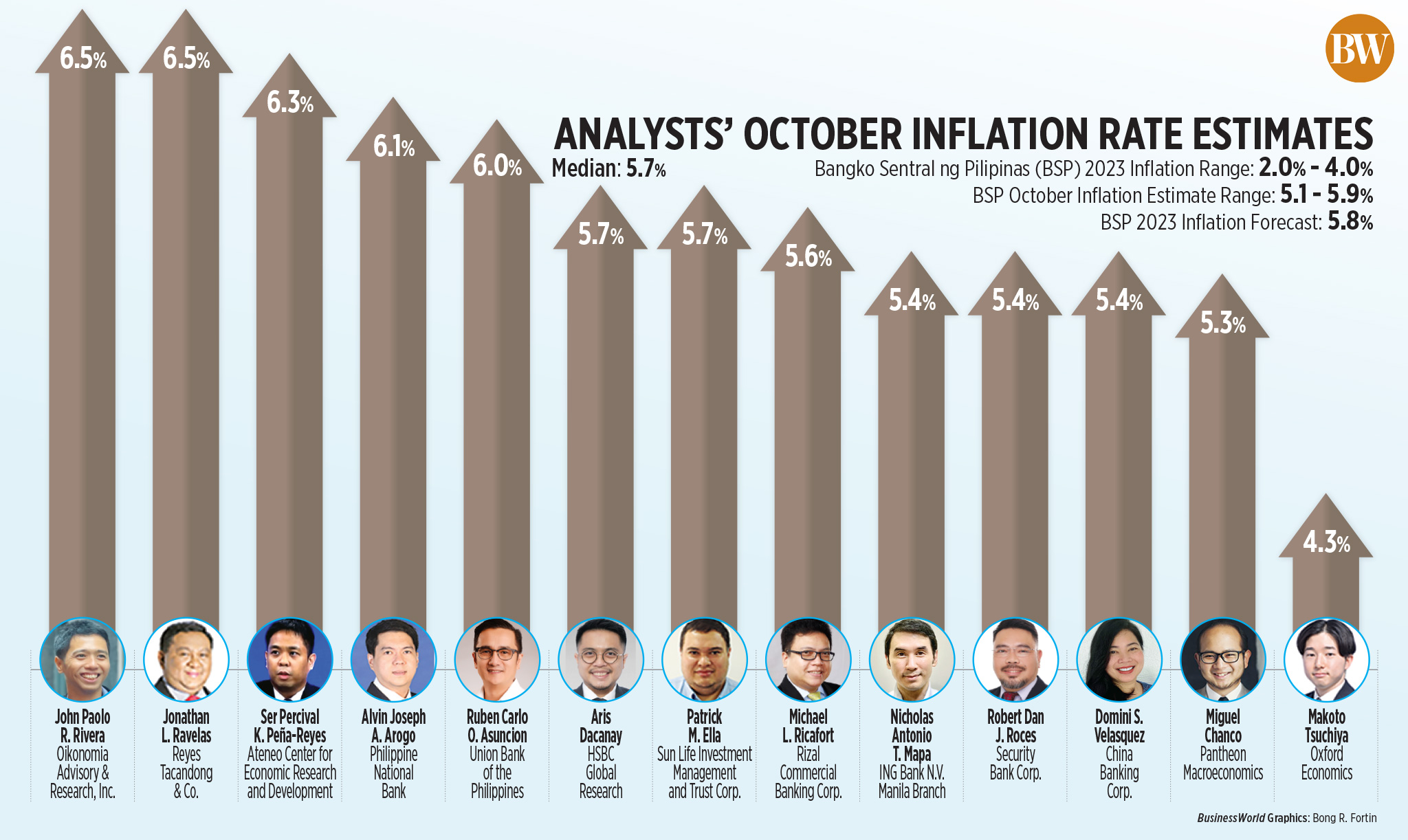
A BusinessWorld poll of 13 analysts conducted this week yielded a median estimate of 5.7% for the consumer price index (CPI) in October. This is within the 5.1-5.9% forecast of the Bangko Sentral ng Pilipinas (BSP) for the month.

If realized, October inflation would be slower than 6.1% in September and 7.7% in the same month last year. It would also be the slowest rate in two months or since 5.3% in August.

Analysts’ October inflation rate estimates

However, October would still mark the 19th straight month inflation breached the central bank’s 2-4% target band.    

The local statistics agency will release the October consumer price index (CPI) data on Nov. 7 (Tuesday).

“Although still elevated, headline inflation likely eased to 5.7% from 6.1% in the previous month. Global oil prices have tapered from the peak in September, which led to lower fuel prices domestically,” HSBC economist for ASEAN Aris Dacanay said in an e-mail. 

In October alone, oil companies cut pump prices for gasoline by PHP 3.1 per liter, diesel by PHP 0.45 per liter, and kerosene by PHP 4.40 per liter, data from the Energy department showed.

“Our latest data show some easing in the cost of essential food items such as rice, meat, and vegetables, as well as reductions in electricity and pump prices this October. While these factors could alleviate inflationary pressures, they may not be substantial enough to warrant diminished vigilance from the central bank given upside risks,” Security Bank Corp. Chief Economist Robert Dan J. Roces said.

Data from the Agriculture department showed that prices of beef rump ranged from PHP 390 to PHP 480 a kilo as of Oct. 31, narrower than the PHP 390 to PHP 550 band on Sept. 29. Retail prices of cabbage, white potato and chayote also fell.

However, Mr. Dacanay noted headline inflation may have remained sticky in October as rice prices remain elevated although easing from their high in September.

“To balance the welfare between producers and consumers, authorities decided to lift the price cap of rice in the first week of October without a corresponding decrease in tariff rates. This likely led to some upward correction in the price of rice, keeping overall inflation elevated,” he said.

The prices of local regular milled rice ranged from PHP 41 to PHP 44 a kilo as of Oct. 31, while well-milled rice ranged from PHP 45 to PHP 53.

Prices of rice have steadied after President Ferdinand R. Marcos, Jr. lifted the rice price ceiling on Oct. 4. In September, Mr. Marcos ordered prices to be capped at PHP 41 a kilo for regular milled rice and PHP 45 for well-milled rice.

Meanwhile, Philippine National Bank economist Alvin Joseph A. Arogo said in an e-mail that higher jeepney fares and recent minimum wage adjustments may have also put upward pressure on inflation in October.

Starting October, traditional and modern jeepneys increased their fares by PHP 1 to PHP 13 and PHP 15, respectively.   

Wage adjustments in Cagayan Valley, Central Luzon, and Soccsksargen regions took effect on Oct. 16. Regional wage boards recently approved a PHP 30-PHP 35 increase in the daily minimum wages for Ilocos and Western Visayas regions, which will be implemented on Nov. 6.

China Banking Corp. Chief Economist Domini S. Velasquez said in a Viber message that higher cooking gas prices and an increase in electricity rates in Metro Manila and Batangas likely added to prices pressures in October.

Liquefied petroleum gas (LPG) prices rose by PHP 3.75 a kilogram in October, its third straight month of increase. AutoLPG prices likewise went up by PHP 2.09 a liter.

Manila Electric Co. hiked the rate for a typical household by PHP 0.4201 per kilowatt-hour (kWh) to PHP 11.8198 in October.

“Meanwhile, core inflation continued its downward trajectory to 5.2% from 5.9% (in September),” Ms. Velasquez said. Core inflation excludes volatile prices of food and fuel.

Back to target
Analysts said it is still possible for headline inflation to return to the 2-4% target band within the fourth quarter this year.

“We think CPI growth within 2%-4% is still achievable within Q4, barring another supply-side shock. However, risks are skewed to the upside and it’s possible that CPI growth will not return to the target band this year,” Makoto Tsuchiya, assistant economist from Oxford Economics, said in an e-mail.

BSP Governor Eli M. Remolona, Jr. earlier said headline inflation may not hit the 2-4% target this year but will instead ease to within target “very briefly” in the first few months of 2024.

He expects inflation will then pick up before easing again in July.

Pantheon Macroeconomics Chief Emerging Asia Economist Miguel Chanco in an e-mail said the BSP chief’s inflation projection is “far too pessimistic.”

“I still see a half-decent chance that inflation returns to the 4% mark by the end of this year, and it’s worth noting that core inflation has continued to fall, despite the recent increase in the headline rate in recent months, underscoring the waning underlying price pressures amid the weakening in economic growth,” he said.

Ms. Velasquez said inflation will likely reach the 2-4% target in the first quarter of next year, before rising again through July.

“We anticipate inflation to slow for the remainder of the year barring new shocks. Easing price pressures could hold off additional rate hikes from the BSP,” she said.

Mr. Arogo said his baseline estimates show that inflation may remain above 4% until the third quarter of 2024 due to persistent supply issues and second-round effects.

Last week, the BSP hiked borrowing costs by 25 basis points (bps) in an off-cycle move, bringing the key rate to a fresh 16-year high of 6.5%. The BSP has raised policy rates by 450 bps since May 2022.    

The BSP sees full-year inflation at 5.8% for 2023, before easing to 3.5% in 2024 and 3.4% in 2025. Officials have said the BSP would revise its inflation forecasts on Nov. 16.         

The BSP’s next policy-setting meeting is scheduled on Nov. 16. — Keisha B. Ta-asan, Reporter

PH trade in goods seen to remain weak until yearend

PH trade in goods seen to remain weak until yearend

The growth in Philippine exports and imports will likely remain muted for the rest of the year amid a global economic slowdown and weak external demand, according to the World Bank.

“Overall, the global outlook for goods trade is expected to remain weak for the rest of 2023 as the demand for manufactured goods continues to remain weak in favor of trade in services. This includes the Philippines’ key commodities, such as its electronics exports,” World Bank Philippines Senior Economist Ralph van Doorn told BusinessWorld in an e-mail.

Mr. Van Doorn said that the worldwide economic slowdown “is expected to contribute to a slowdown in global goods trade by about four percentage points in 2023.”

“Of concern for the Philippines is that slowing growth in the region’s largest trading partners, including China where growth for 2023 is projected to be 5.1%, will lead to weaker external demand for the country’s export commodities,” he added.

Data from the local statistics authority showed that the trade deficit narrowed to USD 36.31 billion in the first eight months of the year from the USD 41.86-billion deficit a year ago.

As of end-August, exports declined by 6.6% to USD 47.81 billion while imports fell by 9.6% to USD 84.12 billion.

For this year, the government is projecting 1% growth for exports and 2% growth for imports. 

Pantheon Macroeconomics Chief Emerging Asia Economist Miguel Chanco said the Philippines may find it difficult to meet its export and import growth assumptions.

“If you’re talking about in nominal (i.e. not real terms), then the government’s export and import forecasts will almost be impossible to meet,” he said in an e-mail.

“In real terms, though, 1% full-year export growth seems doable, though I’m questioning whether 2% growth for imports is as achievable, simply because we’re seeing a notable slowdown in domestic demand this year, on all fronts, from private consumption to fixed investment,” he added.

Mr. Chanco noted other major exporting countries are showing signs of a rebound.

“The only silver lining is that we’re starting to see signs from other major exporters regionally, such as Singapore and Malaysia, that electronics exports are starting to bottom out and should start to show signs of a recovery, however modest, before the end of this year,” he said.

“The risks will remain weighted to the downside, considering China’s resistance to enact more aggressive stimulus measures to shore up demand,” he added.

Semiconductor and Electronics Industries in the Philippines Foundation, Inc. (SEIPI) President Danilo C. Lachica said it is still projecting flat growth for electronics exports this year.

“Our growth projection for 2023 is flat. We have not come out with our 2024 projection, but I hope it will be better than 2023,” he said in a Viber message.

SEIPI earlier revised its forecast to flat from 5% due to the weak performance in the first half.

As of end-August, exports of electronic products declined by 4.8% to $26.8 billion year on year. It made up more than half (56%) of total exports during the period. — By Luisa Maria Jacinta C. Jocson, Reporter

BSP sees October inflation at 5.1-5.9% 

BSP sees October inflation at 5.1-5.9% 

Headline inflation may have eased to 5.1-5.9% in October as prices of fuel and key food items dropped, the Bangko Sentral ng Pilipinas (BSP) said late Tuesday.   

If realized, October inflation would be slower than 6.1% in September and 7.7% a year earlier. However, October would be the 19th straight month that inflation has exceeded the central bank’s 2-4% target.

The lower end of the BSP’s inflation forecast would be the slowest in three months or since 4.7% in July.

The local statistics agency will release October consumer price index (CPI) data on Nov. 7.

“Higher prices of electricity, LPG (liquefied petroleum gas), fruits and fish, as well as the recent adjustment in jeepney fares are the primary sources of upward price pressures in October,” the BSP said.   

Manila Electric Co. said the rate for a typical household went up by P0.4201 per kilowatt-hour (kWh) to PHP 11.8198 in October.   

LPG prices increased by PHP 3.75 a kilogram in October, its third straight month of increase. AutoLPG prices likewise went up by PHP 2.09 a liter. 

Traditional and modern jeepneys also increased fares by PHP 1 to PHP 13 and PHP 15, respectively.   

“Meanwhile, lower prices of rice, meat and vegetables along with the reduction in the prices of petroleum products could contribute to downward price pressures,” the BSP said.   

Data from the Department of Agriculture (DA) showed that as of Oct. 31, prices of beef rump ranged from PHP 390 to PHP 480 a kilo, narrower than PHP 390 to PHP 550 on Sept. 29.   

Prices of cabbage, white potato and chayote also went down.

In October, the prices of gasoline, diesel and kerosene had a net decrease per liter of PHP 3.1, PHP 0.45 and PHP 4.40 respectively, data from the Energy department showed.

“My October inflation view is 5.7% and this is driven by slowing rice prices which has been the largest driver in the past two months,” Patrick M. Ella, an economist at Sun Life Investment Management and Trust Corp., said in an e-mail.   

Based on DA data, the retail price of local regular milled rice ranged from PHP 41 to PHP 44 a kilo as of Oct. 31, while well-milled rice ranged from PHP 45 to PHP 53.

Prices of rice have steadied even after President Ferdinand R. Marcos, Jr. lifted the rice price ceiling on Oct. 4. In September, Mr. Marcos ordered prices to be capped at PHP 41 a kilo for regular milled rice and PHP 45 for well-milled rice. 

Rice accounts for nearly 9% of the CPI basket.

Rizal Commercial Banking Corp. Chief Economist Michael L. Ricafort said better weather conditions in October helped stabilize food prices, compared with the heavy rains that caused agriculture damage from late July to September.

“The palay harvest season from mid-September to October also increased local palay/rice supply, which could have also helped stabilize or even ease rice prices,” he said in a Viber message.   

He noted global crude oil prices have been relatively stable at $82 per barrel despite the Israel-Hamas war.

Mr. Ricafort sees October inflation at 5.6% due to high base effects. High base effects would mean slower year-on-year headline inflation starting the fourth quarter.   

Headline inflation could still ease to within the 2-4% target in the first quarter of 2024, after inflation peaked at 8.7% in January 2023, he said.    

BSP Governor Eli M. Remolona, Jr. has said inflation would likely stay above 2-4% in the first half of 2024, before it starts slowing down in July.   

Mr. Ella said it is possible for inflation to remain elevated next year, but he is more optimistic as inflation may return to the 2-4% target within the second quarter of 2024.   

The BSP said it “will continue to closely monitor developments affecting the outlook for inflation and growth in line with its data-dependent approach to monetary policy formulation.” 

Last week, the Monetary Board hiked benchmark interest rates by 25 basis points (bps) in an off-cycle move, bringing the key rate to a fresh 16-year high of 6.5%. The BSP has raised the rate by 450 bps since May 2022.   

The BSP sees average inflation at 5.8% for 2023, before easing to 3.5% in 2024 and 3.4% in 2025. However, officials said the BSP would revise its inflation forecasts on Nov. 16.        

The BSP’s next policy-setting meeting is on Nov. 16. — By Keisha B. Ta-asan, Reporter

Debt repayment woes unlikely to affect PH financial stability

Debt repayment woes unlikely to affect PH financial stability

More Filipinos have been unable to pay off their loans this year amid high borrowing costs and elevated inflation, but decreasing debt repayment levels may not be a significant risk to financial stability.

A higher number of borrowers were unable to repay their debt this year amid post-pandemic spending, Marie Alexise Charisse Arboleda, head of operations at Collectius, said in an interview with BusinessWorld, and this could rise further as credit card usage is expected to increase this quarter amid the holiday season.

“During this time, many Filipinos tend to prioritize holiday spending, which includes holiday gifting, over debt repayment,” she said. “Given anticipation for high inflation, it is likely that consumers will spend more and we can expect to see a decrease in debt repayment levels across all consumer loans.” 

Consumer credit jumped by 22.7% year on year to PHP 1.17 trillion in August from PHP 950.8 billion a year ago, slightly faster than the 22.6% growth in July, Bangko Sentral ng Pilipinas (BSP) data showed. Specifically, credit card loans expanded by 29.7% year on year in August. 

Overall, outstanding loans disbursed by big banks expanded by 7.2% year on year to PHP 11.06 trillion in August, easing from the 7.7% print in July and was the slowest in 20 months.

“A slowdown in debt repayment rates does pose challenges, but may not necessarily lead to financial crisis…, especially if it is sufficiently addressed by regulatory measures,” Ms. Arboleda said. 

Separate BSP data showed banks’ nonperforming loan (NPL) ratio improved to a four-month low of 3.42% in August from 3.43% in July.

Bad loans declined by 5.9% year on year to PHP 442.9 billion as of end-August. However, this was 0.6% higher than PHP 440.1 billion seen at end-July.

Slower debt repayments can hurt banks and make it harder for financial institutions to lend money and provide financial services, Ms. Arboleda said.

“But banks and other financial institutions in the Philippines are well-capitalized and they generally have risk mitigation strategies in place,” she said.

“The (government) might take steps to reduce risks and support the financial system, especially during tough times, and we saw that also during the pandemic,” she added. 

During the coronavirus pandemic, Filipinos paid their debt on a monthly basis instead of settling them at once, Ms. Arboleda said. 

“Monthly payments have become the standard practice for most loans and it provides borrowers with a structured schedule for clearing their debts,” she said. 

But the high interest rate environment will affect debt repayments as borrowers will need to settle higher monthly installments, especially for credit card loans, she added.

“Additionally, the impact of inflation on debt repayments varies depending on our economic conditions as well. So, if our prices are going up, it can be tougher for Filipinos to manage their debt,” Ms. Arboleda said.

Credit card usage
Credit cards are likely the biggest debt source for average Filipinos as it is one of the most used payment channels, she said.

“Based on our research together with CCAP (Credit Card Association of the Philippines), the total amount of credit card billings is up to P400 billion. This shows that our economy is resilient, but it also means that the Filipinos are turning to borrowing money because of high inflation, which is making their purchasing power weaker,” she said.

Inflation may also affect unbanked Filipinos as it limits their purchasing power, saving options, and make them more sensitive to economic problems, she said.

Ms. Arboleda also noted that the Philippines has seen a gradual shift to digital and card-based payments that accelerated during the pandemic.

“Credit card usage for online and e-commerce was on the rise. Filipinos purchased everything online, from groceries, medicine, food, we paid it online via our credit cards,” she said.

“Also, during the pandemic, savings were touched, which caused people to be alarmed a little. That’s why they use credit or credit cards as their main source (of finance) during the pandemic to survive,” she said.

Credit card use will continue to surge in the Philippines in the coming years, Ms. Arboleda said.

“With the increase of post-pandemic revenge spending and elevated inflation, many customers will rely on consumer credit. The pandemic made it even more popular because it pushed Filipinos to use online and contactless ways of payment,” she said.

“I expect the credit card usage to increase further given the increasing digital literacy with the younger and more digitally savvy population. However, it is crucial for average Filipinos to be aware of their financial situations to avoid defaulting or falling into a debt trap,” she said.

There is still room to enhance financial literacy in the Philippines despite numerous programs and campaigns handled by the government, Ms. Arboleda said.

“How much people use credit cards and how well they repay their debt will depend on our economy. If the economy is doing okay or it’s getting better, it gives people the confidence to use their credit cards because they feel good about being able to pay off what they owe,” she said. “But if our economy is not doing so well and there are job losses and incomes aren’t stable, people tend to be more careful with their credit card use. That can affect the way how they pay their debts.”

“That’s why at Collectius, information is very important to us. We pay close attention to the market trends for both the bank and unbanked customers and we ensure that our customers are well supported with the knowledge in managing their debts,” Ms. Arboleda added.

Collectius, a financial technology company, is one of the five Financial Institutions Strategic Transfer Corporations in the Philippines licensed to acquire nonperforming loans or assets accumulated by banks during the coronavirus pandemic. — Keisha B. Ta-asan

Posts navigation

Older posts
Newer posts

Recent Posts

  • Investment Ideas: April 1, 2026
  • Metrobank US-Iran Risk Index: Signals of an end
  • Eye on Earnings: Demand for connection supports telcos
  • Inflation Preview: March madness
  • Investment Ideas: March 31, 2026

Recent Comments

No comments to show.

Archives

  • April 2026
  • March 2026
  • February 2026
  • January 2026
  • December 2025
  • November 2025
  • October 2025
  • September 2025
  • August 2025
  • July 2025
  • June 2025
  • May 2025
  • April 2025
  • March 2025
  • February 2025
  • January 2025
  • December 2024
  • November 2024
  • October 2024
  • September 2024
  • August 2024
  • July 2024
  • June 2024
  • May 2024
  • April 2024
  • March 2024
  • February 2024
  • January 2024
  • December 2023
  • November 2023
  • October 2023
  • September 2023
  • August 2023
  • July 2023
  • June 2023
  • May 2023
  • April 2023
  • March 2023
  • February 2023
  • January 2023
  • December 2022
  • November 2022
  • October 2022
  • September 2022
  • August 2022
  • July 2022
  • June 2022
  • May 2022
  • March 2022
  • December 2021
  • October 2021

Categories

  • Bonds
  • BusinessWorld
  • Currencies
  • Economy
  • Equities
  • Estate Planning
  • Explainer
  • Featured Insight
  • Fine Living
  • How To
  • Investment Tips
  • Markets
  • Portfolio Picks
  • Rates & Bonds
  • Retirement
  • Reuters
  • Spotlight
  • Stocks
  • Uncategorized

You are leaving Metrobank Wealth Insights

Please be aware that the external site policies may differ from our website Terms And Conditions and Privacy Policy. The next site will be opened in a new browser window or tab.

Cancel Proceed
Get in Touch

For inquiries, please call our Metrobank Contact Center at (02) 88-700-700 (domestic toll-free 1-800-1888-5775) or send an e-mail to customercare@metrobank.com.ph

Metrobank is regulated by the Bangko Sentral ng Pilipinas
Website: https://www.bsp.gov.ph

Quick Links
The Gist Webinars Wealth Manager Explainers
Markets
Currencies Rates & Bonds Equities Economy
Wealth
Investment Tips Fine Living Retirement
Portfolio Picks
Bonds Stocks
Others
Contact Us Privacy Notice Terms of Use
© 2026 Metrobank. All rights reserved.

Access this content:

If you are an existing investor, log in first to your Metrobank Wealth Manager account. ​

If you wish to start your wealth journey with us, click the “How To Sign Up” button. ​

Login HOW TO SIGN UP