



MODEL PORTFOLIO
THE GIST
NEWS AND FEATURES
Global Philippines Fine Living
INSIGHTS
INVESTMENT STRATEGY
Economy Stocks Bonds Currencies
THE BASICS
Investment Tips Explainers Retirement
WEBINARS
2024 Mid-Year Economi Briefing, economic growth in the Philippines
2024 Mid-Year Economic Briefing: Navigating the Easing Cycle
June 21, 2024
Investing with Love
Investing with Love: A Mother’s Guide to Putting Money to Work
May 15, 2024
retirement-ss-3
Investor Series: An Introduction to Estate Planning
September 1, 2023
View All Webinars
DOWNLOADS
Container ship carrying container boxes import export dock with quay crane. Business commercial trade global cargo freight shipping logistic and transportation worldwide oversea concept. Generative AI
Economic Updates
Philippines Trade Update: Wider deficit on strong imports
DOWNLOAD
Frick collection with palm trees 
Economic Updates
Policy Rate Updates: Policy rate updates to reassure 
DOWNLOAD
Man using his smartphone
Reports
Fed to cut just once 
DOWNLOAD
View all Reports
Metrobank.com.ph How To Sign Up
Follow us on our platforms.

How may we help you?

TOP SEARCHES
  • Where to put my investments
  • Reports about the pandemic and economy
  • Metrobank
  • Webinars
  • Economy
TRENDING ARTICLES
  • Investing for Beginners: Following your PATH
  • On government debt thresholds: How much is too much?
  • Philippines Stock Market Outlook for 2022
  • Deficit spending remains unabated

Login

Access Exclusive Content
Login to Wealth Manager
Visit us at metrobank.com.ph How To Sign Up
Access Exclusive Content Login to Wealth Manager
Search
MODEL PORTFOLIO THE GIST
NEWS AND FEATURES
Global Philippines Fine Living
INSIGHTS
INVESTMENT STRATEGY
Economy Stocks Bonds Currencies
THE BASICS
Investment Tips Explainers Retirement
WEBINARS
2024 Mid-Year Economi Briefing, economic growth in the Philippines
2024 Mid-Year Economic Briefing: Navigating the Easing Cycle
June 21, 2024
Investing with Love
Investing with Love: A Mother’s Guide to Putting Money to Work
May 15, 2024
retirement-ss-3
Investor Series: An Introduction to Estate Planning
September 1, 2023
View All Webinars
DOWNLOADS
Container ship carrying container boxes import export dock with quay crane. Business commercial trade global cargo freight shipping logistic and transportation worldwide oversea concept. Generative AI
Economic Updates
Philippines Trade Update: Wider deficit on strong imports
March 27, 2026 DOWNLOAD
Frick collection with palm trees 
Economic Updates
Policy Rate Updates: Policy rate updates to reassure 
March 26, 2026 DOWNLOAD
Man using his smartphone
Reports
Fed to cut just once 
March 19, 2026 DOWNLOAD
View all Reports

Archives: Business World Article

AMLC still eyes to exit FATF ‘gray list’ by January

AMLC still eyes to exit FATF ‘gray list’ by January

The Anti-Money Laundering Council (AMLC) is optimistic that the country can exit the Financial Action Task Force’s (FATF) “gray list” by January next year, but it would require the cooperation of government agencies and the private sector.

“The country is doing what is necessary to hopefully exit the gray list by January next year. We recognize, however, that the decision ultimately rests with the assessors from the FATF’s International Co-operation Review Group (ICRG),” the AMLC told BusinessWorld in an e-mail.

“With the assured cooperation of all agencies concerned and the whole-of-nation approach to address the strategic deficiencies noted by the FATF, the AMLC is optimistic that the Philippines can resolve these remaining strategic deficiencies and finally exit the gray list,” it added.

The Paris-based FATF has kept the Philippines on its gray list of jurisdictions under increased monitoring for “dirty money” risks since June 2021.

To be removed from the list, the Philippines has committed to comply with 18 action plan items of the ICRG. Progress reports are submitted to the FATF in three reporting cycles in a year: January, May and September. The Philippines is expected to undergo another mutual evaluation in 2026.

According to the AMLC, the FATF’s statement for October 2023 highlights the areas where the Philippines needs to enhance its anti-money laundering and counter-terrorism financing (AML/CTF) measures.

“While we had adequately prepared and demonstrated progress, we recognize this as an opportunity and understand that this is necessary to maintain the integrity and stability of the country’s financial system,” it said. 

The implementation of Executive Order (EO) No. 33 will demonstrate the Philippines’ proactive stance and commitment to work with the FATF against dirty money, the AMLC said.

President Ferdinand R. Marcos, Jr. in July issued EO 33, which adopts the National Anti-Money Laundering, Counter-Terrorism Financing and Counter-Proliferation Financing Strategy 2023-2027 (NACS) to incorporate the ICRG action plan.

The NACS is a “harmonized” method that boosts the country’s mechanisms to support an effective AML/CTF regime, the AMLC said. 

In October, Mr. Marcos gave all government agencies until Nov. 30 to address deficiencies in their AML strategies. It also directed the AMLC to submit a comprehensive report of the NACS implementation by Dec. 8.

The AMLC serves as the lead agency of the NACS risk assessment working group, which formulates and issues guidelines for implementation.

“All relevant government agencies, including the supervisors, regulators, law enforcement agencies and prosecutors have been working continuously to accomplish their targets and contribute to the country’s efforts to exit the FATF gray list,” the AMLC said.

The FATF in its October update said the Philippines should continue to demonstrate effective risk-based supervision of designated nonfinancial business and professions (DNFBPs) and ensure that supervisors are using the proper AML/CTF controls to mitigate risks associated with casino junkets.

The Philippines should also enhance and streamline law enforcement agencies’ access to beneficial ownership information and ensure accurate and up-to-date information. It should also increase investigation and prosecution of cases related to money laundering and proliferation financing, the FATF said

The private sector also plays a crucial role in the country’s efforts to exit the gray list, the AMLC said.

“In particular, there is a need to significantly increase registration with the AMLC of lawyers, accountants, company service provider, dealers in precious metals and stones, and real estate brokers and developers,” the AMLC said.

“The AMLC has implemented a strong registration campaign to mandate registration of these DNFBPs. Likewise, to ensure accurate and up to date BO information, corporations should comply with SEC (Securities and Exchange Commission) directives,” it added.

There are 22 other countries in the gray list aside from the Philippines. — Keisha B. Ta-asan
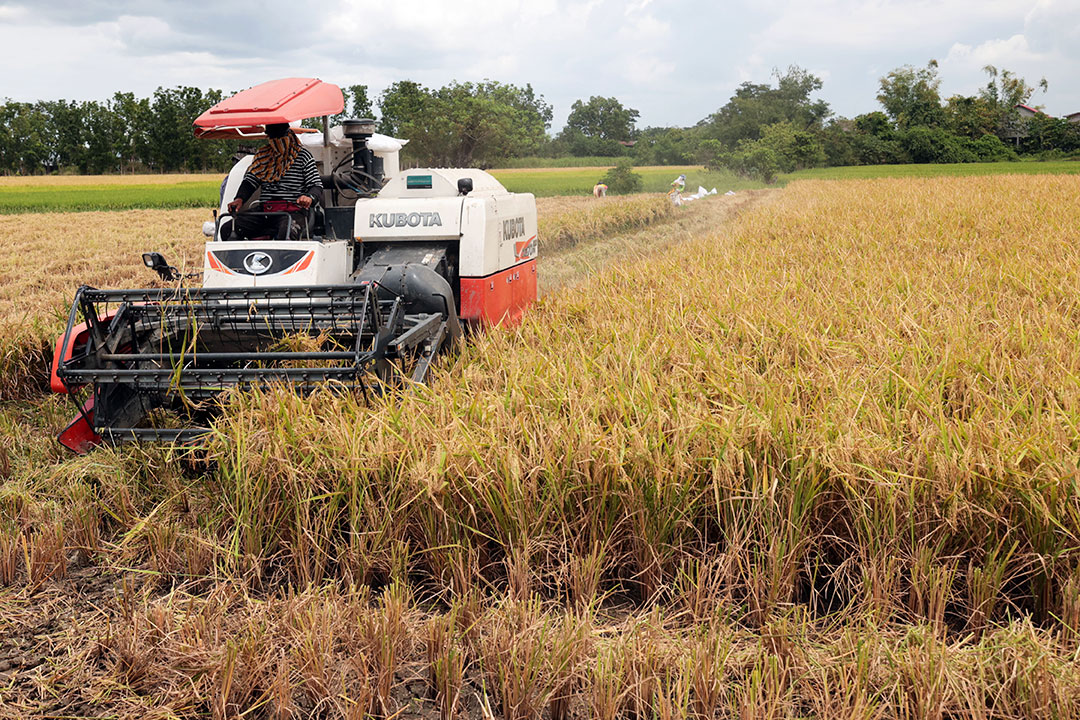
Agricultural output falls 0.3% in Q3

Agricultural output falls 0.3% in Q3

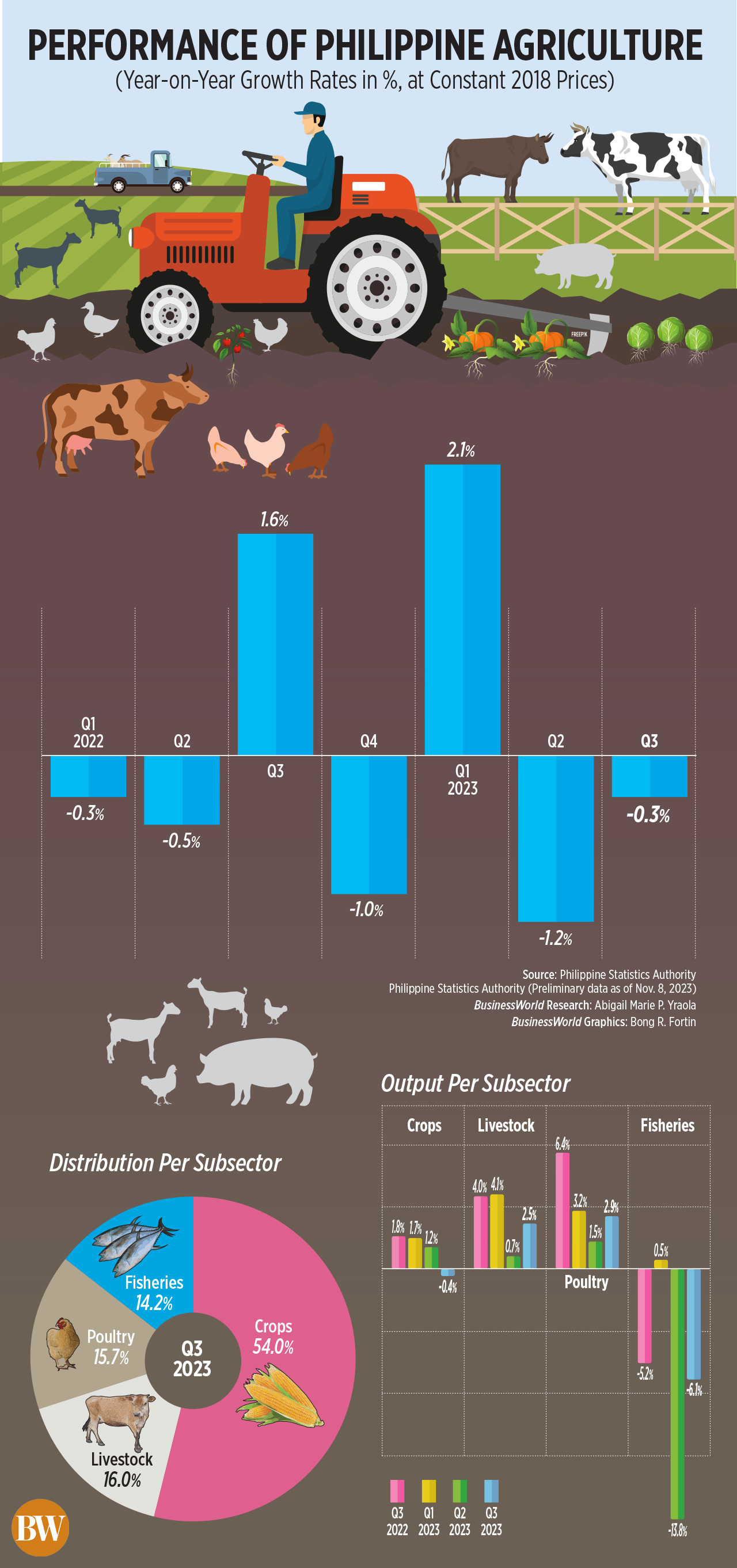
The Philippines’ agricultural output shrank for a second straight quarter in the July-to-September period mainly due to declines in crops and fisheries production, the Philippine Statistics Authority (PSA) said.

Data from the PSA on Wednesday showed the value of production in agriculture and fisheries at constant 2018 prices dipped by 0.3% to PHP 412.412 billion in the July-to-September period, “due to reductions in crops and fisheries production.”

This was a reversal from the 1.6% growth in the same period a year ago, but an improvement from the 1.2% contraction in the second quarter this year.

Performance of Philippine AgricultureAt current prices, the value of production in agriculture and fisheries rose by 4.3% to PHP 522.58 billion in the third quarter.

For the nine months to September, the value of production in agriculture and fisheries at constant 2018 prices inched up by 0.2% from the 0.3% increase in the same period in 2022.

“Despite (the) slight contraction in the value of farm production in the third quarter, there are still strong indications the sector could contribute positively to the economy,” the Department of Agriculture (DA) said in a statement.

The DA set a target of 2.3%-2.5% for agricultural output growth this year.

Crops, which account for more than half or 54% of the sector’s overall production, slipped by 0.4% to PHP 222.69 billion in the third quarter. This was a reversal of the 1.8% expansion in the same period a year ago and the 1.2% growth in the second quarter of 2023.

Roehlano M. Briones, a senior research fellow with the Philippine Institute for Development Studies, said that the drop in crops output was mainly due to weather disruptions.

For the first nine months, the value of crop production grew by 0.9%, an improvement from the 1% decline a year earlier.

In the third quarter, the decline in crop output was mainly attributed to the lower production in sugarcane (-26.4%), potato (-26%), mongo (-21.1%), cabbage (-17.5%), eggplant (-13.9%), and rubber (-12.7%). Lower output was also seen in abaca (-7.7%), ampalaya (-7.5%), and coconut (-1.9%).

Meanwhile, tobacco production surged by 122.1% and onion by 165.1%. Corn inched up by 5%, while banana (0.03%) and mango (15.2%) also showed increased production.

Fisheries recorded the steepest drop in the third quarter as production fell by 6.1% to P58.72 billion, worsening from the 5.2% decline a year ago but improving from the 13.8% contraction in the previous quarter.

Fisheries contributed 14.2% to the total share of agricultural output.

For the January-to-September period, the value of fisheries output at constant 2018 prices fell by 7% from the 4.3% decline a year ago.

Former Agriculture Undersecretary Fermin D. Adriano said fisheries production was affected by typhoons during the third quarter.

Latest data from the Agriculture department showed that the southwest monsoon along with typhoons Egay (international name: Doksuri) and Falcon (international name: Khanun) caused around PHP 12 billion in agricultural damage, with rice production losses at PHP 3 billion. The volume of lost production was estimated at 279,289 metric tons (MT) with 250,174 hectares of affected farmland.

Pangingisda Natin Gawing Tama Network representative Dennis F. Calvan said the contraction in fisheries production was due to “a lot of pressure to the already depleted resource.”

“We might be feeling the brunt of the impacts of El Niño, though technical assessments should be conducted first,” he said in a Viber message.

For the third quarter, double-digit declines were seen in tiger prawn or sugpo (-49%), bigeye tuna or tambakol (-41.1%), fimbriated sardines or tunsoy (-37.8%), mudcrab or alimango (-28.1%), squid or pusit (-26.3%), cavalla or talakitok (-26.3%), threadfin bream or bisugo (-19.4%), blue crab or alimasag (-18.1%), grouper or lapu-lapu (-15.5%), skipjack or gulyasan (-12.6%), and milkfish or bangus (-12%).

Meanwhile, higher production was recorded for indian mackerel or alumahan (60.6%), big-eyed scad or matangbaka (32.8%), yellowfin tuna or tambakol (28.5%), round scad or galunggong (17.2%), tilapia (6.9%), and seaweed (14%).

Newly appointed Agriculture Secretary Francisco Tiu Laurel, Jr. said that the latest agricultural output data still show positive indicators for key commodities under crops and fisheries.

“As we look at the data more closely, we could see positive signs in the rice, corn and onion harvest as well as in our production of tilapia and galunggong — all important food items for the Filipino masses,” he said.

Bright spots
On the other hand, the livestock and poultry sectors recorded gains in the third quarter.

Mr. Adriano said this was due to the recovery of the livestock sector from African Swine Fever and the poultry sector from avian flu.

The value of livestock production, which accounted for 16% of total farm output, rose by 2.5% to P66.1 billion in the third quarter. This was lower than the 4% growth in the third quarter a year ago, but better than the 0.7% increase in the second quarter.

In the third quarter, hog and goat production grew by 3.3% and 0.1%, respectively. However, lower production was seen for dairy (-12.4%), cattle (-1.5%), and carabao (-0.3%).

In the nine months to September, the value of livestock production rose by 2.4%, higher than 1.8% in the same period a year ago.

Meanwhile, poultry output expanded by 2.9% to P64.89 billion in the third quarter, slower than the 6.4% growth in the same quarter of 2022 but higher than the 1.5% increase in the second quarter.

Poultry accounted for 15.7% of the total agricultural output.

The value of chicken eggs, duck, and chicken production expanded by 4.7%, 3.6%, and 2.3%, respectively. Duck eggs declined by 2.2% during the quarter.

From January to September, the value of poultry production at constant 2018 prices rose by 2.5%, much slower than the 8.8% expansion a year ago.

Elias Jose M. Inciong, president of the United Broiler Raisers Association, said despite the growth registered for the poultry sector, this was still below expected output.

“The normal growth of the poultry sector is 4% to 7%. As such, there is some under performance. This may have been caused by adjustments made due to lower-than-expected demand,” he said in a Viber message.

Outlook
For the last quarter of the year, Mr. Briones said he is not optimistic for a turnaround in agricultural output growth due to the El Niño weather event.

Latest data from the state weather bureau showed that a moderate El Niño will continue to persist and is predicted to intensify in the coming months.

On the other hand, Mr. Adriano said that there is a possibility for crops to post higher growth in the fourth quarter as it is “peak palay harvest” in October.

“We have not been visited by destructive typhoons in October and hopefully November, which is also good for other crops,” he said.

“Livestock and poultry will continue to increase given peak demand for such products this Christmas holiday,” he added.

For fisheries, Mr. Calvan said that there may be further decline due to inclement weather and the closed season for fishing grounds, which could disrupt production, especially for capture fisheries.

“Fish importation, where we are expecting 35,000 metric tons (MT) of assorted fish to enter the market, and reliance on aquaculture production are usually the interventions we do during the last quarter until first quarter of next year,” he added.

Mr. Laurel, who was named to the DA post last week, said he expects the agriculture sector will drive growth in the overall economy.

“With the growth numbers in the first three quarters, we remain optimistic agriculture could still contribute positively to the broader economy,” he said.

The agriculture sector contributes about a tenth of the country’s gross domestic product (GDP).

Third-quarter GDP data will be released today (Nov. 9). — By Luisa Maria Jacinta C. Jocson, Reporter

Dollar reserves rise to 6-month high of USD101B

Dollar reserves rise to 6-month high of USD101B

After two straight months of decline, the Philippines saw its dollar reserves rise to a six-month high as of end-October, thanks to the National Government’s (NG) retail dollar bond issuance.

Gross international reserves (GIR) reached USD 101.09 billion as of end-October, up by 3% from USD 98.12 billion as of end-September, based on preliminary data from the Bangko Sentral ng Pilipinas (BSP) released on Tuesday evening.

This was also 7.5% higher than the dollar reserves of USD 94.03 billion as of end-October 2022. The GIR was the highest in six months, or since the USD 101.76 billion in April.

“The month-on-month increase in the GIR level reflected mainly the National Government’s net foreign currency deposits with the BSP, which include proceeds from its issuance of Retail Onshore Dollar Bonds 2 (RDB 2),” the BSP said.

The NG raised $1.26 billion from the first retail dollar bond offering under the Marcos administration. The five-and-a-half-year bonds fetched a coupon rate of 5.75% and were awarded at rates ranging from 5% to 5.75%, bringing the average to 5.509%

“The dollar-denominated bonds, successfully awarded, was likely the biggest contributor to the latest international reserves figure,” China Banking Corp. Chief Economist Domini S. Velasquez said in a Viber message.

Ample foreign exchange buffers protect the country from market volatility and ensure that it is capable of paying its debts in the event of an economic downturn.

The level of dollar reserves as of end-October is enough to cover about 5.9 times the country’s short-term external debt based on original maturity and 3.7 times based on residual maturity.

It is also equivalent to 7.5 months’ worth of imports of goods and payments of services and primary income.

The central bank also attributed the increase in dollar reserves to the higher value of the BSP’s gold holdings as prices of gold in the international market went up, and the BSP’s foreign exchange operations and income from investments abroad.

Based on BSP data, the value of the central bank’s gold holdings rose by 7.9% to USD 10.57 billion as of end-October from USD 9.79 billion as of end-September. It also climbed by 27.8% from USD 8.27 billion a year ago.

The level of foreign exchange reserves expanded by 47.2% to USD 1.23 billion as of end-October from USD 834.4 million as of end-September. However, it was 13.9% lower than USD 1.43 billion seen last year.

The BSP’s foreign investments stood at USD 84.79 billion as of end-October, 2.2% up from USD 82.99 billion in the prior month and 6.4% higher than USD 79.96 billion in the same month in 2022.

According to the BSP, net international reserves rose by 2.3% to USD 100.4 billion as of end-October 2023 from USD 98.1 billion as of end-September.

Net international reserves refer to the difference between the BSP’s reserve assets (GIR) and reserve liabilities, including short-term foreign debt, and credit and loans from the International Monetary Fund (IMF).

The BSP’s reserve assets also include foreign investments, foreign exchange, reserve position in the IMF and special drawing rights (SDR).

Reserves with the IMF slipped by 0.1% to USD 777.4 million as of end-October from USD 778.1 million in the previous month but rose by 5.2% from USD 739.1 million a year ago.

SDRs — or the amount which the Philippines can tap from the IMF’s reserve currency basket — was unchanged at USD 3.725 billion as of end-October from the previous month but went up 3% from $3.62 billion a year ago.

“Moving forward, GIR will be helped by an appreciating peso in the fourth quarter and the dovish statement from the Fed where markets are seeing an end to its hiking cycle already (less pressure on the peso),” Ms. Velasquez said.

The US Federal Reserve has kept its own key policy rate unchanged at 5.25-5.5%. The Fed has hiked policy rates by 525 basis points (bps) from March 2022 to July 2023.

Fed officials have said that it is unclear if overall financial conditions are restrictive enough to tame inflation, but further tightening may begin to weigh on the economy in a significant way.   

The Philippines’ Monetary Board raised borrowing costs by 25 bps in an off-cycle move in October. This brought the key interest rate to 6.5%, the highest in 16 years. The BSP hiked rates by 450 bps since May 2022. 

The BSP is expecting a GIR of USD 99.5 billion for this year and USD 102 billion for 2024. — By Keisha B. Ta-asan, Reporter

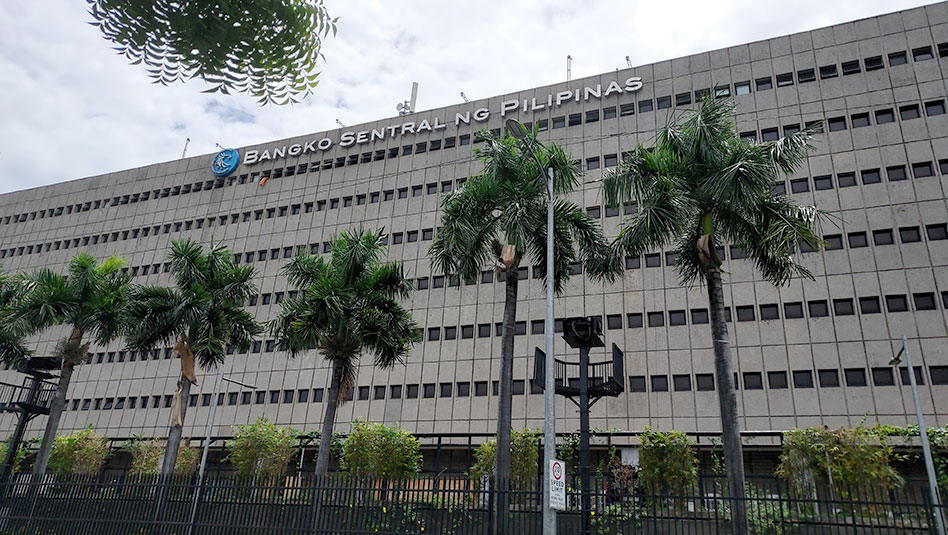
BSP ready to act if needed despite slower inflation

BSP ready to act if needed despite slower inflation

The Philippine central bank said on Tuesday it was prepared to take further monetary policy action if needed to anchor consumer price expectations even as inflation eased for the first time in three months in October.

The consumer price index rose 4.9% in October, less than the 6.1% in September, 5.6% forecast in a Reuters poll, and the central bank’s 5.1% to 5.9% projection, due mainly to slower increases in prices for food including rice.

Rice price inflation slowed to 13.2% in October from 17.9% in September, helping cool consumer prices last month, but the downtrend failed to ease the central bank’s inflation worries with risks to its inflation outlook “skewed significantly to the upside.”

“The Monetary Board deems it necessary to keep monetary policy settings sufficiently tight until inflation expectations are better anchored and a sustained downtrend in inflation becomes evident,” the Bangko Sentral ng Pilipinas (BSP) said in a statement.

“The BSP remains prepared to undertake further monetary policy action as necessary to prevent supply-side pressures on prices from leading to additional second-round effects and dislodging inflation expectations,” it said.

Year-to-date average inflation of 6.4% over January-October remained well outside the central bank’s 2% to 4% comfort range for the year.

Worried that inflation could spiral out of hand, the central bank delivered an off-cycle hike of 25 basis points on Oct. 26, and left the door open to another hike at its meeting on Nov. 16 if the inflation situation worsened.

But Michael L. Ricafort, an economist at Rizal Commercial Banking, said slower inflation in October, coupled with a strong peso and lower global crude oil prices, “would support a pause in local policy rates, or at least reduce the urgency for further rate hikes”.

By the time the central bank meets next week, it would have third-quarter annual economic growth date which, according to Finance Secretary Benjamin E. Diokno, would better second-quarter growth of 4.3%.

But the government also reported data on Tuesday which showed exports contracted 6.3% in September from a year earlier, while imports shrank 14.7%.

The finance secretary, a member of the central bank’s policymaking Monetary Board, said on Monday he would vote to keep the benchmark interest rate steady at 6.5%. — Reuters

BSP to keep policy settings ‘sufficiently tight’

BSP to keep policy settings ‘sufficiently tight’

The Bangko Sentral ng Pilipinas (BSP) will keep its policy settings “sufficiently tight” until inflation is seen to return within its 2-4% annual target, it said in a statement late on Tuesday.

“The Monetary Board deems it necessary to keep monetary policy settings sufficiently tight until inflation expectations are better anchored and a sustained downtrend in inflation becomes evident,” the BSP said following the October inflation release.

The central bank said it will consider the latest inflation outturn and third-quarter gross domestic product (GDP) data to be released on Thursday at its next policy meeting on Nov. 16.

“The BSP remains prepared to undertake further monetary policy action as necessary to prevent supply-side pressures on prices from leading to additional second-round effects and dislodging inflation expectations,” it said.

Headline inflation slowed to a three-month low of 4.9% in October from 6.1% in September and 7.7% in the same month in 2022. This was slower than the 5.7% median estimate in a BusinessWorld poll last week and below the BSP’s 5.1-5.9% forecast.

For the first 10 months, inflation averaged 6.4%, still above the BSP’s 5.8% forecast and 2-4% target for the year.

“The inflation path in the coming months is still seen to remain elevated with the 2024 central forecast shifting closer to the upper end of the inflation target range, indicating persistent price pressures,” the central bank said.

Risks to the outlook are also on the upside for this year up to 2025 amid the potential impact of higher transport fares, increased electricity rates, higher oil prices and minimum wage adjustments in areas outside Metro Manila.

“Meanwhile, the impact of a weaker-than-expected global recovery and successful implementation of government measures to mitigate the impact of El Niño weather conditions are possible primary downside risks to the outlook,” the BSP said.

“The BSP will continue to assess the data as they become available and determine the appropriate policy to bring inflation back within the target range without further delay, in keeping with its price stability mandate,” it added.

Meanwhile, Nomura Global Markets Research Chief ASEAN Economist Euben Paracuelles said in a note that inflation may average 6.2% this year and 3.8% in 2024.

Headline inflation may edge higher to 5.2% in November and December from the 4.9% in October, as food prices may still go up due to the El Niño weather phenomenon, he said.

However, core inflation may continue to decline amid waning demand-side pressures and a slower economic momentum.

“Base effects will start to become more favorable in the next few months, but similar to BSP’s assessment, headline inflation is unlikely to return to BSP’s 2-4% target until August,” Mr. Paracuelles said.

The BSP is unlikely to deliver another rate hike, he said.

“Overall, we believe BSP’s hiking cycle is over, with the current level of the policy rate of 6.5% remaining our forecast for the terminal rate in this hiking cycle,” he said.

Mr. Paracuelles added that the central bank will only start cutting borrowing costs in September 2024.

“This implies the total rate cuts BSP can deliver will be a smaller 75 bps (i.e., 25 bps in each of the remaining three meetings for 2024) versus our previous forecast of 150 bps. This takes our end-2024 forecast for the policy rate to 5.75% from 5% previously,” he said. — Keisha B. Ta-asan

Yields on term deposits rise amid lower demand

Yields on term deposits rise amid lower demand

Yield on the term deposit facility (TDF) of the Bangko Sentral ng Pilipinas (BSP) went up on Wednesday as both tenors went undersubscribed following hawkish signals from monetary authorities.

Total bids for the central bank’s term deposits reached PHP 324.328 billion, below the PHP 400-billion offer for this week. This was also lower than the HP 343.603 billion in tenders seen last week for a PHP 310-billion offer.

Broken down, the seven-day papers fetched bids amounting to PHP 199.395 billion, below the PHP 230-billion auctioned off by the BSP and the PHP 201.652 billion in tenders logged in the previous auction for a PHP 190-billion offer.

Banks asked for yields ranging from 6.5325% to 6.7399%, a higher and narrower margin compared with the 6.439% to 6.7273% band seen a week ago. This caused the average rate of the one-week paper to rise by 4.01 basis points (bps) to 6.6141% from 6.574%.

Meanwhile, demand for the 14-day term deposits amounted to PHP 124.933 billion, lower than the P170-billion offering. This was also below the PHP 141.951 billion in tenders recorded a week ago for a PHP 120-billion offer.

Accepted rates for the papers were from 6.55% to 6.75%, a higher margin than the 6.4% to 6.67% range seen on Nov. 3. With this, the average rate of the two-week deposit rose by 3.31 bps to 6.6233% from 6.5902% in the previous week’s auction.

The central bank has not auctioned 28-day term deposits for three years to give way to its weekly offering of securities with the same tenor.

The term deposits and the 28-day bills are used by the BSP to mop up excess liquidity in the financial system and to better guide market rates.

Yields on the BSP’s term deposits were higher after hawkish signals from the central bank, Rizal Commercial Banking Corp. Chief Economist Michael L. Ricafort said in a Viber message.

The central bank said it intends to keep policy settings “sufficiently tight” until inflation is seen to fall within the 2-4% target range and inflation expectations are better anchored.

“The BSP remains prepared to undertake further monetary policy action as necessary to prevent supply-side pressures on prices from leading to additional second-round effects and dislodging inflation expectations,” it said.

Inflation eased to 4.9% in October from 6.1% in September and 7.7% in the same month in 2022. It was significantly slower than the 5.7% median estimate in a BusinessWorld poll last week and below the 5.1-5.9% forecast of the BSP.

The inflation print was the slowest pace in three months or since 4.7% in July. However, October marked the 19th straight month that inflation breached the central bank’s 2-4% target band.

For the first 10 months, inflation averaged 6.4%, still above the BSP’s 5.8% full-year forecast.

Mr. Ricafort also attributed the higher yields to the BSP’s off-cycle rate hike that took effect on Oct. 27.

The BSP hiked borrowing costs by 25 bps in an off-cycle move last month, bringing the policy rate to a fresh 16-year high of 6.5%.

The central bank has raised policy rates by 450 bps since May 2022.    

Its next policy-setting meeting is on Nov. 16. — K.B. Ta-asan

Peso strengthens against the dollar before third-quarter GDP report

Peso strengthens against the dollar before third-quarter GDP report

The peso strengthened anew against the dollar on Wednesday on optimism over the economy’s performance in the third quarter.

The local unit closed at PHP 56.045 per dollar on Wednesday, rising by seven centavos from its PHP 56.115 finish on Tuesday, based on Bankers Association of the Philippines (BAP) data.

The peso opened Wednesday’s session at PHP 56.09 against the dollar. Its intraday best was at PHP 55.95, while its weakest showing was at PHP 56.10 versus the greenback.

Dollars exchanged went down to USD 1.24 billion on Wednesday from $1.62 billion on Tuesday, BAP data showed.

The peso strengthened against the dollar ahead of the release of third-quarter gross domestic product (GDP) data on Thursday, Rizal Commercial Banking Corp. Chief Economist Michael L. Ricafort said in a Viber message.

“The peso appreciated on lingering optimism ahead of a potentially stronger third-quarter Philippine economic growth report tomorrow,” a trader likewise said in an e-mail on Wednesday.

A BusinessWorld poll of 18 economists and analysts last week yielded a median estimate of 4.9% for third-quarter GDP growth.

If realized, this would be faster than the 4.3% expansion recorded in the second quarter, but slower than 7.7% seen in the third quarter of 2022.

This would bring the average GDP growth for the first nine months to 5.2%, still below the government’s 6-7% full-year target.

The peso was also supported by lower global crude oil prices and US Treasury yields recently amid dovish signals from the US Federal Reserve, Mr. Ricafort said.

The US central bank kept its benchmark interest rate steady at the 5.25%-5.5% range for a second straight meeting during its Oct. 31 to Nov. 1 review.

The Fed has hiked rates by a cumulative 525 basis points since it began its tightening cycle in March 2022.

For Thursday, the trader said the peso could strengthen further as Fed Chair Jerome H. Powell is likewise expected to give a dovish speech on Friday.

The trader sees the peso move between PHP 55.90 and PHP 56.15 per dollar on Thursday, while Mr. Ricafort expects it to range from PHP 55.95 to PHp 56.15. — A.M.C. Sy

Peso down on hawkish Fed comments

Peso down on hawkish Fed comments

THE PESO depreciated against the dollar on Tuesday due to hawkish signals from a US Federal Reserve official and profit taking after the local currency strengthened to the PHP 55-per-dollar level on Monday.

The peso closed at PHP 56.115 per dollar on Tuesday, weakening by 20.5 centavos from its PHP 55.91 finish on Monday, based on Bankers Association of the Philippines data.

The peso opened Tuesday’s session weaker at PHP 56 against the dollar, which was also its intraday best. Its worst showing was at PHP 56.29.

Dollars exchanged rose to USD 1.62 billion on Tuesday from USD 1.15 billion on Monday.

The peso weakened on Tuesday due to hawkish signals from Minneapolis Fed President Neel Kashkari, Rizal Commercial Banking Corp. Chief Economist Michael L. Ricafort said in a Viber message.

The hawkish rhetoric from Mr. Kashkari caused US Treasury yields to rise, which resulted in the dollar generally strengthening against other major currencies, Mr. Ricafort said.

Mr. Kashkari said on Monday that the US central bank likely has more work ahead of it to control inflation, Reuters reported.

“The economy has proved to be really resilient even though we’ve raised interest rates a lot over the past couple of years. That’s good news,” Mr. Kashkari said in an interview on the Fox News television channel.

But he added: “We haven’t completely solved the inflation problem. We still have more work ahead of us to get it done.”

Mr. Kashkari’s comments suggested he is still leaning toward raising interest rates again. The Fed met last week in a gathering that kept its overnight short-term interest rate target unchanged at between 5.25% and 5.5% and preserved the option to raise rates again as inflation is still well above its 2% target.

But with price pressures falling, many in markets believe the Fed is done with raising rates.

“The peso weakened driven by bargain-hunting after the local currency breached the PHP 56 level [on Monday],” a trader said in an e-mail.

For Wednesday, the trader said the peso could strengthen due to potentially dovish signals from Fed officials.

The trader and Mr. Ricafort expect the peso to range from PHP 56 to PHP 56.20 per dollar on Wednesday. — AMCS with Reuters

Index rises to 6,100 level as inflation eases in Oct.

Index rises to 6,100 level as inflation eases in Oct.

THE MAIN INDEX climbed to the 6,100 level on Tuesday as inflation slowed in October, boosting bets that the Bangko Sentral ng Pilipinas (BSP) will not hike rates again at its policy meeting next week.

The benchmark Philippine Stock Exchange index (PSEi) went up by 53.29 points or 0.87% to close at 6,131.32 on Tuesday, while the broader all shares index rose by 18.19 points or 0.55% to end at 3,310.34.

“Philippine shares continued eke out gains as investors remained positive with the latest inflation print,” Regina Capital Development Corp. Head of Sales Luis A. Limlingan said in a Viber message.

The bellwether index rose further “as investors cheered the surprisingly low Philippine October inflation print,” China Bank Capital Corp. Managing Director Juan Paolo E. Colet likewise said in a Viber message on Tuesday.

“This reinforced growing expectations that the BSP will not hike its policy rate this month and perhaps the rest of the year,” Mr. Colet added.

“Nonetheless, daily value turnover was relatively low as some market participants opted to stay on the sidelines ahead of the release of third quarter GDP (gross domestic product) data on Thursday,” he said.

Value turnover went down to PHP 2.99 billion on Tuesday with 240.17 million shares changing hands from the PHP 4.02 billion with 323.74 million issues seen on Monday.

Headline inflation eased to 4.9% in October from 6.1% in September and 7.7% in the same month last year, preliminary data from the Philippine Statistics Authority released on Tuesday showed.

This was lower than the 5.7% median estimate in a BusinessWorld poll last week and the BSP’s 5.1-5.9% forecast for the month.

For the first 10 months, inflation averaged 6.4%, above the central bank’s 5.8% forecast and 2-4% target for the year.

A BusinessWorld poll of 17 economists and analysts last week yielded a median estimate of 4.9% for third quarter GDP growth, faster than the preliminary 4.3% expansion seen in the second quarter.

If realized, this would bring the nine-month GDP growth average to 5.2%, still below the government’s 6-7% full-year target.

All sectoral indices closed higher on Tuesday. Financials climbed by 40.91 points or 2.37% to 1,762.62; industrials rose by 93.97 points or 1.1% to 8,589.75; services went up by 5.17 points or 0.34% to 1,495.83; holding firms increased by 12.09 points or 0.2% to 5,866; mining and oil added 2.60 points or 0.02% to end at 9,896.87; and property inched up by 0.40 point or 0.01% to 2,590.71.

Advancers outnumbered decliners, 89 versus 80, while 48 shares closed unchanged.

Net foreign buying stood at PHP 52.11 million on Tuesday versus the PHP 172.65 million in net selling recorded on Monday. — S.J. Talavera

Philippines October annual inflation at 4.9%, less than forecast

Philippines October annual inflation at 4.9%, less than forecast

MANILA – Philippine annual inflation came in at 4.9% in October versus the previous month’s 6.1%, the statistics agency said on Tuesday, reflecting slower increases in food prices.

Economists in a Reuters poll had forecast annual inflation of 5.6% in October, within the central bank’s 5.1% to 5.9% projection for the month.

October inflation brought the year-to-date average inflation to 6.4%, still outside the central bank’s 2%-4% target for the year.

The slower inflation in October could ease pressure on the central bank to increase interest rates further after it delivered an off-cycle hike of 25 basis points on Oct. 26, on worries that inflation could spiral out of hand.

Philippines Finance Secretary Benjamin Diokno, a member of the central bank’s policymaking Monetary Board said on Monday he would vote to keep the benchmark interest rate steady at 6.5%. — Reuters

Posts navigation

Older posts
Newer posts

Recent Posts

  • Investment Ideas: April 1, 2026
  • Metrobank US-Iran Risk Index: Signals of an end
  • Eye on Earnings: Demand for connection supports telcos
  • Inflation Preview: March madness
  • Investment Ideas: March 31, 2026

Recent Comments

No comments to show.

Archives

  • April 2026
  • March 2026
  • February 2026
  • January 2026
  • December 2025
  • November 2025
  • October 2025
  • September 2025
  • August 2025
  • July 2025
  • June 2025
  • May 2025
  • April 2025
  • March 2025
  • February 2025
  • January 2025
  • December 2024
  • November 2024
  • October 2024
  • September 2024
  • August 2024
  • July 2024
  • June 2024
  • May 2024
  • April 2024
  • March 2024
  • February 2024
  • January 2024
  • December 2023
  • November 2023
  • October 2023
  • September 2023
  • August 2023
  • July 2023
  • June 2023
  • May 2023
  • April 2023
  • March 2023
  • February 2023
  • January 2023
  • December 2022
  • November 2022
  • October 2022
  • September 2022
  • August 2022
  • July 2022
  • June 2022
  • May 2022
  • March 2022
  • December 2021
  • October 2021

Categories

  • Bonds
  • BusinessWorld
  • Currencies
  • Economy
  • Equities
  • Estate Planning
  • Explainer
  • Featured Insight
  • Fine Living
  • How To
  • Investment Tips
  • Markets
  • Portfolio Picks
  • Rates & Bonds
  • Retirement
  • Reuters
  • Spotlight
  • Stocks
  • Uncategorized

You are leaving Metrobank Wealth Insights

Please be aware that the external site policies may differ from our website Terms And Conditions and Privacy Policy. The next site will be opened in a new browser window or tab.

Cancel Proceed
Get in Touch

For inquiries, please call our Metrobank Contact Center at (02) 88-700-700 (domestic toll-free 1-800-1888-5775) or send an e-mail to customercare@metrobank.com.ph

Metrobank is regulated by the Bangko Sentral ng Pilipinas
Website: https://www.bsp.gov.ph

Quick Links
The Gist Webinars Wealth Manager Explainers
Markets
Currencies Rates & Bonds Equities Economy
Wealth
Investment Tips Fine Living Retirement
Portfolio Picks
Bonds Stocks
Others
Contact Us Privacy Notice Terms of Use
© 2026 Metrobank. All rights reserved.

Access this content:

If you are an existing investor, log in first to your Metrobank Wealth Manager account. ​

If you wish to start your wealth journey with us, click the “How To Sign Up” button. ​

Login HOW TO SIGN UP