



MODEL PORTFOLIO
THE GIST
NEWS AND FEATURES
Global Philippines Fine Living
INSIGHTS
INVESTMENT STRATEGY
Economy Stocks Bonds Currencies
THE BASICS
Investment Tips Explainers Retirement
WEBINARS
2024 Mid-Year Economi Briefing, economic growth in the Philippines
2024 Mid-Year Economic Briefing: Navigating the Easing Cycle
June 21, 2024
Investing with Love
Investing with Love: A Mother’s Guide to Putting Money to Work
May 15, 2024
retirement-ss-3
Investor Series: An Introduction to Estate Planning
September 1, 2023
View All Webinars
DOWNLOADS
grocery-2-aa
Inflation Update: Target breached
DOWNLOAD
Container ship carrying container boxes import export dock with quay crane. Business commercial trade global cargo freight shipping logistic and transportation worldwide oversea concept. Generative AI
Economic Updates
Philippines Trade Update: Wider deficit on strong imports
DOWNLOAD
Frick collection with palm trees 
Economic Updates
Policy Rate Updates: Policy rate updates to reassure 
DOWNLOAD
View all Reports
Metrobank.com.ph How To Sign Up
Follow us on our platforms.

How may we help you?

TOP SEARCHES
  • Where to put my investments
  • Reports about the pandemic and economy
  • Metrobank
  • Webinars
  • Economy
TRENDING ARTICLES
  • Investing for Beginners: Following your PATH
  • On government debt thresholds: How much is too much?
  • Philippines Stock Market Outlook for 2022
  • Deficit spending remains unabated

Login

Access Exclusive Content
Login to Wealth Manager
Visit us at metrobank.com.ph How To Sign Up
Access Exclusive Content Login to Wealth Manager
Search
MODEL PORTFOLIO THE GIST
NEWS AND FEATURES
Global Philippines Fine Living
INSIGHTS
INVESTMENT STRATEGY
Economy Stocks Bonds Currencies
THE BASICS
Investment Tips Explainers Retirement
WEBINARS
2024 Mid-Year Economi Briefing, economic growth in the Philippines
2024 Mid-Year Economic Briefing: Navigating the Easing Cycle
June 21, 2024
Investing with Love
Investing with Love: A Mother’s Guide to Putting Money to Work
May 15, 2024
retirement-ss-3
Investor Series: An Introduction to Estate Planning
September 1, 2023
View All Webinars
DOWNLOADS
grocery-2-aa
Inflation Update: Target breached
April 7, 2026 DOWNLOAD
Container ship carrying container boxes import export dock with quay crane. Business commercial trade global cargo freight shipping logistic and transportation worldwide oversea concept. Generative AI
Economic Updates
Philippines Trade Update: Wider deficit on strong imports
March 27, 2026 DOWNLOAD
Frick collection with palm trees 
Economic Updates
Policy Rate Updates: Policy rate updates to reassure 
March 26, 2026 DOWNLOAD
View all Reports

Archives: Business World Article

Rates of T-bills, bonds may end lower

Rates of T-bills, bonds may end lower

Rates of Treasury bills and bonds on offer this week could decline to track secondary market movements, driven by the peso’s appreciation against the dollar and easing global oil prices.

The government will auction off PHP 10 billion in Treasury bills (T-bills) on Tuesday or PHP 3 billion each in 91- and 182-day papers and PHP 4 billion in 364-day papers.

On Wednesday, it will offer PHP 20 billion in reissued seven-year Treasury bonds (T-bonds) with a remaining life of five years and 10 months.

T-bill and bond yields may track the rally seen at the secondary market last week amid a stronger peso, which could reduce importation prices and overall inflation, Rizal Commercial Banking Corp. Chief Economist Michael L. Ricafort said in a Viber message.

Global crude oil prices reached four-month lows last week, which could help alleviate inflationary pressures, causing yields to decline, Mr. Ricafort said.

“The trading week will feature a bond auction with indications of 6.15-6.25%. We think this will be well received as we suspect bond supply in December to be meager,” a trader added in an e-mail.

On Friday, the peso closed at PHP 55.38 against the greenback, appreciating by one centavo from the PHP 55.39 finish on Thursday.

This was the local currency’s strongest close versus the dollar in over three months or since it ended at PHP 55.19 on Aug. 2.

Meanwhile, Brent crude futures settled down 84 cents or 1% at USD 80.58 a barrel on Friday, while US West Texas Intermediate crude fell USD 1.56 or 2% from Wednesday’s close to USD 75.54, Reuters reported.

At the secondary market on Friday, rates of the 91-, 182-, and 364-day T-bills went down by 40.24 basis points (bps), 36.34 bps, and 22.22 bps week on week to end at 5.7399%, 5.9376%, and 6.2694%, respectively, based on PHP Bloomberg Valuation Service (BVAL) Reference Rates data published on the Philippine Dealing System’s website.

Yields on the seven-year and five-year bonds also declined by 15.11 bps and 12.72 bps week on week to end at 6.2715% and 6.242%, respectively.

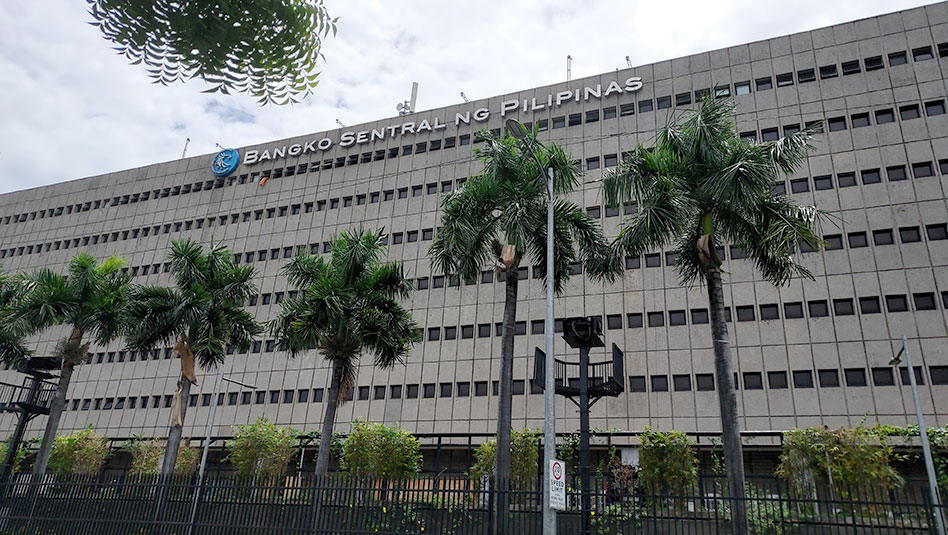
“The PHP BVAL yields mostly continued to ease despite some hawkish signals from local monetary authorities to ensure inflation is anchored towards the Bangko Sentral ng Pilipinas’ (BSP) targets,” Mr. Ricafort added.

BSP Governor Eli M. Remolona, Jr. on Friday said monetary policy will remain “hawkish for a while,” reiterating that the Monetary Board could still resume tightening if inflation picks up anew.

At its Nov. 16 policy meeting, the BSP kept its target reverse repurchase rate at a 16-year high of 6.5% amid easing inflationary pressures following an off-cycle hike of 25 bps last month.

The Monetary Board has now raised borrowing costs by a total of 450 bps since it started its tightening cycle in May 2022.

It will hold its final policy meeting for this year on Dec. 14.

Headline inflation eased to 4.9% in October from 6.1% in September. This brought the 10-month average to 6.4%, still above the BSP’s 2-4% target and 6% forecast for the year.

The Bureau of the Treasury (BTr) did not auction off T-bills last week to make way for its maiden offering of one-year tokenized bonds, from which it raised PHP 15 billion at a coupon rate of 6.5%.

At its last offering of T-bills on Nov. 13, the government raised PHP 15 billion as planned via the short-term papers as total bids reached PHP 46.441 billion or more than thrice the amount on offer.

Broken down, the Treasury made a full PHP 5-billion award of the 91-day T-bills, with tenders for the tenor reaching PHP 20.133 billion. The average rate of the three-month paper fell by 22.9 bps to 6.123%. Accepted rates ranged from 6.024% to 6.197%.

The government likewise borrowed the programmed P5 billion from the 182-day securities, as bids for the paper reached PHP 10.732 billion. The average rate for the six-month T-bill stood at 6.513%, down by 2.3 bps, with accepted yields ranging from 6.45% to 6.549%.

The government also raised PHP 5 billion as planned via the 364-day debt papers, with bids reaching PHP 15.576 billion. The average rate of the one-year T-bill went down by 3.1 bps to 6.56%. Accepted yields were from 6.54% to 6.585%.

On the other hand, the seven-year bonds to be offered on Wednesday were last auctioned off on Aug. 8, where the government raised PHP 23.629 billion, below PHP 30 billion on the auction block, at an average rate of 6.468%. Accepted yields ranged from 6.378% to 6.5%.

The BTr wants to raise PHP 150 billion from the domestic market this month, or PHP 60 billion via T-bills and PHP 90 billion via T-bonds.

The government borrows from local and foreign sources to help fund its budget deficit, which is capped at 6.1% of gross domestic product this year. — Luisa Maria Jacinta C. Jocson with Reuters

PH bond market growth picks up

PH bond market growth picks up

The Philippine bond market’s growth picked up in the third quarter amid more issuances from the government and the central bank, the Asian Development Bank (ADB) said.

The local currency (LCY) bond market grew by 1.8% quarter on quarter to PHP 11.66 trillion or USD 210 billion in the July-September period, ADB’s Asia Bond Monitor report released on Monday showed, faster than the 1.3% expansion seen in the second quarter. Year on year, the bond market grew by 6.5%.

The Philippine bond market’s quarter-on-quarter (q-o-q) growth was the fourth slowest among the seven markets in the emerging East Asia region that expanded last quarter. Hong Kong’s bond market recorded the fastest quarter-on-quarter growth at 5.1%, while Japan’s posted a 0.1% contraction.

Outstanding central bank securities grew by 44.8% quarter on quarter to USD 12 billion “as issuance increased during the quarter to mop up excess liquidity in the market brought about by the BSP’s (Bangko Sentral ng Pilipinas) reduction of the reserve requirement ratio (RRR) and the expiration of pandemic-related relief measures on June 30,” the ADB said.

In June, the BSP cut the RRR for big banks and nonbank financial institutions with quasi-banking functions by 250 basis points (bps) to 9.5%. It has also reduced the ratio for digital banks by 200 bps to 6% and by 100 bps for thrift banks, and rural and cooperative banks to 2% and 1%, respectively.

“Growth of 14.3% q-o-q in the issuance of central bank securities was buoyed by the new 56-day BSP bill that was launched on June 30 as an additional tenor under the BSP Securities Facility to effectively manage changing liquidity conditions in the economy,” it added.

Meanwhile, outstanding Treasury and other government bonds rose by 0.3% to USD 171 billion, slower than the 2.3% growth the prior quarter, “as the government failed to meet its borrowing plan for the quarter due to investors’ demand for higher yields,” the multilateral lender said.

Issuances of Treasury and other government papers rose by 2.5% quarter on quarter, the report showed.

“Meanwhile, the corporate bond stock contracted 2.4% q-o-q to a size of PHP 1.6 trillion, driven by reduced issuance during the quarter. Total corporate bonds outstanding were dominated by the property sector with a 31.9% share of the total LCY corporate bonds outstanding in Q3 2023,” the ADB said.

It said “elevated borrowing costs pushed corporate bond issuance to contract 38.8% q-o-q, or 68.5% compared to the same period in the previous year,” with only three companies tapping the bond market for financing.

Meanwhile, emerging East Asia’s bond market grew by 2.5% quarter on quarter to USD 23.51 trillion in the three months through September, faster than the 2% increase seen in the second quarter.

Year on year, the emerging East Asian region’s bond market expanded by 8.2%. — AMCS

Yields on gov’t debt decline amid Fed bets

Yields on gov’t debt decline amid Fed bets

Yields on government securities (GS) went down last week following the release of minutes of the US Federal Reserve’s policy meeting held earlier this month.

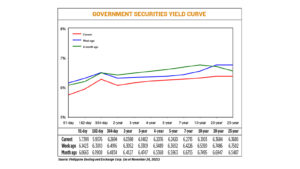
GS yields dropped by an average of 25.7 basis points (bps) week on week, based on PHP Bloomberg Valuation Service Reference Rates as of Nov. 24 published on the Philippine Dealing System’s website.

Yields on fell across all tenors, with rates of the 91-, 182-, and 364-day Treasury bills (T-bills) going down by 40.24 bps (to 5.7399%), 36.34 bps (5.9376%), and 22.22 bps (6.2694%), respectively.

At the belly, rates of the two-, three-, four-, five-, and seven-year Treasury bonds (T-bonds) declined by 24.54 bps (to 6.0598%), 18.27 bps (6.1482%), 14.13 bps (6.2076%), 12.72 bps (6.242%), and 15.11 bps (6.2715%), respectively.

Likewise, yields on the 10-, 20-, and 25-year papers decreased by 22.87 bps (to 6.3103%), 38.02 bps (6.3684%), and 38.22 bps (6.368%), respectively.

Total GS volume reached PHP 23.25 billion on Friday, lower compared with the PHP 32.24 billion on Nov. 17.

Last week’s release of minutes of the Fed’s policy meeting from Oct. 31 to Nov. 1 affected local yield movement, analysts said.

“The slew of softer US economic data on durable goods sales and consumer sentiment bolstered market views of an impending weakness in the US economy. These developments supported the latest policy guidance from the Fed minutes wherein policy makers expressed caution on tightening monetary settings further,” a bond trader said in an e-mail.

Fed officials agreed at their last policy meeting that they would proceed “carefully” and only raise interest rates if progress in controlling inflation faltered, the minutes of the Oct. 31-Nov. 1 gathering showed on Tuesday, Reuters reported.

The US central bank kept its benchmark interest rate steady at the 5.25%-5.5% range for a second straight time during this month’s meeting. It has hiked rates by 525 bps since it began its tightening cycle in March 2022.

The Federal Open Market Committee will next meet on Dec. 12-13 to review policy.

Reports on jobless claims, durable goods, and consumer sentiment seemed to suggest the economy is easing but may stay strong enough to avoid a recession.

Meanwhile, Rizal Commercial Banking Corp. Chief Economist Michael L. Ricafort said US rates also affected GS yields last week.

US 10-year Treasury yields, which set the tone for borrowing costs worldwide, rose to 4.485%. They were still comfortably below the 5% milestone reached last month, Reuters reported.

For this week, local yields are expected to continue their downward path as the peso has gained strength against the dollar, Mr. Ricafort said in an e-mail.

“Given the recent divergence in the inflation path of the US and the Philippines, the Bangko Sentral ng Pilipinas (BSP) might remain relatively more hawkish than the US Federal Reserve. GS yields are likely to be influenced more by the BSP policy guidance and the near-term outlook on domestic inflation,” the bond trader said.

The BSP kept its policy rate unchanged at a 16-year high of 6.5% at its Nov. 16 meeting amid an improving inflation outlook after hiking by bps in an off-cycle move last month.

Since May 2022, the BSP has raised rates by a cumulative 450 bps to tame inflation.

The Monetary Board will hold its last policy meeting this year on Dec. 14.

Philippine headline inflation fell to a three-month low of 4.9% in October from 6.1% in September. For the 10-month period, inflation averaged 6.4%, still well above the BSP’s 2-4% target for the year. — M.I.U. Catilogo with Reuters

‘Higher-for-longer’ era seen to dampen growth   

‘Higher-for-longer’ era seen to dampen growth   

The Bangko Sentral ng Pilipinas’ (BSP) higher-for-longer monetary policy stance may be needed to anchor inflation expectations, but analysts warned high borrowing costs will continue to weigh on growth momentum.

National Economic and Development Authority (NEDA) Secretary Arsenio M. Balisacan said the BSP’s view is that without high interest rates inflation will continue to be a problem.

“Inflation, if it persists, will also kill the economy. Inflation spills to other sectors if it persists, even though it initially started from the supply side,” he told reporters over the weekend in mixed English and Filipino.

“This is also the concern that I see, so for us at the Executive branch, we need to be quick in addressing the supply-side issues,” he said.

A Bloomberg report quoted BSP Governor Eli M. Remolona, Jr. as saying the central bank will remain “hawkish for a while.” This means the Monetary Board is “not about to ease… (but) might even hike,” he added.

“If the inflation rate doesn’t go down as projected, we have no choice,” he said on Thursday. “But what we are watching more than the inflation rate itself is the expectations; if they get de-anchored, we’ll have to do something.” 

At its Nov. 16 policy meeting, the BSP kept its target reverse repurchase rate at a 16-year high of 6.5%. The BSP raised borrowing costs by a total of 450 basis points (bps) from May 2022 to October 2023 to tame inflation.

ING Bank N.V. Manila Senior Economist Nicholas Antonio T. Mapa in an e-mail said the higher-for-longer stance is an example of forward guidance by the BSP, reflecting its commitment to bring down inflation.

“However, there are intended consequences to policy tightening and rate hikes if past and present will continue to weigh on growth momentum, ensuring growth will slow to limit demand-side pressure,” he said.

Mr. Mapa said higher-for-longer policy rates can tame inflation amid easing demand-side pressures, but it could also lead to slower gross domestic product (GDP) growth.

“If cost-side pressures persist then we could still see inflation,” he said. “Monetary policy is not a panacea for all types of inflation after all,” he added. 

Headline inflation slowed to 4.9% in October from 6.1% in September, marking its slowest pace in three months. Still, inflation remained above the 2-4% target for the 19th straight month.

During the 10-month period, inflation averaged 6.4%. This is still above the central bank’s 6% full-year baseline forecast.

Security Bank Corp. Chief Economist Robert Dan J. Roces said keeping a hawkish monetary policy for two quarters straight can be seen as a way to maintain price stability and fight against inflationary pressures. 

“On the other hand, cutting interest rates can stimulate economic growth by reducing the cost of borrowing for businesses and consumers. This approach may be considered when the economy needs a boost in activity or is facing significant downward pressures,” he said.

Philippine GDP expanded by 5.9% in the July-to-September period, faster than the 4.3% growth in the second quarter but slower than the 7.7% expansion in the same quarter in 2022.

For the first nine months of the year, economic growth averaged 5.5%, still below the government’s 6-7% full-year target.

“Thus, the BSP’s decision to either tighten or loosen monetary policy will depend on a thorough assessment of economic indicators and future projections,” Mr. Roces said. “Right now, the future projection is for inflation to remain elevated given upside risks. Therefore, a good chance of elevated for long.”

Earlier this month, the BSP raised its baseline inflation forecast to 6% in 2023 (from 5.8% in September) and to 3.7% in 2024 (from 3.5%) but cut its 2025 inflation estimate to 3.2% (from 3.4%).

The BSP also gave a risk-adjusted inflation forecast at 6.1% for 2023, 4.4% for 2024 and 3.4% for 2025.

Mr. Roces said the central bank must balance managing inflation and supporting economic growth.

“The central bank will likely make decisions based on careful analysis. Growth is not expected to tank but it will slow given elevated rates and inflation,” he said.

China Banking Corp. Chief Economist Domini S. Velasquez said risks are still on the upside amid tighter food supply due to El Niño, higher electricity rates, and likely wage increases in the coming months.

“We expected BSP to remain hawkish all throughout the first half of next year as there are still some months next year that inflation is expected to overshoot the 2-4% target,” she said.

“Although economic growth is moderating, we do not think that BSP would cut policy rates any time soon given inflationary pressures still,” she added. 

The BSP will have its last policy review this year on Dec. 14. — By Keisha B. Ta-asan, Reporter

Shares may go down on profit taking, rate bets

Shares may go down on profit taking, rate bets

THE Philippine stock market could succumb to profit taking this shortened trading week following its recent rally and amid expectations that interest rates here and abroad will remain high in the near term.

On Friday, the 30-member Philippine Stock Exchange index (PSEi) rose by 23.30 points or 0.37% to close at 6,269.50, while the all shares index went up by 20.21 points or 0.6% to 3,348.22.

Week on week, the PSEi climbed by 57.61 points or 0.93% from its 6,211.89 close on Nov. 17.

“Slight gains amidst anemic turnover characterized [last] week’s trade in light of Thanksgiving holiday plus ahead of a shortened trading week,” online brokerage 2TradeAsia.com said in a market report.

Philippine financial markets were closed on Monday due to a public holiday for Bonifacio Day.

For the coming days, the market may decline anew as investors could pocket their profits after the PSEi recorded gains in three out of five trading days last week, Philstocks Financial, Inc. Senior Research Analyst Japhet Louis O. Tantiangco said in a Viber message.

“Expectations that interest rates will remain high for a while following Bangko Sentral ng Pilipinas (BSP) Governor Eli M. Remolona, Jr.’s hawkish statements … may also weigh on the market,” Mr. Tantiangco said.   

“The local market has been building momentum lately, rising for four weeks with a total gain of 5.16%. However, trading has been lethargic, implying that the market’s current rally is not backed by strong investor participation,” he added. 

BSP Governor Eli M. Remolona, Jr. on Friday said their policy stance will remain “hawkish for a while,” reiterating that the Monetary Board could still resume tightening to keep inflation expectations anchored.

At its Nov. 16 meeting, the BSP kept its policy rate at a 16-year high of 6.5% amid easing inflation following an off-cycle hike of 25 basis points (bps) last month.

The Monetary Board has raised borrowing costs by 450 bps since it began its tightening cycle in May 2022.

It will hold its last policy review for this year on Dec. 14.

Meanwhile, the Fed kept its benchmark interest rate steady at the 5.25%-5.5% range for a second straight time during their Oct. 31-Nov. 1 meeting. It has hiked rates by 525 bps since it began its tightening cycle in March 2022.

The Federal Open Market Committee will next meet on Dec. 12-13 to review policy.

“[This] week, investors are expected to watch out for catalysts that can spur optimism towards the local economy. Without such, we may see selling pressures dominate leading to a pull back for the local bourse,” Mr. Tantiangco added. “Chart-wise, the market’s immediate support is seen at its 50-day exponential moving average. Resistance is seen at the 6,400 level.”

Meanwhile, Rizal Commercial Banking Corp. Chief Economist Michael L. Ricafort put the PSEi’s immediate major resistance at the 6,300 level and immediate major support at 6,055-6,100.

For its part, 2TradeAsia.com placed the PSEi’s support at 6,100 and resistance at 6,400. — RMDO

Shares may go down on profit taking, rate bets

Shares may go down on profit taking, rate bets

THE Philippine stock market could succumb to profit taking this shortened trading week following its recent rally and amid expectations that interest rates here and abroad will remain high in the near term.

On Friday, the 30-member Philippine Stock Exchange index (PSEi) rose by 23.30 points or 0.37% to close at 6,269.50, while the all shares index went up by 20.21 points or 0.6% to 3,348.22.

Week on week, the PSEi climbed by 57.61 points or 0.93% from its 6,211.89 close on Nov. 17.

“Slight gains amidst anemic turnover characterized [last] week’s trade in light of Thanksgiving holiday plus ahead of a shortened trading week,” online brokerage 2TradeAsia.com said in a market report.

Philippine financial markets were closed on Monday due to a public holiday for Bonifacio Day.

For the coming days, the market may decline anew as investors could pocket their profits after the PSEi recorded gains in three out of five trading days last week, Philstocks Financial, Inc. Senior Research Analyst Japhet Louis O. Tantiangco said in a Viber message.

“Expectations that interest rates will remain high for a while following Bangko Sentral ng Pilipinas (BSP) Governor Eli M. Remolona, Jr.’s hawkish statements … may also weigh on the market,” Mr. Tantiangco said.   

“The local market has been building momentum lately, rising for four weeks with a total gain of 5.16%. However, trading has been lethargic, implying that the market’s current rally is not backed by strong investor participation,” he added. 

BSP Governor Eli M. Remolona, Jr. on Friday said their policy stance will remain “hawkish for a while,” reiterating that the Monetary Board could still resume tightening to keep inflation expectations anchored.

At its Nov. 16 meeting, the BSP kept its policy rate at a 16-year high of 6.5% amid easing inflation following an off-cycle hike of 25 basis points (bps) last month.

The Monetary Board has raised borrowing costs by 450 bps since it began its tightening cycle in May 2022.

It will hold its last policy review for this year on Dec. 14.

Meanwhile, the Fed kept its benchmark interest rate steady at the 5.25%-5.5% range for a second straight time during their Oct. 31-Nov. 1 meeting. It has hiked rates by 525 bps since it began its tightening cycle in March 2022.

The Federal Open Market Committee will next meet on Dec. 12-13 to review policy.

“[This] week, investors are expected to watch out for catalysts that can spur optimism towards the local economy. Without such, we may see selling pressures dominate leading to a pull back for the local bourse,” Mr. Tantiangco added. “Chart-wise, the market’s immediate support is seen at its 50-day exponential moving average. Resistance is seen at the 6,400 level.”

Meanwhile, Rizal Commercial Banking Corp. Chief Economist Michael L. Ricafort put the PSEi’s immediate major resistance at the 6,300 level and immediate major support at 6,055-6,100.

For its part, 2TradeAsia.com placed the PSEi’s support at 6,100 and resistance at 6,400. — RMDO

Local stocks climb on peso’s rise, auto sales data

Local stocks climb on peso’s rise, auto sales data

PHILIPPINE SHARES closed higher on Friday as the peso sustained its strength against the dollar last week, and amid data showing higher vehicle sales for October that signaled stronger economic activity.

The Philippine Stock Exchange index (PSEi) climbed by 23.30 points or 0.37% to close at 6,269.50 on Friday, while the broader all shares index rose by 20.21 points or 0.6% to finish at 3,348.22.

“The local bourse gained by 23.30 points to 6,269.50, thanks to the strengthened peso against the dollar. This positive momentum was further fueled by robust auto sales in October, indicating resilient consumer demand despite high inflation and elevated interest rates,” Philstocks Financial, Inc. Research Analyst Claire T. Alviar said in a Viber message.

On Friday, the peso closed at P55.38 versus the dollar, rising by a centavo from Thursday’s P55.39 finish, data from the Bankers Association of the Philippines’ website showed.

This was the peso’s strongest close against the greenback in more than three months or since the P55.19-a-dollar finish on Aug. 2.

Meanwhile, a joint report by the Chamber of Automotive Manufacturers of the Philippines, Inc. (CAMPI) and the Truck Manufacturers Association (TMA) released last week showed new vehicle sales increased to 38,128 units in October from 32,146 units in the same month a year ago.

However, car sales declined by 1.3% from 38,628 units sold in September amid elevated inflation.

For the first 10 months, CAMPI-TMA members sold 352,971 units, up by 25.9% from 280,300 units a year ago.

“Overseas, the temporary pause in the conflict between Israel and Hamas also contributed to a more optimistic market sentiment,” Ms. Alviar added.

“Philippine shares traded quietly, [but investors] became bargain hunters as investors were optimistic that the US economy would get a boost following Black Friday,” Regina Capital Development Corp. Head of Sales Luis A. Limlingan said in a Viber message.

Back home, sectoral indices were mixed at the end of Friday’s trading. Property climbed by 31.36 points or 1.18% to 2,689.88; services went up by 9.66 points or 0.63% to 1,521.29; and holding firms rose by 28.58 points or 0.48% to 5,976.28. 

On the other hand, industrials fell by 21.17 points or 0.23% to 8,926.32; financials retreated by 1.44 points or 0.08% to 1,745.72; and mining and oil declined by 5.39 points or 0.05% to 9,660.30.

Value turnover reached P2.68 billion on Friday with 445.73 million issues switching hands, higher than the P2.33 billion with 453.55 million shares traded the previous day. 

Decliners outnumbered advancers, 94 versus 78, while 51 names ended unchanged.

Net foreign selling stood at P123.04 million on Friday versus the net buying worth P85.63 million net foreign inflows recorded on Thursday. 

Philippine financial markets are closed on Monday due to a public holiday for Bonifacio Day. — R.M.D. Ochave

Local stocks climb on peso’s rise, auto sales data

Local stocks climb on peso’s rise, auto sales data

PHILIPPINE SHARES closed higher on Friday as the peso sustained its strength against the dollar last week, and amid data showing higher vehicle sales for October that signaled stronger economic activity.

The Philippine Stock Exchange index (PSEi) climbed by 23.30 points or 0.37% to close at 6,269.50 on Friday, while the broader all shares index rose by 20.21 points or 0.6% to finish at 3,348.22.

“The local bourse gained by 23.30 points to 6,269.50, thanks to the strengthened peso against the dollar. This positive momentum was further fueled by robust auto sales in October, indicating resilient consumer demand despite high inflation and elevated interest rates,” Philstocks Financial, Inc. Research Analyst Claire T. Alviar said in a Viber message.

On Friday, the peso closed at P55.38 versus the dollar, rising by a centavo from Thursday’s P55.39 finish, data from the Bankers Association of the Philippines’ website showed.

This was the peso’s strongest close against the greenback in more than three months or since the P55.19-a-dollar finish on Aug. 2.

Meanwhile, a joint report by the Chamber of Automotive Manufacturers of the Philippines, Inc. (CAMPI) and the Truck Manufacturers Association (TMA) released last week showed new vehicle sales increased to 38,128 units in October from 32,146 units in the same month a year ago.

However, car sales declined by 1.3% from 38,628 units sold in September amid elevated inflation.

For the first 10 months, CAMPI-TMA members sold 352,971 units, up by 25.9% from 280,300 units a year ago.

“Overseas, the temporary pause in the conflict between Israel and Hamas also contributed to a more optimistic market sentiment,” Ms. Alviar added.

“Philippine shares traded quietly, [but investors] became bargain hunters as investors were optimistic that the US economy would get a boost following Black Friday,” Regina Capital Development Corp. Head of Sales Luis A. Limlingan said in a Viber message.

Back home, sectoral indices were mixed at the end of Friday’s trading. Property climbed by 31.36 points or 1.18% to 2,689.88; services went up by 9.66 points or 0.63% to 1,521.29; and holding firms rose by 28.58 points or 0.48% to 5,976.28. 

On the other hand, industrials fell by 21.17 points or 0.23% to 8,926.32; financials retreated by 1.44 points or 0.08% to 1,745.72; and mining and oil declined by 5.39 points or 0.05% to 9,660.30.

Value turnover reached P2.68 billion on Friday with 445.73 million issues switching hands, higher than the P2.33 billion with 453.55 million shares traded the previous day. 

Decliners outnumbered advancers, 94 versus 78, while 51 names ended unchanged.

Net foreign selling stood at P123.04 million on Friday versus the net buying worth P85.63 million net foreign inflows recorded on Thursday. 

Philippine financial markets are closed on Monday due to a public holiday for Bonifacio Day. — R.M.D. Ochave

PEZA investment approvals surge

PEZA investment approvals surge

The Philippine Economic Zone Authority (PEZA) approved investments worth PHP 140.89 billion so far this year, more than double from a year ago, its top official said.

“We are now at PHP 140 billion as of our latest board meeting on Nov. 16, so that is about 92% of our target,” PEZA Director-General Tereso O. Panga told reporters on the sidelines of the PEZA Investors Night on Wednesday.

The investment promotion agency (IPA) is targeting to approve PHP 154.77 billion worth of project registrations this year.

Mr. Panga said the PEZA-approved investments as of Nov. 16 are 147% higher than the PHP 57.05-billion investments approved during the same period last year.

“With two more board meetings to go, we will surpass our targets for the year with flying colors,” he said during his presentation at the event.

The PEZA chief said economic zones will continue to perform well as the Philippine economy posts one of the fastest growth rates in Southeast Asia for this year and next year.

Citing data from the ASEAN+3 Macroeconomic Research Office (AMRO), Mr. Panga said that the Philippine gross domestic product (GDP) is expected to grow by 5.9% and 6.5% this year and in 2024, respectively.

AMRO’s growth forecast for the Philippines is above the regional 2023 and 2024 consensus of 4.3% and 4.5% GDP growth, respectively. The region is composed of the 10-member Association of Southeast Asian Nations (ASEAN) plus China, Japan and South Korea.

Meanwhile, Mr. Panga said PEZA expects around PHP 50 billion worth of investments to come in, which includes a billion-dollar investment from a US company Texas Instruments, Inc.

“We are expecting some more investments that have a combined worth of over PHP 50 billion. If we are lucky enough, these might bring us back to the PHP 200-billion to PHP 250-billion level or the 2012 and 2015 peak years of PEZA investment approvals,” he said in mixed English and Filipino.

The PEZA Board is scheduled to hold a meeting on Nov. 30, while the last meeting will be in December.   

In his presentation, the PEZA director-general said that Japanese companies remain to be the top source for investments, followed by Filipino, American, Dutch and British companies. 

“This year, we are seeing an increase in investments from other markets like China, Taiwan, Australia and the European Union,” Mr. Panga said.

Around a third of the approved investments are in electronics and semiconductors, followed by information technology (IT) services (12.45%) and metals or fabricated metal products investments (8.66%).

“In the coming Industry 4.0, we see huge potential in advanced and smart manufacturing, electric and hybrid vehicles, artificial intelligence and robotics, frontier technologies, and other unique industries,” Mr. Panga said.

The PEZA Board pre-qualified a total of 25 big-ticket locator projects from July 2022 to November 2023 which are estimated to generate PHP 217.21 billion in investments, USD 1.5 billion in exports and 16,414 direct jobs.

Mr. Panga said that a total of 11 economic zones (ecozones) with investments totaling PHP 3.5 billion have already been approved under the current administration. These ecozones are located in Batangas, Bacolod, Bataan, Naga City, Dumaguete City, Davao, Cebu, Pampanga and Sarangani.

There are three ecozones with a total investment of PHP 654.43 million awaiting the release of the presidential proclamation. These are MetroCas Industrial Estates-Special Economic Zone, Suyo Economic Zone, and Kamanga Agro-Industrial Economic Zone.

“We have increased our presence outside of Luzon and the metropolis to bring ecozone development in rural and new growth areas. Rural communities continue to be transformed into bustling urban centers,” Mr. Panga said.

To date, the IPA has 422 operating ecozones. — Justine Irish D. Tabile

BSP urged to remain  hawkish in next 2 years

BSP urged to remain  hawkish in next 2 years

The Bangko Sentral ng Pilipinas (BSP) should retain its tightening bias as forecasts show inflation will remain elevated until 2025, GlobalSource Partners said. 

“All in all, we believe the BSP should remain hawkish in both its policy moves and policy pronouncements. The forecasts indicate above-target inflation for this year, and we agree as to its likelihood, and the next,” GlobalSource Country Analyst Diwa C. Guinigundo said in a report dated Nov. 22.

The BSP’s baseline inflation forecast this year is at 6%, still well above its 2-4% target band. It sees inflation easing to 3.7% for 2024 and 3.2% for 2025.

The Monetary Board kept its key policy rate unchanged at a 16-year high of 6.5% at its Nov. 16 meeting, after hiking by 25 basis points (bps) in an off-cycle move last month. 

Since May 2022, the BSP has raised rates by a cumulative 450 bps to tame inflation. The Monetary Board is set to have its final policy-setting meeting this year on Dec. 14.

“For 2025, we argue for sustained tightening for at least two reasons. One, inflation forecasts are quite close to the upper end of the inflation target and two, credit and economic growth remain intact. There is enough space for monetary cautiousness. The biggest risk is the inability of those nonmonetary interventions to make a difference,” Mr. Guinigundo added.

Mr. Guinigundo, a former BSP deputy governor, said that risk-adjusted inflation forecasts are more “realistic.”

The central bank’s risk-adjusted inflation forecast is higher at 6.1% for 2023, 4.4% for 2024, and 3.4% for 2025.

“These (risk-adjusted) forecasts incorporate potential game changers including higher power and petroleum prices, and higher minimum wages in areas outside Metro Manila, including the impact of prolonged El Niño conditions. Transport fare adjustments and nonmonetary interventions were also considered,” he said.

In a follow-up Viber message, Mr. Guinigundo said that the BSP could potentially “start pausing and ultimately reducing the policy rate” if its risk-weighted forecasts show inflation in 2025 would fall within the 2-4% target.

“Monetary policy works with a long and variable lag — so they need to act fast as soon as they see a clear trend of inflation moderating to within target. Otherwise, they should remain cautious or at least pause. Again, their move will be driven by data and forecasts,” he added.

‘Tall order’
Meanwhile, GlobalSource said that achieving the government’s 6-7% economic growth target this year will be a “tall order.”

“Based on the third-quarter outcome, it is difficult to share the optimistic view of the country’s economic managers that the current (growth) target of 6-7% is still achievable,” Mr. Guinigundo said.

The Philippines’ gross domestic product (GDP) expanded by 5.9% in the third quarter, faster than 4.3% in the second quarter but slower than 7.7% a year earlier.

For the first nine months, economic growth averaged 5.5%. The economy would need to grow by 7.2% in the last quarter to hit the lower end of the government’s target.

Mr. Guinigundo said that the economy’s demand-side drivers have been weak, particularly in private consumption, which accounts for about three-fourths of GDP.

“There has been a perceptible slowdown in household final consumption since the first quarter of 2022, an obvious result of base effects and revenge spending after the pandemic lockout. Since then, private consumption growth has consistently decelerated,” he said, adding that high prices of food and other goods have also curbed consumer spending.

Despite the rebound in government spending, Mr. Guinigundo said that there is “very little left” to fuel growth in the last quarter.

The government’s 6.5-8% growth target for next year will also be hard to reach, GlobalSource said.

“The downsides are just too great, coming from the depressed global economic scenario, unavoidable slowdown from the peak of the credit cycle, COVID scarring in education and the labor market, AI’s negative impact on overseas Filipino workers’ business process outsourcing potential, and the challenge of converting those official government-sponsored investment roadshows into actual foreign direct investments,” Mr. Guinigundo said. — By Luisa Maria Jacinta C. Jocson, Reporter

Posts navigation

Older posts
Newer posts

Recent Posts

  • Metrobank US-Iran Risk Index: A new hope
  • A guide for your peso bond portfolio amid higher for longer rates
  • Investment Ideas: April 8, 2026
  • Inflation Update: The case to tighten
  • Investment Ideas: April 7, 2026

Recent Comments

No comments to show.

Archives

  • April 2026
  • March 2026
  • February 2026
  • January 2026
  • December 2025
  • November 2025
  • October 2025
  • September 2025
  • August 2025
  • July 2025
  • June 2025
  • May 2025
  • April 2025
  • March 2025
  • February 2025
  • January 2025
  • December 2024
  • November 2024
  • October 2024
  • September 2024
  • August 2024
  • July 2024
  • June 2024
  • May 2024
  • April 2024
  • March 2024
  • February 2024
  • January 2024
  • December 2023
  • November 2023
  • October 2023
  • September 2023
  • August 2023
  • July 2023
  • June 2023
  • May 2023
  • April 2023
  • March 2023
  • February 2023
  • January 2023
  • December 2022
  • November 2022
  • October 2022
  • September 2022
  • August 2022
  • July 2022
  • June 2022
  • May 2022
  • March 2022
  • December 2021
  • October 2021

Categories

  • Bonds
  • BusinessWorld
  • Currencies
  • Economy
  • Equities
  • Estate Planning
  • Explainer
  • Featured Insight
  • Fine Living
  • How To
  • Investment Tips
  • Markets
  • Portfolio Picks
  • Rates & Bonds
  • Retirement
  • Reuters
  • Spotlight
  • Stocks
  • Uncategorized

You are leaving Metrobank Wealth Insights

Please be aware that the external site policies may differ from our website Terms And Conditions and Privacy Policy. The next site will be opened in a new browser window or tab.

Cancel Proceed
Get in Touch

For inquiries, please call our Metrobank Contact Center at (02) 88-700-700 (domestic toll-free 1-800-1888-5775) or send an e-mail to customercare@metrobank.com.ph

Metrobank is regulated by the Bangko Sentral ng Pilipinas
Website: https://www.bsp.gov.ph

Quick Links
The Gist Webinars Wealth Manager Explainers
Markets
Currencies Rates & Bonds Equities Economy
Wealth
Investment Tips Fine Living Retirement
Portfolio Picks
Bonds Stocks
Others
Contact Us Privacy Notice Terms of Use
© 2026 Metrobank. All rights reserved.

Access this content:

If you are an existing investor, log in first to your Metrobank Wealth Manager account. ​

If you wish to start your wealth journey with us, click the “How To Sign Up” button. ​

Login HOW TO SIGN UP