MODEL PORTFOLIO
THE GIST
NEWS AND FEATURES
Global Philippines Fine Living
INSIGHTS
INVESTMENT STRATEGY
Economy Stocks Bonds Currencies
THE BASICS
Investment Tips Explainers Retirement
WEBINARS
2024 Mid-Year Economi Briefing, economic growth in the Philippines
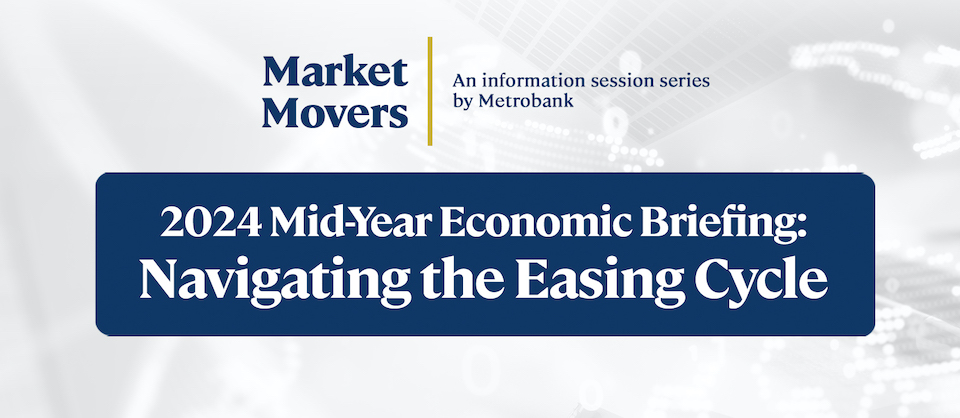
2024 Mid-Year Economic Briefing: Navigating the Easing Cycle
June 21, 2024
Investing with Love
Investing with Love: A Mother’s Guide to Putting Money to Work
May 15, 2024
retirement-ss-3
Investor Series: An Introduction to Estate Planning
September 1, 2023
View All Webinars
DOWNLOADS
grocery-2-aa
Inflation Update: Target breached
DOWNLOAD
Container ship carrying container boxes import export dock with quay crane. Business commercial trade global cargo freight shipping logistic and transportation worldwide oversea concept. Generative AI
Economic Updates
Philippines Trade Update: Wider deficit on strong imports
DOWNLOAD
Frick collection with palm trees 
Economic Updates
Policy Rate Updates: Policy rate updates to reassure 
DOWNLOAD
View all Reports
Metrobank.com.ph How To Sign Up
Follow us on our platforms.

How may we help you?

TOP SEARCHES
  • Where to put my investments
  • Reports about the pandemic and economy
  • Metrobank
  • Webinars
  • Economy
TRENDING ARTICLES
  • Investing for Beginners: Following your PATH
  • On government debt thresholds: How much is too much?
  • Philippines Stock Market Outlook for 2022
  • Deficit spending remains unabated

Login

Access Exclusive Content
Login to Wealth Manager
Visit us at metrobank.com.ph How To Sign Up
Access Exclusive Content Login to Wealth Manager
Search
MODEL PORTFOLIO THE GIST
NEWS AND FEATURES
Global Philippines Fine Living
INSIGHTS
INVESTMENT STRATEGY
Economy Stocks Bonds Currencies
THE BASICS
Investment Tips Explainers Retirement
WEBINARS
2024 Mid-Year Economi Briefing, economic growth in the Philippines
2024 Mid-Year Economic Briefing: Navigating the Easing Cycle
June 21, 2024
Investing with Love
Investing with Love: A Mother’s Guide to Putting Money to Work
May 15, 2024
retirement-ss-3
Investor Series: An Introduction to Estate Planning
September 1, 2023
View All Webinars
DOWNLOADS
grocery-2-aa
Inflation Update: Target breached
April 7, 2026 DOWNLOAD
Container ship carrying container boxes import export dock with quay crane. Business commercial trade global cargo freight shipping logistic and transportation worldwide oversea concept. Generative AI
Economic Updates
Philippines Trade Update: Wider deficit on strong imports
March 27, 2026 DOWNLOAD
Frick collection with palm trees 
Economic Updates
Policy Rate Updates: Policy rate updates to reassure 
March 26, 2026 DOWNLOAD
View all Reports

Archives: Business World Article

Peso strengthens to four-month high

Peso strengthens to four-month high

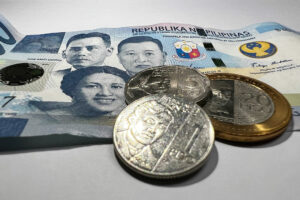
THE PESO appreciated to a four-month high against the dollar on Monday following remarks from US Federal Reserve Chair Jerome H. Powell and ahead of the release of November Philippine inflation data.

The local unit closed at P55.34 per dollar on Monday, strengthening by six centavos from its P55.40 finish on Friday, Bankers Association of the Philippines data showed.

This was the peso’s strongest close in more than four months or since its P55.19-per-dollar finish on Aug. 2.

The peso opened Monday’s session stronger at P55.34 against the dollar, which was also its closing level. Its intraday best was at P55.22, while it went down to as low as P55.37 versus the greenback.

Dollars exchanged inched down to $1.11 billion on Monday from $1.18 billion on Friday.

“The peso appreciated after Fed Chairman Powell echoed his prior cautious guidance on future policy adjustments,” a trader said in an e-mail.

The risks of the Federal Reserve slowing the economy more than necessary have become “more balanced” with those of not moving interest rates high enough to control inflation, Mr. Powell said on Friday, reaffirming the US central bank’s intent to be cautious but also offering fresh optimism on its progress so far, Reuters reported.

The Fed will next meet on Dec. 12-13 to review policy.

The peso was also supported by expectations of slower Philippine headline inflation in November, Rizal Commercial Banking Corp. Chief Economist Michael L. Ricafort said in a Viber message.

A BusinessWorld poll of 15 analysts conducted last week yielded a median estimate of 4.4% for November inflation, at the midpoint of the Bangko Sentral ng Pilipinas’ 4% to 4.8% forecast for the month.

The Philippine Statistics Authority will release the November inflation report on Tuesday.

For Tuesday, the trader said the peso could strengthen further against the dollar on the back of better inflation data.

The trader expects the peso to move between P55.20 and P55.50 a dollar on Tuesday, while Mr. Ricafort sees it ranging from P55.25 to P55.45. — A.M.C. Sy with Reuters

PH manufacturing activity expands in November

PH manufacturing activity expands in November

Manufacturing activity in the Philippines continued to expand in November, propelled by robust demand and growth in new orders and production, S&P Global said.

The S&P Global Philippines Manufacturing Purchasing Managers’ Index (PMI) rose to 52.7 in November from 52.4 in October, indicating a strong improvement in operating conditions, the strongest since February.

“The latest PMI data from S&P Global signaled a further strengthening of the Filipino manufacturing sector in November. Strong demand conditions supported quicker expansions of both new business and output,” Maryam Baluch, economist at S&P Global Market Intelligence, said in a statement on Friday.

A PMI reading above the 50 mark denotes improvement in operating conditions, while a reading below 50 signals deterioration.

In November, the Philippines had the highest PMI reading among Southeast Asian countries with available data, ahead of Indonesia and Singapore (both at 51.7). Meanwhile, Myanmar (48.1), Malaysia (47.9) and Thailand (47.6), and Vietnam (47.3) all recorded contractions during the month.

The headline PMI measures manufacturing conditions through the weighted average of five indices: new orders (30%), output (25%), employment (20%), suppliers’ delivery times (15%), and stocks of purchases (10%).

S&P Global noted the latest PMI survey data showed an uptick in new orders and output.

“Indeed, November saw rates of growth quicken to eight- and ten-month highs, respectively. Firms noted that strong demand conditions both in domestic and foreign markets, new client wins and increased contract work boosted overall sales and in turn spurred greater production,” it said.

On the other hand, purchasing activity declined for the first time in over a year.

“Higher prices for raw materials and concerns of overstocking dissuaded input buying at some firms. However, some businesses continued to purchase inputs amid growing input requirements, thereby helping to offset the overall downturn,” it added.

Manufacturing firms also reported a cut in jobs, ending two months of “tepid growth.”

“The drop came amid continued evidence of spare capacity, as backlogs dropped for the fifth month running and sharply, leading some firms to curtail staffing. That said, a sustained rise in new business encouraged other firms to increase their intake of workers,” it added.

S&P said stocks of purchases expanded but at a modest rate. “Growth in inventories in part stemmed from manufacturing firms holding onto inputs in an effort to become more cost-effective,” it added.

“Meanwhile, vendor performance worsened in November following two months of improvements. The rate at which lead times lengthened was moderate overall, with firms citing material shortages and congestion at ports,” the report said.

“That said, with other price pressures remaining muted, the rate of input price inflation was the weakest recorded in over three years, resulting in a similarly modest uptick in manufacturers’ selling prices,” it added.

Manufacturers were generally optimistic for the next 12 months as almost half of respondents see an expansion in production. “While this marked an improvement since October, confidence levels were still historically subdued,” the report noted.

Rizal Commercial Banking Corp. Chief Economist Michael L. Ricafort said that improved manufacturing output was due to the “seasonal increase in importation, manufacturing, and other production activities” amid the holiday season.

“Generally better weather conditions in most parts of the country also supported the pick up in manufacturing and overall business activities in the country,” he said in a Viber message.

Easing inflation also helped drive factory production, Mr. Ricafort said.

Headline inflation eased to 4.9% in October from 6.1% in September and 7.7% in the same month a year ago.

The latest inflation print was the slowest pace in three months. However, it marked the 19th straight month that inflation breached the central bank’s 2-4% target band. — Luisa Maria Jacinta C. Jocson

‘Hot money’ swings to net outflow in October

‘Hot money’ swings to net outflow in October

Short-term foreign investments continued to exit the Philippines for the second month in October as investors sought higher returns in other countries, data from the Bangko Sentral ng Pilipinas (BSP) showed.

Transactions on foreign investments registered with the central bank through authorized agent banks (AABs) posted a net outflow of USD 328.19 million in October, according to BSP data released on Thursday.

The October figure represents a reversal from the USD 83.44 million in net inflows seen a year earlier. However, it is 52.9% lower than the net outflow of USD 698.01 million in September.

Investments of this nature are commonly referred to as “hot money” due to the ease with which these flows can enter or leave an economy.

“Portfolio outflows from the Philippines persisted as investors sought better returns in countries like the United States,” China Banking Corp. Chief Economist Domini S. Velasquez said in a Viber message.

“The attractive interest rates, strong stock market performance, and ongoing economic resilience in advanced economies and financial centers such as Singapore and Hong Kong have been driving investments in those regions,” she said.

BSP data showed that gross outflows dropped by 19.1% to USD 1.28 billion in October from the USD 1.58 billion seen in the previous month.

October outflows more than doubled (128%) from the USD 561.11 million recorded in the same month in 2022.

The BSP said the United States received 61.9% of total outward remittances.

Meanwhile, gross inflows stood at USD 954.38 million, 7.5% higher than the USD 887.61 million posted in September and by 48% from USD 644.55 million a year earlier.

The bulk of investments (60.5%) went to Philippine Stock Exchange (PSE)-listed securities, mainly in banks, property, holding firms, casinos and gaming, as well as food, beverage and tobacco.

Around 39.5% of the foreign inflows went to investments in peso government securities and other instruments.

Investments during the month mostly came from the United Kingdom, the United States, Luxembourg, Singapore, and Hong Kong, which accounted for 88% of the total foreign inflows.

For the first 10 months of the year, hot money yielded a net outflow of USD 732.58 million, a reversal from the USD 320.24 -million net inflow in the same period last year.

Moving forward, Ms. Velasquez said portfolio inflows to the Philippines may improve in November and December.

“This is primarily due to the sentiment that the US has already reached its peak policy rate, which could prompt investors to divert their investments towards countries like the Philippines,” she said.

The Federal Reserve is widely expected to keep borrowing costs steady in its December policy meeting before its start cutting interest rates in 2024. The Fed has raised rates by 525 basis points (bps) from March 2022 to July 2023.

Back home, the BSP raised policy rates by 450 bps from May 2022 to October 2023, bringing the benchmark interest rate to a 16-year high of 6.5%.

“Additionally, the appreciation of the Philippine peso is expected to further facilitate portfolio inflows as we approach the end of the year,” Ms. Velasquez added.

The BSP expects hot money to yield a net inflow of USD 2 billion this year. — Keisha B. Ta-asan

Peso may move sideways vs dollar

Peso may move sideways vs dollar

The peso may trade sideways against the greenback this week before the release of November inflation data and following comments from the US Federal Reserve chair.

The local currency closed at PHP 55.40 versus the dollar on Friday, appreciating by 8.5 centavos from Thursday’s PHP 55.485 finish, data from the Bankers Association of the Philippines’ website showed.

Week on week, however, the peso inched down by two centavos from its PHP 55.38 close on Nov. 24.

The peso inched up against the dollar on Friday as the Bangko Sentral ng Pilipinas (BSP) said inflation may have eased further in November, Rizal Commercial Banking Corp. Chief Economist Michael L. Ricafort said in a Viber message.

The BSP on Friday said November headline inflation may have settled within the 4-4.8% range. If realized, this would be slower than 4.9% in October and the 8% print in the same month a year ago. 

The low end of the BSP’s November estimate would also match the high end of the central bank’s 2-4% annual inflation target.

The Philippine Statistics Authority will release November inflation data on Tuesday.

The peso was also supported by easing global crude oil prices and US inflation, Mr. Ricafort added.

Improved US personal consumption expenditure (PCE) data could support a pause by the Fed at its next meeting, he said.

Data on Thursday showed US consumer spending rose moderately in October, while the annual increase in inflation was the smallest in more than 2-1/2 years, Reuters reported.

The PCE price index rose 3% in October from a year ago, moderating from a three-month string of 3.4% readings though still above the Fed’s 2% target.

For this week, the peso could trade sideways following comments from Fed Chair Jerome H. Powell and ahead of the release of Philippine November headline inflation data, Security Bank Corp. Chief Economist Robert Dan J. Roces said in a Viber message.

The risks of the Federal Reserve slowing the economy more than necessary have become “more balanced” with those of not moving interest rates high enough to control inflation, Mr. Powell said on Friday, reaffirming the US central bank’s intent to be cautious but also offering fresh optimism on its progress so far, Reuters reported.

As the Fed goes forward, “the data will tell us if we need to do more” rate hikes, Mr. Powell said as he fielded questions from Spelman College President Helene Gayle after his opening remarks at the historically black college.

For this week, Mr. Roces expects the peso to move between PHP 55.30 and PHP 55.80 per dollar, while Mr. Ricafort sees it ranging from PHP 55.10 to PHP 55.60. — A.M.C. Sy with Reuters

PSEi may rise on expectations of slower inflation

PSEi may rise on expectations of slower inflation

Philippine stocks may rise this shortened trading week, with the release of November inflation data expected to be a major catalyst for the market.

The Philippine Stock Exchange index (PSEi) went up by 21.45 points or 0.34% to close at 6,245.18 on Friday, while the broader all shares index climbed by 4.39 points or 0.13% to end at 3,332.22.

Week on week, the PSEi dropped by 24.32 points or 0.39% from its close of 6,269.50 on Nov. 24.

“A growing number of investors are piecing together a picture of a potentially good December for stocks. That narrative will be tested this week as the market turns its focus to the Philippine November inflation print and October US jobs data,” China Bank Capital Corp. Managing Director Juan Paolo E. Colet said in a Viber message.

“The upcoming week will be another four-day trading week, but the release of November inflation data early on should help spark some excitement before discussion once again moves to monetary policy talks mid-December,” online brokerage 2TradeAsia.com said in a report.

The market will be closed on Friday for a holiday in commemoration of the Feast of the Immaculate Conception.

November consumer price index (CPI) data will be released on Tuesday. A BusinessWorld poll of 15 analysts yielded a median estimate of 4.4% for November headline inflation, at the midpoint of the 4-4.8% forecast of the Bangko Sentral ng Pilipinas (BSP) for the month.

If realized, November CPI would be slower than the 4.9% print in October and the 8% logged in the same month last year.

However, November would also mark the 20th straight month that inflation exceeded BSP’s 2-4% annual target.

The Monetary Board will hold its final policy meeting for the year on Dec. 14.

The BSP has raised borrowing costs by 450 basis points since May 2022 to help bring down inflation, with its policy rate now at a 16-year high of 6.5%.

The strong factory activity report released on Friday is also expected to boost sentiment when trading starts this week, Philstocks Financial, Inc. Senior Research Analyst Japhet Louis O. Tantiangco said in a Viber message.

The S&P Global Philippines Manufacturing Purchasing Managers’ Index (PMI) rose to 52.7 in November from 52.4 in October amid robust demand and growth in new orders and production, a report released on Friday showed.

A PMI reading above the 50 mark denotes an improvement in operating conditions, while a reading below 50 signals deterioration.

For this week, 2TradeAsia.com placed the PSEi’s support at 6,100-6,150 and resistance at 6,400.

“Major support is still seen at 6,000 while major resistance is seen at 6,400,” Mr. Tantiangco said.

“The market may see continued consolidation in the 6,200 area and could potentially make an attempt for 6,380 in case of positive news flows,” Mr. Colet added. — S.J. Talavera

English skills give Filipino business students edge in Asia

English skills give Filipino business students edge in Asia

Filipino business students have an edge compared to those from other Asian countries owing to their English skills, which give them different opportunities, an industry expert said.

“One strength that Filipino students have is the command of the [English] language. That is a very important advantage if you’re moving to internationalization,” Mapúa University Enrique T. Yuchengco School of Business (ETYSB) Dean Jagdeep S. Jassel said in an online interview last week.

“There are some countries where the students want to be globally exposed, but their main hindrance or handicap is always the language… Filipino students speak very good English. They’re able to understand. They’re able to articulate, I think that… opens the door to many different opportunities,” he added.

Mr. Jassel comes from Malaysia and has taught in other countries such as India, Japan, China, and Taiwan.

Based on his experience, Filipino business students are very eager to learn as they want to prove themselves, he said.

“It’s best to give your attention to such kinds of characteristics: people who are looking for an opportunity so that they can prove themselves, rather than force feed,” Mr. Jassel said.

He said they want the market to see that Mapúa University is “beyond engineering and architecture” and has a lot to offer, especially with the ongoing collaboration between ETYSB and Arizona State University (ASU).

“This partnership, it’s not just an ordinary MOU (memorandum of understanding)… This is a very concerted effort — a very thoughtful, process-driven kind of partnership,” he said.

The collaboration, which began two years ago, is aimed towards developing students through global immersion, exposure to real work experience, and digital mastery.

“Two years ago, it was more of a planting in a particular relationship. So, to speak, we were getting to know each other, we were understanding better, we looked into structures. But the first intake of students who came in is this year,” Mr. Jassel said.

The business school has been able to develop five new programs for its about 300 students. The institution has access to ASU’s repository of curricula, academic exchange either in person or virtually, and industry exposure.

“Their (ASU) benefit is to have access to this part of the [Asian] market and also to liberalize education — to provide opportunity for any Filipino student who would want to go to the US and eventually even work there or even leave the country,” Mr. Jassel said.

As part of the partnership, ETYSB is also in contact with institutions in ASU’s network, such as Esa Unggul University in Indonesia and Sunway University in Malaysia.

“There are about 20 universities within this network of partnership now. So, we are actually leveraging the strength of network,” Mr. Jassel said.

“I would say one of the edges that Mapúa business students will have is that they will be able to hit the road running when they join any organization,” he added. — Sheldeen Joy Talavera

BSP cancels licenses of two firms

BSP cancels licenses of two firms

The Bangko Sentral ng Pilipinas (BSP) has canceled two firms’ registration to operate as virtual asset service providers (VASP). 

The Monetary Board has revoked the Certificates of Registration of B-Express, Inc. and Coinville Phils., Inc., according to circular letters dated Dec. 1 and signed by BSP Deputy Governor Chuchi G. Fonacier.

Both firms were among the 19 entities in the Philippines that held VASP licenses as of end-June 2022.

The BSP imposed a three-year ban on VASP licensing beginning Sept. 1, 2022.

B-Express, a crypto company based in South Korea, received a virtual currency license from the BSP in March 2019, allowing the firm to engage in crypto to fiat transactions in the Philippines.

Meanwhile, Coinville Phils. was allowed to operate as a remittance and transfer company with virtual currency exchange services in April 2019.

Based on BSP Circular No. 1108, a VASP “refers to any entity that offers services or engages in activities that provide facility for the transfer or exchange of virtual assets” such as cryptocurrency.

VASP activities covered by the central bank include the exchange of one or more forms of virtual assets, transfer of virtual assets, and safekeeping and/or administration of virtual assets or instruments enabling control of virtual assets.

The BSP strengthened security measures for cryptocurrency in 2021, including those for VASPs, which are subject to the central bank’s licensing requirements and anti-money laundering obligations.

The central bank has said digital currencies enable faster and cheaper remittances, but has warned the public about their risks, including their rapidly-changing value, potential use in crimes, and cybersecurity issues. — K.B. Ta-asan

Gov’t debt yields drop on slower Nov. inflation bets

Gov’t debt yields drop on slower Nov. inflation bets

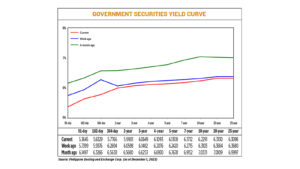
Yields on government securities (GS) ended lower last week as investors expect slower November inflation at home and the US Federal Reserve to keep rates steady for the rest of the year.

GS yields at the secondary market fell by an average of 16.64 basis points (bps) week on week, based on the PHP Bloomberg Valuation (BVAL) Service Reference Rates of Dec. 1 published on the Philippine Dealing System’s website.

Rates went down across all tenors. The 91-, 182-, and 364-day Treasury bills (T-bills) declined by 37.54 bps, 30.47 bps and 49.28 bps to yield 5.3645%, 5.6329%, and 5.7766%, respectively.

At the belly of the curve, the rates of the two-, three-, four-, five-, and seven-year Treasury bonds (T-bonds) went down by 6.97 bps (5.9901%), 8.33 bps (6.0649%), 9.83 bps (6.1093%), 11.12 bps (6.1308%), and 10.03 bps (6.1712%), respectively.

At the long end, yields on the 10-, 20-, and 25-year T-bonds dropped by 8.12 bps (to 6.2291%), 5.54 bps (6.313%), and 5.82 bps (6.3098%), respectively.

Total GS volume traded amounted to PHP 9.3 billion on Friday, lower than the PHP 23.25 billion recorded on Nov. 24.

“Expectations of slowing inflation have fueled yields to fall. This is supported by bets that the US Fed may be at the end of its tightening cycle,” Jonathan L. Ravelas, senior adviser at Reyes Tacandong & Co., said in a Viber message.

A BusinessWorld poll of 15 analysts yielded a median estimate of 4.4% for November headline inflation, at the midpoint of the 4-4.8% forecast of the Bangko Sentral ng Pilipinas (BSP) for the month. 

If realized, the November consumer price index (CPI) would ease from the 4.9% print in October and the 8% recorded in the same month last year.

However, this would mark the 20th straight month that inflation exceeded BSP’s 2-4% annual target.

The November CPI report will be released on Tuesday.

Meanwhile, US Treasury yields and the dollar fell on the day as investors were encouraged by Federal Reserve Chair Jerome H. Powell’s vow to move “carefully” on interest rates, Reuters reported.

Treasury yields fell after Mr. Powell said the risks of hiking interest rates too much and slowing the economy more than necessary have become “more balanced” with the risks of not hiking enough to control inflation.

The Fed kept its target rate steady at the 5.25%-5.5% range for a second straight time during its Oct. 31-Nov. 1 meeting.

It has hiked borrowing costs by a cumulative 525 bps since it began its tightening cycle in March last year.

The Federal Open Market Committee will next meet on Dec. 12-13 to review their policy stance.

“Investors were keen on loading up local bonds across the curve as supply declined significantly especially on the T-bills space. At the same time, the upcoming inflation print for November pushed investors to bet on a lower headline CPI by adding up long end bonds for duration,” Alessandra P. Araullo, chief investment officer at ATRAM Trust Corp., said in a Viber message.

For this week, the auction of 10-year T-bonds and the November CPI data release will be the main GS trading drivers, Ms. Araullo said.

“These events may pull yields lower given the recently announced supply of bonds for the month of December which is significantly lower (only PHP 60 billion for the whole month), and Bangko Sentral ng Pilipinas’ November CPI indicative range at 4-4.8% (lower from previous print at 4.9%),” she said.

“Despite these developments’ movements, equity markets remain cautious as upside risks to inflation remains. Continue to be expect rates to move sideways in the week ahead,” Mr. Ravelas added. — Lourdes O. Pilar with Reuters

T-bill, bond rates to track secondary mart levels

T-bill, bond rates to track secondary mart levels

RATES of Treasury bills and bonds on offer this week could track secondary market levels amid easing global crude oil prices and following comments from US Federal Reserve Chair Jerome H. Powell.

The government will auction off P10 billion in Treasury bills (T-bills) on Monday, or P3 billion each in 91- and 182-day papers and P4 billion in 364-day papers.

On Tuesday, it will offer P20 billion in reissued 10-year Treasury bonds (T-bonds) with a remaining life of nine years and eight months.

T-bill yields could rise this week, while the reissued 10-year T-bonds could decline, Rizal Commercial Banking Corp. Chief Economist Michael L. Ricafort said in a Viber message.

At the secondary market on Friday, the rates of the 91-, 182-, and 364-day T-bills went down by 37.54 basis points (bps), 30.47 bps, and 49.28 bps week on week to end at 5.3645%, 5.6329%, and 5.7766%, respectively, based on PHP Bloomberg Valuation Service Reference Rates data published on the Philippine Dealing System’s website.

Meanwhile, the yield on the 10-year bond went down by 8.12 bps to end at 6.2291% on Friday.

Secondary market rates went down amid lower global crude oil prices and comments from the Fed chair, Mr. Ricafort said.

Meanwhile, a trader expects the 10-year bond to fetch yields of 6.25-6.35%.

“The 10-year bond auction [this] week should be interesting as we suspect speculative trades remain heavy… This will reveal if investment books will be supportive,” the trader said in an e-mail.

On Friday, oil prices settled more than 2% lower for a second consecutive day, with the market unconvinced the latest round of production cuts will be enough to lift prices from a recent slump, Reuters reported.

US crude settled down by 2.49% at $74.07 per barrel and Brent ended at $78.88, down by 2.45% on the day.

Meanwhile, the risks of the Federal Reserve slowing the economy more than necessary have become “more balanced” with those of not moving interest rates high enough to control inflation, Mr. Powell said on Friday, reaffirming the US central bank’s intent to be cautious but also offering fresh optimism on its progress so far.

Noting that a key measure of inflation averaged 2.5% over the six months ending in October, near the Fed’s 2% target, Mr. Powell said it was clear that US monetary policy was slowing the economy as expected with a benchmark overnight interest rate “well into restrictive territory.”

As the Fed goes forward, “the data will tell us if we need to do more” rate hikes, Mr. Powell said as he fielded questions from Spelman College President Helene Gayle after his opening remarks at the historically black college.

The US central bank kept the fed funds rate steady at the 5.25%-5.5% range for a second straight time during its Oct. 31-Nov. 1 meeting.

It has hiked rates by a cumulative 525 basis points (bps) since it began its tightening cycle in March 2022.

The Fed will next meet on Dec. 12-13 to review policy.

Last week, the BTr raised P10 billion as planned via the T-bills it offered on Tuesday as total bids reached P72.215 billion, more than seven times the amount on the auction block.

Broken down, the Treasury made a full P3-billion award of the 91-day T-bills, with tenders for the tenor reaching P25.615 billion. Its average rate fell by 137 bps to 4.753%. Accepted rates ranged from 4.72% to 4.78%.

The government likewise borrowed the programmed P3 billion through the 182-day securities, as bids for the paper reached P22.38 billion. The average rate for the six-month T-bill went down by 133.2 bps to 5.181%, with accepted yields ranging from 5.11% to 5.27%.

Lastly, the BTr raised P4 billion as planned via the 364-day debt papers, with bids reaching P24.22 billion. The average rate of the one-year T-bill went down by 83.3 bps to 5.727%. Accepted yields were from 5.59% to 5.75%.

Meanwhile, the reissued 10-year bonds to be offered on Tuesday were last auctioned off on Nov. 14, where the government raised P30 billion as planned at an average rate of 6.781%. Accepted yields ranged from 6.748% to 6.8%.

The BTr wants to raise P60 billion from the domestic market this month, or P20 billion via T-bills and P40 billion via T-bonds.

The government borrows from local and foreign sources to help fund its budget deficit, which is capped at 6.1% of gross domestic product this year — A.M.C. Sy with Reuters


BTr eyes less December borrowing

BTr eyes less December borrowing

The Philippine government plans to borrow less from the domestic market next month, the Bureau of the Treasury (BTr) said on Thursday, amid a shrinking budget deficit that eases the pressure to finance its debt.

The December borrowing plan is 73% lower than the PHP 225-billion program in November and 60% less than what it raised this month, the BTr said in a memo posted on its website.

The government will borrow PHP 20 billion via Treasury bills and PHP 40 billion via Treasury bonds.

It will sell PHP 3 billion each in 91- and 182-day securities, as well as PHP 4 billion in 364-day T-bills on Dec. 4 and Dec. 11.

The Treasury will also auction off PHP 20 billion each in 10-year and 15-year bonds on Dec. 5 and 12, respectively.

The lower borrowing coupled with a positive outlook for the Philippine economy would likely lead to high demand for both T-bills and T-bonds, analysts said.

The state is borrowing less next month given the shrinking budget gap, Domini S. Velasquez, chief economist at China Banking Corp., said in a Viber message.

Ms. Velasquez said the smaller borrowing via Treasury bills should boost the market rally and aid the decline in interest rates.

“This decision is influenced, in part, by the projected smaller budget deficit for 2023 compared with the initial program,” she said. “As we approach the final months of the year, the government still has around PHP 481.5-billion fiscal space available, which is unlikely to be fully utilized.”

The Philippine government’s budget deficit shrank in October as revenue growth outpaced spending, the Treasury bureau said on Wednesday. The fiscal gap narrowed by 65.27% to PHp 34.4 billion from P99.1 billion a year ago.

In the 10 months to October, the budget gap narrowed by 8.45% to PHP 1.018 trillion from a year earlier. This was equivalent to 67.88% of the full-year PHP 1.499-trillion deficit program.

Revenue increased by 9.41% to PHP 3.224 trillion, which was already 86% of the target for the year.

The government sees no need to borrow more given the approaching Christmas holiday, Michael L. Ricafort, chief economist at Rizal Commercial Banking Corp., said in a Viber message.

Yields would probably decline further if global crude prices and inflation continue to ease, he added.

In October, inflation eased to 4.9% from 6.1% in September and 7.7% a year earlier. This was below the Philippine central bank’s 5.1-5.9% forecast for the month.

October inflation was the slowest in three months but marked the 19th straight month that it breached the central bank’s 2-4% target. Year to date, inflation stood at 6.4%.

“The lower borrowing plan could also suggest that the government had already reached its target for the year,” Robert Dan J. Roces, chief economist at Security Bank Corp., said in a Viber message. “It is also able to fund its spending needs on the back of good revenue, notably during the holiday season.”

The gross domestic borrowing program this year is set at PHP 1.654 trillion, composed of PHP 54.1 billion in T-bills and PHP 1.6 trillion in fixed-rate T-bonds.

The government borrows from local and external sources to help fund a budget deficit capped at 6.1% of the gross domestic product this year. — By Aaron Michael C. Sy, Reporter

Posts navigation

Older posts
Newer posts

Recent Posts

  • Metrobank US-Iran Risk Index: A new hope
  • A guide for your peso bond portfolio amid higher for longer rates
  • Investment Ideas: April 8, 2026
  • Inflation Update: The case to tighten
  • Investment Ideas: April 7, 2026

Recent Comments

No comments to show.

Archives

  • April 2026
  • March 2026
  • February 2026
  • January 2026
  • December 2025
  • November 2025
  • October 2025
  • September 2025
  • August 2025
  • July 2025
  • June 2025
  • May 2025
  • April 2025
  • March 2025
  • February 2025
  • January 2025
  • December 2024
  • November 2024
  • October 2024
  • September 2024
  • August 2024
  • July 2024
  • June 2024
  • May 2024
  • April 2024
  • March 2024
  • February 2024
  • January 2024
  • December 2023
  • November 2023
  • October 2023
  • September 2023
  • August 2023
  • July 2023
  • June 2023
  • May 2023
  • April 2023
  • March 2023
  • February 2023
  • January 2023
  • December 2022
  • November 2022
  • October 2022
  • September 2022
  • August 2022
  • July 2022
  • June 2022
  • May 2022
  • March 2022
  • December 2021
  • October 2021

Categories

  • Bonds
  • BusinessWorld
  • Currencies
  • Economy
  • Equities
  • Estate Planning
  • Explainer
  • Featured Insight
  • Fine Living
  • How To
  • Investment Tips
  • Markets
  • Portfolio Picks
  • Rates & Bonds
  • Retirement
  • Reuters
  • Spotlight
  • Stocks
  • Uncategorized

You are leaving Metrobank Wealth Insights

Please be aware that the external site policies may differ from our website Terms And Conditions and Privacy Policy. The next site will be opened in a new browser window or tab.

Cancel Proceed
Get in Touch

For inquiries, please call our Metrobank Contact Center at (02) 88-700-700 (domestic toll-free 1-800-1888-5775) or send an e-mail to customercare@metrobank.com.ph

Metrobank is regulated by the Bangko Sentral ng Pilipinas
Website: https://www.bsp.gov.ph

Quick Links
The Gist Webinars Wealth Manager Explainers
Markets
Currencies Rates & Bonds Equities Economy
Wealth
Investment Tips Fine Living Retirement
Portfolio Picks
Bonds Stocks
Others
Contact Us Privacy Notice Terms of Use
© 2026 Metrobank. All rights reserved.

Access this content:

If you are an existing investor, log in first to your Metrobank Wealth Manager account. ​

If you wish to start your wealth journey with us, click the “How To Sign Up” button. ​

Login HOW TO SIGN UP