MODEL PORTFOLIO
THE GIST
NEWS AND FEATURES
Global Philippines Fine Living
INSIGHTS
INVESTMENT STRATEGY
Economy Stocks Bonds Currencies
THE BASICS
Investment Tips Explainers Retirement
WEBINARS
2024 Mid-Year Economi Briefing, economic growth in the Philippines
2024 Mid-Year Economic Briefing: Navigating the Easing Cycle
June 21, 2024
Investing with Love
Investing with Love: A Mother’s Guide to Putting Money to Work
May 15, 2024
retirement-ss-3
Investor Series: An Introduction to Estate Planning
September 1, 2023
View All Webinars
DOWNLOADS
grocery-2-aa
Inflation Update: Target breached
DOWNLOAD
Container ship carrying container boxes import export dock with quay crane. Business commercial trade global cargo freight shipping logistic and transportation worldwide oversea concept. Generative AI
Economic Updates
Philippines Trade Update: Wider deficit on strong imports
DOWNLOAD
Frick collection with palm trees 
Economic Updates
Policy Rate Updates: Policy rate updates to reassure 
DOWNLOAD
View all Reports
Metrobank.com.ph How To Sign Up
Follow us on our platforms.

How may we help you?

TOP SEARCHES
  • Where to put my investments
  • Reports about the pandemic and economy
  • Metrobank
  • Webinars
  • Economy
TRENDING ARTICLES
  • Investing for Beginners: Following your PATH
  • On government debt thresholds: How much is too much?
  • Philippines Stock Market Outlook for 2022
  • Deficit spending remains unabated

Login

Access Exclusive Content
Login to Wealth Manager
Visit us at metrobank.com.ph How To Sign Up
Access Exclusive Content Login to Wealth Manager
Search
MODEL PORTFOLIO THE GIST
NEWS AND FEATURES
Global Philippines Fine Living
INSIGHTS
INVESTMENT STRATEGY
Economy Stocks Bonds Currencies
THE BASICS
Investment Tips Explainers Retirement
WEBINARS
2024 Mid-Year Economi Briefing, economic growth in the Philippines
2024 Mid-Year Economic Briefing: Navigating the Easing Cycle
June 21, 2024
Investing with Love
Investing with Love: A Mother’s Guide to Putting Money to Work
May 15, 2024
retirement-ss-3
Investor Series: An Introduction to Estate Planning
September 1, 2023
View All Webinars
DOWNLOADS
grocery-2-aa
Inflation Update: Target breached
April 7, 2026 DOWNLOAD
Container ship carrying container boxes import export dock with quay crane. Business commercial trade global cargo freight shipping logistic and transportation worldwide oversea concept. Generative AI
Economic Updates
Philippines Trade Update: Wider deficit on strong imports
March 27, 2026 DOWNLOAD
Frick collection with palm trees 
Economic Updates
Policy Rate Updates: Policy rate updates to reassure 
March 26, 2026 DOWNLOAD
View all Reports

Archives: Business World Article

Peso rebounds before key US data

Peso rebounds before key US data

The peso strengthened anew against the dollar on Tuesday ahead of the release of the November US consumer inflation data overnight.

The local unit closed at PHP 55.57 per dollar on Tuesday, rising by eight centavos from the near one-month low finish of PHP 55.65 on Monday, data on the Bankers Association of the Philippines’ website showed.

The peso opened Tuesday’s session stronger at PHP 55.60 against the dollar. Its intraday best was at PHP 55.55, while its weakest showing was at PHP 55.65 versus the greenback.

Dollars exchanged rose to USD 1.005 billion on Tuesday from USD 888.88 million recorded on Monday.

“The peso appreciated amid potentially a softer US consumer inflation report for November 2023,” a trader said in an e-mail.

The dollar slightly ahead of the release of November US consumer inflation data, Rizal Commercial Banking Corp. Chief Economist Michael L. Ricafort said in a Viber message.

The November US consumer price index (CPI) report was set to be released overnight.

In October, the US CPI was unchanged for the first time in more than a year following a 0.4% rise in September.

In the 12 months through October, the CPI was up by 3.2% after climbing by 3.7% in September.

The peso was also supported by the rollback in local fuel and energy prices, as it could help bring down inflation to the Bangko Sentral ng Pilipinas’ (BSP) 2-4% annual target, Mr. Ricafort added.

Headline inflation rose by 4.1% year on year in November, easing from the 4.9% in October and 8% in November 2022.

This was the slowest rate in 20 months or since the 4% seen in March 2022.

In the 11 months through November, headline inflation averaged 6.2%, faster than 5.6% in the same period last year. This is still above the BSP’s 2-4% goal.

For Wednesday, the trader said the peso could climb further as the Federal Reserve starts its two-day policy meeting.

The trader sees the peso moving between PHP 55.40 and PHP 55.64 per dollar on Wednesday, while Mr. Ricafort expects it to range from PHP 55.45 to PHP 55.65.

PSEi rises before US CPI data, policy meetings

PSEi rises before US CPI data, policy meetings

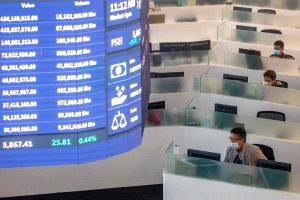
Philippine stocks rose on Tuesday to end a three-day skid as investors await the release of November US consumer price index (CPI) data and the policy meetings of the US Federal Reserve and the Bangko Sentral ng Pilipinas (BSP).

The bellwether Philippine Stock Exchange index (PSEi) climbed by 64.10 points or 1.02% to end at 6,292.39 on Tuesday, while the broader all shares index jumped by 25.81 points or 0.77% to close at 3,353.46. 

“The index surged on market-on-close buying as traders continued to position ahead of the release of US November inflation data as well as the much-awaited policy meetings of the Federal Reserve and Bangko Sentral ng Pilipinas,” China Bank Capital Corp. Managing Director Juan Paolo E. Colet said in a Viber message.

“This Tuesday, the local market rose… as investors took positive cues from Wall Street overnight amid expectations that US inflation further slowed down in November. Additionally, the anticipation that both the Federal Reserve and the BSP will be holding key policy rates amid cooling inflation in the US and at home contributed to the climb,” Philstocks Financial, Inc. Research and Engagement Officer Mikhail Philippe Q. Plopenio said in a Viber message.

The November US CPI report was set to be released overnight.

Meanwhile, the Fed will hold its final review for the year on Dec. 12-13, while the BSP’s Monetary Board will meet to discuss policy on Dec. 14.

The US central bank is widely expected to keep its target rate at the 5.25%-5.5% range for a third straight meeting this week.

It has hiked rates by a cumulative 525 basis points (bps) since it began its tightening cycle in March 2022.

On the other hand, a BusinessWorld poll last week showed 15 out of 17 analysts expect the Monetary Board to keep its target reverse repurchase rate steady at a 16-year high of 6.5% on Thursday, with the BSP remaining vigilant amid lingering risks to prices despite easing inflation recently.

The BSP has raised benchmark interest rates by a cumulative 450 bps since May 2022.

All sectoral indices closed higher on Tuesday. Financials went up by 25.76 points or 1.54% to 1,698.23; property rose by 24.53 points or 0.88% to 2,786.97; holding firms climbed by 50.94 points or 0.85% to 6,007.55; services increased by 12.21 points or 0.79% to 1,549.91; industrials added 56.92 points or 0.65% to end at 8,795.41; and mining and oil gained 21.33 points or 0.22% to close at 9,565.27. 

Value turnover dropped to PHP 3.25 billion on Tuesday with 314.76 million shares changing hands from the PHP 4.06 billion with 392.39 million issues seen on Monday. 

Advancers beat decliners, 97 to 61, while 55 names closed unchanged. 

Net foreign buying stood at PHP 158.02 million on Tuesday versus the PHP 32.81 million in net selling posted on Monday. — R.M.D. Ochave

FDI inflows drop to 3-year low in Sept.

FDI inflows drop to 3-year low in Sept.

Net inflows of foreign direct investments (FDI) slumped to the lowest level in over three years in September, as the uncertain global economic environment dampened investor sentiment.

Data released by the Bangko Sentral ng Pilipinas (BSP) on Monday showed FDI net inflows plunged by 42.2% to USD 422 million in September from USD 731 million in the same month in 2022.

This was also 46.5% lower than the USD 790-million FDI net inflows in August.

The September figure was the lowest monthly net inflow of FDI in over three years, or since the USD 314 million in April 2020 at the height of the coronavirus disease 2019 (COVID-19) pandemic lockdowns.

Security Bank Corp. Chief Economist Robert Dan J. Roces attributed the FDI slump in September to global economic uncertainties such as possible recessions and trade disputes.

“Domestic policy shifts, and currency fluctuations have further dampened confidence. Challenges in key sectors and the attractiveness of other regions also play a role,” he said in a Viber message.

BSP data showed all major FDI components posted a decline in net inflows in September.

Nonresidents’ net investments in debt instruments of local affiliates fell by 47.8% to USD 238 million in September from USD 456 million in the same month in 2022.

Meanwhile, investments in equity and investment fund shares slid by 33.1% to USD 184 million in September from USD 275 million a year ago.

Reinvestment of earnings also slipped by 9.9% year on year to USD 79 million in September.

Nonresidents’ net investments in equity capital (other than reinvestment of earnings) also declined by 43.9% to USD 105 million in September from USD 187 million in the same month last year.

Broken down, equity capital placements slumped by 25.2% to $172 million, while withdrawals climbed by 57% to USD 67 million.

The equity placements were mainly from Japan, Singapore, and the United States, and invested mostly in financial and insurance, construction, manufacturing, and other industries.

“Net FDI inflow in September was the lowest since April 2020, indicating the continued impact of a challenging global economic environment on investor sentiment,” China Banking Corp. Chief Economist Domini S. Velasquez said in a Viber message.

9-month slump
For the first nine months of the year, FDI net inflows dropped by 15.9% to USD 5.9 billion from USD 7 billion in the comparable year-ago period.    

“FDI declined on the back of persistent global economic uncertainties, which continued to affect investor decisions,” the central bank said.

BSP data showed foreign investments in debt instruments declined by 17.2% year on year to USD 4.06 billion in the January-to-September period.

Investments in equity and investment fund shares also dropped by 12.9% to USD 1.8 billion in the nine-month period.

Net foreign investments in equity capital went down by 18.5% to USD 945 million. Equity capital placements inched up by 2.7% to USD 1.39 billion, while withdrawals surged by 126.5% to USD 448 million.

Most of these placements were from Japan, Singapore, the United States, and Germany.

Reinvestment of earnings dipped by 6.1% to USD 869 million in the January-to-September period.

Ms. Velasquez said that if economic conditions improve in 2024, net FDI inflows may improve.

“The country’s favorable growth prospects and the government’s efforts to attract investors such as trade liberalization reforms and overseas roadshows, could also contribute to boosting investor sentiment,” she said.

Ms. Velasquez said the government can still improve infrastructure and the ease of doing business in the Philippines in order to make the country more competitive in attracting investments.

“Moving forward, the Philippines’ FDI outlook hinges on global economic recovery, consistent domestic policies, strong economic performance, and a more competitive regional stance,” Mr. Roces said.

The BSP expects FDI net inflows to end the year at USD 8 billion. — By Keisha B. Ta-asan, Reporter

Congress ratifies PHP5.77-T national budget

Congress ratifies PHP5.77-T national budget

Philippine lawmakers on Monday ratified the Bicameral Conference Committee report on the PHP 5.768-trillion national budget for 2024, with the education, infrastructure, and defense agencies receiving the biggest increases.

This came after the Bicameral Conference Committee reconciled the conflicting provisions of the proposed General Appropriations Act of 2024 and approved around PHP 450 billion in changes to new appropriations.

After Congress’ ratification, the budget measure will be sent to Malacañang for President Ferdinand R. Marcos, Jr.’s signature.

Mr. Marcos is expected to sign the 2024 national budget before he leaves for Japan to attend the 50th anniversary of the Association of Southeast Asian Nations-Japan Friendship and Cooperation commemorative summit from Dec. 16 to 18.

“Education remains a top priority in our expenditure plan for 2024. The increases made to our education agencies support ongoing efforts to make educational opportunities more available and accessible,” Senator Juan Edgardo M. Angara, who heads the Senate Finance Committee, said during Monday’s plenary session before the ratification of the report.

Under the Constitution, the government must prioritize funding the education sector. For 2024, the education sector has been allocated PHP 924.7 billion, of which the Department of Education (DepEd) will receive PHP 758.6 billion.

Citing the consolidated measure, Senate Majority Leader Emmanuel Joel J. Villanueva told plenary that the budgets of Technical Skills and Development Authority (TESDA), DepEd, the Commission on Higher Education (CHED), and state universities and colleges (SUCs) were increased by almost PHP 30 billion.

Mr. Angara said additional funds were given to education agencies to implement scholarship programs, employment training programs and a voucher program for senior high school students.

However, Senate Minority Leader Aquilino Martin D. Pimentel III questioned why the bicam panel approved a PHP 450-billion increase in unprogrammed appropriations, bringing the total to PHP 731.4 billion. This despite the Department of Budget and Management (DBM) initially recommending a total of PHP 281.9 billion in unprogrammed appropriations, which are funds that are put on standby in case of additional priority programs or projects when revenue collection exceeds targets.

“The reason is to carve out fiscal space in the programmed appropriations for other items that are proposed by our colleagues both here and in the House,” Mr. Angara said.

Also, Mr. Villanueva said the Department of Trade and Industry’s budget was increased by about PHP 686 million for the government’s efforts to boost domestic production and make Philippine products more competitive with their global counterparts.

Mr. Angara said the national budget will provide “significant” funds for infrastructure, particularly roads, bridges, railways, and seaports.

“We also kept provisions to ensure that active transport infrastructure like bike lanes, pedestrian walkways, and other commuter safety features are included in their major projects,” he said.

Meanwhile, Party-List Rep. Elizaldy S. Co, who heads the House Committee on Appropriations, said bicam panel increased the allocation for irrigation projects under the National Irrigation Administration by at least PHP 40 billion.

He told reporters that lawmakers granted the request of the Department of Agriculture (DA) for an additional PHP 25 billion to boost the sector.

The national budget also allotted PHP 10 billion in subsidies for the Pambansang Pabahay para sa Pilipino Program (4PH) housing program, Mr. Co said.

The spending plan also includes funding for the Ayuda sa Kapos sa Kita Program (AKAP), a social amelioration program for families earning PHP 23,000 or less monthly.

Each beneficiary of the AKAP program would receive about PHP 5,000 and free medical assistance, Mr. Co. said.

Lawmakers also added P 1 billion for the development of the Philippine General Hospital, National Kidney Center, Philippine Children’s Medical Center, and National Cancer Center.

Mr. Co said the panel denied the Department of Information and Communications Technology’s (DICT) request to restore its confidential funds worth PHP 280 million for its cybersecurity programs.

Congress also stripped confidential funds from civilian agencies. Mr. Angara noted that only about PHP 9.5 billion of these funds were realigned to security agencies mandated to use them.

The senator said the funds were transferred to defense agencies amid tensions with China in the South China Sea, citing a PHP 2-billion budget increase for the Philippine Coast Guard.

Legislators also adopted a provision proposed by Senator Ana Theresia N. Hontiveros-Baraquel barring civilian agencies from using their contingency funds to increase their confidential and intelligence funds.

“(House Appropriations Chair) Mr. Co correctly proposed funding increases for irrigation projects as this ensures a medium-term plan to raise productivity levels in our agricultural sector, particularly rice production,” Terry L. Ridon, a public investment analyst and convenor of think tank InfraWatch PH, said in Facebook Messenger chat.

He said the move was consistent with the government’s commitment to lower the price of rice.

I-Lead Executive Director Zyza Nadine M. Suzara said Congress needs to bolster its oversight over the spending performance of state agencies after the budget bill is passed.

“We have to remember that boosts in funding allocations come with additional targets,” she said in a Viber message. “Public funds ought to be strategically allocated to what taxpayers urgently need.” — By John Victor D. Ordoñez, Reporter

Peso hits near one-month low amid easing bets of early Fed cut

Peso hits near one-month low amid easing bets of early Fed cut

The peso slumped to a near one-month low against the dollar on Monday as strong US jobs data tempered expectations of an early rate cut by the US Federal Reserve.

The local unit closed at PHP 55.65 per dollar on Monday, weakening by 35 centavos from PHP 55.30 on Thursday, based on Bankers Association of the Philippines data.

This is the peso’s worst finish in almost a month or since it closed at PHP 55.67 per dollar on Nov. 17.

The peso opened Monday’s session weaker at PHP 55.57 against the dollar. Its intraday best was at PHP 55.53, while its worst showing was at PHP 55.665 versus the greenback.

Dollars exchanged fell to USD 888.88 million on Monday from USD 1.21 billion on Thursday.

The peso dropped on Monday as the dollar strengthened amid weakening bets of a rate cut by the US central bank in early 2024 following the release of latest nonfarm payrolls data, Rizal Commercial Banking Corp. Chief Economist Michael L. Ricafort said in a Viber message.

“As a result, some profit-taking was also seen in global financial markets, such as the upward correction in US Treasury yields, global crude oil prices, and a slight downward correction in the local stock markets to new one-week lows,” he added. 

“The peso depreciated significantly after the stronger-than-expected US employment report tempered views of an early Fed rate cut next year,” a trader likewise said in an e-mail.

US job growth accelerated in November while the unemployment rate fell to 3.7%, signs of underlying labor market strength that suggested financial market expectations of an interest rate cut early next year were probably premature, Reuters reported.

The Labor department’s closely watched employment report on Friday, however, did not change views that the Federal Reserve’s rate-hiking cycle was complete as annual wages rose moderately last month. Inflation has been cooling in recent months.

The drop in the jobless rate from a nearly two-year high of 3.9% in October alleviated fears that the economy was close to tipping into recession. The US central bank is expected to keep rates unchanged next Wednesday.

Nonfarm payrolls increased by 199,000 jobs last month after rising by an unrevised 150,000 in October, the Labor department’s Bureau of Labor Statistics said. Economists polled by Reuters had forecast 180,000 jobs created.

Financial markets lowered their bets of a rate cut in March. Traders saw higher odds of cut in May. Most economists continued to believe that the Fed would start easing monetary policy in the second half of 2024 as inflation subsides.

The Fed kept its target rate steady at the 5.25%-5.5% range for a second straight time during its Oct. 31-Nov. 1 meeting.

It has hiked rates by a cumulative 525 basis points since it began its tightening cycle in March 2022.

For Tuesday, the trader said the peso could recover against the dollar amid expectations of a good November US consumer price index report to be released later that day.

The trader sees the peso moving between PHP 55.50 and PHP 55.75 per dollar, while Mr. Ricafort expects it to range from PHP 55.55 to PHP 55.75. — AMCS with Reuters

PH stocks drop as US jobs data fuel rate bets

PH stocks drop as US jobs data fuel rate bets

Stocks dropped further on Monday following strong US jobs data, which could support expectations that interest rates will remain steady in the world’s largest economy, a stance that could be mirrored by the Philippine central bank.

The benchmark Philippine Stock Exchange index (PSEi) dropped by 6.48 points or 0.1% to end at 6,228.29 on Monday, while the broader all shares index declined by 1.93 points or 0.05% to finish at 3,327.65. 

“The market is down on strong US employment numbers, pointing to an extended Fed hawkish pause, reinforcing the Bangko Sentral ng Pilipinas’ (BSP) steady hold on the key rate and vigilant stance on the local currency,” First Metro Investment Corp. Head of Research Cristina S. Ulang said in a Viber message.

A US Labor department report showed nonfarm payrolls increased by 199,000 jobs in November, compared with an estimated increase of 180,000, Reuters reported.

The unemployment rate slipped to 3.7%, while average earnings edged up to 0.4% on a monthly basis, compared with forecasts of 0.3% growth.

Interest rate futures show traders widely expect the Federal Reserve to hold interest rates steady at its meeting on Dec. 12-13, according to the CME FedWatch tool.

“The local bourse dropped… as investors digested the statement of the BSP Governor Eli M. Remolona, Jr. that it is premature to discuss policy easing in 2024, prompting negative sentiment due to potential adverse impacts on the economy with prolonged elevated interest rates,” Philstocks Financial, Inc. Research Analyst Claire T. Alviar said in a Viber message.

Mr. Remolona last week said it is premature to discuss policy easing in 2024, with the Monetary Board still prepared to hike borrowing costs if needed to make sure inflation returns to the 2-4% target range.

The Monetary Board will hold its last policy meeting for this year on Thursday, a day after the Fed’s review.

A BusinessWorld poll last week showed 15 out of 17 analysts expect the Monetary Board to keep its target reverse repurchase rate steady this week, with the central bank remaining vigilant amid lingering upside risks to prices despite easing inflation recently.

Most sectoral indices declined on Monday. Financials went down by 33.26 points or 1.95% to 1,672.47; mining and oil dropped by 96.56 points or 1% to 9,543.94; industrials retreated by 24.21 points or 0.27% to 8,738.49; and services decreased by 3.66 points or 0.23% to 1,537.70. 

Meanwhile, holding firms rose by 44.57 points or 0.75% to 5,956.61 and property climbed by 18.06 points or 0.65% to 2,762.44.

Value turnover went up to PHP 4.06 billion on Monday with 392.39 million issues changing hands from the PHP 3.67 billion with 270.24 million issues traded on Thursday.

Decliners outnumbered advancers, 118 to 64, while 48 names ended unchanged. 

Net foreign selling dropped to PHP 32.81 million on Monday from PHP 410.52 million on Thursday.

The market was closed on Friday for a non-working holiday. — RMDO with Reuters

Loans used as reserves hit PHP 8 billion

Loans used as reserves hit PHP 8 billion

Small banks lent out PHP 8.01 billion to micro, small, and medium enterprises (MSMEs) and eligible large enterprises (LEs) as part of their alternative compliance with reserve requirements, the Bangko Sentral ng Pilipinas (BSP) said. 

“For the reserve week ending Oct. 19, TBs (thrift banks) and RCBs (rural and cooperative banks) allocated an aggregate of PHP 8 billion and PHP 6.5 million loans to MSMEs and LEs, respectively, for compliance with the reserve requirements,” it said in a report on recent trends in the Philippine financial system.

The central bank said these accounted for 0.6% and 0.0005% of the total required reserves for the said week. 

The BSP allowed MSMEs loans to be counted as part of banks’ reserve requirements in a bid to boost lending to the sector, which was hit severely by the coronavirus pandemic.

According to the BSP, banks’ availment of the relief measure declined in October this year due to the expiration of its effectivity for universal and commercial banks on June 30.

Smaller lenders can still count their loans to MSMEs and LEs as alternative compliance with reserve requirements until they are fully paid, but not later than Dec. 31, 2025.

Rizal Commercial Banking Corp. Chief Economist Michael L. Ricafort said MSME and LE loans counted as reserve requirements would allow smaller banks to earn more from their loanable funds.

“Given the extension of these regulatory relief requirements for smaller banks, so might as well maximize the returns through these additional MSME and LE loans used as alternative compliance by including the calculation of required reserves while still allowed,” Mr. Ricafort said.

In 2022, banks lent PHP 493.5 billion to MSMEs as alternative compliance with reserve requirements. This was 6.6% higher than the PHP 463.1 billion a year prior.

By banking group, universal and commercial banks extended PHP 390.9 billion in loans to MSMEs, while rural and cooperative banks lent PHP 52.7 billion.

In June, the BSP cut the reserve requirement ratios of big banks by 250 basis points (bps) to 9.5%, by 200 bps to 6% for digital banks, and by 100 bps for thrift banks, and rural and cooperative banks to 2% and 1%, respectively. — Keisha B. Ta-asan

Gross borrowings jump in October

Gross borrowings jump in October

THE NATIONAL GOVERNMENT’S gross borrowings jumped by 23.4% in October as domestic debt surged, the Bureau of the Treasury (BTr) said.

Data from the BTr showed that gross borrowings rose to PHP 225.202 billion in October from PHP 182.429 billion in the same month a year ago.

Gross domestic debt more than tripled to PHP 174.632 billion in October from PHP 56.733 billion a year ago. This accounted for more than three-fourths or 77.5% of total borrowings during the month.

Broken down, domestic debt consisted of PHP 90 billion in fixed-rate Treasury bonds, PHP 71.78 billion in retail onshore dollar bonds, and PHP 12.852 billion in Treasury bills.

Meanwhile, gross external borrowings declined by 59.8% to PHP 50.57 billion in October from PHP 125.696 billion a year ago.

This was composed of PHP 42.514 billion in program loans and PHP 8.056 billion in new project loans.

For the 10-month period, gross borrowings stood at PHP 1.975 trillion, 1.5% lower than PHP 2.006 trillion in the same period a year earlier.

Domestic borrowings slipped by 0.99% to PHP 1.519 trillion during the January-to-October period, from PHP 1.535 trillion a year ago. This accounted for 76.9% of total borrowings for the period.

Fixed-rate Treasury bonds made up the bulk or PHP 1.055 trillion of local debt, followed by retail Treasury bonds (PHP 252.091 billion), Treasury bills (PHP 139.697 billion), and the retail onshore dollar bonds (PHP 71.78 billion).

Meanwhile, external debt in the 10 months to October dropped by 3.3% to PHP 456.311 billion from PHP 471.655 billion.

This consisted of PHP 187.573 billion in program loans, PHP 163.607 billion in global bonds, and PHP 105.131 billion in new project loans.

Rizal Commercial Banking Corp. Chief Economist Michael L. Ricafort said that higher borrowings in October were due to the government’s sale of retail dollar bonds.

The government raised $1.26 billion from the first retail dollar bond offering under the Marcos administration. This was higher than the minimum issue size of $200 million but below the $1.6 billion raised at the maiden retail dollar bond auction in 2021.

The dollar-denominated five-and-a-half-year bonds fetched a coupon rate of 5.75% and were awarded at rates ranging from 5% to 5.75%, bringing the average to 5.509%.

Mr. Ricafort also said that elevated interest rates also drove borrowing costs higher.

The Bangko Sentral ng Pilipinas (BSP) delivered a 25-basis-point (bp) off-cycle rate hike in October, bringing the benchmark rate to a 16-year high of 6.5%. It kept rates steady at its latest policy meeting in November.

Since May 2022, the central bank has raised borrowing costs by a cumulative 450 bps.

“Going forward, lower global crude oil and other commodity prices that help ease inflation towards the target of the central bank would eventually support a pause or even cuts in policy rates, especially in 2024, and thereby help reduce new government borrowings and debt servicing bill,” Mr. Ricafort said.

“Tax and fiscal reform measures would structurally improve tax revenue collections and could lead to more disciplined government spending, thereby helping narrow budget deficits and the borrowings needed to finance the budget deficit,” he added.

In the January-to-October period, the budget deficit narrowed by 8.45% to PHP 1.018 trillion from a year ago. This was equivalent to 67.88% of the full-year PHP 1.499-trillion deficit program.

This year, the National Government set its borrowing program at PHP 2.207 trillion, consisting of PHP 1.654 trillion from domestic sources and PHP 553.5 billion from foreign creditors. — Luisa Maria Jacinta C. Jocson

Gov’t debt yields drop on inflation data

Gov’t debt yields drop on inflation data

YIELDS on government securities (GS) mostly went down last week after headline inflation slowed further in November.

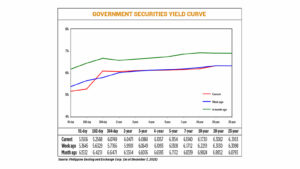
GS yields, which move opposite to prices, went down by an average of 3 basis points (bps) week on week, based on the PHP Bloomberg Valuation (BVAL) Service reference Rates as of Dec. 7 published on the Philippine Dealing System’s website.

Yields on the 91-day and 182-day Treasury bills (T-bills) dropped by 21.39 bps (to 5.1506%) and 37.61 bps (5.2568%), respectively. Meanwhile, the 364-day T-bill saw its rate rise by 29.83 bps week on week to 6.0749%.

Rates at the belly of the curve were likewise mixed, Yields on the two- and three-year Treasury bonds (T-bonds) rose by 5.7 bps (to 6.0471%) and 2.12 bps (6.0861%), respectively, while the rates of the four-, five-, and seven-year bonds fell by 0.36 bp (6.1057%), 1.54 bps (6.1154%), and 3.72 bps (6.1340%).

At the long end of the curve, the 10- and 20- year debt papers went down by 5.61 bps and 0.48 bp to yield 6.173% and 6.3082%, respectively. Meanwhile, the rate of the 25-year bond inched up by 0.05 bp to 6.3103%.

Total GS volume reached P8.67 billion on Thursday, lower than P9.3 billion on Dec. 1, BVAL data showed.

The slower November inflation print pushed yields on most benchmark tenors down last week, Reyes Tacandong & Co. Senior Adviser Jonathan L. Ravelas said in a Viber message.

“GS yields declined as the lower-than-expected Philippine inflation solidified prospects of further easing in domestic prices,” a bond trader likewise said in an e-mail.

Headline inflation eased to its slowest pace in 20 months in November amid easing prices of food as well as restaurant and accommodation services, the Philippine Statistics Authority (PSA) reported last week.

Preliminary data from the PSA showed headline inflation climbed 4.1% annually in November, slower than 4.9% in October and 8% in November 2022.

This was the slowest rate in 20 months or since the 4% seen in March 2022.

It was also slower than the median estimate of 4.4% in a BusinessWorld poll of 15 analysts conducted last week, and at the lower end of the 4-4.8% forecast range of the Bangko Sentral ng Pilipinas (BSP). 

For the first 11 months, headline inflation averaged 6.2%, faster than 5.6% in the same period a year ago. This was still above the BSP’s baseline forecast of 6% and 2-4% target for 2023.

For this week, GS yields may move sideways to lower, depending on the results of the policy meetings of the US Federal Reserve and the BSP, Mr. Ravelas said.

The slower November inflation print has supported views that the BSP could keep its rates steady at its meeting this week, the bond trader said.

“For this week, bond yields might continue to head south as major central banks, including the BSP, are expected to maintain their policy rates on hold,” the trader added.

The BSP’s policy-setting Monetary Board will hold its last meeting for the year on Thursday.

A BusinessWorld poll last week showed 15 out of 17 analysts expect the BSP to keep its target reverse repurchase rate steady this week amid lingering upside risks to prices despite easing inflation recently.

The BSP last month kept its policy rate at a 16-year high of 6.5%. It has raised benchmark interest rates by a cumulative 450 bps since May 2022 to help tame inflation.

Meanwhile, the Federal Open Market Committee will meet on Dec. 12-13 to review policy. Markets expect the US central bank to keep rates steady for a third straight time this week.

The Fed kept its target rate steady at the 5.25%-5.5% range for a second straight time during its Oct. 31-Nov. 1 meeting.

The US central bank has hiked rates by a cumulative 525 bps since it kicked off its tightening cycle in March 2022. — AMCS

BSP to extend rate hike pause — poll

BSP to extend rate hike pause — poll

THE BANGKO SENTRAL ng Pilipinas (BSP) is widely expected to keep its key policy rate at a 16-year high on Thursday despite easing inflation as it remains vigilant against risks.

A BusinessWorld poll last week showed 15 out of 17 analysts expect the Monetary Board to hold the target reverse repurchase (RRP) rate steady at 6.5% on Dec. 14 — the BSP’s last policy review for the year.

A pause on Thursday would be the second straight meeting the BSP left rates unchanged since its 25-basis-point (bp) off-cycle hike on Oct. 26.
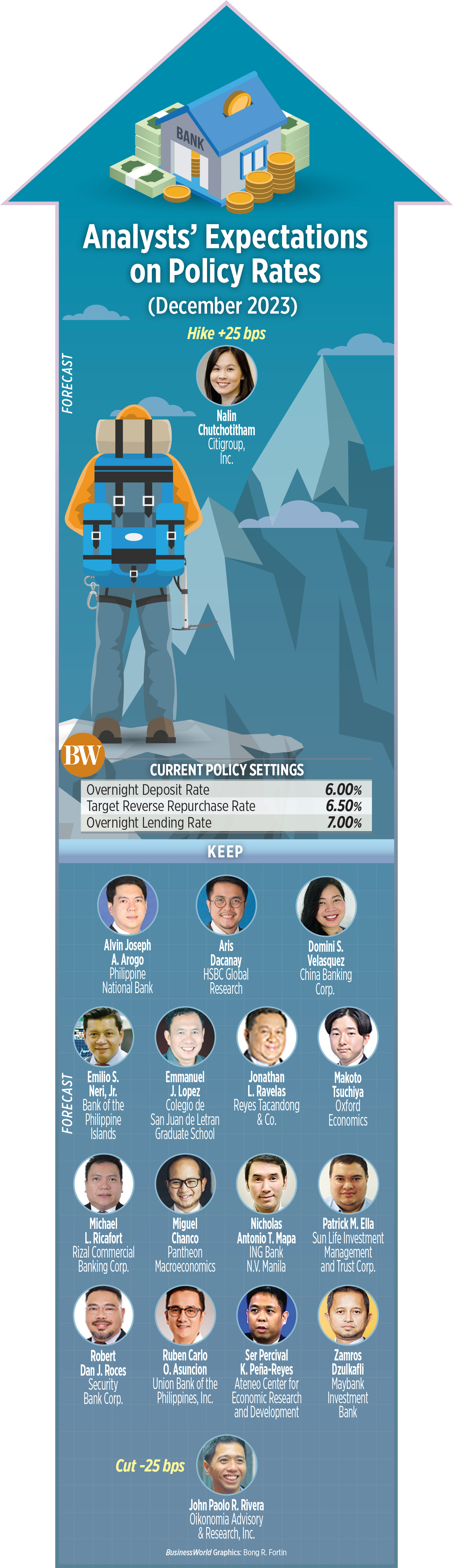
Analysts' Expectations on Policy Rates (December 2023)On the other hand, one economist said the BSP may raise policy rates to further anchor inflation expectations, while another expects the Monetary Board to start easing due to the sharp slowdown in November inflation.   

“We believe that the BSP will keep the target RRP rate unchanged at 6.5% mainly because of the slower inflation rate in November,” Philippine National Bank economist Alvin Joseph A. Arogo said in an e-mail.

Headline inflation eased to 4.1% in November from 4.9% in October and 8% in November 2022. This was the slowest inflation rate in 20 months or since the 4% seen in March last year.   

For the January-to-November period, the consumer price index averaged 6.2%, faster than 5.6% in the same period a year ago. This is still above the BSP’s full-year baseline forecast of 6%.

“We expect BSP to remain on hold at the next meeting on the back of receding pressures on inflation expectations,” Makoto Tsuchiya, an economist from Oxford Economics, said in an e-mail.

He noted the 4.1% inflation in November was a welcome development as it was at the low end of the BSP’s 4-4.8% forecast for the month.

“Recent strength of the peso, which we think will partly unwind, also gives BSP a reason to pause given the implication for lower imported inflation,” Mr. Tsuchiya said. 

The local unit closed at PHP 55.30 per dollar on Thursday, inching up by less than a centavo from its PHP 55.305 finish previously. This was the peso’s strongest close in over four months or since its PHP 55.19-per-dollar finish on Aug. 2.   

“At the same time, the resilient domestic economy performance allows BSP to retain a hawkish stance by staying put,” Mr. Tsuchiya said.

The Philippine economy expanded by 5.9% in July to September, faster than 4.3% in the second quarter but slower than 7.7% a year earlier. For the first nine months, economic growth averaged 5.5%.   

Mr. Arogo said that the general downtrend in gross capital formation, or the investment component of the economy, show that interest rates are “restrictive enough.”   

Gross capital formation slipped by 1.6% in the third quarter, ending nine straight quarters of growth. This was a reversal of the 18.2% expansion a year ago and 0.3% in the second quarter.

Meanwhile, Nalin Chutchotitham, an economist for the Philippines from Citigroup, Inc., said the BSP may hike rates by 25 bps at Thursday’s meeting.

“We still see risks of a 25-bp rate hike, to 6.75%, should the BSP continue to place significant emphasis on anchoring expectations,” she said.   

She noted that the BSP remained cautious even as November inflation slowed and emphasized that the balance of risks is still on the upside.   

Earlier, the BSP cited higher transport fares, electricity rates, and international oil prices, as well as higher-than-expected minimum wage adjustments as key upside risks to inflation.   

ING Bank N.V. Manila Senior Economist Nicholas Antonio T. Mapa said supply-side measures and base effects brought inflation down by 2 percentage points in 60 days, which shows that supply-side remedies are more effective in addressing inflation rather than rate hikes. 

“With inflation down sharply, we believe inflation expectations have been re-anchored, with low contemporaneous inflation prints likely more impactful on expectations than anything else,” he said.   

“With these data and developments, BSP will likely retain policy rates at 6.5% as it appears there is little impetus to tighten further. This could help the BSP re-establish some credibility as a data driven central bank,” Mr. Mapa added.   

Meanwhile, Security Bank Corp. Chief Economist Robert Dan J. Roces said core and headline inflation may pick up in December due to the likely surge in demand as consumers spend more during the holidays.

“Thus, December inflation may slightly be higher on seasonality than November’s, to bring average inflation in 2023 to 6%,” he said in a note.   

RATE CUT IN 2024?

China Banking Corp. Chief Economist Domini S. Velasquez said the BSP may continue to adopt a hawkish stance due to upside risks, even as the impact of supply shocks in August and September have dissipated.   

“In the first half of 2024, upward pressure on food prices (particularly rice) caused by El Niño, possible fuel price increases due to (global) production cuts, and higher-than-expected minimum wage hikes are expected,” she said.   

Still, inflation is projected to settle at an average of 3.7% next year, which could provide room for the BSP to cut its reserve ratio requirement (RRR) or interest rates in the second half.

BSP Governor Eli M. Remolona, Jr. last week said it is premature to discuss policy easing in 2024 until inflation stays comfortably within the 2-4% target range.

He also said there will be no cut in banks’ RRR while the BSP remains hawkish.     

The RRR for big banks is currently at 9.5%, while the ratio for digital banks is at 6%. The BSP also set the RRR for thrift banks, and rural and cooperative banks to 2% and 1%, respectively.

For Mr. Tsuchiya, the BSP may cut rates in the second quarter of 2024.

“There would be less pressure on both currency and inflation, while growth momentum will stay subdued given soft global economic growth and the impact of past monetary tightening on private domestic demand,” he said.   

Ms. Chutchotitham said the BSP may start policy easing in the third quarter next year, with a gradual cut of 25 bps in each meeting up to the rest of 2024.

“We expect end-2024 interest rate to remain elevated to 5.5% to help ensure inflation would remain within target,” she said.   

Meanwhile, Mr. Arogo said in the absence of severe weather disruptions, inflation could fall below 4% within three months. 

“Nevertheless, we continue to anticipate that price growth would only settle sustainably within the BSP’s 2-4% target range starting fourth quarter of 2024. As such, the BSP should only cut rates in the fourth quarter 2024 (total of 50 bps, in our view),” he said.   

Full-year inflation may hit 6% this year, according to the BSP. For next year, the BSP sees inflation averaging 3.7% before easing to 3.2% in 2025. — Keisha B. Ta-asan, Reporter


Posts navigation

Older posts
Newer posts

Recent Posts

  • Metrobank US-Iran Risk Index: A new hope
  • A guide for your peso bond portfolio amid higher for longer rates
  • Investment Ideas: April 8, 2026
  • Inflation Update: The case to tighten
  • Investment Ideas: April 7, 2026

Recent Comments

No comments to show.

Archives

  • April 2026
  • March 2026
  • February 2026
  • January 2026
  • December 2025
  • November 2025
  • October 2025
  • September 2025
  • August 2025
  • July 2025
  • June 2025
  • May 2025
  • April 2025
  • March 2025
  • February 2025
  • January 2025
  • December 2024
  • November 2024
  • October 2024
  • September 2024
  • August 2024
  • July 2024
  • June 2024
  • May 2024
  • April 2024
  • March 2024
  • February 2024
  • January 2024
  • December 2023
  • November 2023
  • October 2023
  • September 2023
  • August 2023
  • July 2023
  • June 2023
  • May 2023
  • April 2023
  • March 2023
  • February 2023
  • January 2023
  • December 2022
  • November 2022
  • October 2022
  • September 2022
  • August 2022
  • July 2022
  • June 2022
  • May 2022
  • March 2022
  • December 2021
  • October 2021

Categories

  • Bonds
  • BusinessWorld
  • Currencies
  • Economy
  • Equities
  • Estate Planning
  • Explainer
  • Featured Insight
  • Fine Living
  • How To
  • Investment Tips
  • Markets
  • Portfolio Picks
  • Rates & Bonds
  • Retirement
  • Reuters
  • Spotlight
  • Stocks
  • Uncategorized

You are leaving Metrobank Wealth Insights

Please be aware that the external site policies may differ from our website Terms And Conditions and Privacy Policy. The next site will be opened in a new browser window or tab.

Cancel Proceed
Get in Touch

For inquiries, please call our Metrobank Contact Center at (02) 88-700-700 (domestic toll-free 1-800-1888-5775) or send an e-mail to customercare@metrobank.com.ph

Metrobank is regulated by the Bangko Sentral ng Pilipinas
Website: https://www.bsp.gov.ph

Quick Links
The Gist Webinars Wealth Manager Explainers
Markets
Currencies Rates & Bonds Equities Economy
Wealth
Investment Tips Fine Living Retirement
Portfolio Picks
Bonds Stocks
Others
Contact Us Privacy Notice Terms of Use
© 2026 Metrobank. All rights reserved.

Access this content:

If you are an existing investor, log in first to your Metrobank Wealth Manager account. ​

If you wish to start your wealth journey with us, click the “How To Sign Up” button. ​

Login HOW TO SIGN UP