



MODEL PORTFOLIO
THE GIST
NEWS AND FEATURES
Global Philippines Fine Living
INSIGHTS
INVESTMENT STRATEGY
Economy Stocks Bonds Currencies
THE BASICS
Investment Tips Explainers Retirement
WEBINARS
2024 Mid-Year Economi Briefing, economic growth in the Philippines
2024 Mid-Year Economic Briefing: Navigating the Easing Cycle
June 21, 2024
Investing with Love
Investing with Love: A Mother’s Guide to Putting Money to Work
May 15, 2024
retirement-ss-3
Investor Series: An Introduction to Estate Planning
September 1, 2023
View All Webinars
DOWNLOADS
grocery-2-aa
Inflation Update: Target breached
DOWNLOAD
Container ship carrying container boxes import export dock with quay crane. Business commercial trade global cargo freight shipping logistic and transportation worldwide oversea concept. Generative AI
Economic Updates
Philippines Trade Update: Wider deficit on strong imports
DOWNLOAD
Frick collection with palm trees 
Economic Updates
Policy Rate Updates: Policy rate updates to reassure 
DOWNLOAD
View all Reports
Metrobank.com.ph How To Sign Up
Follow us on our platforms.

How may we help you?

TOP SEARCHES
  • Where to put my investments
  • Reports about the pandemic and economy
  • Metrobank
  • Webinars
  • Economy
TRENDING ARTICLES
  • Investing for Beginners: Following your PATH
  • On government debt thresholds: How much is too much?
  • Philippines Stock Market Outlook for 2022
  • Deficit spending remains unabated

Login

Access Exclusive Content
Login to Wealth Manager
Visit us at metrobank.com.ph How To Sign Up
Access Exclusive Content Login to Wealth Manager
Search
MODEL PORTFOLIO THE GIST
NEWS AND FEATURES
Global Philippines Fine Living
INSIGHTS
INVESTMENT STRATEGY
Economy Stocks Bonds Currencies
THE BASICS
Investment Tips Explainers Retirement
WEBINARS
2024 Mid-Year Economi Briefing, economic growth in the Philippines
2024 Mid-Year Economic Briefing: Navigating the Easing Cycle
June 21, 2024
Investing with Love
Investing with Love: A Mother’s Guide to Putting Money to Work
May 15, 2024
retirement-ss-3
Investor Series: An Introduction to Estate Planning
September 1, 2023
View All Webinars
DOWNLOADS
grocery-2-aa
Inflation Update: Target breached
April 7, 2026 DOWNLOAD
Container ship carrying container boxes import export dock with quay crane. Business commercial trade global cargo freight shipping logistic and transportation worldwide oversea concept. Generative AI
Economic Updates
Philippines Trade Update: Wider deficit on strong imports
March 27, 2026 DOWNLOAD
Frick collection with palm trees 
Economic Updates
Policy Rate Updates: Policy rate updates to reassure 
March 26, 2026 DOWNLOAD
View all Reports

Archives: Business World Article

Bond issuances may drop amid rate cut bets

Bond issuances may drop amid rate cut bets

BOND ISSUANCES are seen decreasing next year as investors shift to riskier assets amid expectations that central banks here and abroad will begin reducing benchmark interest rates next year.

“From an issuer, they will not want to issue bonds because rates will go down. So, there will be less bond issuances but there will be more activity in the equities market or the real estate investment trust market,” BDO Capital and Investment Corp. President Eduardo V. Francisco told reporters on the sidelines of an event on Wednesday.

In the Philippines, BDO Capital expects benchmark rates to begin easing in September next year, he added.

Still, global central banks will need to remain hawkish due to lingering risks to inflation, Mr. Francisco noted.

“Central banks have to remain cautious because of Ukraine, Israel, or El Niño. But in general, if they manage things well, especially rice and other commodities, it should be okay. Even oil is low despite issues abroad,” he said.

Investors are already shifting to riskier assets as bond yields at the secondary market have started easing, he added.

“So, that’s already the signal. They’re already starting to price it in. They’re anticipating rates to go down. From a bond and equities perspective, equities will go up because there will be interest again in the stock market. That means IPOs (initial public offerings) that were postponed this year could be issued next year,” Mr. Francisco said.

Meanwhile, other analysts said bond issuances could still pick up in 2024 as expectations of easing interest rates could encourage issuers to take advantage of lower borrowing costs.

“We expect bond and other fixed-income issuances to pick up next year. This will be driven by refinancing of debt maturities in 2024, fundraising for major capital expenditures, and a potentially more favorable interest rate environment,” China Bank Capital Corp. Managing Director Juan Paolo E. Colet said in a Viber message.

“Lower borrowing costs tend to increase investments and bond issuances needed to finance new investments,” Rizal Commercial Banking Corp. Chief Economist Michael L. Ricafort said in a Viber message. 

On Thursday, the Bangko Sentral ng Pilipinas (BSP) kept its policy rate steady at a 16-year high of 6.5% for a second straight meeting, as expected by 15 of 17 analysts in a BusinessWorld poll conducted last week.

The interest rates on the BSP’s overnight deposit and lending facilities were likewise kept at 6% and 7%, respectively.

BSP Governor Eli M. Remolona, Jr. said the Monetary Board kept its stance unchanged as “the balance of risks to the inflation outlook still leans significantly toward the upside,” due to potential pressures from rising transport, electricity and fuel prices, as well as the El Niño weather phenomenon.

“With the sum of recent information, the Monetary Board continues to see the need to keep monetary policy settings sufficiently tight to allow inflation expectations to settle more firmly within the target range… Going forward, the BSP remains ready to adjust monetary policy settings as necessary, in line with its mandate to ensure price stability,” Mr. Remolona said.

The Monetary Board has raised benchmark interest rates by a cumulative 450 basis points (bps) since it began its tightening cycle in May 2022 to help bring down inflation.

Meanwhile, the Federal Reserve left interest rates unchanged on Wednesday and US central bank chief Jerome H. Powell said the historic tightening of monetary policy is likely over as inflation falls faster than expected and with a discussion of cuts in borrowing costs coming “into view,” Reuters reported.

“People are not writing down rate hikes” in their latest economic projections, Mr. Powell said at a press conference following the end of the central bank’s final policy meeting of the year.

“That’s us thinking we’ve done enough,” he said, adding that rate increases were “not the base case anymore.”

The Fed has hiked rates by a cumulative 525 bps since March 2022 to the current 5.25%-5.5% range. — A.M.C. Sy with Reuters
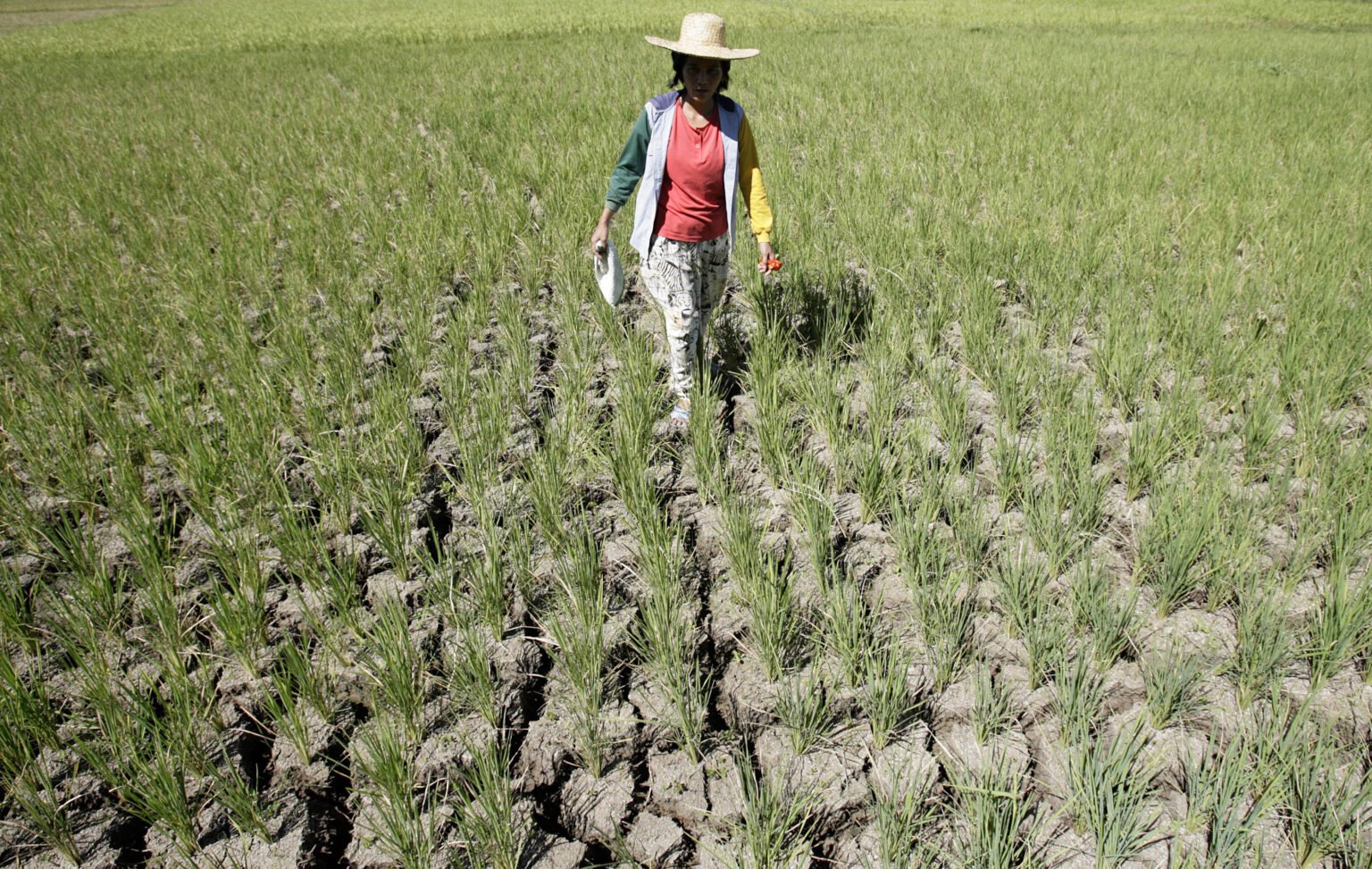

Balisacan tempers economic outlook amid El Niño

Balisacan tempers economic outlook amid El Niño

The Philippines may not be able to achieve the upper end of the government’s 6.5-8% growth target next year amid global headwinds and the El Niño weather event, National Economic and Development Authority (NEDA) Secretary Arsenio M. Balisacan said.

“I would not, this early, give away the 6.5% target, but the 8% may already be out of (reach). Reducing the range is one proposal, but we’ll see once we get all the information,” Mr. Balisacan told reporters at a briefing in Ortigas on Wednesday.

The NEDA chief cited risks such as the El Niño, which is expected to persist until the second quarter of 2024 and may send food prices spiraling.

Mr. Balisacan said he will maintain the 6.5-8% gross domestic product (GDP) growth target for the medium term.

“The reality next year is all the major multilateral agencies are seeing that the global economy is not as expansive as initially expected. For us to also ignore that is not good as well. There’s no harm in reducing that 8% to some-thing lower to be realistic, but not lower the 6.5% because then you’re surrendering too early,” he added.

Mr. Balisacan said he expects growth to continue to be driven by services, particularly tourism, as it has not returned to pre-pandemic levels.

“On the demand side, the good thing about the Philippine economy is we are not so dependent on exports as a driver of economic activity. It’s largely domestic. Although of course, if we get exports growing faster… we hope exports can recover towards the second half of next year,” he added.

Easing inflation will also help support growth next year. “If we can go back to 2-4% (inflation) next year, that will rekindle robust demand,” the NEDA chief said.

However, Mr. Balisacan flagged the potential impact of the El Niño weather phenomenon on the economy.

“We are keenly aware of the persisting challenges we confront as we aim to hit such a target. Elevated inflation remains a risk because of the onset of El Niño,” he added.

Latest data from the state weather bureau showed that a strong El Niño is present in the tropical Pacific and is showing signs of further intensification in the coming months.

While the dry spell may not necessarily impact growth, Mr. Balisacan said it could stoke inflation.

“With respect to growth, the effect on the economy, I don’t think it will make a big impact. The challenge will be more on the prices. If the prices pick up, then the gains we have made in (fighting) inflation will be reversed and we don’t want that. We (don’t want to) go back to the old cycle of high inflation, high interest rates, low demand, low growth,” he said.

The agriculture sector’s growth may be at risk next year due to El Niño. However, Mr. Balisacan noted that unlike previous El Niño episodes, the country’s dams have enough water to cover the dry spell.

Mr. Balisacan also said that the share of agriculture to the economy is smaller than in previous years, limiting the impact of the weather event on GDP growth.

Agriculture typically accounts for around 10% of the economy.

Science and Technology Secretary Renato U. Solidum, Jr. said on Tuesday that 65 out of 82 provinces will likely suffer droughts until May 2024 due to El Niño.

“We are watching closely the markets. If it affects many provinces simultaneously, that could lead to an uptick in prices, that’s what we want to prepare for,” Mr. Balisacan added.

He also said the NEDA is intent on ensuring that inflation returns to the 2-4% target band next year despite the El Niño.

“We will monitor closely and use tools in government, including trade policy tools to ensure we are able to minimize the negative effects of the El Niño phenomenon,” he added.

Mr. Balisacan said that frontloading imports could be one policy tool to mitigate price pressures brought by the dry weather event.

Meanwhile, Mr. Balisacan said that the government’s 6-7% GDP growth target this year is still within reach.

“We are confident we can still reach the lower end of the target or at the very least hit a figure near the lower end of the range. We need to grow by at least 7.2% in the fourth quarter to achieve the official target,” he said.

In the first nine months, the Philippine economy expanded by 5.2%.

The NEDA chief remained optimistic that fourth-quarter GDP growth will be strong due to an increase in household spending amid the holiday season.

EL NIÑO TO DELAY EASING

Meanwhile, Fitch Ratings said the Bangko Sentral ng Pilipinas (BSP), along with other central banks in the region, could delay monetary policy easing in 2024 due to likely high food inflation caused by El Niño.

In a Dec. 13 report written by Fitch analysts Thomas Rookmaaker and Kathleen Chen, the debt watcher said Asian central banks in emerging markets may see some relief once the US Federal Reserve starts policy easing next year.

However, some emerging economies such as the Philippines, India, and Thailand are still at risk from El Niño given the large weight of key food items in the inflation basket.

“Policy responses to potential high food inflation could include delayed monetary policy easing if it affects core inflation, subsidies and protectionism, such as India’s rice export curbs,” Fitch said.

India, Thailand and Vietnam are the largest rice exporters in the world, while the Philippines is more vulnerable as food importers.

The BSP is widely expected to keep its key policy rate at a 16-year high of 6.5% on Thursday, as forecasted by 15 out of 17 analysts from a BusinessWorld poll conducted last week.

A pause on Thursday would be the second straight meeting the BSP left rates unchanged since its 25-basis-point (bp) off-cycle hike on Oct. 26.

The BSP earlier said one of the key upside risks to inflation is the impact of El Niño on domestic food prices, along with higher transport fares, electricity rates, international oil prices, as well as high-er-than-expected minimum wage adjustments.

GlobalSource Country Analyst Diwa C. Guinigundo in a note said the BSP’s risk-adjusted inflation forecasts of 6.1% for 2023, 4.4% for 2024, and 3.4% for 2025 are still unacceptable relative to the 2-4% target.

This, as forecasts for the next two years still remain “uncomfortably close to the upper end of the 2-4% official target,” even if the BSP may announce new inflation forecasts on Thursday.

Mr. Guinigundo said the public should consider the BSP’s risk-adjusted inflation forecast rather than the baseline, as it gives “a more realistic picture of what to expect” amid all potential risks.

“We expect the prolonged dry spell, or El Niño, to hit the supply side and possibly cause an upset of the downward spiral. This could be worsened by higher transport cost and power rates as well as the anticipated minimum wage increases in areas outside Metro Manila,” he said.

Even if the Monetary Board pauses at the Dec. 14 meeting, the BSP is unlikely to immediately turn dovish given the long lag of monetary policy and the numerous risks to the inflation outlook, Mr. Guinigundo said.

“A more circumspect monetary authority will choose to play it safe and keep the policy rate at 6.5% for the time being and at least maintain a steady differential vis-à-vis the US Fed’s target interest rate. A weakening of the peso is a potential outcome, and that could motivate another price upsurge,” he said.

The US Federal Reserve kept the target Fed funds rate unchanged at 5.25-5.5% at its November meeting. The US central bank has raised 525 bps from March 2022 to June 2023. — By Luisa Maria Jacinta C. Jocson with Keisha B. Ta-asan 

ADB maintains PH growth forecast at 5.7% for 2023

ADB maintains PH growth forecast at 5.7% for 2023

The Asian Development Bank (ADB) maintained its growth forecasts for the Philippines for this year and 2024, as it expects robust domestic demand to continue.

In its latest Asian Development Outlook report, the multilateral lender kept its Philippine gross domestic product (GDP) growth projection at 5.7% this year and 6.2% next year.

“The growth forecasts for Indonesia and the Philippines for both years are maintained as both countries showed robust growth in the first nine months of 2023; this momentum is expected to continue, despite tighter financial conditions,” it said.

The ADB’s forecast for the Philippines makes it the fastest-growing economy in Southeast Asia for this year and in 2024.

However, the projections are below the government’s 6-7% and 6.5-8% growth targets for 2023 and 2024, respectively.

“The growth forecast for the Philippines for 2023 is unchanged. The economy continues to be supported by domestic demand, with growth accelerating to 5.9% in the third quarter, averaging 5.5% in the first nine months,” the ADB said.

To meet the lower end of the government’s 6-7% GDP target this year, the economy would need to expand by 7.2% in the fourth quarter.

“Household consumption eased in the third quarter due in part to elevated inflation, but overall it remained robust amid low unemployment and steady remittances from overseas workers,” the ADB said.

The ADB also noted that government expenditures, infrastructure spending, and employment figures also showed an improvement.

It maintained the GDP growth outlook at 6.2% for 2024 amid expectations that strong domestic demand will continue.

“The business outlook, based on the central bank’s third-quarter survey, was more upbeat for 2024 on anticipation of buoyant domestic demand. Manufacturing PMI (purchasing managers’ index) in November rose at its strongest pace in 10 months. And services exports, particularly business process outsourcing and tourism, posted double-digpit growth,” it said.

However, the multilateral lender also said policy makers in developing Asia must remain vigilant as risks to growth still remain, including uncertain global economic conditions, persistent core inflation, and further tightening.

Meanwhile, the ADB retained its inflation forecasts for the Philippines at 6.2% this year, and 4% in 2024.

The ADB’s 6.2% inflation projection this year is still above the central bank’s 2-4% target range and full-year forecast of 6%.

The Bangko Sentral ng Pilipinas (BSP) expects inflation to average 3.7% next year.

“The monetary authorities hiked the policy rate by another 25 basis points (bps) in October, which will help contain inflation,” the multilateral lender said.

From May 2022 to October this year, the BSP has raised interest rates by 450 bps, bringing the benchmark interest rate to a 16-year high of 6.5%.

However, the ADB noted that food inflation is still a challenge for most countries in the region, including the Philippines.

“All these economies are facing double-digit increases in international rice prices on supply concerns. Latest policy rate increases in Indonesia and the Philippines are meant to keep inflation at bay,” it added.

Food inflation eased to 5.8% in November from 7.1% in October and 10.3% in the same month a year ago.

Rice prices have been volatile this year, prompting the government to impose a one-month price ceiling on the key commodity. In September, rice inflation surged to 17.9%, the highest print since March 2009. — Luisa Maria Jacinta C. Jocson

Philippines confident in attaining lower end of GDP target for 2023

Philippines confident in attaining lower end of GDP target for 2023

The Philippines is confident it can still hit the lower end or stay in the vicinity of its 6%-7% gross domestic product growth target for the year, Economic Planning Secretary Arsenio M. Balisacan told a press conference.

Reforms in the government will allow the Southeast Asian nation to sustain its growth in the medium and long term, Mr. Balisacan said.

The Philippine economy grew 5.5% in January to September.

The government is monitoring risks like the El Niño dry weather pattern and geopolitical tensions that could raise uncertainty and disrupt supply chains, Mr. Balisacan said.—Reuters

Term deposit yields inch lower on Fed, BSP bets

Term deposit yields inch lower on Fed, BSP bets

Yields on the Bangko Sentral ng Pilipinas’ (BSP) term deposits went down on Wednesday, with market players betting that both the US Federal Reserve and the Monetary Board will keep rates steady amid easing inflation concerns.

The central bank’s term deposit facility (TDF) attracted bids amounting to PHP 391.323 billion on Wednesday, above the PHP 270 billion on the auction block as well as the PHP 336.436 billion seen a week ago for a PHP 290-billion offer.

Broken down, tenders for the seven-day papers reached PHP 215.640 billion, higher than the PHP 140 billion auctioned off by the central bank and the PHP 178.186 billion in bids for a PHP 160-billion offer seen the previous week.

Banks asked for yields ranging from 6.59% to 6.6875%, narrower than the 6.5% to 6.72% band seen a week ago. This caused the average rate of the one-week deposits to decline by 3 basis points (bps) to 6.6627% from 6.6927% pre-viously.

Meanwhile, bids for the 14-day term deposits amounted to PHp 175.683 billion, higher than the P130-billion offering and the P158.250 billion in tenders for the same offer seen on Dec. 6.

Accepted rates were from 6.60% to 6.6975%, lower than the 6.655% to 6.71% margin recorded a week ago. With this, the average rate for the two-week deposits inched down by 1.36 bps to 6.6756% from the 6.6892% logged in the prior auction.

The BSP has not auctioned off 28-day term deposits for three years to give way to its weekly offerings of securities with the same tenor.

The term deposits and the 28-day bills are used by the central bank to mop up excess liquidity in the financial system and to better guide market rates.

TDF yields went down on Wednesday amid expectations of a continued pause in tightening in the US and the Philippines this week, Rizal Commercial Banking Corp. Chief Economist Michael L. Ricafort said in a Viber message.

A BusinessWorld poll last week showed 15 out of 17 analysts expect the Monetary Board to hold the target reverse repurchase rate steady at 6.5% for a second straight meeting on Thursday, which will be the BSP’s last policy review for the year.

Philippine headline inflation eased to 4.1% in November from 4.9% in October and 8% in November 2022.

For the first 11 months, the consumer price index (CPI) averaged 6.2%, faster than 5.6% in the same period a year ago. This is still above the BSP’s baseline forecast of 6% and 2-4% target for 2023.

Meanwhile, market players are betting on policy easing from the Fed in 2024, pricing in at least 100 bps in rate cuts that could be matched locally, Mr. Ricafort added.

The Fed was expected to keep its target rate unchanged at 5.25-5.5% for a third straight meeting this week. The decision was scheduled to be announced at the end of their two-day meeting overnight.

The US central bank has raised borrowing costs by 525 bps since March 2022.

TDF yields corrected lower on Wednesday as global crude oil prices declined to USD 68 per barrel levels, the lowest in more than five months, Mr. Ricafort said.

This would help support the downward trend in inflation in the US and in the Philippines, he said.

In the US, the CPI edged up 0.1% last month after being unchanged in October, the Labor department’s Bureau of Labor Statistics said.

In the 12 months through November, the CPI increased 3.1% after rising 3.2% in October. — Keisha B. Ta-asan

Peso sinks to PHP 56:USD1 level before Fed

Peso sinks to PHP 56:USD1 level before Fed

The peso closed at the PHP 56-per-dollar level for the first time in almost a month on Wednesday as investors were cautious ahead of the US Federal Reserve’s policy decision.

The local unit closed at PHP 56.055 per dollar on Wednesday, plummeting by 48.5 centavos from its PHP 55.57 finish on Tuesday, based on Bankers Association of the Philippines data.

This is the first time the peso ended at the PHP 56 level in nearly one month or since it closed at PHP 56.06 per dollar on Nov. 14.

The peso opened Wednesday’s session slightly weaker at P55.67 against the dollar, which was already its intraday best. Its worst showing was at PHP 56.08 versus the greenback.

Dollars exchanged jumped to USD 1.6 billion on Wednesday from USD 1.01 billion on Tuesday.

“The peso weakened past the PHP 56 level amid market caution ahead of the US Federal Reserve policy meeting,” a trader said in an e-mail.

The dollar ticked up slightly on Wednesday as traders prepared for the conclusion of a Federal Reserve policy meeting that could offer some insight into when the US central bank will begin lowering interest rates, Reuters re-ported.

The US dollar index, which gauges the currency against six others, added 0.1% to 103.86 as of 0540 GMT, recouping a little of the previous day’s 0.31% drop.

Fed officials were set to give updated economic and interest rate projections later in the day following a meeting where analysts and investors expect rates to remain unchanged at the 5.25%-5.5% range for a third straight meeting.

In particular, investors will be watching to see if Fed Chair Jerome H. Powell pushes back against the prospect of interest rate cuts in the first half of 2024, but also what the central bank’s “dot plot” says about policy makers’ thinking regarding the outlook for monetary policy.

The peso was also dragged lower by El Niño concerns, as this could lead to a pickup in domestic inflation, Rizal Commercial Banking Corp. Chief Economist Michael L. Ricafort said in a Viber message.

The Philippine Atmospheric, Geophysical and Astronomical Services Administration last week said a strong El Niño has intensified in the Tropical Pacific, with sea temperature anomalies exceeding 1.5 degrees centi-grade from normal levels.

This could result in a drought for 77% of the provinces in the country, while 65% of the provinces may see a dry spell, Science and Technology Secretary Renato U. Solidum, Jr. said.

Philippine headline inflation stood at 4.1% in November, easing from the 4.9% in October and 8% in the same month last year.

This was the slowest rate in 20 months or since the 4% seen in March 2022.

In the 11 months through November, headline inflation averaged 6.2%, faster than 5.6% in the same period a year ago. This was still above the Bangko Sentral ng Pilipinas’ (BSP) 2-4% target and 5.6% baseline forecast for 2023.

For Thursday, the trader said the peso could recover against the dollar on profit taking and ahead of the BSP’s policy meeting.

The trader sees the peso moving between PHP 55.85 and PHP 56.10 per dollar on Thursday, while Mr. Ricafort expects it to range from PHP 55.90 to PHP 56.10. — A.M.C. Sy with Reuters

Shares drop as market awaits Fed, BSP decisions

Shares drop as market awaits Fed, BSP decisions

Philippine shares declined anew on Wednesday as investors anticipate the policy decisions of the US Federal Reserve and the Bangko Sentral ng Pilipinas (BSP).

The Philippine Stock Exchange index (PSEi) dropped by 36.65 points or 0.58% to end at 6,255.74 on Wednesday, while the broader all shares index fell by 14.32 points or 0.42% to close at 3,339.14.

“The local bourse dropped by 36.65 points to 6,255.74 as investors awaited the decisions of the Federal Reserve and the Bangko Sentral ng Pilipinas regarding interest rates in the US and the Philippines, respectively,” Philstocks Financial, Inc. Research Analyst Claire T. Alviar said in a Viber message.

“Aside from the interest rate decisions, investors also want to know their outlook on the inflation rate and the timing of monetary policy easing,” Ms. Alviar added.

The Fed was set to announce its policy decision overnight after a two-day review. It was expected to keep its target rate unchanged at 5.25-5.5% for a third straight meeting.

Meanwhile, the BSP will hold its final policy meeting for this year on Thursday.

A BusinessWorld poll conducted last week showed 15 out of 17 analysts expect the Monetary Board to hold the target reverse repurchase rate steady at 6.5% for a second straight meeting.

“Philippine shares traded with a negative bias as traders braced for the final Fed meeting of the year,” Regina Capital Development Corp. Head of Sales Luis A. Limlingan likewise said in a Viber message.

“Many started to position themselves ahead of the BSP’s policy-setting meeting on Dec. 14 and ahead of the release of November inflation data in the US,” he added.

The November US producer price index report was set to be released overnight.

A report released by the US Labor department on Tuesday showed that the US consumer price index (CPI) edged up 0.1% last month after being unchanged in October, Reuters reported.

In the 12 months through November, the CPI increased 3.1% after rising 3.2% in October.

Back home, almost all sectoral indices ended lower on Wednesday. Property went down by 32.75 points or 1.17% to 2,754.22; holding firms retreated by 49.87 points or 0.83% to 5,957.68; mining and oil declined by 52.82 points or 0.55% to 9,512.45; financials dropped by 6.42 points or 0.37% to 1,691.81; and industrials decreased by 12.87 points or 0.14% to 8,782.54.

Meanwhile, services rose by 2.65 points or 0.17% to 1,552.56.

Value turnover went up to PHP 3.55 billion on Wednesday with 245.11 million shares changing hands from the PHP 3.25 billion with 314.76 million issues seen the previous trading day.

Decliners outnumbered advancers, 95 to 64, while 47 names closed unchanged.

Net foreign selling stood at PHP 280.55 million on Wednesday versus the PHP 158.02 million in net buying seen on Tuesday. — R.M.D. Ochave with Reuters

October trade gap balloons to USD4.17B

October trade gap balloons to USD4.17B

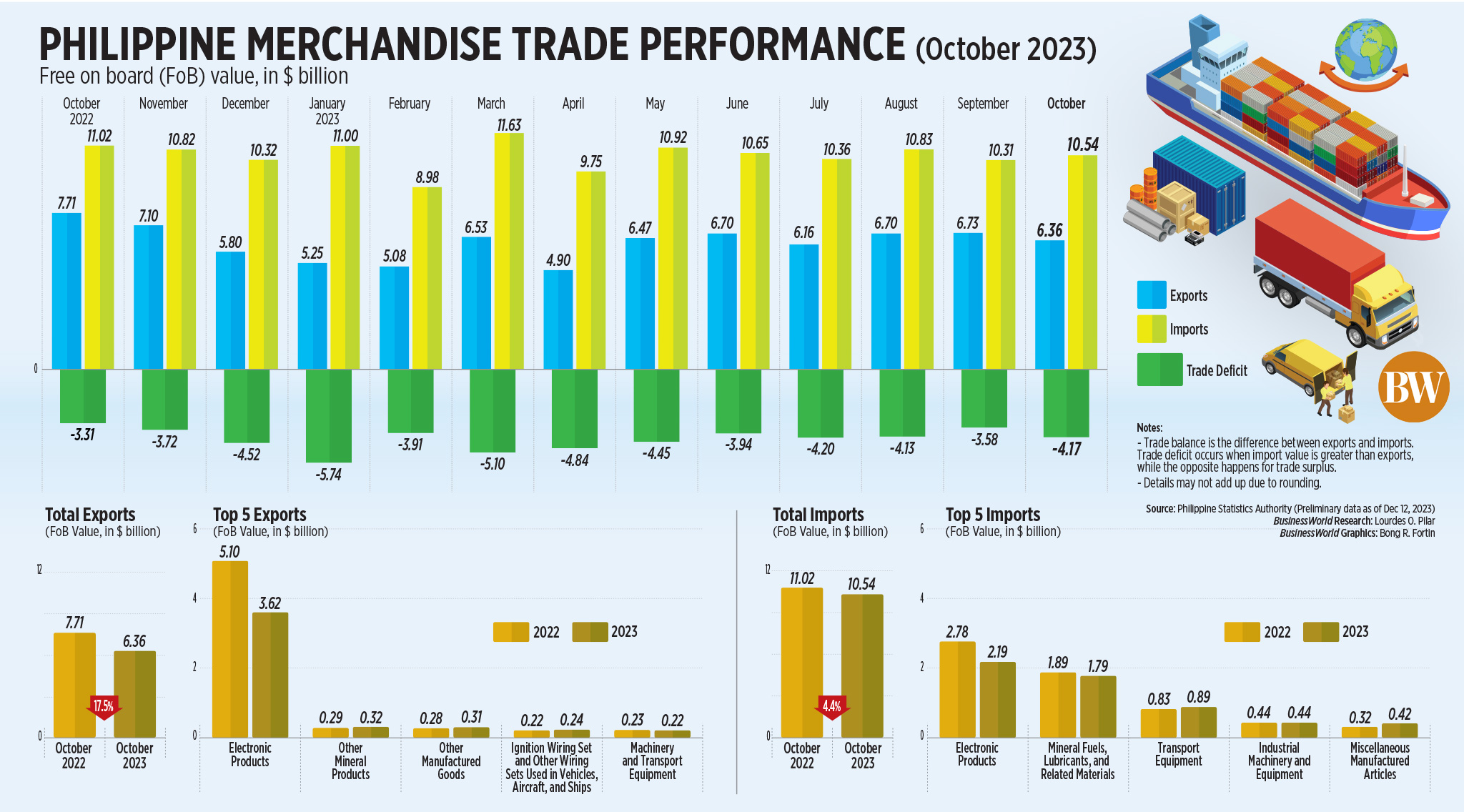
The Philippines’ trade-in-goods deficit widened to a three-month high of USD 4.17 billion in October, as exports declined by double digits amid sluggish global demand.

Preliminary data from the Philippine Statistics Authority (PSA) showed the value of merchandise exports fell by 17.5% to $6.36 billion, from the 6.3% drop in September and a reversal of the 20.1% growth a year ago.

The contraction in exports was the steepest since the 20.2% drop in April.

Philippine Merchandise Trade Performance (October 2023)

The value of merchandise imports slid by 4.4% to USD 10.54 billion in October, reversing 7.7% growth in October 2022 but slower than the 14.1% drop in September.

October marked the ninth straight month of decline in imports, but the slowest contraction since the 1.2% in March.

This brought the country’s trade balance — the difference between imports and exports — to a deficit of $4.17 billion in October, widening from the USD 3.31-billion deficit a year earlier and the $3.58-billion gap in September.

The country’s balance of trade in goods has been in the red for more than eight years or since the USD 64.95-million surplus in May 2015.

For the first 10 months of the year, the trade gap narrowed by 11.9% to USD 44.07 billion from a year ago.

This as exports dropped by an annual 7.8% to USD 60.91 billion, while imports declined 9.6% to USD 104.97 billion in January to October.

The Development Budget Coordination Committee is assuming 1% and 2% growth for exports and imports, respectively, this year.

PSA data showed manufactured goods, which comprised 81.5% of the country’s total export receipts, declined by 21.1% year on year to USD 5.19 billion in October.

“The sharp decline in export growth can be attributed to base effects, but we anticipate ongoing challenges from weak global demand,” China Banking Corp. Chief Economist Domini S. Velasquez said in a Viber message.

ING Bank N.V. Manila Senior Economist Nicholas Antonio T. Mapa said in a Viber message that the steep drop in electronics exports weighed on overall exports.

Electronic products accounted for 56.9% of the total exports in October. However, they slumped by 28.9% to $3.62 billion from $5.1 billion a year ago.

The bulk of electronic exports came from semiconductors, which dropped by 34% to USD 2.83 billion.

“Imports were also down across the board, with capital and raw materials in the red yet again, suggesting soft capital formation and slower growth momentum,” Mr. Mapa said.

By major type of imported goods, orders of raw materials and intermediate goods slid by 7.5% to USD 3.82 billion. Import of capital goods fell by 4.6% to USD 2.86 billion, while consumer goods imports rose by 4.8% to USD 2.02 billion.

“The consecutive months of sluggish imports are concerning, particularly the lack of recovery in capital goods,” Ms. Velasquez said. “The lone bright spot is the resiliency of demand for consumer goods, but this will hardly be sustainable in spurring the economy towards a higher growth path.” 

By commodity group, importation of electronic products — accounting for almost a fifth of total imports — fell by 21% to USD 2.19 billion in October. Imports of mineral fuels, lubricants and related materials dropped by 5.3% to USD 1.79 billion.

“Third-quarter gross domestic product (GDP) was boosted by a positive contribution from net exports, but today’s trade data suggest the fourth quarter will see net exports swinging to a negative contribution to growth,” Mr. Mapa said.

Rizal Commercial Banking Corp. Chief Economist Michael L. Ricafort said in a Viber message that external trade data mainly reflect the risk of an economic slowdown in the United States, China and other major trading partners.

The US was the top destination of Philippine exports, accounting for 16% or USD 1.02 billion of total receipts. It was followed by Japan (14.2% or USD 902.65 million), and China (13.8% or USD 880.37 million).

China was the main source of imported goods in October at USD 2.6 billion, followed by Indonesia (USD 917.53 million), Japan (USD 834.89 million), South Korea (USD 785.81 million) and the United States (USD 711.77 million).

Ms. Velasquez expects slightly better export performance next year amid signs of recovery in global demand in Asian neighbors.

“However, it is essential to take further steps to diversify exports and encourage exporters to jumpstart their businesses,” she said. 

Mr. Ricafort said the recent decline in global crude prices and possible interest rate cuts would help support recovery in global investments and trade in 2024.

“The recent decline in global crude oil prices to five-month lows would help reduce the country’s oil import bill and would help narrow the trade deficit,” he said.

Ateneo de Manila University economics professor Leonardo A. Lanzona said the data show the trade sector is “at a standstill.”

“This again is a result of the absence of industrial policy. With high interest rates, the value of Philippine peso should have encouraged more imports. However, an overvalued peso could deter exports as well,” he said via e-mail.

“An industrial policy aimed at promoting products with comparative advantage or at creating new products could have broken this impasse.” — By Justine Irish D. Tabile, Reporter

NPL ratio inches up to 5-month high in Oct.

NPL ratio inches up to 5-month high in Oct.

The Philippine banking industry’s nonperforming loan (NPL) ratio rose to the highest in five months in October, as soured loans increased due to high borrowing costs.

Preliminary data from the Bangko Sentral ng Pilipinas (BSP) showed the banking industry’s gross NPL ratio inched up to 3.44% in October from 3.4% in the previous month and 3.41% a year ago.

This was also the highest bad loan ratio since 3.46% in May.

Bad loans increased by 9.2% to PHP 449.435 billion from PHP 411.632 billion a year earlier.

Month on month, it inched up by 1.2% from PHP 444.313 billion in September.

Loans are considered nonperforming once they remain unpaid for at least 90 days after the due date. They are deemed as risk assets given borrowers are unlikely to settle such loans.

Rizal Commercial Banking Corp. Chief Economist Michael L. Ricafort said the uptick in bad loans and the NPL ratio was largely due to rising interest rates.

“Policy rate hikes since last year due to higher prices increased the costs and narrowed the profit margins of some borrowers, somewhat reducing the profitability and the ability of some borrowers to pay, partly leading to some pickup in bad loans,” he said.

In an off-cycle move in October, the Bangko Sentral ng Pilipinas (BSP) raised borrowing costs by 25 basis points (bps), bringing the key rate to a 16-year high of 6.5%. 

Since May 2022, the central bank has raised the benchmark rate by a total of 450 bps to tame inflation.

“NPLs remain elevated because income is not yet catching up with high interest rates. The cost of borrowing remains high creating difficulties in repaying debts,” John Paolo R. Rivera, president and chief economist at Oikonomia Advisory & Research, Inc., said in a Viber message.

BSP data showed past due loans rose by 14.4% to PHP 557.083 billion in October from a year earlier. This brought the ratio to 4.26%, up from 4.03% in 2022.

On the other hand, restructured loans dropped by 5.5% to PHP 309.239 billion from PHP 327.355 billion a year ago. These borrowings made up 2.37% of the industry’s total loan portfolio, slightly lower than 2.71% in the previous year.

Banks continued to beef up loan loss reserves, which climbed by 7.4% to PHP 461.085 billion. This brought the loan loss reserve ratio to 3.53%, down from 3.56% last year.

Lenders’ NPL coverage ratio, which gauges the allowance for potential losses due to bad loans, edged lower to 102.59% from 104.27% a year ago.

Mr. Ricafort said a possible slowdown in the United States, China and other major economies could affect the Philippine economy.

“Slower global economic growth would also result in some slowdown in local business and other economic activities in terms of slower sales, earnings, employment and the ability to pay by some borrowers,” he said. — By Luisa Maria Jacinta C. Jocson, Reporter

PH economy seen to grow by 5.6% in 2024

PH economy seen to grow by 5.6% in 2024

The Philippine economy is expected to be the second fastest-growing economy in Southeast Asia in 2024, according to the Mastercard Economics Institute (MEI).

In its latest “Economic Outlook: Balancing Prices & Priorities” report, MEI gave a Philippine gross domestic product (GDP) growth forecast of 5.6% for 2024.

This would make the Philippines the second fastest-growing economy in Southeast Asia, just behind Vietnam which is projected to grow by 6.2%.

MEI data showed Philippine GDP will likely expand faster than Indonesia’s 5.1%, Malaysia’s 4.5%, and Thailand’s 3.4%.

Philippine economic managers are targeting 6.5-8% GDP growth next year.

MEI said the Asia-Pacific region is likely to see a modest GDP growth acceleration, although below trend, in 2024.

“While MEI believes that the global economy will feel more ‘normal’ in 2024 than the prior three years, it is still an economy in the process of rebalancing. This means consumers and corporations will be mindful of how to prioritize their spending and investment in an environment of shifting relative price differentials and higher borrowing costs,” it added. 

MEI cited several global risks that could impact the region’s growth next year, such as geopolitical tensions, persistent inflation, threats to financial stability, uncertainty in China, and climate disasters.

Meanwhile, MEI projected Philippine inflation to average 5.7% next year, well above the Bangko Sentral ng Pilipinas’ (BSP) forecast of 3.7%.

MEI’s inflation outlook for the Philippines is the highest in Southeast Asia, ahead of Vietnam (3.2%), Indonesia (3%), Malaysia (2.4%), and Thailand (1.8%).

The Philippines continued to experience elevated inflation this year, as food and transport costs rose.

However, inflation eased for a second straight month to 4.1% in November. It marked the 20th straight month that inflation was above the central bank’s 2-4% target.

In the first 11 months, inflation averaged 6.2%, faster than 5.6% in the same period a year ago but above the BSP’s full-year baseline forecast of 6%.

As inflation eases, MEI said the Philippine central bank will likely cut policy rates to 6% next year.

“Central banks are likely at or close to peak rates. MEI expects some easing in 2024 as inflation cools while growth remains subdued. This could prompt a partial ‘normalization’ of monetary policy,” it said.

The BSP kept the benchmark rate at a 16-year high 6.5% in its latest November meeting. The central bank has raised rates by 450 basis points since May 2022.

The Monetary Board is set to have its last meeting this year on Thursday (Dec. 14).

BSP Governor Eli M. Remolona, Jr. last week said it is premature to discuss easing in 2024 until inflation stays within the 2-4% target. — Luisa Maria Jacinta C. Jocson

Posts navigation

Older posts
Newer posts

Recent Posts

  • Metrobank US-Iran Risk Index: A new hope
  • A guide for your peso bond portfolio amid higher for longer rates
  • Investment Ideas: April 8, 2026
  • Inflation Update: The case to tighten
  • Investment Ideas: April 7, 2026

Recent Comments

No comments to show.

Archives

  • April 2026
  • March 2026
  • February 2026
  • January 2026
  • December 2025
  • November 2025
  • October 2025
  • September 2025
  • August 2025
  • July 2025
  • June 2025
  • May 2025
  • April 2025
  • March 2025
  • February 2025
  • January 2025
  • December 2024
  • November 2024
  • October 2024
  • September 2024
  • August 2024
  • July 2024
  • June 2024
  • May 2024
  • April 2024
  • March 2024
  • February 2024
  • January 2024
  • December 2023
  • November 2023
  • October 2023
  • September 2023
  • August 2023
  • July 2023
  • June 2023
  • May 2023
  • April 2023
  • March 2023
  • February 2023
  • January 2023
  • December 2022
  • November 2022
  • October 2022
  • September 2022
  • August 2022
  • July 2022
  • June 2022
  • May 2022
  • March 2022
  • December 2021
  • October 2021

Categories

  • Bonds
  • BusinessWorld
  • Currencies
  • Economy
  • Equities
  • Estate Planning
  • Explainer
  • Featured Insight
  • Fine Living
  • How To
  • Investment Tips
  • Markets
  • Portfolio Picks
  • Rates & Bonds
  • Retirement
  • Reuters
  • Spotlight
  • Stocks
  • Uncategorized

You are leaving Metrobank Wealth Insights

Please be aware that the external site policies may differ from our website Terms And Conditions and Privacy Policy. The next site will be opened in a new browser window or tab.

Cancel Proceed
Get in Touch

For inquiries, please call our Metrobank Contact Center at (02) 88-700-700 (domestic toll-free 1-800-1888-5775) or send an e-mail to customercare@metrobank.com.ph

Metrobank is regulated by the Bangko Sentral ng Pilipinas
Website: https://www.bsp.gov.ph

Quick Links
The Gist Webinars Wealth Manager Explainers
Markets
Currencies Rates & Bonds Equities Economy
Wealth
Investment Tips Fine Living Retirement
Portfolio Picks
Bonds Stocks
Others
Contact Us Privacy Notice Terms of Use
© 2026 Metrobank. All rights reserved.

Access this content:

If you are an existing investor, log in first to your Metrobank Wealth Manager account. ​

If you wish to start your wealth journey with us, click the “How To Sign Up” button. ​

Login HOW TO SIGN UP