


MODEL PORTFOLIO
THE GIST
NEWS AND FEATURES
Global Philippines Fine Living
INSIGHTS
INVESTMENT STRATEGY
Economy Stocks Bonds Currencies
THE BASICS
Investment Tips Explainers Retirement
WEBINARS
2024 Mid-Year Economi Briefing, economic growth in the Philippines
2024 Mid-Year Economic Briefing: Navigating the Easing Cycle
June 21, 2024
Investing with Love
Investing with Love: A Mother’s Guide to Putting Money to Work
May 15, 2024
retirement-ss-3
Investor Series: An Introduction to Estate Planning
September 1, 2023
View All Webinars
DOWNLOADS
grocery-2-aa
Inflation Update: Target breached
DOWNLOAD
Container ship carrying container boxes import export dock with quay crane. Business commercial trade global cargo freight shipping logistic and transportation worldwide oversea concept. Generative AI
Economic Updates
Philippines Trade Update: Wider deficit on strong imports
DOWNLOAD
Frick collection with palm trees 
Economic Updates
Policy Rate Updates: Policy rate updates to reassure 
DOWNLOAD
View all Reports
Metrobank.com.ph How To Sign Up
Follow us on our platforms.

How may we help you?

TOP SEARCHES
  • Where to put my investments
  • Reports about the pandemic and economy
  • Metrobank
  • Webinars
  • Economy
TRENDING ARTICLES
  • Investing for Beginners: Following your PATH
  • On government debt thresholds: How much is too much?
  • Philippines Stock Market Outlook for 2022
  • Deficit spending remains unabated

Login

Access Exclusive Content
Login to Wealth Manager
Visit us at metrobank.com.ph How To Sign Up
Access Exclusive Content Login to Wealth Manager
Search
MODEL PORTFOLIO THE GIST
NEWS AND FEATURES
Global Philippines Fine Living
INSIGHTS
INVESTMENT STRATEGY
Economy Stocks Bonds Currencies
THE BASICS
Investment Tips Explainers Retirement
WEBINARS
2024 Mid-Year Economi Briefing, economic growth in the Philippines
2024 Mid-Year Economic Briefing: Navigating the Easing Cycle
June 21, 2024
Investing with Love
Investing with Love: A Mother’s Guide to Putting Money to Work
May 15, 2024
retirement-ss-3
Investor Series: An Introduction to Estate Planning
September 1, 2023
View All Webinars
DOWNLOADS
grocery-2-aa
Inflation Update: Target breached
April 7, 2026 DOWNLOAD
Container ship carrying container boxes import export dock with quay crane. Business commercial trade global cargo freight shipping logistic and transportation worldwide oversea concept. Generative AI
Economic Updates
Philippines Trade Update: Wider deficit on strong imports
March 27, 2026 DOWNLOAD
Frick collection with palm trees 
Economic Updates
Policy Rate Updates: Policy rate updates to reassure 
March 26, 2026 DOWNLOAD
View all Reports

Archives: Business World Article

Yields on government debt fall after central banks’ policy decisions

Yields on government debt fall after central banks’ policy decisions

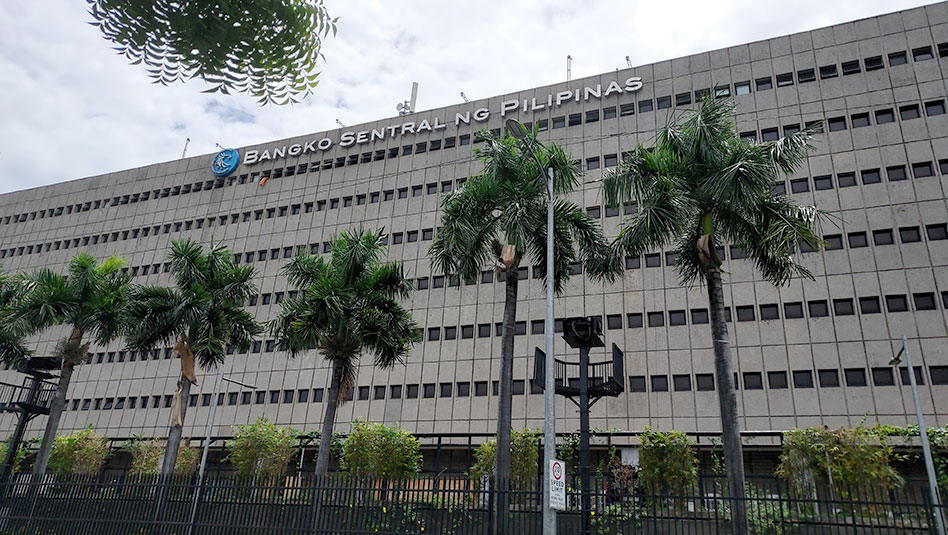
Yields on government securities (GS) traded in the secondary market ended lower last week, driven by policy decisions of both the Bangko Sentral ng Pilipinas (BSP) and central banks around the world.

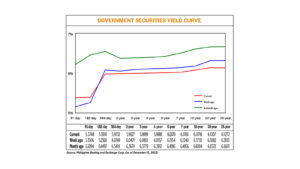
Bond yields, which move opposite to prices, fell by 6.37 basis points (bps) on average week on week, based on PHP Bloomberg Valuation Service Reference Rates as of Dec. 15 published on the Philippine Dealing System’s website.

Last week, rates were mixed across all tenors with yields on the 91-, and 182- day Treasury bills (T-bills) rising by 22.42 bps and 13.23 bps to 5.3748% and 5.3891%, respectively. Meanwhile, the 364-day T-bills went down by 10.17 bps to 5.9732%. 

Similarly, the belly of the curve went down as yields on the two-, three-, four-, five-, and seven-year Treasury bonds (T-bonds) fell by 6.44 bps (5.9827%), 9.62 bps (5.9899%), 10.69 bps (5.9988%), 10.84 bps (6.0070%), and 11.79 bps (6.0161%), respectively.

At the long end, the rates of the 10-, 20-, and 25-year debt papers also decreased by 10.14 bps (6.0716%), 17.75 bps (6.1307%), and 18.31 bps (6.1272%), respectively.

On Friday, total GS volume traded fell to PHP 7.46 billion from PHP 8.67 billion, a week earlier.

This weakness in volume traded is due to muted local market activity from the holiday season, a bond trader said.

The local bond market was significantly influenced by key monetary policy decisions, Lodevico M. Ulpo, Jr., vice-president, and head of Fixed Income Strategies at ATRAM Trust Corp., said in an e-mail.

“The US Federal Reserve maintained the federal funds rate at 5.25%-5.5%, signaling a potential end to its aggressive rate hikes and hinting at possible rate cuts in 2024, introducing a dovish tone,” he said. 

In the local scene, the central bank maintained its key rate at 6.5% aligning with the Fed’s cautious approach, he added.

However, he said that the reluctance of other central banks, such as the Bank of England and the European Central Bank to follow this dovish path suggests ongoing global monetary policy divergences.

“Such differences hint at a potential limit to how much global yields might decrease, indicating a likelihood of continued dislocations in the bond market,” he further explained. 

For the bond trader, the bond market was notably volatile this week amid the flurry of policy decisions from various major central banks both abroad and in the country. 

“The continued easing of US consumer and producer inflation in November has likewise firmed views that the US Federal Reserve might have already concluded its rate-hiking cycle,” the bond trader said. 

In November, headline inflation slowed to 4.1% from 4.9% in October and 8% a year ago, the weakest pace it and in 20 months or since the 4% in March 2022.

Still, the headline figure was above the central bank’s 2-4% target. Year to date, inflation averaged 6.2%, faster than 5.6% logged in January to November 2022.

On the other hand, US consumer prices unexpectedly rose in November as a decline in the cost of gasoline was more than offset by increases in rents, further evidence that the Federal Reserve is unlikely to pivot to interest rate cuts early next year, Reuters reported.

In the 12 months through November, the consumer price index increased 3.1% after rising 3.2% in October. The annual increase in consumer prices has slowed from a peak of 9.1% in June 2022, Reuters said.

Back home, the week saw the central bank maintaining its policy rates for the second straight meeting but hinting at a “tighter-for-longer” policy to anchor inflation expectations.

With these developments, the bond trader said that in totality, “these [news] were taken by market participants as potential leading cues for the expected monetary policy landscape in 2024.”

For Mr. Ulpo, given the US Fed’s dovish guidance, the Philippine bond market saw a significant shift, with yields falling across the curve, closely following the trend in US Treasuries.

“The absence of primary market auctions further amplified this movement, leading to a noticeable decline in yields, moving in parallel by about 15 to 25 bps,” he added.

For this week’s trading session, Mr. Ulpo sees yield movements likely to be more constrained within a trading range as the market heads into the holiday season.

“Despite the recent bullish sentiment and the overall firm fundamental backdrop for rates, the upcoming week might experience a quieter and more range-bound market behavior,” he said.

For the bond trader, likewise, yields will continue to move lower as the projected easing in the Fed’s preferred inflation gauge, the US personal consumption expenditure inflation could bolster the policy pause signaled by the US Fed in its latest December meeting. — Abigail Marie P. Yraola

Peso may appreciate on dollar weakness, remittances

Peso may appreciate on dollar weakness, remittances

The peso could strengthen this week amid the dollar’s continued weakness, and supported by the seasonal increase in remittances.

The local unit closed at PHP 55.655 per dollar on Friday, strengthening by 14 centavos from PHP 55.795 on Thursday, based on Bankers Association of the Philippines data.

Week on week, however, the peso weakened by 35.5 centavos from its PHP 55.30 close on Dec. 7.

The peso opened Friday’s session at PHP 55.73 against the dollar. Its intraday best was at PHP 55.65, while its weakest showing was at PHP 55.75 versus the greenback.

Dollars exchanged fell to USD 846.7 million on Friday from USD 1.49 billion on Thursday.

The peso appreciated on Friday as the dollar weakened amid expectations of rate cuts by the US Federal Reserve in 2024, Rizal Commercial Banking Corp. Chief Economist Michael L. Ricafort said in a Viber message.

The US central bank kept the fed funds rate steady at the 5.25%-5.5% range for a third straight time during its Dec. 12-13 meeting, with Fed Chair Jerome H. Powell saying they are likely done hiking borrowing costs.

It raised rates by a total of 525 basis points (bps) from March 2022 to July 2023.

Mr. Ricafort added this could be matched by the Bangko Sentral ng Pilipinas (BSP) next year.

The BSP on Thursday kept its policy rate steady at a 16-year high of 6.5% for a second straight meeting but said it remained cautious amid lingering upside risks to inflation.

The Monetary Board has raised benchmark interest rates by 450 bps since it began its tightening cycle in May 2022.

For this week, the peso may continue to strengthen as the dollar’s weakness persists and as remittances continue to rise amid the holiday season, Union Bank of the Philippines, Inc. Chief Economist Ruben Carlo O. Asuncion said in a Viber message

“USDPHP (US dollar-Philippine peso exchange rate) may continue to track the USD weakness like that of today. Though the recent global market rallies wane, the USDPHP will be driven by peaking remittance inflows,” he said on Friday.

In October, cash remittances from overseas Filipino workers (OFWs) rose by 3% year on year to USD 3 billion, as migrant Filipinos sent more money home ahead of the holiday season.

The amount of money sent by OFWs was the highest in 10 months, or since the USD 3.16 billion in end-2022, data from the BSP showed.

Month on month, the 3% growth in cash remittances was faster than the 2.6% seen in September and marked the fastest remittances have risen since 3.7% in April.

For this week, Mr. Asuncion expects the peso to move between PHP 55.40 and PHP 55.90 per dollar, while Mr. Ricafort sees the peso ranging from PHP 55.25 to PHP 55.75. — Aaron Michael C. Sy

Shares seen to move sideways amid profit taking

Shares seen to move sideways amid profit taking

Philippine shares are expected to move sideways for the trading week as analysts are projecting investors to book profits after the market’s strong finish last week. 

On Dec. 15, the Philippine Stock Exchange Index (PSEi) improved by 67.96 points or 1.06% to 6,478.44 while the broader all shares index jumped by 14.59 points or 0.43% to 3,409.55.

Compared with the earlier week, the main index climbed by 243.67 points from its 6,234.77 close on Dec. 7. 

Philstocks Financial, Inc. Senior Research Analyst Japhet Louis O. Tantiangco said in a Viber message that the local bourse was carried by strong trading activity.

“The local market had a good run last week, particularly the last two trading days, which were backed by strong trading activity. The US Federal Reserve’s signal of three possible 25-basis-point rate cuts next year proved to be a strong catalyst that can spur market optimism,” Mr. Tantiangco said. 

However, Mr. Tantiangco said the local bourse could move sideways during the upcoming trading week, warning of possible profit taking. 

“Next week, the policy easing prospects of the Fed may still provide support to the local bourse. However, we advise caution as the market’s steep rally last week opens the possibility of profit-taking,” Mr. Tantiangco said.

Mr. Tantiangco also said that the latest policy move of the Bangko Sentral ng Pilipinas (BSP) could influence the market’s movement next week.

On Dec. 14, the BSP opted to keep its key rate unchanged at 6.5% for a second straight meeting but signaled a “tighter-for-longer” policy until inflation expectations have become more firmly anchored.     

“Investors may also digest the results of the BSP’s latest consumer and business confidence surveys which have reflected less upbeat results with respect to sentiment on the economy’s future,” Mr. Tantiangco said, adding that the central bank’s “still tight policy outlook may weigh on sentiment.”

Online brokerage 2TradeAsia.com said in a market report that the local market was buoyed by the “dovish comments” of central banks for 2024. 

“Bulls went on a buying spree, boosted by central banks’ dovish comments for 2024. The PSEi breached the 6,400 key resistance level. The BSP maintained rates as expected, and similarly positive outlook for next year should only support our overweight case for local equities,” 2TradeAsia said. 

Last week, the US Fed kept its benchmark overnight borrowing rate at the 5.25% to 5.5% range amid easing inflation. It also hinted that there would be at least three rate cuts next year.

In its report, 2TradeAsia projected the immediate market support to range from 6,200 to 6,300, and the market resistance at the 6,600 level. 

“Markets hyper-fixated on interest rate cycle shifts tend to gyrate heavily in tandem with macro headlines. Take advantage of rallies to make quick profit off short-term trades, but do not lose sight of 2024, which is shaping up to be a year with more meaningful and impactful recovery,” it added. — Revin Mikhael D. Ochave

Gov’t seen to issue peso or dollar bonds in Q1

Gov’t seen to issue peso or dollar bonds in Q1

THE GOVERNMENT could borrow either from the local or the foreign market in the first quarter of 2024 as both US Treasury yields and PHP Bloomberg Service Valuation Reference Rates have come down.

“They could issue more of [the] longer tenors, they could do Sukuk, tokenized, and other foreign denominations and tap the local markets too,” Reyes Tacandong & Co. Senior Adviser Jonathan L. Ravelas said in a Viber message.

He added the government could look to raise around P3-5 billion or about $500 million to $1 billion for a bond offering. “It could be more,” he added.

The possibility of the Bureau of the Treasury (BTr) issuing Sukuk or tokenized bonds next year is high given the success of the respective maiden issuances last year, China Bank Capital Corp. Managing Director Juan Paolo E. Colet said in a Viber message.

The BTr raised $1 billion from the sale of 5.5-year Sukuk bonds last month. This was twice the benchmark size of at least $500 million and matched the target mentioned by Mr. Diokno in July.

The notes were given an Ijara and Wakala structure with a Commodity Murabaha aspect and were set a profit of 5.045%.

Fitch Ratings, Moody’s Investors Service and S&P Global Ratings rated the bonds “BBB,” “Baa2,” and “BBB+,” matching their ratings for Philippine sovereign debt.

Meanwhile, the government raised P15 billion from the first-ever sale of tokenized Treasury bonds (TTBs) in mid-November, higher than the target issue size of P10 billion.

The BTr priced the one-year tokenized bonds at a coupon rate of 6.5%.

Aside from Sukuk or tokenized bonds, the government will also have different borrowing instruments to choose from such as onshore dollar bonds or Premyo bonds as it has been diversifying its foreign funding sources, he added.

He added that government issuances are expected to pick up next year due to the 2024 national budget, which was recently approved by Congress.

“Overall, the National Government is projected to borrow around P2.5 trillion from local and foreign sources. The government will prioritize domestic issuances of Treasury bonds (T-bonds) and Treasury bills (T-bills) to raise more than P1.8 trillion,” he noted.

The BTr canceled its last T-bills and T-bond auctions on Dec. 11-12 after it completed its domestic funding requirements for the year.

This year, the Philippine government’s borrowing plan was set at P2.207 trillion, consisting of P1.654 trillion from domestic sources and P553.5 billion from foreign sources. — Aaron Michael C. Sy

Peso recovers as Fed, BSP keep key rates unchanged

Peso recovers as Fed, BSP keep key rates unchanged

The peso recovered against the dollar on Thursday as both the US Federal Reserve and the Bangko Sentral ng Pilipinas (BSP) kept rates unchanged at their policy meetings.

The local unit closed at PHP 55.795 per dollar on Thursday, strengthening by 26 centavos from PHP 56.055 on Wednesday, based on Bankers Association of the Philippines data.

The peso opened Thursday’s session at PHP 55.75 against the dollar. Its intraday best was at PHP 55.62, while its worst showing was at PHP 55.80 versus the greenback.

Dollars exchanged went down to USD 1.48 billion on Thursday from USD 1.6 billion on Wednesday.

“Today, the pair tapered off as volatility overnight saw the dollar weaken after the US Fed held rates steady while signaling that their next move will be rate cuts,” Security Bank Corp. Chief Economist Robert Dan J. Roces likewise said in a Viber message on Thursday.

The US central bank kept the fed funds rate steady at the 5.25%-5.5% range for a third straight time during its Dec. 12-13 meeting, with Fed Chair Jerome H. Powell saying they are likely done hiking borrowing costs.

The Fed raised rates by a total of 525 basis points (bps) from March 2022 to July 2023.

The peso was supported by the BSP’s hawkish rhetoric after its meeting on Thursday, Rizal Commercial Banking Corp. Chief Economist Michael L. Ricafort said in a Viber message.

The BSP on Thursday kept its policy rate steady at a 16-year high of 6.5% for a second straight meeting, as expected by 15 of 17 analysts in a BusinessWorld poll last week, but said they remain cautious amid lingering upside risks to inflation.

The Monetary Board has raised benchmark interest rates by 450 bps since it began its tightening cycle in May 2022.

For Friday, Mr. Roces said the peso could continue to get a lift from the BSP’s hawkish stance. He expects the peso to move between PHP 55.50 and PHP 55.80, while Mr. Ricafort sees it ranging from PHP 55.70 to PHP 55.90. — A.M.C. Sy

BSP keeps key rate steady at 6.5%

BSP keeps key rate steady at 6.5%

The Bangko Sentral ng Pilipinas (BSP) left its key rate unchanged at 6.5% for a second straight meeting on Thursday but signaled a “tighter-for-longer” policy until inflation expectations have become more firmly anchored.   

At its last policy meeting for the year, the Monetary Board maintained its target reverse repurchase rate at a 16-year high of 6.5%, as expected by 15 economists in a BusinessWorld poll last week.

Interest rates on the overnight deposit and lending facilities were also left unchanged at 6% and 7%, respectively.

“The Monetary Board continues to see the need to keep monetary policy settings sufficiently tight to allow inflation expectations to settle more firmly within the target range,” BSP Governor Eli M. Remolona, Jr. said in a statement.   

This is the second straight meeting that the BSP stood pat since its 25-basis-point (bp) off-cycle hike on Oct. 26.   

The central bank raised borrowing costs by a total of 450 bps from May 2022 to October this year.

According to Mr. Remolona, the balance of risks to the inflation outlook remains significantly on the upside.

“Key upside risks are associated with potential pressures emanating from higher transport charges, increased electricity rates, and higher oil prices,” he said.   

The BSP lowered its risk-adjusted inflation forecast for 2023 to 6% (from 6.1% in November) and 4.2% (from 4.4%) for 2024. It kept its inflation forecast at 3.4% for 2025. 

Meanwhile, the BSP maintained its average inflation baseline forecasts at 6% for 2023, 3.7% for 2024, and 3.2% for 2025.   

“Part of the reason for (the adjustment) is some of the risk that we were previously reckoning in the last meeting has been included in the baseline such as the strong El Niño. So, some of the potential upside risks have been made part of the baseline already,” BSP Department of Economic Research Director Dennis D. Lapid said.   

BSP Senior Assistant Governor Iluminada T. Sicat said they anticipate a strong El Niño episode in the first quarter next year, before moderating in the second quarter. The BSP estimates that the El Niño weather event could impact inflation by 0.02 percentage point in 2024.   

Ms. Sicat said inflation may return to the 2-4% target range by the first quarter of next year, but it will quicken to above the target in the second quarter. 

“Inflation is likely to settle (within 2-4%) in the first quarter in 2024 mainly due to the negative base effects but could temporarily accelerate above the target from April to July due to the impact of El Niño weather conditions, the lag impact of wage adjustments in 2023, as well as the positive base effects,” she said.   

“Subsequently, inflation is projected to return to target in the third quarter of 2024 and settle nearer in the midpoint of the target in the fourth quarter of 2024 owing to the decline in the world oil prices,” she added.   

Headline inflation slowed to 4.1% in November from 4.9% in October. November marked the 20th straight month that inflation breached the central bank’s 2-4% target range. In the January-to-November period, inflation averaged 6.2%.   

Mr. Lapid also said the BSP incorporated the looming water rate hike in Metro Manila in their forecasts, but noted it only has a “minor effect.”

The Metropolitan Waterworks and Sewerage System approved an increase of P6.41 per cubic meter for Manila Water Co., and a hike of P7.87 per cubic meter for Maynilad Water Services, Inc. The higher rates will take effect on Jan. 1, 2024.   

Mr. Remolona also said strong demand is expected in the fourth quarter due to sustained consumer spending and improved labor market conditions.   

“The BSP will also continue to monitor how firms and households are responding to tighter monetary policy conditions alongside evolving domestic and external economic conditions,” he said.

Mr. Remolona also said the BSP’s latest survey of private economists shows that inflation expectations have been anchored, as mean forecasts for 2024 and 2025 are within the 2-4% target range.   

In its survey of 25 external analysts between Dec. 5 and Dec. 10, the BSP said there were lower mean inflation forecasts for 2023 (at 6% in December from 6.1% in November) and for 2024 (at 3.9% from 4%).   

However, the mean inflation forecast for 2025 stood at 3.5%, a tad higher than the 3.4% previously.

“The Monetary Board also noted that previous adjustments have continued to work their way through the economy, as can be seen from the declining path for core inflation,” Mr. Remolona said.   

Core inflation, which discounts volatile prices of food and fuel, eased to 4.7% in November from 5.3% in October. In the 11 months to November, core inflation averaged 6.8%. 

“In the coming quarters, the National Government’s non-monetary interventions will remain crucial to sustain the disinflation process. Going forward, the BSP remains ready to adjust monetary policy settings as necessary, in line with its mandate to ensure price stability,” Mr. Remolona added.

EASING IN 2024?
Pantheon Macroeconomics Chief Emerging Asia Economist Miguel Chanco said even if the Monetary Board continues to pause, tight monetary policy will continue to weigh on economic growth. 

“Our base case still is that the Board will start easing monetary policy in the first quarter of next year, with 2024 likely to see a total of 100 bps worth of rate cuts, at least, to take pressure off of a slowing economy,” he said. 

Mr. Chanco said the Philippine economy may grow by 4.8% in 2024, slower than a likely 5.4% expansion this year, mainly due to slower private consumption.

He also noted the US Federal Reserve has signaled that a shift to a neutral stance.

“Our house view is that the Fed will slash rates by 150 bps in 2024, giving central banks across the region more than enough room to start normalizing,” he added.

As widely expected, the US Federal Reserve kept rates unchanged at 5.25-5.5% during the Dec. 12-13 meeting. The Fed has raised policy rates by 525 bps from March 2022 to July 2023.

Meanwhile, ING Bank N.V. Manila Senior Economist Nicholas Antonio T. Mapa said the BSP is unlikely to cut anytime soon.

“The central bank will likely extend its pause until inflation is well-within target and until inflation expectations are anchored,” he said.

“We expect the BSP to be on hold well into 2024, with potential rate cuts only likely to be considered towards the end of next year,” he added. — By Keisha B. Ta-asan, Reporter

PEZA approves PHP160B worth of investments

PEZA approves PHP160B worth of investments

The Philippine Economic Zone Authority (PEZA) has approved PHP 160.44 billion worth of investments as of Dec. 7, surpassing its full-year target.

“Locator investments represented the bulk of the increase in investments, particularly reinvestments by existing locators,” PEZA Director-General Tereso O. Panga said in a Viber message.

According to Mr. Panga, the value of the projects approved from January to Dec. 7 has already exceeded its full-year target of PHP 154.77 billion.

The tally is also 14% higher than the PHP 140.7-billion worth of projects approved in the same period a year ago.

The amount of approved PEZA investments is still expected to increase. Mr. Panga said the PEZA Board will have its last meeting for the year on Dec. 19.

PEZA data showed 24 projects worth a combined PHP 19.56 billion were approved during last week’s board meeting. However, this was lower than the 13 projects worth PHP 83.65-billion approved a year ago.

Of the 24 approved projects, 21 were locator projects, while three were developer projects.

Twelve of the locator investments are from existing enterprises with new and expansion projects, while the remaining four are from new businesses.

The three developer-operator projects are information technology centers to be developed in Capas, Tarlac; Bataraza, Palawan; and San Miguel, Tarlac.

By sector, the export sector accounted for the bulk or 14 of the projects that were greenlit last week. Four projects involve facilities enterprise, while three were information technology projects.

The projected direct employment of 4,515 from the projects approved last week is almost seven times the 643 projected employment from the projects approved a year ago.

Despite the lower investments, the value of the projected exports from the projects approved on Dec. 7 is five times higher at $286.9 million than the $56.47 million last year.

“We don’t have economic zone exports by destination. But whatever is reflected in the Philippine Statistics Authority’s (PSA) data on commodity exports, around 60% of that comes from PEZA,” Mr. Panga said.

From January to Dec. 7, PEZA has approved a total of 221 projects, 13.9% higher than the 194 projects greenlit during the same period a year ago.

Exports from the 221 projects are expected to reach USD 3.71 billion, nearly double the $1.98-billion projected exports from the 194 projects approved in the same period last year.

Last month, Mr. Panga said that PEZA is still expecting the entry of more investments that have a combined worth of over PHP 50 billion.

If realized, this will bring back PEZA investments to the P200-billion to PHP 250-billion level or the 2012 and 2015 peak years of its investment approvals. — By Justine Irish D. Tabile, Reporter

PH growth likely to moderate next year

PH growth likely to moderate next year

Philippine economic growth is expected to moderate in the coming months amid weakening consumption and gross capital formation, ING Bank N.V. Manila said.

In an article on its website dated Dec. 13, ING said it expects Philippine gross domestic product (GDP) growth to settle at 5.3% this year and further ease to 4.5% by 2024.

“Philippine GDP growth surprised on the upside in the third quarter and has, for the most part, outperformed our expectations. Despite this, we believe challenges to the outlook remain with household spending appearing stretched and fiscal spending possibly reaching its limits,” ING Senior Economist Nicholas Antonio T. Mapa said.

The economy grew by 5.9% in the third quarter, bringing the nine-month average to 5.5%. This is still below the government’s 6-7% target range this year.

For 2024, the government is targeting 6.5-8% growth.

Mr. Mapa said that GDP growth may not be robust and could moderate next year as private consumption, which accounts for about three-fourths of GDP, is growing at a slower pace.

“We had initially expected spending on basic food items to recover as inflation moderated by mid-2023. However, spending on these items has remained flat. This trend could be explained by the unexpectedly strong household spending at restaurants, with households substituting having meals at home for dining out,” ING said.

Household consumption grew by 5% in the third quarter, the weakest pace in two years. This was also slower than 8% a year ago and 5.5% in the previous quarter.   

Mr. Mapa also said that slower wage growth may mean consumers will cut back on spending.

“With wage adjustments carried out generally once a year, a sharp increase in wages is not likely to take place until mid-2024 at the earliest. The outlook for only modest wage growth suggests that household spending is not likely to rebound sharply next year even if inflation remains within target,” he said.

Gross capital formation, or the investment component of the economy, will likely continue to decline.

“We will likely need to see a sharp rebound in imports of both capital machinery and raw materials before we can expect a recovery for capital formation and given the restrictive monetary policy stance, we could see capital formation staying in the red for at least the first half of next year,” Mr. Mapa said.

Gross capital formation slipped by 1.6% in the third quarter, ending nine straight quarters of growth. This was also a reversal of the 18.2% expansion a year ago and 0.3% in the second quarter.

The boost in government expenditure during the third quarter may be difficult to sustain.

“As noted earlier, government spending was one of the drivers of third-quarter GDP. However, we remain skeptical that it will be a reliable source of growth to power momentum in the coming quarters. The main reason for this is the limited space for fiscal authorities to increase spending due to elevated debt levels,” Mr. Mapa added.

Government spending rose by 6.7% in the July-September period, a turnaround from the 7.1% contraction in the second quarter. Government agencies were ordered to draft catch-up plans for spending amid low budget utilization in the first half.

Mr. Mapa emphasized that ramping up government spending will be key to strong growth in 2024.

“The wild card for growth next year, however, will be government spending, which is expected to be capped by elevated debt levels. We believe that GDP growth can outperform our initial base case scenario but only if government spending is able to expand by double digits for all of 2024,” he added.

Net exports growth is also unlikely to continue.

“Net exports, which have positively contributed to growth for two straight quarters, are likely to revert to a negative contribution to GDP as early as the fourth quarter. With exports likely to struggle next year, we expect the overall trade deficit to remain substantial enough to keep the current account balance in deficit territory and ultimately weigh on overall GDP growth momentum for next year,” Mr. Mapa said.

“We could see upside to this outlook should inflation slow sharply, which could free up some purchasing power for households while an eventual easing of monetary policy by the second half of 2024 should help bolster investment activity,” he added.

INFLATION
Meanwhile, ING expects Philippine inflation to average 4.1% next year. This is still above the central bank’s 2-4% target and its 3.7% baseline forecast.

“We forecast inflation to average 4.1% year on year next year with much of the price pressures driven by supply-side factors such as drought, imported energy price adjustments and a shortage of fish,” Mr. Mapa said.

He said demand-side pressures will be “relatively muted” as consumption is expected to moderate and government spending “will be unable to ramp up spending in a manner that could be inflationary.”

The BSP will also likely continue its tightening path next year, ING said.

“Despite price pressures emanating mainly from the supply side, we believe (BSP Governor Eli M. Remolona, Jr.) will not hesitate to hike rates should inflation indeed flare up next year,” Mr. Mapa said.

The BSP on Thursday kept rates steady at a 16-year high 6.5% for a second straight meeting. From May 2022 to October, the central bank raised borrowing costs by a total of 450 basis points (bps).

Rate cuts are also more likely off the table for next year, ING said. “Thus, we expect the BSP to tighten monetary policy for most of 2024 with only a slim chance for a rate cut towards the end of the year should inflation cool and if global central banks begin to cut rates by midyear,” he added. — Luisa Maria Jacinta C. Jocson

PH ranked among laggards in governance, ESG

PH ranked among laggards in governance, ESG

The Philippines has kept the 11th spot but at a lower overall score in a ranking of 12 Asia-Pacific countries on their performance in corporate governance (CG) and environmental, social, and corporate governance (ESG).

The 2023 CG Watch biennial survey by nonprofit association Asian Corporate Governance Association (ACGA) showed that the Philippines maintained its previous ranking in 2020, besting only Indonesia. The survey looked into the countries’ market performance and practices.

According to the report, the Philippines scored 37.6 in the 2023 ranking, down from a score of 39 in 2020, citing the country’s policy focus being “elsewhere” and the securities regulator’s “lacks resources.” 

Philippines ranks near bottom of Corporate Governance IndexAustralia secured the top spot with a score of 75.2, followed by Japan at 64.6, Singapore at 62.9, Taiwan at 62.8, Malaysia at 61.5, India at 59.4, Hong Kong at 59.3, Korea at 57.1, Thailand at 53.9, and China at 43.7. 

The rankings were based on seven categories, namely: government and public governance; regulators on funding, capacity building, and reform, and enforcement regulators; corporate governance rules; listed companies; investors; auditors and audit regulators; and civil society and media. 

ACGR data showed that the Philippines scored higher in categories such as government and public governance at 29 versus 28 in 2020; CG rules at 48 from 45; investors at 25 from 21; and auditors and audit regulators at 62 from 60. 

However, the country scored lower in terms of regulators at 25 from 27; listed companies at 48 from 55; and civil society and media at 33 from 36. 

“Our goal in CG Watch is to give a diagnosis of the health of CG systems across APAC (Asia-Pacific). More than 20 years after the Asian Financial Crisis there is no doubt that most of the region is in better shape. We hope our scores and rankings help each market to pinpoint next steps for improvement,” ACGA Secretary General Jamie Allen said. 

Meanwhile, a separate survey done by Hong Kong-based capital markets and investment group CLSA Ltd. showed that the Philippines ranked last among the 12 APAC countries in terms of the CLSA CG score. 

The Philippines came out with a score of 49.3 in the 2023 CLSA CG ranking, lower than the 50.5 score in 2020. 

“Our analysis of CG scores by thematic characteristics revealed that gender-diverse firms have the highest CG scores, followed by privately-owned enterprises, large caps and manager-run companies; while state-owned firms score the lowest,” CLSA said.

CLSA reveals CG winners and losers by sector and examines CG scores by corporate characteristics as well as CG’s relationship with broader ESG scores and shareholder value creation.

“The Asian region is characterized by extreme weather events, shifting demographics and geopolitical uncertainties. Now more than ever it has become increasingly crucial to comprehend the connection between effective corporate governance, ESG, and shareholder returns,” CLSA Head of Sustain Asia Research Seungjoo Ro said. 

Sought for comment, SEC Commissioner McJill Bryant T. Fernandez said via Viber message that the regulator has been consistent in promoting corporate governance and protecting minority investors, through policies and regulations consistent with international best practices.

“This can be attested by, among others, the recognitions from both domestic and international bodies, as well as engagements with stakeholders here and abroad,” he said.

He added that the SEC “was neither consulted nor interviewed” about the report.

“To be circumspect, the Commission will go over the entire report and commits to provide substantive comments thereon soonest,” he said.

Rizal Commercial Banking Corp. Chief Economist Michael L. Ricafort said that greater emphasis on ESG compliance is needed since it has been linked to good business practices. 

“Global and local regulators have already encouraged compliance with ESG standards for both issuers and investors even before the pandemic, which somewhat disrupted business, market, and other economic activities,” Mr. Ricafort said in a Viber message. 

“There should be greater emphasis on ESG compliance as this has become one of the important considerations by foreign investors in recent years, as ESG compliance is tied to good business practices,” he added.

Mr. Ricafort added that corporate regulators should have more funding to support more ESG compliance initiatives.

“More funding is needed to bankroll more ESG compliance initiatives amid limited financial resources of the government due to budget deficits especially since the pandemic,” Mr. Ricafort said. — By Revin Mikhael D. Ochave, Reporter

PH stocks rebound as Fed hints at policy easing

PH stocks rebound as Fed hints at policy easing

Philippine shares rebounded on Thursday on improved investor sentiment as the US Federal Reserve kept rates steady at its final meeting this year, with its chief saying they are done hiking borrowing costs.

The Philippine Stock Exchange index rose by 154.74 points or 2.47% to end at 6,410.48 on Thursday, while the broader all shares index climbed by 55.82 points or 1.67% to close at 3,394.96. 

“This Thursday, the local market rose by 154.74 points to 6,410.48 as investors cheered the Federal Reserve’s dovish outlook after it held policy rates unchanged in its recent meeting. The Federal Reserve stated that they anticipate three possible rate cuts for 2024, to be done in 25-basis-point (bp) increments,” Philstocks Financial, Inc. Research and Engagement Officer Mikhail Philippe Q. Plopenio said in a Viber message.

“This gave hope that the Fed may ease their policy soon after more than a year-long combat against inflation. As a result, the bourse was in the green territory for the whole session and even breached the 6,400 resistance level,” he added. 

The Federal Reserve left interest rates unchanged on Wednesday and US central bank chief Jerome H. Powell said the historic tightening of monetary policy is likely over as inflation falls faster than expected and with a discussion of cuts in borrowing costs coming “into view,” Reuters reported.

“People are not writing down rate hikes” in their latest economic projections, Mr. Powell said in a press conference following the end of the central bank’s final policy meeting of the year.

“That’s us thinking we’ve done enough,” he said, adding that rate increases were “not the base case anymore.”

“Locally, investors bought into the assumption that the Bangko Sentral ng Pilipinas (BSP) would follow in a similar fashion, maintaining its own policy rate, but reducing this next year,” Regina Capital Development Corp. Head of Sales Luis A. Limlingan said in a Viber message.

The BSP on Thursday kept its policy rate steady at a 16-year high of 6.5% for a second straight meeting, as expected by 15 of 17 analysts in a BusinessWorld poll conducted last week, but said there is a need to remain hawkish amid lingering upside risks to inflation.

Most sectoral indices ended higher on Thursday. Holding firms increased by 228.11 points or 3.82% to 6,185.79; property rose by 96.92 points or 3.51% to 2,851.14; financials went up by 27.77 points or 1.64% to 1,719.58; industrials gained 144.33 points or 1.64% to end at 8,926.87; and mining and oil climbed by 61.44 points or 0.64% to 9,573.89. 

Meanwhile, services slipped by 6.28 points or 0.4% to 1,546.28.

Value turnover went up to P6.78 billion on Thursday with 385.71 million issues changing hands from the P3.55 billion with 245.11 million shares seen the previous day.

Advancers overwhelmed decliners, 120 against 59, while 44 names ended unchanged.

Net foreign selling climbed to P367.52 million on Thursday from P280.55 million on Wednesday. — with Reuters

Posts navigation

Older posts
Newer posts

Recent Posts

  • Investment Ideas: April 10, 2026 
  • Metrobank US-Iran Risk Index: A new hope
  • A guide for your peso bond portfolio amid higher for longer rates
  • Investment Ideas: April 8, 2026
  • Inflation Update: The case to tighten

Recent Comments

No comments to show.

Archives

  • April 2026
  • March 2026
  • February 2026
  • January 2026
  • December 2025
  • November 2025
  • October 2025
  • September 2025
  • August 2025
  • July 2025
  • June 2025
  • May 2025
  • April 2025
  • March 2025
  • February 2025
  • January 2025
  • December 2024
  • November 2024
  • October 2024
  • September 2024
  • August 2024
  • July 2024
  • June 2024
  • May 2024
  • April 2024
  • March 2024
  • February 2024
  • January 2024
  • December 2023
  • November 2023
  • October 2023
  • September 2023
  • August 2023
  • July 2023
  • June 2023
  • May 2023
  • April 2023
  • March 2023
  • February 2023
  • January 2023
  • December 2022
  • November 2022
  • October 2022
  • September 2022
  • August 2022
  • July 2022
  • June 2022
  • May 2022
  • March 2022
  • December 2021
  • October 2021

Categories

  • Bonds
  • BusinessWorld
  • Currencies
  • Economy
  • Equities
  • Estate Planning
  • Explainer
  • Featured Insight
  • Fine Living
  • How To
  • Investment Tips
  • Markets
  • Portfolio Picks
  • Rates & Bonds
  • Retirement
  • Reuters
  • Spotlight
  • Stocks
  • Uncategorized

You are leaving Metrobank Wealth Insights

Please be aware that the external site policies may differ from our website Terms And Conditions and Privacy Policy. The next site will be opened in a new browser window or tab.

Cancel Proceed
Get in Touch

For inquiries, please call our Metrobank Contact Center at (02) 88-700-700 (domestic toll-free 1-800-1888-5775) or send an e-mail to customercare@metrobank.com.ph

Metrobank is regulated by the Bangko Sentral ng Pilipinas
Website: https://www.bsp.gov.ph

Quick Links
The Gist Webinars Wealth Manager Explainers
Markets
Currencies Rates & Bonds Equities Economy
Wealth
Investment Tips Fine Living Retirement
Portfolio Picks
Bonds Stocks
Others
Contact Us Privacy Notice Terms of Use
© 2026 Metrobank. All rights reserved.

Access this content:

If you are an existing investor, log in first to your Metrobank Wealth Manager account. ​

If you wish to start your wealth journey with us, click the “How To Sign Up” button. ​

Login HOW TO SIGN UP