MODEL PORTFOLIO
THE GIST
NEWS AND FEATURES
Global Philippines Fine Living
INSIGHTS
INVESTMENT STRATEGY
Economy Stocks Bonds Currencies
THE BASICS
Investment Tips Explainers Retirement
WEBINARS
2024 Mid-Year Economi Briefing, economic growth in the Philippines
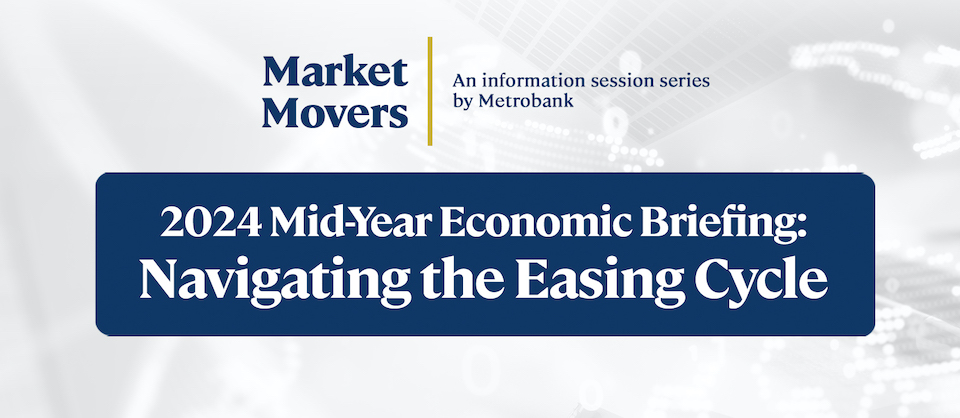
2024 Mid-Year Economic Briefing: Navigating the Easing Cycle
June 21, 2024
Investing with Love
Investing with Love: A Mother’s Guide to Putting Money to Work
May 15, 2024
retirement-ss-3
Investor Series: An Introduction to Estate Planning
September 1, 2023
View All Webinars
DOWNLOADS
grocery-2-aa
Inflation Update: Target breached
DOWNLOAD
Container ship carrying container boxes import export dock with quay crane. Business commercial trade global cargo freight shipping logistic and transportation worldwide oversea concept. Generative AI
Economic Updates
Philippines Trade Update: Wider deficit on strong imports
DOWNLOAD
Frick collection with palm trees 
Economic Updates
Policy Rate Updates: Policy rate updates to reassure 
DOWNLOAD
View all Reports
Metrobank.com.ph How To Sign Up
Follow us on our platforms.

How may we help you?

TOP SEARCHES
  • Where to put my investments
  • Reports about the pandemic and economy
  • Metrobank
  • Webinars
  • Economy
TRENDING ARTICLES
  • Investing for Beginners: Following your PATH
  • On government debt thresholds: How much is too much?
  • Philippines Stock Market Outlook for 2022
  • Deficit spending remains unabated

Login

Access Exclusive Content
Login to Wealth Manager
Visit us at metrobank.com.ph How To Sign Up
Access Exclusive Content Login to Wealth Manager
Search
MODEL PORTFOLIO THE GIST
NEWS AND FEATURES
Global Philippines Fine Living
INSIGHTS
INVESTMENT STRATEGY
Economy Stocks Bonds Currencies
THE BASICS
Investment Tips Explainers Retirement
WEBINARS
2024 Mid-Year Economi Briefing, economic growth in the Philippines
2024 Mid-Year Economic Briefing: Navigating the Easing Cycle
June 21, 2024
Investing with Love
Investing with Love: A Mother’s Guide to Putting Money to Work
May 15, 2024
retirement-ss-3
Investor Series: An Introduction to Estate Planning
September 1, 2023
View All Webinars
DOWNLOADS
grocery-2-aa
Inflation Update: Target breached
April 7, 2026 DOWNLOAD
Container ship carrying container boxes import export dock with quay crane. Business commercial trade global cargo freight shipping logistic and transportation worldwide oversea concept. Generative AI
Economic Updates
Philippines Trade Update: Wider deficit on strong imports
March 27, 2026 DOWNLOAD
Frick collection with palm trees 
Economic Updates
Policy Rate Updates: Policy rate updates to reassure 
March 26, 2026 DOWNLOAD
View all Reports

Archives: Business World Article

Shares dip on Wall Street’s slide, hawkish views

Shares dip on Wall Street’s slide, hawkish views

PHILIPPINE stocks closed lower on Thursday to track Wall Street’s performance overnight and after the local central bank chief said rates might stay “higher for longer.”

The benchmark Philippine Stock Exchange index (PSEi) declined by 51.52 points or 0.79% to end at 6,469.23 on Thursday, while the broader all shares index shed 30.15 points or 0.88% to close at 3,404.26.

Philstocks Financial, Inc. Research and Engagement Officer Mikhail Philippe Q. Plopenio said that stock market investors took cues from Wall Street’s overnight performance wherein profit taking took place.

Mr. Plopenio added that the hawkish statements from Bangko Sentral ng Pilipinas (BSP) Governor Eli M. Remolona, Jr. also weighed on the sentiment.

Mr. Remolona earlier told reporters that the BSP was unlikely to cut rates in the next few months and would consider a reduction only if inflation settles at the midpoint of the 2-4% target.

The BSP last week kept its policy rate steady at a 16-year high of 6.5% for a second straight meeting. The central bank raised borrowing costs by a cumulative 450 basis points from May 2022 to October 2023 to tame inflation.

China Bank Securities Corp. Research Director Rastine Mackie D. Mercado said the index declined as “continued profit-taking underpinned selling pressure.”

“This was likely exacerbated by the overnight sell-off in offshore markets given extremely overbought levels. Fortunately, a surge of market-on-close buying led to pared losses for the day. This may indicate underlying investor interest to participate in the market given the pullback,” Mr. Mercado said.

Almost all sectoral indices dropped on Thursday, except for financials, which climbed by 12.05 points or 0.69% to 1,738.26.

Meanwhile, property went down by 47.44 points or 1.64% to 2,834.78; services lost 21.37 points or 1.33% to 1,578.72; industrials decreased by 75.97 points or 0.85% to 8,769.10; holding firms sank by 52.73 points or 0.82% to 6,341.40; and mining and oil declined by 50.78 points or 0.53% to 9,518.11.

Value turnover went up to PHP 8.61 billion on Thursday with 2 billion issues changing hands from the PHP 6.32 billion with 1.15 million shares on Wednesday.

Decliners outnumbered advancers, 121 against 71, while 46 names ended unchanged.

Net foreign selling stood at P1.81 billion on Thursday from the net foreign buying at PHP 166.8 million on Wednesday. — Sheldeen Joy Talavera

Term deposit yields slip on Fed rate cut bets

Term deposit yields slip on Fed rate cut bets

Yields on the central bank’s term deposit facility dipped on Wednesday after the US Federal Reserve signaled that it would cut rates in 2024.

The central bank’s term deposit facility (TDF) attracted bids amounting to PHP 324.325 billion on Wednesday, above the PHP 230 billion on the auction block but lower than the PHP 391.323 billion seen a week ago for a PHP 270-billion offer.

Broken down, tenders for the seven-day papers reached PHP 194.105 billion, higher than the PHP 120 billion auctioned off by the central bank and the PHP 215.64 billion in bids for a P140-billion offer seen the previous week.

Banks asked for yields ranging from 6.6% to 6.65%, narrower than the 6.59% to 6.6875% band seen a week ago. This caused the average rate of the one-week deposits to decline by 2.98 basis points (bps) to 6.6329% from 6.6627% previously.

Meanwhile, bids for the 14-day term deposits amounted to P130.220 billion, higher than the PHP 110-billion offering but lower than the PHP 175.683 billion in tenders for a PHP 130-billion offer seen on Dec. 13.

Accepted rates were from 6.625% to 6.68%%, narrower than the 6.6% to 6.6975% margin recorded a week ago. With this, the average rate for the two-week deposits inched down by 1.93 bps to 6.6563% from the 6.6756% logged in the prior auction.

The Bangko Sentral ng Pilipinas has not auctioned off 28-day term deposits for three years to give way to its weekly offerings of securities with the same tenor.

The term deposits and the 28-day bills are used by the central bank to mop up excess liquidity in the financial system and to better guide market rates.

TDF yields went down on Wednesday as the US central bank has finally signaled that it would cut rates by 75 bps in 2024, Rizal Commercial Banking Corp. Chief Economist Michael L. Ricafort said in a Viber message.

The US central bank kept the Fed funds rate steady at the 5.25%-5.5% range for a third straight time during its last meeting for the year on Dec. 12-13.

It raised rates by a total of 525 bps from March 2022 to July 2023.

The Federal Open Market Committee will hold its first policy meeting for 2024 on Jan. 30-31.

“Thus, any Fed rate cuts for 2024 could be matched locally and could lead to lower local interest rates, bond yields, and borrowing costs/financing costs for consumers, businesses/industries, government, and other institutions,” Mr. Ricafort added.

The BSP last week kept its policy rate steady at a 16-year high of 6.5% for a second straight meeting but said it remained cautious amid lingering upside risks to inflation.

The Monetary Board has raised benchmark interest rates by 450 bps since it began its tightening cycle in May 2022. — Aaron Michael C. Sy

Rates to stay ‘higher for longer’ — BSP

Rates to stay ‘higher for longer’ — BSP

The Bangko Sentral ng Pilipinas (BSP) is unlikely to start policy easing in the next few months and will only consider cutting rates if inflation settles at the midpoint of the 2-4% target, its governor said on Wednesday.

“We’re unlikely to cut rates in the next few months. We’re in a higher for longer (scenario). When I say hawkish, that basically means high for a while,” BSP Governor Eli M. Remolona, Jr. told reporters.

The Monetary Board last week kept its benchmark rate at a 16-year high of 6.5% for a second straight meeting. Interest rates on the overnight deposit and lending facilities were also left unchanged at 6% and 7%, respectively.

From May 2022 to October this year, the BSP raised borrowing costs by a cumulative 450 bps to tame inflation.

Mr. Remolona said policy easing will only be considered if inflation expectations are within a “comfortable” range.

“If most of the numbers point in the right direction, including expectations, if they really settle into this comfortable range of 3% for inflation, then we would consider cutting rates,” he said.

“If inflation remains higher than we thought and expectations begin to get de-anchored, then we have to do more about inflation. On the other hand… if inflation continues on its path and the expectations should be well-anchored, then we will start to consider easing,” he added.

Headline inflation slowed to 4.1% in November, bringing the 11-month inflation average to 6.2%. November marked the 20th straight month that inflation breached the BSP’s 2-4% target band for this year.

The central bank expects inflation to average 6% this year.

For 2024, Mr. Remolona said inflation will likely hit the upper end of its target band, “closer to 4% than 3%.”

“We’re still not out of the woods when it comes to inflation. If there are further supply shocks, it makes it all the harder,” he said.

The BSP sees inflation averaging 3.7% in 2024.

The central bank earlier said inflation will settle within the 2-4% target in the first quarter but could potentially spike above target from April to July partly due to the El Niño weather event.

“In our analysis, the first quarter (El Niño) might be bad. Second-quarter El Niño is 50-50. We’re more or less anticipating supply shocks,” Mr. Remolona said.

Latest data from the state weather bureau showed that a strong El Niño is present in the tropical Pacific and is showing signs of further intensification in the coming months. It is expected to continue until the second quarter of 2024.

According to the Philippine Atmospheric, Geophysical and Astronomical Services Administration, the El Niño weather pattern increases the likelihood of below-normal rainfall conditions, which could bring dry spells and droughts in some areas of the country.

BSP estimates show that the El Niño weather event could impact inflation by 0.02 percentage point next year.   

“We also included the possibility of the strong episode extending to the second quarter,” BSP Department of Economic Research Director Dennis D. Lapid added.

National Economic and Development Authority Secretary Arsenio M. Balisacan earlier said that the dry spell is one of the major risks to inflation next year.

The Marcos administration reactivated a task force on El Niño to mitigate the impact on the economy. Economic managers are targeting 6.5%-7.5% gross domestic product growth in 2024. — Luisa Maria Jacinta C. Jocson

PH posts BoP deficit of USD216M in November

PH posts BoP deficit of USD216M in November

The Philippines balance of payments (BoP) deficit narrowed to USD 216 million in November from the USD 756-million gap a year ago, preliminary data from the Bangko Sentral ng Pilipinas (BSP) showed.

“The BoP deficit in November 2023 reflected outflows arising mainly from the National Government’s (NG) payments of its foreign currency debt obligations,” the BSP said in a statement.

On a month-on-month basis, the BoP position swung to a deficit from the USD 1.5-billion surplus recorded in October.

The BoP deficit in November was also the smallest since the USD 57 million in August.

The BoP measures the country’s transactions with the rest of the world at a given time. A deficit means more funds fled the economy than what went in, while a surplus shows that more money entered the Philippines.

“The US dollar-Philippine peso exchange rate was lower in November at PHP 55.81 (vs PHP 57.65 in the same period last year) and this may have been the significant reason for the narrowing of the deficit for the period,” Union Bank of the Philippines, Inc. Chief Economist Ruben Carlo O. Asuncion said in a Viber message.

Mr. Asuncion said the narrower BoP deficit reflected recent trade data.

“We must also understand that in terms of merchandise imports, (it) has been on the declining trend from lower global oil prices. Moreover, the exports side continues to be challenged by the current weak external trade environment. These combined factors are seemingly contributing to the narrower BoP deficit,” he said.

In the first 10 months, the trade gap narrowed by 11.9% to USD 44.07 billion. This as exports declined by 7.8% to USD 60.91 billion and imports fell by 9.6% to USD 104.97 billion.

The Development Budget Coordination Committee (DBCC) expects goods exports and imports to contract by 4% and 3%, respectively, this year.

In the first 11 months, the BoP position stood at a surplus of USD 3.03 billion, a turnaround from the USD 7.875-billion deficit in the same period in 2022.

“Based on preliminary data, this development reflected mainly the improvement in the balance of trade alongside the higher net inflows from personal remittances, trade in services, and foreign borrowings by the National Government,” the central bank said.

The BSP said net inflows from foreign direct investments also contributed to the surplus.

Rizal Commercial Banking Corp. Chief Economist Michael L. Ricafort said that the BoP surplus in the January-November period was due to the NG’s recent foreign borrowings.

The government raised USD 1 billion from its maiden offering of Sukuk bonds in late November.

At its end-November position, the BoP reflected a final gross international reserve (GIR) level of USD 102.7 billion. This was 1.7% higher than $101 billion as of end-October.

The GIR was enough to cover six times the country’s short-term external debt based on original maturity and 3.7 times based on residual maturity.

It also represents 7.6 months’ worth of imports of goods and payments of services and primary income.

For the coming months, Mr. Ricafort said that the country’s BoP position could be further supported by growth in cash remittances, revenues from business process outsourcing firms, foreign direct investments, and a narrower trade deficit.

“Going forward, any improvement in BoP data and in GIR data for the coming months could help provide a greater cushion for the peso exchange rate against the US dollar especially versus any speculative attacks,” he added.

This year, the BSP is expecting the BoP to end with a surplus of USD 1.1 billion, equivalent to 0.2% of gross domestic product. — Luisa Maria Jacinta C. Jocson

Marcos inks PHP5.77T national budget

Marcos inks PHP5.77T national budget

President Ferdinand R. Marcos, Jr. on Wednesday signed the P5.768-trillion national budget for 2024, as Congress focused on developing sectors such as education and national defense, among others.

“This budget is more than a spreadsheet of amounts or a ledger of projects,” he said during the signing of Republic Act No. 11975 at Malacañang.

“Rather, it details our battle plan in fighting poverty and combating illiteracy, in producing food and ending hunger, in protecting our homes, in securing our border, and in funding our livelihoods.”

The President reminded government officials to eliminate and steer clear of red tape that would lead to delays in implementing the budget as intended.

“Implementations, delays, and illegal deviations inflict the same havoc of denying the people of the progress and development that they deserve,” Mr. Marcos said.

He called the spending plan a “social contract” with Filipino taxpayers to ensure the government uses their funds for

Next year’s budget is 9.5% higher than this year’s budget and is equivalent to 21.7% of the country’s gross domestic product.

Earlier this month, Congress reconciled the General Appropriations Act of 2024 and approved about PHP 450 billion in new appropriations.

The education sector in the 2024 budget has the biggest allocation of PHP 924.7 billion, as the Department of Education will receive PHP 758.6 billion.

House Speaker Ferdinand Martin G. Romualdez on Tuesday said Congress has allotted PHP 500 billion worth of financial assistance to at least 12 million poor Filipino families next year.

At least PHP 10 billion has been earmarked to provide farmers with free irrigation, seeds, fertilizer and other agricultural products.

Lawmakers have allocated an additional P25 billion to the Department of Agriculture to raise production and P80 billion for irrigation projects under the National Irrigation Administration.

“Higher budgetary allocations for infrastructure, agriculture, and education are vital to improving the country’s productivity,” China Banking Corp. Chief Economist Domini S. Velasquez said in a Viber message.

“The Philippines has been lagging behind in infrastructure development and this remains crucial in reducing the cost of doing business.”

Ms. Velasquez said the government needs to boost its spending on education after the Philippines’ weak performance in the 2022 Program for International Student Assessment (PISA), a global ranking of student performance in math, reading, and science.

Filipino students ranked 77th out of 81 countries as they performed worse than the global average in these subjects.

Lawmakers had boosted the budgets of the Technical Skills and Development Authority, Department of Education, the Commission on Higher Education, and state universities and colleges were increased by almost P30 billion.

Senator Juan Edgardo M. Angara, who heads the Senate Finance Committee, earlier said the budget includes provisions that ensure active transport infrastructure such as bike lanes, and pedestrian walkways are included in major projects.

The budget will also include an additional P1 billion for the expansion of the Philippine General Hospital in Manila, and a separate P1 billion for the Philippine Cancer Center, while P1.5 billion will be used to develop the National Kidney and Transplant Institute.

Senate Majority Leader Joel J. Villanueva earlier said lawmakers boosted the budget of the Department of Trade and Industry by P686 million to boost domestic production and enhance the quality of Philippine products.

Congress also focused on boosting the budgets of defense agencies to ensure national security amid tensions with China in the South China Sea.

Senate President Juan Miguel F. Zubiri has said PHP 6.17 billion has been added to the budgets of the Department of National Defense and Armed Forces of the Philippines. At the same time, the Philippine Coast Guard saw a PHP 2.8 billion budget hike.

Security Bank Corp. Chief Economist Robert Dan J. Roces said state agencies should ensure transparency and accountability in implementing the funding given to them next year.

“Carefully allocating resources based on pressing needs across sectors like agriculture, manufacturing, and more will be key in improving sentiment and also laying the groundwork for long-term growth,” he said in a Viber message.

Mr. Roces said the government should spend more on modernizing infrastructure and programs that foster innovation.

Lawmakers had granted a request from the National Economic and Development Authority to establish an innovations revolving fund to provide grants for innovation programs and projects.

“In this budget, we have included what we consider to be the means that will boost both the physical and human capital of a nation blessed with talent waiting to be tapped with resources ready to be harnessed,” Mr. Marcos said. — By John Victor D. Ordoñez, Reporter


Peso recovers on mixed US housing data

Peso recovers on mixed US housing data

The peso bounced back against the dollar on Wednesday due to mixed US housing and construction data, and after the Bank of Japan kept its policy rate unchanged.

The local unit closed at PHP 55.75 per dollar on Wednesday, strengthening by 20 centavos from PHP 55.95 on Tuesday, based on Bankers Association of the Philippines data.

The peso opened Wednesday’s session at PHP 55.85 against the dollar. Its intraday best was at PHP 55.73, while its weakest showing was at PHP 55.90 versus the greenback.

Dollars exchanged rose to USD 1.59 billion on Wednesday from $1.31 billion on Tuesday.

The peso was supported by mixed US housing and construction data recently, Security Bank Corp. Chief Economist Robert Dan J. Roces said in a Viber message.

US single-family homebuilding surged to more than a 1-1/2-year high in November and could gain further momentum, with declining mortgage rates and incentives from builders likely to draw potential buyers back into the housing market, Reuters reported.

Single-family housing starts, which account for the bulk of homebuilding, jumped 18% to a seasonally adjusted annual rate of 1.143 million units last month, the Commerce Department’s Census Bureau said. That was the highest level since April 2022.

“With these the USD softened, and we saw movement support recovery of the PHP,” Mr. Roces said.

The dollar index inched up 0.13% to 102.25, after sliding more than 0.3% the previous day and touching a four-month low of 101.76 last week, Reuters reported.

“The peso recovered after the Bank of Japan (BoJ) maintained dovish policy guidance and kept its policy rate unchanged at -0.10%,” a trader added in an e-mail.

At the two-day meeting that ended on Tuesday, the BoJ kept its short-term rate target at -0.1% and that for the 10-year government bond yield around 0%. It also left unchanged a pledge to ramp up stimulus “without hesitation” if needed. 

For Thursday, the trader said the peso could depreciate against the dollar ahead of the release of the third quarter US gross domestic product report.

The trader sees the peso moving between PHP 55.65 and PHP 55.90 per dollar on Thursday, while Mr. Roces sees it ranging from PHP 55.50 to PHP 55.80. — Aaron Michael C. Sy with Reuters

PSEi inches lower as investors wait for catalysts

PSEi inches lower as investors wait for catalysts

Philippine shares went down slightly on Wednesday as investors looked for new catalysts that would nudge the main index above the 6,500 level.

The benchmark Philippine Stock Exchange index (PSEi) shed 0.52 points or a minute percentage to end at 6,520.75 on Wednesday, while the broader all shares index climbed by 1.70 points or 0.05% to close at 3,343.41.

“The local bourse saw a marginal decline… as more investors booked gains following the market’s rise in the past few days. Investors were also finding new catalysts to drive the market upwards,” Philstocks Financial, Inc. Research Analyst Claire T. Alviar said in a Viber message.

Regina Capital Development Corp. Head of Sales Luis A. Limli-ngan said in a Viber message that the market declined as investors waited for more cues on interest rates from the US Federal Reserve.

“Philippine shares took a breather from the recent rally as investors look forward to more cues on the rate cuts from the Fed in the new year,” Mr. Limlingan said.

On its Dec. 13 meeting, the US central bank kept interest rates unchanged within the 5.25%-5.5% range, Reuters reported.

“On the data front, consumer confidence for December and existing home sales for November are due out on Dec. 20,” he added.

Sectoral indices were split on Wednesday. Financials dropped by 12.02 points or 0.69% to close at 1,726.21; industrials decreased by 38.32 points or 0.43% to 8,845.07; property declined by 4.10 points or 0.14% to 2,882.22.

Meanwhile, mining and oil climbed by 74.61 points or 0.78% to 9,568.89; holdings firms increased by 41.21 points or 0.64% to 6,394.13; and services rose by 4.89 points or 0.30%.

Value turnover went up to PHP 6.32 billion on Wednesday with 1.15 billion issues changing hands from the PHP 4.37 billion with 748.67 million shares on Tuesday.

advancers outnumbered decliners, 96 against 89, while 42 names ended unchanged.

Net foreign buying declined to PHP 166.8 million on Wednesday from PHP 394.99 million on Tuesday. — Sheldeen Joy Talavera

WB sees faster remittance growth

WB sees faster remittance growth

Remittance flows to the Philippines are projected to grow by 5% this year and next year, the World Bank (WB) said, as demand for Filipino migrant workers remains strong.

Data from the World Bank showed the Philippines remained the fourth-largest recipient of foreign remittances in the world this year with USD 40 billion, after India (USD 125 billion), Mexico (USD 67 billion), and China (USD 50 billion).

“Remittance flows to the Philippines — the largest recipient after China in the East Asia and Pacific region — are likely to reach USD 40 billion in 2023, growing at over 5% compared to under 4% in 2022,” the multilateral lender said in its latest Migration and Development brief.

For next year, remittance flows to the Philippines are expected to grow by around 5% to USD 42 billion.

The latest remittance growth projection is faster than the 2.5% growth penciled in by the World Bank in June.

The Bangko Sentral ng Pilipinas (BSP) expects remittances to grow by 3% this year and in 2024.

The World Bank said remittances to the Philippines account for about 48% of the total remittances to East Asia and the Pacific Islands, excluding China.

“The sustained growth in remittances flows to the Philippines was an outcome of a well-diversified set of host destinations across the world,” the World Bank said.

Remittances came from key source countries such as Hong Kong, China, Korea, Singapore, as well as the Middle East.

“The impact of the Filipino government’s proactive stance in negotiating specific deals with foreign governments such as Saudi Arabia to protect its workers also contributed to facilitating emigration to that country,” the World Bank said.

The multilateral lender said that remittances account for up to 10% of gross domestic product (GDP) in the Philippines, which indicates the “growing dependence of the East Asian economies on labor markets in the high-income countries of North America, Europe, East Asia, and Australia as well as the Gulf Cooperation Council (GCC).”

Remittance costs in the Philippines are also among the cheapest, the multilateral lender noted.

“The average cost of sending $200 to East Asia in the leading least cost corridors was generally under 3% in the second quarter of 2023, thus achieving the Sustainable Development Goal (SDG) target. The fees for sending money to the Philippines were the lowest among the least expensive destinations,” it said.

Remittances have become a crucial support for lower middle-income countries, the World Bank said.

“Remittances have become the premier source of finance for lower middle-income countries, exceeding the more volatile foreign direct investment flows in 2023 by more than $250 billion,” it said.

Remittance inflows can also be used to help support the country’s debt management.

“Remittances also can play an important role in improving a country’s ability to repay debt, due to their large size relative to other sources of foreign exchange, countercyclical nature, and indirect contribution to public finances,” the World Bank said.

It cited a 2017 framework by the World Bank and International Monetary Fund that showed the contribution of remittances to debt sustainability.

“Similarly, econometric results show that the inclusion of remittances in the denominator of the debt-to-export ratio in middle-income countries with large remittance receipts would improve the sovereign rating by one notch,” it said.

The World Bank said remittances are one of the few sources of private external finance that are likely to continue to expand in the next decade.

“As debt indicators have worsened in the lower middle-income countries, and sovereign risks increased, countries may benefit from efforts to attract diaspora investors who may view investment opportunities in their countries of origin through a more favorable lens than do institutional investors from the Global North,” it added. 

In the first 10 months of 2023, cash remittances rose by 2.8% to USD 27.49 billion.

By country source, the United States remained the biggest source of cash remittances at 41.5%. It was followed by Singapore (7%), Saudi Arabia (6%), Japan (5%), United Kingdom (4.8%), United Arab Emirates (4.1%), Canada (3.6%), Qatar (2.8%), Taiwan (2.7%), and South Korea (2.5%) — Luisa Maria Jacinta C. Jocson

New vehicle sales growth slows to 7.6% in November

New vehicle sales growth slows to 7.6% in November

New vehicles jumped by an annual 7.6% in November, the slowest growth in 21 months as high interest rates weighed on consumer demand.

A joint report by the Chamber of Automotive Manufacturers of the Philippines, Inc. (CAMPI) and the Truck Manufacturers Association (TMA) showed new vehicle sales rose to 37,683 in November from 35,037 in the same month a year ago.

This was the weakest sales growth in 21 months or since the 7.3% contraction recorded in February 2022.

Month on month, vehicle sales slipped by 1.2% from 38,128 units sold in October.

“Total sales slightly declined on a month-on-month basis, but the industry still displayed a relatively strong performance in November,” CAMPI President Rommel R. Gutierrez said in a statement on Tuesday.

“Vehicle sales are being pushed by continued aggressive marketing activities and supply improvement across all brands,” he added.

However, consumer spending has slowed in recent months, reflecting the impact of soaring interest rates.

The Philippine central bank has raised borrowing costs by a cumulative 450 basis points between May 2022 and October 2023, bringing the key rate to a 16-year high of 6.5%.

CAMPI-TMA data showed sales growth of commercial vehicles and passenger cars slowed to single digits in November.

Sales of commercial vehicles, which made up nearly three-fourths of the monthly sales, went up by 7.7% to 28,114 units in November.

Month on month, commercial vehicle sales inched up by 0.3%.

Broken down, light commercial vehicle sales went up by 6% to 21,427 units, while sales of Asian utility vehicles increased by 13.6% to 5,609 units in November.

Sales of light trucks and heavy trucks increased by 20.9% and 14.5% to 649 and 95 units, respectively.

On the other hand, medium truck sales dipped by 0.9% to 334 units in November.

Meanwhile, passenger car sales increased by 7.1% to 9,569 units in November from 8,931 units a year ago.

However, sales of passenger cars dropped by 5.14% month on month.

Despite the slower growth in November, CAMPI-TMA members sold 390,654 units in the eleven-month period, up by 23.9% from 315,337 units a year ago.

For the January-to-November period, commercial vehicle sales jumped by 22.2% to 290,989 units, while passenger car sales rose by 29% to 99,665 units.

Mr. Gutierrez said the eleven-month tally puts the industry on track for full recovery to pre-pandemic levels.

“We already achieved 92% of our 2023 forecast in November; we may even exceed our sales forecast of 423,000 units if sales performance in the last three months is sustained,” said Mr. Gutierrez.

CAMPI earlier revised its 2023 sales target to 423,000 units from 395,000 units previously. If realized, this would be 20% higher than the 352,596 vehicles sold in 2022.

Toyota Motor Philippines Corp. remained the market leader with a 46.2% share as eleven-month sales rose by 15% to 180,480 units.

Mitsubishi Motors Philippines Corp. came in second with a 53.8% increase in sales to 71,833 units from January to November.

In third spot is Ford Motor Co. Phils., Inc. as sales jumped by 33.3% to 28,586 units.

Rounding out the top five were Nissan Philippines, Inc., which saw a 27.7% increase in sales to 24,743 units, and Suzuki Phils., Inc. whose sales fell by 8% to 16,676 units. — Justine Irish D. Tabile

Big banks’ Q3 asset growth fastest in two quarters

Big banks’ Q3 asset growth fastest in two quarters

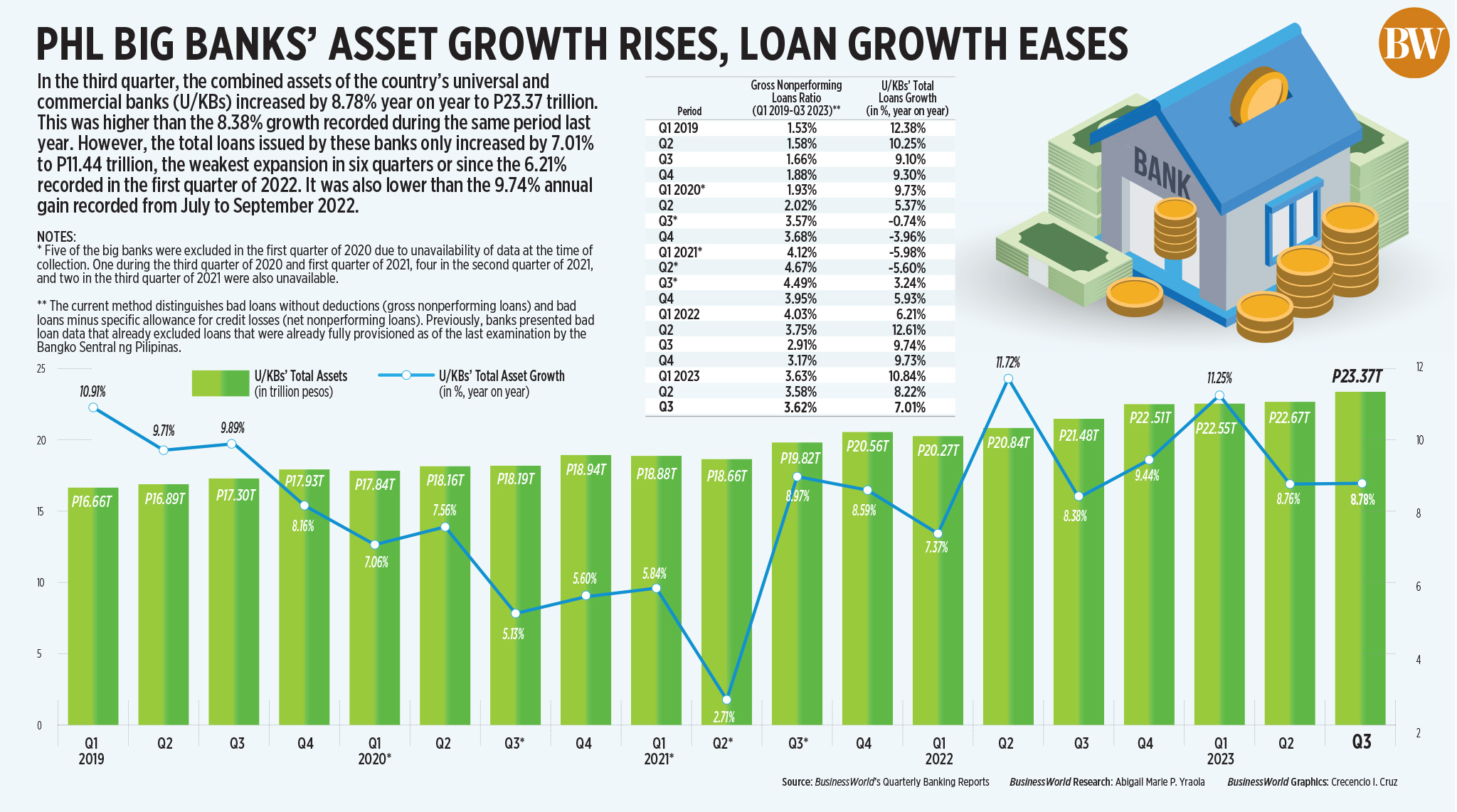
The combined assets of the Philippines’ biggest banks rose by 8.78% in the third quarter, while lending growth slowed amid high borrowing costs.

The latest edition of BusinessWorld’s quarterly banking report showed the combined assets of 45 universal and commercial banks (U/KBs) increased by 8.78% year on year to PHP 23.37 trillion in the July-to-September period from PHP 21.48 trillion a year ago. 

This was a tad faster than the 8.38% growth logged in the same period last year and 8.76% in the second quarter.

PHL big banks’ asset growth rises, loan growth eases

Asset growth was the fastest in two quarters or since 11.25% in the first three months of 2023.

Meanwhile, total loans of these big banks inched up by 7.01% to PHP 11.44 trillion in the third quarter, slower than the 9.74% growth posted a year ago.

The third-quarter loan growth was the slowest in six quarters or since the 6.21% growth in the first quarter of 2022.

The slowdown in lending was reflected in soaring borrowing costs, which discouraged consumers from taking out loans. The Bangko Sentral ng Pilipinas’ (BSP) key rate stood at a near 16-year high 6.25% in the third quarter.

In late October, the Monetary Board raised policy rates by 25 basis points (bps) in an off-cycle hike, which brought the benchmark rate to 6.5%. Between May 2022 and October 2023, the BSP has raised borrowing costs by a cumulative 450 bps.

Bad loans, also known as nonperforming loans (NPLs), jumped by 6.8% to PHP 374.27 billion in the July-to-September period from PHP 350.44 billion in the same period a year ago.   

This brought the NPL ratio — the share of soured loans to the total loan portfolio — to 3.62% from 2.91% in the same quarter a year ago.

Loans are considered to be nonperforming if any principal and/or interest are left unpaid for more than 90 days from the contractual due date or accrued interests for more than 90 days have been capitalized, refinanced, or delayed by agreement. 

Meanwhile, the nonperforming asset (NPA) ratio — the share of NPLs and foreclosed properties to total assets — further eased to 0.89% from 1.1% a year ago.

Relative to total assets, foreclosed real and other properties stood at 0.25% in the third quarter, lower than 0.28% posted in the same period last year.

Total loan loss reserves went up by 8.4% to PHP 413.09 billion during the July-to-September period from PHP 381.25 billion a year ago.

These big banks median capital adequacy ratio (CAR) — the lender’s ability to absorb losses from risk-weighted assets — reached 21.54% in the third quarter, better than the 19.6% median a year ago. However, this was lower than the 21.75% median CAR in the second quarter.

The ratio remained well above the regulatory minimum of 10% set by the BSP as well as the international minimum standard of 8% under the Basel III framework.

The median return on equity (RoE), which is an indicator of profitability, increased to 9.42% in the third quarter from 6.42% in the same quarter a year ago.   

The RoE, the ratio of net profit to average capital, measures the amount that shareholders make on every peso they invest in a company.

Sy-led BDO Unibank, Inc. (BDO) remained the largest bank in terms of total assets with PHP 4.22 trillion, followed by Metropolitan Bank & Trust Co. (Metrobank) with PHP 3.15 trillion and Land Bank of the Philippines (LANDBANK) with PHP 3.1 trillion.

BDO also led the industry in lending with PHP 2.63 trillion worth of loans issued, followed by Bank of the Philippine Islands (BPI) with PHP 1.73 trillion and Metrobank with PHP 1.4 trillion.

In terms of deposits, BDO led with PHP 3.41 trillion, followed by LANDBANK with PHP 2.74 trillion and Metrobank with PHP 2.35 trillion.

Among banks with at least PHP 100 billion assets, China Banking Corp. logged the fastest year-on-year asset growth of 21.16%, followed by Philippine Bank of Communications (15.23%) and Rizal Commercial Banking Corp. (14.63%).

Meanwhile, Standard Chartered Bank was the most aggressive lender with an annual increase of 31.08%, followed by Bank of Commerce with 20.66% and East West Banking Corp. with 18.42%

BusinessWorld Research has been tracking the financial performance of the country’s large banks on a quarterly basis since the late 1980s using banks’ published statements. — By Abigail Marie P. Yraola, Researcher

Posts navigation

Older posts
Newer posts

Recent Posts

  • Metrobank US-Iran Risk Index: Fragile ceasefire 
  • Investment Ideas: April 10, 2026 
  • Metrobank US-Iran Risk Index: A new hope
  • A guide for your peso bond portfolio amid higher for longer rates
  • Investment Ideas: April 8, 2026

Recent Comments

No comments to show.

Archives

  • April 2026
  • March 2026
  • February 2026
  • January 2026
  • December 2025
  • November 2025
  • October 2025
  • September 2025
  • August 2025
  • July 2025
  • June 2025
  • May 2025
  • April 2025
  • March 2025
  • February 2025
  • January 2025
  • December 2024
  • November 2024
  • October 2024
  • September 2024
  • August 2024
  • July 2024
  • June 2024
  • May 2024
  • April 2024
  • March 2024
  • February 2024
  • January 2024
  • December 2023
  • November 2023
  • October 2023
  • September 2023
  • August 2023
  • July 2023
  • June 2023
  • May 2023
  • April 2023
  • March 2023
  • February 2023
  • January 2023
  • December 2022
  • November 2022
  • October 2022
  • September 2022
  • August 2022
  • July 2022
  • June 2022
  • May 2022
  • March 2022
  • December 2021
  • October 2021

Categories

  • Bonds
  • BusinessWorld
  • Currencies
  • Economy
  • Equities
  • Estate Planning
  • Explainer
  • Featured Insight
  • Fine Living
  • How To
  • Investment Tips
  • Markets
  • Portfolio Picks
  • Rates & Bonds
  • Retirement
  • Reuters
  • Spotlight
  • Stocks
  • Uncategorized

You are leaving Metrobank Wealth Insights

Please be aware that the external site policies may differ from our website Terms And Conditions and Privacy Policy. The next site will be opened in a new browser window or tab.

Cancel Proceed
Get in Touch

For inquiries, please call our Metrobank Contact Center at (02) 88-700-700 (domestic toll-free 1-800-1888-5775) or send an e-mail to customercare@metrobank.com.ph

Metrobank is regulated by the Bangko Sentral ng Pilipinas
Website: https://www.bsp.gov.ph

Quick Links
The Gist Webinars Wealth Manager Explainers
Markets
Currencies Rates & Bonds Equities Economy
Wealth
Investment Tips Fine Living Retirement
Portfolio Picks
Bonds Stocks
Others
Contact Us Privacy Notice Terms of Use
© 2026 Metrobank. All rights reserved.

Access this content:

If you are an existing investor, log in first to your Metrobank Wealth Manager account. ​

If you wish to start your wealth journey with us, click the “How To Sign Up” button. ​

Login HOW TO SIGN UP