




MODEL PORTFOLIO
THE GIST
NEWS AND FEATURES
Global Philippines Fine Living
INSIGHTS
INVESTMENT STRATEGY
Economy Stocks Bonds Currencies
THE BASICS
Investment Tips Explainers Retirement
WEBINARS
2024 Mid-Year Economi Briefing, economic growth in the Philippines
2024 Mid-Year Economic Briefing: Navigating the Easing Cycle
June 21, 2024
Investing with Love
Investing with Love: A Mother’s Guide to Putting Money to Work
May 15, 2024
retirement-ss-3
Investor Series: An Introduction to Estate Planning
September 1, 2023
View All Webinars
DOWNLOADS
grocery-2-aa
Inflation Update: Target breached
DOWNLOAD
Container ship carrying container boxes import export dock with quay crane. Business commercial trade global cargo freight shipping logistic and transportation worldwide oversea concept. Generative AI
Economic Updates
Philippines Trade Update: Wider deficit on strong imports
DOWNLOAD
Frick collection with palm trees 
Economic Updates
Policy Rate Updates: Policy rate updates to reassure 
DOWNLOAD
View all Reports
Metrobank.com.ph How To Sign Up
Follow us on our platforms.

How may we help you?

TOP SEARCHES
  • Where to put my investments
  • Reports about the pandemic and economy
  • Metrobank
  • Webinars
  • Economy
TRENDING ARTICLES
  • Investing for Beginners: Following your PATH
  • On government debt thresholds: How much is too much?
  • Philippines Stock Market Outlook for 2022
  • Deficit spending remains unabated

Login

Access Exclusive Content
Login to Wealth Manager
Visit us at metrobank.com.ph How To Sign Up
Access Exclusive Content Login to Wealth Manager
Search
MODEL PORTFOLIO THE GIST
NEWS AND FEATURES
Global Philippines Fine Living
INSIGHTS
INVESTMENT STRATEGY
Economy Stocks Bonds Currencies
THE BASICS
Investment Tips Explainers Retirement
WEBINARS
2024 Mid-Year Economi Briefing, economic growth in the Philippines
2024 Mid-Year Economic Briefing: Navigating the Easing Cycle
June 21, 2024
Investing with Love
Investing with Love: A Mother’s Guide to Putting Money to Work
May 15, 2024
retirement-ss-3
Investor Series: An Introduction to Estate Planning
September 1, 2023
View All Webinars
DOWNLOADS
grocery-2-aa
Inflation Update: Target breached
April 7, 2026 DOWNLOAD
Container ship carrying container boxes import export dock with quay crane. Business commercial trade global cargo freight shipping logistic and transportation worldwide oversea concept. Generative AI
Economic Updates
Philippines Trade Update: Wider deficit on strong imports
March 27, 2026 DOWNLOAD
Frick collection with palm trees 
Economic Updates
Policy Rate Updates: Policy rate updates to reassure 
March 26, 2026 DOWNLOAD
View all Reports

Archives: Business World Article

Rates of T-bills, bonds may end mixed

Rates of T-bills, bonds may end mixed

Rates of Treasury bills (T-bills) on offer this week could be steady, while the new five-year bonds could fetch yields at par with secondary market levels, amid bets on the US Federal Reserve’s next policy move.

The Bureau of the Treasury (BTr) will auction off PHP 15 billion in T-bills on Monday, or PHP 5 billion each in 91-, 182-, and 364-day papers.

On Tuesday, the government will offer PHP 30 billion in fresh five-year Treasury bonds (T-bonds).

T-bill rates could be mixed and little changed this week, mostly tracking secondary market yields, Rizal Commercial Banking Corp. Chief Economist Michael L. Ricafort said in a Viber message.

The five-year bonds could also fetch rates close to secondary market levels, Mr. Ricafort added.

Secondary market yield movements were mostly mixed as investors were betting on the Fed’s next monetary policy decision, he said.

“Despite neutral auction results, players were generally biddish until strong US jobs data ruined the buying mood as it sparked doubts on how soon the Fed can start lowering rates,” a trader likewise said in an e-mail on Friday.

The trader sees the five-year bond fetching rates from 6% to 6.125%.

At the secondary market on Friday, the rates of the 91-, 182-, and 364-day Treasury bills (T-bills) dropped by 1.73 basis points (bp), 0.94 bp, and 4 bps week on week to 5.2265%, 5.5084%, and 5.8274%, respectively, based on PHP Bloomberg Valuation Service Reference Rates data published on the Philippine Dealing System’s website.

Meanwhile, the five-year bond rose by 8.02 bps week on week to yield 6.0188%.

The monthly nonfarm payrolls report showed the US economy added 216,000 new jobs in December, Reuters reported.

The jobless rate held steady at 3.7%, down from most forecasters’ expectations for it to rise, prompting concerns that the Fed’s long battle to tame inflation may have further to run.

Futures traders on Friday saw a 66.4% chance of the Fed in March starting to lower its benchmark overnight interest rate from the current 5.25% to 5.5% range, according to the CME Group’s FedWatch Tool.

The US central bank last month kept the fed funds rate steady at 5.25-5.5% for a third straight meeting after hiking borrowing costs by a cumulative 525 bps from March 2022 to July 2023.

The Federal Open Market Committee will hold its first policy meeting for the year on Jan. 25-26.

Meanwhile, Philippine inflation data released on Friday also affected secondary market yields, Mr. Ricafort added.

Inflation slowed to 3.9% in December from 4.1% in November and 8.1% in the same month a year ago. This was the first time the consumer price index (CPI) settled within the central bank’s 2-4% target and was the slowest since the 3% reading in February 2022.

However, headline inflation averaged 6% for 2023, faster than 5.8% in 2022 and marking second straight year that the CPI exceeded the Bangko Sentral ng Pilipinas’ 2-4% annual goal.

Last week, the BTr raised PHP 17 billion from its offer T-bills, above the initial PHP 15-billion program, as total bids reached PHP 39.945 billion or more than twice the amount on the auction block.

Broken down, the Treasury made a full PHP 5-billion award of the 91-day T-bills as tenders for the tenor reached PHP 13.36 billion. The average rate of the three-month paper rose by 14.4 bps to 5.14%. Accepted rates ranged from 5.4% to 5.88%.

The BTr likewise borrowed PHP 5 billion as planned via the 364-day debt papers as bids for the tenor reached PHP 12.225 billion. The average rate of the one-year T-bill went up by 9.7 bps to 5.829% from 5.732% previously, with accepted rates from 5.498% to 6.7%.

Meanwhile, the government raised PHP 7 billion through the 182-day securities, above the original PHP 5-billion program, as bids for the paper reached PHP 14.36 billion. The average rate for the six-month T-bill stood at 5.578%, jumping by 31.1 bps from the previous auction, with accepted yields ranging from 5.328% to 5.85%.

The Treasury bureau wants to raise PHP 195 billion from the domestic market this month, or PHP 75 billion via T-bills and PHP 120 billion through T-bond offerings.

The government borrows from local and foreign sources to help fund its budget deficit, which is capped at 5.1% of gross domestic product this year. — A.M.C. Sy with Reuters


Peso may be broadly steady vs dollar

Peso may be broadly steady vs dollar

The peso could be broadly steady against the dollar this week, supported by the continued inflow of remittances and as interest rates remain elevated.

The local unit closed at PHP 55.57 per dollar on Friday, weakening by seven centavos from its PHP 55.50 close on Thursday, Bankers Association of the Philippines data showed.

Week on week, the peso depreciated by 20 centavos from its PHP 55.37 close on December 29.

The peso opened Friday’s session steady at PHP 55.50 against the dollar. Its intraday best was at PHP 55.475, while its weakest showing was at PHP 55.78 versus the greenback.

Dollars exchanged jumped to USD 2.05 billion on Friday from USD 1.72 billion on Thursday.

The peso depreciated against the dollar on Friday after the Bangko Sentral ng Pilipinas (BSP) said it would limit its intervention in the foreign exchange market, Rizal Commercial Banking Corp. Chief Economist Michael L. Ricafort said in a Viber message.

BSP Governor Eli M. Remolona, Jr. said last week they will finalize a new framework this year to make the peso more competitive and reduce restrictions in the foreign exchange market.

The peso was also dragged lower by a stronger dollar after the US jobs report eased expectations of a rate cut by the US Federal Reserve soon, Mr. Ricafort added.

The monthly nonfarm payrolls report showed the US economy added 216,000 new jobs in December, Reuters reported.

The jobless rate held steady at 3.7%, down from most forecasters’ expectations for it to rise, prompting concerns that the Fed’s long battle to tame inflation may have further to run.

The US central bank last month kept the fed funds rate unchanged at 5.25-5.5% for the third straight time after it hiked borrowing costs by a cumulative 525 basis points (bps) from March 2022 to July 2023.

The Federal Open Market Committee will hold its first policy meeting this year on Jan. 25-26.

For this week, the peso could be “relatively stronger and stable” amid expectations of elevated interest rates, Oikonomia Advisory & Research, Inc. President and Chief Economist John Paolo R. Rivera said in a Viber message.

The Bangko Sentral ng Pilipinas raised borrowing costs by 450 bps from May 2022 to October 2023, bringing the policy rate to a 16-year high of 6.5%.

The Monetary Board will hold its first meeting this year on Feb. 12.

The peso will also continue to be supported by remittances, Mr. Rivera said.

“With the sustained influx of remittances, the strength of the peso is reinforced. As the holiday season ends and the new year starts, we can expect minimal movements in the exchange rate next week given the prevalent conditions I mentioned,” he said.

For this week, Mr. Ricafort sees the peso ranging from PHP 55.35 to PHP 55.85. — AMCS with Reuters

Stocks may drop on profit taking, lack of leads

Stocks may drop on profit taking, lack of leads

Philippine shares may decline this week due to profit taking and amid a lack of major trading drivers.

The Philippine Stock Exchange index (PSEi) climbed by 27.12 points or 0.41% to end at 6,629.64 on Friday, while the broader all shares index rose by 16.76 points or 0.48% to close at 3,502.52.

Week on week, the PSEi rose by 179.6 points or 2.78% from its 6,450.04 finish on Dec. 29.

“The local market started the week on a positive note, rising 2.78% to 6,629.64. The market’s technical reading has also been bullishly biased. The market has been on an uptrend since bottoming last Oct. 31, 2023,” Philstocks Financial, Inc. Senior Research Analyst Japhet Louis O. Tantiangco said in a Viber message.

“The local bourse greets the New Year on a high note, breaking past 6,600 on the first week of trading in 2024,” online brokerage 2TradeAsia.com said in a market report. 

However, for this week, stocks may drop on profit taking as investors look for positive catalysts, Mr. Tantiangco said.

“Investors are expected to look for clues on inflation and monetary policy outlook,” he said.

“To sustain the momentum, the market is seen to need more positive catalysts. While the decline of inflation last December is seen to have helped in lifting sentiment, investors are still expected to look further, primarily how the inflation trend and the BSP’s (Bangko Sentral ng Pilipinas) policy path will be this year,” Mr. Tantiangco added.

Inflation slowed to 3.9% in December from 4.1% in November and 8.1% a year ago, the Philippine Statistics Authority reported on Friday. This was the slowest reading and was the first time the consumer price index (CPI) settled within the BSP’s 2-4% target in 22 months or since the 3% in February 2022.

The December print was also a tad lower than the 4% median estimate in a BusinessWorld poll and was within the 3.6% to 4.4% estimate given by the BSP for the month.

For 2023, headline inflation averaged 6%, slightly faster than the 5.8% in 2022 and marking the second straight year that the CPI exceeded the BSP’s 2-4% target.

This was the fastest print in 14 years or since the 8.2% full-year average in 2008, at the height of the global financial crisis.

The BSP said risks to the inflation outlook remain significantly on the upside, citing possible inflationary pressures from higher transport charges, increased electricity rates, rising oil prices, and elevated food prices due to strong El Niño conditions.

“Looking ahead, the Monetary Board deems it necessary to keep monetary policy settings sufficiently tight until a sustained downtrend in inflation becomes evident,” the central bank said on Friday.

The market will also await the release of latest labor and foreign direct investments data this week, Mr. Tantiangco said.

Meanwhile, 2TradeAsia.com put the PSEi’s immediate support for the week at 6,500 and resistance at 6,700-6,750. — R.M.D. Ochave

BSP to limit its forex intervention

BSP to limit its forex intervention

The Bangko Sentral ng Pilipinas (BSP) is looking to limit its foreign exchange intervention on markets by finalizing a new framework this year, its chief said on Thursday.

In his first public event this year at the Rotary Club’s weekly meeting, BSP Governor Eli M. Remolona, Jr. said the central bank aims to make the peso more competitive and reduce restrictions in the foreign exchange market.

“We’re developing a framework for intervention… We think intervention should only happen during times of stress. It’s meant to contain stress,” he said.

Mr. Remolona told reporters that BSP Senior Assistant Governor Edna C. Villa will head the central bank’s Financial Markets department, replacing retired Ma. Ramona Gertrudes D.T. Santiago. 

The foreign exchange framework will also be implemented this year, he said.

The BSP chief has instructed Ms. Villa to identify the Philippines’ peers in the region when it comes to movements against the dollar.

“We want to do things in the right way. We want to do things based on fundamentals and also based on what we know is going on in the markets,” he said.

Meanwhile, Mr. Remolona noted that October 2022 was a stressful episode for the central bank and the foreign exchange market. 

“Those are the events in which we want to intervene,” he said. “I think we’ve been intervening a bit too much. If it’s about containing stress, that also means intervention should be infrequent.”

In October 2022, the peso reached its record low of P59 against the dollar. This also caused the peso to add to inflationary pressures during that time, which prompted the BSP to intervene in the foreign exchange market and raise interest rates. 

The peso has since rebounded to the P55 level, closing at P55.50 against the dollar on Thursday.

To tame inflation, the Monetary Board hiked borrowing costs by 450 basis points (bps) from May 2022 to October 2023. This has brought the key interest rate to 6.5%, its highest in 16 years.

Mr. Remolona said the current 6.5% policy rate is still appropriate to ensure growth and tame inflation at the same time. 

“People say we’ve been tightening too much… that’s a very difficult challenge because we want to make sure that we don’t tighten unnecessarily,” he said.

However, the BSP chief said there are still upside risks to inflation, but he is hoping that inflation will settle within the 2-4% target range for most of 2024.

BSP sees inflation settling at an average of 6% in 2023, before easing to 3.7% in 2024 and 3.2% in 2025.

A BusinessWorld poll last week yielded a median estimate of 4% for December headline inflation, within the BSP’s 3.6-4.4% forecast for the month. This is slightly slower than 4.1% in November but significantly below 8.1% in December 2022.

If realized, December could mark the first time that inflation met the central bank’s 2-4% target after 20 straight months. It would also be the slowest since the 3% print in February 2022.

This would bring the 2023 inflation average to 6%, matching the BSP’s baseline forecast.

The Philippine Statistics Authority will release December consumer price index data on Friday. — By Keisha B. Ta-asan, Reporter

PH firms seen to hike salaries by 6.2% this year

PH firms seen to hike salaries by 6.2% this year

Salary increases are expected to be higher in the Philippines this year, amid growing demand for professionals and elevated inflation, according to global professional services firm Mercer.

In its Total Remuneration Survey conducted last year, Mercer said Philippine-based organizations projected a median salary hike of 6.2% in 2024, slightly higher than the actual 6% salary increase last year. 

It is also above the projected average median salary increase of 5.2% in Asia for 2024.

“The projected hike in median salary increment can be attributed to factors such as the rising demand for skilled professionals, the need to attract and retain top talent in a fiercely competitive job market, and persistent inflationary pressures,” Mercer said in a statement.

The expected median salary increase in the Philippines is the fourth highest in the region, just behind India (9.3%), Vietnam (7%), and Indonesia (6.5%).

The country surpassed the projected median salary increments in Mainland China (5.2%), Malaysia (5.1%), Thailand (4.7%), South Korea (4.4%), and Singapore (4.2%).

Meanwhile, Hong Kong SAR (2.6%), Taiwan (3.8%) and Japan (3.9%) reported the lowest projected median salary increments in the region.

Floriza I. Molon, business leader at Mercer Philippines, said that most industries are seen to ramp up hiring as businesses expand this year.

“The Philippines is poised for economic growth despite some global headwinds. Some industries will continue to hire as businesses, particularly in shared services and outsourcing industry, retail and consumer sectors expand,” Ms. Molon said.

Mercer said salary increases will likely be consistent in most industries this year, as firms seek to retain talent.

The energy sector is seen to raise salaries by 7% this year, the highest among industries in the Philippines, data from Mercer showed. This is the same as the 7% hike implemented in 2023.

The high-technology industry is expected to hike salaries by 6.8%, a tad higher than the actual 6.5% increase last year.

Firms in retail and wholesale will increase wages by 6.7%, slightly higher than last year’s 6.5%.

Consumer goods firms will hike wages by 6.5%, faster than the 6% implemented last year.

“Besides compensation, companies would need to reassess their total rewards programs focusing on the employee benefits and work experience,” Ms. Molon said.

Citing Mercer Global Talent Trends 2023 report, Ms. Molon said that employees prefer to stay with organizations that offer job security, work flexibility and high pay.

“Employees are also expecting benefits and career opportunities within their organizations. The ability to provide these creates a more holistic and strategic management on talent in the workplace,” she added.

China Banking Corp. Chief Economist Domini S. Velasquez said businesses will likely provide higher salary increases as inflation remains elevated.

The Bangko Sentral ng Pilipinas (BSP) expected inflation to have averaged 6% in 2023. It sees inflation averaging 3.7% in 2024.

“The rise in inflation could prompt businesses to provide higher compensation to offset the increased cost of living for Filipinos,” Ms. Velasquez said in a Viber message.

“Moreover, the approved minimum wage hikes in 2023 would further contribute to the upward trend in average wages for individuals earning above the minimum wage,” she added.

Ms. Velasquez said the wage increases should not “exacerbate” inflation and be balanced out by improving worker productivity.

“One key factor in achieving this balance is the improvement of worker productivity. As businesses recover from the impact of the pandemic and economic activities gradually increase, it is anticipated that Filipino workers will demonstrate higher productivity levels,” she said.

Meanwhile, Rizal Commercial Banking Corp. Chief Economist Michael L. Ricafort said that implementing salary increases will not only allow businesses to be competitive but also allow the Philippines to catch up with its regional peers in terms of per capita income.

“Given the fact that the Philippines is still among the fastest-growing economies in Asia, it still has relatively lower per capita incomes and is yet to catch up with other neighboring countries,” he said.

“Essentially the demand-supply balance of talent is a major determinant for wage growth in view of local or overseas employment choices for local talents,” he added. — Justine Irish D. Tabile

DoF says CREATE incentives benefited P1T worth of projects

DoF says CREATE incentives benefited P1T worth of projects

Projects benefitting from incentives under the Corporate Recovery and Tax Incentives for Enterprises (CREATE) law have reached PHP 1.02 trillion in investment capital as of October, the Department of Finance (DoF) said. 

In a social media post, the DoF said this reflects the efforts of the Marcos administration to promote the Philippines as a good investment destination. 

“This landmark milestone also gained PHP 572.98 billion worth of foreign direct investment (FDI) pledges, with 910 CREATE-approved projects varying across priority sectors listed in the Strategic Investment Priority Plan,” it said.

Of the 910 CREATE-approved projects, around 49 big-ticket tax incentive applications with a total investment capital of PHP 817 billion were approved by the Fiscal Incentives Review Board.

The remaining 861 projects — with a combined investment capital of PHP 203 billion — were from investment promotion agencies (IPAs).

“These projects are expected to accumulate a committed employment count of around 99,400 jobs within its incentivized period, with the labor-intensive manufacturing sector having the highest number of approved projects among the priority sectors,” the DoF said.

“This underscores the employability of the country’s workforce in high-quality jobs that will contribute to long-term economic growth,” it added.

CREATE was signed into law in 2021 to aid enterprises that have yet to recover from the coronavirus pandemic. It reduced corporate income tax rates, provided tax relief measures, and rationalized fiscal incentives.

“As CREATE establishes a performance-based, time-bound, targeted, and transparent tax incentives regime in the country, incentivized projects or activities under the key structural tax reform are to achieve performance metrics to ensure that the grant of fiscal support to registered business enterprises leads to higher economic returns,” the DoF said. 

In August, Albay Rep. Jose Ma. Clemente S. Salceda filed the CREATE to Maximize Opportunities for Reinvigorating the Economy (CREATE MORE) bill, which seeks to reconcile disparities between the CREATE Act and its implementing rules, primarily on value-added tax (VAT)-related transactions. 

Under CREATE MORE, local and export companies, even those inside ecozones and freeports, would continue to enjoy duty exemptions, VAT exemption on importation, and the VAT zero-rating of local purchases as provided in their respective IPA registrations.

Registered export enterprises would also enjoy non-income tax incentives, VAT exemption on importation and VAT zero-rating on local purchases, as long as the registered firm maintains 70% of the total annual production as export sale and continues to be registered in good standing with the IPA.

The measure also proposes to lower corporate income tax to 20% for those under the enhanced deduction regime from 20-25%.

The bill is currently being taken up in the House of Representatives. — Keisha B. Ta-asan

PH energy companies bullish, eye 2024 demand surge

PH energy companies bullish, eye 2024 demand surge

Some  listed Philippine energy companies are bent on diversifying their energy portfolio amid an expected surge in demand and a pipeline of projects.

“We are currently diversifying our power portfolio by developing several renewable energy facilities, with numerous others in the pipeline,” Antonio Miguel B. Alcantara, deputy chief executive officer at Alsons Power Group, said in a Viber message last week.

He said the company is optimistic for 2024 year with the operation of its 14.5-megawatt (MW) Siguil hydropower plant in Maasim, Sarangani province.

“We are committed to expanding our footprint and diversifying our power portfolio,” Mr. Alcantara said. “This year signifies a major milestone in our journey as we enter the Visayas market with the groundbreaking of our 95.2-megawatt baseload backup power plant in Ubay, Bohol.”

The project will serve as a dependable source of backup electricity for consumers in Bohol.

The energy company is also working on two additional renewable power facilities — the 37.8-MW Siayan hydropower project in Zamboanga del Norte and the 42-MW Bago hydropower plant in Negros Occidental.

Meanwhile, Emmanuel V. Rubio, president and chief executive officer at Aboitiz Power Corp. (AboitizPower), said the company is confident about this year despite tight market conditions.

“As electricity demand continues to grow, we will strive to generate more megawatt-hours in 2024 through higher plant availability and new capacities, especially as we expect coal prices to decline,” he said.

Power consumption is projected to increase by 6.6% this year, requiring 600-700 MW of power reserves, he said.

“This substantial increase in electricity demand underscores the pivotal role of power generation, transmission and distribution companies in meeting this need,” Mr. Rubio said.

He said the expected increase requires significant infrastructure development, including the construction of new power plants and the expansion of the power grid to ensure that electricity reaches demand centers.

AboitizPower has allotted PHP 50 billion in capital expenditure this year, mostly for the expansion and construction of its renewable energy (RE) projects.

It targets to energize its 17-MW binary geothermal power project in Tiwi, Albay this year, as well as its 173-megawatt peak (MWp) solar power project in Calatrava, Negros Occidental.

It also expects several projects to come online this year and in 2025, including its 44-MWp solar plant in Armenia, Tarlac; the 85-MWp solar plant in San Manuel, Pangasinan; and the 206-MW wind project in San Isidro, Northern Samar in partnership with Singapore-based Vena Energy and Vivant Energy Corp.

The company has set a target net attributable capacity of 9,200 MW and 50:50 balance between RE and thermal portfolios by the end of the decade.

To date, it has renewable energy projects with a combined capacity of close to 1,000 MW that are in the pipeline.

Meanwhile, Manila Electric Co. (Meralco) said it would ensure stable and reliable electricity for its 7.8 million customers.

“We maintain a high level of power reliability because the company has been allocating a substantial amount of capital expenditures every year to ensure service quality,” Meralco spokesman and Vice-President for corporate communications Joe R. Zaldarriaga said in a Viber message. “We put up new substations and replaced facilities that needed to be upgraded.”

The distribution utility has launched its two competitive selection processes for a total of 3,000 MW. Meralco has just announced it is seeking bidders for 660-MW supply for the summer.

“There will be challenges for sure like the El Niño phenomenon, which we are closely monitoring especially during the summer months,” Mr. Zaldarriaga said.

Meralco’s controlling stakeholder, Beacon Electric Asset Holdings, Inc., is partly owned by PLDT Inc.

Hastings Holdings, Inc., a unit of PLDT Beneficial Trust Fund subsidiary MediaQuest Holdings, Inc., has an interest in BusinessWorld through the Philippine Star Group, which it controls. — By Sheldeen Joy Talavera, Reporter

PSEi rebounds before December inflation data

PSEi rebounds before December inflation data

Philippine shares rebounded on Thursday amid expectations of better inflation data for December.

The Philippine Stock Exchange index (PSEi) gained 103.64 points or 1.59% to end at 6,602.52 on Thursday, while the broader all shares index rose 35.52 points or 1.02% to close at 3,485.76.

“This Thursday, the local market rose by 103.64 points to 6,602.52 on the back of hopes that headline inflation in the Philippines had further declined last December. Supporting the said hopes is the midpoint of the Bangko Sentral ng Pilipinas’ (BSP) 3.6-4.4% range forecast which is below the preceding month’s 4.1%,” Philstocks Financial, Inc. Research and Engagement Officer Mikhail Philippe Q. Plopenio said in a Viber message.

The Philippine Statistics Authority will release December consumer price index data on Friday.

A BusinessWorld poll last week yielded a median estimate of 4% for December headline inflation, within the BSP’s 3.6-4.4% forecast for the month. This is slightly slower than the 4.1% in November but significantly below the 8.1% in December 2022.

If realized, December could mark the first time that inflation met the central bank’s 2-4% target after 20 straight months. It would also be the slowest since the 3% print in February 2022.

This would bring the 2023 inflation average to 6%, matching the BSP’s baseline forecast.

“The index surged above the 6,600 level and reached its highest close in more than five months as investors positioned ahead of the release of the Philippine December inflation print on Friday,” China Bank Capital Corp. Managing Director Juan Paolo E. Colet likewise said in a Viber message.

“The PSEi bucked the fall of most Asian markets as traders bought up local stocks on expectations that domestic headline inflation last month cooled to 4%, which is within the BSP’s target inflation range,” Mr. Colet added.

Asian shares fell on Thursday as traders dialed back bets of steep and early rate cuts this year, with the minutes of the US Federal Reserve’s last meeting providing few clues on when US cuts might start, Reuters reported.

MSCI’s broadest index of Asia-Pacific shares outside Japan fell 0.17% and was headed for the third straight day of losses.

Back home, almost all sectoral indices ended higher on Thursday. Property increased by 78.36 points or 2.77% to 2,907.31; financials climbed by 30.76 points or 1.78% to 1,754.47; services rose by 25.86 points or 1.59% to 1,651.63; holding firms went up by 71.46 points or 1.13% to 6,360.48; and industrials added 33.14 points or 0.36% to end at 9,137.63. 

Meanwhile, mining and oil dropped by 77.40 points or 0.78% to 9,777.89. 

Value turnover climbed to PHP 5.18 billion on Thursday with 461.64 million issues changing hands from the PHP 3.11 billion with 182.7 million shares seen on Wednesday.

Advancers outnumbered decliners, 110 to 85, while 46 issues ended unchanged. 

Net foreign buying stood at PHP 768.3 million on Thursday versus the PHP 260.5 million in net selling seen the prior day. — R.M.D. Ochave with Reuters

Debt pile rises to record PHP14.5 trillion

Debt pile rises to record PHP14.5 trillion

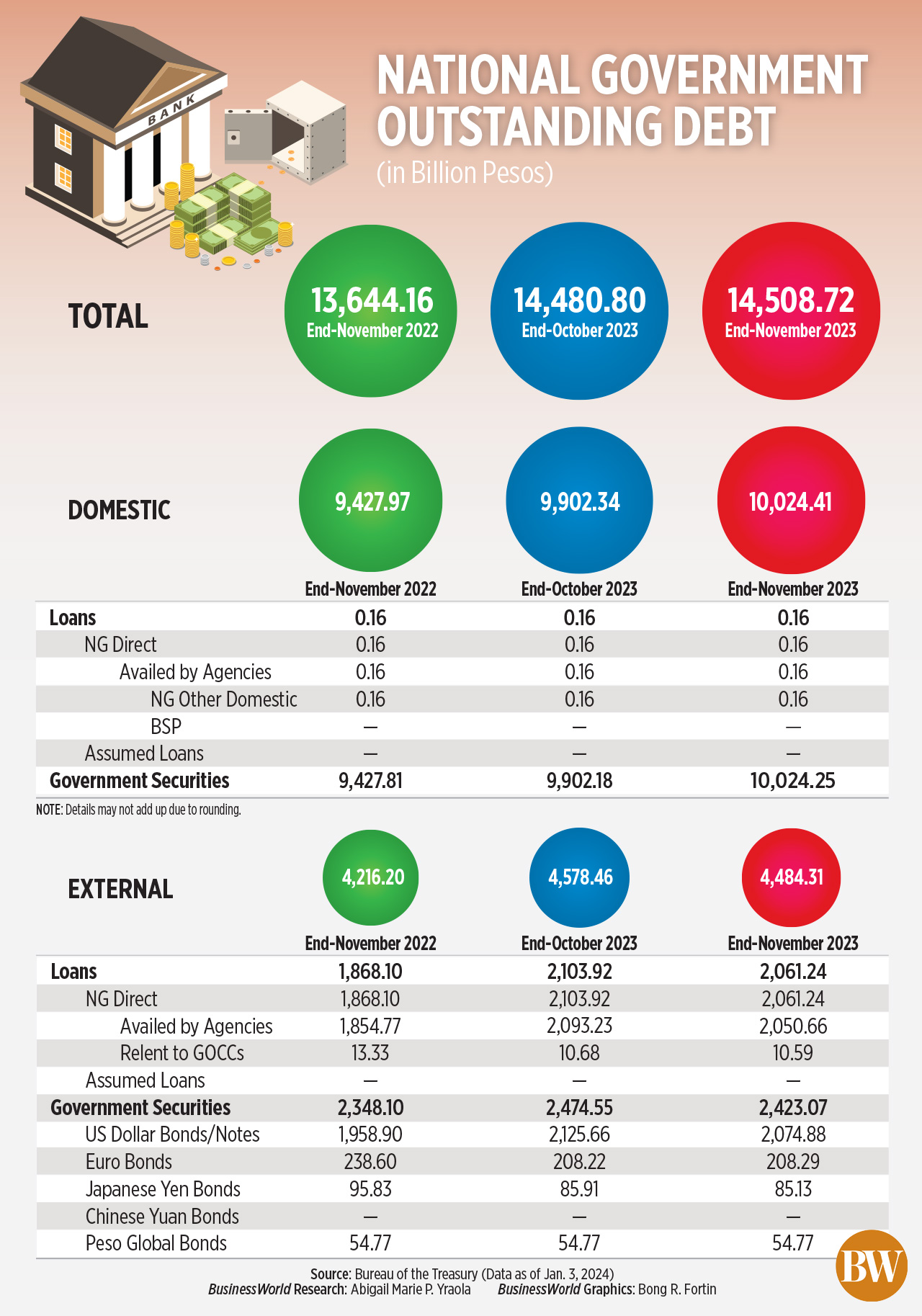
The National Government’s (NG) total outstanding debt hit a fresh high of PHP 14.51 trillion as of end-November, the Bureau of the Treasury (BTr) said on Wednesday.   

The outstanding debt inched up by 0.2% from PHP 14.48 trillion as of end-October, data from the BTr showed.

“NG’s debt stock increased by PHP 27.92 billion or 0.2% month over month, primarily due to the net issuance of domestic securities,” the BTr said in a press release.

National Government outstanding debtYear on year, the debt stock rose by 6.3% from PHP 13.64 trillion.

Outstanding debt went up by 8.1% from PHP 13.42 trillion as of end-December 2022.

More than two-thirds or 69.1% of total outstanding debt as of end-November came from domestic sources.

As of end-November, domestic debt increased by 1.2% to PHP 10.02 trillion from PHP 9.9 trillion a month earlier due to the net issuance of government securities.

Domestic debt also rose by 6.3% from PHP 9.43 trillion in the same period a year prior.

“New domestic debt issued during the month totaled PHP 171.091 billion while principal redemption amounted to PHP 45.14 billion, underlying a net issuance of PHP 125.95 billion,” the BTr said.

“The increase was partially offset by the PHP 3.87-billion effect of peso appreciation on foreign currency-denominated domestic securities,” it added.

Data from the Treasury department showed the peso closed at PHP 55.451 against the dollar as of end-November, strengthening by PHP 1.357 or 2.4% from PHP 56.808 as of end-October.

Meanwhile, external debt, which accounted for 31% of the total, slipped by 2.1% to PHP 4.48 trillion as of end-November from PHP 4.58 trillion as of end-October.

However, external debt rose by 6.4% from PHP 4.22 trillion a year ago.

“For November, the lower level of external debt was due to the net repayment of foreign loans amounting to PHP 1.08 billion and favorable foreign exchange movements, wherein the PHP 109.37 billion reduction attributed to peso appreciation against the US dollar far exceeded the upward adjustment linked to third-currency appreciation of PHP 16.3 billion,” the BTr said.

Broken down, external borrowings consisted of PHP 2.06 trillion in loans and PHP 2.42 trillion in global bonds.

As of end November, the NG’s overall guaranteed obligations slid by 12.2% to PHP 353.14 billion from PHP 361 billion as of end-October.

Year on year, guaranteed debt declined by 8.9% from PHP 388 billion.

“The decline in the level of guaranteed debt was attributed to the net repayment of both domestic and external guarantees amounting to PHP 1.21 billion and PHP 3.5 billion, respectively,” the BTr said.

“In addition, the peso appreciation against the US dollar further trimmed PHP 4.07 billion (from guaranteed debt). These more than offset the P0.92-billion effect of third currency appreciation on similarly denominated guarantees,” it added.

China Banking Corp. Chief Economist Domini S. Velasquez said the government incurred more debt to support budget financing.

“The increase in government debt was likely driven by the financing needs of government projects and programs. However, this growth was likely limited by lower market interest rates and the appreciation of the peso during the month,” she said.

Rizal Commercial Banking Corp. Chief Economist Michael L. Ricafort said the record high NG debt was due to new borrowings to fund the budget deficit.

For 2023, the government has set a budget deficit ceiling of PHP 1.499 trillion, equivalent to 6.1% of the gross domestic product (GDP).

“Looking ahead to 2024, we expect the government to increase its borrowings to fund the 2024 budget which is 9.5% higher than that of last year,” Ms. Velasquez said.

“On a positive note, the expected downtrend in market yields and further strengthening of the peso will help moderate debt growth. However, we think that the proposed tax reforms are crucial to ensure that the budget deficit and government debt remain at manageable levels,” she added.

Mr. Ricafort said the government’s outstanding debt could still increase in the coming months due to the maiden issuance of Sukuk bonds worth USD 1 billion last December.

“Continued budget deficits, though narrower from year ago levels, could still lead to additional borrowings/debt by the national government,” he said.

For 2023, the government plans to borrow PHP 2.207 trillion, consisting of PHP 1.654 trillion from domestic sources and PHP 553.5 billion from foreign sources. –– Keisha B. Ta-asan

MUFG sees PH economy growing by 5.6% this year

MUFG sees PH economy growing by 5.6% this year

The Philippine economy may grow by 5.6% this year as easing inflation could help boost consumption, MUFG Global Markets Research said.

In a report, MUFG Global Markets said the Philippine gross domestic product (GDP) is forecast to expand by 5.6% this year, picking up from the likely 4.8% GDP growth in 2023.

However, the growth forecast is below the Philippine government’s 6.5% to 7.5% growth target for 2024.

“We think that headwinds to domestic demand from elevated food and energy prices should gradually fade over time, but the growth rebound will probably be more evident from the second half of 2024 onwards, assuming no further food supply shocks,” it said.

Philippine GDP growth accelerated to 5.9% in the third quarter, mainly driven by faster government spending, while private consumption slowed. This brought the nine-month GDP growth average to 5.5%, still below the government’s 6-7% full-year target.

“The more stable external environment, coupled with stable USDPHP (US dollar-Philippine peso exchange rate), should also help Bangko Sentral ng Pilipinas (BSP) keep rates on hold through the next few months, and to start the rate-cutting cycle from the second half of 2024, as such helping investment and private consumption activity,” the research firm said.

MUFG Global Markets Research expects the BSP to cut interest rates by 50 basis points (bps) this year. This would bring the benchmark rate to 6% by end-2024, from the current 16-year high of 6.5%.

The Monetary Board has raised borrowing costs by a cumulative 450 basis points (bps) from May 2022 to October 2023 to tame inflation.

“We think the Philippine central bank will remain cautious for now, even as it looks more likely now that the Fed will start its rate-cutting cycle in 2024, together with the recent progress in bringing inflation down. This is also because upside risks to inflation are still present,” the research firm said.

Markets are anticipating the US Federal Reserve will begin cutting rates this year as inflation eases. At its December meeting, the Fed had forecast 75 bps in rate cuts for 2024.

“We think the Philippines’ central bank would prefer to take its lead from the Fed and wait for the US rate-cutting cycle to be clearly underway, before commencing its rate cuts,” it said.

For this year, MUFG Global Markets Research said Philippine inflation is seen to slowly return to the upper end of the BSP’s 2-4% target band if there are no more supply shocks.

“We expect the Philippines’ CPI (consumer price index) to fall into the central bank’s upper half of the inflation target by the first quarter 2024, and to stay around that range through the course of 2024… There are nonetheless still upside risks to inflation stemming from food supply shocks, possible transport fare hikes, and minimum wage increases,” it added.

BSP Governor Eli M. Remolona, Jr. said last month the central bank will likely keep benchmark interest rates higher for longer until inflation settles at around 3%.

MUFG Global Markets Research said the Philippine peso will likely underperform in 2024, as the current account deficit is seen at -3% of GDP and the central bank beefs up its foreign exchange reserves.

It expects the peso to end at PHP 55.40 per dollar by the first quarter of 2024, and by PHP 55 per dollar by yearend.

“Our forecasts imply some underperformance in PHP against other Asian FX (foreign exchange), but to a lesser extent than before, with lower global oil prices and fading of domestic food supply shocks helping to contain both inflation pressures and the current account deficit,” it said. — AMCS

Posts navigation

Older posts
Newer posts

Recent Posts

  • Metrobank US-Iran Risk Index: Fragile ceasefire 
  • Investment Ideas: April 10, 2026 
  • Metrobank US-Iran Risk Index: A new hope
  • A guide for your peso bond portfolio amid higher for longer rates
  • Investment Ideas: April 8, 2026

Recent Comments

No comments to show.

Archives

  • April 2026
  • March 2026
  • February 2026
  • January 2026
  • December 2025
  • November 2025
  • October 2025
  • September 2025
  • August 2025
  • July 2025
  • June 2025
  • May 2025
  • April 2025
  • March 2025
  • February 2025
  • January 2025
  • December 2024
  • November 2024
  • October 2024
  • September 2024
  • August 2024
  • July 2024
  • June 2024
  • May 2024
  • April 2024
  • March 2024
  • February 2024
  • January 2024
  • December 2023
  • November 2023
  • October 2023
  • September 2023
  • August 2023
  • July 2023
  • June 2023
  • May 2023
  • April 2023
  • March 2023
  • February 2023
  • January 2023
  • December 2022
  • November 2022
  • October 2022
  • September 2022
  • August 2022
  • July 2022
  • June 2022
  • May 2022
  • March 2022
  • December 2021
  • October 2021

Categories

  • Bonds
  • BusinessWorld
  • Currencies
  • Economy
  • Equities
  • Estate Planning
  • Explainer
  • Featured Insight
  • Fine Living
  • How To
  • Investment Tips
  • Markets
  • Portfolio Picks
  • Rates & Bonds
  • Retirement
  • Reuters
  • Spotlight
  • Stocks
  • Uncategorized

You are leaving Metrobank Wealth Insights

Please be aware that the external site policies may differ from our website Terms And Conditions and Privacy Policy. The next site will be opened in a new browser window or tab.

Cancel Proceed
Get in Touch

For inquiries, please call our Metrobank Contact Center at (02) 88-700-700 (domestic toll-free 1-800-1888-5775) or send an e-mail to customercare@metrobank.com.ph

Metrobank is regulated by the Bangko Sentral ng Pilipinas
Website: https://www.bsp.gov.ph

Quick Links
The Gist Webinars Wealth Manager Explainers
Markets
Currencies Rates & Bonds Equities Economy
Wealth
Investment Tips Fine Living Retirement
Portfolio Picks
Bonds Stocks
Others
Contact Us Privacy Notice Terms of Use
© 2026 Metrobank. All rights reserved.

Access this content:

If you are an existing investor, log in first to your Metrobank Wealth Manager account. ​

If you wish to start your wealth journey with us, click the “How To Sign Up” button. ​

Login HOW TO SIGN UP