MODEL PORTFOLIO
THE GIST
NEWS AND FEATURES
Global Philippines Fine Living
INSIGHTS
INVESTMENT STRATEGY
Economy Stocks Bonds Currencies
THE BASICS
Investment Tips Explainers Retirement
WEBINARS
2024 Mid-Year Economi Briefing, economic growth in the Philippines
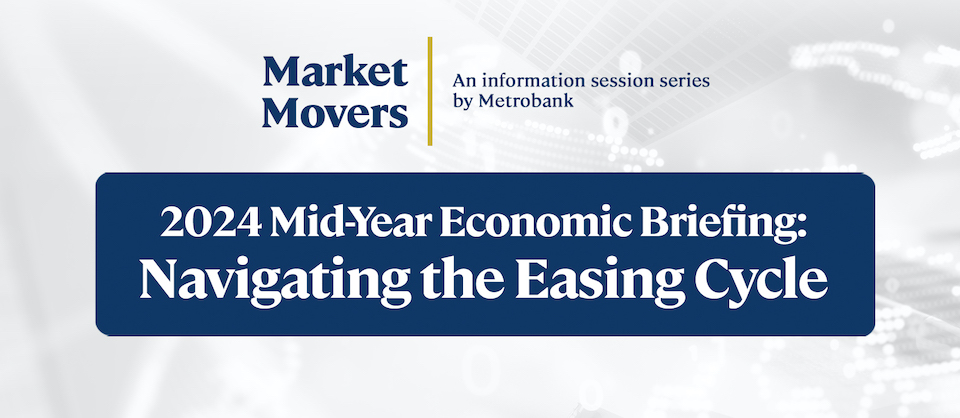
2024 Mid-Year Economic Briefing: Navigating the Easing Cycle
June 21, 2024
Investing with Love
Investing with Love: A Mother’s Guide to Putting Money to Work
May 15, 2024
retirement-ss-3
Investor Series: An Introduction to Estate Planning
September 1, 2023
View All Webinars
DOWNLOADS
grocery-2-aa
Inflation Update: Target breached
DOWNLOAD
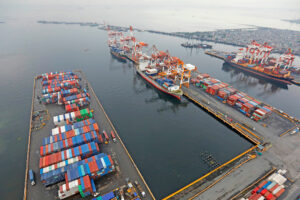
Container ship carrying container boxes import export dock with quay crane. Business commercial trade global cargo freight shipping logistic and transportation worldwide oversea concept. Generative AI
Economic Updates
Philippines Trade Update: Wider deficit on strong imports
DOWNLOAD
Frick collection with palm trees 
Economic Updates
Policy Rate Updates: Policy rate updates to reassure 
DOWNLOAD
View all Reports
Metrobank.com.ph How To Sign Up
Follow us on our platforms.

How may we help you?

TOP SEARCHES
  • Where to put my investments
  • Reports about the pandemic and economy
  • Metrobank
  • Webinars
  • Economy
TRENDING ARTICLES
  • Investing for Beginners: Following your PATH
  • On government debt thresholds: How much is too much?
  • Philippines Stock Market Outlook for 2022
  • Deficit spending remains unabated

Login

Access Exclusive Content
Login to Wealth Manager
Visit us at metrobank.com.ph How To Sign Up
Access Exclusive Content Login to Wealth Manager
Search
MODEL PORTFOLIO THE GIST
NEWS AND FEATURES
Global Philippines Fine Living
INSIGHTS
INVESTMENT STRATEGY
Economy Stocks Bonds Currencies
THE BASICS
Investment Tips Explainers Retirement
WEBINARS
2024 Mid-Year Economi Briefing, economic growth in the Philippines
2024 Mid-Year Economic Briefing: Navigating the Easing Cycle
June 21, 2024
Investing with Love
Investing with Love: A Mother’s Guide to Putting Money to Work
May 15, 2024
retirement-ss-3
Investor Series: An Introduction to Estate Planning
September 1, 2023
View All Webinars
DOWNLOADS
grocery-2-aa
Inflation Update: Target breached
April 7, 2026 DOWNLOAD
Container ship carrying container boxes import export dock with quay crane. Business commercial trade global cargo freight shipping logistic and transportation worldwide oversea concept. Generative AI
Economic Updates
Philippines Trade Update: Wider deficit on strong imports
March 27, 2026 DOWNLOAD
Frick collection with palm trees 
Economic Updates
Policy Rate Updates: Policy rate updates to reassure 
March 26, 2026 DOWNLOAD
View all Reports

Archives: Business World Article

Peso to stay rangebound

Peso to stay rangebound

The peso is expected to trade sideways against the dollar this week following the surprise uptick in US consumer inflation in December. 

The local currency closed at PHP 55.911 versus the dollar on Friday, appreciating by 3.9 centavos from Thursday’s PHP 55.95 finish, data from the Bankers Association of the Philippines’ website showed.

Week on week, however, the peso weakened by 21.1 centavos from its PHP 55.70 close on Jan. 5.

The peso was better supported against the dollar following the faster-than-expected rise in US inflation, Security Bank Corp. Chief Economist Robert Dan J. Roces said in a Viber message.

The consumer price index (CPI) rose 0.3% last month after nudging up 0.1% in November, the Labor department’s Bureau of Labor Statistics said, Reuters reported.

In the 12 months through December, the CPI rose 3.4% after increasing 3.1% in November. Economists polled by Reuters had forecast the CPI would gain 0.2% on the month and climb 3.2% on a year-on-year basis.

Inflation averaged 4.1% in 2023, down from 8% in 2022.

Rizal Commercial Banking Corp. Chief Economist Michael L. Ricafort said core inflation in the US, which eased to 3.9% year on year from 4% in November, could still justify Fed rate cuts in the second half of the year.

Market players are still pricing in rate cuts of more than 150 basis points this year, he said.

The peso appreciated on Friday after President Ferdinand R. Marcos, Jr. announced a new Finance chief, Mr. Ricafort added.

Former lawmaker Ralph G. Recto took his oath as Department of Finance secretary on Friday. He replaced Benjamin E. Diokno, who was sworn in as a member of the central bank’s Monetary Board.

Mr. Recto was previously a member of the country’s economic team as chief of the National Economic and Development Authority in 2008.

For this week, Mr. Roces said the peso could remain “range-bound” before US data on retail sales and the release of the Fed Beige Book, which a report on economic conditions in the US.

Market players will also look at the latest remittances and overall balance of payments data to be released by the Philippine central bank this week, Mr. Ricafort added.

He expects the local unit to move from PHP 55.60 to PHP 56.10 per dollar this week. — Keisha B. Ta-asan with Reuters

Stocks may hold on to gains as mart awaits leads

Stocks may hold on to gains as mart awaits leads

Philippine shares are expected sustain their upward trend this week, but the lack of strong catalysts could prevent the market from rising further, analysts said.

The Philippine Stock Exchange index (PSEi) improved by 29.45 points or 0.44% to end at 6,643.18 on Friday, while the broader all shares index rose by 10.85 points or 0.31% to close at 3,506.61. 

Week on week, the PSEi climbed by 13.54 points or 0.2% from its 6,629.64 close on Jan. 5.

“The local bourse held on to slight gains while waiting for stronger catalysts to reinforce the market’s upward momentum,” online brokerage firm 2TradeAsia.com said in a market report.

“The PSEi gained for the second straight week of the new year, higher for the fourth week in five weeks, somewhat catching up with the much larger gains posted by the US and other global stock markets since 2023,” Rizal Commercial Banking Corp. Chief Economist Michael L. Ricafort said in a Viber message.

Philippine shares could continue to rise this week, Mr. Ricafort said.

“The upward trend in the PSEi could continue after rising for almost all days from the start of 2024… amid the recent gains in the US stock markets to among two-year highs and near record highs,” he said.

On Friday, Wall Street stocks closed nearly flat after moving between modest gains and losses during the session, Reuters reported. The Dow Jones Industrial Average fell 118.04 points or 0.31% to 37,592.98. The S&P 500 gained 3.59 points or 0.08% at 4,783.83; and the Nasdaq Composite rose 2.58 points or 0.02% to 14,972.76.

The US market will be closed on Monday for the Martin Luther King, Jr. holiday.

“Investors are expected to watch out for positive catalysts. Without such, sustaining the market’s climb [this] week could be difficult. Meanwhile, the dampened Federal Reserve rate cut hopes following the US’ December 2023 inflation print and worries over the tensions in the Middle East may weigh on sentiment,” Philstocks Financial, Inc. Senior Research Analyst Japhet Louis O. Tantiangco said in a Viber message.

Regina Capital Development Corp. Head of Sales Luis A. Limlingan said in a Viber message that the market’s movement will be “data dependent,” with the PSEi expected to consolidate at the 6,600 level.

“Some key economic events this week will be China’s gross domestic product, US consumer sentiment, and retail sales [data],” Mr. Limlingan said.

Meanwhile, Mr. Ricafort put the PSEi’s immediate minor support at 6,390-6,500 and immediate major support at 6,210-6,300, while Mr. Tantiangco placed its major support at 6,400 and major resistance at 6,700.

For its part, 2TradeAsia.com put the PSEi’s support at 6,550 and resistance at 6,700-6,800.

“[The] PSEi is building a clearer technical runway towards 6,800… In the short term, improving macroeconomic factors plus confirmation of earnings should lubricate the ascent and provide opportunities to day range trade,” the online brokerage said. — R.M.D. Ochave

Recto set to take over Finance dep’t

Recto set to take over Finance dep’t

Former Senator Ralph G. Recto, who pushed higher value-added taxes (VAT) in the Senate in the early 2000s, has been appointed Finance secretary, according to Senate President Juan Miguel F. Zubiri.

Mr. Recto, who was elected Batangas congressman in 2022 and served three six-year terms as a senator, is set to take his oath at the Presidential Palace on Friday, according to news reports quoting his wife, former Batangas lawmaker and actress Vilma Santos-Recto.

He will replace Benjamin E. Diokno, who served as central bank governor under the Duterte administration.

“In the Senate, we always regarded him as the resident numbers genius,” Mr. Zubri said in a statement as he welcomed the appointment of Mr. Recto.

“This was not just for his mathematical ability, but more importantly for his ability to immediately see the big picture implications of these numbers.”

Presidential Communications Office chief Cheloy Velicaria-Garafil confirmed Mr. Recto will take his oath as Finance secretary before President Ferdinand R. Marcos, Jr. on Friday. Also scheduled to take his oath is former Robinsons Land Corp. President and Chief Executive Officer Frederick D. Go, who was appointed Special Assistant to the President for Investment and Economic Affairs.

Mr. Recto and Mr. Diokno did not reply to requests for comment.

In an interview with Bloomberg TV on Monday, Mr. Diokno refused to comment on reports that he will be replaced.

“My relationship with the President is confidential and before making any announcement, I have to clear that with the President,” he said.

Mr. Recto was elected representative of the 6th district of Batangas in 1992 and served three terms. He was first elected to the Senate in 2001 at the age of 37, the youngest among his colleagues in the upper chamber at that time. There, he chaired the committees on Ways and Means and on Trade and Industry.

However, the grandson of the late Filipino statesman Claro M. Recto lost his Senate reelection bid in 2007 after pushing to raise the VAT by 2 points to 12%.

Then-president Gloria Macapagal-Arroyo appointed him as director-general of the National Economic and Development Authority in 2008 but left after one year.

He made a Senate comeback in 2010 and consecutively secured the seat in the following elections until 2022.

“More than most, he understands how to bridge the gap between the abstractions of mathematics and the very concrete realities that we face as a nation,” Mr. Zubiri said. “So, I have no doubt that he will be a good Finance secretary, who will continue to push the country along on the road to greater economic prosperity.”

House Ways and Means Chair Jose Maria Clemente S. Salceda said Mr. Recto’s longstanding relationship with the Congress would help.

“His experience and network will be crucial in enacting meaningful reforms to address the rising cost of living, create employment and expand our fiscal space,” he said in a Facebook Messenger chat.

Mr. Salceda noted that Mr. Recto was one of the authors of the 1997 Comprehensive Tax Reform Program during his tenure in the House.

“I am optimistic that key tax reforms pending in the Senate will also move faster with his appointment, due to his relationships in that chamber, as well as his ability to broker viable compromises,” the lawmaker said.

Mr. Recto’s appointment signals a “pivotal shift towards policies that are not only economically sound but also socially responsible and politically astute,” Terry L. Ridon, a former lawmaker and convenor of think tank InfraWatch PH, said in a Facebook Messenger chat.

He said Mr. Recto’s comprehensive background in both the Executive and Legislative branches of government empowers him to “bring a holistic perspective to economic policy.”

“Heading the government’s economic team in this time of economic turmoil and global unease requires a leader who has shown a track record for pursuing economic decisions that do not put the public at greater risk,” he added.

Gary Ador Dionisio, dean of the De La Salle – College of Saint Benilde School of Diplomacy and Governance, said the appointment of Mr. Recto shows there is dissatisfaction with the former Finance leadership and that Mr. Marcos wants to consolidate his own team.

“This will help President Marcos to pursue his new economic agenda under the leadership of Secretary Recto,” he said via Messenger chat. “Since Secretary Recto is also a long-time politician his political capital will be helpful to President Marcos in consolidating both his political and economic network.”

Philip Arnold P. Tuaño, dean of the Ateneo School of Government, said Mr. Recto would bring a policy perspective to the plans of the Finance department, “which is critical to the advancement of some of the proposed tax reforms which still need to be done.”

Mr. Tuaño said Mr. Recto would not be spared from questions on whether he might just last one year as Finance secretary to run for Senator in 2025, “similar to his NEDA director-general appointment in 2008 and his resignation to run for Senator in 2009.”

Assessing the performance of Mr. Recto’s predecessor, Mr. Ridon said Mr. Diokno had issued “cautionary statements” against suspending value-added and excise taxes on petroleum products, “standing in stark contrast to the urgent relief needed by the populace.”

“His insistence on the potential harm to the economy and government finances overlooks the immediate benefits such a suspension could provide, especially in light of the recent surge in fuel prices,” the policy analyst said.

He also recalled that Mr. Diokno opposed the implementation of a price cap on rice in September last year, with the outgoing secretary saying it was made without the input of economic advisors. The price cap order had also been opposed by Mr. Diokno’s colleagues at the University of the Philippines School of Economics.

“The biggest red flag that earned the ire of the public is Diokno’s repeated claim that the central bank has done enough to control inflation, despite the unabated price hikes and their impact on the average Filipino,” Mr. Ridon said. — By Kyle Aristophere T. Atienza, Reporter


PH projected to grow 6% this year

PH projected to grow 6% this year

The Philippines’ gross domestic product (GDP) is projected to grow faster this year as easing inflation will help boost “revenge spending,” analysts said.

First Metro Investment Corp. (FMIC) and the University of Asia and the Pacific (UA&P) said they expect GDP growth at 6% this year, still below the government’s 6.5-7.6% target.

“I think they will not be able to make the 6.5% unless foreign investments come in. And so far, if we look at 2023, foreign investments were actually down significantly… but we have to see how things pan out in the coming months,” Victor A. Abola, an economist at UA&P, said at a briefing in Makati City on Thursday.

FMIC and UA&P projected full-year GDP to average 5.5% in 2023, still below the government’s 6-7%. The economy grew by 5.5% in the nine-month period. 

The Philippine Statistics Authority (PSA) is set to release full-year 2023 GDP data on Jan. 31.

“Growth will accelerate from 5.5% (in 2023) to 6% (in 2024), driven by the services sector, particularly, transport, accommodations, and food services, which are experiencing revenge spending,” Mr. Abola said.

Filipino consumers are expected to continue to splurge this year, which will help drive growth.

“We’re just seeing the beginning of (revenge spending) because high inflation has sort of toned down that expansion. So, I think that we’ll see faster GDP growth in 2024,” Mr. Abola said.

Improved employment will also boost the economy this year, Mr. Abola said, citing the record low jobless rate seen in November.

The country’s unemployment rate fell to 3.6% in November from 4.2% in the previous month and a year ago, marking an 18-year low. In November, the number of employed people also rose to 49.64 million from 47.8 million in October and 49.7 million in November 2022.

FMIC Executive Vice-President Daniel D. Camacho said the BSP will likely keep rates steady for the first half.

“Our fearless forecast for yearend is a reduction of 75 bps to 125 bps across the curve,” Mr. Camacho said. “We do not foresee a cut in BSP rates in the first half but possibly one or two in the second half of the year which will further push rates downwards.”

The benchmark rate is currently at 6.5%, the highest in 16 years. From May 2022 to October last year, the BSP raised borrowing costs by a total of 450 bps.

“I think the BSP will be quite slow in cutting rates, the first one is 25 bps likely in June and depending on the Fed moves, it will probably mimic the rate cuts in the second half,” Mr. Abola added.

The Monetary Board is set to have its next policy review on Feb. 15.

Optimistic outlook
Meanwhile, BMI Asia Country Risk Analyst Shi Cheng Low said Philippine GDP growth is seen to pick up to 6.2% in 2024 from a likely 5.7% in 2023.

“There are two main reasons behind our more optimistic view. One is easing inflation… which is really good news for household incomes and (will) support private consumption,” Mr. Low said.

“We expect the resilience in private consumption to remain throughout 2024 and on top of that, because we are expecting cuts in the second half of the year, this will actually help a rebound in investment growth,” he added.

Mr. Low noted easing price pressures will also prompt the BSP to loosen policy in the second half of this year.

Inflation averaged 6% for 2023, slightly higher than 5.8% in 2022. This marked the second straight year that inflation breached the BSP’s 2-4% target band.

This year, the central bank expects full-year inflation to ease to 3.7% and 3.2% in 2025.

Mr. Low also said foreign direct investment (FDI) net inflows to the Philippines will pick up in 2024.

“Because we are expecting rate cuts in major economies in the second half of the year including the Fed, we expect FDIs to pick up significantly, at least, in terms of foreign investments into the Philippines,” he said.

The BSP expects FDI net inflows to have reached USD 8 billion at the end of 2023, before accelerating to USD 10 billion by end-2024.

Debt
FMIC’s Mr. Abola said he also expects debt as a share of GDP to ease further this year.

“We’re seeing that it will ease to 60.4% this year and continue next year to about 59%. We are on the way to providing more fiscal space, with faster growth and lower interest rates,” he added.

The National Government’s debt-to-GDP ratio stood at 60.2% as of end-September. This is still slightly above the 60% threshold considered by multilateral lenders to be manageable for developing economies.

The government is targeting to bring the ratio to below 60% by 2025.

On the other hand, Mr. Abola said that the government must also work on beefing up its gross international reserves.

“We need to rebuild our gross dollar reserve because (it) is not very ideal for the environment in which we have global markets that we can easily move money around,” he said.

Latest data from the BSP showed that dollar reserves slipped by 0.3% to USD 102.45 billion as of end-December from USD 102.72 billion in November. — Luisa Maria Jacinta C. Jocson and Keisha B. Ta-asan

PSEi to hit 7,500 level this year — First Metro Investment

PSEi to hit 7,500 level this year — First Metro Investment

The Philippine Stock Exchange Index (PSEi) is expected to reach the 7,000 to 7,500 level this year, driven by improving investor sentiment, investment company First Metro Investment Corp. (FMIC) said on Thursday.

“Our forecast is (that the PSEi will hit) 7,000 to 7,500 level this year, and that is supported by earnings per share growth of 11%,” said FMIC Head of Research Cristina S. Ulang during a media briefing in Makati City.

Ms. Ulang added that the price-to-earnings range for the PSEi will be from 12.6x to 13.6x.

FMIC projects that the PSEi is set to recover this year, supported by “improving investor sentiment and easing equity risk premium arising from declining inflation and interest rates, and resilient double-digit corporate earnings.”

On Thursday, the bellwether Philippine Stock Exchange Index (PSEi) improved by 67.62 points or 1.03% to close at 6,613.73, while the broader all shares climbed by 26.12 points or 0.75% to end at 3,495.76.

The PSEi ended the last trading day of 2023 at 6,450.04, down by 69.07 points or 1.06%.

According to Ms. Ulang, some risks that could hamper the growth of the local bourse include geopolitical tensions, the El Niño phenomenon, inflation, slower growth in China, elections, and a sharp slowdown in global growth.

She said that cuts in policy rates could influence whether the market reaches the 7,500 level or not.

“If the rate cuts come sooner than expected, then that’s going to cheer the market and going to enliven the risk-taking. But if it gets postponed and creates a lot of uncertainty, then it may be a struggle for the market to reach 7,500 level,” Ms. Ulang said.

“If we’re going to have a resurgent inflation, then it’s going to delay the rate cutting and that’s going to disappoint the market,” she added.

Meanwhile, FMIC Executive Vice President and Investment Banking Head Daniel D. Camacho said the local bourse could see initial public offerings (IPOs) by the second half of the year.

“It’s a matter of if the market is right. It’s a matter of timing. Most likely, it would be the second half. But we’re confident that total overall market volume and the number of equity issuances will definitely exceed last year’s,” Mr. Camacho said.

The PSE is expecting six IPOs this year, with the first one being the PHP 12.9 billion debut share sale of Saavedra-led Citicore Renewable Energy Corp. in March.

FMIC, the investment banking arm of the Metropolitan Bank & Trust Co. (Metrobank) group, offers various products and services such as debt and equity underwriting, loan syndication, project finance, financial advisory, government securities and corporate debt trading, equity brokering, asset management, and research. — Revin Mikhael D. Ochave

Metrobank sees strong loan demand boosting income

Metrobank sees strong loan demand boosting income

Metropolitan Bank & Trust Co. (Metrobank) expects loan demand this year to be boosted by stronger economic growth and rate cuts from the Bangko Sentral ng Pilipinas (BSP), which could propel its net earnings.

“We expect faster GDP (gross domestic product) growth coupled with the prospect of rate cuts [this] year with easing inflation, leading to more optimistic business and consumer sentiment, hence stimulating loan demand,” Metrobank said in an e-mail.

The bank expects to sustain its net income growth this year on the back of a strong capital base and loan growth.

“Metrobank is well positioned to take on opportunities to finance the requirements of a growing economy given our strong capital and healthy loan portfolio,” it said.

The government targets GDP growth of 6.5-7.5% this year, slightly faster than the 6-7% goal for 2023.

The Philippine economy expanded by 5.9% in the third quarter of 2023, bringing the nine-month average to 5.5%.

Meanwhile, the BSP may cut borrowing costs by as much as 100 basis points (bps) this year as inflation is seen to stay mostly within the 2-4% target band, the Finance chief said on Monday.

Finance Secretary and Monetary Board member Benjamin E. Diokno said the BSP could mirror the expected 75-100 bps in cuts from the US Federal Reserve later this year.

The BSP kept the benchmark rate steady at a 16-year high of 6.5% at its December meeting. This was after the Monetary Board tightened rates by 450 bps from May 2022 to October 2023 to tame inflation.

Inflation averaged 6% in 2023, higher than 5.8% in 2022. It marked the second straight year that average inflation breached the BSP’s 2-4% target.

In 2023, Metrobank’s loan growth was driven by a strong capital base, low nonperforming loans (NPLs), and high provisions, it said.

As of end-September 2023, Metrobank’s loan portfolio grew by 7% year on year.  

Meanwhile, the bank’s NPL ratio stood at 1.7% at end-September, improving from 1.9% in the same period in 2022.

“This is in contrast to the mild uptick in industry NPL ratio to 3.5% as of September from 3.2% end-2022. Our prudent risk management has kept our restructured loans stable at just 0.4% of loans, among the lowest in the industry,” Metrobank said.

The lender saw a “strong” performance throughout 2023, with a 36% growth in attributable net income for the first nine months to PHP 31.8 billion amid an expanding asset base, higher margins, healthy net interest income growth and better asset quality, it said.

Metrobank saw its net income rise by 38.7% to PHP 10.89 billion in the third quarter of 2023 as the growth in its revenues outpaced its expenses.

For the first nine months, its attributable net income stood at PHP 31.8 billion, a 35.6% increase from PHP 23.4 billion a year earlier.

The bank’s shares rose by 50 centavos or 0.9% to end at PHP 56 apiece on Thursday. — A.M.C. Sy

Peso returns to PHP 55-per-dollar level before US inflation data release

Peso returns to PHP 55-per-dollar level before US inflation data release

The peso bounced back against the dollar on Thursday on expectations of softer US consumer inflation data.

The local unit closed at PHP 55.95 per dollar on Thursday, strengthening by 32.5 centavos from its PHP 56.275 finish on Wednesday, based on Bankers Association of the Philippines data.

The peso opened Thursday’s session slightly stronger at PHP 56.20 against the dollar. Its intraday best was at P55.93, while its worst showing was at PHP 56.22 versus the greenback.

Dollars exchanged declined to USD 1.91 billion on Thursday from USD 2.55 billion on Wednesday.

The peso appreciated against the dollar amid expectations of a weaker US consumer inflation report, Security Bank Corp. Chief Economist Robert Dan J. Roces said in a Viber message.

“The peso rebounded strongly at the PHP 55 level amid expectations of weaker US consumer inflation reports,” a trader likewise said in an e-mail.

The dollar drifted lower in Asia on Thursday as traders waited on US inflation data to see whether bets on as many as five US Federal Reserve interest rate cuts this year were justified, Reuters reported.

The dollar index fell 0.1% to 102.23.

Market attention has zeroed in on the US consumer price index report (CPI) due later on Thursday. Core CPI is forecast to remain unchanged at 0.3% from the month before, while year-on-year inflation is expected to slow to 3.8% from November’s 4%, a Reuters poll showed.

For Friday, the trader expects the peso to move between PHP 55.85 and PHP 56.10 per dollar, while Mr. Roces said the local currency could be mostly range-bound. — A.M.C. Sy with Reuters

PH shares rebound on World Bank GDP outlook

PH shares rebound on World Bank GDP outlook

Philippine shares bounced back on Thursday after the World Bank said it expects the country to be among the fastest growing economies in Southeast Asia this year and ahead of the release of latest US consumer inflation data.

The 30-member Philippine Stock Exchange index (PSEi) gained by 67.62 points or 1.03% to close at 6,613.73 on Thursday, while the broader all shares climbed by 26.12 points or 0.75% to end at 3,495.76.

“The World Bank’s projection that the Philippines will be one of the fastest-growing economies in Southeast Asia this 2024 was cheered by many,” Philstocks Financial, Inc. Research and Engagement Officer Mikhail Philippe Q. Plopenio said in a Viber message.

In its latest Global Economic Prospects, the multilateral lender projected Philippine gross domestic product (GDP) to expand by 5.8% in 2024, same as its forecast in December.

The projection is the fastest among Southeast Asian economies, tied with Cambodia (5.8%), and ahead of Vietnam (5.5%), Indonesia (4.9%), Malaysia (4.3%), Lao People’s Democratic Republic (4.1%), Timor-Leste (3.5%), Thailand (3.2%), and Myanmar (2%).

However, this is below the Development Budget Coordination Committee’s 6.5-7.5% growth target for 2024.

The Philippine Statistics Authority will release fourth-quarter and full-year 2023 GDP figures on Jan. 31.

“This Thursday, the local market rose… due to positive cues from Wall Street overnight as investors positioned ahead of the December US inflation report,” Mr. Plopenio added.

“Philippine shares settled higher as investors made bets ahead of the US December inflation reading,” Regina Capital Development Corp. Head of Sales Luis A. Limlingan likewise said in a Viber message.

December US consumer price index data were set to be released overnight.

Back home, the majority of sectoral indices closed higher on Thursday except for services, which dropped by 9.02 points or 0.55% to 1,606.15.

Meanwhile, financials rose by 50.47 points or 2.81% to 1,843.91; industrials climbed by 111.54 points or 1.23% to 9,180.52; mining and oil increased by 73.88 points or 0.77% to 9,558.56; holding firms went up by 40.19 points or 0.64% to 6,301.29; and property gained by 9.03 points or 0.31% to end at 2,891.56.

“Among the index members, Jollibee Foods Corp. was at the top, climbing 3.92% to P259.80. JG Summit Holdings, Inc. lost the most, dropping 1.71% to PHP 40.20,” Mr. Plopenio said.

Value turnover declined to PHP 5.27 billion on Thursday with 346.84 million issues changing hands from the PHP 11.57 billion with 518.12 million shares seen the prior day.

Advancers outnumbered decliners, 100 to 67, while 51 names closed unchanged.   

Net foreign buying increased to PHP 648.31 million on Thursday from PHP 557.38 million on Wednesday. — R.M.D. Ochave

November trade gap widens to USD 4.7B

November trade gap widens to USD 4.7B

THE PHILIPPINES’ trade-in-goods deficit hit USD 4.69 billion in November, the widest gap in seven months due to flattish import growth and the continued decline in exports amid sluggish global demand.

Preliminary data from the Philippine Statistics Authority (PSA) showed the deficit jumped by 26.3% from the USD 3.72-billion gap a year ago. It was also wider than the revised USD 4.39 billion in October.

November marked the widest trade deficit since the USD 4.84-billion gap in April. The last time the country swung to a trade surplus was in May 2015 with USD 64.95 million.

Philippine Merchandise Trade Performance (November 2023)

Merchandise exports contracted by 13.7% to USD 6.13 billion, the third straight month of decline, though slower than the 17.5% drop in October. This was a reversal from the 13.1% growth a year ago.

November also saw the smallest export value since USD 4.9 billion in April.

On the other hand, the value of the country’s import bill inched up 0.02% year on year to USD 10.82 billion.

November saw the first growth in imports after nine straight months of annual decline. The flattish growth was still better than the 2.4% decline in October and the 1.5% drop in November 2022.

The month’s import bill had the biggest value in three months or since the USD 10.83 billion in August.

For January to November, the trade deficit narrowed to USD 48.98 billion from the USD 53.72-billion gap a year earlier.

Exports fell by 8.4% to USD 67.03 billion at end-November, while imports declined by 8.6% to USD 116.01 billion. The government expects exports to have declined by 4% in 2023, and imports to have dropped by 3%.

Analysts attributed the wider trade gap to the continued decline in exports, particularly semiconductors.

In a Viber message, Security Bank Corp. Chief Economist Robert Dan J. Roces said the November data showed the “export slump overshadowing steady imports.”

Outbound sales of manufactured goods, which made up 81.4% of the total exports, sank by 17.5% to USD 4.99 billion.

“Exports declined for the third consecutive month mainly due to the weakness in the sales of semiconductors, the country’s largest export,” China Banking Corp. Chief Economist Domini S. Velasquez said in a separate Viber message.

Electronic products, accounting for the bulk of the manufactured goods and more than half of the total exports, slumped by 24.7% to USD 3.44 billion.

Semiconductors, making up 80% of electronic products and 45.3% of November exports, slid by 25.7% to USD 2.78 billion.

Mr. Roces noted imports were “unexpectedly flat” in November, ending nine straight months of decline.

“Consumer goods accelerated for a second month thanks to holiday spending, while capital goods (+0.1%) were flat, albeit halting seven months of contraction,” he added.

Imports of raw materials and intermediate goods, which accounted for 36.2% of the total import bill, fell by 3.8% to USD 3.92 billion in November.

Mineral fuels, lubricants, and related materials also dropped by 7.8% annually to USD 1.56 billion.

Meanwhile, capital and consumer goods rose by 0.1% and 15.4%, respectively, to USD 3.03 billion and USD 2.27 billion.

The United States was the top destination of locally made products in November with a 16% share worth USD 1.14 billion.

Japan was the Philippines’ second-biggest export trading partner with a 13.2% share worth USD 938.3 million. Exports to China were valued at USD 876.27 million, equivalent to a 12.3% share.

On the other hand, China remained the Philippines’ main source of imported goods with a value of USD 2.6 billion, accounting for 24% of the total. Imports from Indonesia were valued at USD 1.15 billion (10.6% of the total), while imports from Japan reached USD 943.57 million (8.2%).

“Overall, the trade balance remained in substantial deficit. This development suggests that the current account is likewise in shortfall and points to sustained pressure on the peso in the coming months,” Nicholas Antonio T. Mapa, senior economist at ING Bank N.V. Manila, said in a note.

Mr. Roces said the trade deficit likely further widened in the fourth quarter.

“Weaker trade could derail economic growth. The lack of capital goods imports is worrisome given that this is a leading indicator of investments and GDP (gross domestic product) growth. Hopefully, we see this improve this year as the government undertakes more infrastructure projects,” Ms. Velasquez said.

For the first nine months of 2023, Philippine GDP expanded by 5.5%, below the government’s 6-7% full-year target. – Andrea C. Abestano, Researcher

WB sees PHL as fastest-growing economy in Southeast Asia this year

WB sees PHL as fastest-growing economy in Southeast Asia this year

THE WORLD BANK (WB) expects the Philippines to be among the fastest-growing economies in Southeast Asia this year.

In its latest Global Economic Prospects, the multilateral lender projected Philippine gross domestic product (GDP) to expand by 5.8% in 2024, same as its forecast in December.

The Philippine growth projection is the fastest among Southeast Asian economies, tied with Cambodia (5.8%), and ahead of Vietnam (5.5%), Indonesia (4.9%), Malaysia (4.3%), Lao People’s Democratic Republic (4.1%), Timor-Leste (3.5%), Thailand (3.2%) and Myanmar (2%).

However, this is below the Development Budget Coordination Committee’s (DBCC) 6.5-7.5% growth target for 2024.

The World Bank’s growth forecast for the Philippines is also higher than its 4.5% projection for East Asia and the Pacific.

The multilateral lender sees slower growth in the region due to the “anticipated deceleration in economic activity in China.”

Other risks to the growth outlook include geopolitical tensions in the Middle East that could lead to higher oil prices, dampened global trade, tightening financial conditions, and climate-related disasters, it said.

“Extreme weather events, the frequency of which has increased in recent decades as a result of climate change, also pose a downside risk to the regional outlook,” it added.

In the Philippines, the government is preparing for the potential impact of the El Niño weather event this year.

The latest bulletin from the state weather bureau showed that El Niño will likely persist from March to May, when dry season crops are often harvested.

National Economic and Development Authority (NEDA) Secretary Arsenio M. Balisacan earlier said El Niño would likely affect the agriculture sector and drive food prices higher, which could threaten the inflation downtrend.

On the other hand, the multilateral lender said resilient domestic demand could spur growth drivers in the East Asia and Pacific region.

“Modest inflation, and in many cases robust labor markets supported by buoyant service activity, are anticipated to sustain household spending,” it said.

“In some economies, increased government spending, including on social protection and public sector wages, will also support demand,” it added.

However, investment inflows may be dampened due to lagged effects from policy tightening and elevated public debt, the World Bank said.

For 2025, the World Bank maintained its GDP projection for the Philippines at 5.8%, the same as its previous forecast. This would be below the government’s 6.5-8% growth goal.

At 5.8%, the Philippines is expected to be the third-fastest growing economy in Southeast Asia next year, behind Cambodia (6.1%) and Vietnam (6%).

The bank also kept its growth forecast for 2023 at 5.6%, which would fall short of the government’s 6-7% GDP target.

The Philippine Statistics Authority (PSA) is set to release fourth-quarter and full-year 2023 GDP data on Jan. 31.

INFLATION

Meanwhile, the World Bank said headline inflation in the East Asia and Pacific region might ease slightly amid “moderating global commodity prices, improved food supplies and well-anchored inflation expectations.”

In its December update, the multilateral lender projected Philippine inflation to settle at 3.6% this year and 3% in 2025.

In 2023, inflation averaged 6%, the highest in 14 years. This also marked the second straight year average inflation breached the 2-4% target.

The Bangko Sentral ng Pilipinas (BSP) expects inflation to average 3.7% this year and 3.2% in 2025.

“Despite inflation receding below target in many economies, interest rates are expected to remain broadly unchanged in 2024 on account of tight monetary policy in major advanced economies, lingering concerns about weakening exchange rates and capital outflows, and the potential for a resurgence in inflation,” the World Bank said.

The Philippine central bank raised borrowing costs by 450 basis points from May 2022 to October last year, bringing the key rate to a 16-year high of 6.5%.

BSP Governor Eli M. Remolona, Jr. has said the central bank would only consider policy easing if inflation settles comfortably within the target. – Luisa Maria Jacinta C. Jocson, Reporter

Posts navigation

Older posts
Newer posts

Recent Posts

  • Metrobank US-Iran Risk Index: Fragile ceasefire 
  • Investment Ideas: April 10, 2026 
  • Metrobank US-Iran Risk Index: A new hope
  • A guide for your peso bond portfolio amid higher for longer rates
  • Investment Ideas: April 8, 2026

Recent Comments

No comments to show.

Archives

  • April 2026
  • March 2026
  • February 2026
  • January 2026
  • December 2025
  • November 2025
  • October 2025
  • September 2025
  • August 2025
  • July 2025
  • June 2025
  • May 2025
  • April 2025
  • March 2025
  • February 2025
  • January 2025
  • December 2024
  • November 2024
  • October 2024
  • September 2024
  • August 2024
  • July 2024
  • June 2024
  • May 2024
  • April 2024
  • March 2024
  • February 2024
  • January 2024
  • December 2023
  • November 2023
  • October 2023
  • September 2023
  • August 2023
  • July 2023
  • June 2023
  • May 2023
  • April 2023
  • March 2023
  • February 2023
  • January 2023
  • December 2022
  • November 2022
  • October 2022
  • September 2022
  • August 2022
  • July 2022
  • June 2022
  • May 2022
  • March 2022
  • December 2021
  • October 2021

Categories

  • Bonds
  • BusinessWorld
  • Currencies
  • Economy
  • Equities
  • Estate Planning
  • Explainer
  • Featured Insight
  • Fine Living
  • How To
  • Investment Tips
  • Markets
  • Portfolio Picks
  • Rates & Bonds
  • Retirement
  • Reuters
  • Spotlight
  • Stocks
  • Uncategorized

You are leaving Metrobank Wealth Insights

Please be aware that the external site policies may differ from our website Terms And Conditions and Privacy Policy. The next site will be opened in a new browser window or tab.

Cancel Proceed
Get in Touch

For inquiries, please call our Metrobank Contact Center at (02) 88-700-700 (domestic toll-free 1-800-1888-5775) or send an e-mail to customercare@metrobank.com.ph

Metrobank is regulated by the Bangko Sentral ng Pilipinas
Website: https://www.bsp.gov.ph

Quick Links
The Gist Webinars Wealth Manager Explainers
Markets
Currencies Rates & Bonds Equities Economy
Wealth
Investment Tips Fine Living Retirement
Portfolio Picks
Bonds Stocks
Others
Contact Us Privacy Notice Terms of Use
© 2026 Metrobank. All rights reserved.

Access this content:

If you are an existing investor, log in first to your Metrobank Wealth Manager account. ​

If you wish to start your wealth journey with us, click the “How To Sign Up” button. ​

Login HOW TO SIGN UP