



MODEL PORTFOLIO
THE GIST
NEWS AND FEATURES
Global Philippines Fine Living
INSIGHTS
INVESTMENT STRATEGY
Economy Stocks Bonds Currencies
THE BASICS
Investment Tips Explainers Retirement
WEBINARS
2024 Mid-Year Economi Briefing, economic growth in the Philippines
2024 Mid-Year Economic Briefing: Navigating the Easing Cycle
June 21, 2024
Investing with Love
Investing with Love: A Mother’s Guide to Putting Money to Work
May 15, 2024
retirement-ss-3
Investor Series: An Introduction to Estate Planning
September 1, 2023
View All Webinars
DOWNLOADS
grocery-2-aa
Inflation Update: Target breached
DOWNLOAD
Container ship carrying container boxes import export dock with quay crane. Business commercial trade global cargo freight shipping logistic and transportation worldwide oversea concept. Generative AI
Economic Updates
Philippines Trade Update: Wider deficit on strong imports
DOWNLOAD
Frick collection with palm trees 
Economic Updates
Policy Rate Updates: Policy rate updates to reassure 
DOWNLOAD
View all Reports
Metrobank.com.ph How To Sign Up
Follow us on our platforms.

How may we help you?

TOP SEARCHES
  • Where to put my investments
  • Reports about the pandemic and economy
  • Metrobank
  • Webinars
  • Economy
TRENDING ARTICLES
  • Investing for Beginners: Following your PATH
  • On government debt thresholds: How much is too much?
  • Philippines Stock Market Outlook for 2022
  • Deficit spending remains unabated

Login

Access Exclusive Content
Login to Wealth Manager
Visit us at metrobank.com.ph How To Sign Up
Access Exclusive Content Login to Wealth Manager
Search
MODEL PORTFOLIO THE GIST
NEWS AND FEATURES
Global Philippines Fine Living
INSIGHTS
INVESTMENT STRATEGY
Economy Stocks Bonds Currencies
THE BASICS
Investment Tips Explainers Retirement
WEBINARS
2024 Mid-Year Economi Briefing, economic growth in the Philippines
2024 Mid-Year Economic Briefing: Navigating the Easing Cycle
June 21, 2024
Investing with Love
Investing with Love: A Mother’s Guide to Putting Money to Work
May 15, 2024
retirement-ss-3
Investor Series: An Introduction to Estate Planning
September 1, 2023
View All Webinars
DOWNLOADS
grocery-2-aa
Inflation Update: Target breached
April 7, 2026 DOWNLOAD
Container ship carrying container boxes import export dock with quay crane. Business commercial trade global cargo freight shipping logistic and transportation worldwide oversea concept. Generative AI
Economic Updates
Philippines Trade Update: Wider deficit on strong imports
March 27, 2026 DOWNLOAD
Frick collection with palm trees 
Economic Updates
Policy Rate Updates: Policy rate updates to reassure 
March 26, 2026 DOWNLOAD
View all Reports

Archives: Business World Article

Vehicle sales surpass target in 2023

Vehicle sales surpass target in 2023

By Justine Irish D. Tabile, Reporter

VEHICLE SALES rose by an annual 22% in 2023, surpassing the industry’s target, a report showed, as consumer demand remained robust despite elevated inflation and rising interest rates.

A joint report of the Chamber of Automotive Manufacturers of the Philippines, Inc. (CAMPI) and the Truck Manufacturers Association (TMA) showed total vehicle sales last year reached 429,807, a 21.9% increase from the 352,596 units sold in 2022.

It also surpassed the industry’s 423,000 revised sales target by 1.6%. CAMPI-TMA’s original sales target was 395,000 units.
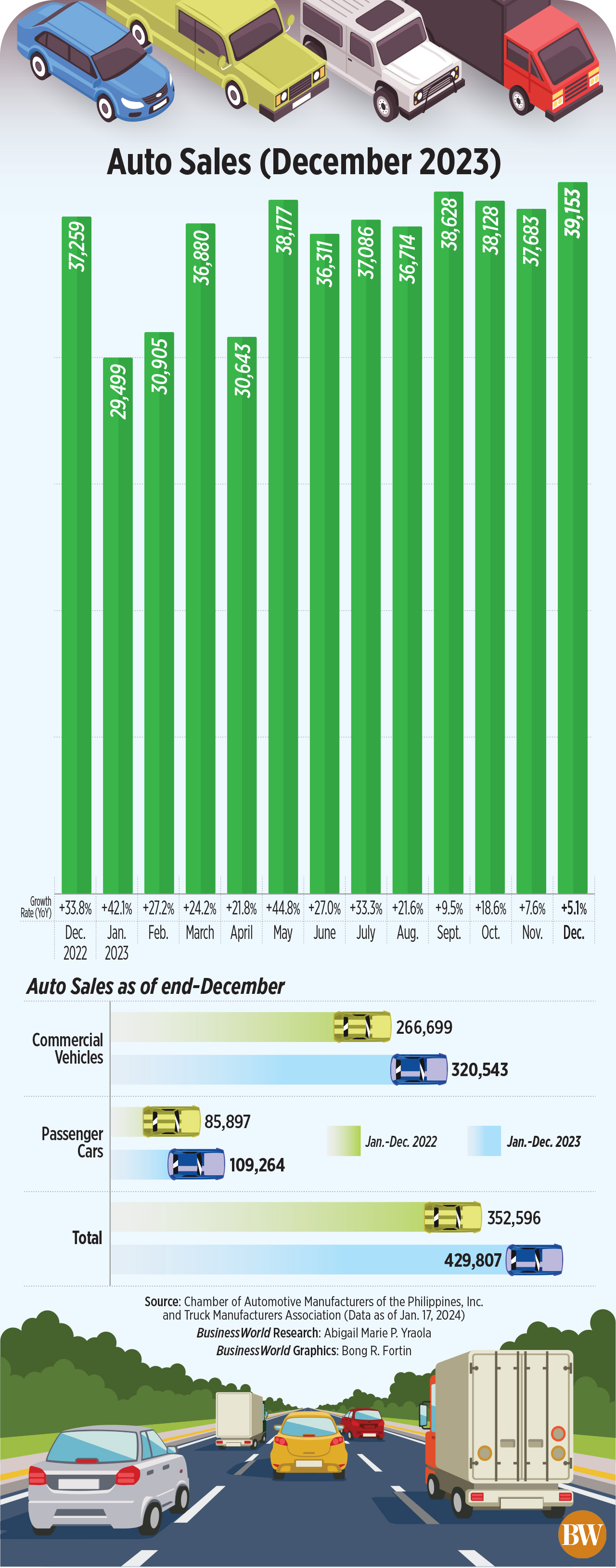
Auto Sales (December 2023)In a statement, CAMPI noted the strong year-on-year sales growth was mainly due to “sustained consumer demand, easier access to credit, and improved supply conditions across all brands.”

“2023 was a very strong year for the industry and we are very excited about 2024,” CAMPI President Rommel Gutierrez said in a statement on Wednesday.

For the January-to-December period, commercial vehicle sales jumped by 20.2% to 320,543 units, while passenger car sales rose by 27.2% to 109,264 units.

The higher sales of commercial vehicles were driven by the 30.5% growth in Asian utility vehicles (AUVs) and 18.3% rise in light commercial vehicles.

Mr. Gutierrez said that the industry is hoping to reach record-breaking sales in 2024, banking on the country’s growth and new car models.

“Positive economic outlook, new model introductions and the electrification trend are expected to contribute to a record-breaking sales this year,” he said.

Economic managers are targeting 6.5-7.5% gross domestic product (GDP) growth for 2024.

Sought for comment, Rizal Commercial Banking Corp. Chief Economist Michael L. Ricafort said that the double-digit sales growth could also be attributed to the country’s favorable demographics and employment data, which he said was at the strongest in at least 18 years.

“Furthermore, lower downpayment and other promos and perks offered by some automakers also helped spur greater demand for vehicles,” he said.

Mr. Ricafort noted that the limited mass and public transport system also pushed consumers to purchase vehicles, especially with the release of new models including hybrid and electric vehicles.

For the coming months, he said that the easing trend in headline inflation towards the target of the central bank at 2%-4% would support local policy rate cuts.

“This would reduce borrowing costs for automotive loans which would also lead to some increase in vehicle sales that are financed by loans,” Mr. Ricafort added.

China Banking Corp. Chief Economist Domini S. Velasquez said that the downtrend in inflation may have provided consumers with more flexibility in their budgets, allowing them to make big-ticket purchases.

“Recovery from the pandemic may also have encouraged consumers to purchase vehicles for increased mobility, as more companies adopted return to office, and as demand for leisure travel increased,” she said.

“Looking ahead, vehicle sales will likely continue to post decent growth on the back of improved consumer confidence due to cooler inflation and lower borrowing costs with the possible interest rate cuts this year,” she added.

SINGLE-DIGIT INCREASE
In December last year, new automotive sales went up by an annual 5.1% to 39,153 units from 37,259 in December 2022. This was the slowest growth in 22 months or since the 7.3% contraction recorded in February 2022.

Month on month, vehicle sales jumped by 3.9% from 37,683 units sold in November.

Mr. Gutierrez said that the end-of-year deals spurred sales in the month of December.

Sales of commercial vehicles, which made up nearly three-fourths of the monthly sales, went up by 3.2% to 29,554 units in December. Month on month, commercial vehicle sales jumped by 5.1% from 28,114 units sold in November.

Broken down, light commercial vehicle sales declined by 2.3% to 22,102 units, while sales of AUVs surged by 29.5% to 6,558 units in December.

Sales of medium and heavy trucks dropped by 22.5% and 6.9% to 286 and 54 units, respectively.

On the other hand, light truck sales went up by 5.3% to 554 units in December.

CAMPI-TMA data showed sales of light, medium and heavy trucks all had a double-digit decline versus November’s tally.

Meanwhile, passenger car sales jumped by 11.4% to 9,599 units in December from 8,614 units a year prior.

Month on month, sales of passenger cars inched up by 0.31% from 9,569 in November.

Toyota Motor Philippines Corp. remained the market leader with a 46.54% share as full-year sales rose by 14.9% to 200,031 units.

Mitsubishi Motors Philippines Corp. came in second with a 47.3% increase in sales to 78,371 units from January to December.

In third spot is Ford Motor Co. Phils., Inc. as sales jumped by 26.8% to 31,320 units.

Rounding out the top five were Nissan Philippines, Inc., which saw a 27.9% increase in sales to 27,136 units, and Suzuki Phils., Inc. whose sales fell by 7.5% to 18,454 units.

High rates to weigh on economy till ’25

High rates to weigh on economy till ’25

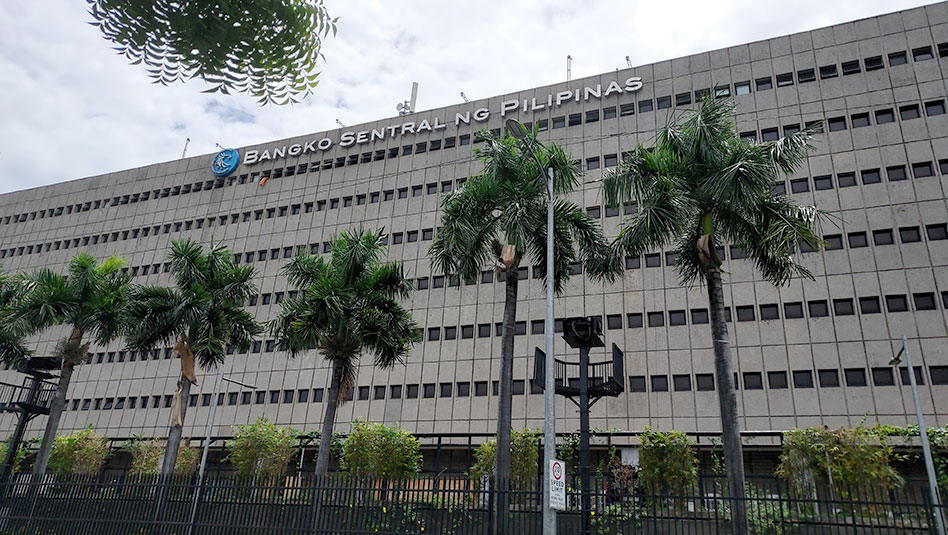
The Philippines gross domestic product (GDP) will likely fall short of the government growth targets through 2025 as the impact of multi-year high interest rates may continue to weigh on the economy, the Bangko Sentral ng Pilipinas (BSP) said.   

In the highlights of the Monetary Board meeting in December, the central bank said it has raised its growth forecasts through 2025, reflecting the faster-than-expected GDP outturn in the third quarter of 2023.   

“However, GDP growth could settle below the Development Budget Coordination Committee’s (DBCC) target from 2023 to 2025 as subdued global economic conditions and the lagged impact of the policy rate adjustments weigh on economic activity,” the BSP said.   

At its December meeting, the DBCC maintained its growth target at 6-7% for 2023 amid robust domestic demand. The GDP growth goal range for 2024 was narrowed to 6.5-7.5% from 6.5-8% previously, while the 6.5-8% goal from 2025 to 2028 was retained.

The Philippine economy expanded by 5.9% in the third quarter of 2023, faster than the 4.3% growth in the previous quarter due to increased private and public spending. This brought the year-to-date GDP growth to 5.5%.

Despite the below-target forecasts, the BSP said the Philippines’ growth prospects remained firm amid easing price pressures and stable labor market conditions.

“Labor market conditions have remained generally stable compared to the previous month, with the higher share of wage and salaried workers and the decline in underemployment signaling an improvement in employment quality,” it said.

The country’s unemployment rate dropped to 4.2% in October, which translated to 2.09 million jobless Filipinos during the month, 150,000 lower than 2.24 million in the same month last year.

For the first 10 months of 2023, the unemployment rate stood at 4.6%, which is below the 5.3-6.4% target for 2023 under the Philippine Development Plan.

“In addition, the sustained growth in vehicle sales in October likewise suggested that private consumption remained relatively firm despite tighter financial conditions,” the central bank added.   

New vehicle sales jumped by an annual 18.6% to 38,128 units in October from 32,146 units in the same month a year ago.

The BSP said improving labor market quality and robust domestic demand will mitigate the impact of higher interest rates and the El Niño weather conditions on economic activity.   

At its last policy meeting for 2023, the Monetary Board maintained its target reverse repurchase rate at a 16-year high of 6.5%. This was the second straight meeting that the BSP maintained key rates since its 25-basis-point (bp) off-cycle hike on Oct. 26, 2023.

The central bank raised borrowing costs by a total of 450 bps from May 2022 to October 2023 to tame inflation and quell inflationary expectations. 

The Philippine Institute for Development Studies (PIDS) said it sees GDP growth at 5.5-6% this year.

“Financial conditions have also not worsened (yet) as one might expect amid monetary tightening, with macro conditions set to further improve with declining inflation and some credit easing (this) year,” PIDS said in its latest Macroeconomic Outlook report.

However, the think tank’s forecast is faster than its 5.2% GDP growth projection for 2023.

“In line with previous expectations, monetary tightening and fiscal constraints due to a rising debt burden, and a generally ‘gloomy and uncertain’ outlook for the world economy, with many countries battling high inflation and experiencing a slowdown, has constrained consumer and government spending (last) year,” it added.

The think tank said other growth drivers this year would be the resilience of the service sector and a resurgence in construction amid improved business sentiment.

“Consumption may still support growth despite weak global economic prospects, given the steady flow of remittances from abroad; increased wages, which may partially offset lost purchasing power; and an improved jobs picture, with an increase in wage and salary employees,” it added.

Fourth-quarter and full-year 2023 GDP data are set to be released on Jan. 31.

High inflation
The Monetary Board said there is still a need to keep the current monetary policy settings tight until inflation expectations are firmly anchored.

“In this regard, the Monetary Board continues to closely monitor the impact of previous monetary policy adjustments on inflation, inflation expectations, and overall economic activity,” the BSP said.   

“Should inflation risks further escalate, the Monetary Board stands ready to adjust monetary policy settings as necessary to steer inflation toward a path consistent with the BSP’s price stability mandate,” it said.   

Last month, the BSP lowered its risk-adjusted inflation forecast for 2023 to 6% (from 6.1% in November) and 4.2% (from 4.4%) for 2024. It kept its inflation forecast at 3.4% for 2025.   

The BSP maintained its average inflation baseline forecasts at 6% for 2023, 3.7% for 2024, and 3.2% for 2025.     

Risks to the inflation outlook are still on the upside over the near term, the BSP said, as transport fares may further increase given the pending fare hike petitions for jeepneys, taxis, and the train railway system.   

Electricity rates could increase this year as well following the Supreme Court decision in July 2022 to nullify the order issued by the Energy Regulatory Commission, that regulated the prices in the Wholesale Electricity Spot Market in November and December 2013, the BSP said.   

Other upside risks to inflation include higher global oil prices amid the conflict in the Middle East, larger-than-expected minimum wage hikes, and the possible spike in food prices due to supply constraints.   

Meanwhile, mean inflation forecasts of private sector analysts for 2024 and 2025 are within the 2-4% target range, according to a BSP survey.

In its survey of 25 external analysts between Dec. 5 and Dec. 10, the BSP said there were lower mean inflation forecasts for 2023 (at 6% in December from 6.1% in November) and for 2024 (at 3.9% from 4%).     

However, the mean inflation forecast for 2025 stood at 3.5%, a tad higher than 3.4% previously.   

The Monetary Board will meet again on Feb. 15, its first policy review for this year.

Meanwhile, PIDS expects inflation to settle within the central bank’s 2-4% target band this year.

However, it warned of several risks that could push food prices higher, such as  India’s export ban and the El Niño phenomenon.

The state weather bureau’s latest bulletin showed that the majority of global climate models suggest that El Niño will likely persist until May.

“Moreover, as previously mentioned, renewed geopolitical conflicts may lead to large volatilities in commodities prices, which could disturb the downward trend in global inflation,” PIDS added.

To ensure inflation does not spike, the think tank said that the government must “make use of every weapon in its arsenal” to tame prices.

“Particularly those that work through the supply side, such as easing import restrictions on agriculture products that may face shortages and instituting a better system for anticipating and addressing these shortages,” it said.

It also called on the central bank to employ “high-frequency monitoring and a calibrated response to price developments that carefully considers the nature of shocks, estimated pass-throughs, and policy lags to ensure that monetary decisions are always well-timed.”

PIDS also emphasized the need to have a “sound and credible” fiscal consolidation plan.

“Although our debt sustainability analysis generates still relatively benign results, and while the Philippine economy has been among the fastest growing in the region, it may be hard to generate the speed of growth needed to quickly climb out of debt, given narrower fiscal space and current weak macroeconomic prospects globally,” it said.

The government is aiming to bring down the debt-to-GDP ratio to below 60% by 2025 and the deficit-to-GDP ratio to 3% by 2028.

Maharlika fund
PIDS also noted that the Maharlika Investment Fund (MIF) must be managed efficiently amid tight fiscal space.

“With the country’s fiscal position still just recovering from the pandemic crisis, economic managers need to make sure that the establishment of the MIF will not draw from an already scarce state fund,” it said.

Investments made by the fund should also match the needs of national development, PIDS said.

“As what the government ideally strives for when crafting the public budget, the likelihood of turning a profit may be higher if investment decisions are kept free of political complexities and patronage. Fund success consequently hinges on finding ways to settle this conflict,” it added.

The country’s first sovereign wealth fund should also be able to attract new capital from multilaterals, other sovereign funds, large institutional investors, and private funds.

“In the end, success of the MIF will depend on whether it has, in fact, enhanced capital (and use of capital), boosted infrastructure development, fostered FDI, and promoted economic growth,” it said.

“All while also turning in a profit, or otherwise proving itself viable. It will be — and should be — highly monitored by the public, as these funds are now beyond the usual (budgetary) controls, with strategic decisions affecting the entire country now largely up to the board,” it added. — By Keisha B. Ta-asan and Luisa Maria Jacinta C. Jocson, Reporters

PSE, PDSHC on Go’s investment czar appointment: ‘An Ideal fit’

PSE, PDSHC on Go’s investment czar appointment: ‘An Ideal fit’

The Philippine Stock Exchange, Inc. (PSE) and the Philippine Dealing System Holdings Corp. (PDSHC) expressed their support on Tuesday for the appointment of former Robinsons Land Corp. President and Chief Executive Officer Frederick D. Go as the investment czar.

In a joint statement, PSE and PDSHC board directors said that Mr. Go is an “ideal fit” for his appointment as special assistant to the President for investment and economic affairs and concurrent head of the economic development group of the Marcos cabinet.

“PSE and PDSHC believe that Mr. Go is an ideal fit for this position given his business acumen, extensive experience and visionary leadership in the corporate sector. Mr. Go exemplified these traits in his position as president and chief executive officer of a publicly listed company that experienced substantial growth and expansion in the last decade or so,” they said.

“We express our full trust and support in the leadership of Mr. Go. We hope to work with him on initiatives that will help deepen the Philippine capital market,” they added.

The joint statement was signed by PSE Chairman Jose T. Pardo, PDSHC Chairman Cezar P. Consing, and PSE and PDSHC President and Chief Executive Officer Ramon S. Monzon.

“(Mr. Go’s) exposure and involvement in various sectors, including property, air transportation, banking, power, among others, also gives him a unique perspective of vital industries in the country,” they said.  

Mr. Go heads the Office of the Special Assistant to the President for Investment and Economic Affairs, which is responsible for providing strategic advice on economic concerns, including inflation and investment opportunities. The office was created under Executive Order No. 49 issued in December last year.

In early 2023, Mr. Go was appointed as Presidential Adviser on Investment and Economic Affairs. — Revin Mikhael D. Ochave

Gov’t fully awards fresh 7-year Treasury bonds

Gov’t fully awards fresh 7-year Treasury bonds

The government fully awarded fresh Treasury bonds (T-bonds) on Tuesday amid strong investor demand.

The Bureau of the Treasury (BTr) raised PHP 30 billion via seven-year bonds it auctioned off, as bids reached PHP 107.095 billion — more than three times the offer.

The bonds were awarded at a coupon rate of 6.125%, according to auction results posted on the Treasury website. Accepted yields ranged from 6% to 6.125% for an average rate of 6.094%.

The coupon rate was 0.22 basis point above the 6.1228% quoted for the seven-year bond on the secondary market before the auction, based on PHP Bloomberg Valuation Service Reference Rates data provided by the bureau.

“The auction received strong demand, going 3.6 times oversubscribed as total submitted bids amounted to PHP 107.1 billion,” the Treasury said in a statement. “With its decision, the committee raised the full program of PHP 30 billion.”

To accommodate the strong demand, BTr opened its tap facility to raise P5 billion more via the bonds.

Demand was driven by easing inflation and low global crude oil prices, Michael L. Ricafort, chief economist at Rizal Commercial Banking Corp., said in a Viber message.

Philippine inflation eased to 3.9% in December, slower than 4.1% in November and 8.1% a year earlier. This was also the slowest in nearly two years.

The Bangko Sentral ng Pilipinas (BSP) expects inflation to average 3.7% this year and further ease to 3.2% in 2025. Last year, inflation averaged 6%.

Mr. Ricafort said the market is anticipating signals of a possible rate cut by the central bank.

Monetary Board member and former Finance Secretary Benjamin E. Diokno last week said the central bank might cut borrowing costs by as much as 100 basis points later this year to keep in step with the US Federal Reserve.

BSP Governor Eli M. Remolona, Jr. earlier said the central bank would only consider cutting key rates once inflation settles firmly within the 2-4% target.

BSP hiked rates by 450 bps from May 2022 to October 2023, bringing the key rate to a 16-year high of 6.5%. The Monetary Board is set to meet on Feb. 15.

“After recent hints of a possible local policy rate cut, the Fed dot plot already showed a 75-bps possible rate cut for 2024, but the markets priced in a possible larger Fed rate cut of about 150 bps for 2024,” Mr. Ricafort said.

Markets widely expect a rate cut at the Fed’s March policy meeting. The Fed has raised rates by 525 bps since March 2022 to 5.25-5.5%.

“Demand was quite strong as investors seem to welcome news of a drop in vegetable prices, which may help incoming inflation data,” a trader said in a text message.

The Treasury bureau plans to raise PHP 195 billion from the domestic market this month — PHP 75 billion via T-bills and PHP 120 billion through T-bonds.

The government borrows from local and foreign sources to help fund its budget deficit, which is capped at 5.1% of the gross domestic product this year or PHP 1.39 trillion. — By Luisa Maria Jacinta C. Jocson, Reporter

BSP’s 10-month income plunges by 75% due to higher expenses

BSP’s 10-month income plunges by 75% due to higher expenses

The Philippine central bank’s 10-month net income ended October fell by 75% to PHP 21.59 billion from a year earlier due to higher spending, according to data posted on its website.

Expenses rose by 65.9% to PHP 174.48 billion, while interest expenses more than doubled to PHP 138.77 billion.

The Bangko Sentral ng Pilipinas (BSP) did not provide income data for October alone.

It recognized PHP 51 billion in net gain from foreign exchange (FX) rate fluctuations during the 10 months, 33.8% lower than a year ago.

The BSP records gains or losses from fluctuations in FX rates arising from its foreign currency-denominated transactions.

Meanwhile, revenue rose by 24.9% year on year to PHP 145.1 billion, much of it coming from interest income from foreign investments and government securities.

BSP’s 10-month interest income rose by 29.8% to PHP 162.98 billion from a year earlier.

The central bank posted a miscellaneous net loss of PHP 17.89 billion as of end-October, compared with PHP 9.44 billion in net loss a year earlier.

Total central bank assets went up by 2.3% to PHP 7.483 trillion in January to October from a year ago, while liabilities inched up by 1.9% to PHP 7.363 trillion.

BSP’s net worth stood at PHP 119.8 billion at the end of October, 40.4% higher than a year earlier.

The central bank’s net income rose by 87.6% to PHP 63.73 billion in 2022 from a year ago. — Keisha B. Ta-asan

Peso weakens amid Red Sea tensions and hawkish ECB

Peso weakens amid Red Sea tensions and hawkish ECB

The peso weakened against the dollar on Tuesday as market players flocked to the safe-haven currency amid heightened tensions in the Red Sea and hawkish signals from the European Central Bank (ECB).   

The local currency closed at PHP 55.83, six centavos weaker than a day earlier, data from the Bankers Association of the Philippines website showed.

The peso opened Tuesday’s session at PHP 55.85 a dollar, appreciated to as much as PHP 55.795 and weakened to as much as PHP 55.99 against the greenback. Dollars traded rose to USD 1.62 billion from USD 1.31 billion on Monday.

The peso weakened after strengthening for three straight trading days as tensions increased in the Middle East, Michael L. Ricafort, chief economist at Rizal Commercial Banking Corp., said in a Viber message.

Attacks on ships in the Red Sea weighed on risk sentiment, as Houthi militants hit a US-owned container vessel with a missile in the Gulf of Aden, although the ship did not suffer significant damage. Iran also launched attacks against targets in Syria and Northern Iraq.

The peso also declined after hawkish comments from ECB officials, Mr. Ricafort said.

ECB Governing Council member Joachim Nagel has said it is too soon for market players to discuss policy rate cuts as inflation remained elevated. 

Robert Holzmann, another policy maker from the ECB, said no one should count on the ECB cutting rates at all this year given the conflict in the Red Sea, which could push up shipping costs through the Suez Canal.

The peso also weakened after government announcements that the strong El Niño episode could last until February, Mr. Ricafort said. 

In an advisory, the state weather agency said El Niño could persist through next month, advising government agencies and Filipinos to take precautionary measures to mitigate its impact. 

The Department of Agriculture has begun cluster meetings nationwide to discuss strategies on how to ease the impact of El Niño on rice output.

“The peso weakened amid potentially hawkish remarks on US policy from Fed official [Christopher J.] Waller tonight,” a trader said in an e-mail.

Markets are pricing in a 25-basis-point (bp) cut in March from the US Federal Reserve, which could be the first rate cut from the US Fed since it started hiking rates in March 2022. 

The Fed raised borrowing costs by 525 bps from March 2022 to July 2023, bringing the target Fed fund rate to 5.25-5.5%.

The trader expects the peso to continue weakening against the dollar on Wednesday as the market stays cautious before the release of China’s economic output report.

Mr. Ricafort expects the peso to move between PHP 55.75 and PHP 55.95 a dollar, while the trader sees it ranging from PHP 55.75 to PHP 56. — By Keisha B. Ta-asan, with Reuters

PSEi breaks three-day rally amid profit taking

PSEi breaks three-day rally amid profit taking

The Philippine Stock Exchange Index (PSEi) fell on Tuesday as investors booked profits amid tensions in the Red Sea, breaking its three-day rally.

The 30-member stock Index dropped by 0.65% or 43.45 points to close at 6,637. The broader all-share index fell by 0.49% or 17.54 points to 3,506.23.

“The market declined as the main index approached a major technical resistance,” AB Capital Securities, Inc. Vice-President Jovis L. Vistan said in a Viber message. “The PSEi was hovering near a major downtrend line and a potential double as its current levels.”

“This prompted traders to take some profits following the recent run-up of the market,” he added. 

The local bourse declined as investors monitored tensions in the Red Sea, Mikhail Philippe Q. Plopenio, research and engagement officer at Philstocks Financial, Inc. said in a Viber message. 

“Tensions in the Red Sea is also being monitored by many because this poses an upside risk to oil prices,” he said. “This comes amid reports that oil tankers are avoiding the area amid the turmoil between United States forces and the Houthis.”

Investors were also waiting for a positive catalyst to emerge first before pushing through with a sustainable rally, Mr. Plopenio said. 

Last week, US and British warplanes, ships and submarines launched air strikes across Yemen in retaliation against Houthi attacks in the Red Sea, which is one of the world’s busiest shipping lanes. 

The Islamist militants said its attacks in the Red Sea aim to show its alliance with Palestinians amid the Israel-Hamas war.

All sectoral indexes fell on Tuesday. Mining and oil declined by 1.45% or 140.10 points to 9,497.39; industrials by 0.93% or 86.62 points to 9,139.20; holding firms by 0.64% or 41.43 points to 6,366.19; and property by 0.63% or 18.36 points to 2,882.57.

The service index also fell by 0.5% or 8.31 points to 1,636.40, while financials dropped by 0.22% or 4.18 points to 1,838.97.

“Among the index members, JG Summit Holdings, Inc. was at the top, climbing 2.2% to PHP 41.90. ACEN Corp. lost the most, dropping 2.96% to PHP 4.26,” Mr. Plopenio said. 

Value turnover improved to PHP 5.98 billion with 501.41 million issues changing hands from PHP 5.82 billion and 460.92 million issues on Monday.

Decliners outnumbered advancers 114 to 67, while 58 stocks were unchanged.

Net foreign buying reached PHP 461.86 million, a turnaround from the PHP 244.01 million net foreign outflows a day earlier. — By Revin Mikhael D. Ochave, Reporter

November cash remittances sink to 6-month low

November cash remittances sink to 6-month low

Money sent home by overseas Filipino workers (OFWs) reached USD 2.719 billion in November — the lowest in six months — amid geopolitical tensions in the Middle East and a stronger peso against the dollar. 

Cash remittances grew by 2.8% from USD 2.644 billion a year earlier, according to data released by the Bangko Sentral ng Pilipinas (BSP) on Monday.

The growth in cash remittances was the slowest annual pace since the 2.6% in September.

Overseas Filipinos' cash remittances (Nov. 2023)

The amount of money sent by OFWs to the Philippines was also the lowest since USD 2.494 billion in May 2023.

Month on month, remittances declined by 9.3% from USD 2.998 billion in October. 

In a statement, the BSP attributed the year-on-year growth in cash remittances to higher receipts from land- and sea-based workers. 

Cash remittances from land-based OFWs jumped by an annual 2.9% to USD 2.14 billion in November, while inflows from sea-based workers increased by 2.6% to USD 579.747 million.   

Union Bank of the Philippines, Inc. Chief Economist Ruben Carlo O. Asuncion said migrant workers typically send more cash remittances in the fourth quarter.   

“October, November and December are peak remittance months, and we see that OFWs send more usually for the holiday celebrations and spending for their recipients,” he said.   

China Banking Corp. Chief Economist Domini S. Velasquez said the month-on-month slowdown in cash remittances was due to reduced inflows from the United States, the country’s main source of remittances.   

Based on BSP data, cash remittances from the US stood at USD 1.041 billion, 13.3% lower than USD 1.2 billion in October.   

“Remittances from the Middle East also stalled, possibly due to the challenging conditions faced by OFWs amid escalating tensions in the region,” Ms. Velasquez said.   

The Middle East has been on high alert amid fears of a wider conflict since Hamas militants launched a surprise attack on Israel in October 2023.    

“The lower dollar-peso exchange rate in the latter part of November might have dissuaded Filipinos from sending money back home,” Ms. Velasquez said.   

ING Bank N.V. Manila Senior Economist Nicholas Antonio T. Mapa noted that the peso appreciated against the dollar in November compared with a year ago.   

The peso closed at PHP 55.485 versus the greenback on Nov. 30, appreciating by 2.2% or PHP 1.245 from its PHP 56.73 close on Oct. 31. The peso was also significantly stronger than its PHP 56.56 finish at the end of November 2022.   

“On a positive note, remittances from Europe, particularly from the United Kingdom, surged in November as its economy showed a subtle rebound coming from a previous decline,” Ms. Velasquez said.   

For the January to November, cash remittances coursed through banks rose by 2.8% to USD 30.211 billion from USD 29.38 billion a year earlier.   

Still, this was below the BSP’s 3% remittance growth projection for 2023.

In the 11 months to November, the BSP said there were higher inflows from the United States, Saudi Arabia and the United Arab Emirates (UAE).

The United States was the biggest remittance source with a 41.2% share. It was followed by Singapore (6.9%), Saudi Arabia (6%), Japan (5%), the United Kingdom (4.7%), UAE (4.3%), Canada (3.6%), Qatar (2.8%), Taiwan (2.7%) and South Korea (2.5%). 

Remittances from the top 10 countries cumulatively made up 79.7% of the total during the 11-month period. 

Meanwhile, personal remittances, which include inflows in kind, rose by 2.9% to USD 3.017 billion in November from USD 2.931 billion a year ago. 

This brought the year-to-date level to USD 33.585 billion, up by 2.9% from USD 32.649 billion a year earlier. 

“We can expect remittances to sustain their growth to support domestic consumption, as well as provide the backbone for foreign currency flows, helping limit the impact from the chronic trade deficit,” Mr. Mapa said.   

Latest data from the Philippine Statistics Authority showed a trade deficit of USD 4.17 billion in October, against the USD 3.31-billion deficit a year earlier.    

Export revenue dropped 17.5% year on year to USD 6.36 billion in October, while merchandise imports declined by 4.4% to USD 10.54 billion.

“Looking ahead, we anticipate a decent growth in remittances, driven by the sustained demand for Filipino labor. Wage increases in Hong Kong and Taiwan in 2024 will also contribute to the growth of remittances,” Ms. Velasquez said.   

The central bank expects remittances to have grown by 3% in 2023. It also sees remittance growth at 3% this year.

Philippine-China tensions over South China Sea may have wider implications for region — Moody’s

Philippine-China tensions over South China Sea may have wider implications for region — Moody’s

The dispute between the Philippines and China over the South China Sea could have more widespread effects on the Asia-Pacific region, Moody’s Investors Service said.

“Greater strains in China’s relationship with the Philippines over competing claims in the South China Sea over the past year could have more widespread implications for the region,” it said in a report dated Jan. 15.

Tensions between the Philippines and China have increased under the Marcos administration. The Philippines has cited incursions by Chinese vessels around South China Sea features closest to the Southeast Asian nation.

The situation has worsened after the Chinese Coast Guard last month fired water cannons to block Manila’s attempt to deliver food and other supplies to troops stationed at BRP Sierra Madre, a World War II-era warship intentionally grounded to stake the Philippines’ claim on the waterway.

A United Nations-backed tribunal in 2016 said China’s claim to nearly the entire South China Sea has no legal basis, but Beijing has largely ignored the ruling and continued its island-building activities.

Moody’s noted several geopolitical risks in the region such as a possible escalation of hostilities between North and South Korea, as well as the upcoming elections in Indonesia and India.

“We expect relative domestic political stability to provide some space for reform in Malaysia, the Philippines and Thailand,” it said.

Domestic consumption
Meanwhile, Moody’s noted stable domestic consumption in the Philippines would likely mitigate the impact of China’s slowdown, weak external demand and tight funding conditions globally.

It said Asia-Pacific economies would continue to face heightened liquidity strains, currency depreciation pressures and shifts in geopolitics this year. 

“Stable domestic consumption, underpinned by robust labor markets and the provision of limited targeted fiscal support, will mitigate such factors to varying degrees, particularly in large emerging markets such as India, Indonesia, the Philippines and Vietnam,” it said.

The government is targeting 6-7% gross domestic product (GDP) growth this year and 6.5-7.5% next year. The economy expanded by 5.9% in the third quarter. GDP needs to grow by 7.2% in the fourth quarter to reach the lower end of the government’s goal. 

Household consumption grew by 5% in the third quarter, slower than 8% a year ago and 5.5% in the previous quarter. It was also the weakest rise in consumption in two years.

The country’s unemployment rate fell to a fresh record low in November, easing to 3.6% from 4.2% in the previous month and in November 2022, based on the latest data from the local statistics agency.   

Meanwhile, Moody’s said GDP for 25 rated sovereigns in the Asia-Pacific region would decelerate to 3.6% in 2024 from a likely 4.2% growth in 2023. 

The debt watcher said the outlook for sovereign creditworthiness in the region is negative for 2024. This is on the back of a continued slowdown in China’s economic growth, weak external demand and tight global credit conditions. 

Moody’s said it sees China’s GDP slowing to 4% for the next two years from an average of 6% over 2014 to 2023. 

“A slew of structural factors, including an aging population and a shrinking labor force, as well as property stress and slow gains in productivity, will drive a further decline in the potential growth rate to around 3.5% by 2030,” it said. 

A slowdown in the United States in the near term and a subdued growth momentum in the Euro area would also weaken demand for Asia-Pacific (APAC) exports, it said. 

“The US and Europe are as significant as China as export destinations for many APAC economies,” the debt watcher said.

Philippine merchandise exports contracted by 13.7% to $6.13 billion in November, the third straight month of decline, though slower than the 17.5% drop in October. This was a reversal from the 13.1% growth a year ago.   

The United States was the top destination of locally made products in November with a 16% share worth USD 1.14 billion. This was followed by Japan, with a 13.2% share worth USD 938.3 million. Exports to China were valued at $876.27 million, equivalent to a 12.3% share. 

Meanwhile, Moody’s said fiscal deficits have remained wide in the region, as governments reallocated spending to infrastructure development and measures to address high inflation while balancing efforts to implement reforms that could raise revenue. 

“India and the Philippines will continue to leverage gains in digitalization from the pandemic to increase revenue through stricter tax compliance and other administrative measures, without a significant broadening of the tax base that could prove politically unpopular,” it said. 

Based on data from the Treasury department, the budget gap narrowed by 10.1% to PHP 1.11 trillion as of end-November 2023 from a year earlier. This represents 74.1% of the programmed PHP 1.499-trillion deficit for the full year.

Revenue collection rose by an annual 8.8% to PHP 3.6 trillion, representing 95.58% of the PHP 3.729-trillion target for 2023.

Borrowing costs might also remain elevated in the region, as central banks would only start easing gradually this year, the debt watcher said. 

“With the prominent exceptions of China and Japan, central banks in the region have hewed closely to the Fed’s policy stance even in the absence of significant demand-side pressures on inflation,” Moody’s said. 

“This has helped to stabilize exchange rates and dampen the pass-through from import prices, but inflation has remained above target for a number of economies and prompted further tightening in late 2023, including in Australia and the Philippines,” it added. 

The Philippine central bank raised interest rates by 450 basis points from May 2022 to October 2023, bringing the key rate to 6.5%, the highest in 16 years. — Keisha B. Ta-asan

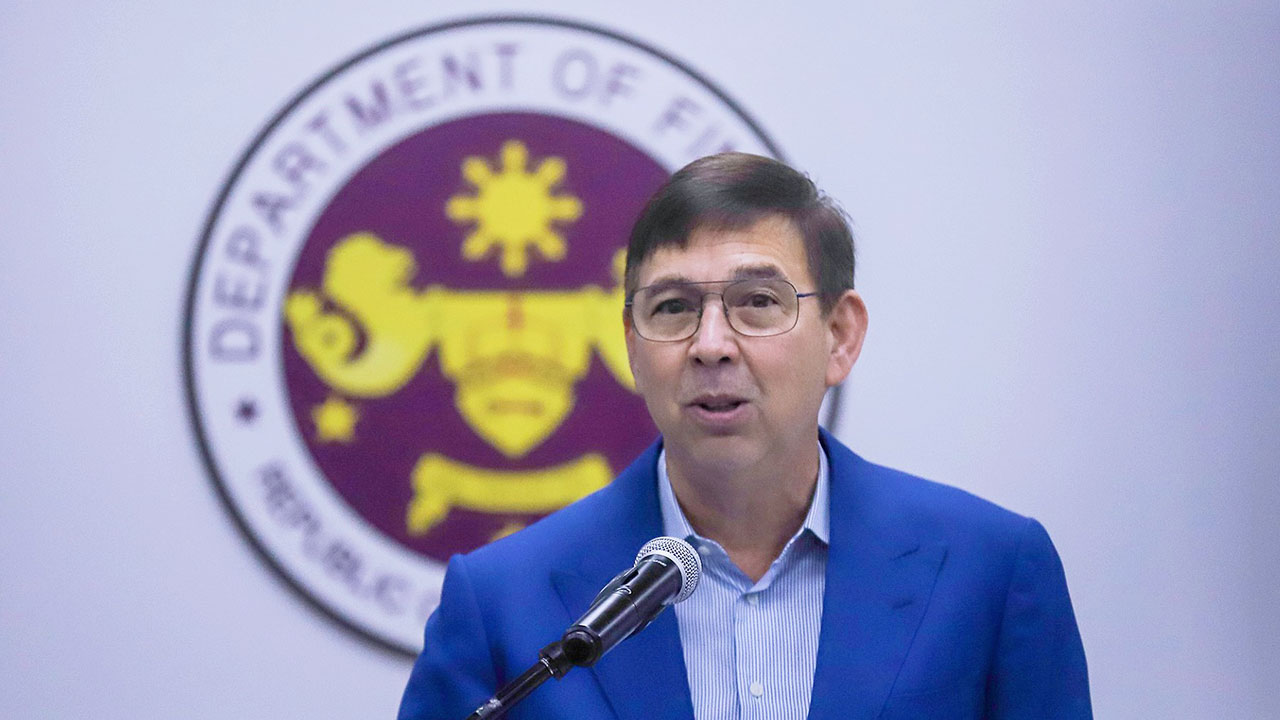
Recto officially takes over DoF

Recto officially takes over DoF

Former congressman and Senator Ralph G. Recto on Monday officially took over the Department of Finance (DoF) from Benjamin E. Diokno, at a time when the government needs to ramp up its fiscal consolidation efforts.

“Our task is to actualize the President’s vision articulated in the national development plan. There will be many obstacles for sure,” Mr. Recto said during the turnover ceremony at the DoF on Monday.

“But I am highly confident that through increased effort and sincere dedication, and by rethinking the way we do things and innovating on the way we govern, we can make significant progress towards approximating this vision,” he added.

Mr. Recto has retained the department’s undersecretaries, while designating Finance Undersecretary Maria Luwalhati C. Dorotan-Tiuseco as his chief of staff.

Ms. Dorotan-Tiuseco in a Viber message said she has been tapped as chief of staff, adding that there have been “no other changes” to date. She was the undersecretary  in charge of the Information Management Service, Political and Legislative Liaison Group and Climate Finance Policy Group.

At a briefing after his oath-taking ceremony on Friday, Mr. Recto said a reshuffle of the department officials is unlikely. “I don’t expect to. You know when I entered the National Economic and Development Authority, I only brought one person with me,” he said.

The agency’s roster of undersecretaries includes Catherine L. Fong of the Privatization and Corporate Affairs Group Maria Edita Z. Tan of the International Finance Group, and Bayani H. Agabin of the Legal Affairs Office and Revenue Integrity Protection Service.

Also included are Chief Economist Zeno Ronald. R. Abenoja, officer-in-charge Karlo Fermin S. Adriano of the Fiscal Policy and Monitoring Group and officer-in-charge Dakila Elteen M. Napao of the Revenue Operations Group.

At the turnover ceremony on Monday, Mr. Diokno described Mr. Recto as a “seasoned policy maker and an undeniable patriot.”

“He has sponsored several key economic and tax reforms that have transformed our economy for the better and reignited the country’s growth potential,” said Mr. Diokno, who returns to the Monetary Board.

The DoF said Mr. Recto is also scheduled to have briefings with heads of DoF-attached agencies and bureaus throughout the week.

Agencies and corporations under the DoF include the Bureau of Internal Revenue (BIR), Bureau of Customs (BoC), Bureau of the Treasury (BTr), Bureau of Local Government Finance, Insurance Commission, National Tax Research Center and Philippine Guarantee Corp.

The newly appointed Finance chief earlier said he would be continuing strategies under the Medium-Term Fiscal Framework, as well as push for the immediate passage of priority tax reforms.

Mr. Recto also said he would use measures to protect consumers from high prices and make sure to meet the revenue collection targets for the year.

The government is targeting to generate PHP 4.235 trillion in revenues this year, equivalent to 15.5% of the gross domestic product (GDP), according to the latest Development Budget Coordination Committee (DBCC) statement.

This year, the BIR is tasked to raise PHP 3.05 trillion, while the BoC is expected to collect PHP 1 trillion.

Latest data from the Treasury showed that the National Government’s budget deficit narrowed by 10.1% to PHP 1.11 trillion in January to November.

Revenue collection rose by 8.8% to PHP 3.6 trillion as of end-November, as tax revenues went up by 7.3% to PHP 3.18 trillion and nontax revenues jumped by 22.9% to PHP 381.9 billion.

Mr. Recto said he will support the passage of the Capital Markets Development Act, push reforms in public and private pensions and ensure that the Maharlika Investment Fund is managed judiciously.

Meanwhile, the Financial Executives Institute of the Philippines (FINEX) in a statement on Monday welcomed Mr. Recto’s focus on improving revenue collection, accelerating investments and freeing up resources for social services.

“FINEX looks forward to working with (Mr. Recto), especially on matters affecting the capital markets and the financial sector of the economy,” it added.

The Bankers Association of the Philippines in an earlier statement said Mr. Recto would be crucial in the “reformation of fiscal and economic policies, together with balancing political realities.”

“While the Philippine economy continues to grow due to its strong fundamentals, it is currently facing local and global economic headwinds such as inflation,” BAP President Jose Teodoro K. Limcaoco said.

“The country needs an experienced economist who can navigate the ongoing challenges of this operating environment, and (Mr. Recto) is an ideal fit for this job,” he added. — Luisa Maria Jacinta C. Jocson

Posts navigation

Older posts
Newer posts

Recent Posts

  • Metrobank US-Iran Risk Index: Fragile ceasefire 
  • Investment Ideas: April 10, 2026 
  • Metrobank US-Iran Risk Index: A new hope
  • A guide for your peso bond portfolio amid higher for longer rates
  • Investment Ideas: April 8, 2026

Recent Comments

No comments to show.

Archives

  • April 2026
  • March 2026
  • February 2026
  • January 2026
  • December 2025
  • November 2025
  • October 2025
  • September 2025
  • August 2025
  • July 2025
  • June 2025
  • May 2025
  • April 2025
  • March 2025
  • February 2025
  • January 2025
  • December 2024
  • November 2024
  • October 2024
  • September 2024
  • August 2024
  • July 2024
  • June 2024
  • May 2024
  • April 2024
  • March 2024
  • February 2024
  • January 2024
  • December 2023
  • November 2023
  • October 2023
  • September 2023
  • August 2023
  • July 2023
  • June 2023
  • May 2023
  • April 2023
  • March 2023
  • February 2023
  • January 2023
  • December 2022
  • November 2022
  • October 2022
  • September 2022
  • August 2022
  • July 2022
  • June 2022
  • May 2022
  • March 2022
  • December 2021
  • October 2021

Categories

  • Bonds
  • BusinessWorld
  • Currencies
  • Economy
  • Equities
  • Estate Planning
  • Explainer
  • Featured Insight
  • Fine Living
  • How To
  • Investment Tips
  • Markets
  • Portfolio Picks
  • Rates & Bonds
  • Retirement
  • Reuters
  • Spotlight
  • Stocks
  • Uncategorized

You are leaving Metrobank Wealth Insights

Please be aware that the external site policies may differ from our website Terms And Conditions and Privacy Policy. The next site will be opened in a new browser window or tab.

Cancel Proceed
Get in Touch

For inquiries, please call our Metrobank Contact Center at (02) 88-700-700 (domestic toll-free 1-800-1888-5775) or send an e-mail to customercare@metrobank.com.ph

Metrobank is regulated by the Bangko Sentral ng Pilipinas
Website: https://www.bsp.gov.ph

Quick Links
The Gist Webinars Wealth Manager Explainers
Markets
Currencies Rates & Bonds Equities Economy
Wealth
Investment Tips Fine Living Retirement
Portfolio Picks
Bonds Stocks
Others
Contact Us Privacy Notice Terms of Use
© 2026 Metrobank. All rights reserved.

Access this content:

If you are an existing investor, log in first to your Metrobank Wealth Manager account. ​

If you wish to start your wealth journey with us, click the “How To Sign Up” button. ​

Login HOW TO SIGN UP