MODEL PORTFOLIO
THE GIST
NEWS AND FEATURES
Global Philippines Fine Living
INSIGHTS
INVESTMENT STRATEGY
Economy Stocks Bonds Currencies
THE BASICS
Investment Tips Explainers Retirement
WEBINARS
2024 Mid-Year Economi Briefing, economic growth in the Philippines
2024 Mid-Year Economic Briefing: Navigating the Easing Cycle
June 21, 2024
Investing with Love
Investing with Love: A Mother’s Guide to Putting Money to Work
May 15, 2024
retirement-ss-3
Investor Series: An Introduction to Estate Planning
September 1, 2023
View All Webinars
DOWNLOADS
grocery-2-aa
Inflation Update: Target breached
DOWNLOAD
Container ship carrying container boxes import export dock with quay crane. Business commercial trade global cargo freight shipping logistic and transportation worldwide oversea concept. Generative AI
Economic Updates
Philippines Trade Update: Wider deficit on strong imports
DOWNLOAD
Frick collection with palm trees 
Economic Updates
Policy Rate Updates: Policy rate updates to reassure 
DOWNLOAD
View all Reports
Metrobank.com.ph How To Sign Up
Follow us on our platforms.

How may we help you?

TOP SEARCHES
  • Where to put my investments
  • Reports about the pandemic and economy
  • Metrobank
  • Webinars
  • Economy
TRENDING ARTICLES
  • Investing for Beginners: Following your PATH
  • On government debt thresholds: How much is too much?
  • Philippines Stock Market Outlook for 2022
  • Deficit spending remains unabated

Login

Access Exclusive Content
Login to Wealth Manager
Visit us at metrobank.com.ph How To Sign Up
Access Exclusive Content Login to Wealth Manager
Search
MODEL PORTFOLIO THE GIST
NEWS AND FEATURES
Global Philippines Fine Living
INSIGHTS
INVESTMENT STRATEGY
Economy Stocks Bonds Currencies
THE BASICS
Investment Tips Explainers Retirement
WEBINARS
2024 Mid-Year Economi Briefing, economic growth in the Philippines
2024 Mid-Year Economic Briefing: Navigating the Easing Cycle
June 21, 2024
Investing with Love
Investing with Love: A Mother’s Guide to Putting Money to Work
May 15, 2024
retirement-ss-3
Investor Series: An Introduction to Estate Planning
September 1, 2023
View All Webinars
DOWNLOADS
grocery-2-aa
Inflation Update: Target breached
April 7, 2026 DOWNLOAD
Container ship carrying container boxes import export dock with quay crane. Business commercial trade global cargo freight shipping logistic and transportation worldwide oversea concept. Generative AI
Economic Updates
Philippines Trade Update: Wider deficit on strong imports
March 27, 2026 DOWNLOAD
Frick collection with palm trees 
Economic Updates
Policy Rate Updates: Policy rate updates to reassure 
March 26, 2026 DOWNLOAD
View all Reports

Archives: Business World Article

External debt payments fall by 20%

External debt payments fall by 20%

The Philipppines’ external debt service burden fell by 19.8% as of end-April as principal payments declined, data from the Bangko Sentral ng Pilipinas (BSP) showed.

Preliminary data from the central bank showed that the country’s debt service burden on its external borrowings dropped to USD 4.64 billion in the January-April period from USD 5.785 billion a year ago.

The debt service burden refers to the amount of money a country needs to pay back its foreign creditors.

BSP data showed principal payments slid by 41.5% to $2.115 billion as of end-April from USD 3.613 billion in the same period in 2023.

Meanwhile, interest payments jumped by 16.3% to USD 2.525 billion at end-April from USD 2.172 billion in 2023.

As of the first quarter, the debt service burden as a share of gross domestic product (GDP) stood at 3%, lower than 4.3% a year ago.

Earlier data from the BSP showed that the country’s outstanding external debt rose by 8.3% to a record USD 128.7 billion as of end-March.

This brought the external debt-to-GDP ratio to 29% from 28.9% a year earlier. Broken down, 17.8% came from the public sector while 11.2% was from the private sector.

External debt includes all types of borrowings by residents from nonresidents.

Rizal Commercial Banking Corp. Chief Economist Michael L. Ricafort said that the lower external debt payments were due to the smaller amount of matured external debt paid this year compared with last year.

“For the coming months, possible cuts in Fed and local policy rates that led to lower bond yields would help ease the external debt service bill in terms of lower interest payments on them,” he said in a Viber message. 

Investors have locked onto the US central bank’s Sept. 17-18 meeting for the start of interest rate cuts that US Federal Reserve Chair Jerome H. Powell has said will represent a “consequential” change in policy from the pandemic-era battle against inflation to a phase of easing monetary policy, Reuters reported. 

The Fed is expected to hold its benchmark interest rate steady in the 5.25%-5.5% range at its July 30-31 meeting, but its new policy statement may also change the descriptions of the economy and outlook to lay the groundwork for a rate cut in September.

Meanwhile, BSP Governor Eli M. Remolona, Jr. has repeatedly signaled the possibility of beginning policy easing by August this year.

He earlier said that the central bank can cut by a total of 50 basis points (bps) this year.

From May 2022 to October 2023, the BSP raised borrowing costs by a cumulative 450 bps in order to tame inflation.

The Monetary Board kept the benchmark rate to an over 17-year high of 6.5% for a sixth straight meeting in June.

Latest data from the Bureau of the Treasury showed that the National Government’s outstanding debt rose to a fresh high of PHP 15.35 trillion as of end-May. — Luisa Maria Jacinta C. Jocson

Marcos told to get real as he delivers address in his 3rd year

Marcos told to get real as he delivers address in his 3rd year

Arthur Ugbaniel, a 29-year-old professional who studied to become a chef, has been operating a motorcycle taxi for about a year now, having failed to find a job that pays well.

“This is just temporary,” the former call center agent said in an interview while dropping off a passenger in front of a bus station along the EDSA highway near the Philippine capital. “I’m planning to work overseas — maybe Japan — where I can get a competitive salary.”

The Philippines, which is largely an agricultural nation, has failed to use its vast natural resources to build a solid manufacturing base, which economists said is key to its long-term growth.

Scorecard: Philippine Development Plan 2023–2028

Ferdinand R. Marcos, Jr., who is now in his third year as President and will deliver his State of the Nation Address (SONA) before Congress today (July 22), had promised to boost the agriculture sector and marshal investments for manufacturing, which employs only 8% of the country’s workforce.

In May, he vowed to make the Philippines a hub for smart manufacturing, citing its “geopolitical location, economic engagements and participation in regional agreements.”

The government of Mr. Marcos, whose campaign was centered on a promise of unity and a vow to bring the price of rice to P20 a kilo, targets 6.5-8% economic growth through 2028, while reducing the poverty rate to as low as 8%.

These targets are unrealistic, Jesus Felipe, director of the Angelo King Institute for Economic and Business Studies at De La Salle University, said in an e-mail, while faulting the Philippine leader for his populist stance.

The only way to achieve these targets is by pursuing industrialization, which does not seem to be a government priority, he added.

“Perhaps the biggest problem the administration faces is that it started with overly optimistic forecasts for 2023-2028 about growth, income per capita and poverty reduction,” Mr. Felipe said. “They were and still are no more than a wish list.”

“When one listens to the President or members of the Cabinet, one gets the impression that they are talking about Switzerland, one of the richest countries in the world,” he said.

Presidential Communications Office Secretary Cheloy Velicaria-Garafil did not immediately reply to a Viber message seeking comment.

The World Bank reported the country’s gross national income per capita increased by 7% to $4,230 in 2023, but Mr. Felipe noted that around 80% of Filipinos earn PHP 15,000 a month. “Over 50% of the labor force, or 25 million workers, are employed in agriculture, wholesale and retail trade, and construction at very low wages and productivity. With this employment structure, it is impossible to talk about the Fourth Industrial Revolution or Artificial Intelligence as the future of the country.”

Mr. Marcos has gone on more than 20 foreign trips since 2022 — 11 last year and three so far this year — to attract investments.

“His traveling all over the world to attract foreign direct investments is bearing more fruit in actual interests being shown, especially by Japanese, South Korean, and European investors in various infrastructure projects, renewable energy and large-scale agribusiness ventures,” said Bernardo M. Villegas, an economist and professor emeritus at the University of Asia and the Pacific.

But bureaucratic red tape that discourages both local and foreign investments remains a problem, he said.

Data from the Philippine central bank showed foreign direct investments (FDIs) fell by 36.9% to USD 556 million in April from a year earlier, the lowest in 10 months. In the January-April period, FDI net inflows jumped by 18.7% to USD 3.525 billion.

‘HIGHEST PRIORITY’
Mr. Villegas said the Marcos government is on the right track in addressing food insecurity and inflation, which hit 3.7% in June from 3.9% in May and 5.4% a year ago.

Inflation-adjusted wages were 17.5% to 24.6% lower than daily minimum wages across the country, according to a BusinessWorld Research in June.

Mr. Villegas said the Marcos government has given the “highest priority” to food inflation, which quickened to 6.5% in June from 6.1% a month earlier, by cutting tariff rates for key farm products including rice.

“He has recognized the harsh reality that there are some food items in which we do not have comparative advantage of producing and which have to be imported, despite objections from our farmers,” he said.

Executive Order No. 62, which is being challenged by farmer’s groups at the Supreme Court, slashed tariffs on rice imports to 15% from 35% until 2028 as part of a reduced tariff regime for other farm products such as pork and corn.

“Aside from international travels, we saw the initiative to push Charter change as an economic strategy to attract investments when clearly, there are more important policies and issues the government should focus on,” Cielo D. Magno, a professor at the University of the Philippines School of Economics, said in an e-mail.

Ms. Magno, who served as Finance undersecretary under Mr. Marcos, criticized Finance Secretary Ralph G. Recto’s declaration that no new taxes would be collected.

“It’s founded on political interests,” she said, noting that before Mr. Recto took over in December, the Finance department had endorsed higher sin and mining taxes.

Ms. Magno, who resigned from the Marcos Cabinet last year after the President imposed a price cap on rice amid spiraling prices, said the failure to manage spending would lead to higher deficits and debt.

The government has also poorly managed the country’s human capital, with no clear direction for the future workforce, she added.

Filipino students were among the world’s weakest in math, reading, and science, according to the 2022 Program for International Student Assessment (PISA). The Philippines ranked 77th out of 81 countries and performed worse than the global average in all categories.

Citing the 2022 report, the Organization for Economic Cooperation and Development said 15-year-old Filipino students ranked 63rd out of 64 countries in terms of creative thinking.

Priority bills that seek to fix the deteriorating quality of Philippine education and harmonize enterprise-based education and training programs are pending in both Houses of Congress and are targeted for approval before the end of the 19th Congress in June 2025.

Critics have said the Education department had been highly politicized after Mr. Marcos appointed Vice-President Sara Duterte-Carpio, his running mate in 2022, to the post.

Ms. Carpio resigned from the Cabinet last month amid worsening ties between her family and the Marcos camp.

Mr. Marcos’ third year in office is not expected to be easy amid a gloomy outlook for household spending, which grew by 4.6% in the first quarter, slower than 5.3% in the fourth quarter and 6.4% a year ago. It was the slowest pace seen since the 4.8% decline in the first quarter of 2021 amid a coronavirus pandemic.

But his foreign policy appears to be a bright spot amid the growing threat from China, which claims the South China Sea almost in its entirety including waters within the Philippines’ exclusive economic zone (EEZ).

Randy P. Tuaño, dean of the Ateneo de Manila University School of Government, praised the President’s political pivot away from China to its western allies including the US.

“The President’s performance in terms of dealing with foreign relations and external threats is relatively commendable,” he said in an e-mail.

“We have again reestablished our ties with our traditional allies in Asia and in the world, and we have stood up relatively well to threats to our national sovereignty in the West Philippine Sea,” he added, referring to areas of the South China Sea within the Philippines’ EEZ.

‘SENSE OF REALITY’
Six of 10 Filipinos were satisfied with the state’s handling of the sea dispute with China, according to a Social Weather Stations (SWS) poll conducted days after a June 17 standoff at Second Thomas Shoal.

“While efforts in addressing our national security issues and building an improved business environment are worthy goals, unfortunately, addressing institutional and bureaucratic issues, which are important to improve the delivery of public services, still needs significant attention,” Mr. Tuaño said.

“The bureaucratic rightsizing project has not yet taken off and most government departments are still very much top-heavy, with numerous undersecretaries and assistant secretaries in place,” he said. “Efforts to strengthen the use of information and communications technology in the delivery of services needs to be addressed.”

Hansley A. Juliano, who teaches politics at Ateneo, expects Mr. Marcos to become even more populist amid his declining approval and trust ratings, which fell by 2 points and 5 points to 53% and 52% in the latest Pulse Asia Research, Inc. poll.

He will probably focus on handouts such as cash and food aid rather than build houses and schools, which may take years to finish, he said in a Facebook Messenger chat.

Jan Robert R. Go, a political science professor at the University of the Philippines, said the government needs to innovate and shun a “business as usual” attitude in running its affairs.

Mr. Villegas said Mr. Marcos must increase the country’s savings rate to make long-term capital available for long-gestating projects.   

“The government budgets for public education and public health should be increased to match those of the other ASEAN (Association of Southeast Asian Nations) countries in terms of percentage to GDP (gross domestic product) from 3% to at least 6%,” he said.

“There should also be more determined efforts to uproot corruption in the procurement of government supplies and in the implementation of public work projects,” he added.

Ms. Magno said the President in his third SONA should rally Congress to boost industries and take a stand against offshore gambling firms, which authorities have linked to crimes.

“We don’t hear anything on industrial policy from the President,” she said. “It’s not enough to travel to attract investments and boost the economy.”

Mr. Felipe said the President should “bring a sense of reality” to the SONA and avoid creating false expectations. “The country will continue doing moderately well, but not [at the level] the government claims.”


T-bill, bond rates to track secondary mart levels

T-bill, bond rates to track secondary mart levels

Rates of Treasury bills (T-bills) and bonds (T-bonds) to be auctioned off this week may inch higher, mirroring the slight upward correction in secondary market yields following weeks of decline amid increased expectations of a rate cut by the Bangko Sentral ng Pilipinas (BSP) as early as next month.

The Bureau of the Treasury (BTr) will auction off PHP 20 billion in T-bills on Monday, or PHP 6.5 billion each in 91- and 182-day papers and PHP 7 billion in 364-day debt.

On Tuesday, the government will offer PHP 25 billion in reissued 20-year T-bonds with a remaining life of 19 years and 10 months.

Yields on the T-bills and T-bonds on offer this week could track the slight rise in secondary market yields on Friday, Rizal Commercial Banking Corp. Chief Economist Michael L. Ricafort said in a Viber message.

Mr. Ricafort noted that secondary market rates inched up last week but still remained relatively low due to mounting bets of a BSP rate cut by August.

Secondary market rates rose week on week due to higher US Treasury yields recently, a trader said in an e-mail.

The trader added that the 20-year T-bonds on offer this week could fetch rates ranging from 6.4% to 6.5%.

“We believe that the BTr might do a partial award or reject if bids get higher than secondary yields, given its aggressive tap award in last week’s 10-year auction.”

At the secondary market on Friday, the rates of the 91-day, 182-day, and 364-day T-bills went up by 5.1 basis points (bps), 3.84 bps, and 5.73 bps week on week to end at 5.7355%, 6.0223%, and 6.1053%, respectively, based on PHP Bloomberg Valuation Service Reference Rates data published on the Philippine Dealing System’s website. The 20-year bond likewise rose by 1.76 bps week on week to 6.3828%.

BSP Governor Eli M. Remolona, Jr. last month said the Monetary Board may deliver its first rate cut in over three years at its Aug. 15 review — the only policy meeting scheduled in the third quarter — as they expect inflation to continue easing this semester.

Meanwhile, the BTr on Tuesday raised PHP 30 billion as planned via the bonds as total bids reached PHP 96.605 billion, or more than thrice the amount on the auction block. The bonds, which have a remaining life of nine years and six months, were awarded at an average rate of 6.212%. Accepted yields ranged from 6.18% to 6.223%.

To accommodate the strong demand, the BTr opened its tap facility window, from which it accepted another PHP 30 billion in bids. This brought last week’s total award to PHP 60 billion, and the total outstanding volume for the series to PHP 201.9 billion.

Last week, the BTr raised PHP 22.6 billion from the T-bills it offered, higher than the PHP 20-billion program, as total bids reached PHP 46.736 billion, or more than twice the amount placed on the auction block.

Broken down, the Treasury borrowed PHP 6.5 billion as programmed from the 91-day T-bills as tenders for the tenor reached PHP 15.51 billion. The average rate of the three-month papers rose by 1.9 bps to 5.717% from the previous week. Accepted rates ranged from 5.702% to 5.74%.

Meanwhile, the government awarded PHP 9.1 billion in 182-day securities, higher than the PHP 6.5-billion plan, as bids for the tenor reached PHP 17.525 billion. The average rate for the six-month T-bill stood at 5.978%, inching up by 1 bp week on week, with accepted rates at 5.95% to 5.998%.

Lastly, the Treasury raised the planned PHP 7 billion via the 364-day debt papers as demand totaled PHP 13.701 billion. The average rate of the one-year debt decreased by 0.1 bp to 6.072%. Accepted yields were from 6% to 6.09%.

On the other hand, the reissued 20-year bonds to be offered on Tuesday were last auctioned off on June 26, where the government raised PHP 30 billion as planned at an average rate of 6.86%, 1.5 bps below the 6.875% coupon rate.

The BTr wants to raise PHP 215 billion from the domestic market this month, or PHP 100 billion from T-bills and PHP 115 billion via T-bonds.

The government borrows from local and foreign sources to help fund its budget deficit, which is capped at PHP 1.48 trillion or 5.6% of gross domestic product for this year. — A.M.C. Sy

Yields on gov’t securities inch up on high bond supply

Yields on gov’t securities inch up on high bond supply

Yields on government securities (GS) traded in the secondary market ended mostly higher last week following the results of the Treasury’s 10-year bond auction, which partly offset the rally caused by expectations of a Bangko Sentral ng Pilipinas (BSP) rate cut as early as August.

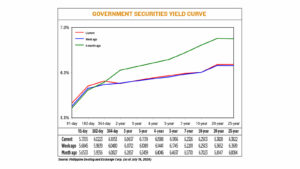
GS yields, which move opposite to prices, went up by 2.11 basis points (bps) on average week on week, based on PHP Bloomberg Valuation Service Reference Rates data as of July 19 published on the Philippine Dealing System’s website.

Rates of the 91-, 182-, and 364-day Treasury bills (T-bills) increased by 5.10 bps, 3.84 bps, and 5.73 bps week on week to 5.7355% and 6.0223%, and 6.1053%, respectively.

At the belly, yields on the three-, four-, five- and seven-year Treasury bonds (T-bonds) went up by 0.5 bp (to 6.1139%), 1.47 bps (6.1588%), 2.11 bps (6.1956%) and 1.25 bps (6.2326%), respectively, while the two-year T-bonds inched down by 0.55 bp to fetch 6.0657%.

At the long end, the 20-, and 25-year debt papers saw their rates increase by 1.76 bps (to 6.3828%) and 2.03 bps (6.3822%), respectively, while the 10-year bond’s yield was flat at 6.2503%.

GS volume traded was at PHP 8.06 billion on Friday, lower than the PHP 41.7 billion recorded a week prior.

“[Last] week, bond yields remained largely range-bound as optimism surrounding the BSP’s guidance on potential interest rate cuts in August was tempered by an unexpectedly high bond market supply. The Bureau of the Treasury’s (BTr) issuance of P60 billion in 10-year bonds led to market resistance against further downward pressure on yields due to supply indigestion,” ATRAM Trust Corp. Vice-President and Head of Fixed Income Strategies Lodevico M. Ulpo, Jr. said.

“Market players initially pushed the 10-year bond yield lower early in the week, but the larger-than-expected bond award later caused yields to rise, resulting in yields remaining range-bound,” he said.

Dino Angelo C. Aquino, vice-president and head of fixed income of Security Bank Corp., likewise attributed recent GS yield movements to the dovish comments made by the central bank chief, coupled with the possibility of lower inflation in the next few months. 

“Lower inflation, [can be attributed] to the implementation of Executive Order 62, where the import on rice tariffs will be cut from 35% to 15%,” Mr. Aquino said.

“Economic growth forecasts from the IMF (International Monetary Fund) and ADB (Asian Development Bank) for the Philippines suggest a clear path towards a soft landing, indicating that monetary policy cuts could occur while growth remains well managed,” Mr. Ulpo added.

BSP Governor Eli M. Remolona, Jr. last month said the Monetary Board may deliver its first rate cut in over three years at its Aug. 15 review — the only policy meeting scheduled in the third quarter — as they expect inflation to continue easing this semester.

The Monetary Board could reduce borrowing costs by 25 bps in the third quarter and by another 25 bps in the fourth quarter, he said.

The BSP last month kept its policy rate at a 17-year high of 6.5% for a sixth straight meeting after raising interest rates by 450 bps from May 2022 to October 2023.

Meanwhile, the BTr on Tuesday made a full award of the reissued 10-year T-bonds at lower rates as the offer was met with robust demand amid expectations of monetary easing by the BSP.

The Treasury raised PHP 30 billion as planned via the bonds as total bids reached P96.605 billion, or more than thrice the amount on the auction block. The bonds, which have a remaining life of nine years and six months, were awarded at an average rate of 6.212%. Accepted yields ranged from 6.18% to 6.223%.

The average rate of the reissued seven-year bonds dropped by 54.2 bps from the 6.754% fetched for the series’ last award on June 11 and was 3.8 bps lower than the 6.25% coupon for the issue.

To accommodate the strong demand seen for Tuesday’s bond auction, the BTr opened its tap facility window, from which it accepted another PHP 30 billion in bids. This brought last week’s total award to PHP 60 billion, and the total outstanding volume for the series to PHP 201.9 billion.

For this week, GS yield movements will likely be driven by the results of the Treasury’s bond auction on Tuesday, Mr. Ulpo said. The BTr will offer PHP 25 billion in reissued 20-year T-bonds with a remaining life of 19 years and 10 months.

“We anticipate that the upcoming 20-year auction will serve as a key indicator of the Bureau of the Treasury’s auction strategy and the market’s capacity to absorb additional bond supply. While the guided issue amount is P25 billion, a repeat of an aggressive tap award could push yields higher,” he said.

“Key driving factors will include market reactions to the auction results, investor sentiment regarding bond supply absorption, and any additional guidance from the BSP on monetary policy,” Mr. Ulpo added.

For his part, Mr. Aquino said the market may consolidate as GS yields are already around 40-60 bps lower for the month, with investors continuing to price in BSP rate cut expectations.

“As we speak, given where the levels are, the market is already pricing in two rate deductions for 2024,” he said. “We’re going to see some sticky price movements in the next few sessions, probably up until the next few weeks, as we approach the BSP meeting. So, we do expect range-bound movements.” — Abigail Marie P. Yraola

Peso may rise before US PCE

Peso may rise before US PCE

The peso may strengthen against the dollar this week ahead of the release of June US personal consumption expenditures (PCE) index data on Friday and as markets digest comments from US Federal Reserve officials.

The local unit closed at PHP 58.335 per dollar on Friday, weakening by 8.5 centavos from its PHP 58.25 finish on Thursday, Bankers Association of the Philippines data showed.

Still, week on week, the peso rose by 4.5 centavos from its PHP 58.38-per-dollar finish on July 12.

The peso declined on Friday amid broad dollar strength and higher US Treasury yields, Security Bank Corp. Chief Economist Robert Dan J. Roces said in a Viber message.

The dollar rose against other major currencies on Friday amid mixed signals from Fed officials, Rizal Commercial Banking Corp. Chief Economist Michael L. Ricafort added in a Viber message.

For this week, the peso may remain range-bound with an upward bias ahead of the release of June PCE data on July 26 (Friday), which could affect the Fed’s policy path, Mr. Roces said.

June’s PCE price index is expected to have climbed 0.1% on a monthly basis, according to a Reuters poll.

Meanwhile, Mr. Ricafort expects the peso to move between PHP 58.25 to PHP 58.45 per dollar on Monday. — AMCS

Rate cut anticipation to fuel stock market’s rally

Rate cut anticipation to fuel stock market’s rally

Philippine Shares could extend their climb this week in anticipation of the expected interest rate cut from the Bangko Sentral ng Pilipinas (BSP) by next month and as more firms report their latest financial results.

On Friday, the Philippine Stock Exchange index (PSEi) jumped by 1.29% or 86.68 points to finish at 6,791.69, while the broader all shares index increased by 0.69% or 24.97 points to close at 3,627.83.

This was the PSEi’s best finish in over three months or since it closed at 6,827.06 on April 4.

Week on week, the bellwether index surged by 2.16% or 143.46 points from its 6,648.23 finish on July 12, marking four consecutive weeks of gains.

“Bulls continued to sustain momentum, zooming past 6,700, carried by optimistic expectations on policy rates,” online brokerage firm 2TradeAsia.com said in a note.

“We continue to see a buildup in positive momentum for the local bourse as it extended its rally to a fourth straight week. The local market has also gotten past the 6,700 level, which was previously considered as a resistance. Its 50-day and 200-day exponential moving averages are about to form a golden cross. Finally, value turnover, whilst still tepid, is seen to be improving compared to previous weeks,” Philstocks Financial, Inc. Senior Research Analyst Japhet Louis O. Tantiangco said in a Viber message.

For this week, Mr. Tantiangco said the market could initially decline as investors pocket their gains from the PSEi’s recent rally. “However, at its current level, the local market is still deemed to be fundamentally undervalued. Hence, long-term investors may also take positions this week.”

“The market could still be able to post gains this week with optimism driven by hopes of a rate cut by the BSP soon and anticipation of second-quarter corporate results,” Mr. Tantiangco said.

BSP Governor Eli M. Remolona, Jr. last month said the Monetary Board may deliver its first rate cut in over three years at its Aug. 15 review — the only policy meeting scheduled in the third quarter — as they expect inflation to continue easing this semester.

The Monetary Board could reduce borrowing costs by 25 basis points (bps) in the third quarter and by another 25 bps in the fourth quarter, he said.

The BSP last month kept its policy rate at a 17-year high of 6.5% for a sixth straight meeting after raising interest rates by 450 bps from May 2022 to October 2023.

“The local currency, if it strengthens further against the US dollar and Wall Street, if it continues to post record performances, are also expected to provide aid to the bourse,” Mr. Tantiangco added. He put the PSEi’s support at 6,700 and resistance at 7,000 for this week.

2TradeAsia.com placed the PSEi’s immediate primary support at 6,650, secondary support at 6,500, and resistance at 7,000.

“The PSEi made a stopping point just a touch south of a strong resistance point in 6,800. It would be a relatively tall order to break this level,… but so far, the macro backdrop plus corporate fundamentals are backing lofty ambitions towards 7,000,” it said. — R.M.D. Ochave

Rate cuts to spur fundraising in 2nd half

Rate cuts to spur fundraising in 2nd half

Firms’ fundraising and lending activities are seen to surge in the second half of this year amid the expected easing by the Bangko Sentral ng Pilipinas (BSP).

“The BSP’s possible policy shift signals a positive step towards fostering capital formation within the Philippines. By lowering borrowing costs, the central bank is essentially making it cheaper for businesses to secure funding,” Rafael S. Algarra, Jr., East West Banking Corp. group head for financial markets and wealth management, said in an e-mail. 

First Metro Investment Corp. Head of Research Cristina S. Ulang said that expected rate cuts will “cheapen” credit, which is good for companies looking to borrow.

This will also “encourage expanded capex (capital expenditure) programs of companies (and) enable greater access to fundraising channels and all for the uplift of overall economic activities,” she said in a Viber message.

Markets are widely anticipating the central bank to begin its easing cycle next month. This as BSP Governor Eli M. Remolona, Jr. has repeatedly signaled that they are on track to cut rates on Aug. 15, the Monetary Board’s next policy review and only meeting in the third quarter.

Mr. Remolona has said that the BSP can cut rates by up to 50 basis points (bps) this year, split into 25-bp cuts in the third and fourth quarters. 

For Mr. Algarra, markets have already been “grappling with a prolonged period of high interest rates.”

“This restrictive monetary environment has understandably led businesses to postpone expansion and new projects due to the high cost of borrowing,” he said.

From May 2022 to October 2023, the Monetary Board has raised borrowing costs by a cumulative 450 bps.

This brought the key rate to an over 17-year high of 6.5%.

If the BSP cuts rates in August, this would be the first reduction since the 25-bp cut delivered in November 2020 amid the COVID-19 pandemic.

Mercantile Securities Corp. Head Trader Jeff Radley C. See said these latest signals from the central bank would lead to a higher possibility of fundraising by companies.

“Cutting rates will signal bullish sentiment for the property sector, especially real estate investment trusts (REITs),” Mr. See said in a Viber message.

For his part, D&L Industries, Inc. President and Chief Executive Officer Alvin D. Lao said the impact of lower rates would be felt in terms of lower interest expenses on existing loans.

“I believe that, for firms in general, almost everyone has been expecting rates to drop since last year and (have) been likely holding off taking out big loans in anticipation of lower rates. It is likely that borrowing activity may increase as rates are cut,” he said in an e-mail.

Damosa Land President Ricardo F. Lagdameo said that most firms will be able to ramp up capital spending amid lowered interest rates.

“I think for the most part, many developers have continued their capital spending activities despite elevated rates to take advantage of opportunities today. With rates beginning to come down soon, spending will likely increase,” he said in an e-mail.

This could also possibly bring down costs for consumers, Mr. Lagdameo said.

“Apart from us as developers being able to enjoy lower interest rates soon (hopefully), what will also provide more confidence is that interest rates for borrowers or end users of real estate products will also normalize. I anticipate that this will create more demand for homes,” he added.

Rizal Commercial Banking Corp. Chief Economist Michael L. Ricafort said that rate cuts would also boost stock market activity.

“Rate cuts would also help improve market conditions in terms of higher stock market prices that would eventually encourage more share sales in terms of initial public offerings (IPOs), secondary offerings, preferred shares, stock rights offerings, among others,” he said in a Viber message.

The Philippine Stock Exchange (PSE) is targeting six IPOs this year. So far this year, the local bourse has had three IPOs: OceanaGold (Philippines), Inc.; Citicore Renewable Energy Corp.; and NexGen Energy Corp.

On the other hand, Mr. Algarra said that the full impact of the rate cuts may not be felt immediately.

“While we anticipate an uptick in fundraising activities, we believe a more significant acceleration will likely materialize in the early months of next year. This is due to the time it typically takes for businesses to finalize investment plans and secure financing,” he said.

For the coming months, Mr. Algarra said it will be crucial to monitor key indicators such as loan disbursements, investment approvals, and business sentiment.

“These metrics will provide valuable insights into the effectiveness of the BSP’s policy shift and its ultimate impact on the Philippine economy.”

“Overall, the BSP’s decision to cut rates presents an opportunity to break free from the constraints of high borrowing costs and propel the Philippines towards a period of renewed economic growth,” he added. – Luisa Maria Jacinta C. Jocson, Reporter

Data-sharing deal to help BIR go after ‘big-time’ tax evaders

Data-sharing deal to help BIR go after ‘big-time’ tax evaders

The Bureau of Internal Revenue (BIR) vowed to run after big-time corporate tax evaders as the agency can now access documents filed with the Securities and Exchange Commission (SEC).

“The BIR will maximize our partnership with the SEC by running after big-time corporate tax evaders. This sharing of information between the agencies will be used to investigate large-scale tax fraud activities perpetrated by companies such as that of ghost receipts and corporate tax evasion,” BIR Commissioner Romeo D. Lumagui, Jr. said in a statement.

Under a data-sharing deal, the BIR will have access to the SEC’s Swift Corporate and Other Records Exchange protocol where it can check all the corporate documents of any SEC-registered taxpayer in real time.

The BIR can look into the documents, such as articles of incorporation and annual financial statements, that are crucial to corporate tax fraud investigation or audit.

For its part, the BIR will provide SEC with a tax identification number verification for the latter’s online digital services to enhance its monitoring of the capital market.

Analysts said the new data-sharing deal between the BIR and SEC will help boost state revenues as the former ramps up its efforts to go after tax evaders.

“By granting the BIR access to essential documents such as articles of incorporation and audited financial statements, this initiative aims to streamline tax assessments and combat tax evasion. Companies will face stricter compliance requirements, while the SEC’s digital platforms simplify document submission and authentication,” Globalinks Securities and Stocks, Inc. Trader Mark V. Santarina said in a Viber message.

“The ease of data access for regulatory bodies necessitates accurate filings to avoid penalties,” he added.

AP Securities, Inc. Senior Research Analyst Francis Ferdinand D. Subido said this will result in increased transparency in the corporate sector.

“Company financials will better reflect the impact of taxes paid to their assets, especially to their cash,” he told BusinessWorld in a Viber message.

“Before, since companies submit another copy of their financial statements to the tax collectors, there is a misalignment in the timing of taxes paid to authorities versus the income tax expense recorded during the financial reporting period. This is why we get deferred tax assets and liabilities,” he said.

COL Financial Group, Inc. Chief Equity Strategist April Lynn Lee-Tan said in a Viber message that the data-sharing agreement makes it easier for the BIR to identify which companies are not paying the correct taxes.

“The BIR would need to look at a company’s financials to know how much taxes need to be paid,” she added.

The government loses around P500 billion annually due to tax evasion, the BIR said last year.

“This (data-sharing deal) can boost government revenue and promote fairer competition within the Philippine economy, but both agencies need to address data security, standardization, and staff training to ensure its effectiveness,” Security Bank Corp. Chief Economist Robert Dan J. Roces said in a Viber message.

Mr. Subido said the data-sharing agreement will also support the government’s push to improve tax administration.

“Gaining access to the financial statements will allow regulators to better understand the accounting methods that companies use. They can better get a gauge of what the true taxable income amount should be,” he said.

“This might even attract more businesses to the Philippines, because as we know, the amount of red tape here is something that has been keeping businesses away,” he added.

Mr. Santarina said the data-sharing initiative will also increase confidence in the local capital market.

“The SEC’s collaboration with other agencies underscores the importance of adhering to regulatory standards, enhancing comprehensive business activity monitoring, and potentially boosting investor confidence in the capital markets industry,” he said.

Ensuring the ease of making tax payments would boost compliance among taxpayers, said Benedicta Du-Baladad, founding partner and chief executive officer of Du-Baladad and Associates.

“When taxpayers feel that taxes are fair, clear, easy to comply with, and consistent in their application, there is a natural attraction for taxpayers to voluntarily comply without the BIR going after them,” she said in a Viber message.

The passage of Republic Act No. 11976 or the Ease of Paying Taxes law would also help improve the digitalization and taxpayer services of the BIR. – Revin Mikhael D. Ochave, Reporter, with Beatriz Marie D. Cruz

PHL consumer demand seen to remain muted

PHL consumer demand seen to remain muted

Domestic demand in the Philippines and other emerging Asian economies is expected to remain muted amid a high interest rate environment, S&P Global Ratings said.

“Consumer demand is more subdued in the Philippines with elevated interest rates (with the policy rate at 6.5%) and weak consumer confidence,” S&P said in its Emerging Markets (EM) Monthly Highlights.

The Bangko Sentral ng Pilipinas (BSP) kept its key rate to an over 17-year high of 6.5% since October 2023 to tame inflation.

“Opposing forces are at work as consumer demand remains broadly stable in EM Asia. On the one hand, demand is dampened by tighter monetary policy and spillovers from weaker economic growth last year,” it said.

“On the other hand, resilient labor markets and recovering tourism are supporting consumption activity.”

In the first quarter, the Philippine gross domestic product (GDP) grew by a weaker-than-expected 5.7%.

Household spending, which accounts for about three-fourths of growth, grew by 4.6%. This was its slowest pace since the 4.8% decline in the first quarter of 2021.

“We observe a slowdown in long-term GDP growth across some EMs, mostly because of slower labor productivity and fixed investment,” S&P Global said.

“In an environment of high interest rates, EM Asian economies with higher domestic savings may be better positioned to finance investments and boost long-term growth prospects,” it said.

The Philippines is targeting 6-7% economic growth this year, 6.5-7.5% for 2025 and 6.5-8% for 2026 to 2028.

However, S&P Global said it sees stronger GDP growth in the region this year compared with 2023, although there are risks to this outlook.

“In several economies, policy-related risks have risen following elections that are generating uncertainty over reforms, fiscal trajectories, and institutional frameworks,” it said.

S&P Global expects Philippine GDP growth to average 5.8% this year, falling short of the government’s goal.

“Policy uncertainty could exacerbate existing risks. Policy uncertainty will be a key factor late in the year and into 2025 as US elections play out and new administrations in key EMs begin to execute their plans,” it added.

The US presidential election is scheduled for Nov. 5.

In the Philippines, the midterm elections will be held in May 2025 and will have Filipinos voting for senators and local officials such as congressmen, governors, and mayors, among others.

Meanwhile, the credit rater said it also expects the delay in the US Federal Reserve’s easing cycle to also impact monetary loosening in the region.

“A later-than-anticipated start to the Fed’s interest rate cuts will contribute to slower monetary policy normalization in most major EMs, though our view on terminal benchmark interest rates remains unchanged,” it said.

BSP Governor Eli M. Remolona, Jr. has said that the central bank is on track to begin cutting rates by August this year.

The BSP could cut by up to 50 basis points (bps) for the full year, he added, through 25-bp cuts in the third and fourth quarters.

S&P Global also noted easing food inflation in the region. “Food inflation has been moderating in the past 12 months, but at an uneven pace across EMs.”

In the Philippines, headline inflation slowed to 3.7% in June from 3.9% in May, marking the seventh straight month that inflation settled within the BSP’s 2-4% target band.

Though food inflation in June quickened to 6.5%, rice inflation eased to 22.5% from 23% a month earlier. Rice accounts for nearly half of overall inflation.

“Most economies in the region are highly dependent on food imports, particularly on wheat, rice, and corn,” S&P Global said.

“Despite some moderation, prices for several key food commodities, such as wheat and rice, remain around 10-15% above pre-2022 levels. Inflationary pressures stemming from elevated food prices continue to complicate disinflation trajectories for food-importing EMs,” it added.

For the first half of the year, inflation averaged 3.5%, slightly above the central bank’s 3.3% full-year forecast. — Luisa Maria Jacinta C. Jocson

PSEi rallies to 6,700 level as peso strengthens

PSEi rallies to 6,700 level as peso strengthens

The main index rallied on Thursday to end at the 6,700 level for the first time since April amid a strengthening peso and positive economic prospects for the Philippines.

The benchmark Philippine Stock Exchange index (PSEi) rose by 0.25% or 17.30 points to finish at 6,705.01 on Thursday, while the broader all-shares index climbed by 0.22% or 8.24 points to end at 3,602.86.

This was the PSEi’s best close since April 29’s 6,769.64 and was the first time it ended at the 6,700 level since the 6,700.49 finish recorded on April 30.

“The local market extended its climb as investors cheered the continuous improvement of the peso against the dollar… The bourse closed above the 6,700 resistance level after testing it in the past few days,” Philstocks Financial, Inc. Research and Engagement Officer Mikhail Philippe Q. Plopenio said in a Viber message.

After hitting 17-month lows last month amid bets on the timing of monetary easing here and in the United States, the peso has since rebounded against the dollar.

On Thursday, the local unit rose for a third straight day, closing at PHP 58.25 versus the greenback, Bankers Association of the Philippines data showed. This was 4.5 centavos stronger than its PHP 58.295 finish on Wednesday and marked the peso’s best close since May 28’s PHP 57.97.

“Also, the Asian Development Bank’s (ADB) projection of the Philippines’ leading the ASEAN (Association of Southeast Asian Nations) region together with Vietnam in terms of economic growth for 2024 and 2025 cheered up investors,” Mr. Plopenio said.

The ADB on Thursday said it expects Philippine gross domestic product (GDP) to grow by 6% this year, at the low end of the government’s 6-7% target. For 2025, the ADB sees Philippine GDP expanding by 6.2%, below the government’s 6.5-7.5% goal.

“Philippine shares continued to rally as regional stocks moved out of the tech-driven firms. Analysts worry that this shift may not protect stocks from potential economic slowdown challenges,” Regina Capital Development Corp. Head of Sales Luis A. Limlingan added in a Viber message.

Sectoral indices were mixed. Financials climbed by 2.55% or 50.90 points to 2,045.25; industrials went up by 0.56% or 51.53 points to 9,222.91; and services rose by 0.26% or 5.30 points to 2,030.09.

Meanwhile, mining and oil fell by 1.79% or 160.97 points to 8,803.27; holding firms went down by 1.13% or 66.39 points to 5,765.43; and property declined by 0.64% or 17.27 points to 2,670.53.

Value turnover rose to PHP 4.61 billion on Thursday with 1.08 billion shares changing hands from the PHP 4.22 billion with 694.38 million stocks traded on Wednesday.

Decliners beat advancers, 89 versus 80, while 59 issues were unchanged.

Net foreign buying dropped to PHP 385.96 million on Thursday from PHP 715.58 million on Wednesday. — RMDO

Posts navigation

Older posts
Newer posts

Recent Posts

  • Metrobank US-Iran Risk Index: Fragile ceasefire 
  • Investment Ideas: April 10, 2026 
  • Metrobank US-Iran Risk Index: A new hope
  • A guide for your peso bond portfolio amid higher for longer rates
  • Investment Ideas: April 8, 2026

Recent Comments

No comments to show.

Archives

  • April 2026
  • March 2026
  • February 2026
  • January 2026
  • December 2025
  • November 2025
  • October 2025
  • September 2025
  • August 2025
  • July 2025
  • June 2025
  • May 2025
  • April 2025
  • March 2025
  • February 2025
  • January 2025
  • December 2024
  • November 2024
  • October 2024
  • September 2024
  • August 2024
  • July 2024
  • June 2024
  • May 2024
  • April 2024
  • March 2024
  • February 2024
  • January 2024
  • December 2023
  • November 2023
  • October 2023
  • September 2023
  • August 2023
  • July 2023
  • June 2023
  • May 2023
  • April 2023
  • March 2023
  • February 2023
  • January 2023
  • December 2022
  • November 2022
  • October 2022
  • September 2022
  • August 2022
  • July 2022
  • June 2022
  • May 2022
  • March 2022
  • December 2021
  • October 2021

Categories

  • Bonds
  • BusinessWorld
  • Currencies
  • Economy
  • Equities
  • Estate Planning
  • Explainer
  • Featured Insight
  • Fine Living
  • How To
  • Investment Tips
  • Markets
  • Portfolio Picks
  • Rates & Bonds
  • Retirement
  • Reuters
  • Spotlight
  • Stocks
  • Uncategorized

You are leaving Metrobank Wealth Insights

Please be aware that the external site policies may differ from our website Terms And Conditions and Privacy Policy. The next site will be opened in a new browser window or tab.

Cancel Proceed
Get in Touch

For inquiries, please call our Metrobank Contact Center at (02) 88-700-700 (domestic toll-free 1-800-1888-5775) or send an e-mail to customercare@metrobank.com.ph

Metrobank is regulated by the Bangko Sentral ng Pilipinas
Website: https://www.bsp.gov.ph

Quick Links
The Gist Webinars Wealth Manager Explainers
Markets
Currencies Rates & Bonds Equities Economy
Wealth
Investment Tips Fine Living Retirement
Portfolio Picks
Bonds Stocks
Others
Contact Us Privacy Notice Terms of Use
© 2026 Metrobank. All rights reserved.

Access this content:

If you are an existing investor, log in first to your Metrobank Wealth Manager account. ​

If you wish to start your wealth journey with us, click the “How To Sign Up” button. ​

Login HOW TO SIGN UP