



MODEL PORTFOLIO
THE GIST
NEWS AND FEATURES
Global Philippines Fine Living
INSIGHTS
INVESTMENT STRATEGY
Economy Stocks Bonds Currencies
THE BASICS
Investment Tips Explainers Retirement
WEBINARS
2024 Mid-Year Economi Briefing, economic growth in the Philippines
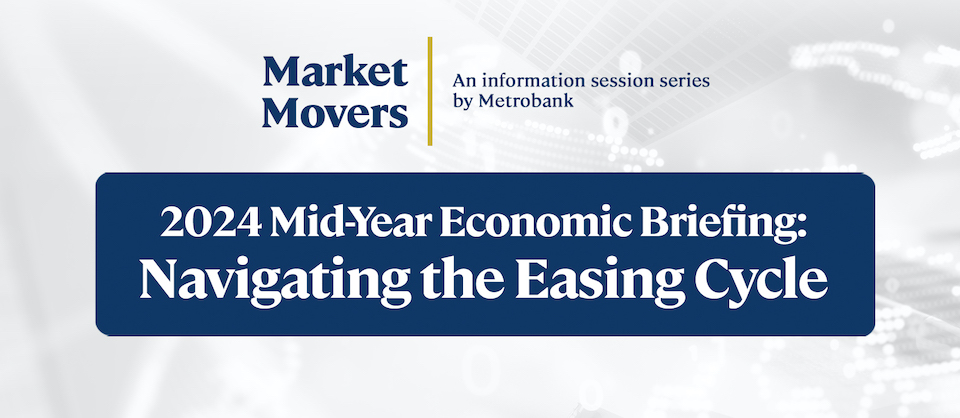
2024 Mid-Year Economic Briefing: Navigating the Easing Cycle
June 21, 2024
Investing with Love
Investing with Love: A Mother’s Guide to Putting Money to Work
May 15, 2024
retirement-ss-3
Investor Series: An Introduction to Estate Planning
September 1, 2023
View All Webinars
DOWNLOADS
Container ship carrying container boxes import export dock with quay crane. Business commercial trade global cargo freight shipping logistic and transportation worldwide oversea concept. Generative AI
Economic Updates
Philippines Trade Update: Wider deficit on strong imports
DOWNLOAD
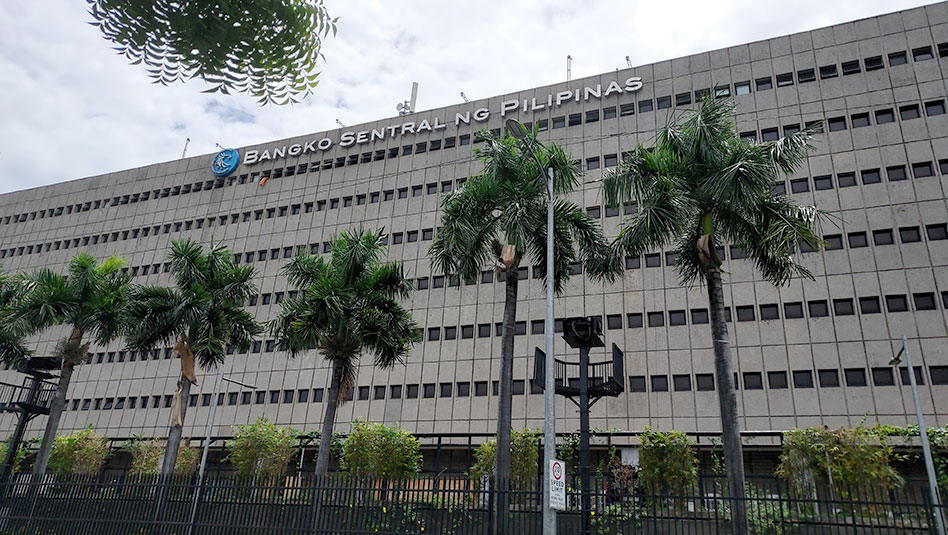
Frick collection with palm trees 
Economic Updates
Policy Rate Updates: Policy rate updates to reassure 
DOWNLOAD
Man using his smartphone
Reports
Fed to cut just once 
DOWNLOAD
View all Reports
Metrobank.com.ph How To Sign Up
Follow us on our platforms.

How may we help you?

TOP SEARCHES
  • Where to put my investments
  • Reports about the pandemic and economy
  • Metrobank
  • Webinars
  • Economy
TRENDING ARTICLES
  • Investing for Beginners: Following your PATH
  • On government debt thresholds: How much is too much?
  • Philippines Stock Market Outlook for 2022
  • Deficit spending remains unabated

Login

Access Exclusive Content
Login to Wealth Manager
Visit us at metrobank.com.ph How To Sign Up
Access Exclusive Content Login to Wealth Manager
Search
MODEL PORTFOLIO THE GIST
NEWS AND FEATURES
Global Philippines Fine Living
INSIGHTS
INVESTMENT STRATEGY
Economy Stocks Bonds Currencies
THE BASICS
Investment Tips Explainers Retirement
WEBINARS
2024 Mid-Year Economi Briefing, economic growth in the Philippines
2024 Mid-Year Economic Briefing: Navigating the Easing Cycle
June 21, 2024
Investing with Love
Investing with Love: A Mother’s Guide to Putting Money to Work
May 15, 2024
retirement-ss-3
Investor Series: An Introduction to Estate Planning
September 1, 2023
View All Webinars
DOWNLOADS
Container ship carrying container boxes import export dock with quay crane. Business commercial trade global cargo freight shipping logistic and transportation worldwide oversea concept. Generative AI
Economic Updates
Philippines Trade Update: Wider deficit on strong imports
March 27, 2026 DOWNLOAD
Frick collection with palm trees 
Economic Updates
Policy Rate Updates: Policy rate updates to reassure 
March 26, 2026 DOWNLOAD
Man using his smartphone
Reports
Fed to cut just once 
March 19, 2026 DOWNLOAD
View all Reports

Archives: Business World Article

Philippine shares inch up on Fed’s dovish shift

Philippine shares inch up on Fed’s dovish shift

Philippine shares inched up to a near five-month high on Tuesday after US Federal Reserve Chair Jerome H. Powell said they could begin their easing cycle next month.

The Philippine Stock Exchange index (PSEi) rose by 0.16% or 11.45 points to finish at 6,973.41 on Tuesday, while the broader all shares index improved by 0.3% or 11.55 points to end at 3,761.28.

This was the PSEi’s best close in nearly five months or since it ended at 6,979.81 on April 1.

“The PSEi followed global indices higher after Federal Reserve Chairman Powell said that the time has come for the Fed to adjust rates. However, profit-taking kept the benchmark index below the key 7,000 level,” AP Securities, Inc. Research Head Alfred Benjamin R. Garcia said in a Viber message.

“Investors cheered the Fed’s dovish signals as monetary policy easing by the Fed would give more room for the Bangko Sentral ng Pilipinas (BSP) to ease their policy, too,” Philstocks Financial, Inc. Senior Research Analyst Japhet Louis O. Tantiangco said in a Viber message.

Mr. Powell on Friday endorsed an imminent start to interest rate cuts, saying further cooling in the job market would be unwelcome and expressing confidence that inflation is within reach of the US central bank’s 2% target, Reuters reported.

With its policy rate currently in the 5.25%-5.5% range, the Fed has “ample room” to reduce borrowing costs to cushion the economy, Mr. Powell said.

Meanwhile, the BSP on Aug. 15 reduced its target reverse repurchase rate by 25 basis points (bps) to 6.25%. Prior to the cut, the Monetary Board kept the policy rate at an over 17-year high of 6.5% for six straight meetings following cumulative hikes worth 450 bps between May 2022 and October 2023 to combat elevated inflation.

BSP Governor Eli M. Remolona, Jr. said they could cut rates by another 25 bps within the year. The Monetary Board’s remaining policy-setting meetings this year are on Oct. 17 and Dec. 19.

“Philippine shares slowly inched towards the 7,000 level as investors start to rebalance ahead of both the MSCI and the end of month closing,” Regina Capital Development Corp. Head of Sales Luis A. Limlingan added in a Viber message.

The majority of sectoral indices closed lower. Services declined by 0.4% or 8.95 points to 2,229.11; holding firms dropped by 0.33% or 19.45 points to 5,864.39; financials went down by 0.04% or 0.97 points to 2,121.42; and industrials slipped by 0.32 point to 9,237.62.

On the other hand, property surged by 2.71% or 73.54 points to 2,778.13; and mining and oil rose by 0.12% or 10.23 points to 8,166.20.

Value turnover slipped to PHP 6.8 billion on Tuesday with 831.25 million shares changing hands from the PHP 6.99 billion with 653.22 million issues traded on Thursday.

Advancers beat decliners, 110 versus 94, while 51 names were unchanged.

Net foreign buying went down to PHP 897.83 million on Tuesday from PHP 2.34 billion on Thursday. — R.M.D. Ochave with Reuters
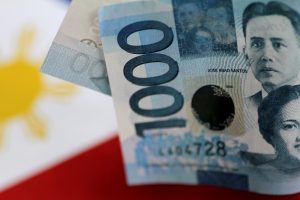
NG budget gap widens to PHP 642.8B

NG budget gap widens to PHP 642.8B

The National Government’s (NG) budget deficit widened in the first seven months of the year as spending growth outpaced revenues, the Department of Finance (DoF) said.

Finance Secretary Ralph G. Recto told the Senate Finance Committee that the budget gap ballooned by 7.2% to PHP 642.8 billion as of end-July from PHP 599.5 billion in the same period a year ago.

This accounts for less than half (43.32%) of the NG’s PHP 1.48-trillion deficit ceiling for this year.

“We are on track to meet our fiscal program for the year with the robust performances of the Bureau of Internal Revenue (BIR), the Bureau of Customs (BoC), the Bureau of the Treasury, and our GOCCs (government-owned and -controlled corporations),” Mr. Recto told the hearing.

In the first seven months, government spending jumped by 13.2% to PHP 3.25 trillion from PHP 2.87 trillion a year ago. This accounted for 21.9% of gross domestic product (GDP).

Meanwhile, revenues climbed by 14.8% to PHP 2.61 trillion during the January-to-July period from PHP 2.27 trillion last year. This was equivalent to 17.1% of GDP.

Broken down, tax revenues rose by 11% to PHP 2.24 trillion during the seven-month period from PHP 2.02 trillion a year ago. This accounted for 14.6% of GDP.

“This strong revenue performance placed us among Asia’s top revenue-to-GDP ratios of 17.1% for the first half of the year, and this is above our full-year target of 16.1%,” Mr. Recto said.

Mr. Recto said BIR collections went up by 12.7% to PHP 1.68 trillion as of end-July, while Customs collections rose by 5.8% to PHP 535.9 billion.

Tax revenues from other offices increased by 14.9% to PHP 20.4 billion in the first seven months from PHP 17.8 billion last year.

On the other hand, nontax revenue collections jumped by 44.5% to PHP 368.8 billion as of end-July from PHP 255.3 billion in the same period last year.

This was driven by higher GOCC dividends in the first seven months of the year, Mr. Recto said.

As of end-July, BTr collections jumped by 27.8% to PHP 183.8 billion, while nontax revenue collections from other offices surged by 66% to PHP 185 billion.

The Finance chief attributed the government’s strong revenue performance to intensified digitalization and enhanced collection strategies.

Jonathan L. Ravelas, senior adviser at professional service firm Reyes Tacandong & Co., said the wider deficit can be attributed to higher debt servicing costs and increased spending to address the impact of natural disasters.

“The likely reasons for the widening budget deficit in July include increased government spending, higher debt servicing costs, and the impact of natural disasters. These disasters led to unexpected expenses for disaster response and recovery,” he said in a Viber message.

In a Viber message, Union Bank of the Philippines, Inc., Chief Economist Ruben Carlo O. Asuncion said the government is continuing its major push for infrastructure in the third quarter as seen with the faster spending.

In the first half of the year, state spending on infrastructure increased by 20.6% to PHP 611.8 billion from PHP 507.2 billion a year ago, according to the Budget department. This exceeded the PHP 545.3-billion program for the period by 12.2%.

The NG aims to spend 5-6% of GDP yearly on infrastructure through 2028.

To address the widening deficit, the government must increase revenue collections, reduce spending, and promote economic growth, Security Bank Corp. Chief Economist Robert Dan J. Roces said.

Meanwhile, the DoF expects a 10.3% average annual revenue growth in the medium term as it ramps up its digitalization strategies, Mr. Recto said.

These strategies include border security enhancement, revenue collection and revenue-base protection, adaptive regulations and compliance monitoring, vigilant enforcement operations and vigorous intelligence gathering activities, and effective engagement with stakeholders as well as interagency cooperation.

Revenues as a percentage of GDP are expected to increase to 16.15% in 2025, 16.21% in 2026, 16.59% in 2027, and 16.96% in 2028.

For this year, the government’s budget deficit ceiling is equivalent to 5.6% of GDP. The government wants to reduce the deficit-to-GDP ratio to 3.7% by 2028.

Budget deficit data for July will be released on Wednesday, the Treasury bureau said. – Beatriz Marie D. Cruz, Reporter

AMLC aims to comply with FATF action items by October

AMLC aims to comply with FATF action items by October

The Anti-Money Laundering Council (AMLC) is eyeing to address by October the remaining action items set by the Financial Action Task Force (FATF) in order to exit the “gray list” of jurisdictions under increased monitoring for money laundering risks.

“We are hopeful that we will comply with all these action items by October of this year,” AMLC Executive Director Matthew M. David told a Senate budget hearing on Tuesday.

“If we comply with the action items by October this year, by early next year, which is January, there is a big probability of an on-site visit,” he added.

The on-site visit is one of the steps in the FATF’s mutual evaluations, where it assesses the implementation of a country’s measures against anti-money laundering and counter-financing of terrorism (AML/CFT).

After the on-site visit, the assessors will draft a report that will then be presented at the FATF’s next plenary.

The remaining action items that the Philippines must address include “demonstrating that supervisors are using AML/CFT controls to mitigate risks associated with casino junkets.”

It must also address deficiencies that concern “applying cross-border measures to all main sea/airports including detection of false declarations of currency and confiscation action in line with risk; and demonstrating an increase in the prosecution of terrorism financing cases in line with risk.”

“Those are the only remaining action items. If you remember, in June 2021, there were 18 recommended action items imposed by FATF through the joint group. But now, it’s only three,” Mr. David said.

The action item on terrorism financing prosecution will require more filing of cases, he said.

“We need to file more terrorism financing cases until the end of this cycle, which is this month,” he said.

As of the first half of the year, the AMLC has secured 19 freeze orders, 17 bank inquiry orders, and four petitions for civil forfeiture. In addition, 64 complaints have been filed with the Justice department while 12 cases were filed in court.

Mr. David said that the action item on casino junkets will depend mainly on the Philippine Amusement and Gaming Corp. as the AMLC has already turned over the supervision of casinos and junket operators to the gaming regulator.

He said there are around 12 land-based casinos and approximately 40 junket operators.

Meanwhile, the item on cross-border measures will require the cooperation of the Bureau of Customs.

“Actually, the issue there is about our submission of the Customs declaration and it’s because of our e-travel system. Now, that’s up and running,” Customs Commissioner Bienvenido Y. Rubio said.

In its June update, the FATF kept the Philippines on its gray list for a third straight year.

BSP Governor Eli M. Remolona, Jr. earlier said the country could exit the gray list by next year.

ARTIFICIAL INTELLIGENCE

Meanwhile, AMLC said it is also planning to integrate artificial intelligence (AI) in its operations as soon as next year.

“In the AMLC, the AI project is already under development. We’re about to complete it within this year. We already procured suppliers more than a year ago,” Mr. David said.

“It will be completed this year, but it will be operational early next year, provided that we will procure the subscription,” he added.

Under the AMLC’s proposed PHP 346-million budget for 2025, more than PHP 50 million will go to the procurement of the subscription of the AI system.

“Because if you develop an AI, you need subscription also annually. That’s the biggest chunk of our information and communication technologies (ICT) products that we are procuring for next year,” he said.

AMLC plans to use AI tools to process covered transaction reports (CTRs) and suspicious transaction reports (STRs).

“We have big data from the CTRs and STRs. Last year, we received 15 million CTRs and STRs. CTRs are transaction reports from banks and among other covered persons. We have 14,000 covered persons, that’s why there are many transaction reports submitted. How will you manage big data like that without the assistance of the AI?”

Mr. David said AMLC has only around 30 analysts that process the data. “We need the assistance of technology and machine learning,” he added. – Luisa Maria Jacinta C. Jocson, Reporter

Outlook for remittance growth remains positive

Outlook for remittance growth remains positive

The continued growth in overseas Filipino worker (OFW) remittances will likely be sustained, although a potential slowdown in developed economies could weigh on this outlook, GlobalSource Partners said.

“The prospects for OFW remittances appear promising given the recovery of many advanced economies,” GlobalSource analysts Diwa C. Guinigundo and Wilhelmina C. Mañalac said in a report.

“A reversal of fortune in the advanced economies, however, could be ominous for overseas employment and corresponding remittances, as well as their mitigating impact on both the real sector and the external payments position of the Philippines, and for that matter, other labor-exporting economies.”

The latest data from the Bangko Sentral ng Pilipinas (BSP) showed that cash remittances jumped by 2.9% to USD 16.25 billion in the first half from USD 15.8 billion in the same period a year ago.

The central bank expects cash remittances to grow by 3% this year.

GlobalSource said that growth prospects for remittances “remain positive” as multilateral institutions like the International Monetary Fund expect a “slight acceleration” in the growth of advanced economies.

“In the last decade, the number of Filipinos leaving for abroad has continued to rise, resulting in… sustained growth in their remittances,” it said.

From 2014 to 2023, remittances stood at USD 323.7 billion, equivalent to an annual average of USD 32.4 billion or a growth rate of 3.9%, GlobalSource said.

“OFW remittances trended upward for this period, except in 2020, when remittances declined by 0.8% as a result of the COVID-19 (coronavirus disease 2019) pandemic. Funds sent through the formal banking channels made up the bulk of total remittances, comprising about 90% of the total,” it said.

GlobalSource said remittances contribute “substantially” to the Philippines’ foreign exchange coffers.

“The Philippines now relies heavily on OFW remittances as a major source of foreign exchange earnings,” it said.

The country’s gross international reserves (GIR) jumped to USD 105.65 billion as of end-July, its highest level in over two years or since the USD 107.3-billion level recorded in March 2022.

“In many ways, OFW remittances help stabilize volatile capital flows and the peso-dollar exchange rate,” it added.

“Diversified across the globe, OFW remittances have provided a natural hedge against specific regional recessions until today, as weak remittance flows from affected areas have been mitigated by remittances from less affected parts of the world,” GlobalSource said.

Remittances also help mitigate the current account deficit and fuels personal consumption expenditures, it added.

The latest data from the central bank showed that the current account deficit stood at USD 1.7 billion in the first quarter, equivalent to -1.6% of GDP.

“The consistency of remittance flows also derives from the altruistic nature of these transfers, with Filipinos sending home money to finance their families’ daily expenditures, housing payments, tuition fees, and even expenses for milestone celebrations,” it said.

“All these reasons combine to cause remittance flows to steadily rise over the years, even against the backdrop of severe economic downturns such as the global financial crisis in 2008-2009.”

GlobalSource said there is “relative stability” in OFW employment as most are employed in industries such as services, sales, crafts and other related sectors.

“Many of them are also professional engineers and architects, accountants and IT experts. A handful of them are in management,” it added.

The United States accounted for nearly half of overall remittances in the first half of the year. This was followed by Singapore (6.9%), Saudi Arabia (6%), Japan (5%), the United Kingdom (5%) the United Arab Emirates (4.1%), Canada (3.4%), Qatar (2.9%), Korea (2.8%) and Taiwan (2.7%).

The World Bank earlier said remittances to the Philippines, which was the third-largest recipient of remittances in 2023, are projected to grow by about 3% this year and in 2025. — Luisa Maria Jacinta C. Jocson


BTr hikes T-bill award on strong demand

BTr hikes T-bill award on strong demand

The government upsized the volume of Treasury bills (T-bills) it awarded on Tuesday amid strong demand and despite mostly higher yields as investors sought to lock in better returns on expectations of rate cuts from the US Federal Reserve and the Bangko Sentral ng Pilipinas (BSP) in the coming months.

The Bureau of the Treasury (BTr) raised PHP 22.6 billion from the T-bills it auctioned off on Tuesday, higher than the planned PHP 20 billion, as total bids reached PHP 53.4 billion or more than twice the amount on offer. However, the demand seen on Tuesday was lower than the PHP 61.297 billion in tenders recorded at the Aug. 19 T-bill auction.

“The auction was 2.7 times oversubscribed with total bids reaching PHP 53.4 billion, prompting the Committee to increase the accepted non-competitive bids for the 182-day securities,” the Treasury said in a statement.

Broken down, the BTr borrowed PHP 6.5 billion as programmed from the 91-day T-bills as tenders for the tenor reached PHP 14.94 billion. The three-month papers were quoted at an average rate of 5.966%, 2.6 basis points (bps) higher than the 5.94% recorded last week. Accepted rates ranged from 5.934% to 5.999%.

Meanwhile, the government hiked its award of 182-day securities to PHP 9.1 billion versus the original PHP 6.5-billion plan as bids for the tenor reached PHP 19.43 billion. The average rate of the six-month T-bill stood at 5.996%, up by 0.7 bp from the 5.989% fetched last week, with accepted rates at 5.96% to 6.025%.

Lastly, the Treasury raised PHP 7 billion as planned via the 364-day debt papers as demand for the tenor totaled PHP 19.01 billion. The average rate of the one-year debt inched down by 0.01 bp to 6.022% from the 6.023% quoted last week, with accepted rates at 5.985% to 6.06%.

At the secondary market before the auction, the 91-, 182-, and 364-day T-bills were quoted at 5.9247%, 6.0559%, and 6.1038%, respectively, based on PHP Bloomberg Valuation Service Reference Rates data provided by the Treasury.

“The BTr continued to take advantage of strong demand given the increase in non-competitive awards for the 182-day bills,” a trader said in a text message.

“Treasury bill average auction yields mostly corrected slightly higher, as some investors tend to lock in interest rates for longer-term tenors amid the widely expected Fed and BSP rate cuts for the coming months, as affirmed recently by Fed Chair Jerome H. Powell and most Fed officials during the Jackson Hole Economic Symposium over the weekend,” Rizal Commercial Banking Corp. Chief Economist Michael L. Ricafort said in a Viber message.

Mr. Powell on Friday endorsed an imminent start to interest rate cuts, saying further cooling in the job market would be unwelcome and expressing confidence that inflation is within reach of the US central bank’s 2% target, Reuters reported.

“The time has come for policy to adjust,” Mr. Powell said in a highly anticipated speech to the Kansas City Fed’s annual economic conference in Jackson Hole, Wyoming. “The direction of travel is clear, and the timing and pace of rate cuts will depend on incoming data, the evolving outlook, and the balance of risks.”

Analysts and financial markets had already widely expected the Fed to deliver its first rate cut at its Sept. 17-18 policy meeting, a view that was cemented after a readout of the central bank’s July meeting said a “vast majority” of policy makers agreed the policy easing likely would begin next month.

With its policy rate currently in the 5.25%-5.5% range, the Fed has “ample room” to reduce borrowing costs to cushion the economy, Mr. Powell said.

Meanwhile, the BSP this month cut benchmark interest rates for the first time in almost four years to mark the start of a “calibrated” easing cycle amid an improving inflation and economic outlook, with its governor signaling at least one more reduction before the end of the year.

The Monetary Board reduced its target reverse repurchase rate by 25 bps to 6.25%, as expected by nine out of 16 analysts in a BusinessWorld poll. Prior to the cut, the BSP kept its policy rate at an over 17-year high of 6.5% for six straight meetings following cumulative hikes worth 450 bps between May 2022 and October 2023 to rein in elevated inflation.

BSP Governor Eli M. Remolona, Jr. said they could cut rates by another 25 bps within the year. The Monetary Board’s remaining policy-setting meetings this year are on Oct. 17 and Dec. 19.

Analysts expect the BSP’s easing cycle to continue until next year, with at least 100 bps in rate cuts seen in 2025.

Tuesday’s T-bill auction was the last for the month. The Treasury raised PHP 85.2 billion via the short-term papers in August, higher than the P80-billion program, as it upsized its awards at two out of four auctions.

On Wednesday, the BTr will offer PHP 25 billion in 20-year Treasury bonds (T-bonds) with a remaining life of 19 years and nine months.

The Treasury wants to raise PHP 220 billion from the domestic market this month, or PHP 80 billion through T-bills and PHP 140 billion via T-bonds.

The government borrows from local and foreign sources to help fund its budget deficit, which is capped at PHP 1.48 trillion or 5.6% of gross domestic product for this year. — Aaron Michael C. Sy with Reuters

Infrastructure spending improves

Infrastructure spending improves

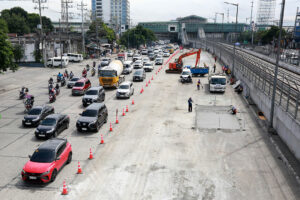
The National Government’s (NG) spending on infrastructure jumped by 17% in June as it increased disbursements for completed public works projects, the Department of Budget and Management (DBM) said.

In its latest report, the DBM said infrastructure and other capital outlays rose by 17% to PHP 139.7 billion in June from PHP 119.4 billion in the same month a year ago.

Month on month, infrastructure spending inched up by 2.45% from PHP 136.4 billion in May.

The uptick in June infrastructure spending was attributed to “disbursements made by the DPWH (Department of Public Works and Highways) for completed road, bridge and multi-purpose building projects, prior years of right-of-way claims, and progress billings for other road infrastructure projects funded under the Unprogrammed Appropriations,” the DBM said.

The NG also spent on capital outlay projects under the Department of National Defense’s Revised Armed Forces of the Philippines Modernization Program.

In June, infrastructure spending included locally funded projects under the Office of the Presidential Adviser on the Peace, Reconciliation and Unity’s PAyapa at MAsaganang PamayaNAn (PAMANA) Program such as road networks, flood control, and water supply systems, among others.

The government also spent on the construction, repair and rehabilitation of justice halls nationwide.

Ruben Carlo O. Asuncion, chief economist at Union Bank of the Philippines, Inc., said the uptick in infrastructure spending in June was reflected in the faster second-quarter economic growth.

“The government pushed to spend and supported domestic demand weakness in the second quarter amid the El Niño impact and elevated interest rates,” he said in a Viber message.

Preliminary data released by the Philippine Statistics Authority (PSA) showed gross domestic product (GDP) expanded by an annual 6.3% in the April-to-June period, quicker than the revised 5.8% growth in the first quarter and 4.3% in the second quarter of 2023.

PSA data also showed government spending rose by 10.7% in the second quarter, a reversal of the 7.1% contraction a year earlier.

“Preparations for the midterm elections may have also increased the urgency to expedite the rollout and completion of more infrastructure projects before the election ban by early 2025, and to show more accomplishments/results that may be felt by the electorate,” Rizal Commercial Banking Corp. Chief Economist Michael L. Ricafort said in a Facebook Messenger chat.

FIRST HALF

For the first half, infrastructure and other capital outlays increased by 20.6% to PHP 611.8 billion from PHP 507.2 billion a year ago.

This exceeded the PHP 545.3-billion program for the period by 12.2% “as a result of the efforts of the DPWH to speed up the completion of its ongoing projects and expedite the processing of payment claims both from prior year’s obligations and the current year’s budget,” the DBM said.

The DBM also said there were direct payments made for foreign-assisted road and rail transport projects under the Public Works and Transporation departments in the first half.

“As early as January, we already provided them (implementing agencies) their allotments and most of the DPWH projects were already undergoing early procurement… By January, they already implemented most of the projects,” Budget Secretary Amenah F. Pangandaman told a briefing on Wednesday.

Overall infrastructure disbursements, which also accounted for the infrastructure components of transfers to local government units (LGUs), and subsidy and equity to government-owned and -controlled corporations, rose by 18.4% to PHP 720.5 billion as of end-June from P608.6 billion last year.

This exceeded the government’s PHP 671.3-billion program for the period by 7.33%, data showed. It was also equivalent to 5.7% of gross domestic product (GDP).

“Infrastructure spending and MOOE (maintenance and other operating expenses) will continue to drive disbursements for the remaining months of the year, with 56.1% and nearly 52% of their full-year program, respectively, expected this second semester,” the DBM said.

For infrastructure spending, the DBM said this includes payments for ongoing construction works.

“The said expenditures will hopefully help buttress strong economic growth by creating demand in the construction sector or supporting other related services industries, while also facilitating the recovery of the agriculture sector,” the department said.

Terry L. Ridon, a public investment analyst and convenor of think tank InfraWatch PH, said he expects infrastructure spending to further increase this year.

“Infrastructure agencies should try their best to improve their absorptive capacities for this year’s projects, particularly as 2025 is an election year in which the law mandates a suspension of project implementation for a specific period of time,” he said in a Viber chat.

Mr. Asuncion said the government should focus spending on infrastructure, flood control and energy generation projects.

“The challenge is that it would take time to put new projects up and going,” he said.

The government aims to spend 5-6% of GDP annually for infrastructure through 2028. – Beatriz Marie D. Cruz, Reporter

Loan growth to pick up in 2025

Loan growth to pick up in 2025

Loan growth is seen to improve next year as the Philippine central bank is expected to further cut policy rates, S&P Global Ratings said.

“We think that the loan growth will start to pick up, but at a very slow rate,” S&P Global Director and Lead Analyst Ivan Tan said in a webinar on Wednesday.

“We think that most of the loan growth pick-up is going to come in 2025. That’s when we are forecasting the policy rate will be cut to 5% by next year.”

The Monetary Board last week lowered the target reverse repurchase (RRP) rate by 25 basis points (bps) to 6.25% from 6.5%, which was the highest rate in over 17 years.

BSP Governor Eli M. Remolona, Jr. earlier signaled the possibility of another 25-bp cut in either October or December.

Mr. Tan said the recent rate cut by the BSP is unlikely to have any immediate impact on loan growth.

“The Philippines is usually a country where the policy rate is 3%, give or take… So even with this 25-bp rate cut, a 6.25% policy rate versus what I would consider a normalized 3% rate is still quite high,” he said.

The country’s loan growth in the pre-pandemic period had averaged 10% to 12% annually, Mr. Tan said.

“In 2023, it only grew about 7% to 8%. By the Philippines’ standard, it’s very low. It’s very low because the policy rate in the Philippines was very, very high,” he added.

The central bank has raised borrowing costs by a cumulative 450 bps from May 2022 to October 2023 to tame inflation.

The latest data from the BSP showed that bank lending rose by 10.1% year on year to P12.09 trillion in June.

The bank lending growth in June was unchanged from May, which was the fastest pace since the 10.2% recorded in March 2023.

Mr. Tan also noted that loan growth patterns are likely to change.

“We have been observing a risk-on behavior where the Philippine banks are maintaining the large corporate loans, but growing almost twice as fast in the higher-using and higher-risk consumer segment,” he said.

“Just to note, the Philippine nonperforming loan (NPL) [ratio] is at about 3%. Consumer NPL, the delinquency rate is twice as high,” he added.

The banking industry’s NPL ratio eased to 3.51% in June from 3.57% in May. The bad loan ratio in May was the highest in nearly two years.

“We are watching that very closely because there’s kind of a risk-on behavior. Philippine banks are growing consumer loans faster to improve the yield, for yield enhancement purposes, but they are taking on incremental risk in the process also,” he added. — Luisa Maria Jacinta C. Jocson

Meralco gives more time for 400-MW power supply bids

Meralco gives more time for 400-MW power supply bids

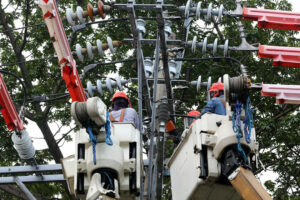
Manila Electric Co. (Meralco) has extended the deadline for firms to submit bids for its 400-megawatt (MW) power supply requirement for next year to October, ensuring participants have more time to prepare their offers, the power distributor said on Wednesday.

The deadline to submit bids is now scheduled for Oct. 1, extended from the previous date of Sept. 3, Meralco said in a statement.

Meralco has set the pre-bid conference on Aug. 29, moved from the previous date of Aug. 1. 

Similarly, the bid submission deadline for its 600-MW power supply has been moved to Aug. 27 from Aug. 2.

Eight companies expressed interest and participated in the pre-bid conference last month for Meralco’s 600-MW power supply requirement.

These are First Gas Power Corp. and First NatGas Power Corp. of First Gen Corp.; Mariveles Power Generation Corp. and Masinloc Power Co. Ltd. of San Miguel Global Power Holdings Corp.; GNPower Dinginin Ltd. Co. and Therma Luzon, Inc. of Aboitiz Power Corp.; Southwest Luzon Power Generation Corp. of Semirara Mining and Power Corp.; and Quezon Power (Philippines) Ltd Co.

“We urge prospective bidders to submit their best offers for Meralco’s 600-MW and 400-MW supply requirements for next year,” said Lawrence S. Fernandez, Meralco’s chairman for bids and awards committee for power supply agreements.

“We look forward to receiving competitive offers that will help us fulfill our mandate of providing reliable and least-cost electricity to our customers,” he added.

The government requires distribution utilities to choose the cheapest electricity supply via a competitive selection process (CSP).

“We would also like to reiterate that the CSPs are being conducted in compliance with the rules and guidelines set by the Department of Energy and the Energy Regulatory Commission. We remain dedicated to conducting this process with utmost transparency and fairness,” Mr. Fernandez said.

Meralco resumed its bidding procedures for the 1,000-MW power supply requirement after the Taguig Regional Trial Court dismissed the injunction that had delayed the process.

Meralco’s controlling stakeholder, Beacon Electric Asset Holdings, Inc., is partly owned by PLDT, Inc. Hastings Holdings, Inc., a unit of PLDT Beneficial Trust Fund subsidiary MediaQuest Holdings, Inc., has an interest in BusinessWorld through the Philippine Star Group, which it controls. — Sheldeen Joy Talavera

Peso extends climb amid growing dovish Fed bets

Peso extends climb amid growing dovish Fed bets

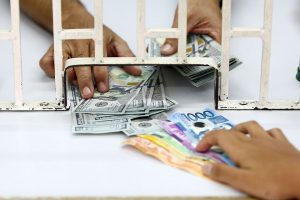
The peso climbed to a new four-month high against the dollar on Wednesday amid growing expectations of a September rate cut by the US Federal Reserve.

The local unit closed at PHP 56.50 per dollar on Wednesday, strengthening by five centavos from its PHP 56.55 finish on Tuesday, Bankers Association of the Philippines data showed.

This was the peso’s strongest finish in more than four months or since its PHP 56.491 per dollar close on April 8.

The peso opened Wednesday’s session sharply stronger at PHP 56.40 against the dollar. Its weakest showing was at PHP 56.54, while its intraday best was at PHP 56.345 versus the greenback.

Dollars exchanged inched up to USD 1.59 billion on Wednesday from USD 1.55 billion on Tuesday.

“The dollar-peso opened [stronger] amid heightened dovish Fed bets, but buying interest ensued later in the session,” a trader said by phone.

The peso was supported by a broadly weaker dollar amid expectations that US labor data to be released overnight would bolster wagers on a September cut by the Fed, Rizal Commercial Banking Corp. Chief Economist Michael L. Ricafort said in a Viber message.

The dollar slipped to its lowest this year versus the euro on Wednesday as traders braced for potentially crucial revisions to US payrolls data later in the day, ahead of a speech by Federal Reserve Chair Jerome H. Powell at the end of the week, Reuters reported.

The US currency also dipped below the closely watched 145 yen level and hovered close to the more-than-one-year low to sterling reached overnight.

Pressure notably came from US bond yields, which hit their lowest since Aug. 5, when yields crashed to a more-than-one-year trough after surprisingly soft monthly jobs figures sparked recession fear.

A weak monthly payrolls report at the start of this month was a catalyst for a spike in volatility across asset classes, leaving market participants bracing for another potential shock with revised data due later Wednesday.

The Aug. 2 payrolls report sent traders racing to price in prospects of the Fed needing to slash interest rates by a half percentage point at its mid-September policy meeting, pushing the implied probability of such a move to about 71%, according to CME Group’s FedWatch Tool.

However, a run of better macroeconomic data has since seen the odds flip, with bets now 72% for a quarter-point cut and 28% for the bigger reduction.

Mr. Powell’s keynote address on Friday at the Kansas City Fed’s Jackson Hole economic symposium will be parsed carefully for any hints on the likely size of a rate cut next month, and whether borrowing costs are likely to be lowered at each subsequent Fed meeting.

The US dollar index — which measures the currency against the euro, sterling, yen, and three other major rivals — edged to its lowest since Jan. 2 at 101.30 before recovering to 101.48 as of 0450 GMT. It had fallen 0.5% or more in each of the previous three sessions.

For Thursday, Mr. Ricafort sees the peso ranging from PHP 56.40 to PHP 56.70 per dollar.

Meanwhile, the trader said the peso is expected to continue consolidating as markets await the Fed’s September policy meeting. — AMCS with Reuters


Profit-taking halts PHL shares’ three-day climb

Profit-taking halts PHL shares’ three-day climb

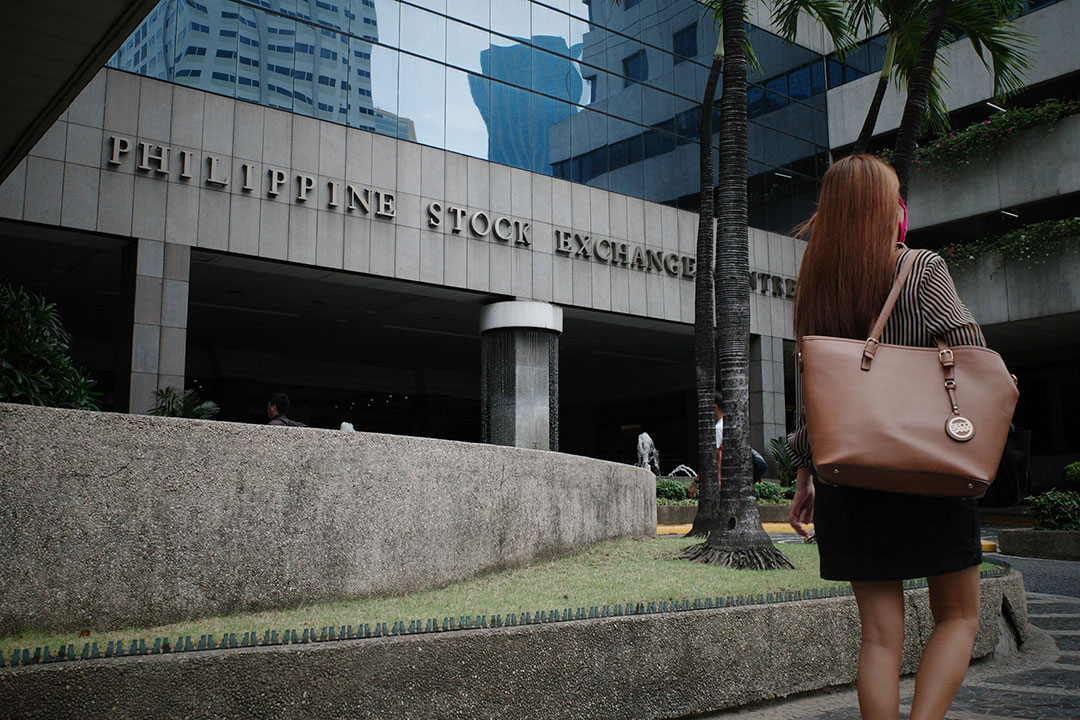
Philippine stocks snapped their three-day rally on Wednesday as investors pocketed their gains ahead of the US Federal Reserve’s annual economic symposium.

The Philippine Stock Exchange index (PSEi) dropped by 0.63% or 44.14 points to end at 6,900.62 on Wednesday, while the broader all shares index dropped by 0.12% or 4.71 points to finish at 3,724.38.

“The local market closed lower this Wednesday by 0.63% to 6,900.62 on the back of profit taking. Investors booked gains after three consecutive days of rallying,” Philstocks Financial, Inc. Senior Research Analyst Japhet Louis O. Tantiangco said in a Viber message.

“The local bourse also took cues from Wall Street’s decline wherein investors took a cautious stance while waiting for the Jackson Hole Economic Symposium where the Fed may give clues on their policy outlook,” he added.

Wall Street’s main indexes slipped in volatile trading on Tuesday, ahead of a symposium at Jackson Hole later this week and minutes from the Federal Reserve’s meeting last month which could offer clues on a September interest rate cut, Reuters reported.

The Dow Jones Industrial Average index dropped by 0.15% or 61.56 points to 40,834.97; the S&P 500 lost 0.2% or 11.13 points to 5,597.12; and the Nasdaq Composite went down by 0.33% or 59.83 points to 17,816.94.

Traders are looking forward to any hints from Fed Chair Jerome H. Powell of a rate cut at the upcoming Fed meeting in September when he delivers his speech at the annual economic symposium in Jackson Hole on Friday.

Odds for the Fed cutting interest rates by 25 basis points (bps) in September stand at 73.5%, compared with a near-even split between a 50- and 25-bp cut seen a week ago, according to the CME FedWatch Tool.

“Philippine shares succumbed to profit taking after hitting 7,000 intraday [on Tuesday] as investors started to keep to cash ahead of the long weekend,” Regina Capital Development Corp. Head of Sales Luis A. Limlingan said in a Viber message.

Philippine financial markets will be closed on Friday (Aug. 23) for a special nonworking holiday in observance of Ninoy Aquino Day, which was moved from the original Aug. 21 date.

Almost all sectoral indices closed lower on Wednesday, with industrials being the lone gainer, rising by 0.14% or 13.12 points to 9,207.97.

Property dropped by 1.52% or 42.20 points to 2,722.89; financials went down 1.03% or 21.70 points to 2,070.22; mining and oil declined by 0.91% or 75.05 points to 8,161.14; services retreated by 0.22% or 5.05 points to 2,222.14; and holding firms decreased by 0.2% or 11.91 points to 5,841.26.

Value turnover declined to PHP 5.14 billion on Wednesday with 863.73 million issues changing hands from the PHP 8.09 billion with 673.38 million issues traded on Tuesday.

Market breadth was negative as decliners outnumbered advancers, 130 versus 78, while 49 issues closed unchanged.

Net foreign buying declined to PHP 565.27 million on Wednesday from PHP 2.06 billion on Tuesday. — Revin Mikhael D. Ochave with Reuters

Posts navigation

Older posts
Newer posts

Recent Posts

  • Investment Ideas: April 1, 2026
  • Metrobank US-Iran Risk Index: Signals of an end
  • Eye on Earnings: Demand for connection supports telcos
  • Inflation Preview: March madness
  • Investment Ideas: March 31, 2026

Recent Comments

No comments to show.

Archives

  • April 2026
  • March 2026
  • February 2026
  • January 2026
  • December 2025
  • November 2025
  • October 2025
  • September 2025
  • August 2025
  • July 2025
  • June 2025
  • May 2025
  • April 2025
  • March 2025
  • February 2025
  • January 2025
  • December 2024
  • November 2024
  • October 2024
  • September 2024
  • August 2024
  • July 2024
  • June 2024
  • May 2024
  • April 2024
  • March 2024
  • February 2024
  • January 2024
  • December 2023
  • November 2023
  • October 2023
  • September 2023
  • August 2023
  • July 2023
  • June 2023
  • May 2023
  • April 2023
  • March 2023
  • February 2023
  • January 2023
  • December 2022
  • November 2022
  • October 2022
  • September 2022
  • August 2022
  • July 2022
  • June 2022
  • May 2022
  • March 2022
  • December 2021
  • October 2021

Categories

  • Bonds
  • BusinessWorld
  • Currencies
  • Economy
  • Equities
  • Estate Planning
  • Explainer
  • Featured Insight
  • Fine Living
  • How To
  • Investment Tips
  • Markets
  • Portfolio Picks
  • Rates & Bonds
  • Retirement
  • Reuters
  • Spotlight
  • Stocks
  • Uncategorized

You are leaving Metrobank Wealth Insights

Please be aware that the external site policies may differ from our website Terms And Conditions and Privacy Policy. The next site will be opened in a new browser window or tab.

Cancel Proceed
Get in Touch

For inquiries, please call our Metrobank Contact Center at (02) 88-700-700 (domestic toll-free 1-800-1888-5775) or send an e-mail to customercare@metrobank.com.ph

Metrobank is regulated by the Bangko Sentral ng Pilipinas
Website: https://www.bsp.gov.ph

Quick Links
The Gist Webinars Wealth Manager Explainers
Markets
Currencies Rates & Bonds Equities Economy
Wealth
Investment Tips Fine Living Retirement
Portfolio Picks
Bonds Stocks
Others
Contact Us Privacy Notice Terms of Use
© 2026 Metrobank. All rights reserved.

Access this content:

If you are an existing investor, log in first to your Metrobank Wealth Manager account. ​

If you wish to start your wealth journey with us, click the “How To Sign Up” button. ​

Login HOW TO SIGN UP