



MODEL PORTFOLIO
THE GIST
NEWS AND FEATURES
Global Philippines Fine Living
INSIGHTS
INVESTMENT STRATEGY
Economy Stocks Bonds Currencies
THE BASICS
Investment Tips Explainers Retirement
WEBINARS
2024 Mid-Year Economi Briefing, economic growth in the Philippines
2024 Mid-Year Economic Briefing: Navigating the Easing Cycle
June 21, 2024
Investing with Love
Investing with Love: A Mother’s Guide to Putting Money to Work
May 15, 2024
retirement-ss-3
Investor Series: An Introduction to Estate Planning
September 1, 2023
View All Webinars
DOWNLOADS
Container ship carrying container boxes import export dock with quay crane. Business commercial trade global cargo freight shipping logistic and transportation worldwide oversea concept. Generative AI
Economic Updates
Philippines Trade Update: Wider deficit on strong imports
DOWNLOAD
Frick collection with palm trees 
Economic Updates
Policy Rate Updates: Policy rate updates to reassure 
DOWNLOAD
Man using his smartphone
Reports
Fed to cut just once 
DOWNLOAD
View all Reports
Metrobank.com.ph How To Sign Up
Follow us on our platforms.

How may we help you?

TOP SEARCHES
  • Where to put my investments
  • Reports about the pandemic and economy
  • Metrobank
  • Webinars
  • Economy
TRENDING ARTICLES
  • Investing for Beginners: Following your PATH
  • On government debt thresholds: How much is too much?
  • Philippines Stock Market Outlook for 2022
  • Deficit spending remains unabated

Login

Access Exclusive Content
Login to Wealth Manager
Visit us at metrobank.com.ph How To Sign Up
Access Exclusive Content Login to Wealth Manager
Search
MODEL PORTFOLIO THE GIST
NEWS AND FEATURES
Global Philippines Fine Living
INSIGHTS
INVESTMENT STRATEGY
Economy Stocks Bonds Currencies
THE BASICS
Investment Tips Explainers Retirement
WEBINARS
2024 Mid-Year Economi Briefing, economic growth in the Philippines
2024 Mid-Year Economic Briefing: Navigating the Easing Cycle
June 21, 2024
Investing with Love
Investing with Love: A Mother’s Guide to Putting Money to Work
May 15, 2024
retirement-ss-3
Investor Series: An Introduction to Estate Planning
September 1, 2023
View All Webinars
DOWNLOADS
Container ship carrying container boxes import export dock with quay crane. Business commercial trade global cargo freight shipping logistic and transportation worldwide oversea concept. Generative AI
Economic Updates
Philippines Trade Update: Wider deficit on strong imports
March 27, 2026 DOWNLOAD
Frick collection with palm trees 
Economic Updates
Policy Rate Updates: Policy rate updates to reassure 
March 26, 2026 DOWNLOAD
Man using his smartphone
Reports
Fed to cut just once 
March 19, 2026 DOWNLOAD
View all Reports

Archives: Business World Article

CEO optimism remains high — survey

CEO optimism remains high — survey

Majority of chief executive officers (CEOs) in the Philippines are confident that their organizations will see revenue growth in the next 12 months, despite geopolitical uncertainties, a survey showed.

Results of the survey conducted by PwC Philippines in partnership with the Management Association of the Philippines (MAP) showed that 85% of 168 CEOs are optimistic that their companies will post revenue growth in the next 12 months.

The results of the survey, which ran from July 8 to Aug. 9, showed improved optimism compared with the 79% of 157 CEOs who said they were confident of topline growth last year.

PWC MAP 2024 CEO Survey: CEOs optimistic about their industry prospectsMeanwhile, 86% of CEOs are confident of revenue growth in the next three years, slipping from 87% in the previous survey.

The survey also showed that 86% of the CEOs are confident about industry prospects for the next 12 months, higher than the 83% seen in the previous survey. This is the highest level of optimism since the pandemic.

“What helped drive optimism among our CEOs here in the Philippines is mainly our country’s economic growth,” said Karen Patricia A. Rogacion, deals and corporate partner at PwC, at a press briefing on Monday.

She noted the Philippines recorded faster economic growth despite geopolitical uncertainties, which have affected economies in the United States and Europe.

“When the year started, at the global level, we had a slow start. We are still feeling the impact of the Russia-Ukraine war as well as the impact of China’s real estate crisis,” she said.

“Several economies, such as the US and even Europe, were expecting a recession because of the high interest rates and unstable market conditions. In the Philippines, however, we showed fast growth,” she added.

The Philippine economy grew by 6% in the first six months of the year, hitting the low end of the government’s target of 6-7% this year.

In the survey, CEOs said infrastructure development, domestic consumption, and foreign direct investments are the main drivers of growth in the next 12 months.

“Given the top three drivers, it’s also been consistent that the CEOs say that our government is doing a good job in pushing for infrastructure development, forging stronger relationships with other nations, and also managing inflation,” Ms. Rogacion said.

However, 62% of the CEOs said geopolitical uncertainties arising from the Russia-Ukraine war, conflicts in the West Philippine Sea, and upcoming elections in other countries are keeping them awake at night.

“We have actually been indirectly and directly affected by challenges due to global supply chain pressures, inflation, and other related threats,” she said.

Donald L. Lim, chair of the MAP CEO Conference Committee, said CEOs fear geopolitical uncertainties as these may suddenly disrupt supply chains and operations.

“I think the geopolitics, whether Ukraine-Russia or even the West Philippine Sea, are a great unknown. We don’t know what will happen. But if that happens, it will have a severe impact on the business,” he added.

However, Roderick M. Danao, chairman and senior partner of PwC, said that some companies are already starting to manage and mitigate the effects of geopolitical uncertainties.

“A few local companies have effectively tried to manage to mitigate the effect [through] product diversification, market diversification, and supply-chain diversification,” Mr. Danao said.

“Of course, all of these have to be backed up by long-term risk management plans for the company to adapt and to proactively manage the impact of the geopolitical conflicts,” he added.

TECHNOLOGICAL INNOVATION

Meanwhile, the survey showed that 46% of the CEOs believe that their company will no longer be viable after 10 years if it continues running on its current path.

According to PwC, new technologies such as generative artificial intelligence (GenAI) are set to revolutionize business models, redefine work processes, and transform industries.

“I always believe that AI will certainly bring more opportunities rather than threats,” said Mr. Danao.

In the survey, 40% of the CEOs said that they have already adopted the technology, while 71% believe that GenAI will change how their companies create, deliver, and capture value.

Even though 78% of the leaders believe that the technology can improve the quality of their company’s products and services, the survey also showed 61% of the CEOs said that they are not yet widely adopting the technology in their operations.

Asked why there is still low adoption, Mr. Danao and Mr. Lim said that AI in the Philippines is still in its nascent stage.

“The awareness is still very low at the Philippine corporate level. We are all excited about what this AI can bring into our organization. But embedding AI is still a work in progress. There will be investments and workforce upskilling needed,” Mr. Danao said.

“We are just at the tip of the iceberg. I think you’ll be lucky to have real AI adoption across the majority, meaning more than 50%, in five years. It will be a long time,” Mr. Lim said.

Mary Jade Roxas-Divinagracia, deals and corporate finance managing partner at PwC, said AI adoption will be led by industries like healthcare, banks, financial institutions, and retail.

“And then you have one of the major industries in the Philippines, the business process outsourcing, and this can be a game changer for them, not just on the risk side, but on the opportunity side as well,” she added.

However, Mr. Lim said that the full adoption of AI may result in job losses if the workforce will not be able to keep up.

“AI won’t replace jobs. Those people who use AI will replace those who do not know how to use it. So, I think the problem is more on education because the teachers do not understand this,” he said.

“So, we have to make sure that the educational system prepares our next three batches of graduates to use and harness AI. Will there be a loss of jobs? I think there will be. Because it won’t be able to catch up,” he added. – Justine Irish D. Tabile, Reporter


Banks’ NPL ratio rises to over two-year high

Banks’ NPL ratio rises to over two-year high

Philippine banks’ asset quality worsened in July as the industry’s gross nonperforming loan (NPL) ratio rose to its highest in over two years.

Preliminary data from the Bangko Sentral ng Pilipinas (BSP) showed the banking industry’s gross NPL ratio went up to 3.58% in July from 3.51% in June and 3.43% a year ago.

This was the highest bad loan ratio in 25 months or since 3.6% in June 2022.

Data from the BSP showed that soured loans increased by 1.13% to PHP 508.11 billion as of end-July from PHP 502.42 billion a month earlier. Year on year, bad loans jumped by 15.46% from PHP 440.07 billion.

Loans are considered nonperforming once they remain unpaid for at least 90 days after the due date. These are deemed as risk assets since borrowers are unlikely to pay.

The loan portfolio of Philippine banks slid by 0.78% to PHP 14.21 trillion as of end-July from PHP 14.32 trillion at end-June. However, it increased by 10.79% from PHP 12.82 trillion a year ago.

Past due loans rose by 1.88% to PHP 625.71 billion in July from PHP 614.17 billion a month earlier. Year on year, it increased by 18.37% from PHP 528.62 billion.

This brought the past due ratio to 4.4% in July, higher than 4.29% in June and 4.12% a year ago.

On the other hand, restructured loans stood at PHP 291.08 billion in July, down by 0.86% from PHP 293.62 billion in June. Year on year, it fell by 4.47% from PHP 304.71 billion a year ago.

Restructured loans accounted for 2.05% of the industry’s total loan portfolio, steady from a month ago but lower than 2.38% in July 2023.

Banks’ loan loss reserves inched down by 0.05% to PHP 479.24 billion in July from PHP 479.46 billion in June but rose by 6.44% from PHP 450.24 billion a year ago.

This brought the loan loss reserve ratio to 3.37%, slightly higher than 3.35% last month but lower than 3.51% a year ago.

Lenders’ NPL coverage ratio, which gauges the allowance for potential losses due to bad loans, slipped to 94.32% in July from 95.43% in June and 102.66% in July 2023.

The higher NPL ratio in July can be attributed to elevated borrowing costs, Rizal Commercial Banking Corp. Chief Economist Michael L. Ricafort said in a Viber message.

“The NPL ratio for Philippine banks reached 3.58% in July, a two-year high likely due to factors like post-pandemic recovery challenges, rising interest rates, and sector-specific issues,” Reyes Tacandong & Co. Senior Adviser Jonathan L. Ravelas said in a Viber message.

The BSP had kept its policy rate at an over 17-year high of 6.5% from October 2023 to July 2024. At its August meeting, the Monetary Board cut its policy rate by 25 basis points (bps) to 6.25%.

“Furthermore, the latest pickup in banks’ NPL ratio may also be a function of faster loan growth in recent months, meaning the faster expansion in banks’ loan portfolio also partly corresponds to some pickup in NPLs as well, so it is very important to have tight and uncompromising credit/lending standards to curb NPLs to as minimal as possible,” Mr. Ricafort said.

Outstanding loans of universal and commercial banks rose by 10.4% year on year to PHP 12.14 trillion in July from PHP 11 trillion a year ago. This was the fastest loan growth in 19 months or since the 13.7% logged in December 2022.

For the rest of the year, Mr. Ricafort said rate cuts by the US Federal Reserve and the BSP would lower borrowing costs for consumers and businesses.

“(This) could also help boost economic growth and other business activities, thereby could lead to some improvement in borrowers’ ability to pay that helps ease NPL ratio and overall asset quality of banks,” he said.

Mr. Ravelas said he is “cautiously optimistic” on the outlook for banks.

“However, with improved economic conditions, accommodative measures from the BSP, and strengthened risk management by banks, the outlook for asset quality is cautiously optimistic for the rest of the year,” Mr. Ravelas added.

BSP Governor Eli M. Remolona, Jr. previously said the central bank could cut rates by another 25 bps within the year. The Monetary Board’s last two policy-setting meetings this year are on Oct. 17 and Dec. 19. — Aaron Michael C. Sy

Philippines is still most disaster-prone country for 16th straight year

Philippines is still most disaster-prone country for 16th straight year

The Philippines remained the most disaster-prone country for the 16th straight year, as it continues to face extreme natural events like typhoons, earthquakes and droughts.

In the latest World Risk Index, the Philippines’ risk score inched up to 46.91 this year from 46.86 last year.

A country’s score is measured based on its exposure to disasters as well as vulnerability to its effects. A score of 100 means a country has a “very high risk” while zero suggests otherwise.

The World Risk Report, published by Germany-based Bündnis Entwicklung Hilft and the Institute for International Law of Peace and Armed Conflict at Ruhr University Bochum (IFHV), assesses the disaster risk for 193 countries using 100 indicators.

The Philippines, which faces an average of 20 typhoons every year, has topped the World Risk Index since 2009.

“In 2024, the risk hotspots remain in the Americas and Asia, hosting eight of the 10 countries with the highest risk scores. Over the long term, however, these hotspots will shift to countries with climate-sensitive exposure and high vulnerability,” the report said.

Indonesia ranked second in the index with a score of 41.13, followed by India (40.96), Colombia (37.81) and Mexico (35.93). The rest of the top 10 included Myanmar (35.85), Mozambique (34.44), Russia (28.12), Bangladesh (27.73), and Pakistan (27.02).

Global disaster risks are also closely linked to poverty and inequality, the report said.

“This persistence often results from robust interactions between increasing vulnerability and damage caused by extreme events. Countries with climate-sensitive exposure and high to very high vulnerability are particularly at risk. These countries can expect more frequent and more intense extreme natural events and damage in the future,” it said.

In terms of exposure to disasters, the Philippines ranked fourth with a score of 39.99. China had the highest exposure (64.59), followed by Mexico (50.08), and Japan (43.67). A high score means a country is most exposed to drought, earthquakes, tsunamis, cyclones, coastal and riverine flooding, and rising sea levels.

“Climate change is increasing the frequency and intensity of extreme natural events, leaving less and less time for regeneration. As soon as one disaster is overcome, the next threat is already looming,” the report said.

The Philippines also had “very high” scores in terms of vulnerability (55.03), susceptibility (51.16), and lack of coping capacities (58.07).

“Extreme weather events, conflicts and pandemics overlap and amplify each other. Global trends such as climate change, population growth and political polarization promote multiple crises and intensify their effects,” the report said.

For instance, the Philippines was hit by 22 typhoons during the coronavirus disease 2019 (COVID-19) pandemic, including Supertyphoon Rolly (international name: Goni) which was considered one of the strongest ever.

“Hundreds of thousands of destroyed homes, overcrowded evacuation centers and the resulting increase in COVID-19 cases not only led to a dramatic increase in humanitarian needs, but also had a negative impact on the mental health of the population,” the report said.

Terry L. Ridon, a public investment analyst and convenor of think tank InfraWatch PH, said the Philippines’ tight fiscal space has affected risk mitigation measures.

“While government has disaster and climate bodies which craft policy relating to adaptation and mitigation measures to address disaster and climate risks, government offices have not yet done enough to actually implement climate resilient programs and projects,” he said in a Viber message.

“A particular reason for this is our limited fiscal space, in which fundamental social services and infrastructure are the most important spending priorities.”

Typhoons may have cost the Philippine economy around $20 billion in gross domestic product losses from 1990 to 2020, the Asian Development Bank said in a 2021 report.

The Philippine government should come up with ways to make its key projects or programs more climate-responsive or climate-resilient, Mr. Ridon added.

Leonardo A. Lanzona, who teaches economics at the Ateneo de Manila University, said the Philippines has a high risk of disasters due to its vulnerability to climate change.

“If institutions are strong, there are ways of mitigating the effects of extreme weather conditions in the country. Climate is one significant challenge we face, and our institutions are powerless in protecting our properties and lives. I am thinking of corruption, and flood control funds can be diverted into their interests,” Mr. Lanzona said. — Beatriz Marie D. Cruz

T-bill yields go down amid policy easing hopes

T-bill yields go down amid policy easing hopes

The government upsized the volume of Treasury bills (T-bills) it awarded on Monday as yields went down on strong demand and expectations of more rate cuts by the Bangko Sentral ng Pilipinas (BSP) this year amid easing inflation.

The Bureau of the Treasury (BTr) raised PHP 22.6 billion from the T-bills it auctioned off on Monday, higher than the planned PHP 20 billion, as total bids reached PHP 64.515 billion or more than thrice the amount on offer. This was also higher than the PHP 53.105 billion in tenders recorded at the Sept. 2 auction.

Broken down, the BTr borrowed PHP 6.5 billion as programmed from the 91-day T-bills as tenders for the tenor reached PHP 22.7 billion. The three-month papers were quoted at an average rate of 5.84%, 10.7 basis points (bps) lower than 5.947% recorded last week, with the government only accepting bids with this yield.

Meanwhile, the government hiked its award of 182-day securities to PHP 9.1 billion from the original PHP 6.5-billion plan as bids for the tenor reached PHP 21.51 billion. The average rate of the six-month T-bill stood at 5.98%, down by 2.2 bps from the 6.002% fetched last week, with the BTr only accepting tenders with this rate.

Lastly, the Treasury raised PHP 7 billion as planned via the 364-day debt papers as demand for the tenor totaled PHP 20.305 billion. The average rate of the one-year debt inched down by 1.1 bps to 6.029% from the 6.04% quoted last week, with accepted rates at 6.02% to 6.04%.

At the secondary market before the auction, the 91-, 182-, and 364-day T-bills were quoted at 5.9150%, 5.9879%, and 6.0734%, respectively, based on PHP Bloomberg Valuation Service (BVAL) Reference Rates data provided by the Treasury.

“The continual strong demand for short-tenored notes reflects increasing investor demand in securing high yielding returns ahead of further BSP rate cuts in the following months,” a trader said in an e-mail. “The lower awarded T-bill rates this week reflected lowered inflation expectations following the softer-than-expected August inflation rate.”

“Treasury bill average auction yields all slightly eased, similar to the slight weekly declines in the comparable short-term PHP BVAL yields after headline inflation eased to 3.3% in August,” Rizal Commercial Banking Corp. Chief Economist Michael L. Ricafort likewise said in a Viber message.

The BSP last month cut benchmark interest rates for the first time in almost four years amid an improving inflation and economic outlook, with its governor signaling at least one more reduction before the end of the year.

The Monetary Board on Aug. 15 reduced its policy rate by 25 bps to 6.25% from a 17-year high of 6.5%.

BSP Governor Eli M. Remolona, Jr. said they could cut rates by another 25 bps within the year. The Monetary Board’s last two policy-setting meetings this year are on Oct. 17 and Dec. 19.

Headline inflation eased to a seven-month low of 3.3% in August from 4.4% in July and 5.3% in the same month a year ago, the Philippine Statistics Authority reported on Thursday. This was within the BSP’s 3.2-4% forecast for the month and was well below the 3.7% median estimate in a BusinessWorld poll of 15 analysts.

In the first eight months, inflation averaged 3.6%, slightly above the BSP’s 3.4% baseline forecast but within its 2-4% annual target.

The slower-than-expected August print could justify further policy easing, analysts have said.

T-bill rates also declined amid “more dovish signals from most Fed officials recently would increase the odds of future Fed rate cuts, even the possibility of a larger 50-bp Fed rate cuts in the coming months to prevent the risk of recession,” Mr. Ricafort added.

Federal Reserve policy makers on Friday signaled they are ready to kick off a series of interest rate cuts at the US central bank’s meeting next week, noting a cooling in the labor market that could accelerate into something more dire in the absence of a policy shift, Reuters reported.

Their remarks were widely seen as endorsing a quarter-percentage-point reduction in the Fed’s policy rate, and leaving the door open to further and perhaps bigger moves should the job market continue to slow down.

Policy makers have kept the Fed’s benchmark borrowing rate in the current 5.25%-5.5% range since July 2023 after an aggressive rate-hiking campaign that began 18 months earlier in response to a surge in inflation.

“It is now appropriate to dial down the degree of restrictiveness in the stance of policy by reducing the target range for the federal funds rate,” New York Fed President John Williams said at a Council on Foreign Relations event.

Speaking at the University of Notre Dame, Fed Governor Christopher Waller went further, saying he could support back-to-back cuts, or bigger cuts, if the data suggests the need.

“I was a big advocate of front-loading rate hikes when inflation accelerated in 2022, and I will be an advocate of front-loading rate cuts if that is appropriate,” Mr. Waller said.

Chicago Fed President Austan Goolsbee, who has for months signaled he thinks rates need to come down, also said he wants to calibrate policy based on data as it comes in.

“I don’t think what happens at the next meeting alone is what’s the most important,” Mr. Goolsbee said in an interview with CNBC, adding that it would be critical for the Fed to understand the trend of the data over the next several policy meetings.

Data published earlier on Friday showed monthly job gains have averaged 116,000 in the June-August period, below what many economists estimate is needed to meet the job-growth needs of an expanding population.

All three policy makers noted progress on bringing inflation down, with Mr. Waller saying it is now on the “right path” to get to the Fed’s 2% goal.

Traders of futures that settle to the Fed’s policy rate are now pricing a 75% chance that the US central bank will start by cutting its policy rate by 25 bps.

They are pricing in a 4.25%-4.5% policy rate by the end of this year, a level that implies a bigger rate cut at one of the central bank’s last two meetings of the year.

On Tuesday, the BTr will offer PHP 30 billion in reissued seven-year Treasury bonds (T-bonds) with a remaining life of four years and eight months.

The Treasury wants to raise PHP 195 billion from the domestic market this month, or PHP 80 billion through T-bills and PHP 115 billion via T-bonds.

The government borrows from local and foreign sources to help fund its budget deficit, which is capped at PHP 1.48 trillion or 5.6% of gross domestic product for this year. — A.M.C. Sy with Reuters

BSP to shift to enhanced forecasting model by next year

BSP to shift to enhanced forecasting model by next year

The Bangko Sentral ng Pilipinas (BSP) aims to shift to an enhanced macroeconomic forecasting model by next year that will help in the formulation of monetary policy, officials said on Monday.

The BSP will adopt the Policy Analysis Model for the Philippines (PAMPh) for determining the path of monetary policy, which was made in partnership with the International Monetary Fund’s Institute for Capacity Development and the Japan International Cooperation Agency.

“The shift to conditional forecasts as a key input to monetary policy formulation is in line with best practices in inflation targeting central banks. Specifically, by representing the key economic gaps in the Philippine economy, the PAMPh allows a systematic, internally consistent, and economically coherent analysis of current and future economic conditions that will guide monetary policy formulation in the BSP,” BSP Department of Economic Research (DER) Economic and Financial Forecasting Group Deputy Director Dennis M. Bautista said at a briefing on Monday.

“Conditional forecasts will take the BSP in communicating current decisions and more importantly, the probable path of policy decisions helping to anchor inflation expectations,” he added.

The BSP will be shifting from its current multi-equation model (MEM) and single equation model (SEM).

The PAMPh generates a suggested policy path that Monetary Board members may use when making policy decisions. The previous models only forecast the inflation rate over a decided time frame based on a fixed policy rate.

“I think the key limitation is that the multi-equation model assumes a constant interest rate over the policy horizon,” BSP DER Director Dennis D. Lapid said. “So, this current model (PAMPh) ensures that when we give out a path for future inflation, it will have a corresponding path for not just GDP (gross domestic product), but also the policy interest rate along with it.”

The BSP will not disclose the policy paths forecasted by the PAMPh, and they will be for internal use for now, he added.

Mr. Bautista said the PAMPh uses 290 equations, while the MEM uses 24. The PAMPh also considers more sectors to see inflation drivers and other economic imbalances.

“The MEM has very good forecasting and performance but when you compare the two, the PAMPh considers more details of the economy. So, it can be used to address more, plus gives more explicit input on the monetary policy stance. It’s producing an entire path of the policy rate,” BSP Deputy Governor Francisco G. Dakila, Jr. said.

Mr. Bautista said the BSP will not be abandoning the old model but will use it along with the PAMPh.

“The MEM will then be one of the so-called satellite models. The PAMPh is quarterly because many of the variables are available only quarterly. But you need more detailed information on the development of inflation on a higher frequency basis, so that means you need a lot of so-called satellite or complementary models. The MEM will be one of them because it produces forecasts of inflation in the near term,” Mr. Dakila added.

University of the Philippines Los Baños Economics Senior Lecturer Enrico P. Villanueva said in a social media message that the main difference between the old and the new models could be better inflation forecasts.

“The past few months or year, their forecasted range of inflation, although a bit wide in range, normally captured the actual inflation figure,” he said.

“Due to the inherent difficulty of capturing and forecasting levels of economic variables, my suggestion is actually to temper the model’s output using expert judgment,” Mr. Villanueva added. “While macroeconomic modeling through graphical depiction is a doable and practical undertaking, its translation into mathematical or econometric models to be used in forecasting is not tractable. Econometric forecasting models are typically laden with assumption and oversimplification of complex real-life relationships among variables.” — AMCS

Analysts trim inflation expectations

Analysts trim inflation expectations

Private sector economists trimmed their inflation expectations for this year and the next two years, with the majority expecting the consumer price index (CPI) to fall within the Bangko Sentral ng Pilipinas’ (BSP) 2-4% target range until 2026.

The BSP’s Monetary Policy Report from its August meeting showed the analysts’ forecasts continued to move closer to the midpoint of the 2-4% target range.

The BSP’s survey of external forecasters (BSEF) for August showed that the mean inflation forecast was cut to 3.5% for this year from 3.7% in the May survey.

The inflation forecast for 2025 was trimmed to 3.1% from 3.5% in the May survey.

Likewise, analysts cut the 2026 forecast to 3.2% from the 3.4% projection in May.

“Risks to the inflation outlook are broadly balanced, with local inflation expected to trend lower for the rest of the year,” the BSP said. “Downside risks to the inflation outlook are seen to stem largely from lower rice prices, following the implementation of Executive Order (EO) No. 62.”

President Ferdinand R. Marcos, Jr. issued EO 62, which reduced tariffs on imported rice to 15% from 35% until 2028 to lower prices of the staple. The order took effect in July.

“Analysts also anticipate downward inflationary pressures from a stronger peso against the US dollar, as well as favorable base effects,” the BSP said.

The local unit closed at PHP 55.905 per dollar on Friday, strengthening by 30.5 centavos from its PHP 56.21 finish on Thursday, Bankers Association of the Philippines data showed. This was the first time the peso hit the PHP 55-per-dollar level in almost six months or since its PHP 55.58-a-dollar close on March 18.

Year to date, the peso has depreciated by 53.5 centavos from its PHP 55.37-a-dollar close on Dec. 29, 2023.

“Meanwhile, the main upside risk is expected to arise from second-round effects, such as higher electricity costs brought about by a potential uptick in oil prices amid geopolitical conflicts,” the BSP said.

At the same time, the BSEF showed most analysts expect inflation to remain within the 2-4% target until 2026.

“Compared to the July survey, the August probability distribution for 2024 remained narrow and within the target range. The probability distribution shifted slightly to the left for 2024-2026, indicating a strong likelihood that inflation will stay well within the target range,” the BSP said.

Forecasts provided by 18 out of 23 respondents showed an 86.4% chance that inflation will remain within the 2-4% target range for 2024. However, this was lower than the 87.2% recorded in July.

On the other hand, analysts estimated a 12.5% chance that inflation will surpass the target range, up from 12%.

Meanwhile, the probability of inflation staying within the target range for 2025 decreased to 80.6% from 84.3%.

Expectations of inflation staying within target for 2026 likewise slipped to 82.7% from 86.8%.

The BSEF also showed that most analysts see the BSP cutting rates by another 25 basis points (bps) in the fourth quarter, bringing the total amount of rate cuts for the year to 50 bps.

“Moreover, they expect the BSP to lower the rate by 50-250 bps in 2025, with additional cuts of up to 100 bps by the end of 2026,” it said.

Last month the Monetary Board cut its policy rate by 25 bps to 6.25% from 6.5%.

BSP Governor Eli M. Remolona, Jr. previously said the central bank could cut rates by another 25 bps within the year. The Monetary Board’s last two policy-setting meetings this year are on Oct. 17 and Dec. 19. — Aaron Michael C. Sy

August dollar reserves rise to over 2-year high

August dollar reserves rise to over 2-year high

The Philippines’ foreign exchange reserves rose to its highest level in over two years, mainly due to the increase in the central bank’s earnings from its foreign investments.

Preliminary data from the Bangko Sentral ng Pilipinas (BSP) showed that gross dollar reserves inched up by 0.18% to USD106.92 billion as of end-August from USD106.74 billion as of end-July.

“The month-on-month increase in the GIR (gross international reserves) level reflected mainly the net income from the BSP’s investments abroad,” the central bank said in a statement.

Year on year, the country’s dollar buffers rose by 7.39% from USD99.57 billion in August 2023.

The dollar reserves in August were also at their highest level in 29 months or since the USD107.3 billion in March 2022.

As of end-August, the level of dollar reserves was enough to cover about 6.1 times the country’s short-term external debt based on original maturity and 3.7 times based on residual maturity.

It was also equivalent to 7.9 months’ worth of imports of goods and payments of services and primary income.

Ample foreign exchange buffers shield an economy from market volatility and ensure the country can pay its debts in case of an economic downturn.

BSP data showed that foreign investments went up by 0.33% to USD91.41 billion as of end-August from USD91.11 billion a month ago, and by 8.65% from USD84.13 billion in the same month last year.

Reserves in the form of gold were valued at USD10.22 billion as of end-August, slipping by 0.88% from USD10.31 billion in the previous month and by 0.1% from USD10.23 billion a year ago.

On the other hand, net foreign currency deposits slipped by 4.4% to USD773.4 million from USD809 million month on month. However, this increased by 19.98% from USD664.6 million a year earlier.

Net international reserves as of end-August went up by 0.19% to USD106.9 billion from USD106.7 billion last month.

Net international reserves are the difference between the BSP’s reserve assets or GIR and reserve liabilities, such as short-term foreign debt and credit and loans from the International Monetary Fund (IMF).

The Philippines’ reserve position in the IMF increased by 0.83% to USD725.9 million as of end-August from USD719.9 million as of end-July. However, this was an 8.16% drop from USD790.4 million a year ago.

Special drawing rights, or the amount the country can tap from the IMF, rose by 0.2% to USD3.8 billion from USD3.79 billion last month. It also increased by 0.72% from USD3.77 billion last year.

“The continued increase in the GIR could be attributed to the continued increase in the country’s structural US dollar inflows such as overseas Filipino worker remittances, BPO (business process outsourcing) revenues, exports, foreign investments (foreign direct investments and foreign portfolio), among others,” Rizal Commercial Banking Corp. Chief Economist Michael L. Ricafort said in a Viber message.

In the first half, cash remittances jumped by 2.9% year on year to USD16.25 billion.

Hot money yielded a net inflow of USD1.46 billion in the January-to-July period, surging by 830.7% from the USD157.3-million inflows in the same period a year ago.

In the January-to-May period, net inflows of foreign direct investments jumped by 15.8% year on year to USD4.024 billion.

“For the coming months, GIR could still increase due to proceeds of the National Government’s USD2.5-billion global bond issuance in the latter part of August 2024, and the remaining USD500-million global bond issuance programmed for the rest of 2024,” Mr. Ricafort said in a Viber message.

Last month, the government raised USD2.5 billion from a three-tranche US dollar-denominated global bond offering. In May, USD2 billion was raised from the issuance of global bonds.

The government has yet to borrow USD500 million out of the total USD5-billion borrowing plan for this year.

The BSP expects the GIR level to settle at USD104 billion by yearend. — Beatriz Marie D. Cruz


Rice inflation seen to cool once India lifts export ban

Rice inflation seen to cool once India lifts export ban

Rice inflation may further cool in the coming months once India relaxes a ban on exports, analysts said.

“India may reconsider its export ban, impacting international prices further. The stronger peso will also make imports cheaper, easing inflation further,” Union Bank of the Philippines, Inc., Chief Economist Ruben Carlo O. Asuncion said in a Viber message.

Market participants are anticipating that India, the world’s top rice exporter, could soon ease export restrictions on rice.

Last year, global rice prices spiked after India suspended exports of non-basmati white rice.

Headline inflation eased to 3.3% in August from 4.4% in July due to the slower rise in food and transport costs, the Philippine Statistics Authority (PSA) said last week.

In August, rice inflation slowed to 14.7% from 20.9% a month earlier. This was the lowest rice inflation since the 13.2% print in October last year.

Rice was the top contributor to the August inflation basket, accounting for 32.7% or 1.1 percentage points.

National Statistician Claire Dennis S. Mapa has said rice inflation is expected to fall to a single digit in September due to base effect.

It could be recalled that the consumer price index (CPI) for rice first hit double digits in September last year at 17.9%.

However, the effects of the recent Typhoon Enteng as well as higher oil prices may stoke rice inflation, Security Bank Corp. Chief Economist Robert Dan J. Roces said.

“Rice inflation falling to a single digit in September is possible, but it may be difficult to say for sure at the moment with the extent of the recent typhoon damage,” he said in a Viber chat.

Agricultural damage brought by Typhoon Enteng has risen to PHP 659 million, the Department of Agriculture said over the weekend.

“We must remain vigilant of global factors like oil prices and domestic challenges like the impact of typhoons on rice supply, as these could affect future inflation,” Mr. Roces added.

Last week, the Organization of the Petroleum Exporting Countries and their allies including Russia agreed to delay its oil output increase to October and November as crude prices fell to a nine-month low, Reuters reported.

PSA’s Mr. Mapa also noted that the lower tariffs on rice imports have yet to significantly bring down retail prices.

In the last 45 days, the prices of regular and well-milled rice per kilo dropped by an average of 30 and 40 centavos respectively, PSA data showed.

“It’s slow, but we hope to see bigger drops in the coming months,” Mr. Mapa said.

In June, President Ferdinand R. Marcos, Jr. reduced the tariff on rice imports to 15% from 35% until 2028 to tame rice prices.

While the tariff cuts are expected to bring down rice prices, its effects may not be felt by most households, said Ateneo de Manila University economics professor Leonardo A. Lanzona.

“The expected effects of reduced tariffs are concentrated on premium quality rice which the public seldom buys. These types of rice are now relatively cheaper but still more expensive than the locally produced variety consumed by the majority,” he said in a Facebook Messenger chat.

The average price of a kilo of regular milled rice fell to PHP 50.66 in August from PHP 50.90 a month earlier, while well-milled rice prices declined to PHP 55.56 from PHP 55.85, data from the local statistics agency showed.

MORE RATE CUTS

Meanwhile, the Monetary Board is expected to continue with its easing cycle amid the slower inflation in August.

“The recent drop in Philippine inflation, especially rice prices, is a promising sign that our monetary and fiscal policies are working. This should pave the way for more interest rate cuts,” Mr. Roces said.

Mr. Asuncion said they now expect a 25-basis-point (bp) cut in October, and “a probable 1-2% reduction of the RRR (reverse repurchase rate) toward the end of 2024.”

The Bangko Sentral ng Pilipinas (BSP) cut policy rates by 25 bps at its Aug. 15 meeting, bringing the benchmark rate to 6.25% from 6.5% previously.

BSP Governor Eli M. Remolona, Jr. has signaled another 25-bp cut before the year ends. The Monetary Board has two remaining rate-setting meetings this year, on Oct. 17 and Dec. 19. – Beatriz Marie D. Cruz, Reporter

Treasury bill, bond rates may drop on Fed bets

Treasury bill, bond rates may drop on Fed bets

Rates of the Treasury bills (T-bills) and Treasury bonds (T-bonds) on offer this week are expected to go down in anticipation of the US Federal Reserve’s monetary easing action this month.

The Bureau of the Treasury (BTr) will auction off PHP 20 billion in T-bills on Monday, or PHP 6.5 billion in 91- and 182-day papers and PHP 7 billion in 364-day debt.

On Tuesday, the government will offer PHP 30 billion in reissued seven-year T-bonds with a remaining life of four years and eight months.

Yields on the T-bills and T-bonds on offer this week may track the week-on-week decline in secondary market rates, Rizal Commercial Banking Corp. Chief Economist Michael L. Ricafort said in a Viber message.

The reissued bonds could fetch yields ranging from 5.975% to 6.025%, a trader said in an e-mail.

“All eyes are on tonight’s US jobs data, where the survey has been the lowest in two years. Global markets are basically hinged on the data and could open up the strong resistance at 6% for local bonds,” the trader said on Friday.

At the secondary market, the 91-, 182-, and 364-day T-bills saw their yields go down by 0.04 basis point (bp), 1.07 bps, and 0.91 bp week on week to end at 5.9150%, 5.9879%, and 6.0734%, respectively, based on PHP Bloomberg Valuation Service Reference Rates data as of Sept. 6 published on the Philippine Dealing System’s website.

The seven-year bond also inched down by 0.08 bp week on week to fetch 6.0606%, while the five-year debt, the tenor closest to the remaining life of the papers on offer this week, slipped by 0.12 bp to end at 6.0420% on Friday.

Secondary market yields mostly slipped last week as the market awaited the release of key US economic data, which could affect the Federal Reserve’s policy decision this month, and following slower-than-expected Philippine headline inflation in August, Mr. Ricafort said.

“Softer US economic data could support increased odds of Fed rate cuts in the coming months that could be matched locally,” he added.

Financial markets initially raised the chances of a half-point rate cut at the Fed’s Sept. 17-18 policy meeting to above 50% before slashing them to 25%, CME Group’s FedWatch Tool showed, Reuters reported. The odds of a 25-bp rate reduction increased to 75% from 57% earlier.

The Fed has maintained its policy rate in the current 5.25%-5.5% range for more than a year, having raised it by 525 bps in 2022 and 2023.

Meanwhile, the Bangko Sentral ng Pilipinas (BSP) on Aug. 15 reduced its policy rate by 25 bps to 6.25%, marking its first easing move in nearly four years.

BSP Governor Eli M. Remolona, Jr. has said they could cut rates by another 25 bps within the year. 

Last week, the BTr raised PHP 22.6 billion from the T-bills, higher than the planned PHP 20 billion, as total bids reached PHP 53.105 billion.

Broken down, the Treasury borrowed P6.5 billion as programmed from the 91-day T-bills as tenders for the tenor reached PHP 18.01 billion. The average rate for the three-month papers declined by 1.9 bps to 5.947%. Accepted rates ranged from 5.94% to 5.96%.

Meanwhile, the government hiked its award of 182-day securities to PHP 9.1 billion versus the original PHP 6.5-billion plan as bids for the tenor reached PHP 19.26 billion. The average rate of the six-month T-bill stood at 6.002%, up by 0.6 bp, with accepted rates at 5.98% to 6.02%.

Lastly, the Treasury raised PHP 7 billion as planned via the 364-day debt papers as demand for the tenor totaled PHP 15.835 billion. The average rate of the one-year debt inched up by 1.8 bps to 6.04%, with accepted rates at 6% to 6.055%.

Meanwhile, the reissued seven-year T-bonds on offer on Tuesday were last auctioned off on Aug. 6, where the BTr raised P30 billion as planned at an average rate of 6.107%, below the 6.5% coupon.

The Treasury wants to raise PHP 195 billion from the domestic market this month, or PHP 80 billion through T-bills and PHP 115 billion via T-bonds.

The government borrows from local and foreign sources to help fund its budget deficit, which is capped at PHP 1.48 trillion or 5.6% of gross domestic product for this year. — AMCS with Reuters

Yields end mixed amid US, PHL economic data

Yields end mixed amid US, PHL economic data

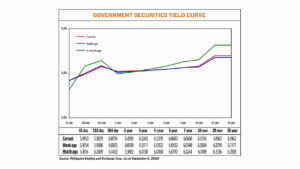
Yields on government securities (GS) ended mixed last week as the market mainly consolidated ahead of key US economic data and following slower-than-expected Philippine headline inflation in August.

GS yields, which move opposite to prices, inched up by 0.41 basis point (bp) on average week on week on Friday, according to PHP Bloomberg Valuation Service Reference Rates data published on the Philippine Dealing System’s website.

Yields on the short end of the curve dropped. Rates of the 91-, 182-, and 364-day Treasury bills (T-bills) slipped by 0.04 bp (to 5.9150%), 1.07 bps (to 5.9879%), and 0.91 bp (6.0734%) week on week, respectively.

At the belly, most tenors rallied except for the five-year bond, which saw its yield decline by 0.12 bp to 6.0420%. Rates of the two- three-, four-, and seven-year Treasury bonds (T-bonds) went up by 1.01 bps (to 6.0192%), 0.72 bp (6.0243%), 0.17 bp (6.0319%), and 0.08 bp (6.0606%) respectively.

Lastly, rates of all tenors at the long end rose. The 10-, 20-, and 25-year debt papers saw their yields increase by 0.67 bp (to 6.0761%), 2.03 bps (6.1962%), and 1.96 bps (6.1967%) respectively.

GS volume traded was at P30.76 billion on Friday, higher than the P16.01 billion recorded a week earlier.

“Despite well-subscribed T-bills and 20-year bond auctions and a better-than-expected inflation print, yields were consolidating last week as the market was focused on US numbers and anticipation of a Federal Reserve action by the middle of this month,” Security Bank Corp. Chief Investment Officer for Trust and Asset Management Group Noel S. Reyes said in an e-mail.

Mr. Reyes said US economic data released last week, including reports on manufacturing and employment, pointed to an “increased dovish bias for the Fed, fueling further division about how much the Fed will cut (25 bps or 50 bps).”

“A 50-bp cut may lead market to believe the Fed is behind the curve, hence the caution last week. The market did see pockets of buying when yields went up midweek, but still not enough to stir a rally given the focus on the US economy and the Fed’s possible action. Overall, week on week, yields were up 1-3 bps,” he added.

US employment increased less than expected in August, but a drop in the jobless rate to 4.2% suggested the labor market was not falling off the cliff to warrant a half-point interest rate cut from the Federal Reserve this month, Reuters reported.

The closely watched employment report from the Labor department on Friday also showed solid wage growth last month, which should help to support consumer spending and keep the economy out of recession for now. Nonetheless, labor market momentum has slowed, with 86,000 fewer jobs added in June and July than previously reported.

The report led to a chorus of Fed officials declaring that the US central bank was ready to start cutting rates at its policy meeting in about two weeks. Higher borrowing costs are curbing overall demand in the economy.

Nonfarm payrolls increased by 142,000 jobs last month after a downwardly revised 89,000 rise in July, which was the smallest gain since an outright decline in December 2020, the Labor department’s Bureau of Labor Statistics said. Economists polled by Reuters had forecast payrolls increasing by 160,000 jobs after a previously reported 114,000 gain in July.

June payrolls were revised down by 61,000 jobs to 118,000. The slowdown in employment growth is coming from a step-down in hiring. Layoffs remain at historic low levels.

In addition to waning demand evident in declining job openings, the below-expectations rise in employment last month likely reflected a seasonal quirk, characterized by a tendency for August payrolls to initially print lower relative to the consensus estimate before being revised higher later.

Financial markets initially raised the chances of a half-point rate cut at the Fed’s Sept. 17-18 policy meeting to above 50% before slashing them to 25%, CME Group’s FedWatch Tool showed. The odds of a 25-bp rate reduction increased to 75% from 57% earlier.

Fed Governor Christopher Waller said on Friday “the time has come” for the central bank to begin a series of interest rate cuts this month, adding “if the data suggests the need for larger cuts, then I will support that as well.”

The Fed has maintained its policy rate in the current 5.25%-5.5% range for more than a year, having raised it by 525 bps in 2022 and 2023.

Meanwhile, Philippine headline inflation eased to a seven-month low of 3.3% in August from 4.4% in July and 5.3% in the same month a year ago, the government reported on Thursday.

This was within the Bangko Sentral ng Pilipinas’ (BSP) 3.2-4% forecast for the month and was well below the 3.7% median estimate in a BusinessWorld poll of 15 analysts.

“With August inflation lower than expected at 3.3%, prospects of another 25-bp cut before the end of the year is likely,” Jonathan L. Ravelas, senior adviser at professional service firm Reyes Tacandong & Co., said in a Viber message.

The BSP on Aug. 15 reduced its policy rate by 25 bps to 6.25%, marking its first easing move in nearly four years.

BSP Governor Eli M. Remolona, Jr. has said they could cut rates by another 25 bps within the year. The Monetary Board’s last two policy-setting meetings this year are on Oct. 17 and Dec. 19.

For this week, both Mr. Reyes and Mr. Ravelas said GS yields could move sideways amid a lack of leads.

“All eyes will focus on the US CPI (consumer price index) midweek since there are not much economic data coming out in the Philippines. Expectations are for a low print, which should intensify talks of how much the Fed cuts…,” Mr. Reyes said.

US consumer inflation data will be released on Sept. 11 (Wednesday).

Local GS yields may remain range-bound before the Fed’s policy review next week, he added. — P.O.A. Montalvo with Reuters

Posts navigation

Older posts
Newer posts

Recent Posts

  • Ask Your Advisor: How do I gain exposure to gold?
  • Stock Market Weekly: Iffy negotiations
  • Metrobank US-Iran Risk Index: No time to settle down
  • Investment Ideas: March 30, 2026
  • Peso GS Weekly: Yields recede amid BSP’s pause

Recent Comments

No comments to show.

Archives

  • March 2026
  • February 2026
  • January 2026
  • December 2025
  • November 2025
  • October 2025
  • September 2025
  • August 2025
  • July 2025
  • June 2025
  • May 2025
  • April 2025
  • March 2025
  • February 2025
  • January 2025
  • December 2024
  • November 2024
  • October 2024
  • September 2024
  • August 2024
  • July 2024
  • June 2024
  • May 2024
  • April 2024
  • March 2024
  • February 2024
  • January 2024
  • December 2023
  • November 2023
  • October 2023
  • September 2023
  • August 2023
  • July 2023
  • June 2023
  • May 2023
  • April 2023
  • March 2023
  • February 2023
  • January 2023
  • December 2022
  • November 2022
  • October 2022
  • September 2022
  • August 2022
  • July 2022
  • June 2022
  • May 2022
  • March 2022
  • December 2021
  • October 2021

Categories

  • Bonds
  • BusinessWorld
  • Currencies
  • Economy
  • Equities
  • Estate Planning
  • Explainer
  • Featured Insight
  • Fine Living
  • How To
  • Investment Tips
  • Markets
  • Portfolio Picks
  • Rates & Bonds
  • Retirement
  • Reuters
  • Spotlight
  • Stocks
  • Uncategorized

You are leaving Metrobank Wealth Insights

Please be aware that the external site policies may differ from our website Terms And Conditions and Privacy Policy. The next site will be opened in a new browser window or tab.

Cancel Proceed
Get in Touch

For inquiries, please call our Metrobank Contact Center at (02) 88-700-700 (domestic toll-free 1-800-1888-5775) or send an e-mail to customercare@metrobank.com.ph

Metrobank is regulated by the Bangko Sentral ng Pilipinas
Website: https://www.bsp.gov.ph

Quick Links
The Gist Webinars Wealth Manager Explainers
Markets
Currencies Rates & Bonds Equities Economy
Wealth
Investment Tips Fine Living Retirement
Portfolio Picks
Bonds Stocks
Others
Contact Us Privacy Notice Terms of Use
© 2026 Metrobank. All rights reserved.

Access this content:

If you are an existing investor, log in first to your Metrobank Wealth Manager account. ​

If you wish to start your wealth journey with us, click the “How To Sign Up” button. ​

Login HOW TO SIGN UP