





MODEL PORTFOLIO
THE GIST
NEWS AND FEATURES
Global Philippines Fine Living
INSIGHTS
INVESTMENT STRATEGY
Economy Stocks Bonds Currencies
THE BASICS
Investment Tips Explainers Retirement
WEBINARS
2024 Mid-Year Economi Briefing, economic growth in the Philippines
2024 Mid-Year Economic Briefing: Navigating the Easing Cycle
June 21, 2024
Investing with Love
Investing with Love: A Mother’s Guide to Putting Money to Work
May 15, 2024
retirement-ss-3
Investor Series: An Introduction to Estate Planning
September 1, 2023
View All Webinars
DOWNLOADS
Container ship carrying container boxes import export dock with quay crane. Business commercial trade global cargo freight shipping logistic and transportation worldwide oversea concept. Generative AI
Economic Updates
Philippines Trade Update: Wider deficit on strong imports
DOWNLOAD
Frick collection with palm trees 
Economic Updates
Policy Rate Updates: Policy rate updates to reassure 
DOWNLOAD
Man using his smartphone
Reports
Fed to cut just once 
DOWNLOAD
View all Reports
Metrobank.com.ph How To Sign Up
Follow us on our platforms.

How may we help you?

TOP SEARCHES
  • Where to put my investments
  • Reports about the pandemic and economy
  • Metrobank
  • Webinars
  • Economy
TRENDING ARTICLES
  • Investing for Beginners: Following your PATH
  • On government debt thresholds: How much is too much?
  • Philippines Stock Market Outlook for 2022
  • Deficit spending remains unabated

Login

Access Exclusive Content
Login to Wealth Manager
Visit us at metrobank.com.ph How To Sign Up
Access Exclusive Content Login to Wealth Manager
Search
MODEL PORTFOLIO THE GIST
NEWS AND FEATURES
Global Philippines Fine Living
INSIGHTS
INVESTMENT STRATEGY
Economy Stocks Bonds Currencies
THE BASICS
Investment Tips Explainers Retirement
WEBINARS
2024 Mid-Year Economi Briefing, economic growth in the Philippines
2024 Mid-Year Economic Briefing: Navigating the Easing Cycle
June 21, 2024
Investing with Love
Investing with Love: A Mother’s Guide to Putting Money to Work
May 15, 2024
retirement-ss-3
Investor Series: An Introduction to Estate Planning
September 1, 2023
View All Webinars
DOWNLOADS
Container ship carrying container boxes import export dock with quay crane. Business commercial trade global cargo freight shipping logistic and transportation worldwide oversea concept. Generative AI
Economic Updates
Philippines Trade Update: Wider deficit on strong imports
March 27, 2026 DOWNLOAD
Frick collection with palm trees 
Economic Updates
Policy Rate Updates: Policy rate updates to reassure 
March 26, 2026 DOWNLOAD
Man using his smartphone
Reports
Fed to cut just once 
March 19, 2026 DOWNLOAD
View all Reports

Archives: Business World Article

Agencies’ incomplete documents delay PPP projects — NEDA chief

Agencies’ incomplete documents delay PPP projects — NEDA chief

Many public-private partnership (PPP) projects face delays in approval because implementing agencies fail to complete the requirements, the National Economic and Development Authority (NEDA) said.

“The causes of delays are incomplete submissions of implementing agencies. It’s not NEDA. We are an easy recipient of the blame because we are the reviewers,” NEDA Secretary Arsenio M. Balisacan told the Senate Finance Committee on Wednesday.

This came after Senate Finance Committee Chair Mary Grace Natividad S. Poe-Llamanzares noted that the NEDA is often blamed for delays in PPP project implementation.

“Oftentimes there are many good PPP project proposals, but there’s a bottleneck in the NEDA. And some of them are pretty obvious like airport development, but the NEDA is pointed out for being slow,” she said in mixed English and Filipino.

The Philippine government is banking on PPP projects to implement its “Build Better More” infrastructure program, given the tight fiscal space.

However, Mr. Balisacan said implementing agencies should make sure they have completed staff work on PPP projects before submitting them to the NEDA.

“We cannot bring those projects to the NEDA Board, chaired by the President, with incomplete staff work. So, our appeal to the project proponents is to complete the proposal before you bring it in because it will only be delayed,” he said in mixed English and Filipino.

Mr. Balisacan said proponent agencies are required to submit a feasibility study for the project.

“If the feasibility study doesn’t provide the information that we are looking for, then there is no way we can advise the President whether this project is economically beneficial or not,” he said.

“Because at the end, at NEDA, what we are tasked to do is to assure the taxpayers that the projects that we approve will yield benefits that are greater than the cost.”

Under Republic Act No. 11966 or the PPP Code, PPP projects above the P15-billion threshold will still be submitted to the NEDA Board, while those below the threshold that do not require government subsidy will be sent to the implementing agency.

Projects that require government subsidy must be sent to the NEDA-Investment Coordination Committee (ICC), while local projects go under their respective councils.

All PPP proposals to the government must be approved within 120 days.

There are 164 PPP projects in the pipeline valued at PHP 3.2 trillion, latest data from the PPP Center showed. Of the total, 90 are solicited projects, while 74 are unsolicited.

Nigel Paul C. Villarete, senior adviser on PPP at the technical advisory group Libra Konsult, Inc., said that PPP projects are usually delayed due to rushed submissions and changes in leadership.

“Oftentimes, they (agencies) resort to shortcuts, resulting in missing documents, some of which are important and crucial, thus causing delays,” he said in a Viber message.

“PPPs usually are huge multi-year projects which cut across government’s six-year and three-year terms, oftentimes involving changes in project leaderships. More often than not, the new project managers are not familiar with the projects,” he added.

Mr. Villarete cited the need for a special interagency monitoring unit with long-term officials who could provide a “historical cross-administration” assessment of PPP projects.

Meanwhile, the Surallah-T’Boli-San Jose Road in South Cotabato was the latest project added to the list of completed infrastructure flagship projects (IFPs) since the beginning of the Marcos administration, Mr. Balisacan told the hearing.

The Flood Risk Improvement and Management Project for the Cagayan de Oro River was also completed this year, Mr. Balisacan said. Both completed in 2023 were the Samar Pacific Coastal Road Project and the Integrated Disaster Risk Reduction and Climate Change Adaptation Measures in Pampanga Bay Project. 

The government’s pipeline has 186 IFPs with a projected total cost of PHP 9.6 trillion. — Beatriz Marie D. Cruz

Peso down as CPI data dash hopes of big Fed cut

Peso down as CPI data dash hopes of big Fed cut

The peso depreciated against the dollar on Thursday after a surprise uptick in core US inflation for August dampened hopes for a big rate cut from the US Federal Reserve next week.

The local unit closed at PHP 56.20 per dollar on Thursday, weakening by 22.5 centavos from its PHP 55.975 finish on Wednesday, Bankers Association of the Philippines data showed.

The peso opened Thursday’s session weaker at PHP 56.08 against the dollar. Its worst showing was at its close of PHP 56.20, while its intraday best was at PHP 55.96.

Dollars exchanged went down to USD 1.696 billion on Thursday from USD 1.71 billion on Wednesday.

“The peso [closed at] the PHP 56 level after the surprise uptick in the monthly growth in US core inflation tempered expectations of a strong Fed policy rate cut next week,” a trader said in an e-mail.

US consumer prices rose slightly in August, but underlying inflation showed some stickiness amid higher costs for housing and other services, further dashing hopes of a half-point interest rate cut from the Federal Reserve next week, Reuters reported.

The mixed inflation report from the Labor department on Wednesday followed data last week showing the labor market still cooling in an orderly fashion in August, defying fears of a sharp deterioration, with the unemployment rate retreating from a near three-year high touched in July.

The consumer price index (CPI) increased 0.2% last month after rising by a similar margin in July, the Labor department’s Bureau of Labor Statistics said. The rise in the CPI was in line with economists’ expectations.

In the 12 months through August, the CPI advanced 2.5%. That was the smallest year-on-year rise since February 2021 and followed a 2.9% increase in July.

Financial markets saw a roughly 15% probability of a 50-basis-point (bp) rate cut at the Fed’s Sept. 17-18 policy meeting, down from 29% before the CPI data were published, according to CME Group’s FedWatch Tool. The odds of a quarter-point rate reduction were around 85%, up from 71% earlier.

The central bank has maintained its benchmark overnight interest rate in the current 5.25%-5.50% range for a year, having raised it by 525 bps in 2022 and 2023.

Excluding the volatile food and energy components, the CPI climbed 0.3% in August after rising 0.2% in July. The so-called core CPI, seen as a measure of underlying inflation, was boosted by a 0.5% rise in shelter, which includes rents and hotel and motel accommodation, after advancing 0.4% in July.

In the 12 months through August, the core CPI increased 3.2%. Core inflation rose by the same margin in July. It increased at a 2.1% rate in the last three months.

The peso was also dragged down by demand for the dollar amid the seasonal increase in imports, Rizal Commercial Banking Corp. Chief Economist Michael L. Ricafort added.

For Friday, the trader said the peso could rebound against the greenback amid a potentially weaker US producer inflation report.

The trader sees the peso moving between PHP 56 and PHP 56.25 per dollar on Friday, while Mr. Ricafort expects it to range from PHP 56.10 to PHP 56.30. — AMCS with Reuters

PSEi ends at 7,000 level as Fed rate cut looms

PSEi ends at 7,000 level as Fed rate cut looms

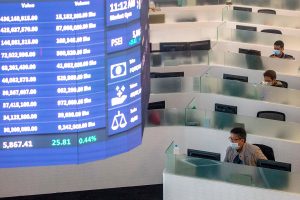
The main index on Thursday closed above 7,000 for the first time since February 2023 as August US consumer inflation data bolstered expectations of a US Federal Reserve rate cut next week and amid strong foreign buying.

The Philippine Stock Exchange index (PSEi) rose by 1.14% or 79.79 points to end at 7,024.67 on Thursday, while the broader all shares index went up by 0.67% or 25.44 to close at 3,791.65. This was the PSEi’s best finish and was the first time it closed at the 7,000 level since it ended at 7,027.38 on Feb. 3, 2023.

“The PSEi finally closed above the 7,000 level for the first time in more than 19 months as investors reacted to a relatively favorable US August headline inflation print as well as an overnight tech-driven rally in US stock markets,” Juan Paolo E. Colet, managing director at Chinabank Capital Corp., said in a Viber message.

“The index was finally able to breach its key resistance at 7,000 after US inflation fell to its lowest level since February 2021, strengthening the case for a Fed rate cut next week,” AP Securities, Inc. Research Head Alfred Benjamin R. Garcia added in a Viber message.

The US consumer price index (CPI) increased 0.2% last month after rising by a similar margin in July, the Labor department’s Bureau of Labor Statistics said, Reuters reported. The rise in the CPI was in line with economists’ expectations.

In the 12 months through August, the CPI advanced 2.5%. That was the smallest year-on-year rise since February 2021 and followed a 2.9% increase in July.

Financial markets saw a roughly 15% probability of a 50-basis-point rate cut at the Fed’s Sept. 17-18 policy meeting, down from 29% before the CPI data was published, according to CME Group’s FedWatch Tool. The odds of a quarter-point rate reduction were around 85%, up from 71% earlier.

Philippine stocks climbed amid “a wave of foreign buying interest,” AB Capital Securities, Inc. Vice-President Jovis L. Vistan said in a Viber message.

Net foreign buying rose to PHP 348.48 million on Thursday from PHP 340.59 million on Wednesday.

All sectoral indices rose on Thursday. Property climbed by 1.4% or 39.12 points to 2,829.83; services rose by 1.28% or 28.53 points to 2,248.74; holding firms went up by 1.16% or 67.69 points to 5,875.02; industrials added 0.63% or 58.92 points to end at 9,301.64; financials gained 0.58% or 12.53 points to close at 2,157.59; and mining and oil increased by 0.35% or 27.56 points to 7,832.18.

Value turnover went down to PHP 5.46 billion on Thursday with 1.05 billion shares changing hands from the PHP 8.02 billion with 926.84 million shares traded on Wednesday.

Decliners outnumbered advancers, 107 versus 90, while 60 names closed unchanged.

“We’re fairly confident that the index will be able to hold above this level, especially with corporate fundamentals and macroeconomic indicators looking good so far,” Mr. Garcia said.

“If the 7,000 breakout is sustained in the next few days, the market may attempt to hurdle the next resistance at 7,100,” Mr. Colet added. — S.J. Talavera with Reuters

Term deposit yields decline as inflation eases to 7-month low

Term deposit yields decline as inflation eases to 7-month low

Yields on the term deposits of the Bangko Sentral ng Pilipinas (BSP) declined on Wednesday following slower-than-expected headline inflation in August.

Demand for the central bank’s term deposit facility (TDF) amounted to PHP 218.169 billion on Wednesday, above the P200-billion offering. However, this was below the PHP 239.937 billion in bids for a PHP 220-billion offer last week.

Broken down, tenders for the seven-day papers reached PHP 132.746 billion, higher than the PHP 100 billion on the auction block. This was also above the PHP 127.29 billion in bids for a PHP 120-billion offering seen the previous week.

Banks asked for yields ranging from 6.23% to 6.3155%, a wider and lower band compared with the 6.2475% to 6.35% seen a week ago. With this, the average rate of the one-week term deposits went down by 0.66 basis point (bp) to 6.3028% from 6.3094% previously.

Meanwhile, the 14-day papers fetched bids amounting to PHP 85.423 billion, below the PHP 100-billion offer and the PHP 112.648 billion in tenders for the same volume auctioned off last week.

Accepted rates for the tenor were from 6.25% to 6.455%, lower than the 6.285% to 6.465% range seen last week. This caused the average rate of the two-week papers to inch down by 0.11 bp to 6.3776% from 6.3787% in the prior auction.

The central bank has not offered 28-day term deposits for nearly four years to give way to its weekly auctions of securities with the same tenor.

The term deposits and 28-day bills are used by the BSP to mop up excess liquidity in the financial system and to better guide market rates.

“BSP TDF average auction yields slightly eased week on week after the latest inflation data,” Rizal Commercial Banking Corp. Chief Economist Michael L. Ricafort said in a Viber message.

Mr. Ricafort said the lower inflation print could support further rate cuts from the BSP in the coming months, which would match the expected reductions by the US Federal Reserve.

Headline inflation eased to a seven-month low of 3.3% in August from 4.4% in July and 5.3% in the same month a year ago, the Philippine Statistics Authority reported last week. This was within the BSP’s 3.2-4% forecast for the month and was well below the 3.7% median estimate in a BusinessWorld poll of 15 analysts.

The Monetary Board on Aug. 15 reduced its policy rate by 25 bps to 6.25%, its first easing move in nearly four years. Prior to the cut, the BSP kept its policy rate at an over 17-year high of 6.5% for six straight meetings following cumulative hikes worth 450 bps between May 2022 and October 2023 to rein in inflation.

BSP Governor Eli M. Remolona, Jr. has said they could cut rates by another 25 bps within the year. The Monetary Board’s last two policy-setting meetings this year are on Oct. 17 and Dec. 19.

Meanwhile, the Fed is widely expected to begin its easing cycle at its Sept. 17-18 policy meeting, with markets pricing in a 25-bp cut at the review and 100 bps in reductions for this year. The US central bank has kept the federal fund target rate at 5.25%-5.5% range following increases worth 525 bps from March 2022 to July 2023. — B.M.D. Cruz

Philippine banks’ assets rise to PHP 25.93 trillion at end-July

Philippine banks’ assets rise to PHP 25.93 trillion at end-July

The Philippine banking industry’s assets jumped by 12.24% year on year as of end-July, Bangko Sentral ng Pilipinas (BSP) data showed.

Lenders’ combined assets increased to P25.93 trillion at end-July from P23.10 trillion a year prior, according to preliminary BSP data posted on its website.

However, this inched down by 0.998% from the P26.19 trillion recorded as of end-June.

Banks’ assets are mainly supported by deposits, loans, and investments. These include cash and due from banks as well as interbank loans receivable (IBL) and reverse repurchase (RRP), net of allowances for credit losses.

“The latest increase in banks’ total assets could be largely attributed to the faster, double-digit growth in banks loans, continued growth in bank deposits, and earnings growth that also added to banks’ capitalization,” Rizal Commercial Banking Corp. Chief Economist Michael L. Ricafort said in a Viber message.

Broken down, the banking sector’s total loan portfolio inclusive of IBL and RRP climbed by 10.95% to PHP 13.73 trillion as of end-July from PHP 12.37 trillion in the previous year.

Net investments, or financial assets and equity investments in subsidiaries, increased by 12.53% to PHP 7.69 trillion from PHP 6.83 trillion a year ago.

Meanwhile, cash and due from banks stood at PHP 2.46 trillion as of end-July, inching down by 0.99% from PHP 2.48 trillion a year earlier.

Net real and other properties acquired increased by 4.04% to PHP 110.11 billion from PHP 105.83 billion a year ago.

Banks’ other assets surged by 48.74% to PHP 1.95 trillion from PHP 1.31 trillion a year earlier.

On the other hand, the total liabilities of the banking system rose by 12.53% to PHP 22.71 trillion at end-July from PHP 20.18 trillion in the comparable year-ago period.

This was mainly driven by the 9.43% increase in deposit liabilities to PHP 19.27 trillion from PHP 17.61 trillion a year prior.

The Philippine banking system’s combined net income stood at PHP 190.26 billion in the first half, rising by 4.1% from PHP 182.76 billion a year prior, latest data from the central bank showed.

Mr. Ricafort said banks could see faster asset growth moving forward as the BSP is expected to cut benchmark interest rates further, which could boost lending, trading gains and other investment income.

The Monetary Board last month cut benchmark interest rates for the first time in almost four years amid an improving inflation and economic outlook, with its governor signaling at least one more reduction before the end of the year.

The Monetary Board on Aug. 15 reduced its policy rate by 25 basis points (bps) to 6.25% from a 17-year high of 6.5%.

BSP Governor Eli M. Remolona, Jr. said they could cut rates by another 25 bps within the year. The Monetary Board’s last two policy-setting meetings this year are on Oct. 17 and Dec. 19. — A.M.C. Sy

Peso surges vs dollar ahead of US inflation data

Peso surges vs dollar ahead of US inflation data

The peso returned to the PHP 55-per-dollar mark anew on Wednesday on expectations of slower US consumer inflation in August, which would give the US Federal Reserve confidence to proceed with its planned rate cut this month.

The local unit closed at PHP 55.975 per dollar on Wednesday, strengthening by 41 centavos from its PHP 56.385 finish on Tuesday, Bankers Association of the Philippines data showed.

The peso last ended at the PHP 55 level on Friday, finishing at a near six-month high of PHP 55.905 against the greenback.

The local unit opened Wednesday’s session at PHP 56.35 against the dollar, which was already its worst showing. Its intraday best was at PHP 55.935 versus the greenback.

Dollars exchanged rose to USD 1.71 billion on Wednesday from USD 1.57 billion on Tuesday.

The peso was supported by a generally weaker dollar on Wednesday amid expectations of easing inflation in the United States, Rizal Commercial Banking Corp. Chief Economist Michael L. Ricafort said in a Viber message.

“The dollar-peso pair traded lower on expectations of a lower consumer price index (CPI), elevating bets that the Fed will cut by 50 basis points (bps) at their September policy meeting,” a trader said by phone.

For Thursday, the trader sees the peso moving between PHP 55.80 and PHP 56.30 per dollar, while Mr. Ricafort expects it to range from PHP 55.90 to PHP 56.10.

The dollar fell to its lowest against the yen this year on Wednesday after investors upped the chances of Democrat Kamala Harris beating Republican rival Donald Trump in November’s presidential election after a scheduled debate, Reuters reported.

Traders were also awaiting a key US inflation report that could provide clues on how aggressively the Federal Reserve cuts rates next week. Wednesday’s CPI report is expected to show headline inflation rose 2.6% year on year in August, according to a Reuters poll, slowing from 2.9% in July.

The dollar dropped as much as 1.24% to 140.71 yen, a level not seen since Dec. 28, before trading at 141.16 yen. The dollar index — which measures the currency against six others — slipped 0.22% to 101.43 after rising to a one-week top at 101.77 on Tuesday.

Fed funds futures indicate a 63% chance of a standard 25-bp reduction, and a 37% chance of a super-sized 50-bp cut, according to the CME’s FedWatch tool. — AMCS with Reuters

Shares snap four-day climb before US CPI data

Shares snap four-day climb before US CPI data

Philippine shares ended their four-day rally on Wednesday due to weak data and as investors turned cautious before the release of the August US consumer price index (CPI) report overnight.

The benchmark Philippine Stock Exchange index (PSEi) fell by 0.56% or 39.75 points to end at 6,944.88, while the broader all shares index dropped by 0.53% or 20.09 points to close at 3,766.21.

“The local market succumbed to selling pressure this Wednesday after four days of rallying. Investors digested the widening of the Philippines’ balance of trade in goods deficit last July amid a tepid export performance, and the drop in its June foreign direct investment (FDI) net inflows,” Philstocks Financial, Inc. Senior Research Analyst Japhet Louis O. Tantiangco said in a Viber message.

The country’s trade-in-goods balance, or the difference between exports and imports, stood at a USD 4.87-billion deficit in July, wider by 18.05% from the USD 4.12-billion gap a year ago, according to preliminary data from the Philippine Statistics Authority. This was the widest monthly deficit since USD 5.02 billion in March 2023.

Meanwhile, FDI net inflows fell by 29% to USD 394 million in June from USD 555 million in the same period a year ago, preliminary data from the Bangko Sentral ng Pilipinas showed. This was the lowest monthly level seen in more than four years or since the USD 314 million recorded in April 2020.

“Philippine shares finally closed in the red after successive session of closing higher as investors collectively held their breath before the latest US CPI data,” Regina Capital Development Corp. Head of Sales Luis A. Limlingan said in a Viber message.

“US stocks ended mixed as investors awaited August’s consumer price index report on Wednesday and the producer price index on Thursday, both key to the Federal Reserve’s September rate decision. A rate cut is expected to ease economic concerns,” he added.

On Tuesday, the Dow Jones Industrial Average fell 92.63 points or 0.23% to 40,736.96; the S&P 500 climbed by 24.47 points or 0.45% to 5,495.52; and the Nasdaq Composite went up by 141.28 points or 0.84% to 17,025.88.

Back home, almost all sectoral indices closed lower on Wednesday. Property dropped by 2.49% or 71.28 points to 2,790.71; mining and oil declined by 1.1% or 87.27 points to 7,804.62; industrials went down by 0.4% or 37.95 points to 9,242.72; financials retreated by 0.36% or 7.86 points to 2,145.06; and holding firms decreased by 0.17% or 10.18 points to 5,807.33.

Services was the lone gainer, inching up by 0.02 points to end at 2,220.21.

Value turnover rose to PHP 8.02 billion on Wednesday with 926.84 million shares changing hands from the PHP 7.26 billion with 776.85 million shares traded on Tuesday.

Decliners outnumbered advancers, 131 versus 66, while 47 names closed unchanged.

Net foreign buying went down to PHP 340.59 million on Wednesday from PHP 759.26 million on Tuesday. — Revin Mikhael D. Ochave


June FDI net inflows at four-year low

June FDI net inflows at four-year low

Philippine foreign direct investment (FDI) net inflows sank to an over four-year low in June amid lower placements across all instruments, the Bangko Sentral ng Pilipinas (BSP) reported on Tuesday.

The inflows fell by 29% to USD 394 million from USD 555 million a year ago, preliminary data from the BSP showed.

Month on month, net inflows dropped by 27.55% from USD 510 million in May.

Net Foreign Direct Investment

June’s net inflow was the lowest level since the USD 314 million recorded in April 2020.

“The decline resulted from lower net inflows across all major FDI components,” the BSP said.

Nonresidents’ net investments in debt instruments declined by 30% year on year to USD 213 million in June from USD 304 million, central bank data showed. These consist mainly of intercompany borrowing or lending between foreign direct investors and their subsidiaries or affiliates in the Philippines.

Net investments in equity capital other than the reinvestment of earnings likewise went down by 33.2% to USD 74 million from USD 111 million a year ago.

Equity capital placements slid by 34.09% year on year to USD 87 million, while withdrawals dropped by 38.1% to USD 13 million.

Reinvestment of earnings also decreased by 23.4% to USD 107 million from USD 140 million a year ago, while investments in equity and investment fund shares dropped by 27.89% to USD 181 million.

By source, equity capital placements were mainly from Japan (47%), followed by the United States (15%), Sweden (14%) and Singapore (14%).

These were invested mainly in the manufacturing (48%), real estate (18%), wholesale and retail trade (16%) and financial and insurance (11%) sectors.

NET INFLOWS RISE IN FIRST HALF

Meanwhile, in the first semester, FDI net inflows increased by 7.9% to USD 4.4 billion from USD 4.1 billion a year earlier, BSP data showed.

Investments in equity and investment fund shares rose by 32.7% year on year to USD 1.71 billion in the January-to-June period.

Net foreign investments in equity capital surged by 62% to USD 1.197 billion in the six-month period. Placements went up by 57.9% to USD 1.158 billion and withdrawals rose by 41.5% to USD 261 million.

These placements mostly came from the United Kingdom (52%), followed by Japan (30%) and the United States (7%), and were mostly invested in the manufacturing (77%) and real estate (10%) industries.

Meanwhile, net investments in debt instruments went down by 3.4% to USD 2.725 billion in the first semester from USD 2.821 billion a year ago.

Reinvestment of earnings also dropped by 6.7% to USD 514 million.

FDI net inflows slumped in June due to elevated interest rates, as the market at that time was still uncertain about the start of the monetary easing cycles of both the BSP and US Federal Reserve, Rizal Commercial Banking Corp. Chief Economist Michael L. Ricafort said in a Viber message.

The Monetary Board on Aug. 15 reduced its policy rate by 25 basis points (bps) to 6.25%, its first easing move in nearly four years. Prior to the cut, the BSP kept its policy rate at an over 17-year high of 6.5% for six straight meetings following cumulative hikes worth 450 bps between May 2022 and October 2023 to rein in inflation.

BSP Governor Eli M. Remolona, Jr. has said they could cut rates by another 25 bps within the year. The Monetary Board’s last two policy-setting meetings this year are on Oct. 17 and Dec. 19.

Meanwhile, the Fed is widely expected to begin its easing cycle at its Sept. 17-18 policy meeting, with markets pricing in a 25-bp cut at the review and 100 bps in reductions for this year. The US central bank has kept the federal fund target rate at 5.25%-5.5% range following increases worth 525 bps from March 2022 to July 2023.

Still, FDI inflows grew year on year in the six months ending June as the Philippines posted robust economic growth last quarter compared with other countries in the region, Mr. Ricafort said.

Philippine gross domestic product (GDP) expanded by 6.3% in the second quarter, bringing first-half growth to 6% and meeting the low end of the government’s 6-7% target for the year.

At 6.3%, the Philippines’ GDP growth was the second-fastest in the April-to-June period, only behind Vietnam (6.9%). It was ahead of Malaysia (5.8%), Indonesia (5%) and China (4.7%).

“For the coming months, further cuts in BSP and Fed rates amid the easing inflation trend would further reduce borrowing costs that would help spur greater global investments, business, and other economic activities worldwide, which would thereby help boost FDIs,” Mr. Ricafort said.

“We expect [FDIs] to get better as we have seen so far this July-August, particularly, as BSP did a rate cut within the period mentioned,” Union Bank of the Philippines, Inc. Chief Economist Ruben Carlo O. Asuncion said in a Viber message.

The central bank expects to end 2024 with USD 9.5 billion in FDI net inflows. In 2023, net inflows fell by 6.6% year on year to USD 8.9 billion. – Aaron Michael C. Sy, Reporter

July trade gap widest in 16 months

July trade gap widest in 16 months

The Philippines in July posted its widest trade deficit since March 2023 as imports grew at their fastest clip in three months, outpacing the uptick in exports, the Philippine Statistics Authority (PSA) reported on Tuesday.

Preliminary data from the PSA showed that the country’s trade-in-goods balance — the difference between exports and imports — stood at a USD 4.87-billion deficit in July, 18.05% bigger than the USD 4.12-billion gap a year ago.

Month on month, the July trade gap also widened by 12.73% from the USD 4.32-billion deficit in June.

Philippine Merchandise Trade Performance (July 2024)

The July trade deficit was the widest monthly gap since USD 5.02 billion in March 2023.

Meanwhile, for the first seven months, the Philippines’ trade deficit narrowed by 5.78% to USD 29.91 billion from USD 31.75 billion a year ago.

The country’s balance of trade in goods has been in the red for 110 straight months (nine years) or since the USD 64.95-million surplus in May 2015.

In July, the value of imports increased by 7.2% year on year to USD 11.12 billion from USD 10.37 billion, which was the fastest rise since April’s 13%. This was also the highest import value since the USD 11.63 billion recorded in March 2023.

Month on month, imports jumped by 12.4%.

For the first seven months, imports declined by 1.04% annually to USD 72.57 billion.

Lower commodity prices in the global market made imports more attractive to local buyers, Rizal Commercial Banking Corp. Chief Economist Michael L. Ricafort said in a Viber message.

“The seasonal increase in importation activities in the third quarter, a consistent pattern seen for many years, could lead to a further pickup in imports,” he said, adding that the peso’s recent appreciation versus the dollar would make imports cheaper and exports more expensive.

After trading at the P58 level against the dollar and hitting 18-month lows in May due to uncertainty over the timing of interest rate cuts here and abroad, the peso has since recovered, closing at the P56 level at end-August and even returning to the P55 mark earlier this month.

Meanwhile, July exports inched up by 0.1% to USD 6.249 billion from USD 6.246 billion a year ago, marking the first annual growth since April’s 27.9%. Month on month, exports went up by 12.24%.

Year to date, exports have risen by an annual 2.59% to USD 42.66 billion.

Exports are unlikely to post “significant gains” for the rest of the year, Union Bank of the Philippines, Inc., Chief Economist Ruben Carlo O. Asuncion said in a Viber message.

“The sober export outlook in the second half of 2024 is against a backdrop of lackluster China growth and risk of slower prospects for developed markets that already prompted key central banks, led by the European Central Bank, Bank of England and Bank of Canada, to start dismantling their high interest rate structures to prioritize growth moving forward, likely to be followed by the US Federal Reserve,” Mr. Asuncion said.

The Development Budget Coordination Committee expects 5% and 2% growth in exports and imports, respectively, this year.

IMPORTS

In July, imports of raw materials and intermediate goods picked up by 13.31% to USD 4.22 billion, accounting for 38% of total imports for the month.

Imported capital goods rose by 9.52% to USD 3.29 billion making up 29.6% of the total. Imports of consumer goods increased by 3.11% to USD 2.13 billion for a 19% share.

By value, imports of electronic products were the highest at USD 2.53 billion in July, up by 11.84% from last year. They accounted for 22.8% of total imports.

These were followed by mineral fuels, lubricants and related materials at USD 1.44 billion (12.9%) and transport equipment at USD 1.03 billion (9.2%)

China was the biggest source of imports in July with a value of USD 3.08 billion, making up 27.7% of the total import bill.

It was followed by Indonesia with imports valued at USD 947.55 million (8.5%), Japan with USD 893.54 million (8%), South Korea with USD 810.32 million (7.3%) and the United States with USD 675.58 million (6.1%).

EXPORTS

Meanwhile, among major types of goods, exports of manufactured goods went down by 3.1% year on year to USD 4.98 billion in July, but still made up the bulk or 79.6% of the total.

On the other hand, exports of mineral products rose by 11.4% to USD 583.6 million.

By commodity group, exports of electronic goods dropped by 11.9% to USD 3.25 billion from USD 3.69 billion a year ago. Still, electronic products were the country’s top export in terms of value, accounting for 52.1% of the total.

Among electronic products, semiconductor exports dropped by 22.63% to USD 2.37 billion.

Electronic goods remained the Philippines’ top export amid the positive outlook for artificial intelligence and technology sector, Mr. Asuncion said.

“We have yet to see how demand for electronics will recover in the next coming months. The tech sector in the region and in other advanced countries would still need to do better,” he added.

Overall, the United States remained the top destination for Philippine-made goods in July, with exports valued at USD 1.06 million, making up 16.9% of the total for the month.

Japan was the second-biggest market for Philippine exports with a value of USD 872.43 million (14% share), followed by China with USD 791.29 million (12.7%), Hong Kong with USD 744.82 million (11.9%) and South Korea with USD 305.17 million (4.9%).

Other top export destinations for the month were Taiwan, Germany, Thailand, and the Netherlands. – Beatriz Marie D. Cruz, Reporter

Philippines may miss out on demographic dividend as job creation stays weak

Philippines may miss out on demographic dividend as job creation stays weak

The Philippines’ one-year high unemployment rate in July highlights the economy’s inability to absorb workers into the labor force, which may result in the country missing out on the benefits of its demographic “sweet spot,” analysts said.

“The high unemployment rate especially among the new entrants shows the weakness of the economy in absorbing greater numbers of workers into the labor market,” Economics professor at the Ateneo de Manila University Leonardo A. Lanzona, Jr. told BusinessWorld in a Facebook Messenger chat.

“As the country is about to complete its demographic transition, more and more people will be in their working ages,” he added. “If the country is able to handle this phase well, it would reap demographic dividends. However, the country seems to be at a loss in generating the beneficial effects of this development.”

The country’s unemployment rate rose to a one-year high of 4.7% in July as fresh graduates entered the workforce, the Philippine Statistics Authority (PSA) said on Friday.

Preliminary data from the PSA’s Labor Force Survey (LFS) showed the jobless rate picked up from a two-decade low of 3.1% in June and was the highest since the 4.9% recorded a year ago.

This translated to 2.38 million unemployed Filipinos in July, up by 755,000 from 1.62 million in June. Year on year, this went up by 86,000 from 2.29 million in July 2023.

PSA Undersecretary and National Statistician Claire Dennis S. Mapa on Friday said these new graduates could not find jobs in the market, with youth unemployment, or Filipinos aged 15 to 24 in the workforce, reaching 1.02 million, contributing 43% to the jobless rate.

The demographic dividend refers to “the accelerated economic growth that can result from a rapid decline in a country’s fertility and the subsequent change in the population age structure,” according to the World Bank.

“Demographic dividend corresponds to a 20–30-year period in a country’s demographic transition when the proportion of working age population compared to the number of dependents increases rapidly,” it said.

In November 2023, National Economic and Development Authority Secretary Arsenio M. Balisacan said the “demographic sweet spot” could contribute at least a percentage point increase to the country’s growth potential or prospects for the next two to three decades.

This “window of opportunity” has started for the Philippines, he said, as its working-age population is now growing faster than the overall population.

“At this period, savings rise and growth is felt, hence demographic dividends are earned. If we reach this phase, but if people are out of work, we will lose these dividends,” Mr. Lanzona said.

“One has to remember that this phase in our demographic transition happens only once, and if we fail to take advantage of this, we will miss our chance to escape the lower middle-income trap that we have been in for the last 40 years,” he added.

Federation of Free Workers President Jose Sonny G. Matula told BusinessWorld in a Viber message that the rise of joblessness is concerning, especially for those new to the workforce as “it reflects the challenges our economy continues to face despite recovery efforts.”

“The increase in joblessness is a signal that more needs to be done to create sustainable and decent jobs,” Mr. Matula said. “Structural issues in our economy, such as mismatched skills, limited job opportunities in certain sectors, and ongoing inflationary pressures, are contributing factors.”

Rising joblessness shows the need for immediate relief measures and long-term reforms to address the root causes of unemployment, he added.

University of the Philippines Diliman School of Labor and Industrial Relations Assistant Professor Benjamin B. Velasco added that the country’s low labor force participation rate (LFPR) also shows that the government needs to do its part in providing more jobs for its working-age population.

The LFPR declined to 63.5% in July from 66% in June.

“With the private sector unable to provide quality jobs, the government has to step in, possibly through a jobs guarantee program, where it provides meaningful, quality jobs in sectors that the private sector does not find profitable. One is climate mitigation, like reforestation or river cleanup,” Mr. Velasco said in a Facebook Messenger chat.

JOB-SKILLS MISMATCH

For his part, Technical Education and Skills Development Authority (TESDA) Director-General Jose Francisco B. Benitez said addressing the education crisis is key to reaping the potential benefits of the country’s demographic transition,

“We should bridge them (workforce entrants) to a better pathway. The demographic dividend is real, but with the ongoing education crisis, it’s concerning. We really need to address it,” Mr. Benitez told BusinessWorld in mixed English and Filipino on the sidelines of an event on Tuesday.

“Compared to the Commission on Higher Education or even the Department of Education, TESDA has a faster response time because our courses are shorter. So, TESDA should also quickly provide the right kind of programs and assistance, particularly in empowering the youth,” he added.

TESDA is working to ensure that senior high school students who choose technical-vocation tracks have an apprenticeship pathway, Mr. Benitez said.

“If we can generate proper labor intelligence on a local level, then we can help those looking for a job or who might have a mismatch to have opportunities to gain the skills necessary to bridge that gap,” he added. “The kind of jobs required must come from the industry itself, including the specific skills they are seeking in order to provide employment to our fellow citizens.”

GREEN JOBS

Mr. Matula said he hopes the full implementation of the government’s Trabaho Para sa Bayan plan, which is a 10-year employment roadmap, and the Green Jobs Act would help boost job creation in the country.

“The landscape of green jobs in the Philippines is expanding, driven by national policies and international cooperation aimed at promoting sustainable development,” he said.

Mr. Matula cited a study by TESDA, which said the green job market is expected to generate about 5.10 million positions by next year, spanning sectors such as renewable energy, agriculture, waste management, and construction.

The Department of Labor and Employment (DoLE), he added, is actively conducting consultations and mapping projects to identify and promote green jobs in key sectors, such as energy, manufacturing, and tourism.

“DoLE needs to focus on programs that upskill and reskill workers to match the demands of growing industries, enhance labor market programs, and strengthen support for small and medium enterprises, which are the backbone of our job market,” Mr. Matula added. – Chloe Mari A. Hufana, Reporter

Posts navigation

Older posts
Newer posts

Recent Posts

  • Ask Your Advisor: How do I gain exposure to gold?
  • Stock Market Weekly: Iffy negotiations
  • Metrobank US-Iran Risk Index: No time to settle down
  • Investment Ideas: March 30, 2026
  • Peso GS Weekly: Yields recede amid BSP’s pause

Recent Comments

No comments to show.

Archives

  • March 2026
  • February 2026
  • January 2026
  • December 2025
  • November 2025
  • October 2025
  • September 2025
  • August 2025
  • July 2025
  • June 2025
  • May 2025
  • April 2025
  • March 2025
  • February 2025
  • January 2025
  • December 2024
  • November 2024
  • October 2024
  • September 2024
  • August 2024
  • July 2024
  • June 2024
  • May 2024
  • April 2024
  • March 2024
  • February 2024
  • January 2024
  • December 2023
  • November 2023
  • October 2023
  • September 2023
  • August 2023
  • July 2023
  • June 2023
  • May 2023
  • April 2023
  • March 2023
  • February 2023
  • January 2023
  • December 2022
  • November 2022
  • October 2022
  • September 2022
  • August 2022
  • July 2022
  • June 2022
  • May 2022
  • March 2022
  • December 2021
  • October 2021

Categories

  • Bonds
  • BusinessWorld
  • Currencies
  • Economy
  • Equities
  • Estate Planning
  • Explainer
  • Featured Insight
  • Fine Living
  • How To
  • Investment Tips
  • Markets
  • Portfolio Picks
  • Rates & Bonds
  • Retirement
  • Reuters
  • Spotlight
  • Stocks
  • Uncategorized

You are leaving Metrobank Wealth Insights

Please be aware that the external site policies may differ from our website Terms And Conditions and Privacy Policy. The next site will be opened in a new browser window or tab.

Cancel Proceed
Get in Touch

For inquiries, please call our Metrobank Contact Center at (02) 88-700-700 (domestic toll-free 1-800-1888-5775) or send an e-mail to customercare@metrobank.com.ph

Metrobank is regulated by the Bangko Sentral ng Pilipinas
Website: https://www.bsp.gov.ph

Quick Links
The Gist Webinars Wealth Manager Explainers
Markets
Currencies Rates & Bonds Equities Economy
Wealth
Investment Tips Fine Living Retirement
Portfolio Picks
Bonds Stocks
Others
Contact Us Privacy Notice Terms of Use
© 2026 Metrobank. All rights reserved.

Access this content:

If you are an existing investor, log in first to your Metrobank Wealth Manager account. ​

If you wish to start your wealth journey with us, click the “How To Sign Up” button. ​

Login HOW TO SIGN UP