MODEL PORTFOLIO
THE GIST
NEWS AND FEATURES
Global Philippines Fine Living
INSIGHTS
INVESTMENT STRATEGY
Economy Stocks Bonds Currencies
THE BASICS
Investment Tips Explainers Retirement
WEBINARS
2024 Mid-Year Economi Briefing, economic growth in the Philippines
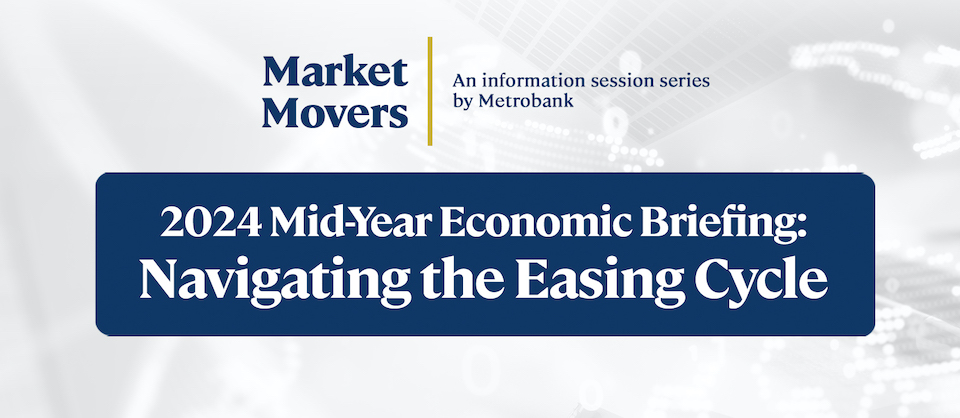
2024 Mid-Year Economic Briefing: Navigating the Easing Cycle
June 21, 2024
Investing with Love
Investing with Love: A Mother’s Guide to Putting Money to Work
May 15, 2024
retirement-ss-3
Investor Series: An Introduction to Estate Planning
September 1, 2023
View All Webinars
DOWNLOADS
Container ship carrying container boxes import export dock with quay crane. Business commercial trade global cargo freight shipping logistic and transportation worldwide oversea concept. Generative AI
Economic Updates
Philippines Trade Update: Wider deficit on strong imports
DOWNLOAD
Frick collection with palm trees 
Economic Updates
Policy Rate Updates: Policy rate updates to reassure 
DOWNLOAD
Man using his smartphone
Reports
Fed to cut just once 
DOWNLOAD
View all Reports
Metrobank.com.ph How To Sign Up
Follow us on our platforms.

How may we help you?

TOP SEARCHES
  • Where to put my investments
  • Reports about the pandemic and economy
  • Metrobank
  • Webinars
  • Economy
TRENDING ARTICLES
  • Investing for Beginners: Following your PATH
  • On government debt thresholds: How much is too much?
  • Philippines Stock Market Outlook for 2022
  • Deficit spending remains unabated

Login

Access Exclusive Content
Login to Wealth Manager
Visit us at metrobank.com.ph How To Sign Up
Access Exclusive Content Login to Wealth Manager
Search
MODEL PORTFOLIO THE GIST
NEWS AND FEATURES
Global Philippines Fine Living
INSIGHTS
INVESTMENT STRATEGY
Economy Stocks Bonds Currencies
THE BASICS
Investment Tips Explainers Retirement
WEBINARS
2024 Mid-Year Economi Briefing, economic growth in the Philippines
2024 Mid-Year Economic Briefing: Navigating the Easing Cycle
June 21, 2024
Investing with Love
Investing with Love: A Mother’s Guide to Putting Money to Work
May 15, 2024
retirement-ss-3
Investor Series: An Introduction to Estate Planning
September 1, 2023
View All Webinars
DOWNLOADS
Container ship carrying container boxes import export dock with quay crane. Business commercial trade global cargo freight shipping logistic and transportation worldwide oversea concept. Generative AI
Economic Updates
Philippines Trade Update: Wider deficit on strong imports
March 27, 2026 DOWNLOAD
Frick collection with palm trees 
Economic Updates
Policy Rate Updates: Policy rate updates to reassure 
March 26, 2026 DOWNLOAD
Man using his smartphone
Reports
Fed to cut just once 
March 19, 2026 DOWNLOAD
View all Reports

Archives: Business World Article

PSEi drops on profit taking as Fed rate cut looms

PSEi drops on profit taking as Fed rate cut looms

Philippine stocks closed lower Wednesday due to last-minute profit-taking as the market awaited the US Federal Reserve’s policy decision.

The benchmark Philippine Stock Exchange index (PSEi) slipped by 0.27% or 19.46 points to end at 7,155.90 on Wednesday, while the broader all shares index declined by 0.05% or 2.21 points to close at 3,847.96.

The PSEi climbed to as high as 7,219.17 intraday, but investors pocketed some of their profits, causing the index to end lower compared to Tuesday’s close.

“Last-minute profit-taking sent the local market lower this Wednesday. Investors booked gains following the bourse’s two-day rally,” Philstocks Financial, Inc. Senior Research Analyst Japhet Louis O. Tantiangco said in a Viber message. “Investors also took a cautious stance while waiting for the Fed’s policy decision.”

“The PSEi snapped its two-day winning streak as traders awaited the Fed’s rate cut decision, with a 63% chance of a 50-bp cut. However, some investors are concerned that a larger-than-expected cut could indicate underlying economic weakness,” Regina Capital Development Corp. Head of Sales Luis A. Limlingan said in a Viber message.

Asian stocks struggled as traders weighed the odds of a super-sized Federal Reserve interest rate cut later in the day, Reuters reported.

The chances of the Fed kicking off its easing cycle with a supersized cut of 50 basis points (bps) oscillated in Asia, retreating to 63% early in the day from 67% around the same time on Tuesday, before stabilizing around 65%, according to LSEG data.

Japan’s Nikkei stock average climbed as much as 1.3% early on in reaction to overnight weakness in the yen, but pared those gains to just 0.23% as of 0526 GMT as the currency rebounded.

China’s blue chips slipped 0.18% after coming back online following a holiday-extended weekend, and Taiwan also returned from a day off to tumble 1%. Australia’s benchmark sagged 0.1%.

MSCI’s broadest index of Asia-Pacific shares outside Japan slid 0.27%.

Back home, sectoral indices ended mixed. Financials went down by 0.66% or 14.60 points to 2,185.31; services declined by 0.59% or 13.03 points to 2,195.47; and industrials went down by 0.12% or 11.85 points to 9,548.83.

On the other hand, mining and oil climbed by 1.82% or 148.08 points to 8,251.26; property rose by 0.88% or 25.33 points to 2,905; and holding firms inched up by 0.01% or 1.15 points to 6,134.32.

Value turnover declined to PHP 6.14 billion on Wednesday with 879.65 million shares switching hands from the PHP 6.69 billion with 712.81 million issues traded on Tuesday.

Advancers outnumbered decliners, 125 to 68, while 60 issues closed unchanged.

Net foreign buying declined to PHP 773.87 million on Wednesday from PHP 806.45 million on Tuesday. — R.M.D. Ochave with Reuters

NEDA sees faster growth in 2nd half

NEDA sees faster growth in 2nd half

Philippine gross domestic product (GDP) growth in the second semester could be faster than the 6% average in the first half amid easing inflation and lower policy rates, the National Economic and Development Authority (NEDA) said.

“Now, with inflation lower, with policy rates lower, with the labor market continuing to be robust, I think we would see an even better second half than in the first half,” NEDA Secretary Arsenio M. Balisacan told BusinessWorld on the sidelines of a Senate hearing on Wednesday. 

In the second quarter, GDP expanded by 6.3%, bringing the first-half growth to 6%.

“We are expecting 6-7% (GDP growth) for the full year, and I think that the likelihood that we’ll achieve that is now very high,” Mr. Balisacan said.

However, even as inflation eased to a seven-month low of 3.3% in August, Mr. Balisacan noted that the economy remains sensitive to inflationary pressures.

Year to date, inflation averaged 3.6%, settling within the 2-4% target range of the Bangko Sentral ng Pilipinas (BSP).

The inflation downtrend has allowed the BSP to begin its easing cycle with its first rate cut in nearly four years last August. The Monetary Board lowered the policy rate by 25 basis points (bps) to 6.25% from the over 17-year high of 6.25% previously.

Mr. Balisacan noted the impact of lower policy rates “is not almost instantaneous.”

Despite this, the Philippine and US central banks’ expected easing path should help boost investment activity and support growth, he said.

“Especially now that the expectations everywhere with the Fed expected to decrease (interest rates)… then, there is now greater stimulus for us to continue lowering the policy rates,” he said.

“With the business community hearing that, they are likely to rethink their investment plans.”

BSP Governor Eli M. Remolona, Jr. earlier signaled another 25-bp cut in the fourth quarter. The last two Monetary Board meetings for the year are scheduled on Oct. 17 and Dec. 19.

Meanwhile, GDP growth is expected to settle within the government’s target range this year, but may fall short of the growth goals in the next two years, according to the latest forecasts from the BSP’s Policy Analysis Model for the Philippines.

“The overall balance of demand and supply conditions, as captured by the output gap or the difference between actual and potential output, indicates limited demand-based inflation pressures over the policy horizon,” the central bank said in its August 2024 Monetary Policy Report.

The BSP said growth prospects are “relatively stable for the rest of the year, driven by robust construction spending and the timely implementation and expanded coverage of various government programs.”

The central bank said economy could miss the 6.5-7.5% and 6.5-8% targets for 2025 and 2026, respectively.

The BSP said that higher consumption, driven by remittances and wage hikes, could offset the impact of cumulative rate hikes.

“This will bring domestic output closer to its potential over the policy horizon,” it said.

The BSP also said that improvements in labor market conditions and continued investment growth could help drive growth.

“Productivity growth is also expected to improve further due to robust economic activity and stable infrastructure spending,” the BSP added. “Moreover, key reforms could shore up investments and business activity, and help accelerate the country’s potential output.” — Beatriz Marie D. Cruz, Reporter, with Aaron Michael C. Sy 

PSEi may end above 7,000 this year on monetary policy easing prospects

PSEi may end above 7,000 this year on monetary policy easing prospects

The bellwether Philippine Stock Exchange index (PSEi) could end the year above the 7,000 mark on expectations of monetary easing here and abroad, analysts said, especially with the US Federal Reserve expected to kick off its long-awaited rate cut cycle this week.

On Monday, the PSEi rose by 1.15% or 81.35 points to close at 7,104.20, while the broader all-share index climbed by 0.82% or 31.37 points to 3,820.

Monday’s close was an over two-year high for the benchmark index, as it was its best finish since 7,142.42 on April 20, 2022.

This also marked a 10.14% or 654.16-point increase from the PSEi’s end-2023 close of 6,450.04.

The market’s rise was driven by anticipation for the Fed’s two-day policy meeting this week, where it is expected to cut rates for the first time in over four years.

Monetary easing prospects will likely continue to propel Philippine stocks in the coming months, analysts said.

“We’re still maintaining our projection at 7,355, but we’ll be open to revise after the Fed meeting,” AP Securities, Inc. Research Head Alfred Benjamin R. Garcia told BusinessWorld via Viber message.

China Bank Capital Corp. Managing Director Juan Paolo E. Colet said the PSEi might outperform expectations as market sentiment continues to improve.

“We are maintaining our 7,100 initial target for now. The current bullishness of the market and sustained net foreign buying make it increasingly likely that the index will reach and perhaps exceed that level,” he said in a Viber message.

“We will reassess the target as the market evolves in reaction to forthcoming economic data and the path of monetary policy easing,” he added.

Rizal Commercial Banking Corp. Chief Economist Michael L. Ricafort said he expects the PSEi to end at the 7,000-7,500 level this year.

“This is amid Fed rate and local policy rate cuts that could reduce the borrowing costs of listed companies,” he said in a Viber message.

“Rate cuts would also lead to faster economic growth in terms of more demand for loans, higher investments, more global trade such as exports and imports, more jobs, higher consumer spending, and more business and other economic activities,” he said. “These will in turn lead to higher sales and earnings of listed companies, which would lead to higher valuations and share prices.”

The US central bank has kept the federal fund target rate at 5.25%-5.5% range following increases worth 525 basis points (bps) from March 2022 to July 2023 to quell elevated inflation. It last cut rates in March 2020, bringing rates to near-zero to support the US economy during the coronavirus pandemic.

Fed speakers and data releases over the past month have had markets shifting the odds around the size of this week’s rate cut, debating whether the Fed will head off weakness in the labor market with aggressive cuts or take a slower wait-and-see approach, Reuters reported.

Futures markets were fully pricing a quarter-point cut from the Fed on Wednesday, with around a 60% chance they opt for a larger 50-bp move. Last week, the chances of a larger move stood at about 15%.

Markets widely expect the Fed to cut rates by at least 100 bps this year, with more reductions seen in 2025.

The Bangko Sentral ng Pilipinas (BSP) on Aug. 15 reduced its policy rate by 25 bps to 6.25%, its first easing move in nearly four years. 

Prior to the cut, the Monetary Board kept the target reverse repurchase rate at an over 17-year high of 6.5% for six straight meetings following cumulative hikes worth 450 bps between May 2022 and October 2023 to help rein in rising prices.

BSP Governor Eli M. Remolona, Jr. has telegraphed another 25-bp cut within the year, but analysts have said that easing domestic inflation and expectations of several Fed easing moves this year may give the Philippine central bank confidence to slash borrowing costs further. The Monetary Board’s last two policy-setting meetings this year are on Oct. 17 and Dec. 19. — R.M.D. Ochave with Reuters

Boards approve wage hikes in Calabarzon, Central Visayas

Boards approve wage hikes in Calabarzon, Central Visayas

Regional wage boards have approved increases in the daily minimum wages of workers in the Cavite, Laguna, Batangas, Rizal, Quezon (Calabarzon) provinces and in Central Visayas, the Department of Labor and Employment (DoLE) said on Monday.

The Regional Tripartite Wages and Productivity Boards (RTWPB) of Region 4-A and Region 7 issued wage orders granting hikes ranging from PHP 21 to PHP 75 per day in Calabarzon and from PHP 33 to PHP 43 for workers in Central Visayas, depending on the geographical area and labor sector.

The increases will take effect on Sept. 30 for Calabarzon and Oct. 2 for Central Visayas. Once implemented, the new minimum wage rates in the private sector for Calabarzon will range from PHP 425 to PHP 560, while those for Central Visayas will be from PHP 453 to PHP 501.

“Both adjustments were reached through consensus and unanimously approved by the government, labor and employer representatives in both RTWPBs, and have likewise been unanimously affirmed by the National Wages and Productivity Commission (NWPC),” the DoLE said in a statement.

“The new rates for workers in private establishments translate to about a 7%-8% increase from the prevailing daily minimum wage rates in the two regions and will result in a comparable 11% increase in wage-related benefits,” it added.

President Ferdinand R. Marcos, Jr. in his third State of the Nation Address in July ordered wage boards to review regional minimum wage rates before the anniversaries of previous wage increases. The last wage order for Calabarzon took effect on Sept. 24, 2023, while that for Central Visayas was implemented starting Oct. 1, 2023.

The new wage orders are expected to benefit 1.2 million minimum wage earners in the two regions, the Labor department said.

About 2.7 million full-time wage and salary workers earning above the minimum wage may also indirectly benefit from upward adjustments to correct wage distortion, it added.

Under the wage order issued by the wage board of Calabarzon, the increases will be given in two tranches in some areas — the first upon the order’s effectivity on Sept. 30, and the second on April 1, 2025.

“RTWPB 4-A re-categorized the grouping of areas on the basis of the income classification of local government units, and simplified the wage structure into the agriculture and non-agriculture sectors and retail establishments employing not more than 10 workers,” the DoLE said.

For nonagriculture workers, the daily minimum wage will increase to PHP 560 for those in the extended metropolitan area, to PHP 520 for those working in first-class municipalities, and to PHP 450 for those in second- and third-class municipalities.

Nonagriculture workers in component cities will receive PHP 520 a day under the first tranche, which will be hiked to PHP 540 under the second tranche. Those in fourth-, fifth- and sixth-class municipalities will get a PHP 420 daily wage by end-September and PHP 450 by April 2025.

For agriculture workers, the daily minimum wage will be PHP 500 for those in the extended metropolitan area and component cities and PHP 425 for those in the second- to sixth-class municipalities.

Meanwhile, workers in the agriculture sector in first-class municipalities will be paid PHP 465 daily under the first tranche of the hike and PHP 500 under the second tranche.

Lastly, the daily wage rate for retail and service establishments employing not more than 10 workers will be PHP 425.

Meanwhile, daily minimum wage rates in Central Visayas are based on area and are the same for both the agriculture and non-agriculture sectors.

All workers in the class A geographical area or Expanded Metro Cebu — composed of the cities of Carcar, Cebu, Danao, Lapu-Lapu, Mandaue, Naga and Talisay and the municipalities of Compostela, Consolacion, Cordova, Liloan, Minglanilla and San Fernando — will now receive PHP 501 daily under the new wage order.

Those in class B or the cities of Bais, Bayawan, Bogo, Canlaon, Dumaguete, Guihulngan, Tagbilaran, Tanjay, and Toledo will see their daily wage rise to PHP 463.

Lastly, those in class C areas, or the municipalities not covered under classes A and B, will be paid PHP 453 a day.

INFLATION IMPACT UNLIKELY

University of the Philippines Diliman School of Labor and Industrial Relations Assistant Professor Benjamin B. Velasco said the increases in daily minimum wages in the two regions are unlikely to spur inflation.

“The wage orders provide for a ‘modest’ increase in minimum wages. Numerous global studies reveal that moderate wage increases have little to no impact on employment and prices (i.e., not inflationary and do not lead to layoffs),” Mr. Velasco said in a Facebook Messenger chat.

He said the increase could provide relief to workers amid rising prices but reiterated the call of various groups for a legislated wage hike, specifically for a PHP 150 “wage recovery” to “recover lost purchasing power due to inflation.”

The Senate earlier this year passed a bill granting a PHP 100 wage hike, but the House of Representatives has yet to pass a similar measure. Proposals ranging from PHP 100 to PHP 750 remain pending at the House.

Employers Confederation of the Philippines Governor Arturo “Butch” C. Guerrero III said that while some of their members expressed concerns about the new wage orders for the two regions, they prefer RTWPB-mandated wage hikes over legislated increases.

“We want the regional wage board to decide on the increase rather than a legislated wage increase,” Mr. Guerrero told BusinessWorld in a phone call. “They (politicians) just go ahead and vote at the cost of the business and at the cost of the livelihood of the workers. We don’t want that to happen. We’d prefer [that the wage increases] go through regional wage boards.”

For his part, Bukluran ng Manggagawang Pilipino President Renecio “Luke” S. Espiritu, Jr. said the notion of “provincial” wage rates should be scrapped to allow all workers to earn equally.

“Calabarzon is highly industrialized — it is the “factory hub” of the Philippines. Central Visayas is also highly commercialized, with lots of malls, hotels, and economic zones there,” he said in Filipino through Facebook Messenger. “Both are similar to the National Capital Region — except that the wages are lower there.” – Chloe Mari A. Hufana, Reporter

July debt service bill jumps by 26%

July debt service bill jumps by 26%

The National Government’s (NG) debt payments jumped in July as interest payments on local borrowings increased, the Bureau of the Treasury (BTr) said.

The latest BTr data showed that the debt service bill went up 26.13% to PHP 81.17 billion in July from PHP 64.36 billion in the same month a year ago.

Month on month, debt payments also rose by 22.85% from PHP 66.08 billion in June.

The debt service bill refers to payments made by the government on its domestic and foreign borrowings.

Interest payments comprised 97.85% of the debt service bill for the month.

In July, interest payments increased by 24.99% to PHP 79.43 billion from PHP 63.55 billion in the same month in 2023.

Broken down, interest paid on domestic obligations soared by 41.84% to PHP 55.32 billion in July from PHP 39 billion last year.

This consisted of PHP 47.03 billion for fixed-rate Treasury bonds, PHP 3.58 billion for retail Treasury bonds, PHP 2.9 billion for Treasury bills (T-bills), and others (PHP 1.81 billion).

Interest payments made on external debt dipped by 1.78% to PHP 24.11 billion in July from PHP 24.55 billion last year.

On the other hand, principal payments more than doubled to PHP 1.74 billion in July from PHP 808 million a year earlier.

Principal payments on external debt surged by 113.58% to PHP 1.56 billion in July from PHP 729 million in the same month last year.

Amortization on domestic debt soared by 134.18% to PHP 185 million in July from PHP 79 million a year prior.

In the first seven months of the year, NG debt payments jumped 40.28% to PHP 1.36 trillion from PHP 972.29 billion a year ago.

Principal payments accounted for 66.52% of debt servicing as of end-July.

Amortization payments jumped by 44.87% to PHP 907.3 billion during the January-to-July period from PHP 626.28 billion a year ago. Principal payments on domestic debt stood at PHP 757.62 billion, while amortization payments on external debt amounted to PHP 149.68 billion.

In the January-July period, interest payments rose by 31.98% to PHP 456.66 billion from PHP 346 billion last year.

Domestic interest payments as of end-July amounted to PHP 323.36 billion, while external interest payments stood at PHP 133.3 billion.

During the period, interest payments on local borrowings comprised PHP 217.53 billion for fixed-rate Treasury bonds, PHP 78.24 billion for retail Treasury bonds, PHP 18.68 billion for T-bills, and others (PHP 8.91 billion).

“Rising interest rates and maturing obligations are driving up the government’s debt service bill. However, strong revenue collection and external financing are helping to manage the burden,” Security Bank Corp. Chief Economist Robert Dan J. Roces said in a Viber message.

Elevated interest rates here and abroad continued to drive up interest payments on debt, Rizal Commercial Banking Corp. Chief Economist Michael L. Ricafort said.

“The stronger peso exchange rate recently could reduce the peso equivalent of foreign debt principal and interest payments,” Mr. Ricafort said in a Viber message.

The local unit closed at PHP 55.995 on Friday, 20.5 centavos stronger than its PHP 56.2 finish on Thursday.

A potential rate cut by the Bangko Sentral ng Pilipinas (BSP) and the US Federal Reserve could help reduce the NG’s interest payments, Mr. Ricafort added.

At its Aug. 15 meeting, the Monetary Board cut the policy rate by 25 basis points (bps) to 6.25% from the over 17-year high of 6.5% previously.

BSP Governor Eli M. Remolona, Jr. earlier said the Monetary Board may cut interest rates by another 25 bps in the fourth quarter. Only two meetings are left this year — Oct. 17 and Dec. 19.

For its part, the Fed is widely expected to begin its easing cycle this week.

The National Government (NG) plans to borrow PHP 630 billion from the domestic market in the third quarter. Broken down, it is looking to raise PHP 260 billion from T-bills and PHP 370 billion via T-bonds in the period.

The NG’s debt stock climbed to a record-high PHP 15.69 trillion as of end-July from PHP 15.48 trillion as of end-June.

This year’s debt service program is set at PHP 2.03 trillion, according to the latest Budget of Expenditures and Sources of Financing.

T-bill, bond rates may be mixed as market awaits Fed meeting

T-bill, bond rates may be mixed as market awaits Fed meeting

Rates of the Treasury bills (T-bills) and Treasury bonds (T-bonds) on offer this week may end mixed as the market expects the US Federal Reserve to adopt a dovish stance in their policy decision.

The Bureau of the Treasury (BTr) will auction off PHP 20 billion in T-bills on Monday, or PHP 6.5 billion in 91- and 182-day papers and PHP 7 billion in 364-day debt.

On Tuesday, the government will offer PHP 30 billion in reissued 10-year T-bonds with a remaining life of nine years and four months.

Yields on the T-bills and T-bonds on offer this week may mirror the mixed movements in secondary market rates on Friday, Rizal Commercial Banking Corp. Chief Economist Michael L. Ricafort said in a Viber message.

The reissued 10-year bonds to be auctioned off on Tuesday could fetch yields ranging from 6.05% to 6.10%, a trader said in an e-mail.

At the secondary market, the 91- and 364-day T-bills saw their yields go down by 5.34 basis points (bps) and 6.16 bps week on week to end at 5.8616% and 6.0118%, respectively, based on PHP Bloomberg Valuation Service Reference Rates data as of Sept. 13 published on the Philippine Dealing System’s website. Meanwhile, the 182-day T-bill went up by 0.2 bp to fetch 5.9899%.

On the other hand, the 10-year bond saw its yield rise by 1.65 bps week on week to end at 6.0926%.

Secondary market yields were mixed on Friday amid expectations of a rate cut by the Fed at its Sept. 17-18 meeting, Mr. Ricafort said.

“Local yields traded 3-4 bps lower [on Friday] on some buying interest across the curve ahead of [this] week’s FOMC (Federal Open Market Committee) meeting. The Fed remains non-committal on the size of rate cut in its upcoming meeting; however, mixed economic data raises doubt of a 50-bp cut. Nevertheless, a dovish tone is still expected,” the trader likewise said.

The Federal Reserve is nearly as likely to deliver an outsized interest-rate cut this week as a more-usual-sized reduction, trading in rate-futures contracts suggested on Friday, as financial markets priced in a bigger chance that the Fed will move more aggressively, Reuters reported.

A quarter-point reduction at the Fed’s Sept. 17-18 meeting is still seen as the slightly more likely outcome, but only marginally so.

Futures tied to the Fed’s policy rate now reflect about a 47% chance that the Fed will cut its policy rate, currently in the 5.25%-5.5% range, by a half of a percentage point. That’s up from about 28% on Thursday.

The market move reflects increasing bets by traders that the Fed may try to head off deterioration in the labor market, rather than take a slower see-what-happens-next approach with a smaller opening reduction.

Fed Chair Jerome H. Powell last month said he would not want to see any further cooling in the labor market, and “the time has come” to cut rates.

Since then, other Fed policy makers have signaled their sympathy with that view, including San Francisco Fed President Mary Daly who said a weakening job market would be unwelcome. Fed Governor Chris Waller said he would support front-loading rate cuts should conditions merit.

The change in market sentiment amplifies a discussion that began in earnest at the Fed’s July 30-31 meeting, when “several” policy makers said there was already a “plausible case” to cut rates, according to minutes of the session — a fact that may leave some officials now advocating for a bigger increase in September if they think the Fed should have cut already. 

Mr. Powell, in comments at the Fed’s annual research symposium in Jackson Hole last month, made clear that rates would fall at the Fed’s September meeting. He was noncommittal, though, on how far or how fast the decline might be, or whether officials would open the door with a conventional quarter-point reduction or something larger.

Alongside the interest rate decision on Sept. 18, the Fed will issue new economic projections from policy makers that will indicate how far they anticipate reducing rates by the end of the year. Investors currently expect 1.25 percentage points of cuts by then, though markets have jockeyed back and forth between bets for smaller and larger cuts over a volatile month of trading.

The way data have evolved does suggest a quicker pace of cuts than suggested not only in June, when Fed policy makers penciled in just one 25-bp rate cut this year, but also than in March, when the median projection was for three quarter-point rate cuts by the end of the year.

Last week, the BTr raised PHP 22.6 billion from the T-bills, higher than the planned PHP 20 billion, as total bids reached PHP 64.515 billion or more than thrice the amount on offer.

Broken down, the Treasury borrowed PHP 6.5 billion as programmed from the 91-day T-bills as tenders for the tenor reached PHP 22.7 billion. The average rate for the three-month papers went down by 10.7 bps to 5.84%.

Meanwhile, the government hiked its award of 182-day securities to PHP 9.1 billion from the original PHP 6.5-billion plan as bids for the tenor reached PHP 21.51 billion. The average rate of the six-month T-bill stood at 5.98%, down by 2.2 bps week on week.

Lastly, the Treasury raised PHP 7 billion as planned via the 364-day debt papers as demand for the tenor totaled PHP 20.305 billion. The average rate of the one-year debt inched down by 1.1 bps to 6.029%.

On the other hand, the reissued 10-year bonds on offer on Tuesday were last auctioned off on July 16, where the BTr raised PHP 30 billion as planned at an average rate of 6.212%, below the 6.25% coupon.

The Treasury wants to raise PHP 195 billion from the domestic market this month, or PHP 80 billion through T-bills and PHP 115 billion via T-bonds.

The government borrows from local and foreign sources to help fund its budget deficit, which is capped at PHP 1.48 trillion or 5.6% of gross domestic product for this year. — AMCS with Reuters

BSP net income surges at end-June on higher interest earnings

BSP net income surges at end-June on higher interest earnings

The Bangko Sentral ng Pilipinas (BSP) saw its net income surge in the first half amid higher interest earnings, preliminary data showed.

The central bank’s net profit surged by 330.51% to PHP 85.50 billion in the six months ending June from PHP 19.86 billion a year earlier, according to data posted on its website.

Revenues went up by 56.9% year on year to PHP 164.08 billion from PHP 104.58 billion.

Broken down, interest income made up bulk of the BSP’s revenues during the first semester at PHP 119.76 billion, rising by 28.21% year on year from PHP 93.41 billion.

Miscellaneous income, which includes fees, penalties and other operating income, stood at PHP 44.32 billion at end-June, up by 296.78% from PHP 11.17 billion a year earlier.

On the other hand, the BSP’s expenses declined by 8.9% year on year to P106.13 billion in the first half.

Broken down, other expenses, which include net trading losses, fell by 40.02% to PHP 21.82 billion from PHP 36.38 billion. Meanwhile, interest expenses rose by 5.19% year on year to PHP 84.31 billion as of June.

This brought the central bank’s net income before foreign exchange (FX) gains, tax, and capital reserves to PHP 57.95 billion in the first semester, a turnaround from the PHP 11.94-billion loss it posted in the comparable year-ago period.

Its bottom-line was boosted by a PHP 27.56-billion net FX gain from its foreign currency-denominated transactions in the period.

Meanwhile, separate BSP data showed that its assets went up by 8% to PHP 7.874 trillion at end-June from PHP 7.294 trillion a year ago.

International reserves made up bulk of its assets at PHP 6.13 trillion, up from PHP 5.46 trillion a year prior.

On the other hand, the BSP’s liabilities climbed by 7.6% to PHP 7.667 trillion in the first half from PHP 7.126 trillion.

Currency in circulation stood at PHP 2.31 trillion as of June, while deposits with the central bank were at PHP 2.599 trillion, the data showed.

The central bank’s net worth stood at PHP 207.73 billion as of June, up 24.14% from PHP 167.34 billion a year earlier. — AMCS

Peso to move mostly sideways vs dollar before Fed decision

Peso to move mostly sideways vs dollar before Fed decision

The peso could mostly trade sideways against the dollar this week as the market awaits the US Federal Reserve’s policy meeting, where it is expected to cut rates for the first time since March 2020.

On Friday, the local unit closed at PHP 55.995 per dollar, strengthening by 20.5 centavos from its PHP 56.20 finish on Thursday, Bankers Association of the Philippines data showed.

However, week on week, the peso depreciated by nine centavos from its PHP 55.905 finish on Sept. 6.

The peso was supported by a generally weaker dollar on Friday, Rizal Commercial Banking Corp. Chief Economist Michael L. Ricafort said in a Viber message.

“The dollar weakened as mixed US data fueled Fed rate cut bets,” Security Bank Corp. Chief Economist Robert Dan J. Roces added in a Viber message.

“The dollar-peso traded within ranges as slightly better US inflation data, the producer price index (PPI), was weighed down by higher-than-expected jobless claims overnight,” he said.

The PPI for final demand rose 0.2% in August, compared with estimates for 0.1% growth, Reuters reported. The core number, which strips out volatile food and energy prices, rose 0.3%, higher than the 0.2% forecast.

Separately, initial claims for state unemployment benefits stood at 230,000 for the week ended Sept. 7, in line with estimates.

The US dollar fell on Friday to its lowest level in nearly nine months against the Japanese yen after media reports once again fueled speculation the Federal Reserve could deliver a super-sized 50-basis-point (bp) interest rate cut at its policy meeting this week.

Analysts said reports by the Wall Street Journal and Financial Times late on Thursday saying a 50-bp rate reduction is still an option, and comments from a former Fed official arguing for an outsized cut, caused a shift in market expectations.

The US rate futures market has priced in a 51% probability of a 50-bp easing by the Fed at the conclusion of its two-day meeting on Wednesday. Futures traders have also factored in 117 bps of cuts for 2024, up from 107 bps in the previous session.

In late afternoon trading, the dollar was down 0.66% to 140.855 yen, after earlier dropping to 140.285, its lowest level since Dec. 28. On the week, it fell 1%.

The dollar trimmed losses after data showed US consumer sentiment improved in September amid easing inflation.

US economic data last week appeared to support the case for a typical 25-bp cut this week, with the measure of consumer price inflation that strips out volatile food and energy prices rising more than expected in August.

But former New York Fed President Bill Dudley on Friday added to the speculation about a 50-bp Fed rate cut, saying there was a strong case for such a move and that rates were currently 150-200 basis points above the so-called neutral rate for the US economy, where policy is neither restrictive nor accommodative.

For this week, Mr. Roces said the Federal Open Market Committee’s policy meeting will be a major catalyst for the peso’s movement.

Mr. Ricafort sees the peso moving between PHP 55.80 and PHP 56.30 per dollar this week. — AMCS with Reuters

Fed cut anticipation may keep PSEi above 7,000

Fed cut anticipation may keep PSEi above 7,000

Philippine shares may stay at the 7,000 level this week as the US Federal Reserve is expected to cut rates for the first time in over four years.

On Friday, the Philippine Stock Exchange index (PSEi) inched down by 0.02% or 1.82 points to end at 7,022.85, while the broader all shares index declined by 0.08% or 3.02 points to close at 3,788.63.

Still, week on week, the PSEi ended 86.76 points or 1.25% higher than its 6,936.09 finish on Sept. 6, marking its second straight week of gains.

“Momentum favored local equities ahead of what is likely the Fed’s first rate cut since March 2020. The PSEi closed above the 7,000 level for the first time since February 2023,” online brokerage 2TradeAsia.com said in a market note.

For this week, the expected Fed cut at its Sept. 17-18 meeting is expected to give Philippine shares a lift, Philstocks Financial, Inc. Senior Research Analyst Japhet Louis O. Tantiangco said in a Viber message.

“[This] week, the market may continue to test the validity of its breach of the 7,000 level. Taking the center stage would be the Federal Reserve’s policy decision and outlook. A policy rate cut by the Fed together with hints of further easing moving forward is expected to fuel optimism at the local front since this would give the Bangko Sentral ng Pilipinas more room to ease their policy, too,” Mr. Tantiangco said.

The Federal Reserve is nearly as likely to deliver an outsized interest-rate cut this week as a more-usual-sized reduction, trading in rate-futures contracts suggested on Friday, as financial markets priced in a bigger chance that the Fed will move more aggressively, Reuters reported.

A quarter-point reduction at the Fed’s Sept. 17-18 meeting is still seen as the slightly more likely outcome, but only marginally so.

Futures tied to the Fed’s policy rate now reflect about a 47% chance that the Fed will cut its policy rate, currently in the 5.25%-5.5% range, by a half of a percentage point. That’s up from about 28% on Thursday.

“The local currency’s strengthening against the dollar, if it continues [this] week, is also expected to help the local bourse,” Mr. Tantiangco added. “Chart-wise, if the market holds ground at 7,000, its trading range is seen from 7,000 to 7,150.”

On Friday, the peso ended at PHP 55.995 per dollar, rising by 20.50 centavos from its PHP 56.20 close on Thursday, Bankers Association of the Philippines data showed.

Rizal Commercial Banking Corp. Chief Economist Michael L. Ricafort said the PSEi’s next resistance is its Sept. 10 intraday high of 7,109.75, while its immediate minor support level is at 6,835-6,940.

2TradeAsia.com put the market’s immediate support at 6,900 and resistance at 7,100-7,200.

“With macro and corporate data moving positively along a similar direction, volumes should be aided by institutional funds edging back into risk after consecutive quarters of being harrumphed by either tight capital environment or limited growth play options,” it said. — R.M.D. Ochave with Reuters

World Bank optimistic on PHL growth

World Bank optimistic on PHL growth

The World Bank is confident the Philippine economy will continue to perform well this year and in 2025, as easing interest rates will likely boost domestic consumption.

“We are confident, we’re relatively confident that the economy will continue performing well,” Gonzalo J. Varela, World Bank lead economist and program leader of the equitable growth, finance and institutions practice group for Brunei, Malaysia, the Philippines, and Thailand, told reporters on Tuesday.

The World Bank expects the country to grow by an average of 5.9% from this year until 2026. It projects Philippine GDP growth at 5.8% in 2024.

Economic managers are targeting 6-7% growth this year, and 6.5-7.5% in 2025.

Despite the impact of recent typhoons, Mr. Varela said he sees “some persistence in high economic activity” and expects a strong economic performance in the third quarter.

“On the one hand, you have expectations of the BSP (Bangko Sentral ng Pilipinas) loosening monetary policy, and that will stimulate consumption and investment, at the same time, you have a global economy that is going to be more difficult to navigate,” he said.

The BSP began its easing cycle on Aug. 15 with a 25-basis-point (bp) cut, bringing the policy rate to 6.25%.

Mr. Varela said the BSP’s next rate cut will depend not just on easing inflation but also on the US Federal Reserve.

“It will depend on what happens with the Fed in the next couple of weeks. So if the Fed decreases interest rates, as we are expecting for the next 12 months, or large reductions in interest rates, I think that will give space for BSP to loosen monetary policy,” he said.

The Federal Reserve is now widely expected to undertake a smaller 25-bp interest rate cut at its meeting next week.

BSP Governor Eli M. Remolona, Jr. has previously said they could cut rates by another 25 bps within the year. The Monetary Board’s last two policy-setting meetings this year are scheduled for Oct. 17 and Dec. 19.

GLOBAL SLOWDOWN

However, a slowdown in the global economy could impact the Philippines’ growth trajectory.

“We also need to keep in mind that we’re in a world in which growth is slower. So global growth being slower, you know, the Philippines cannot escape gravity,” Mr. Varela said.

The World Bank forecasts a 2.6% GDP growth for the global economy this year, and 2.7% expansion in 2025 and 2026.

“The Philippine economy, like many others, is vulnerable to global economic downturns. A slowdown in the global market can lead to decreased exports, lower remittances from Filipinos working abroad, and higher borrowing costs,” Security Bank Corp. Chief Economist Robert Dan J. Roces said in a Viber message.

To temper the impact of a global slowdown, Mr. Roces said rate cuts by the BSP would “stimulate domestic demand and stabilize the peso.”

“However, effectiveness will always depend on the severity of the global slowdown amidst the strength of the Philippine domestic economy, and the coordination of monetary and fiscal policies,” he added.

Rizal Commercial Banking Corp. Chief Economist Michael L. Ricafort also said in a Viber message that lower interest rates would spur loan demand, leading to a pickup in GDP growth, investments, employment, trade, and other business activities.

In a separate Viber message, Bank of the Philippine Islands (BPI) Lead Economist Emilio S. Neri, Jr. said the global slowdown is not expected to have a significant drag on the Philippines’ economy due to the midterm elections in May 2025.

Historically, the economy gets a boost from increased spending during election years.

FINANCING PROJECTS

Meanwhile, Mr. Varela said the World Bank will continue to provide financing for projects in the Philippines even as it becomes an upper middle-income economy.

“We expect the program to keep growing… We expect to keep supporting the Philippines in that respect. The transition to upper middle-income branch status, in terms of cost of financing, what we need to keep in mind is that interest rates are expected to decline globally and that will also impact the cost of financing that the World Bank can offer,” he said.

According to the World Bank’s latest income classification data, the Philippines remained a lower middle-income country with a gross national income (GNI) per capita of USD 4,230 in 2023, higher than USD 3,950 in 2022.

The Marcos administration is aiming to achieve upper middle-income status for the country by 2025.

To become an upper middle-income country, the Philippines now needs to have an estimated gross national income (GNI) per capita of USD 4,516 to USD 14,005. This is higher than the previous range of USD 4,466 to USD 13,845.

Mr. Varela also said the World Bank is working with its partners to reduce the cost of financing by blending grants with loans, especially for climate change mitigation or adaptation projects.

“The Philippines is in the ‘ring of fire’ of typhoons. It’s the number one country most affected by natural disasters globally. So, investing in resilient infrastructure is crucial,” he added.

Meanwhile, Mr. Varela said that the World Bank’s Country Partnership Framework for 2025 to 2028 is expected to be approved early next year.

Under the new framework, World Bank loans would be focused on increasing firms’ and farms’ productivity, bolster a competitive business environment, ensure inclusive finance, improve health and nutrition.

The World Bank also aims to help enhance education quality and skills, improve resilience to shocks and climate change, and provide better services to conflict-affected and underserved areas, and help in the country’s transition to a greener economy.

The World Bank is also expected to approve the Philippine Second Digital Transformation development policy loan (DPL) and Digital Infrastructure Project around October to November, Mr. Varela said.

The government is seeking a USD 750-million loan for the Second Digital Transformation DPL, which aims to fast-track the countryside adaptation of digital technologies. It also seeks a USD 287.24-million loan for the Digital Infrastructure Project, which seeks to improve broadband connectivity in the country. — Aaron Michael C. Sy


 

Posts navigation

Older posts
Newer posts

Recent Posts

  • Ask Your Advisor: How do I gain exposure to gold?
  • Stock Market Weekly: Iffy negotiations
  • Metrobank US-Iran Risk Index: No time to settle down
  • Investment Ideas: March 30, 2026
  • Peso GS Weekly: Yields recede amid BSP’s pause

Recent Comments

No comments to show.

Archives

  • March 2026
  • February 2026
  • January 2026
  • December 2025
  • November 2025
  • October 2025
  • September 2025
  • August 2025
  • July 2025
  • June 2025
  • May 2025
  • April 2025
  • March 2025
  • February 2025
  • January 2025
  • December 2024
  • November 2024
  • October 2024
  • September 2024
  • August 2024
  • July 2024
  • June 2024
  • May 2024
  • April 2024
  • March 2024
  • February 2024
  • January 2024
  • December 2023
  • November 2023
  • October 2023
  • September 2023
  • August 2023
  • July 2023
  • June 2023
  • May 2023
  • April 2023
  • March 2023
  • February 2023
  • January 2023
  • December 2022
  • November 2022
  • October 2022
  • September 2022
  • August 2022
  • July 2022
  • June 2022
  • May 2022
  • March 2022
  • December 2021
  • October 2021

Categories

  • Bonds
  • BusinessWorld
  • Currencies
  • Economy
  • Equities
  • Estate Planning
  • Explainer
  • Featured Insight
  • Fine Living
  • How To
  • Investment Tips
  • Markets
  • Portfolio Picks
  • Rates & Bonds
  • Retirement
  • Reuters
  • Spotlight
  • Stocks
  • Uncategorized

You are leaving Metrobank Wealth Insights

Please be aware that the external site policies may differ from our website Terms And Conditions and Privacy Policy. The next site will be opened in a new browser window or tab.

Cancel Proceed
Get in Touch

For inquiries, please call our Metrobank Contact Center at (02) 88-700-700 (domestic toll-free 1-800-1888-5775) or send an e-mail to customercare@metrobank.com.ph

Metrobank is regulated by the Bangko Sentral ng Pilipinas
Website: https://www.bsp.gov.ph

Quick Links
The Gist Webinars Wealth Manager Explainers
Markets
Currencies Rates & Bonds Equities Economy
Wealth
Investment Tips Fine Living Retirement
Portfolio Picks
Bonds Stocks
Others
Contact Us Privacy Notice Terms of Use
© 2026 Metrobank. All rights reserved.

Access this content:

If you are an existing investor, log in first to your Metrobank Wealth Manager account. ​

If you wish to start your wealth journey with us, click the “How To Sign Up” button. ​

Login HOW TO SIGN UP