MODEL PORTFOLIO
THE GIST
NEWS AND FEATURES
Global Philippines Fine Living
INSIGHTS
INVESTMENT STRATEGY
Economy Stocks Bonds Currencies
THE BASICS
Investment Tips Explainers Retirement
WEBINARS
2024 Mid-Year Economi Briefing, economic growth in the Philippines
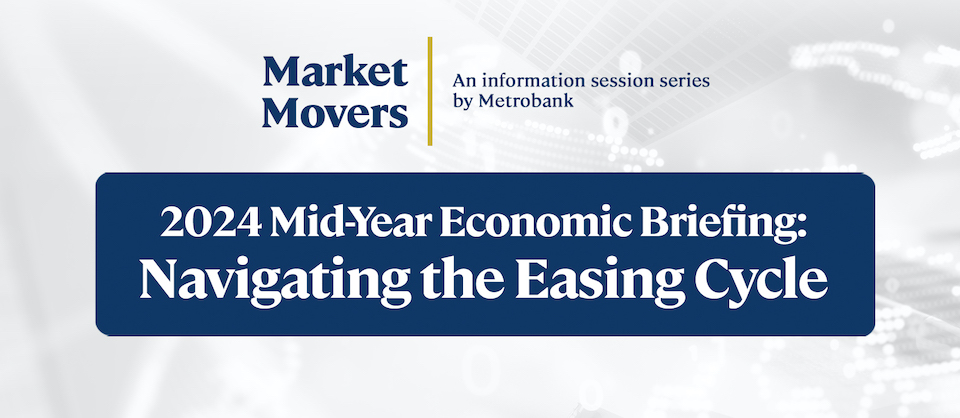
2024 Mid-Year Economic Briefing: Navigating the Easing Cycle
June 21, 2024
Investing with Love
Investing with Love: A Mother’s Guide to Putting Money to Work
May 15, 2024
retirement-ss-3
Investor Series: An Introduction to Estate Planning
September 1, 2023
View All Webinars
DOWNLOADS
Container ship carrying container boxes import export dock with quay crane. Business commercial trade global cargo freight shipping logistic and transportation worldwide oversea concept. Generative AI
Economic Updates
Philippines Trade Update: Wider deficit on strong imports
DOWNLOAD
Frick collection with palm trees 
Economic Updates
Policy Rate Updates: Policy rate updates to reassure 
DOWNLOAD
Man using his smartphone
Reports
Fed to cut just once 
DOWNLOAD
View all Reports
Metrobank.com.ph How To Sign Up
Follow us on our platforms.

How may we help you?

TOP SEARCHES
  • Where to put my investments
  • Reports about the pandemic and economy
  • Metrobank
  • Webinars
  • Economy
TRENDING ARTICLES
  • Investing for Beginners: Following your PATH
  • On government debt thresholds: How much is too much?
  • Philippines Stock Market Outlook for 2022
  • Deficit spending remains unabated

Login

Access Exclusive Content
Login to Wealth Manager
Visit us at metrobank.com.ph How To Sign Up
Access Exclusive Content Login to Wealth Manager
Search
MODEL PORTFOLIO THE GIST
NEWS AND FEATURES
Global Philippines Fine Living
INSIGHTS
INVESTMENT STRATEGY
Economy Stocks Bonds Currencies
THE BASICS
Investment Tips Explainers Retirement
WEBINARS
2024 Mid-Year Economi Briefing, economic growth in the Philippines
2024 Mid-Year Economic Briefing: Navigating the Easing Cycle
June 21, 2024
Investing with Love
Investing with Love: A Mother’s Guide to Putting Money to Work
May 15, 2024
retirement-ss-3
Investor Series: An Introduction to Estate Planning
September 1, 2023
View All Webinars
DOWNLOADS
Container ship carrying container boxes import export dock with quay crane. Business commercial trade global cargo freight shipping logistic and transportation worldwide oversea concept. Generative AI
Economic Updates
Philippines Trade Update: Wider deficit on strong imports
March 27, 2026 DOWNLOAD
Frick collection with palm trees 
Economic Updates
Policy Rate Updates: Policy rate updates to reassure 
March 26, 2026 DOWNLOAD
Man using his smartphone
Reports
Fed to cut just once 
March 19, 2026 DOWNLOAD
View all Reports

Archives: Business World Article

Debt yields dip after Q4 borrowing plan

Debt yields dip after Q4 borrowing plan

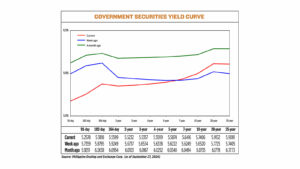
Yields on government securities traded in the secondary market mostly fell last week after the Philippines’ Bureau of the Treasury (BTr) announced a PHP 310-billion local borrowing plan for the last quarter.

Debt yields, which move opposite prices, dropped by 11.86 basis points (bps) week on week on average on Friday, based on PHP Bloomberg Valuation Service Reference Rates data posted on the Philippine Dealing System website.

The rate of the 91-, 182- and 364-day Treasury bills (T-bills) fell, while yields on the two-, three-, four- and five-year Treasury bonds dipped.

On the other hand, the rates of the seven-year T-bond, 10-, 20- and 25-year debt rose.

Volume fell to PHP 47.88 billion on Friday from PHP 113.58 billion on Sept. 20.

A bond trader said yields on seven-year T-bonds and 10- to 25-year debt increased due to some profit taking before the borrowing plan was announced.

Last week, the Treasury bureau said it would borrow PHP 310 billion from the domestic market in the fourth quarter — PHP 220 billion from T-bills and PHP 90 billion via T-bonds.

This is amid expectations of further interest rate cuts that could drive yields lower. The borrowing is less than the PHP 672.5 billion that was raised this quarter.

“The PHP 310-billion borrowing plan is significantly less than the PHP 630-billion auction size in the third quarter,” Dino Angelo C. Aquino, vice-president and head of fixed income at Security Bank Corp., said in a Viber message. “The market will likely see further buying momentum given less supply of bonds in the fourth quarter.”

He added that inflation data for September due this week would likely influence bond movements.

“Expect yields to trend lower especially with the outlook for reverse repurchase, and the announced reserve requirement ratio cut,” a bond trader said in a Viber message.

Last week, Finance Secretary Ralph G. Recto said inflation is slowing, and it would likely ease to 2.5% this month from 3.3% last month.

He added that the government remained cautious since global oil prices could go up due to worsening conflict in the Middle East.

Mr. Recto also said the Philippine central bank could match the 50-bp rate cut by the US Federal Reserve to boost growth.

The central bank in August cut the key rate by 25 bps to 6.25% from the over 17-year high of 6.5% amid an improving inflation outlook.

On Sept. 20 it said reserve requirements for universal and commercial banks would be cut by 250 bps to 7% of deposits from 9.5% on Oct. 25 to promote better pricing for financial services and intermediation costs. — Charles Worren E. Laureta

PHL to borrow PHP 310B locally in Q4

PHL to borrow PHP 310B locally in Q4

The Philippines is looking at borrowing PHP 310 billion from the domestic market in the fourth quarter, the Bureau of the Treasury (BTr) said on Thursday, amid expectations of further rate cuts that could drive yields lower.

The planned auctions put the government on track for its full-year borrowing target, National Treasurer Sharon P. Almanza said in a Viber message.

This year’s borrowing plan is set at PHP 2.57 trillion — PHP 1.92 trillion from domestic sources and PHP 646.08 billion from overseas, according to Treasury data. 

How does the Philippines’ sectoral debt as a share of GDP compare with other emerging markets in Asia for Q2?

Interest rate cuts by the US Federal Reserve and Philippine central bank could push yields lower during auctions in the last quarter, Michael L. Ricafort, chief economist at Rizal Commercial Banking Corp., said in a Viber message.

He added that the lower borrowings are due to more holidays during the period. “Even borrowing requirements of the National Government are seasonally lower in the fourth quarter, with fewer maturities of government securities during the holiday-shortened month and quarter, though there might be some window-dressing activities toward the accounting yearend.”

The Treasury bureau would try to raise PHP 220 billion from Treasury bills (T-bills) and PHP 90 billion via Treasury bonds (T-bonds), it said in a notice posted on its website. In the third quarter, the BTr raised PHP 672.5 billion, higher than the PHP 630-billion program.

In October alone, the government plans to borrow PHP 145 billion — PHP 100 billion in T-bills and PHP 45 billion in T-bonds.

The government will hold five auctions for T-bills next month and will try to raise PHP 6.5 billion via the 91- and 182-day tenors at each auction. It will also offer PHP 7 billion in 364-day T-bills weekly. Next month’s auctions will be held on Sept. 30, Oct. 7, 14, 21 and 28.

Meanwhile, the BTr will try to raise PHP 45 billion via T-bonds at three auctions for PHP 15 billion each in October — via five-year bonds on Oct. 1, seven-year debt on Oct. 15 and 10-year paper on Oct. 29.

In November, the government will seek to raise PHP 90 billion from the domestic market — PHP 60 billion from T-bills and PHP 30 billion from T-bonds.

The Treasury will offer PHP 6.5 billion worth of 91- and 182-day T-bills and PHP 7 billion of 364-day debt at auctions on Nov. 4, 11 and 13.

For the long-term debt, the government will offer PHP 15 billion each in 20-year T-bonds on Nov. 12 and five-year debt paper on Nov. 26.

In December, the Treasury plans to raise PHP 75 billion from the domestic market — PHP 60 billion via T-bills and PHP 15 billion via T-bonds.

The BTr has four T-bill auctions scheduled for December. It will sell PHP 5 billion each in 91-, 182- and 364-day T-bills at each of the auctions on Nov. 25, Dec. 2, 9 and 16. It will also sell PHP 15 billion worth of 10-year bonds on Dec. 10.

Finance Secretary Ralph G. Recto, who is a member of the central bank’s Monetary Board, has said they could afford to slash interest rates further and match the size of the Fed’s rate cuts, Reuters reported.

“The Fed reduced by 50 basis points (bps). I think we can also do half a percent,” Mr. Recto a told a news briefing this week.

The Fed started cutting rates on Sept. 18, with a larger-than-usual half-percentage-point reduction, which will likely be followed by a 25-bp cut in both November and December, according to a Reuters poll.

Bangko Sentral ng Pilipinas (BSP) Governor Eli M. Remolona, Jr. earlier said there was room for one more interest rate cut this year. The BSP’s next meeting is on Oct. 17.

Slowing inflation allowed the central bank to cut its key rate by 25 bps to 6.25% in August, its first rate cut since November 2020, ahead of major central banks including the Fed.

In the short term, the lower borrowing plan for the fourth quarter could drive yields lower unless the government issues an unscheduled borrowing such as a retail Treasury bond, a trader said in a text message.

Ms. Almanza has said the BTr had yet to decide if it would issue more retail Treasury bonds this year.

“So far, our auctions have been successful, and we have raised much more domestically, so it would depend on the deficit,” she said in mixed English and Filipino on Sept. 17. “We don’t have to really fill in the programmed borrowings for this year… So, for better management of costs and debt service, we don’t have to borrow everything.”

The government last issued retail Treasury bonds in February, when it raised a record PHP 584.86 billion at a coupon rate of 6.25%.

The trader also noted that the fourth-quarter borrowing schedule is almost equal to the scheduled maturities during the quarter.

The government borrows from local and foreign sources to help fund its budget deficit, which is capped at PHP 1.48 trillion or 5.6% of economic output this year.

DEBT-TO-GDP RATIO

Meanwhile, the Philippines’ household debt-to-gross domestic product (GDP) ratio fell to 12.1% in the second quarter from 13.2% a year earlier, showing “stable” liability management, the Institute of International Finance (IIF) said.

This was lower than the 47% average for emerging markets in Asia and the 60.9% global average, it said in a report.

For nonfinancial companies, the debt-to-GDP ratio in the three months ended June also declined to 26.8% from 28.7% a year ago. Philippine government debt fell slightly to 56.8% of GDP from 56.9%.

Debt in the Philippine financial sector also dropped to 7.6% of GDP from 8.8% a year earlier, the IIFC said.

The institute’s Global Debt Monitor looks at indebtedness across sectors in mature and emerging markets.

Richard Francis, Fitch Ratings senior director and co-head for the Americas, said the Philippines’ stable debt outlook continues to be supported by growth.

“There are some challenges there, but I think another key factor is that growth has actually been supportive of the Philippines’ rating as well,” he told a virtual news briefing on Wednesday night.

In June, Fitch Ratings affirmed the Philippines’ “BBB” investment grade rating and kept its “stable” outlook. A “BBB” rating means an economy can pay its debt.

Philippine economic growth averaged 6% in the first half, falling at the low end of the government’s 6-7% target.

Christian Kopf, head of Fixed Income and Currencies at Union Investment Group, said the Philippines could manage its debt given low borrowing costs.

“The Philippines is one country which does a very good job in its investor relations programs… and I think it does play out in the form of very low borrowing costs,” he told the briefing.

Leonardo A. Lanzona, an economics professor at the Ateneo de Manila University, said debt still takes up a huge chunk of the country’s economic output.

“While the government’s debt-to-GDP ratio may have slightly declined, it remains a dominant factor in the system, with a debt that is more than 50% of GDP,” he said in a Facebook Messenger chat.

“Emerging economies are expected to have lower debt-to-GDP ratios because they typically have less borrowing capacity and must avoid excessive debt to maintain investor confidence,” he added.

Treasury data showed that the Philippines’ debt-to-GDP ratio will rise to 60.6% by end-2024. It is expected to fall to 60.4% in 2025, 60.2% in 2026, 58.4% in 2027 and 56.3% in 2028. – Aaron Michael C. Sy and Beatriz Marie D. Cruz, Reporters


Nomura sees wider PHL current account deficit

Nomura sees wider PHL current account deficit

The Philippines’ current account gap is expected to widen next year, according to Nomura Global Markets Research, reflecting a surge in imports amid a recovering economy and rising commodity prices.

“We still forecast a gradual widening of the current account deficit to 2.5% of gross domestic product (GDP) in 2025 from 2.3% in 2024, driven by the same factors that led to the return of the deficits,” Nomura analysts Euben Paracuelles and Nabila Amani said in a report.

They did not provide an amount.

In the first half of the year, the country’s current account deficit stood at $7.1 billion, accounting for 3.2% of GDP.

The Bangko Sentral ng Pilipinas (BSP) estimates the current account deficit to reach $6.8 billion this year, equivalent to 1.5% of economic output. It expects the deficit to hit $5.5 billion or 1.1% of GDP next year.

“From a savings-investment perspective, the swing to the current account deficit reflects a pickup in investment ratios, while savings ratios have fallen, especially after the pandemic,” Nomura said.

It also noted that the current account deficit has been driven by the widening goods trade deficit.

The Philippines’ trade deficit widened by 18.05% to $4.87 billion in July, according to data from the local statistics agency.

In July, the value of imports increased by 7.2% year on year to $11.12 billion, the fastest rise since 13% in April. It was also the highest since March 2023.

The country’s balance of trade in goods has been in the red for nine years.

“Unlike regional peers, goods exports have remained relatively flat over the past several years, likely reflecting the lack of industrial policy to move up the value chain, particularly in the electronics sector (60% of goods exports),” Nomura said.

“In contrast, imports have more than doubled, reflecting rising domestic demand and an increasingly supply-constrained economy.”

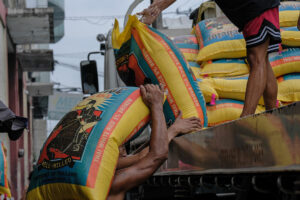
It noted the persistent rise in food imports, particularly rice, reflecting “low productivity in the agriculture sector and the vulnerability to weather-related shocks and external risks.”

In June, President Ferdinand R. Marcos, Jr. issued Executive Order No. 62, cutting tariffs on rice imports to 15% from 35% until 2028.

“The country remains one of the region’s largest oil importers and is therefore susceptible to international crude oil price hikes,” it added.

Nomura also said the trade deficit is “no longer being fully offset by the sum of worker remittances (secondary income) and receipts from outsourcing and tourism sectors (services balance).”

Data from Nomura showed that in nominal dollar terms, worker remittance growth has slowed to 3.1% per year since 2018 from the 6% average from 2011 to 2017.

“Adjusted for inflation and in local currency terms, real remittance growth is even lower, at just 0.7% on average,” it added.

Meanwhile, Nomura said the Philippines’ balance of payments (BoP) has undergone “structural changes” in the past decade.

“First, the current account balance has shifted to a deficit from a surplus since 2016 (except during the pandemic),” it said. “Net unclassified items have also added to the deficit.”

The capital and financial account surplus has also “expanded significantly” after the pandemic, the central bank said and has remained elevated due to external state loans.

Financial account outflows stood at $10.5 billion in the first half, according to data from the central bank.

“Given these new BoP dynamics, we look at a ‘broad basic balance,’ which is showing an increasing deficit and implies greater sensitivity of the BoP to swings in portfolio flows and hence to risk-on/risk-off episodes,” Nomura said.

The country’s BoP level stood at a $1.6-billion surplus as of August.

“The composition of the capital and financial surplus has changed, with external loans now larger than net foreign direct investments (FDI), which indicates a new way of current account deficit financing,” Nomura said.

“A closer look at these loans shows a healthy pipeline through 2025, but the drawndowns are irregular and only partially converted into local currency, contributing to BoP volatility,” it added.

The central bank expects the BoP to post a surplus of $2.3 billion this year, equivalent to 0.5% of GDP. – Luisa Maria Jacinta C. Jocson, Reporter

Peso down as market awaits Fed hints

Peso down as market awaits Fed hints

The peso declined anew against the dollar on Thursday amid bets on the US Federal Reserve’s next policy move.

The local unit closed at PHP 55.965 per dollar on Thursday, weakening by 8.5 centavos from its PHP 55.88 finish on Wednesday, Bankers Association of the Philippines data showed.

The peso opened Thursday’s session weaker at PHP 56.05 against the dollar. Its intraday best was at PHP 55.94, while its worst showing was at PHP 56.09 versus the greenback.

Dollars exchanged went down to USD 1.37 billion on Thursday from USD 1.54 billion on Wednesday.

“The peso tracked the dollar’s recovery last night due to aggressive Fed bets and lower US PCE (personal consumption expenditure) expectations,” the first trader said in a phone interview on Thursday.

“The peso depreciated due to market caution ahead of key US economic data releases on durable goods and initial jobless claims overnight,” the second trader said in an e-mail.

For Friday, the second trader said the peso could recover amid a likely softer US PCE report and potentially dovish remarks from Fed Chair Jerome H. Powell.

The first trader sees the peso moving between PHP 55.70 and PHP 56.10 per dollar, while the second trader expects it to range from PHP 55.85 to PHP 56.10

The dollar held firm on Thursday following its sharpest rally since early June as traders looked ahead to speeches from key Federal Reserve policy makers later in the day for clues on the pace of interest rate cuts, Reuters reported.

The US currency rebounded strongly overnight from a more than one-year low to the euro and 2 1/2-year trough versus sterling.

While there was no obvious catalyst for the rebound, investors appeared to take a more nuanced view on just how aggressive future US rate reductions would be, with Fed speakers this week not presenting a unified view on the path forward.

Later on Thursday, Mr. Powell was set to give pre-recorded remarks at a conference in New York, where New York Fed President John Williams was also set to speak. Boston Fed President Susan Collins and Fed Governors Michelle Bowman and Lisa Cook were set to take to the podium at various other venues as well.

Traders still expect a second super-sized 50-basis-point rate reduction at the Fed’s next meeting in November, but the odds edged down to 57.4% from 58.2% a day earlier, according to the CME Group’s FedWatch Tool.

The dollar index, which measures the currency against the euro, sterling, yen and three other major peers, eased 0.10% to 100.84 as of 0444 GMT, following a 0.57% jump on Wednesday, its biggest one-day gain since June 7.

The yen hit a three-week low of 145.04 per dollar and last fetched 144.77. — A.M.C. Sy with Reuters

Stocks rebound on dovish hints from BSP chief

Stocks rebound on dovish hints from BSP chief

Philippine shares rebounded on Thursday, with the main index hitting a new over two-year high, after dovish comments from the Bangko Sentral ng Pilipinas (BSP) governor.

The Philippine Stock Exchange index (PSEi) jumped by 1.3% or 96.12 points to end at 7,458.74 on Thursday, while the broader all shares index rose by 0.97% or 38.46 points to 3,978.10.

Thursday’s close was the PSEi’s best finish in over 31 months or since it ended at 7,502.48 on Feb. 9, 2022.

“After a brief pullback on Wednesday, the local market bounced back this Thursday. Optimism was fueled by cues of possible rate cuts from the BSP,” Philstocks Financial, Inc. Senior Research Analyst Japhet Louis O. Tantiangco said in a Viber message.

The Monetary Board could slash rates by 50 basis points (bps) more this year via 25-bp cuts at its Oct. 17 and Dec. 19 meetings, BSP Governor Eli M. Remolona, Jr. said on Wednesday.

The BSP on Aug. 15 began its easing cycle with a 25-bp reduction, bringing its policy rate to 6.25% from the over 17-year high of 6.5%. This was the first time it cut rates in nearly four years.

If the Monetary Board delivers rate cuts worth 50 bps in its last two meetings, it would bring the benchmark rate to 5.75% by end-2024.

“Local shares recovered from a two-day slump, buoyed by the Asian Development Bank’s (ADB) decision to maintain its gross domestic product (GDP) growth forecast for the Philippines at 6% for 2024 and 6.2% for 2025,” Regina Capital Development Corp. Head of Sales Luis A. Limlingan said in a Viber message. “The ADB attributed this outlook to easing inflation and expected policy adjustments that could stimulate domestic demand.”

The multilateral bank’s Philippine GDP growth projection for this year is at the low end of the government’s 6-7% goal, while the forecast for 2025 is below its 6.5-7.5% target.

Philippine economic growth averaged 6% in the first half. To meet the lower end of the government’s target for the year, GDP must expand by 6% this semester.

The majority of sectoral indices closed higher on Thursday. Financials surged by 2.59% or 60.21 points to 2,384.69; holding firms rose by 1.07% or 67.08 points to 6,328.70; services went up by 0.94% or 21.03 points to 2,255.78; industrials climbed by 0.83% or 81.16 points to 9,821.05; and property inched up by 0.37% or 11.05 points to 2,988.45.

Meanwhile, mining and oil dropped by 0.34% or 30.19 points to 8,743.01.

“San Miguel Corp. was the day’s top index gainer, jumping 6.11% to PHP 89.50. Semirara Mining and Power Corp. was at the bottom, falling 1.48% to PHP 33.35,” Mr. Tantiangco said.

Value turnover rose to PHP 12.53 billion on Thursday with 1.18 billion shares changing hands from the PHP 8.05 billion with 1.07 billion issues traded on Wednesday.

Advancers outnumbered decliners, 111 to 80, while 61 names closed unchanged.

Net foreign buying surged to PHP 4.79 billion on Thursday from PHP 921.22 million on Wednesday. — R.M.D. Ochave

Remolona signals 2 more rate cuts

Remolona signals 2 more rate cuts

The Bangko Sentral ng Pilipinas (BSP) could slash rates by 50 basis points (bps) more this year, its governor said on Wednesday.

BSP Governor Eli M. Remolona, Jr. told reporters the Monetary Board could implement two more rate cuts at its next two meetings scheduled for Oct. 17 and Dec. 19.

“We have a policy meeting in October. And we also have one in December. So, 25 bps, 25 bps. That’s possible, in principle,” he said on the sidelines of a forum at the Asian Development Bank.

The central bank began its easing cycle in August by cutting the target reverse repurchase (RRP) rate by 25 bps to 6.25% from the over 17-year high of 6.5%. This was the first time the BSP reduced rates in nearly four years.

Asked if the Monetary Board could deliver a 50-bp rate cut in one meeting, Mr. Remolona said that there would be a risk of a “hard landing” in that scenario. Central banks normally deliver 25-bp rate cuts, he added.

“In normal times, that’s what central banks do — 25 bps, 25 bps, 25 bps.”

If the Monetary Board delivers rate cuts worth 50 bps later this year, it would bring the benchmark rate to 5.75% by end-2024.

Mr. Remolona said the central bank would continue monitoring the latest macroeconomic data and indicators.

“We have to look at the numbers. It’s not the last number that decides. The last number that we get, the September number that will be released next week, that feeds into our projections.”

“So, what we care about is the projection for one year from now, because the effect of monetary policy is slow. That’s the relevant number,” he added.

Mr. Remolona also said September inflation could be lower than the August print.

Headline inflation eased to 3.3% in August from 4.4% in July. September inflation data will be released on Oct. 4.

The BSP expects full-year inflation to settle at 3.4%.

CAPITAL MARKETS

Meanwhile, the BSP chief said they are working on initiatives to further deepen capital markets.

“When it comes to price stability, deeper capital markets strengthen our transmission mechanism,” Mr. Remolona said.

These also support the central bank’s mandate on financial stability, he added.

“When the banking system gets into trouble, we want investments to have access to some other source of funds and that would be the corporate bond market, the stock market.”

The BSP and Bankers Association of the Philippines (BAP) are working on enhancing short-term benchmarks to further develop capital markets.

They are scheduled to announce on Sept. 30 the latest enhancements to short-term benchmarks via peso (PHP) interest rate swaps and repurchase agreements for government securities.

Mr. Remolona earlier said he planned to revive the swap market. A swap is a derivative contract where one party exchanges the values or cash flows of one asset for another.

Swaps are traded over the counter, versus options and futures that are traded on a public exchange.

Interest rate, equity, credit default, and currency swaps are the most common types of swaps. – Luisa Maria Jacinta C. Jocson, Reporter

NG budget gap narrows to PHP 54.2 billion in August

NG budget gap narrows to PHP 54.2 billion in August

The National Government’s (NG) budget gap sharply narrowed in August as a double-digit jump in revenues offset a surprising dip in spending, the Bureau of the Treasury (BTr) said on Wednesday.

Treasury data showed the budget deficit shrank by 59.24% to PHP 54.2 billion from the PHP 133-billion gap a year ago.

“The lower deficit was brought about by the 24.4% growth in government receipts alongside a minimal 0.68% contraction in government expenditures,” the Treasury said in a statement.

National Government fiscal performanceMonth on month, the budget shortfall widened by 87.93% from PHP 28.85 billion in July.

In August, government spending slipped by 0.68% to PHP 440.5 billion from PHP 443.6 billion a year earlier.

“This can be partly attributed to the lower total subsidy releases to government corporations, and the sizeable outstanding checks recorded in various departments, such as the Department of Public Works and Highways (DPWH), the Department of Social Welfare and Development (DSWD), and the Department of Health (DoH) during the period,” BTr said.

Primary spending, which refers to total expenditures minus interest payments, fell by 3.27% to PHP 387.8 billion in August. It accounted for 88.02% of total spending for the month.

Interest payments jumped by 23.7% to P52.8 billion, driven by “additional issuances of debt securities at relatively higher coupon rates,” the Treasury said.

On the other hand, revenue collection increased by 24.4% to PHP 386.3 billion from PHP 310.6 billion a year ago.

Tax revenues rose by 9.76% to PHP 320.2 billion in August, driven by an 11.51% jump in Bureau of Internal Revenue (BIR) collections to PHP 238.1 billion.

Collections by the Bureau of Customs (BoC) went up by 4.69% to PHP 78.5 billion, while those by other offices also rose by 11.97% to PHP 3.6 billion.

Nontax revenues surged by 251.22% to PHP 66.1 billion, as privatization proceeds, fees, charges and grants jumped by 295.34% to PHP 49.6 billion.

Treasury collections also rose by 162.88% to PHP 16.5 billion, primarily driven by the Power Sector Assets and Liabilities Management’s PHP 10-billion settlement of guarantee fee arrears, alongside increased Philippine Amusement and Gaming Corp. (PAGCOR) income.

NG’s primary deficit net of interest payments stood at PHP 1.4 billion for August, lower than the primary deficit of PHP 90.3 billion a year ago.

Security Bank Corp. Chief Economist Robert Dan J. Roces said the August budget shortfall “suggests that fiscal discipline measures are yielding results.”

“I think the government will remain vigilant in managing expenditures and continue to implement strategies for revenue enhancement to ensure long-term fiscal sustainability amidst volatility in a monetary easing environment,” he said in a Viber message.

EIGHT-MONTH DEFICIT

In the first eight months of the year, the budget deficit narrowed by 4.86% to PHP 697 billion from PHP 732.5 billion a year ago.

As of end-August, the budget shortfall accounted for 47.09% of the government’s PHP 1.48-trillion deficit ceiling for this year.

Revenue collections went up by 15.91% to PHP 2.99 trillion in the eight-month period from PHP 2.58 trillion last year.

Tax revenues rose by 10.83% to PHP 2.56 trillion, as BIR collections jumped by 12.55% to PHP 1.92 trillion, while Customs revenues increased by 5.66% to PHP 614.4 billion.

Nontax revenues in the first eight months surged by 58.66% to PHP 434.9 billion. Treasury income rose by 33.46% to PHP 200.3 billion “largely due to higher dividend remittances, interest on advances from GOCCs (government-owned and -controlled corporations), guarantee fee collections, and the NG share from PAGCOR income.”

On the other hand, government spending grew by 11.32% to PHP 3.69 trillion in the eight months from PHP 3.31 trillion in the year-ago period.

“Year-to-date primary expenditures grew by 8.7% or PHP 254.5 billion to PHP 3.2 trillion from last year’s PHP 2.9 trillion for the same period largely due to higher National Tax Allotment releases to LGUs (local government units),” BTr said.

Interest payments as of end-August also jumped by 31.07% to PHP 509.4 billion.

As of end-August, the primary deficit had narrowed by 45.47% to PHP 187.5 billion.

Rizal Commercial Banking Corp. Chief Economist Michael L. Ricafort said easing interest rates and a stronger peso “would help ease/reduce debt servicing costs for the coming months and would help narrow the budget deficit.”

“One measure that would help reduce the National Government’s budget deficit and also reduce additional borrowings and overall debt by the NG would be the increased remittance of dividends and surplus by some GOCCs to the NG, if allowed under the law,” he said.

In April, the Department of Finance raised the mandatory dividend remittances of GOCCs to the NG to 75% of their annual net earnings in 2023 from 50%.

The government’s budget deficit ceiling for this year is equivalent to 5.6% of gross domestic product. It aims to reduce the deficit-to-GDP ratio to 3.7% by 2028. — Beatriz Marie D. Cruz

ADB keeps PHL growth forecasts

ADB keeps PHL growth forecasts

The Asian Development Bank (ADB) kept its economic growth forecasts for the Philippines at 6% this year and 6.2% for 2025, as moderating inflation and further policy easing boost domestic demand.

In its latest outlook, the Philippines and Vietnam are expected to be the fastest-growing economies in Southeast Asia this year and in 2025.

This year, the two countries’ 6% growth is projected to outpace Cambodia (5.8%), Indonesia (5%), Malaysia (4.5%), Laos (4%), Brunei (3.7%), Timor-Leste (3.1%), Singapore (2.6%), Thailand (2.3%) and Myanmar (0.8%).   

However, the ADB’s Philippine gross domestic product (GDP) growth projection for this year is at the low end of the government’s 6-7% goal, while the forecast for 2025 is below the government’s 6.5-7.5% target.

“Most of the ingredients for the Philippines’ sustained economic growth are in place — rising government revenues are boosting public expenditures on infrastructure and social services, increasing employment is driving consumption, and reforms to open the economy to more investments are underway,” ADB Philippines Country Director Pavit Ramachandran said in a statement.

In the first half, the Philippines’ GDP growth averaged 6%. To meet the lower end of the government’s target, the economy must grow by 6% in the second semester.

Sustained public investment will also continue to lift growth, ADB said. The manufacturing, construction and service sector will also contribute positively to economic output, the Manila-based lender said.

External demand for electronics exports bodes well for the Philippines, which is involved in low value-added segments such as assembly, testing and packaging. However, the ADB said it might not benefit from the demand for high-tech products.

“That’s why the Philippines is experiencing increased exports at this point, but not in the case say of Cambodia, Indonesia and Thailand because they’re not yet in the high-tech products so they’re not benefiting from the AI (artificial intelligence)-related upcycle, semiconductor upcycle, at this point,” Dulce Zara, senior regional cooperation officer at ADB’s Southeast Asia Department, told a virtual briefing.

As of end-July, Philippine exports of electronic products grew by 2.5% to $23.88 billion. They accounted for 56% of total exports.

SLOWING INFLATION

“With inflation slowing, the country is in a strong position to lead growth in Southeast Asia,” Mr. Ramachandran said.

The ADB lowered its inflation forecast for the Philippines to 3.6% this year from 3.8% in its April update.

For 2025, the ADB also trimmed its inflation forecast for the Philippines to 3.2% from 3.4%.

These forecasts are slightly higher than the Bangko Sentral ng Pilipinas’ (BSP) 3.4% projection for 2024, and 3.1% for 2025. 

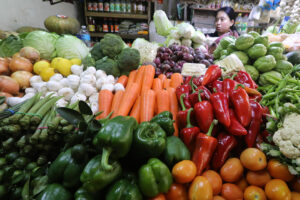
“Food price pressures are expected to dissipate on the impact of reduced import duties on key staples,” the ADB said.

In June, President Ferdinand R. Marcos, Jr. slashed tariffs on imported rice to 15% from 35% to tame inflation. Last year, he also extended reduced tariffs on corn, pork, and mechanically deboned meat.

A sustained downtrend in inflation could prompt the BSP to continue its easing cycle through 2025, the ADB said.

At its August meeting, the Monetary Board began its easing cycle with a 25-basis-point (bp) cut in interest rates. This brought the key policy rate to 6.25% from an over 17-year high of 6.5%.

The country’s current account deficit is also expected to narrow amid a recovery in exports and strong growth in remittances, the ADB said.

The BSP widened its projected current account deficit to $6.8 billion (equivalent to -1.5% of GDP) from its previous forecast of $4.7 billion (-1% of GDP).

However, the ADB noted several risks that weigh on the Philippine outlook, such as a sharper slowdown in major economies and China, and financial volatility arising from the US Federal Reserve’s policy decisions. 

“Heightened geopolitical tensions and higher global commodity prices also pose risks. Severe weather events could elevate inflationary pressures,” it added. 

DEVELOPING ASIA

Meanwhile, the ADB raised its growth forecast for developing Asia to 5% this year from 4.9%, driven by strong demand for tech exports and faster consumption.

“Strong economic fundamentals will continue to underpin expansion this year and next,” ADB Chief Economist Albert Park said in a statement.

“Financial conditions are expected to improve as inflation moderates further and the United States eases its monetary policy, and this will support the positive outlook for the region.”

The ADB trimmed its 2024 growth forecast for Southeast Asia to 4.5% from 4.6% in April.

“Subdued government capital spending and slower-than-expected export recovery will weigh on growth in Southeast Asia this year,” it said.

The ADB kept its 2025 growth projection for developing Asia at 4.9%, and for Southeast Asia at 4.7%.

Meanwhile, the Manila-based lender also trimmed its inflation forecast for developing Asia this year to 2.8% from 3.2% in April after China’s inflation projection was revised to 0.5% from 1.1%.

For 2025, Developing Asia’s inflation was also cut to 2.9% from 3%.

“Inflation is already coming down in the region, so these conditions for monetary policy easing are already materializing and the Fed could create additional space for monetary policy easing by Asian economies,” ADB Principal Economist John Beirne told the briefing.

“Whether they would do that really depends on their domestic circumstances as regards the outlook for inflation.”

However, the ADB raised its inflation forecast for Southeast Asia this year to 3.3% from 3.2% in April due to currency depreciation in Laos and Myanmar.

“A stronger-than-expected easing of global commodity prices, as well as currency appreciation in some cases, were contributory factors. For 2025, the inflation projection for the subregion is raised to 3.2%,” it said. — Beatriz Marie D. Cruz

Congress leaders vow to pass budget bill on time

Congress leaders vow to pass budget bill on time

Leaders of the Senate and House of Representatives on Wednesday assured the public that Congress could approve the proposed PHP 6.352-trillion national budget for 2025 on time, despite political realignments and tension inside their backyards.

At the same time, the two chambers seek to pass several priority measures by December, including a bill allowing foreign investors to lease land for up to 99 years from 75 years.

Senate President Francis Joseph G. Escudero said committee hearings in the upper chamber were “right on schedule,” paving the way for a smooth approval of the budget bill.

“We expect it to be approved with enough time for it to be read and reviewed by the President in relation to the line-item vetoes he can make on the budget bill and sign it into law before the end of the year,” he said, referring to the proposed 2025 General Appropriations Act.

“We held budget hearings on the different budget proposals of each department in the Senate simultaneously with the House, and we are also waiting for the House to approve their version of the General Appropriations Bill so deliberations on the 2025 budget can start in the Senate plenary.”

House Speaker Ferdinand Martin G. Romualdez said the lower chamber was scheduled to pass the budget bill on third and final reading on Wednesday night.

It would be ready for transmission in short order to the Senate, he added.

President Ferdinand R. Marcos, Jr. has certified as urgent the proposed 2025 national budget, which is 9.5% higher than P5.268 trillion this year.

Despite Senate investigations into several issues including Philippine Offshore Gaming Operators’ ties to criminal syndicates, Mr. Escudero said they will be able to pass the budget bill on time.

“Has it ever not been passed by the Senate on time, regardless of which year? It has always been passed by the Senate on time before we went on recess,” he said.

Meanwhile, tensions remain high over the refusal of Vice-President Sara Duterte-Carpio to appear before congressmen during budget deliberations. She had also refused to send authorized representatives.

Asked what would happen to the proposed budget of the Office of the Vice-President, Mr. Romualdez said the House “would take the matter up shortly.”

Arjan P. Aguirre, who teaches politics at the Ateneo de Manila University, said passing next year’s budget on time and without delays would provide good optics — politics-wise — ahead of the 2025 midterm elections.

It could mean that the “government is very much in control in handling the economy,” he said in a Facebook Messenger chat. It could also signal that the administration has stable resources for its political machinery.

The two Congress leaders were in Malacañang on Wednesday for the Sixth Legislative-Executive Development Advisory Council (LEDAC) meeting, which earlier committed to prioritize 28 bills for approval by June 2025.

Mr. Romualdez said the House has accomplished all but two of the administration’s priority legislative measures, such as the proposed amendments to the Foreign Investor Long-Term Lease Act and Agrarian Reform law.

“We are confident that before the year ends, we shall have finished all by December,” he said, referring to the two bills.

Mr. Escudero said the Senate also hopes to approve the two bills by December, along with proposed amendments to the Electric Power Industry Reform Act of 2001 and the Universal Health Care Act of 2019.

The bill creating a Water Resources department is also among the priorities this year, he added.

Some of these five bills, three of which have been passed by the House, were awaiting “completion of a reconciled version” from the Executive branch, according to the Senate leader, who is facing threats of ouster from his colleagues.

Hansley A. Juliano, who teaches politics at the Ateneo de Manila University, said it’s concerning that the proposal to amend the Foreign Investor Long-Term Lease Act has been considered a priority measure without significant public discussions.

“For it to be brought in without serious public discussion in this vein (essentially an insertion) raises massive alarm bells on sovereignty and citizens’ ownership,” he said, noting that the bill was similar to the Parity Rights arrangement the Philippines had with the United States in the pre-Marcos Sr. era.

“Why exactly do they need to operate on the level of leasing when many global businesses and operations may not even necessarily need massive physical spaces here anymore?” he asked.

Mr. Aguire said the priority bills were “arguably materials for propaganda and campaigning in the leadup to the 2025 elections.”

“The urgency somewhat makes sense, but it also belies once again the attitude of the bulk of our district representatives to not be consultative of the larger public.”

Leonardo A. Lanzona, who teaches economics at the Ateneo de Manila University, said Congress should first approve the budget bill before considering other new bills.

“There seems to be a measure of irresponsibility if the aim of Congress is to pass as many laws as possible without considering the effects of such laws on the budget that is still in fact being completed,” he said.

“Passing new bills that are incongruent to the budget would lead either to new expenditures or possible inaction in these laws, which are worse than having no new laws at all.”

Separately, the Palace said Mr. Marcos had sought the “immediate passage” of the Waste-to-Energy bill during the LEDAC meeting.

“We have to look at it in a more urgent sense because it really becomes such an important part of the flood control program,” he said at the meeting, based on a press release from the Palace.

The bill, which has been passed by the House on final reading, is still pending in the Senate.

Mr. Marcos noted that waste-to-energy projects have reduced flooding by 40%. It has to be implemented at the local government level, he added.

“I think waste-to-energy now has taken on a new role. It is no longer just for garbage, or waste disposal or waste management.  It is also now very much part of the flood control effort,” he said. – Kyle Aristophere T. Atienza, Reporter

Sept. inflation likely eased to 2.5% — Recto

Sept. inflation likely eased to 2.5% — Recto

Philippine inflation would likely ease to 2.5% this month, giving the central bank room to cut interest rates more than expected, Finance Secretary Ralph G. Recto said on Tuesday.

But the government remains cautious as the escalating conflict in the Middle East could lead to a spike in global oil prices, he said.

“Inflation is on a downward trend,” Mr. Recto, fresh from a Cabinet meeting on managing food and nonfood inflation, said at a Palace briefing. “We expect inflation to go down to 2.5% by September.”

September inflation data will be released on Oct. 4.

Mr. Recto said the Bangko Sentral ng Pilipinas (BSP) can further reduce interest rates and match the size of the US Federal Reserve’s jumbo rate cut.

“The Fed cut by 50 basis points (bps) or half a percent, I think, we can also do half a percent,” he said in mixed English and Filipino.

BSP Governor Eli M. Remolona, Jr. earlier said that they could cut by another 25 bps in the fourth quarter.

Easing inflation had prompted the BSP to begin its easing cycle at its Aug. 15 meeting. The Monetary Board cut rates by 25 bps, bringing the benchmark rate to 6.25% from the over 17-year high of 6.5%. This was the first time the BSP reduced rates since November 2020.

Headline inflation slowed year on year to a seven month low of 3.3% in August, from 4.4% in July, due to a moderate rise in food prices and a decline in transport costs.

Year to date, inflation rose by 3.6%, slower than 6.6% a year ago.

Mr. Recto said inflation could average 3.4% this year, and further ease to 2.9-3.1% in 2025.

The BSP last month adjusted its baseline inflation forecasts to 3.4% for 2024 (from 3.3% previously), 3.1% for 2025 (from 3.2% previously), and 3.2% for 2026 (from 3.3% previously).

“The beauty about reducing inflation is that your gross domestic product (GDP) growth goes up and more jobs can be created, your borrowing cost goes down,” Mr. Recto said.

He said the possible rate cut will boost the Philippines’ chance of hitting its 6.5-7.5% growth target for 2025.

However, Mr. Recto said the tensions in the Middle East threaten the government’s inflation expectations, noting that global oil prices could spike if a war breaks out.

“Our biggest challenge is external headwinds. One is the war in the Middle East, and we don’t want that to go out of hand and possibly lead to oil price increases,” Mr. Recto said, referring to the escalation in the conflict between Israel and Lebanon’s Hezbollah.

“There is also a pressure for electricity prices to go up,” he added.

Meanwhile, Diwa C. Guinigundo, country analyst for the Philippines of GlobalSource Partners, said geopolitical conflicts “could trigger a possible escalation in oil prices, energy and food prices and ultimately, inflation.”

“With inflation showing some easing trend, within-target inflation forecasts, and the balance of risks tilting to the downside, there is definitely some scope for further accommodation by the BSP,” he told BusinessWorld.

Asked to comment on Mr. Recto’s statements, the former BSP deputy governor said: “I would expect our fiscal authorities to avoid speaking on monetary policy, especially on matters of inflation forecasts and the likely direction of monetary policy, as well as providing some sort of forward guidance to the market.

Security Bank Corp. Chief Economist Robert Dan J. Roces said external threats, particularly conflicts in the Middle East and global oil prices, are still “significant concerns.”

“While these projections signal effective anti-inflation measures, the true test lies in translating lower inflation into tangible benefits for ordinary citizens through job creation, improved social services, and sustainable economic practices,” Mr. Roces said in a Viber message.

Leonardo A. Lanzona, who teaches economics at Ateneo de Manila University, said the government appears to be forgetting that the recent inflation has been fueled by food prices, not external factors.

“This has to do more with the internal management of the economy. Unless food, especially rice, prices are controlled, the inflation risks remain,” he said in a Facebook Messenger chat.

At the Tuesday briefing, Agriculture Secretary Francisco Tiu Laurel said the pressure on pork prices will likely ease as the government rolls out vaccines for African Swine Fever, which has forced producers to cull hogs.

The government has tested the vaccines locally with 10,000 doses, he noted, adding that the next 450,000 doses will be awarded next month.

“We hope to complete the procurement of 600,000 doses by the end of December this year,” he said.

EXCESS LIQUIDITY

Meanwhile, Mr. Guinigundo said the government should keep a close eye on the potential excess in liquidity following the lifting of banks’ reserve requirement ratio (RRR) by 250 bps.

“(This) could add nearly PHP 500 billion in domestic liquidity. With a small negative output gap, we would not want to dissipate that window and risk a potential resurgence in inflation due to additional liquidity injection,” he said.

“What is supporting this monetary stance by the BSP is the favorable inflation expectations even following the recent reduction in both the policy rate and the RRR,” he added.

At the Palace briefing, Mr. Recto, a member of the Monetary Board, said the BSP had considered the RRR cut’s potential impact on inflation.

“We’ve considered that when we decided on the policy in the last BSP meeting. This will be good for the economy. It will improve the capital markets,” he said. “We’re injecting roughly P380 billion into the system. It will be good for banks. And then, it will have a lag effect.”

The BSP will reduce the RRR for big banks and nonbank financial institutions with quasi-banking functions by 250 bps to 7% from 9.5% previously, effective Oct. 25.

It will also reduce the ratio for digital banks by 200 bps to 4%, thrift banks by 100 bps to 1%, and rural banks and cooperative banks by 100 bps to 0%. — Kyle Aristophere T. Atienza

Posts navigation

Older posts
Newer posts

Recent Posts

  • Navigating precarious times with cost averaging
  • Trade Update: Wider trade deficit in February
  • Metrobank US-Iran Risk Index: No swift end seen
  • Investment Ideas: March 27, 2026
  • BSP Update: First rate hike likely in June 

Recent Comments

No comments to show.

Archives

  • March 2026
  • February 2026
  • January 2026
  • December 2025
  • November 2025
  • October 2025
  • September 2025
  • August 2025
  • July 2025
  • June 2025
  • May 2025
  • April 2025
  • March 2025
  • February 2025
  • January 2025
  • December 2024
  • November 2024
  • October 2024
  • September 2024
  • August 2024
  • July 2024
  • June 2024
  • May 2024
  • April 2024
  • March 2024
  • February 2024
  • January 2024
  • December 2023
  • November 2023
  • October 2023
  • September 2023
  • August 2023
  • July 2023
  • June 2023
  • May 2023
  • April 2023
  • March 2023
  • February 2023
  • January 2023
  • December 2022
  • November 2022
  • October 2022
  • September 2022
  • August 2022
  • July 2022
  • June 2022
  • May 2022
  • March 2022
  • December 2021
  • October 2021

Categories

  • Bonds
  • BusinessWorld
  • Currencies
  • Economy
  • Equities
  • Estate Planning
  • Explainer
  • Featured Insight
  • Fine Living
  • How To
  • Investment Tips
  • Markets
  • Portfolio Picks
  • Rates & Bonds
  • Retirement
  • Reuters
  • Spotlight
  • Stocks
  • Uncategorized

You are leaving Metrobank Wealth Insights

Please be aware that the external site policies may differ from our website Terms And Conditions and Privacy Policy. The next site will be opened in a new browser window or tab.

Cancel Proceed
Get in Touch

For inquiries, please call our Metrobank Contact Center at (02) 88-700-700 (domestic toll-free 1-800-1888-5775) or send an e-mail to customercare@metrobank.com.ph

Metrobank is regulated by the Bangko Sentral ng Pilipinas
Website: https://www.bsp.gov.ph

Quick Links
The Gist Webinars Wealth Manager Explainers
Markets
Currencies Rates & Bonds Equities Economy
Wealth
Investment Tips Fine Living Retirement
Portfolio Picks
Bonds Stocks
Others
Contact Us Privacy Notice Terms of Use
© 2026 Metrobank. All rights reserved.

Access this content:

If you are an existing investor, log in first to your Metrobank Wealth Manager account. ​

If you wish to start your wealth journey with us, click the “How To Sign Up” button. ​

Login HOW TO SIGN UP