MODEL PORTFOLIO
THE GIST
NEWS AND FEATURES
Global Philippines Fine Living
INSIGHTS
INVESTMENT STRATEGY
Economy Stocks Bonds Currencies
THE BASICS
Investment Tips Explainers Retirement
WEBINARS
2024 Mid-Year Economi Briefing, economic growth in the Philippines
2024 Mid-Year Economic Briefing: Navigating the Easing Cycle
June 21, 2024
Investing with Love
Investing with Love: A Mother’s Guide to Putting Money to Work
May 15, 2024
retirement-ss-3
Investor Series: An Introduction to Estate Planning
September 1, 2023
View All Webinars
DOWNLOADS
Container ship carrying container boxes import export dock with quay crane. Business commercial trade global cargo freight shipping logistic and transportation worldwide oversea concept. Generative AI
Economic Updates
Philippines Trade Update: Wider deficit on strong imports
DOWNLOAD
Frick collection with palm trees 
Economic Updates
Policy Rate Updates: Policy rate updates to reassure 
DOWNLOAD
Man using his smartphone
Reports
Fed to cut just once 
DOWNLOAD
View all Reports
Metrobank.com.ph How To Sign Up
Follow us on our platforms.

How may we help you?

TOP SEARCHES
  • Where to put my investments
  • Reports about the pandemic and economy
  • Metrobank
  • Webinars
  • Economy
TRENDING ARTICLES
  • Investing for Beginners: Following your PATH
  • On government debt thresholds: How much is too much?
  • Philippines Stock Market Outlook for 2022
  • Deficit spending remains unabated

Login

Access Exclusive Content
Login to Wealth Manager
Visit us at metrobank.com.ph How To Sign Up
Access Exclusive Content Login to Wealth Manager
Search
MODEL PORTFOLIO THE GIST
NEWS AND FEATURES
Global Philippines Fine Living
INSIGHTS
INVESTMENT STRATEGY
Economy Stocks Bonds Currencies
THE BASICS
Investment Tips Explainers Retirement
WEBINARS
2024 Mid-Year Economi Briefing, economic growth in the Philippines
2024 Mid-Year Economic Briefing: Navigating the Easing Cycle
June 21, 2024
Investing with Love
Investing with Love: A Mother’s Guide to Putting Money to Work
May 15, 2024
retirement-ss-3
Investor Series: An Introduction to Estate Planning
September 1, 2023
View All Webinars
DOWNLOADS
Container ship carrying container boxes import export dock with quay crane. Business commercial trade global cargo freight shipping logistic and transportation worldwide oversea concept. Generative AI
Economic Updates
Philippines Trade Update: Wider deficit on strong imports
March 27, 2026 DOWNLOAD
Frick collection with palm trees 
Economic Updates
Policy Rate Updates: Policy rate updates to reassure 
March 26, 2026 DOWNLOAD
Man using his smartphone
Reports
Fed to cut just once 
March 19, 2026 DOWNLOAD
View all Reports

Archives: Business World Article

Electricity transmission rates decrease in October — NGCP

Electricity transmission rates decrease in October — NGCP

Electricity consumers may see a reduction in their bills for October due to a decline in overall transmission charges, according to the National Grid Corporation of the Philippines (NGCP).

“There is a downward trend in the transmission rates, from PHP 1.22 per kilowatt-hour (kWh) to PHP 1.19 per kWh,” Julian Ryan Datingaling, NGCP’s head of revenue management department, said during a briefing on Thursday.

Mr. Datingaling said that ancillary services (AS) rates for the September supply period went down by 7.3% to PHP 0.5680 per kWh.

Ancillary services are deployed by grid operators to support the transmission of power from generators to consumers to maintain reliable operations. These are pass-through charges billed by the grid operator and remitted directly to generation companies.

The transmission wheeling rate, or what NGCP charges for its primary services of delivering power, climbed by 3.68% to P0.4936 per kWh, attributed to the decrease in electricity consumption in September.

“With a fixed revenue and a decrease in consumption, the tendency is an increase in the rates,” Mr. Datingaling said.

For Luzon, transmission charges went down by an estimated PHP 0.09 per kWh. Rates in the Visayas increased by PHP 0.29 per kWh, while rates in Mindanao declined by PHP 0.02 per kWh.

“For this month, more than 50% of our billing is for ancillary services, and that proportion is largely driven by market prices in the reserve market,” NGCP Spokesperson Cynthia P. Alabanza said.

The NGCP clarified that it does not earn from AS and did not benefit from the increase in prices as it is a pass-through cost and is collected for generation companies.

“Of the overall transmission charge, only 49 centavos is charged by NGCP for the delivery of its services to power consumers. This month’s transmission charge is comprised mainly of AS charges remitted directly to power generators providing ancillary services to the grid,” the grid operator said.

Transmission charges usually account for 3% of a monthly electricity bill.

Meanwhile, Ms. Alabanza said that the company is looking forward to the release of the decision from the Energy Regulatory Commission (ERC) regarding its rate reset process.

“NGCP is more than capable of pursuing all its transmission projects, but we do need to have our reset issued and our applications acted on,” Ms. Alabanza said.

“It is very critical for us to have a fair recovery mechanism and completion of the reset process to ensure what level of capex (capital expenditure) we can spend,” she added.

The rate reset process is usually a “forward-looking” exercise that requires the regulated entity to submit forecast expenditures and proposed projects over a five-year regulatory period.

NGCP’s rate reset process accounts for the fourth regulatory period, which covers the years 2016 to 2020 and includes the lapsed period of two years.

ERC Commissioner Catherine P. Maceda told a Senate budget hearing on Wednesday that the commission was preparing to publish the final draft determination within the month. — Sheldeen Joy Talavera

Finance Chief Recto sees 6% growth in third quarter

Finance Chief Recto sees 6% growth in third quarter

The Philippine economy likely grew by 6% in the third quarter as declining inflation may have fueled a rebound in consumer spending, Finance Secretary Ralph G. Recto said.

“I’m still hoping 6%, more so that inflation is declining,” Mr. Recto told reporters on the sidelines of an event late on Tuesday.

“The biggest [driver] would be household consumption, which is 75% of the economy,” he added.

For as long as household consumption grows by 6%, Mr. Recto said, the economy would likely grow by 6%. 

Economic managers are targeting 6-7% growth this year. 

In the second quarter, gross domestic product (GDP) expanded by 6.3% as improved government spending and investments offset weak consumption growth. Household spending in the April-June period grew by 4.6% year on year, the weakest since the first quarter of 2021. 

For the first half, GDP growth averaged 6%. The economy has to grow by at least 6% in the second half to hit the low end of the target.

The statistics agency is expected to release third-quarter GDP data on Nov. 7.

Mr. Recto said slowing inflation likely helped drive growth in the July-to-September period.

The consumer price index eased to a four-year low of 1.9% year on year in September from 3.3% in August as food and transport costs declined.

Year to date, inflation averaged 3.4%, settling within the 2-4% target range of the Bangko Sentral ng Pilipinas (BSP).

Mr. Recto said the Development Budget Coordination Committee (DBCC) could meet before yearend to review the macroeconomic assumptions and targets.

“I think the DBCC should meet but maybe in December… not really to adjust but just to review not only growth targets but take a look at the entire macro-fiscal framework,” he said.

Mr. Recto said that any adjustments to the government’s growth and fiscal targets should be for next year, as economic managers also have to consider other factors such as external headwinds.

“We have to take a look at what’s happening globally also. For example, we have to prepare just in case you have more tensions in the Middle East,” he said.

At its last meeting in June, the DBCC kept the 2024 GDP growth target at 6-7% and 6.5-7.5% GDP expansion for 2025. It targets 6.5-8% growth from 2026 to 2028.

Earlier this week, Budget Secretary and DBCC Chairperson Amenah F. Pangandaman raised the possibility of an upward revision of this year’s growth target amid slowing inflation and improved state spending.

Meanwhile, Albay Rep. Jose Ma. Clemente S. Salceda, who also heads the House Committee on Ways and Means, gave a 5.7-6.1% GDP growth forecast for the third quarter.

“Inflation, while obviously slowing down, would still have had some real impact on the consumption patterns of consumers. I expect robust consumption of basic goods to have persisted, but some weakness in discretionary spending,” he said in a Viber message.

Rizal Commercial Banking Corp. Chief Economist Michael L. Ricafort said he sees at least 6% economic growth in the July-to-September period, driven by better jobs data.

“Easing inflation trend would boost consumer spending… amid the net improvement in employment data in recent months to among the best in 19 years,” he said in a Viber message.

The unemployment rate eased to 4% in August from 4.7% in July and 4.4% in August last year. This translated 2.07 million unemployed Filipinos, down by 305,000 from July and by 149,000 from a year earlier.

The employment rate in August rose to 96%, equivalent to 49.15 million employed Filipinos, from 95.3% in July and 95.6% a year ago. — Beatriz Marie D. Cruz

Inflation now on a ‘target-consistent path,’ says BSP Governor Remolona

Inflation now on a ‘target-consistent path,’ says BSP Governor Remolona

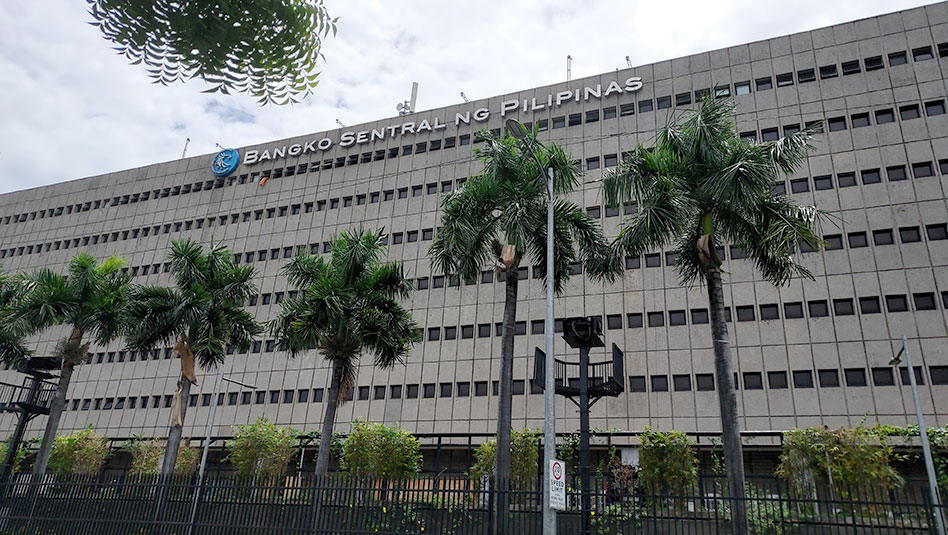
Inflation is now on a “target-consistent path,” which provides room for further easing, Bangko Sentral ng Pilipinas (BSP) Governor Eli M. Remolona, Jr. said.

“With inflation now on a target-consistent path, we have room for a calibrated shift to a less restrictive monetary policy stance,” Mr. Remolona said in an interview with Global Finance magazine.

Headline inflation sharply eased to 1.9% in September from 3.3% in August. This was also the slowest print in over four years or since the 1.6% clip in May 2020.

This year so far, inflation has remained within the central bank’s 2-4% target range, except for the 4.4% spike in July due to higher electricity costs.

In the first nine months, headline inflation averaged 3.4%, which was also the central bank’s full-year forecast.

“In fact, about two months before our latest policy rate cut, our forward guidance already indicated that we expected to shift to a less hawkish monetary stance,” Mr. Remolona said.

The central bank kicked off its easing cycle in August with a 25-basis-point (bps) rate cut, bringing the benchmark rate to 6.25% from an over 17-year high of 6.5%.

“The cut in rates in August was driven by our projections of inflation and growth based on the latest data on domestic conditions. The timing of the Federal Open Market Committee’s (FOMC) actions did not play much of a role in our decision,” Mr. Remolona said.

The BSP chief also noted that cutting ahead of the Fed did not have any significant impact on the financial system.

“The reaction of financial markets to the BSP easing its policy rate earlier than the US Fed has been relatively muted, with the Philippine peso weakening only slightly versus the US dollar right after the recent policy decision and has since continued to appreciate,” he added.

However, Mr. Remolona noted that the BSP will “continue to monitor lingering upside risks to prices, including those coming from higher electricity rates and external factors.”

He earlier said that the Monetary Board can cut by up to 25 bps at each of its last two meetings this year, slated on Oct. 16 and Dec. 19.

GROWTH OUTLOOK

At the same time, Mr. Remolona said the economy was able to withstand the effects of high interest rates.

“Previous policy rate increases had some dampening effect on demand, including credit activity. Nevertheless, the impact of tight financial conditions was something the domestic economy could absorb — as indicated by sustained GDP growth and improving employment condition,” he said.

Economic growth will likely settle within the 6-7% target this year, Mr. Remolona added.

“The outlook for domestic output growth over the medium term is largely intact. With 6.3% growth in the second quarter, it would likely settle within the government’s target in 2024 as a whole… We expect growth to be supported by robust construction spending and the timely implementation of various government programs,” he said.

The Philippine economy grew by 6.3% in the second quarter, the fastest in five quarters or since 6.4% in the first quarter of 2023.

Meanwhile, the BSP chief noted the Philippine banking industry’s strong growth prospects.

“The country’s banking sector has been a reliable source of strength for the economy. Bank lending has consistently grown to support economic activities without compromising credit quality. We attribute this in part to prudent lending standards of banks,” Mr. Remolona said.

“We expect the trend of robust loan growth and good credit quality to continue in the months ahead.”

The latest BSP data showed bank lending rose by an annual 10.7% to PHP 12.25 trillion in August from PHP 11.07 trillion a year ago.

Mr. Remolona said that nonperforming loans (NPLs) are “very manageable.”

The banking system’s total loan portfolio was at PHP 14.2 trillion at end-July, with NPLs accounting for 3.58%, he added. — Luisa Maria Jacinta C. Jocson

Rate cuts may boost demand amid condo oversupply in Metro Manila

Rate cuts may boost demand amid condo oversupply in Metro Manila

Further rate cuts by the Philippine central bank could help spur new residential project launches and drive take-up of existing condominiums in Metro Manila, a property consultant said.

In its third-quarter property market report, Leechiu Property Consultants (LPC) said the inventory level of condominium units in Metro Manila has reached 67,600 units across 510 buildings — “the highest since the pandemic.”

“It’s an oversupply of the buildings in the market at 29 months’ supply. (Developers) have been slowly launching new projects,” LPC Research Director Roy Amado Golez said at a briefing on Oct. 8.

Quezon City and Ortigas (plus fringe areas) have the most number of unsold condominium units at 18,000 and 13,500, respectively.

High interest rates may have dampened demand for residential condominiums in Metro Manila. LPC said 6,885 units were sold in the July-to-September period, “close to the 7,000 level for the third straight quarter.”

The Bangko Sentral ng Pilipinas (BSP) had kept its policy rate at an over 17-year high of 6.5% from October 2023 to mid-August 2024. It reduced the benchmark rate to 6.25% at its Aug. 15 meeting.

“The interest rate levels today are still at elevated levels, at 6.25%. However, we’ll be likely seeing rate cuts in October as well as December. Hopefully, those rate cuts will  boost… the residential market,” Mr. Golez said.

BSP Governor Eli M. Remolona, Jr. earlier signaled the Monetary Board could deliver two 25-basis-point (bp) rate cuts at each of its two remaining meetings this year.

LPC said rate cuts would help ease lending conditions for both developers and homebuyers, as well as encourage developers to launch new projects.

Muted demand may have prompted developers to defer new residential projects. New project launches plunged by 39% to 2,145 units in the quarter ending September, which LPC said was the lowest since the pandemic.

“What developers are most likely doing now is reselling or re-launching or reintroducing marketing programs for their current inventory,” Mr. Golez said, adding that lower interest rates may provide a lift to sales in the next few quarters.

However, LPC noted that property developers may still remain cautious about launching new projects.

“Headwinds due to external risks such as heightened geopolitical events and current global economic uncertainty may see a continued cautious approach by developers,” it said.

Another reason for lackluster demand for condominiums could be the change in preferences of homebuyers.

“It has become evident already in the last so many quarters, especially when you look at the loans taken from the banks. The percentage of loans taken for house allotments has been steadily increasing while those for condominiums have been declining,” Mr. Golez said.

He noted many homebuyers now prefer to live in townships outside of Metro Manila. Townships located south of Metro Manila have been growing, with the population in the Calaba (Cavite-Laguna-Batangas) projected to reach 12 million by the end of 2024 from only 7 million in 2005, he added.

“If you look at the provinces or at least in the Calaba area, along the expressways, you’re getting a bigger unit and you’re in a less dense (area), there’s less traffic (and) a better environment,” Mr. Golez said.

Tam Angel, director for investment sales at LPC, said developers are preferring to do more horizontal developments “because it has a shorter turnaround time for them for a return on their capital.”

As interest rates remained high, developers wanted to preserve their value sheets and their liquidity by shifting more to horizontal development.

“They were able to do that by, instead of building a condo in three, four, five years and having the big chunks of that return come in on the fifth year because we all know these savings are stretched out, they get a balloon payment on the last year,” Mr. Angel added.

He said horizontal development has a faster turnaround time of 18 to 24 months. — Aubrey Rose A. Inosante

Banking system’s total assets jump by 11% to PHP 26 trillion

Banking system’s total assets jump by 11% to PHP 26 trillion

The Philippine banking industry’s total assets jumped by 10.8% as of end-August, Bangko Sentral ng Pilipinas (BSP) data showed.

Preliminary data from the BSP showed banks’ combined assets rose to PHP 25.99 trillion as of end-August from PHP 23.46 trillion in the same period a year ago.

Month on month, total assets inched up by 0.2% from PHP 25.93 trillion as of end-July.

Banks’ assets are mainly supported by deposits, loans, and investments. These include cash and due from banks as well as interbank loans receivable (IBL) and reverse repurchase (RRP), net of allowances for credit losses.

The banking sector’s total loan portfolio inclusive of IBL and RRP climbed by 10.5% to PHP 13.82 trillion as of end-August from PHP 12.51 trillion in the same period a year ago.

Net investments, or financial assets and equity investments in subsidiaries, increased by 6.6% to PHP 7.41 trillion as of end-August from PHP 6.95 trillion a year prior.

Cash and due from banks stood at P2.65 trillion as of end-August, up by 3.9% from PHP 2.55 trillion a year earlier.

Net real and other properties acquired went up by 3.9% to PHP 111 billion from P106.8 billion a year ago.

Banks’ other assets surged by 48.1% to PHP 2 trillion at end-August from PHP 1.35 trillion a year earlier.

Meanwhile, the total liabilities of the banking system rose by 10.8% to PHP 22.73 trillion from PHP 20.52 trillion in the year-ago period.

Rizal Commercial Banking Corp. Chief Economist Michael L. Ricafort said the higher asset level as of end-August was due to continued growth in bank lending.

The latest data from the BSP showed outstanding loans of universal and commercial banks rose by 10.7% year on year to P12.25 trillion in August. This was its fastest growth rate in 20 months or since the 13.7% logged in December 2022.

Mr. Ricafort noted that banks’ asset growth is nearly twice the country’s latest gross domestic product (GDP) growth.

The Philippine economy grew by 6.3% in the second quarter, faster than the 5.8% growth in the first quarter and 4.3% a year ago.

“The continued growth in banks’ earnings that also added to banks’ capitalization may have also supported the latest growth in banks’ total assets,” he added.

The Philippine banking system’s combined net income rose by 4.1% year on year to PHP 190.26 billion in the first half.

Mr. Ricafort said that further policy rate cuts by the BSP and US Federal Reserve will also support loan activity.

The central bank could deliver 25-basis-point (bp) rate cuts at each of its two remaining meetings this year, BSP Governor Eli M. Remolona, Jr. earlier said.

The Monetary Board’s next policy review is on Oct. 16.

“The latest cut in banks’ reserve requirement ratio (RRR) and possible further reduction in RRR for the coming years would be another source of growth for banks’ loans, earnings, and total assets,” Mr. Ricafort added.

The BSP has announced its plans to cut big banks’ RRR to 7% from 9.5%, effective later this month.

Mr. Remolona has said that they are looking to reduce the RRR to zero within his term, which ends in 2029. – Luisa Maria Jacinta C. Jocson, Reporter

PHL banks’ Q2 exposure to real estate sector lowest in 4.5 years

PHL banks’ Q2 exposure to real estate sector lowest in 4.5 years

The exposure of Philippine banks and trust entities to the property sector declined to 19.92% at end-June, data from the Bangko Sentral ng Pilipinas (BSP) showed.

This was lower than the 20.31% ratio at end-March and the 20.8% logged in the same period a year ago.

This was also the lowest real estate exposure ratio recorded in four and a half years or since the 19.84% seen as of December 2019.

The BSP monitors lenders’ exposure to the real estate industry as part of its mandate to maintain financial stability.

Investments and loans extended by Philippine banks to the real estate sector rose by 3.6% to PHP 3.16 trillion as of June from PHP 3.05 trillion a year ago.

Broken down, real estate loans increased by 7.3% to PHP 2.79 trillion in the period from PHP 2.6 trillion at end-June 2023.

Residential real estate loans jumped by 8.9% year on year to PHP 1.04 trillion from PHP 958.192 billion, while commercial real estate loans edged up by 6.1% to P1.74 trillion from P1.64 trillion.

Past due real estate loans stood at PHP 141.254 billion, higher by 7.1% from PHP 131.843 billion a year prior.

Past due residential real estate loans rose by 3.5% to P97.89 billion from P94.59 billion, while past due commercial real estate loans climbed by 16.4% to P43.37 billion from P37.25 billion.

Meanwhile, gross nonperforming real estate loans went up by 5% to PHP 110.862 billion as of the second quarter from PHP 105.632 billion a year ago.

This brought the gross nonperforming real estate loan ratio to 3.98% at end-June, easing from 4.07% a year earlier.

On the other hand, real estate investments fell by 18.4% to PHP 371.108 billion from PHP 454.856 billion in the same period a year ago.

This, as debt securities declined by 16.7% year on year to PHP 245.313 billion from PHP 294.558 billion. Equity securities likewise dropped by 21.5% to PHP 125.795 billion from PHP 160.298 billion.

Joey Roi H. Bondoc, director and head of research at Colliers Philippines, said the low real estate exposure seen at end-June is in line with the slow recovery of the property market.

“It’s what we’re seeing right now. It’s definitely reflecting the slow take-up that we’re seeing in the market,” he said via phone call.

Mr. Bondoc said this was due to the lengthened remaining inventory life of unsold condominium units.

“We have about 21,000 units right now across Metro Manila and these remain unsold. These are ready for occupancy already. But the problem is, we’re seeing a slow take-up of this ready-for-occupancy (RFO) units, about 21,000 units, and our estimate is that it will take the market five years to fully absorb these unsold RFOs,” he said.

From 2019 to 2019, the average period for absorption of unsold RFOs was at 12 months, according to Colliers data.

“But right now, take-up is only about 12,000 to 13,000 units and then the amount of time for the unsold RFOs to be absorbed is 60 months,” Mr. Bondoc said.

“So, it’s really a dampened market at this point, especially in Metro Manila. This only reflects the slow exposure of banks to the residential real estate market.”

Mr. Bondoc also noted that real estate developers are not launching new projects, especially in Metro Manila.

“They’re not launching a lot of vertical projects. If you’re seeing less launches right now, after four or five years, these launches will be under bank financing. Definitely, we will see reduced exposure of the Philippine banking system to residential loans in the near to medium term,” he added.

Rizal Commercial Banking Corp. Chief Economist Michael L. Ricafort said the lower exposure of banks was also due to the “adoption of credit risk management based on global best practices.”

This led to “more prudent management of property exposures in view of prescribed limits set by regulators also partly led to the decrease in the said exposures to the sector,” he said in a Viber message.

In 2020, the central bank raised the real estate loan limit of banks to 25% of their total loan portfolio from 20% previously to help free up additional liquidity as a relief measure during the coronavirus pandemic.

Mr. Ricafort also noted higher vacancies due to the rise in hybrid or remote work arrangements, shuttering of Philippine offshore gaming operators (POGOs) and increase in online businesses.

“Thus, the continued need for banks to diversify their loan portfolio and credit risk exposures, also in view of tighter capitalization standards that may require higher risk weights for riskier loans and investments, including those in the real estate sector,” he added.

Separate data from the central bank showed that the Residential Real Estate Price Index rose by an annual 2.7% in the second quarter, much slower than the 6.1% recorded in the previous quarter.

Mr. Bondoc added that the BSP’s easing cycle will have a lagged impact on real estate loans.

“It will not be immediately felt by the market. We’re estimating, since the cut was just recent, perhaps early 2025 to mid 2025,” he said.

“If there will be additional cuts, perhaps if there are two more rounds this year, those will definitely be felt by mid of next year.”

The central bank began its easing cycle in August, cutting borrowing costs by 25 basis points (bps) to bring the policy rate to 6.25% from an over-17 year high of 6.5% previously.

BSP Governor Eli M. Remolona, Jr. earlier said that the Monetary Board can deliver 25-bps rate cuts at each of its last two meetings of the year.

“Definitely, there is greater room for policy rate easing, but in terms of their effect on mortgage rates, which currently is at 8.3% average, it will take a bit longer for the policy rate cut to have an effect on the actual mortgage rates imposed by banks. There really is a lag effect, so it will not have an immediate impact on the residential take-up,” Mr. Bondoc said. – Luisa Maria Jacinta C. Jocson, Reporter

Philippines’ August joblessness eases

Philippines’ August joblessness eases

Unemployment in the Philippines eased to 4% in August as more female workers got hired in the service sector, the local statistics agency said on Tuesday.

Preliminary data from the Philippine Statistics Authority’s (PSA) labor force survey showed the jobless rate fell from 4.7% in July and 4.4% in August last year.

This translated 2.07 million unemployed Filipinos, down by 305,000 from July and by 149,000 from a year earlier.

Philippine Labor Force Situation

“A major factor that we saw in August 2024 is that many women participated in the labor force and many of them were absorbed by our labor market,” PSA Undersecretary and National Statistician Claire Dennis S. Mapa told a news briefing in mixed English and Filipino.

About 1.03 million female workers joined the labor force, most of whom worked for more than 40 hours a week, he added.

National Economic and Development Authority Secretary Arsenio M. Balisacan said Filipinos “are in for a potentially better holiday season as the latest labor survey showed promising labor market results.”

He said fast-tracking key infrastructure projects in energy, logistics and physical and digital connectivity is critical to attracting investments in higher-value-added sectors, such as manufacturing and agribusiness, and boosting labor productivity.

“With the government’s continued focus on attracting strategic investments and the timely passage of key reforms, the Philippines is well-positioned to translate its promising macroeconomic fundamentals into long-term prosperity for its workforce and economy,” he added.

The labor force participation rate among female Filipino workers rose to 54.7% from 52.4% in July and 52.9% in August last year. For male workers, the rate dipped to 74.8% from 76.3% a year ago. It was 74.5% in July.

The employment rate in August rose to 96% from 95.3% in July and 95.6% a year ago, equivalent to 49.15 million employed Filipinos.

The employment rate for women rose to 95.3% from 94.8% in July and 95.1% a year earlier. The rate among male workers also rose to 96.5% from 95.6% in July and 96% in August last year.

Job gains by industry (Aug. vs July)

INCREASED DIGITALIZATION
The entry of contractual workers due to digitalization resulted in more women being hired in August, said Leonardo A. Lanzona, Jr., an economics professor at the Ateneo de Manila University.

“In general, women are concerned with other factors that are not related to compensation,” he said in a Facebook Messenger chat. “Greater engagement in digital labor platforms allowed them to find extra income without leaving home and their children.”

He said more female workers being hired is not seasonal, but a result of growing digitalization and more flexible working hours, often at the expense of lower pay.

“These jobs offer very little protection and tend to be very unstable,” Mr. Lanzona said. “ In reality, people do not prefer these types of jobs but are forced to accept them in the absence of better options.”

“Improving working conditions can only be achieved if more options in the domestic labor markets are available,” he added.

Benjamin B. Velasco, assistant professor at the University of the Philippines School of Labor and Industrial Relations in Diliman, said the lower unemployment and underemployment rates and higher female labor participation are “welcome news.”

“We just need to be aware of two things,” he told BusinessWorld via Messenger chat. “First, the fine print — employed means working for at least one hour in the past week, and second, these positive figures are only episodic or temporary changes.”

He also noted that the female labor force participation rate was higher in June at 55.8% and March at 55.1%. “So definitely, it’s not a long-term trend,” he added, noting that the rate rises and falls slightly, but the long term is at 50%.

“Meaning, half of working-age women do not work and are outside the labor force.”

Job quality slightly improved in August as the underemployment rate dipped to 11.2% from 12.1% in July and 11.7% a year earlier.

This meant 5.48 million Filipinos with jobs were still looking for more work or longer working hours, compared with 5.78 million underemployed workers in July and 5.63 million a year earlier.

“The Employers Confederation of the Philippines (ECoP) has emphasized that while declining unemployment rates are positive, there is a continued need to focus on creating high-quality jobs, especially for sectors like retail and wholesale, which significantly contributed to employment gains,” ECoP Governor Arturo C. Guerrero III told BusinessWorld in a Viber message.

“ECoP also advocates enhancing workers’ skills to meet industry demands, ensuring sustained job growth and economic resilience,” he added.

“Let’s hope that more jobs will open for our countrymen due to the continued decrease in the inflation rate, which will strengthen the income of our businesses and every family,” Finance Secretary Ralph G. Recto said in a statement in mixed English and Filipino.

“The latest monetary policy easing due to the deceleration of inflation will also encourage further growth in consumption and investment that translates to more quality employment for Filipinos. More and better jobs will allow Filipino families to spend more, boosting our economy,” he added.

Job gains by industry (Aug 2024 vs Aug 2023)

Mr. Mapa said they expect employment figures to improve further this quarter, as corporate earnings and the economy get boosted by increased consumption.

“The expectation is that people spend more since they will have more money from their 13th month pay,” Mr. Velasco said. “These are seasonal or episodic bumps but unfortunately do not signify a long-term shift in employment.”

“The structure of the economy has not changed so we can’t expect also a qualitative change in employment,” he added.

Federation of Free Workers President Jose Sonny G. Matula in a Viber message said increasing wages is crucial since Filipinos are likely to spend their extra money locally, effectively boosting the economy.

The average Filipino worker worked 40.7 hours a week in August, a slight decline from 41.1% in July and 40.8 hours a year earlier.

The service sector remained the top employer with an employment rate of 63.3%, followed by agriculture at 19.3% and industry at 17.4%.

Bukluran ng Manggagawang Pilipino National President Renecio “Luke” S. Espiritu said precarious working conditions and the absence of security of tenure affect women the most.

“They are the ones left to attend to the household as unpaid reproductive labor, often resorting to unstable sideline jobs or attending to small family retail businesses to cope with rising prices and to add to their partner’s starvation wages,” he said in a Facebook Messenger chat. – Chloe Mari A. Hufana, Reporter


August factory output drops on electronics, food

August factory output drops on electronics, food

Factory output dropped to a four-month low in August due to slower growth in electronics and food manufacturing, according to the Philippine Statistics Authority (PSA).

Preliminary results of the agency’s Monthly Integrated Survey of Selected Industries (MISSI) showed factory production, as measured by the volume of production index (VoPI), slowed to 2.8% year on year from 6.8% in July and 5.6% a year earlier.

This was also the lowest annual growth in the manufacturing sector since 1.4% in April, PSA data showed.

Month on month, the manufacturing sector’s VoPI fell by 0.9% from the 3.9% uptick in July. Stripping out seasonality factors, factory output dropped by 7.6% in August from 10.5% a month earlier.

This brought the average manufacturing output growth for the eight-month period to 1.7%, slower than 5.4% in 2023.

In comparison, S&P Global’s Philippine Manufacturing Purchasing Managers’ Index (PMI) rose to 53.7 in September from 51.2 in August. It was the fastest PMI recorded since 53.8 in June 2022.

A PMI reading above 50 indicates improved operating conditions, while a reading below 50 shows the opposite.

The year-on-year decline in manufacturing was mainly driven by the slower annual increase in the manufacture of food products, with a 0.6% annual increase from 13.1% in the previous month.

Also contributing to the slow growth in factory activity were the slower yearly increases in the manufacture of computer, electronic and optical products at 4.2% from 13.2% in July, and coke and refined petroleum products at 15.5% from 20.4%.

Of the 19 industry divisions, 13 posted year-on-year increases in August, led by coke and refined petroleum products; beverages (12.8% from 12.2%); and computer, electronic and optical products (4.2% from 13.2%).

Meanwhile, six industry divisions posted annual declines, led by the manufacture of basic metals — 3.2% in August from a 9.4% drop in July. Chemical and chemical products fell by 3.6% and other manufacturing and repair and installation of machinery and equipment dropped by 10.3%.

August’s capacity utilization rate, or the extent at which industry resources are used in producing goods, averaged 75.5%, lower than 75.7% in July.

All industry divisions reported capacity utilization rates of more than 60% during the month.

The top three industry divisions with the highest capacity utilization rates were the manufacture of textiles (82.2%), nonmetallic mineral products (82%) and manufacture of machinery and equipment except electrical (82%).

The slow factory activity in August was due to the lagged effects of inflation and supply chain constraints in the past months, Paolo R. Rivera, a research fellow at the Philippine Institute for Development Studies, said in a Viber message.

“Low demand due to inflation can also explain it, as well as the prevailing unemployment at that time, constraining production,” he added.

Inflation has averaged 3.6% as of end-August. Manufacturing slowed in August amid typhoons and the impact of the ghost months on consumer behavior, Michael L. Ricafort, chief economist at Rizal Commercial Banking Corp., said in a Viber message.

Slower growth in the US and China, two of the Philippines’ major trading partners, also affected factory activity, he added.

The Philippine central bank’s 25-basis-point cut in August, which is expected to be followed by a series of rate cuts this quarter, could help reduce manufacturers’ borrowing and financing costs, Mr. Ricafort said.

BSP Governor Eli M. Remolona, Jr. last week said the Monetary Board could deliver a 25-bps rate cut at its two remaining meetings this year. – Beatriz Marie D. Cruz, Reporter

World Bank raises Philippine 2024, 2025 growth forecasts

World Bank raises Philippine 2024, 2025 growth forecasts

The World Bank (WB) has raised its economic growth forecasts for the Philippines for this year and in 2025, driven by improved service exports and public investments. 

But weak consumption and investment will keep the country’s growth below pre-pandemic levels, it said.

In its East Asia and Pacific Economic Update, the Washington-based multilateral lender now expects the Philippine economy to grow by 6% this year from 5.8%.

The Philippines could become the second-fastest growing economy in Southeast Asia, behind Vietnam (6.1%) and ahead of Cambodia (5.3%), Indonesia (5%), Malaysia (4.9%), Laos (4.1%), Timor-Leste (3%), Thailand (2.4%) and Myanmar (1%).

“Among the larger countries, only Indonesia is expected to grow in 2024 and 2025 above pre-pandemic levels, while growth in Malaysia, the Philippines, Thailand and Vietnam is expected to be below those levels,” the World Bank said.

For 2025, it forecasts Philippine economic output to expand by 6.1% from 5.9% in its April forecast.

The lender’s growth forecasts for the Philippines are at the low end of the government’s target of 6-7% for 2024 and below the 6.5-7.5% goal for next year.

The Philippine economy grew by 6.3% in the second quarter, faster than 5.8% in the previous quarter and 4.3% a year ago. In the first half, growth averaged 6%.

The World Bank said service exports and public investment have supported Philippine economic growth, but consumption and private investment remain weak.

From 2024 to 2026, the lender expects the Philippine economy to grow by an average of 6%, it said in a separate report.

This will be supported by remittances, jobs, slower inflation and external demand. However, weaker growth in China, global economic slowdown and weather disruptions are risks to the outlook.

It also projects the government’s budget deficit to fall to 4.6% of gross domestic product (GDP) by 2026 due to improved state spending. This is slightly below the 4.73% target for the year.

Better revenue collection will be supported by key tax measures, improved tax administration and higher dividends from state-owned corporations, the World Bank said.

The lender also raised this year’s growth forecast for the East Asia-Pacific region to 4.8% from 4.5% in April.

“Most East Asia-Pacific economies are expected to experience robust growth in 2024, supported by private consumption and a positive external environment,” according to the report. In 2025, the region is expected to grow by 4.4% from its previous forecast of 4.3%.

However, domestic demand is expected to moderate in the Philippines, Indonesia and Thailand, while private investment growth remains weak across the region.

“Investment growth has been declining across most countries in the region over the past two decades, with particularly sharp drops in China, Indonesia, Malaysia, and more recently, the Philippines.”

It also noted that the Philippines and Malaysia have kept a conservative fiscal stance due to their higher structural deficit this year.

GREATER POLICY SPACE

The World Bank expects inflation in the region to moderate within target amid stable input costs, tepid demand conditions and easing food inflation pressures. But inflation in Laos and Myanmar will likely stay elevated due to currency pressure.

“The combination of low domestic inflation and declining international interest rates is creating greater space for more supportive monetary policy in the East Asia-Pacific region,” it said, noting that the Philippines, China and Indonesia have adopted an “expansionary” monetary policy stance.

The Bangko Sentral ng Pilipinas (BSP) started its easing cycle in August, reducing the benchmark rate by 25 basis points (bps) to 6.25%.

BSP Governor Eli M. Remolona, Jr. last week signaled the possibility of delivering a 25-bp rate cut at each of the Monetary Board’s remaining meetings this year on Oct. 16 and Dec. 19.

“Cuts in US policy rates have created more space for monetary policy in the region, especially because domestic inflation has also significantly declined and is within target ranges in most countries,” World Bank East Asia and Pacific Chief Economist Aaditya Mattoo told a virtual news briefing on Tuesday.

“Countries in the East Asia and the Pacific Region continue to be an engine of growth for the world economy,” Manuela V. Ferro, vice-president of the World Bank for East Asia and the Pacific, said in a statement.

“However, growth is slowing. To sustain strong growth over the medium term, countries in East Asia and the Pacific must be proactive in modernizing and reforming their economies to navigate changing patterns of trade and technological change.”

Several risks could dampen East Asia-Pacific’s growth outlook, the World Bank said. These include a slowdown in the global economy, as well as the slower-than-expected decline in inflation in advanced economies, which could result in tighter global financial conditions.

Trade restrictions, which might be heightened after the US presidential elections, could also dampen regional growth, according to the lender.

Meanwhile, the World Bank expects the Philippines’ poverty rate to decline to 13.6% this year, before sliding to 11.3% in 2026, according to its latest Macro Poverty Outlook. Its previous forecasts were 12.2% and 9.3% for 2024 and 2026.

The country’s poverty incidence eased to 15.5% in 2023 from 18.1% in 2021, according to the local statistics agency.

“Despite the overall decline, there were provinces with rising poverty, most of which were affected by extreme weather events like El Niño and typhoons,” the World Bank said.

The Philippine government seeks to reduce the poverty incidence to 9% by the end of President Ferdinand R. Marcos, Jr.’s six-year term in 2028. — Beatriz Marie D. Cruz

Meralco sees lower generation charge for October

Meralco sees lower generation charge for October

Manila Electric Co. (Meralco) expects a reduction in the cost of power procured from suppliers for the October billing cycle, attributed to lower electricity prices in the Wholesale Electricity Spot Market (WESM), a company official said.

“Initial indication shows a possible decrease in the generation charge in the October billing,” Meralco Vice-President and Head of Corporate Communications Joe R. Zaldarriaga said in a Viber message on Tuesday.

“This is primarily driven by lower WESM charges as prices went down due to reduced demand brought about by cooler temperatures in the September supply month,” he added.

Preliminary data from the Independent Electricity Market Operator of the Philippines (IEMOP) showed that the average power price system-wide declined by 34.7% to PHP 3.88 per kilowatt-hour (kWh) in September from PHP 5.94 per kWh a month earlier.

IEMOP, the operator of the Wholesale Electricity Spot Market, attributed the decline to cooler weather conditions, which reduced demand.

WESM is where energy companies can buy power when their long-term contracted power supply is insufficient for customer needs.

“Also contributing to this is the end of the collection of the deferred May 2024 WESM costs last month,” Mr. Zaldarriaga said.

To recall, the Energy Regulatory Commission directed the staggered collection of charges related to WESM purchases over a four-month period to mitigate the impact of high generation rates.

Last month, Meralco customers saw an increase in their electricity bills due to higher transmission charges.

Overall rate climbed by PHP 0.1543 per kWh to PHP 11.7882 per kWh in September from PHP 11.6339 per kWh in August.

Generation charge, which usually accounts for at least 50% of the monthly electricity bill, went down by PHP 0.1547 per kWh last month.

Transmission charge, on the other hand, rose by PHP 0.2913 per kWh due to higher ancillary service charges following the resumption of commercial operations of the reserve market in August.

Meralco is the main power distributor for Metro Manila and nearby areas, covering 39 cities and 72 municipalities, delivering power to at least 7.6 million customers.

Meralco’s controlling stakeholder, Beacon Electric Asset Holdings, Inc., is partly owned by PLDT Inc.

Hastings Holdings, Inc., a unit of PLDT Beneficial Trust Fund subsidiary MediaQuest Holdings, Inc., has an interest in BusinessWorld through the Philippine Star Group, which it controls. — Sheldeen Joy Talavera

Posts navigation

Older posts
Newer posts

Recent Posts

  • Navigating precarious times with cost averaging
  • Trade Update: Wider trade deficit in February
  • Metrobank US-Iran Risk Index: No swift end seen
  • Investment Ideas: March 27, 2026
  • BSP Update: First rate hike likely in June 

Recent Comments

No comments to show.

Archives

  • March 2026
  • February 2026
  • January 2026
  • December 2025
  • November 2025
  • October 2025
  • September 2025
  • August 2025
  • July 2025
  • June 2025
  • May 2025
  • April 2025
  • March 2025
  • February 2025
  • January 2025
  • December 2024
  • November 2024
  • October 2024
  • September 2024
  • August 2024
  • July 2024
  • June 2024
  • May 2024
  • April 2024
  • March 2024
  • February 2024
  • January 2024
  • December 2023
  • November 2023
  • October 2023
  • September 2023
  • August 2023
  • July 2023
  • June 2023
  • May 2023
  • April 2023
  • March 2023
  • February 2023
  • January 2023
  • December 2022
  • November 2022
  • October 2022
  • September 2022
  • August 2022
  • July 2022
  • June 2022
  • May 2022
  • March 2022
  • December 2021
  • October 2021

Categories

  • Bonds
  • BusinessWorld
  • Currencies
  • Economy
  • Equities
  • Estate Planning
  • Explainer
  • Featured Insight
  • Fine Living
  • How To
  • Investment Tips
  • Markets
  • Portfolio Picks
  • Rates & Bonds
  • Retirement
  • Reuters
  • Spotlight
  • Stocks
  • Uncategorized

You are leaving Metrobank Wealth Insights

Please be aware that the external site policies may differ from our website Terms And Conditions and Privacy Policy. The next site will be opened in a new browser window or tab.

Cancel Proceed
Get in Touch

For inquiries, please call our Metrobank Contact Center at (02) 88-700-700 (domestic toll-free 1-800-1888-5775) or send an e-mail to customercare@metrobank.com.ph

Metrobank is regulated by the Bangko Sentral ng Pilipinas
Website: https://www.bsp.gov.ph

Quick Links
The Gist Webinars Wealth Manager Explainers
Markets
Currencies Rates & Bonds Equities Economy
Wealth
Investment Tips Fine Living Retirement
Portfolio Picks
Bonds Stocks
Others
Contact Us Privacy Notice Terms of Use
© 2026 Metrobank. All rights reserved.

Access this content:

If you are an existing investor, log in first to your Metrobank Wealth Manager account. ​

If you wish to start your wealth journey with us, click the “How To Sign Up” button. ​

Login HOW TO SIGN UP