


MODEL PORTFOLIO
THE GIST
NEWS AND FEATURES
Global Philippines Fine Living
INSIGHTS
INVESTMENT STRATEGY
Economy Stocks Bonds Currencies
THE BASICS
Investment Tips Explainers Retirement
WEBINARS
2024 Mid-Year Economi Briefing, economic growth in the Philippines
2024 Mid-Year Economic Briefing: Navigating the Easing Cycle
June 21, 2024
Investing with Love
Investing with Love: A Mother’s Guide to Putting Money to Work
May 15, 2024
retirement-ss-3
Investor Series: An Introduction to Estate Planning
September 1, 2023
View All Webinars
DOWNLOADS
Container ship carrying container boxes import export dock with quay crane. Business commercial trade global cargo freight shipping logistic and transportation worldwide oversea concept. Generative AI
Economic Updates
Philippines Trade Update: Wider deficit on strong imports
DOWNLOAD
Frick collection with palm trees 
Economic Updates
Policy Rate Updates: Policy rate updates to reassure 
DOWNLOAD
Man using his smartphone
Reports
Fed to cut just once 
DOWNLOAD
View all Reports
Metrobank.com.ph How To Sign Up
Follow us on our platforms.

How may we help you?

TOP SEARCHES
  • Where to put my investments
  • Reports about the pandemic and economy
  • Metrobank
  • Webinars
  • Economy
TRENDING ARTICLES
  • Investing for Beginners: Following your PATH
  • On government debt thresholds: How much is too much?
  • Philippines Stock Market Outlook for 2022
  • Deficit spending remains unabated

Login

Access Exclusive Content
Login to Wealth Manager
Visit us at metrobank.com.ph How To Sign Up
Access Exclusive Content Login to Wealth Manager
Search
MODEL PORTFOLIO THE GIST
NEWS AND FEATURES
Global Philippines Fine Living
INSIGHTS
INVESTMENT STRATEGY
Economy Stocks Bonds Currencies
THE BASICS
Investment Tips Explainers Retirement
WEBINARS
2024 Mid-Year Economi Briefing, economic growth in the Philippines
2024 Mid-Year Economic Briefing: Navigating the Easing Cycle
June 21, 2024
Investing with Love
Investing with Love: A Mother’s Guide to Putting Money to Work
May 15, 2024
retirement-ss-3
Investor Series: An Introduction to Estate Planning
September 1, 2023
View All Webinars
DOWNLOADS
Container ship carrying container boxes import export dock with quay crane. Business commercial trade global cargo freight shipping logistic and transportation worldwide oversea concept. Generative AI
Economic Updates
Philippines Trade Update: Wider deficit on strong imports
March 27, 2026 DOWNLOAD
Frick collection with palm trees 
Economic Updates
Policy Rate Updates: Policy rate updates to reassure 
March 26, 2026 DOWNLOAD
Man using his smartphone
Reports
Fed to cut just once 
March 19, 2026 DOWNLOAD
View all Reports

Archives: Business World Article

August infrastructure spending declines 11%

August infrastructure spending declines 11%

Infrastructure spending by the National Government declined by an annual 11.1% in August as heavy rains hampered the implementation of public works projects, the Department of Budget and Management (DBM) said. 

In its latest report posted on its website on Tuesday, the DBM said infrastructure and other capital outlays fell to PHP 108.6 billion from PHP 122.1 billion a year earlier.

Month on month, infrastructure spending dropped by 13.1% from PHP 125 billion in July.

The DBM attributed the drop  to lower disbursements by the Department of Public Works and Highways (DPWH) due to “adverse weather conditions which slowed down project implementation.”

Rizal Commercial Banking Corp. Chief Economist Michael L. Ricafort said recent typhoons had caused heavy floods that delayed infrastructure projects.

The DBM also cited “delays in the submission of billing documents by contractors, which affected the timelines for the processing and release of payments for ongoing projects.”

There were also adjustments in project timelines as some major infrastructure projects experienced delays or were rescheduled, it said.

About PHP 22 billion worth of outstanding checks as of end-August had not yet been encashed by contractors, the DBM said.

“Likewise, capital expenditures were down year on year sans the big-ticket releases for local counterpart funds for the various foreign-assisted projects of the DoTr (Department of Transportation),” the DBM said.

As of Aug. 31, key allotment releases included PHP 13.3 billion under the DoTr for capital outlays.

This was allocated “mostly to cover the loan proceeds requirement for the implementation of the Davao Public Transport Modernization Project and for the payment of right-of-way expenses relative to the implementation of the Metro Manila Subway Project Phase I and North-South Commuter Railway System,” the DBM said.

About P3.7 billion was also released to the Department of Information and Communications Technology at the end of August as part of the funding requirements for the government’s Free Internet Wi-Fi Connectivity in Public Places program.

In the January-August period, infrastructure and other capital outlays rose by 14.2% to PHP 845.3 billion from PHP 740.3 billion a year ago.

The DBM expects infrastructure spending to improve after the issuance of PHP 15.1 billion worth of allotments to the DPWH in September. This will mainly cover the government’s counterpart requirements for various foreign-assisted projects this year, such as the Metro Manila Subway, North-South Commuter Railway System and Davao Public Transport Modernization Project.

About PHP 10 billion will be allotted for the revised modernization program of the Armed Forces of the Philippines.

Mr. Ricafort said agencies would likely ramp up infrastructure spending before the midterm elections in 2025.

“For the coming months, government spending especially on infrastructure and other projects could be accelerated in preparation for the midterm elections, especially before the election ban, which could be a major source of economic growth.”

Nigel Paul C. Villarete, senior adviser on public-private partnerships at the technical advisory group Libra Konsult, Inc., said the government should implement catch-up plans as bad weather could affect construction schedules.

“Midyear to later months will have much more deviations in spending due to the onset of the rainy season, which has a significant effect on construction schedules,” he said in a Viber message.

The government aims to spend 5-6% of gross domestic product on infrastructure this year. — Beatriz Marie D. Cruz
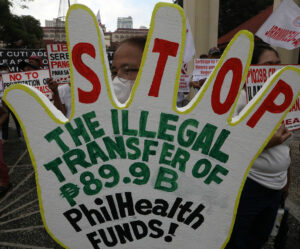

Supreme Court issues TRO vs PhilHealth fund transfer

Supreme Court issues TRO vs PhilHealth fund transfer

The Supreme Court (SC) issued on Tuesday a temporary restraining order (TRO) on the further transfer of excess funds of Philippine Health Insurance Corp. (PhilHealth) to the National Treasury.

“The TRO is effective immediately,” SC Spokesperson Camille Sue Mae L. Ting said. “The TRO is just really to prevent the further transfer of more funds from PhilHealth to the National Treasury.”

The SC consolidated the petitions filed by 1SAMBAYAN Coalition, a group led by Senator Aquilino Martin “Koko” D. Pimentel III and another group led by Bayan Muna Chairman Neri J. Colmenares.

The three petitions were filed to stop the transfer of PHP 89.9 billion in excess funds from PhilHealth to the National Treasury.

“All three petitions challenge the return of excess reserve funds from government-owned and -controlled corporations to the National Treasury to fund unprogrammed appropriations,” the SC public information office said in a statement.

The TRO was issued after P60 billion in PhilHealth funds have already been transferred to the Treasury in three tranches since May.

A fourth and final tranche worth PHP 29.9 billion was scheduled to be transferred to the Treasury in November.

Ms. Ting said it is still possible for the High Court to tackle the plea for a status quo ante order, which could allow the return of the PHP 60 billion to PhilHealth’s coffers.

The oral arguments scheduled for Jan. 14, 2025, would push through, she added.

A copy of the TRO had yet to be released.

In a statement, Finance Secretary Ralph G. Recto said the department “respects the Supreme Court’s intervention.”

“I recognize the right of every citizen to seek redress from the courts. Rest assured that the DoF (Department of Finance) will fully comply with the order of the Supreme Court,” he said.

“We give our full cooperation to the Supreme Court as we look forward to the opportunity to shed light on the issues presented during the oral arguments.”

A provision included in the 2024 General Appropriations Act allowed the DoF to issue Circular No. 003-2024, authorizing PhilHealth and the Philippine Deposit Insurance Corp. to transfer PHP 89.9 billion and PHP 110 billion, respectively.

These would help fund unprogrammed appropriations worth PHP 203.1 billion, which would support government programs in health, infrastructure and social services.

“We reiterate that before proceeding with the utilization of GOCC (government-owned or -controlled corporation) idle funds, our agency exercised due diligence and consulted extensively with the government’s legal experts,” Mr. Recto said.

“These include the Governance Commission for GOCCs, the Government Corporate Counsel and the Commission on Audit. These efforts were undertaken to ensure full compliance with our laws,” he added.

In a statement, PhilHealth said it fully respects and will abide by the ruling.

PhilHealth said it remains focused on its mission to provide healthcare to Filipinos through “better and responsive benefit packages and availment policies that ensure greater access to healthcare services.”

Solicitor-General Menardo I. Guevarra, whose office represents government agencies in legal cases, said they would “respect the TRO,” noting that it is “limited to PhilHealth funds only.”

One of the petitioners, former SC Senior Associate Justice Antonio T. Carpio, said the TRO “saves the poorest of the poor of Filipinos… whose only source of life-saving medicine is PhilHealth.”

“We hope that the Executive branch will return all the transferred funds back to PhilHealth pending the final decision of the Supreme Court,” he said in a Viber group chat message with reporters.

Mr. Carpio, along with 1SAMBAYAN, said in their petition that since PhilHealth funds are “special funds,” they cannot be transferred unless their purpose has been abandoned or accomplished.

They added that the fund transfers violated Article VI, Section 25 (5) of the Constitution. Under the Charter, “no law shall be passed authorizing any transfer of appropriations.”

Former Finance Undersecretary Cielo D. Magno, who filed the first petition questioning the transfer with Mr. Pimentel, said they are hoping the top court would declare the fund transfer as unconstitutional.

“This measure will temporarily stop the financial hemorrhage of PhilHealth,” she told BusinessWorld in a Viber message. – Chloe Mari A. Hufana, Reporter

Philippine motor vehicle production jumps 35% in Aug.

Philippine motor vehicle production jumps 35% in Aug.

Philippine motor vehicle output jumped by 34.7% in August, logging the second-fastest growth in the region, the ASEAN Automotive Federation (AAF) said.

In a report released on Tuesday, the AAF said the country produced 10,941 units in August, 2,816 more than 8,125 units produced a year earlier.

At 34.7%, the Philippine motor vehicle output growth was behind Myanmar’s 48.7% growth but faster than the 8.9% growth in Malaysia.

It also outperformed the 11.3% decline in the region during the month. A decline in output was seen in Vietnam (7.4%), Indonesia (14.6%), and Thailand (20.6%).

In the first eight months of 2024, Philippine motor vehicle production expanded by 17.3% to 86,585 units from 73,789 a year ago.

This was the second-fastest growth in the region, behind Myanmar, which expanded by 180% to 1,697 units in the first eight months from 606 last year.

In third spot was Malaysia, whose production grew 7.8% to 536,313 units from 497,309 a year ago.

Indonesia (18%), Thailand (17.7%), and Vietnam (8.5%) recorded a drop in production in the January-to-August period. The region’s production had fallen by 12% to 2.51 million as of end-August.

Meanwhile, motorcycle and scooter production in the Philippines surged by 101.3% in August to 115,974, the fastest growth so far this year.

The Philippines posted the highest growth in motorcycle and scooter production among the four countries in August. Indonesia posted a 6.9% growth in production to 630,601 units, followed by Malaysia where output went up 3.3% to 53,323 units.

Motorcycle and scooter production in Thailand slumped by 15.8% to 144,244 units in August.

Overall, the four countries produced 944,142 motorcycles and scooters in August, up by 8.5% from 870,144 units a year ago.

In the first eight months, Philippine motorcycle and scooter production jumped by 5.2% to 893,293, followed by Indonesia which increased production by 2.2% to 4.69 million.

Thailand saw a 12.2% drop in production to 1.29 million, while Malaysia’s output fell by 9.6% to 365,876.

This brought the region’s total motorcycle and scooter production to 7.24 million in the January-to-August period, down 1% from 7.31 million a year ago.

Vehicle manufacturers may have ramped up production in August in anticipation of increased demand.

Toyota Motor Philippines, Inc. (TMP) First Vice-President for Corporate Affairs Josephine Villanueva said production is also driven by market requirements.

“We have been placing greater importance in providing the best Toyota ownership experience to our customers. As the customer requirements continue to evolve, we ensure that we provide value-chain offerings suited to the needs of the Filipino market,” she said in a Viber message.

Rizal Commercial Banking Corp. Chief Economist Michael L. Ricafort said higher vehicle sales might have also spurred manufacturers to ramp up production.

“For the coming months, rate cuts could further reduce borrowing costs, thereby further supporting demand for auto and motorcycle loans that could, in turn, lead to faster growth in vehicle and motorcycle sales and production,” he said in a Viber message.

Last week, TMP President Masando Hashimoto cited cooling inflation, strong remittances from overseas Filipino workers and interest rate cuts as revenue drivers.

In the AAF report, the Philippines had the third-fastest growth in motor vehicle sales in the first eight months at 10.3% to 304,765 units.

Meanwhile, motorcycle and scooter sales grew 4.9% in the January-to-August period to 1.1 million, representing the fastest growth in the region.

Region-wide, motor vehicle sales declined by 7.7% to 2.02 million, while motorcycle sales were almost flat (0.3%) at 6.98 million. – Justine Irish D. Tabile, Reporter

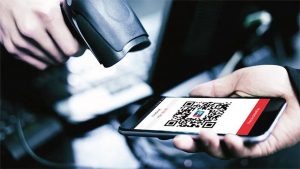
BSP sees some gaps in digital payment use

BSP sees some gaps in digital payment use

The Philippines has made progress in promoting digital payments, but there are still many barriers to hurdle before it meets its digitalization goals, the Bangko Sentral ng Pilipinas (BSP) said.

“We recognize that while there is a sustained increase in the use of digital payments, there are still gaps that need to be addressed holistically,” BSP Deputy Director Maria Christina S. Masangkay said during a central bank’s public information campaign.

“Indeed, we have come a long way but still have far to go. We have reached our 50% goal, yet survey results show that we still have a lot to overcome,” she said in mixed English and Filipino.

Earlier data from the BSP showed the share of online payments in the total volume of monthly retail transactions rose to 52.8% in 2023 from 42.1% in 2022. This was slightly higher than the central bank’s target of digitalizing 50% of the volume of retail payments by end-2023.

The BSP is targeting to achieve a 60-70% share of digital payments over the total retail payment volume by 2028.

Ms. Masangkay said there is a need to improve access to digital infrastructure, enhance internet connectivity, make fees for digital payments more affordable and promote the widespread acceptance of digital payments.

“In overcoming these barriers, the BSP has been proactive in providing the enabling policy and regulatory framework that supports the digitalization of priority payment risk cases most relevant to consumers, may they be individuals, businesses or the government.”

“Some of this may not fall squarely within the BSP purview. Thus, strategic collaborations with stakeholders, both from the government and the private sectors, are being pursued,” she added.

Ms. Masangkay noted the central bank’s recent efforts to promote digital payments, such as pushing for PESONet, InstaPay, QR Ph and Bills Pay Ph to become the “preferred mode of payments” for Filipinos.

“Other payment streams in the pipeline will further support the person-to-business, business-to-business, and person-to-person segments,” she added.

The BSP earlier announced it was developing new facilities to boost digital payments, such as the request to pay (RTP) facility and direct debit facility.

Last year, the bulk or 84.4% of retail payments made were from merchant and supplier payments, BSP data showed.

The central bank also seeks to enhance cross-border payments to “increase the business competitiveness of the Philippines’ e-commerce, exports and international trade sector,” Ms. Masangkay said.

In March 2023, the BSP and four other central banks in the region said they would connect their domestic instant payment systems through the Bank for International Settlements’ Project Nexus.

“The BSP’s efforts to promote digitalization of payments are strategically geared towards advancing financial inclusion by ensuring an efficient, safe, and secure digital payments ecosystem that supports the needs of our stakeholders while also increasing the number of Filipinos who have access to financial services,” BSP Assistant Governor Zeno R. Abenoja said.

Bank notes still needed

Meanwhile, GlobalSource Partners said the Philippines still requires the use of banknotes despite the rapid shift to digital because it lacks the infrastructure to accommodate the transition.

GlobalSource country analysts Diwa C. Guinigundo and Wilhelmina C. Mañalac said the country’s digital transition “still has a long road ahead.”

“If some quarters believe that these trends could dislodge the use of banknotes in the Philippines… this may not be the case, just as yet,” they said in a report.

“The reason is obvious. The Philippines continues to be challenged by the limited communication connectivity including the issues of internet coverage, speed and cost. There is a big deficit in physical infrastructure that is critical to online, digital payments and settlements.”

It cited the BSP’s recent announcement of collaborating with German government banknote printer Bundesdruckerei GmbH to improve currency production and share knowledge on payment management.

BSP Governor Eli M. Remolona, Jr. said there is still a need for banknotes even as more people shift to electronic payments.

Banknotes should also be made “more secure, more durable and even more sustainable,” Mr. Remolona said.

GlobalSource said the partnership to future-proof banknotes showed that the “transition to a higher level of digitalization may still be a remote target, considering the challenges of weak connectivity and infrastructure backbone.”

At the start of 2024, internet penetration in the Philippines stood at 73.6%, according to the “Digital 2024” report by DataReportal. This meant that 26.4% of the country’s population remained offline at the beginning of the year.

“Between urban cities and rural areas, digital access could not be more stark. Fixed broadband speed averages only around 95 Mbps (megabits per second), so much lower than say, Singapore, where internet speed can be as fast as 291 Mbps,” GlobalSource added. — Luisa Maria Jacinta C. Jocson

IMF: Inflation risks still tilted to upside

IMF: Inflation risks still tilted to upside

The International Monetary Fund (IMF) said that upside risks to the outlook for Philippine headline inflation still persist.

“Risks to the inflation outlook have receded somewhat but remain tilted to the upside,” a representative of the IMF told BusinessWorld in an e-mail.

“Food prices remain vulnerable to adverse supply shocks, and rising geopolitical tensions and recurrent commodity price volatility also pose upside risks,” it added.

Bangko Sentral ng Pilipinas (BSP) Governor Eli M. Remolona, Jr. earlier said that the balance of risks to the inflation outlook for next year until 2026 has shifted to the upside.

This is primarily due to expectations of higher electricity rates and minimum wages, he said.

Regional wage boards earlier this month approved a hike in the daily minimum wages of workers in Cagayan Valley, Central Luzon and Soccsksargen.

In July, the Regional Tripartite Wages and Productivity Board also approved a PHP 35 minimum daily wage hike for workers in the National Capital Region.

Meanwhile, the IMF sees inflation settling at 3.3% this year and 3% in 2025.

The BSP expects inflation to average 3.1% this year and accelerate to 3.2% next year and 3.4% in 2026.

The IMF said that “decisive monetary tightening and non-monetary measures” have helped tame food inflation in the Philippines.

“Lower commodity prices have helped bring inflation down to within the BSP’s target band,” it said.

Headline inflation eased to 1.9% in September from 3.3% in August. The September print was also the slowest in over four years or since the 1.6% print in May 2020.

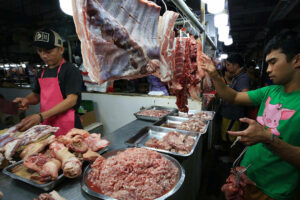
Food inflation slowed to 1.4% from 4.2% a month ago. This as rice inflation sharply slowed to 5.7% in September from 14.7% in August and 17.9% last year.

“The BSP reduced its policy rate by 25 basis points (bps) in both its August and October meetings this year, consistent with inflation and inflation expectations returning towards the target,” the IMF said.

Since it began its easing cycle in August, the Monetary Board has reduced policy rates by 50 bps, bringing the key rate to 6%.

Mr. Remolona earlier said the central bank could deliver another 25-bp rate cut at the last policy-setting review on Dec. 19.

Current account

Meanwhile, the IMF sees the country’s current account deficit further easing in the near term.

“The narrowing of the current account deficit in 2024 and 2025 will be supported by lower commodity prices, a gradual pickup in exports, supported by tourism returning towards pre‑pandemic levels and demand for the business process outsourcing sector holding up,” the IMF said.

The IMF expects the Philippines’ current account deficit to settle at 2.2% of gross domestic product (GDP) this year and ease further to 1.8% in 2025 and 1.1% by 2029.

“Inward remittances are also expected to rise slightly,” it added.

In the January-August period, cash remittances expanded by 2.9% to USD 22.22 billion from USD 21.58 billion a year earlier. The BSP expects cash remittances to grow by 3% this year.

“Over the medium term, the current account is expected to be supported by a continued gradual rise in exports,” the IMF said.

“From a saving‑investment perspective, the current account improvement is expected to be driven by a rise in private and public savings, with the latter underpinned by the government’s plans to implement a gradual medium-term fiscal consolidation,” it added.

In the first half of the year, the country’s current account deficit stood at USD 7.1 billion, accounting for 3.2% of GDP.

The BSP expects the current account deficit to reach $6.8 billion this year or 1.5% of GDP. – Luisa Maria Jacinta C. Jocson, Reporter

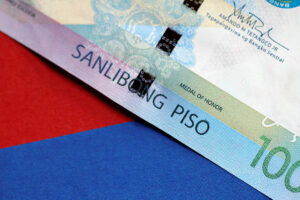
Trump win could pose risk to peso, other Asian currencies — analysts

Trump win could pose risk to peso, other Asian currencies — analysts

The return of Donald J. Trump to the US presidency could cause Asian currencies such as the Philippine peso to weaken, analysts said.

“We suspect Asian currencies would underperform under a Trump presidency, even if they don’t seem to have been affected worse than others by the apparent rise in his chances of winning lately,” Capital Economics said in a report.

The peso closed at PHP 58.225 per dollar on Monday, strengthening by 9.5 centavos from its PHP 58.32 finish on Friday.

Last week, the local unit fell to the PHP 58-per-dollar level for the first time since Aug. 2.

“What’s more, that rise has coincided with an increase in the chances of a Trump election win, if prediction markets are to be believed. And his policies could be a particularly stiff headwind for Asia’s currencies,” Capital Economics said.

Republican nominee Mr. Trump has made stringent trade restrictions among his proposed policies, eyeing to impose tariffs of 60% or higher on all Chinese goods as well as a 10% or even 20% universal tariff.

Analysts noted the potential weakness of the peso amid a Trump presidency.

“If Republicans sweep elections, tariff hikes and closing of borders to immigrants can mean higher inflation and higher rates in the US, which can underpin US-dollar strength,” Bank of the Philippine Islands Lead Economist Emilio S. Neri, Jr. said.

Rizal Commercial Banking Corp. Chief Economist Michael L. Ricafort said markets are already pricing in a Trump victory, which had led to the strengthening of the US dollar versus other major global currencies.

“Any Trump victory could lead to higher US inflation amid possible trade war that could lead to higher tariff rates on imports from China and other countries, tighter immigration rules that could increase US labor costs, deficit spending on possible tax cuts and economic stimulus, among others,” he said.

Mr. Trump is up against Democratic candidate Vice-President Kamala Harris in the US presidential elections scheduled on Nov. 5.

“Any Trump presidency would lead to more protectionist policies that could potentially slow down global trade, similar to the first Trump administration, and could also slow down foreign direct investments, OFW remittances with tighter immigration rules,” Mr. Ricafort said.

Latest data from the local statistics authority showed the United States remained the top destination of Philippine-made goods in August. It recorded an export value of USD 1.22 billion, accounting for 18.1% of the total imports during the month.

In the first eight months, cash remittances expanded by 2.9% to USD 22.22 billion from USD 21.58 billion a year earlier. The United States accounted for nearly half or 41.3% of overall remittances during the period.

Capital Economics noted that Mr. Trump’s campaign rhetoric “probably may not translate directly into policy.”

“But tariffs are one of the easier parts of Trump’s agenda for him to enact. And the region’s central banks are unlikely to fight depreciation pressure if he does. So, our sense is that Asian FX (foreign exchange) could still be in for a tough ride if Trump were to prevail,” it added. – Luisa Maria Jacinta C. Jocson, Reporter

Philippines aims to be in top 20% in World Bank’s Business Ready report

Philippines aims to be in top 20% in World Bank’s Business Ready report

The Philippines is hoping to be included among the top 20% of the countries assessed by the World Bank for its Business Ready (B-READY) report by 2026, the Anti-Red Tape Authority (ARTA) said.

“We should always aim for the top. We shouldn’t just be in the top 40%, but 20%… For 2026 that is our aim,” said ARTA Director-General Ernesto V. Perez on the sidelines of the Ease of Doing Business Convention on Monday.

The B-READY report assesses the business and investment climate by considering three pillars: regulatory framework, public services, and operation efficiency.

In the inaugural World Bank B-READY report released earlier this month, the Philippines ranked 16th out of 50 economies in the regulatory framework with 70.68 points. This made the Philippines among the top 40% of economies in terms of regulatory framework.

“By 2028, our target really is to improve our economy, and as we all know, the survey results have a direct bearing on our foreign direct investments. Investors look at the country’s performance in the ranking when they decide to invest in the country,” Mr. Perez said.

He said the surveys today are no longer just focused on Quezon City but across the country, which makes them very technical.

“This is why ARTA is really focused on this. We are really studying how we can really improve our ranking,” he added.

However, the B-READY report showed the Philippines ranked 24th in public services and 36th in operational efficiency.

“Hopefully, in the next survey result, which is going to be two years from now, as we are not going to participate in this coming survey period,” he said.

The World Bank’s next B-READY report is scheduled to be released in 2026.

“We will not stop. Having been designated by the President as the focal point for the B-READY report, we are going to form technical working groups (TWG) to address the 10 priority areas,” Mr. Perez said.

The TWG will include representatives from the Securities and Exchange Commission, Philippine Health Insurance Corp., Home Development Mutual Fund (Pag-IBIG), Social Security System, Bureau of Internal Revenue, and the Department of Trade and Industry, among others.

“The laws and regulations are already there and only need to be implemented, and the best way to implement them is to gather all the agencies involved and the support of the private sector,” Mr. Perez said.

Next month, ARTA will conduct a public sector consultation on the formulation of reform guidebook that will serve as the agency’s roadmap in making the Philippines more business ready.

Aside from the public consultation, ARTA will also conduct meetings with different agencies involved until December. It targets to finalize the reform guidebook by June 2025.

ARTA will be focusing on the improvement of regulatory framework, public services, and operational efficiency from 2024 to 2026, while digital transformation is set to be a continued focus until 2028.

Under the Ease of Doing Business Act, local government units (LGUs) are required to implement an electronic business one-stop shop to expedite processing of all business permits.

“Currently, 112 LGUs have complied with this requirement… and as records show, those first 10 LGUs that have been able to set up one have experienced substantial increases in their number of business registrations and revenue collections,” said Mr. Perez.

“This is the best evidence that when we streamline and digitalize government processes, we can be effective in our fight against red tape and corruption in the process,” he added.

Meanwhile, World Bank Group Lead Economist and Program Leader for Brunei, Malaysia and Philippines Prosperity Gonzalo Varela said that the framework of the B-READY report follows the life cycle of a firm. This covers  business entry, business location, utility services, labor, financial services, international trade, taxation, dispute resolution, market competition, and business insolvency.

“If we look by area, business entry is a crucial one because, in a way, regulations or poor implementation of regulations that prevent business entry are barriers to competition or barriers to having a more dynamic business environment,” said Mr. Varela.

The Philippines scored 48 points in business entry, landing at the bottom 20% economies for this area. 

“It’s in operational efficiency and public services where the efforts probably should be placed,” he said.

The Philippines scored 43 points out of 100 on public services and 14 points on operational efficiency.

Mr. Varela also said key areas for improvement include business location, market competition and business insolvency.

However, Guillermo M. Luz, chairman of the Asian Institute of Management – Rizalino S. Navarro Policy Center for Competitiveness Advisory Council, said that the country’s overall goal “should go beyond a higher competitiveness ranking.”

“Our ultimate goal has to be increased investments, economic growth and greater inclusive growth where we see significant drops in poverty incidence and corresponding growth of our middle class,” he said in a keynote message.

“It is only growing our middle class that we can hope to build sustainability, socially, politically and economically, from which to create genuine economic development,” he added. – Justine Irish D. Tabile, Reporter

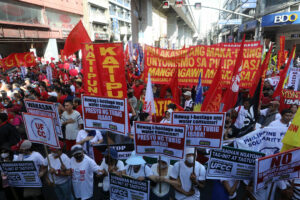
Philippines’ score drops in Labor Rights Index

Philippines’ score drops in Labor Rights Index

The Philippines’ score in the global Labor Rights Index worsened this year, largely due to an environment that restricts unions, strikes, and collective bargaining deals.

A study by the Amsterdam-based WageIndicator Foundation and the Center for Labor Research showed the Philippines logged a score of 68 out of 100 in the global Labor Rights Index this year, falling 2.5 points from a 70.5 score in 2022.

According to the scale, a score of 60.5 to 70 means there is limited access to decent work.

Philippines worsens in Labor Rights Index

However, the Philippines’ score was below the global average of 74.

The Labor Rights Index scored economies based on labor laws only, discounting the actual working conditions or labor law compliance in workplaces, the Dutch organization said in a statement.

The biennial report showed that the country maintained its 2022 scores in nine of the 10 indicators in the study, except for Freedom of Association, where it scored zero out of 100.

“The Philippines saw a negative score adjustment in the Freedom of Association Indicator,” it said. It cited the provision in the Labor Code that a trade union “must demonstrate majority support in a bargaining unit for engaging in collective bargaining.”

University of the Philippines-Diliman School of Labor and Industrial Relations Assistant Professor Benjamin B. Velasco said the score on the rights of association and collective bargaining was “not surprising” due to the labor-related killings in the country and the unimplemented recommendations of the International Labor Organization High-Level Mission last year.

“The challenge for [the country] is how to improve its institutions (Department of Labor and Employment, labor inspectors, Philippine Economic Zone Authority, police, and military) so that laws (labor-related or otherwise) are implemented fairly and judiciously. Unfortunately, this is easier said than done,” he added in a Facebook Messenger chat.

The Philippines posted a score of 100 for the Maternity at Work indicator, which is attributed to policies supporting maternity leave, benefits, and job protection for pregnant workers.

Philippine laws mandate at least 14 weeks of paid maternity leave, with cash benefits covering a substantial portion of a worker’s wages.

The Philippines had a score of 80 in four indicators: Fair Wages, Employment Security, Social Security, and Fair Treatment.

For Fair Wages, it cited Philippine laws on minimum wages and overtime compensation but noted the lack of a law requiring additional compensation for working on a weekly rest day.

For Employment Security, it cited laws that require written employment contracts and severance of at least two weeks’ wages for every year of service. However, there is no law that limits the probationary period to three months.

Bukluran ng Manggagawang Pilipino National President Renecio “Luke” S. Espiritu called the scores for Fair Wages and Employment Security as “absurd,” noting that the minimum wage in the country (PHP 7,531) is only a third of the living wage (PHP 21,494).

“We in the labor movement will not stop in our fight to abolish all manpower agencies, a legislated wage increase of PHP 750 plus, and guaranteeing union rights,” he said in a Facebook Messenger chat.

Meanwhile, the country scored 75 in both Safe Work and Child and Forced Labor as there is a lack of law restricting work that is prejudicial to the health of the mother or the child, and the lack of law setting employment entry age equal to or higher than the compulsory schooling age.

The Philippines scored 60 on Decent Working Hours, since it lacks laws restricting maximum working hours, including overtime, to 56 hours per week and requiring at least three working weeks of paid annual leave.

It also scored 50 on Family Responsibilities as there is no law requiring four-month parental leave for parents and flexible working arrangements for workers with family responsibilities.

“Comparing with other [Southeast Asian] countries. [The Philippines scored] higher than average. But this is because the ranking is based on legislation, not implementation,” Mr. Velasco said. “If enforcement is taken into consideration, I believe the Philippines will [score] lower.”

The Labor Rights Index 2024 is a de-jure index covering 145 economies and structured around the working lifespan of a worker.

In total, 46 questions or evaluation criteria are scored across 10 indicators. The overall score is calculated by taking the average of each indicator, with 100 being the highest possible score.

Greece and Hungary are among the top scorers, with 96 points each, while Nigeria is the worst with 37 points. – Chloe Mari A. Hufana, Reporter

Philippines on final steps to exit FATF ‘gray list’ by 2025

Philippines on final steps to exit FATF ‘gray list’ by 2025

The Philippines has made headway in its bid to exit the Financial Action Task Force’s (FATF) “gray list” by next year as it has “substantially completed” its remaining action items.

“Yes, I think we passed a very important step,” Bangko Sentral ng Pilipinas (BSP) Governor Eli M. Remolona, Jr. said in a text message.

This after the FATF kept the Philippines in its list of jurisdictions under increased monitoring for “dirty money” risks in its October plenary.

The Philippines has now been on the gray list for over three years or since June 2021.

However, the FATF said the country has addressed the remaining deficiencies in the recommended action items to improve its anti-money laundering and counter financing of terrorism (AML/CFT) regime.

“We’re very happy to report and for me to share with you that this week the plenary examined the progress of the Philippines and consider that the Philippines has indeed substantially completed this action plan,” FATF President Elisa de Anda Madrazo said at a press conference late on Friday.

The FATF will conduct an on-site visit to verify this progress, which is set to take place anytime between now and February 2025.

“An on-site visit means that a group of experts go into the country to verify the progress that it has made so that the FATF can decide whether to remove it from the gray list or not. We will expect an answer on this in February of 2025,” she added.

The on-site assessment will also “verify if the implementation of AML/CFT reforms has begun and is being sustained, and that the necessary political commitment remains in place to sustain implementation in the future,” the FATF said on its website.

The Anti-Money Laundering Council (AMLC) in a statement said the country is now “closer to exiting the anti-money laundering watchlists by 2025.”

This would pave the way for Filipinos, particularly overseas workers, to “benefit from faster and cheaper remittances and other transactions,” it added.

“Failure to address the remaining action plan items would have put the Philippines at risk of entering the blacklist,” the AMLC said.

“FATF member countries impose restrictions and additional checks, and possibly refusal of financial transactions with countries in the blacklist. This results in failed transactions, delays, and costs that may be passed on to the consumers,” it added.

AMLC said that the FATF’s Asia-Pacific Joint Group will visit the country early next year to “verify the sustainability of the AML/CTF reforms.”

“This is the final step toward the country’s removal from the gray list,” it added.

The FATF last week said the Philippines has implemented key reforms such as “demonstrating that risk-based supervision of Designated Non-Financial Businesses and Professions (DNFBPs) is occurring; demonstrating that supervisors are using AML/CFT controls to mitigate risks associated with casino junkets; implementing the new registration requirements for Money or Value Transfer Services (MVTS) and applying sanctions to unregistered and illegal remittance operators.”

In July, Malacañang issued an executive order mandating all government offices to adopt the National Anti-Money Laundering, Counter-Terrorism Financing, and Counter-Proliferation Financing Strategy 2023-2027.

The FATF also noted the country’s reforms focused on streamlining law enforcement agencies’ access to beneficial ownership information and increasing number of money laundering investigations and prosecutions.

FATF’s Ms. Madrazo said that the Philippines is an “example of the positive impact that this process can have in a country.”

“With billions of dollars flowing into the country annually and the sheer volume of cross-border transactions, the progress made by the Philippines will have a huge impact in the security of the international financial system,” she added

Meanwhile, analysts said the country is well on its way to exiting the gray list, but continued implementation of reforms is still needed.

“There is a good possibility to exit from the list if a clear warning and information dissemination of the need to be compliant to ‘entities with potential’ violations of FATF are done. Continuous monitoring of these entities must be done,” Antonio A. Ligon, a law and business professor at De La Salle University in Manila, said in a Viber message.

On the other hand, Chester B. Cabalza, founding president of International Security and Development Center, said that the on-site visit is still a “reaffirmation that the country is still risky for dirty money that needs to be cleansed.”

“Transparency in our financial records and strong coordination for line government agencies are needed to address this discrepancy,” he said. “The Philippines has to get out from the gray list to become more productive and return to a healthy financial environment in the region.”

Leonardo A. Lanzona, an economics professor at the Ateneo de Manila University, said it will be crucial to address poverty and corruption if it wishes to get to the bottom of dirty money risks.

“While the government is setting the institutional requirements in moving out of the gray list, the overriding condition that keeps the country in the list remains. This pertains to poverty which is not a direct requirement in the list but can indirectly influence the required factors in moving out of the list,” he said in an e-mail.

Mr. Lanzona said poverty contributes to informality and “breeds unregulated transactions and corrupt financial networks that are not allowed by FATF.” – Luisa Maria Jacinta C. Jocson, Reporter

Gov’t borrowings surge in September

Gov’t borrowings surge in September

The national government’s (NG) gross borrowings  spiked in September as its dollar bond issuance drove up foreign debt, the Bureau of the Treasury (BTr) said.

Data from the BTr showed that total gross borrowings soared by 255.64% to PHP 367.18 billion in September from PHP 103.25 billion in the same month a year ago.

Month on month, gross borrowings more than doubled from PHP 174.03 billion in August.

The bulk or 60% of September’s gross borrowings came from external sources.

Gross external debt surged to PHP 221.98 billion in September from PHP 11.18 billion last year.

External borrowings in September included PHP 140.99 billion in global bonds, PHP 72.65 billion in program loans, and P8.35 billion in new project loans.

On the other hand, gross domestic borrowings jumped by 57.71% to PHP 145.2 billion in September from PHP 92.07 billion a year earlier.

This consisted of P120 billion in fixed-rate Treasury bonds (T-bonds) and PHP 25.2 billion in Treasury bills (T-bills).

Rizal Commercial Banking Corp. Chief Economist Michael L. Ricafort said the surge in September borrowings was mainly due to the latest dollar bond issuance.

In August, the government raised USD 2.5 billion from the issuance of triple-tranche US dollar-denominated global bonds. The transaction, which was finalized in September, was the country’s second foray into the international debt market this year.

The beginning of the easing cycle of the Bangko Sentral ng Pilipinas (BSP) and US Federal Reserve also supported the spike in domestic borrowings in September amid “favorable” borrowing costs, Mr. Ricafort said.

“US and local government bond yields posted bigger declines than the policy rates, resulting in more savings for the government and other borrowers, and making it more attractive to hedge immediate borrowing requirements,” Mr. Ricafort said in a Viber message.

Since starting its easing cycle in August, the BSP has lowered borrowing costs by a total of 50 basis points (bps), bringing the key policy rate to 6%.

For its part, the US Federal Reserve last month slashed interest rates by 50 bps to the 4.75% to 5% range.

Philippine Institute for Development Studies Senior Research Fellow John Paolo R. Rivera said the government needed to ramp up its borrowings in September to fund the wider fiscal gap.

“The increase in external gross borrowings may be from the need to reduce budget deficits alongside fiscal consolidation and enhanced revenue generation,” he said in a Viber message.

For the first nine months of 2024, the budget deficit narrowed by 1.35% to PHP 970.2 billion from PHP 983.5 billion a year ago.

“External and domestic borrowings may also be used for unplanned expenses such as calamity response, recovery expenses, and sustained infrastructure investments,” Mr. Rivera added.

New-month period

Meanwhile, the BTr reported that gross borrowings in the January-September period jumped by 31.42% to PHP 2.3 trillion from PHP 1.75 trillion last year.

The majority or 78.07% of gross borrowings in the nine-month period were from domestic sources.

Domestic debt as of end-September stood at PHP 1.8 trillion, up by 33.55% from PHP 1.34 trillion in the same period a year ago.

These were made up of PHP 1.02 trillion in fixed-rate T-bonds, PHP 584.86 billion in retail T-bonds, and PHP 186.92 billion in T-bills.

External debt in the first nine months rose by 24.33% to PHP 504.45 billion from PHP 405.74 billion a year prior.

This was composed of PHP 256.24 billion in global bonds, PHP 173.15 billion in program loans, and PHP 75.06 billion in new project loans.

Further rate cuts will likely encourage more borrowings in the last three months of 2024, Mr. Ricafort said.

“As interest rates globally and locally would continue to decline in the coming months, this would make borrowings more attractive, in view of the need to constantly finance future budget deficits.”

This year’s borrowing plan is set at PHP 2.57 trillion, with PHP 1.92 trillion coming from domestic sources and P646.08 billion from overseas, according to the latest Budget of Expenditures and Sources of Financing data. — Beatriz Marie D. Cruz

Posts navigation

Older posts
Newer posts

Recent Posts

  • Navigating precarious times with cost averaging
  • Trade Update: Wider trade deficit in February
  • Metrobank US-Iran Risk Index: No swift end seen
  • Investment Ideas: March 27, 2026
  • BSP Update: First rate hike likely in June 

Recent Comments

No comments to show.

Archives

  • March 2026
  • February 2026
  • January 2026
  • December 2025
  • November 2025
  • October 2025
  • September 2025
  • August 2025
  • July 2025
  • June 2025
  • May 2025
  • April 2025
  • March 2025
  • February 2025
  • January 2025
  • December 2024
  • November 2024
  • October 2024
  • September 2024
  • August 2024
  • July 2024
  • June 2024
  • May 2024
  • April 2024
  • March 2024
  • February 2024
  • January 2024
  • December 2023
  • November 2023
  • October 2023
  • September 2023
  • August 2023
  • July 2023
  • June 2023
  • May 2023
  • April 2023
  • March 2023
  • February 2023
  • January 2023
  • December 2022
  • November 2022
  • October 2022
  • September 2022
  • August 2022
  • July 2022
  • June 2022
  • May 2022
  • March 2022
  • December 2021
  • October 2021

Categories

  • Bonds
  • BusinessWorld
  • Currencies
  • Economy
  • Equities
  • Estate Planning
  • Explainer
  • Featured Insight
  • Fine Living
  • How To
  • Investment Tips
  • Markets
  • Portfolio Picks
  • Rates & Bonds
  • Retirement
  • Reuters
  • Spotlight
  • Stocks
  • Uncategorized

You are leaving Metrobank Wealth Insights

Please be aware that the external site policies may differ from our website Terms And Conditions and Privacy Policy. The next site will be opened in a new browser window or tab.

Cancel Proceed
Get in Touch

For inquiries, please call our Metrobank Contact Center at (02) 88-700-700 (domestic toll-free 1-800-1888-5775) or send an e-mail to customercare@metrobank.com.ph

Metrobank is regulated by the Bangko Sentral ng Pilipinas
Website: https://www.bsp.gov.ph

Quick Links
The Gist Webinars Wealth Manager Explainers
Markets
Currencies Rates & Bonds Equities Economy
Wealth
Investment Tips Fine Living Retirement
Portfolio Picks
Bonds Stocks
Others
Contact Us Privacy Notice Terms of Use
© 2026 Metrobank. All rights reserved.

Access this content:

If you are an existing investor, log in first to your Metrobank Wealth Manager account. ​

If you wish to start your wealth journey with us, click the “How To Sign Up” button. ​

Login HOW TO SIGN UP