MODEL PORTFOLIO
THE GIST
NEWS AND FEATURES
Global Philippines Fine Living
INSIGHTS
INVESTMENT STRATEGY
Economy Stocks Bonds Currencies
THE BASICS
Investment Tips Explainers Retirement
WEBINARS
2024 Mid-Year Economi Briefing, economic growth in the Philippines
2024 Mid-Year Economic Briefing: Navigating the Easing Cycle
June 21, 2024
Investing with Love
Investing with Love: A Mother’s Guide to Putting Money to Work
May 15, 2024
retirement-ss-3
Investor Series: An Introduction to Estate Planning
September 1, 2023
View All Webinars
DOWNLOADS
Container ship carrying container boxes import export dock with quay crane. Business commercial trade global cargo freight shipping logistic and transportation worldwide oversea concept. Generative AI
Economic Updates
Philippines Trade Update: Wider deficit on strong imports
DOWNLOAD
Frick collection with palm trees 
Economic Updates
Policy Rate Updates: Policy rate updates to reassure 
DOWNLOAD
Man using his smartphone
Reports
Fed to cut just once 
DOWNLOAD
View all Reports
Metrobank.com.ph How To Sign Up
Follow us on our platforms.

How may we help you?

TOP SEARCHES
  • Where to put my investments
  • Reports about the pandemic and economy
  • Metrobank
  • Webinars
  • Economy
TRENDING ARTICLES
  • Investing for Beginners: Following your PATH
  • On government debt thresholds: How much is too much?
  • Philippines Stock Market Outlook for 2022
  • Deficit spending remains unabated

Login

Access Exclusive Content
Login to Wealth Manager
Visit us at metrobank.com.ph How To Sign Up
Access Exclusive Content Login to Wealth Manager
Search
MODEL PORTFOLIO THE GIST
NEWS AND FEATURES
Global Philippines Fine Living
INSIGHTS
INVESTMENT STRATEGY
Economy Stocks Bonds Currencies
THE BASICS
Investment Tips Explainers Retirement
WEBINARS
2024 Mid-Year Economi Briefing, economic growth in the Philippines
2024 Mid-Year Economic Briefing: Navigating the Easing Cycle
June 21, 2024
Investing with Love
Investing with Love: A Mother’s Guide to Putting Money to Work
May 15, 2024
retirement-ss-3
Investor Series: An Introduction to Estate Planning
September 1, 2023
View All Webinars
DOWNLOADS
Container ship carrying container boxes import export dock with quay crane. Business commercial trade global cargo freight shipping logistic and transportation worldwide oversea concept. Generative AI
Economic Updates
Philippines Trade Update: Wider deficit on strong imports
March 27, 2026 DOWNLOAD
Frick collection with palm trees 
Economic Updates
Policy Rate Updates: Policy rate updates to reassure 
March 26, 2026 DOWNLOAD
Man using his smartphone
Reports
Fed to cut just once 
March 19, 2026 DOWNLOAD
View all Reports

Archives: Business World Article

Yields on term deposits drop on strong demand

Yields on term deposits drop on strong demand

Term deposit yieds fell on Wednesday amid strong demand for the offering ahead of the release of Philippine November inflation data.

The Bangko Sentral ng Pilipinas’ (BSP) term deposit facility (TDF) attracted total bids worth PHP 342.937 billion on Wednesday, well above the PHP 260 billion placed on the auction block and the PHP 250.598 billion in bids fetched a week ago for a PHP 280-billion offer.

Broken down, bids for the seven-day term deposits stood at PHP 213.622 billion, above the PHP 150-billion offer as well as the PHP 154.953 billion in tenders for the PHP 160 billion auctioned off a week ago.

Accepted rates were from 5.9755% to 6.06%, narrower than the 5.975% to 6.0815% range a week ago. As a result, the average rate for the one-week deposits fell by 1.59 basis points (bps) to 6.0425% from 6.0584% last week.

Meanwhile, tenders for the 14-day papers reached PHP 129.315 billion, higher than the PHP 110 billion auctioned off by the central bank. It was also above the PHP 95.645 billion in bids for the PP120-billion worth of deposits offered last week.

Banks asked for yields ranging from 6% to 6.11%, also narrower than the 6% to 6.125% margin a week earlier. This caused the average rate of the two-week deposits to slip by 0.86 bp to 6.0816% from the 6.0902% quoted the previous week.

The BSP has not auctioned off 28-day term deposits for more than four years to give way to its weekly offerings of securities with the same tenor.

The central bank uses the term deposits and BSP bills to help mop up excess liquidity in the financial system and to better guide market rates.

“The BSP TDF average auction yields mostly eased slightly for the 11th straight week ahead of the latest local inflation data that is expected to remain relatively benign at 2% levels,” Michael L. Ricafort, chief economist at Rizal Commercial Banking Corp., said in a Viber message.

The Philippine Statistics Authority is scheduled to release November inflation data on Thursday (Dec. 5.)

Philippine headline inflation likely picked up to 2.5% in November, according to the median estimate in a BusinessWorld poll of 15 analysts conducted last week.

This is within the central bank’s 2.2% to 3% forecast for the month as well as its 2-4% annual target.

This would also be slightly faster than the 2.3% clip in October but slower than 4.1% in the same month a year ago.

The central bank expects headline inflation to average 3.1% this year. In the first 10 months, the consumer price index averaged 3.3%.

Easing inflation would also make room for further monetary easing by the BSP, Mr. Ricafort said.

BSP Governor Eli M. Remolona, Jr. has said that the Monetary Board could reduce or keep rates steady at its Dec. 19 meeting, its last policy review for the year.

Since August, the central bank has lowered benchmark borrowing costs by 50 bps, bringing the policy rate to 6%. — Luisa Maria Jacinta C. Jocson

Philippine government’s debt reaches record PHP 16 trillion

Philippine government’s debt reaches record PHP 16 trillion

The national government’s (NG) outstanding debt inched up to a fresh high of PHP 16.02 trillion as of end-October amid the peso’s depreciation against the US dollar, the Bureau of the Treasury (BTr) said.

Data from the BTr on Tuesday showed that outstanding debt went up by 0.8% or by PHP 126.95 billion to PHP 16.02 trillion as of end-October from PHP 15.89 trillion as of end-September.

“The increase was primarily driven by the valuation impact of peso depreciation against the US dollar from PHP 56.017 at end-September 2024 to PHP 58.198 at end-October 2024,” the BTr said in a statement.

National Government outstanding debtYear on year, debt jumped by 10.6% from PHP 14.48 trillion. Of the total debt stock, 67.98% came from domestic sources.

As of end-October, outstanding domestic debt slid by 0.4% to PHP 10.89 trillion from PHP 10.94 trillion at the end of September.

Government securities accounted for nearly all of domestic debt.

Year on year, domestic debt increased by 10% from PHP 9.9 trillion.

“The decline was primarily due to the PHP 52.65-billion net redemption of government securities, partially offset by the PHP 6.23-billion escalation in peso conversion of US dollar-denominated domestic debt brought about by the weakened peso,” the BTr said.

Meanwhile, external debt rose by 3.5% to PHP 5.13 trillion at end-October from PHP 4.96 trillion at end-September, the BTr said.

Year on year, external debt increased by 12.05% from PHP 4.58 trillion in the same period a year ago.

“The increase was driven by net foreign loan availments totaling PHP 20.47 billion, as well as foreign exchange movements, which added P152.9 billion to external debt,” BTr said.

The Treasury said the peso depreciation against the US dollar has increased external debt by PHP 193 billion.

“However, this has been tempered by the PHP 40.1-billion effect of favorable third-currency movements relative to the US dollar,” it said.

External debt comprised of PHP 2.42 trillion in loans and PHP 2.71 trillion in global bonds as of end-October.

Broken down, government securities consisted of PHP 2.32 trillion in US dollar bonds, PHP 218.49 billion in euro bonds, PHP 58.2 billion in Islamic certificates, PHP 57.93 billion in Japanese yen bonds, and PHP 54.77 billion in peso global bonds.

Meanwhile, the NG guaranteed obligations at the end-October increased by 10.4% to PHP 411.76 billion from PHP 372.86 billion as of end-September.

“This resulted from PHP 35.85 billion in net availments of domestic guarantees and the P6.15-billion effect of peso depreciation against the US dollar, although partially attenuated by the PHP 3.1-billion downward revaluation in external guarantees linked to third-currencies movements,” the BTr said.

Year on year, NG guaranteed obligations jumped by 14.1% from PHP 361 billion.

“I can only surmise that the increasing fiscal deficit in the face of limited tax revenues will really ultimately result in higher NG debt from the end-Sept. level of PHP 15.9 trillion to over PHP 16 trillion for October,” GlobalSource country analyst Diwa C. Guinigundo said.

The Development Budget Coordination Committee on Monday raised the deficit ceiling for 2024 to PHP 1.52 trillion, representing -5.7% of gross domestic product (GDP) from PHP 1.48 trillion or -5.6% of GDP previously.

“In peso terms, dollar obligations will be higher including the corresponding debt servicing. If the dollar continues to strengthen relative to the peso and other currencies and revenue intake of NG remains limited, the outlook is not exactly encouraging,” Mr. Guinigundo said.

Rizal Commercial Banking Corp. Chief Economist Michael L. Ricafort said debt remained high as the government borrowed more to fund the budget deficit.

“Weaker peso exchange rate against the US dollar by about 15% since 2022 also effectively increased the peso equivalent of US dollar- and other foreign currency-denominated debt of the National Government,” he added.

Mr. Ricafort said rate cuts by the US Fed and Bangko Sentral ng Pilipinas would help reduce debt servicing costs.

At the end of September, the NG debt as a share of GDP stood at 61.3%, higher than 60.2% a year earlier and 60.1% at end-2023.

This was still above the 60% threshold deemed by multilateral lenders as manageable for developing economies.

The government aims to lower the debt-to-GDP ratio to 60.6% by the end of 2024.

The NG’s debt stock is expected to hit P16.06 trillion at the end of 2024. — Aubrey Rose A. Inosante

BSP may grant over four new digital banking licenses

BSP may grant over four new digital banking licenses

The Bangko Sentral ng Pilipinas (BSP) could consider granting more than four new digital banking licenses if enough applicants are able to comply with the stricter criteria, an official said.

BSP Deputy Governor Chuchi G. Fonacier said on Monday that “there is a possibility” of granting more than four licenses for digital lenders, subject to the approval of the Monetary Board.

“It depends, we will see. Does it have a good value proposition? It will be up to the Monetary Board (if it will) go beyond the four,” she told reporters.

The central bank will lift the moratorium on the grant of new digital banking licenses on Jan. 1, 2025.

The BSP earlier said it will allow four more digital banks to operate in the country, which would bring the maximum number to 10. These can either be new applicants or banks that seek to convert their existing license to a digital one.

In 2021, the BSP capped the number of digital banking licenses at six as it sought to boost regulatory capacity and supervision of the sector.

Ms. Fonacier said they will be issuing a circular on the new digital bank application within the month.

“But even before the application period starts, we’re already entertaining questions, proposals. Of course, the proponents would already plan. We have already started engaging them,” she said.

The BSP is also monitoring lenders already behaving like digital banks and will push them to obtain digital bank licenses, Ms. Fonacier said.

“We’ll see once the applications start coming in and our assessment of the existing ones doing digital bank-like operations,” she added.

If there is a need to exceed the four available slots, especially among those banks already operating like digital lenders, Ms. Fonacier said they will seek the Monetary Board’s approval to increase the number of licenses.

However, she also noted that there is still a chance that the BSP will not grant all four slots if the applicants do not meet the criteria.

The central bank earlier said applicants must “bring something new to the table” and offer innovative products to better reach underserved and untapped markets.

Applicants will also undergo a rigorous licensing process that will evaluate their value proposition, business models and resource capabilities.

They must also be compliant with the standard licensing criteria, which cover capital adequacy and corporate governance and risk management, among others.

Ms. Fonacier said there has been “a lot” of interest from new players from here and abroad, citing a European digital bank with a “good track record.”

If the applicants are able to meet the requirements, these banks should be able to secure their licenses within the next year.

After the applicant complies with the BSP’s requirements, they are then required to register with the Securities of Exchange and Commission, she added.

There are currently six online lenders in the Philippines, namely, Tonik Digital Bank, Inc.; GoTyme Bank of the Gokongwei group and Singapore-based Tyme; Maya Bank of Voyager Innovations, Inc.; Overseas Filipino Bank, a subsidiary of Land Bank of the Philippines; UNObank of DigibankASIA Pte. Ltd.; and UnionDigital Bank of Union Bank of the Philippines, Inc.

The BSP defines a digital bank as a lender that offers financial products and services that are processed end-to-end through a digital platform or electronic channels with no physical branch. — Luisa Maria Jacinta C. Jocson

Philippine firms account for 3% of region’s cyber threats – study

Philippine firms account for 3% of region’s cyber threats – study

Threats targeting local companies continued to increase in the first half of the year, according to global cybersecurity company Kaspersky, with the Philippines accounting for about 3% of the online attacks recorded in Southeast Asia.

“As businesses and governments in the region continue to embrace digitalization to drive economic growth, their increased reliance on digital platforms broadens their attack surface,” Kaspersky General Manager for Southeast Asia Yeo Siang Tiong said in a media release on Tuesday.

In the six months to June, Kaspersky said it had logged and blocked more than 26 million web threats in the Southeast Asian region, or an average of 146,944 web attacks daily.

Kaspersky said businesses in Southeast Asia face challenges as they navigate the booming digital economy, which can be exploited by cybercriminals.

The majority of the web-based or online threats in the region were recorded in Malaysia, which faced 19.62 million threats in the January-to-June period; Indonesia recorded a total of 3.2 million; while Vietnam and Thailand recorded 1.45 million and 1.06 million web attacks, respectively.

The Philippines ranked second to last in the region with 846,837 recorded threats, accounting for 3.25% of the over 26 million web attacks recorded in the first semester. Singapore, on the other hand, logged 574,292 attacks.

In a previous report, Kaspersky said web threats targeting Philippine companies reached a total of 1.69 million in the full year 2023, up from nearly 500,000 in 2022.

“This leads to more opportunities for cybercriminals to exploit vulnerabilities in unprotected systems, which can cause disruptions to supply chains, financial institutions, and critical infrastructure such as healthcare and energy,” Mr. Yeo said.

Ronald B. Gustilo, national campaigner for Digital Pinoys, said cybercriminals will always take advantage of any country’s digital activity regardless of the strength of its digital infrastructure.

“The Philippines remains a good target for them because we are among the countries that are still catching up with the fast-paced development of digital technology,” he said.

Kaspersky said increasing cyber threats damage productivity and make the public suspicious or mistrustful of digital technology, which in turn could lead to financial losses.

“While there has been a significant improvement compared to previous years, many Filipinos are still challenged with digital literacy, hence the high number of cybercrime victims,” Mr. Gustilo said.

The Philippine digital economy is expected to maintain its growth trajectory, driven by e-commerce and the continued development of digital infrastructure, according to the e-Conomy SEA report by Google, Temasek Holdings, and Bain & Co.

It also said that the country’s digital economy is projected to grow by 20% to $31 billion in terms of gross merchandise value this year, making it the fastest-growing digital economy in Southeast Asia.

Mr. Yeo said that cybercriminals in the region are getting more sophisticated by leveraging tools like artificial intelligence and other technologies.

Kaspersky said that local companies must ensure continued vigilance and investments in strengthening their cybersecurity posture and must leverage technologies to help combat threats. — Ashley Erika O. Jose

DBCC tweaks GDP growth targets

DBCC tweaks GDP growth targets

The Development Budget Coordination Committee (DBCC) on Monday trimmed the economic growth target for this year to a range of 6-6.5% but widened the target band to 6-8% for 2025 until 2028, due to “evolving domestic and global uncertainties.”

Budget Secretary Amenah F. Pangandaman, who chairs the DBCC, said Philippine gross domestic product (GDP) is now projected to grow by 6-6.5% this year, narrower than the previous 6-7% goal.

“Despite domestic challenges, we are optimistic that we can still attain our growth target for the year of 6% to 6.5%. In particular, we expect the Philippine economy to bounce back during the last quarter, given the anticipated increase in holiday spending, continued disaster recovery efforts, low inflation, and a robust labor market,” she said at a briefing after a DBCC meeting on Monday afternoon.

The DBCC’s review of the macroeconomic assumptions came after the Philippine economy expanded by a weaker-than-expected 5.2% in the third quarter, which was the slowest since the 4.3% logged in the second quarter of 2023.

In the first nine months, GDP growth averaged 5.8%. To meet the lower end of the government’s revised 6-6.5% target band, the economy would need to grow by 6.5% in the fourth quarter.

Finance Secretary Ralph G. Recto said the Philippine economy can still “realistically” grow by 6% for the full year.

“The growth assumptions for 2025 to 2028 have been given a wider band of 6% to 8%, reflecting the anticipated impact of structural reforms and evolving domestic and global uncertainties,” Ms. Pangandaman said.

To achieve the targets, she said the government is committed to “accelerating infrastructure investments, enhancing the ease of doing business, and boosting national competitiveness.”

The DBCC chair said they expect the recently signed Republic Act No. 12066 or Corporate Recovery and Tax Incentives for Enterprises to Maximize Opportunities for Reinvigorating the Economy (CREATE MORE) Act to spur faster growth and attract more foreign investments.

Fiscal program

“We have maintained our medium-term fiscal targets for 2025 to 2028. This means that we remain determined to reduce the country’s deficit in a more gradual and realistic manner, while also bolstering long-term investments that create more jobs, increase incomes, and decrease poverty incidence,” Ms. Pangandaman said.

The DBCC said it raised the deficit ceiling for 2024 to -5.7% of GDP from -5.6% previously. It kept the deficit ceiling at -5.3% of GDP for 2025, -4.7% for 2026, -4.1% for 2027 and -3.7% for 2028.

For this year, the DBCC raised the revenue outlook to PHP 4.383 trillion in 2024 from PHP 4.27 trillion previously. Revenue targets were kept at PHP 4.644 trillion for 2025, PHP 5.063 trillion for 2026, PHP 5.627 trillion for 2027, and PHP 6.249 trillion for 2028.

“On average, revenue collections are expected to remain at 16.5% of GDP from 2025 to 2028, reaching PHP 6.250 trillion (17% of GDP) by the end of the administration. This means that over the medium term, the government will be collecting a billion more in revenues a day annually,” Ms. Pangandaman said.

She said this will be supported by new measures such as the value-added tax (VAT) on digital services and tax administration reforms centered on digitalization.

At the same time, Ms. Pangandaman said government spending will remain one of the major contributors to growth.

This year’s expenditure program was raised to PHP 5.907 trillion from PHP 5.754 trillion previously.

DBCC expects expenditures to remain at an average of about 21% of the GDP from 2024 until 2028.

The 2025 spending target was maintained to PHP 6.182 trillion; 2026 was set at PHP 6.54 trillion, 2027 to PHP 7.027 trillion, and for 2028 to PHP 7.621 trillion.

“Our fiscal discipline and fluid debt management have recently earned our country a regional on credit rating outlook, found stable to positive from the S&P Global and a series of high rating affirmations from different global credit rating agencies,” Ms. Pangandaman said.

Revisions

During its meeting, the DBCC also tweaked the macroeconomic assumptions for inflation, crude oil, foreign exchange rate and exports growth.

Inflation is now projected to average 3.1-3.3% this year, a narrower band from the previous assumption of 3-4%. For 2025 to 2028, inflation assumption is kept at 2-4%.

The assumption for Dubai crude oil prices was trimmed to USD 78-USD 81 per barrel this year, from USD 70-USD 85 per barrel previously. Crude oil price assumptions were cut to USD 60- USD 80 per barrel from USD 65-USD 85 per barrel for 2025 to 2028, “with the anticipated improvements in global oil production over the medium term,” the DBCC said.

The DBCC now sees the Philippine peso averaging PHP 57-PHP 57.50 against the US dollar this year, “given sustained remittance growth, recovery in travel services, and growing outsourcing revenues.”

The peso is expected to “broadly stabilize” at PHP 56-PHP 58 per dollar in 2025, and PHP 55-PHP 58 per dollar for 2026 to 2028.

On external trade assumptions, the DBCC lowered the goods export growth to 4% this year from 5% previously, “in line with the observed slowdown in export revenues in recent months as well as the revision in the outlook for the domestic semiconductor industry.”

For 2025 to 2028, exports growth was maintained at 6%.

DBCC kept its assumptions for imports growth at 2% this year, 5% for 2025 and 8% for 2026-2028. — A.R.A.Inosante

Factory activity expands in November

Factory activity expands in November

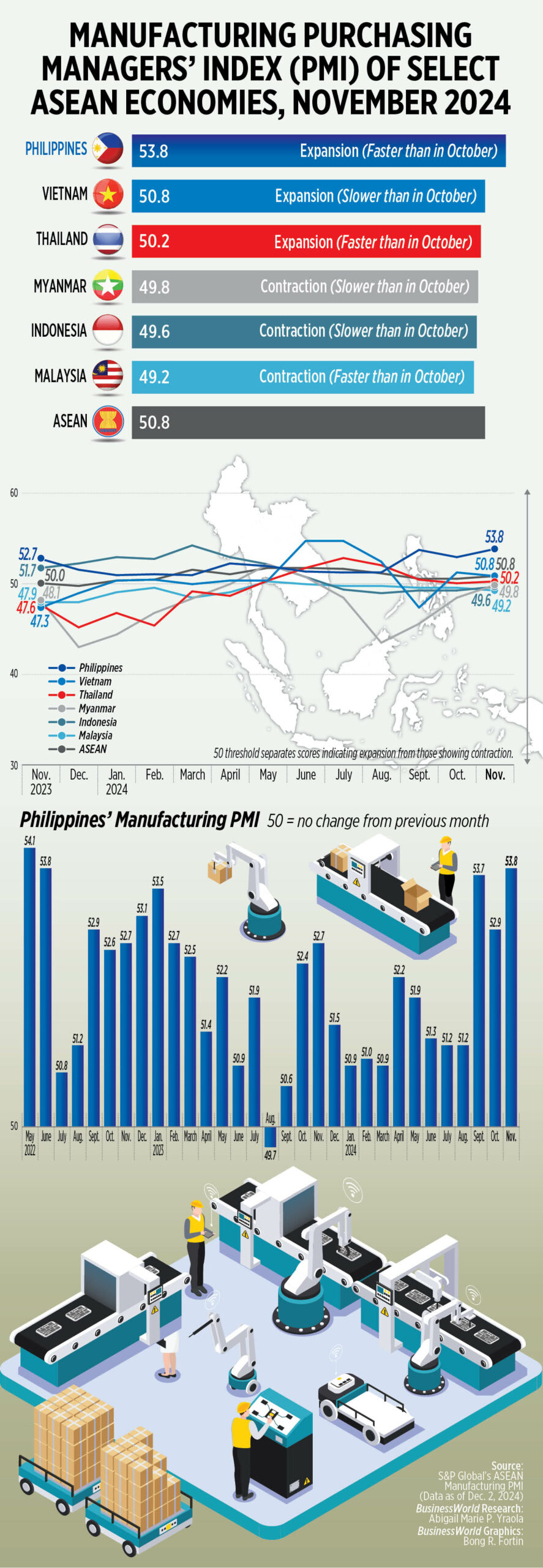
Philippine manufacturing activity jumped to a 30-month high in November, as firms anticipate stronger demand in the coming months, a survey by S&P Global showed on Monday.

The S&P Global Philippines Manufacturing Purchasing Managers’ Index (PMI) rose to 53.8 in November from 52.9 in October. This was the strongest improvement in operating conditions since the 54.1 reading in May 2022.

It also marked the 15th straight consecutive monthly improvement in manufacturing activity in the Philippines.

A PMI reading above 50 means improved operating conditions from the previous month, while a reading below 50 shows deterioration.

“November saw the Filipino manufacturing sector ramping up production in anticipation of greater sales in the coming months,” Maryam Baluch, economist at S&P Global Market Intelligence, said in a report.

“Hiring, purchasing activity and post-production inventories were also raised in preparation. New sales recorded further growth, as demand conditions continued to improve.”

The Philippines posted the highest PMI reading among six Association of Southeast Asian Nation (ASEAN) member countries, followed by Vietnam (50.8) and Thailand (50.2).

Myanmar (49.8), Indonesia (49.6) and Malaysia (49.2) all saw a contraction in PMI in November.

“Last month’s headline improvement was led by a big bounce in the Philippines’ gauge to 53.8 from 52.9, with the archipelago’s stellar outperformance in this survey continuing to mask a lot of the softness across the broader region,” Pantheon Macroeconomics Chief Emerging Asia Economist Miguel Chanco said in an e-mailed statement.

The average PMI among the six Southeast Asian economies stood at 50.8.

“Manufacturers eagerly anticipated a sales boost in the months ahead, prompting a notable ramp-up in production during the latest survey period, with growth accelerating from October,” S&P said.

It noted that the increased production went to supporting the growth of new sales, as demand conditions rose for a 15th straight month.

“While the pace of increase moderated to a three-month low, it remained solid and historically strong. The uptick in output was also attributed by companies to inventory building,” S&P said.

S&P said the inventory of finished goods increased for the first time in four months, with the pace of accumulation the fastest in two years.

Manufacturers also ramped up hiring in November.

“Companies expanded their capacity further as job creation was recorded for a third straight month. The pace of increase was just shy of October’s recent peak,” it said.

S&P said purchasing activity increased in November, but this did not result in a rise in pre-production inventories since companies used the inputs for current production.

“Some supply-side challenges acted as headwinds, as adverse weather conditions resulting from the recent typhoons hitting the country and rising inflationary pressures make a difficult environment for manufacturers,” Ms. Baluch said.

S&P noted the November data showed signs that supply chains are still “strained.” It noted that typhoons led to port congestion and flooding “with average lead times lengthening rapidly and to the most significant degree in over three years.”

In November, S&P said that inflationary pressures “intensified” as rising costs of supplies and raw materials led to a faster increase in expenses — the strongest since February 2023.

Charges for Filipino manufactured goods went up in November, as output charge inflation reaching a 21-month high.

“Nonetheless, firms remained optimistic about future output, with hopes that improved demand trends and the upcoming election year will provide a boost to the sector,” Mr. Baluch said.

S&P noted that manufacturers’ sentiment in November was the highest since early 2023.

Rizal Commercial Banking Corp. Chief Economist Michael L. Ricafort said factory activity rose as firms made preparations for the Christmas holiday season.

Mr. Ricafort said further rate cuts and a “benign inflation rate” would be beneficial for the economy, including manufacturing, though with some lag effects.

The Monetary Board could deliver another rate cut either at its December policy review or the meeting after, Bangko Sentral ng Pilipinas (BSP) Governor Eli M. Remolona, Jr. said earlier.

Since starting its easing cycle in August, the BSP has cut rates by 50 basis points, bringing the benchmark rate to 6%. – Aubrey Rose A. Inosante, Reporter

AMRO cuts Philippine growth outlook amid slowing consumption

AMRO cuts Philippine growth outlook amid slowing consumption

Philippine economic growth may fall short of the government’s target this year amid a slower-than-expected rise in consumption and investment, the ASEAN+3 Macroeconomic Research Office (AMRO) said.

In its latest Annual Consultation Report, AMRO cut its gross domestic product (GDP) growth projection for the Philippines to 5.8% this year from its 6.1% estimate in October.

This would fall below the government’s revised 6-6.5% growth target for 2024.

AMRO said household spending and private investment were weaker than expected this year due to elevated inflation and high interest rates.

“Household consumption, underpinned by a strong labor market and robust remittances, continued to expand, but at a slower pace due to the lagged impact of high inflation.”

“Private investment is gradually rebounding but has yet to reach pre-pandemic levels, partly due to weak investment sentiment amid high interest rates,” it added.

Latest data from the Philippine Statistics Authority (PSA) showed that Philippine GDP growth averaged 5.8% in the first nine months of the year.

For 2025, AMRO retained its growth forecast of 6.3% for 2025.

“The pickup in growth is driven by higher government spending as well as an upturn in external demand and strengthening domestic demand,” it said.

The think tank also expects domestic demand to improve moving forward, which would support growth.

“Private consumption is anticipated to grow faster in the rest of the year, supported by strong labor market conditions, lower inflation and robust overseas remittances.”

“With the start of the monetary policy easing cycle, private investment sentiments are expected to improve,” it added.

However, AMRO said the growth outlook faces “heightened geopolitical risks” that may increase the likelihood of supply disruptions and further global economic fragmentation.

The Philippine economy’s growth momentum could also be “derailed by a sharp slowdown in major trading partners in the near term,” it added.

“Over the long term, the country’s potential growth could be constrained by insufficient infrastructure investment, vulnerabilities to climate change, and prolonged scarring effects caused by the coronavirus disease 2019 (COVID-19) pandemic.”

Consumption growth may still be hampered by elevated inflation, it added.

“Philippine growth prospects, particularly private consumption, are clouded by the risk of high food inflation… Higher costs of basic needs would further reduce households’ ability to afford discretionary items and hence constrain household consumption.”

However, AMRO projects headline inflation to average 3.2% this year and the next.

“Inflation is expected to stay broadly within the target range in the second half of 2024 through 2025, benefiting from the continued easing of global commodity prices and government measures,” it said.

The Bangko Sentral ng Pilipinas (BSP) expects inflation to average 3.1% this year and 3.2% in 2025.

“While upside risks such as wage increases and local food supply shocks remain, the decline in headline inflation is expected to continue in the second half of 2024 due to lower commodity prices of fuel and food, and tariff cuts on imported rice,” AMRO said.

“Meanwhile, inflationary pressure will likely remain moderate due to a positive output gap and second-round effects, following increases in minimum wages and persistently high inflation expectations.”

With inflation expected to remain within target, AMRO said that there is room for the BSP to continue its rate-cutting cycle.

“As inflation will continue to ease within the target band, there is room to adopt a less restrictive monetary policy stance if current growth trends continue,” it said.

“However, if supply-side risks emerge, a whole-of-government approach should be taken to address inflationary pressures.”

Since August, the central bank has lowered borrowing costs by 50 basis points (bps), bringing the key rate to 6%.

The Monetary Board is set to have its last policy review for the year on Dec. 19.

“As year-to-date inflation has returned to the upper half of the target range, the BSP has room to gradually adjust the policy rate to a moderately restrictive stance,” AMRO said.

“This will lend some support to private investment and allow the BSP to rebuild space for renewed policy rate hikes if inflationary risks were to reemerge.”

Meanwhile, AMRO said that the Philippine government’s fiscal consolidation efforts can still be enhanced.

“The current fiscal-monetary policy mix is appropriate and can be adjusted further to support economic growth while rebuilding policy buffers.”

AMRO expects the fiscal stance from this year to 2025 to be “neutral.”

It projects the fiscal deficit settling at 5.7% of GDP this year and 5.6% of GDP in 2025, driven by “robust revenue collection despite higher expenditure.”

“Moving forward, the fiscal balance is expected to gradually decline to 4.2% of GDP by 2028,” it added.

The latest data from the Treasury showed the budget deficit narrowed to PHP 963.9 billion in the January-October period.

The government has set a deficit ceiling of PHP 1.52 trillion this year, equivalent to 5.7% of economic output. It expects to lower the budget gap to 3.7% of GDP by 2028.

Rising debt

Meanwhile, AMRO expects the National Government’s (NG) outstanding debt to rise slightly before easing further.

“Public debt is projected to increase slightly from 60.1% of GDP in 2023 to 60.7% in 2024, due to the government’s sustained funding needs and higher debt servicing costs.”

“However, it is expected to gradually decrease to 57.6% of GDP in 2028, on account of improved fiscal positions and robust economic growth.”

The NG’s debt-to-GDP ratio stood at 61.3% at the end of September, still above the 60% threshold deemed by multilateral lenders as manageable for developing economies.

The government seeks to bring the ratio down to 60.6% by the end of 2024, and below 60% by 2028.

“While the need for strategic adjustments in medium-term fiscal policy to support the economy is recognized, fiscal consolidation should be accelerated when conditions allow,” AMRO said.

“The government is likely to continue its medium-term fiscal consolidation plan at a slower pace to better support economic growth. However, it would be prudent to quicken the pace of fiscal consolidation if conditions allow, as restoring fiscal space remains critical to build greater resilience to external shocks amid elevated uncertainty.”

AMRO recommended efforts to expedite revenue mobilization and increase efficiency, as well as long-term fiscal reforms for fiscal sustainability.

“Overall financial stability remains sound; at the same time, a more active use of macroprudential toolkits could be considered to mitigate the financial stability risks,” it said.

“Some signs of vulnerabilities have emerged in certain areas, such as the household and property sectors, which warrant close monitoring. Meanwhile, the authorities should strengthen the institutional framework to safeguard financial stability and deepen the bond and repo markets.” – Luisa Maria Jacinta C. Jocson Reporter


Hot money outflows reach USD 529.7 million in Oct., BSP says

Hot money outflows reach USD 529.7 million in Oct., BSP says

More short-term foreign investments flowed out of the Philippines than what entered in October, data from the Bangko Sentral ng Pilipinas (BSP) showed.

Transactions on foreign investments registered with the central bank through authorized banks posted a net outflow of USD 529.68 million in October, higher than the USD 328.19-million outflow in the same month a year ago.

This was also a reversal of the USD 1.03-billion net inflow in September.

These foreign portfolio investments are also called “hot money” due to the ease by which these funds enter and leave the economy.

Central bank data showed gross outflows of hot money increased by 56.7% to USD 2.01 billion in October from USD 1.28 billion a year ago. It also jumped by 33.4% from the USD 1.5-billion outflows in September.

“The US remains to be the top destination of outflows, receiving USD 889.06 million (or 44.2%) of total outward remittances,” the BSP said.

Meanwhile, gross inflows rose by 55.1% to USD 1.48 billion from USD 954.38 million in the same month a year prior. Month on month, gross inflows declined by 41.5% from USD 2.53 billion.

The top five investor economies during the month were the United Kingdom, Singapore, the United States, Luxembourg and Malaysia, accounting for the bulk or 87.8% of foreign portfolio investment inflows.

Most of the investments (54.5%) went to Philippine Stock Exchange-listed securities in banks; holding firms; transportation services; property; and food, beverage and tobacco. The rest (45.5%) went to peso government securities.

In the January-October period, BSP-registered foreign investments yielded a net inflow of USD 2.49 billion, a turnaround from the USD 715.43-million outflow in the same period in 2023.

Broken down, gross inflows stood at USD 15.02 billion, while gross outflows amounted to USD 12.52 billion in the first 10 months.

The BSP expects foreign portfolio investments to yield a net inflow of USD 4.2 billion in 2024.

Rizal Commercial Banking Corp. Chief Economist Michael L. Ricafort said more hot money exited the country as geopolitical risks in the Middle East triggered profit taking in global and local markets.

“Regional geopolitical tensions and local economic risks, such as fiscal consolidation and concerns over growth momentum, have likely added to investors’ cautious stance,” John Paolo R. Rivera, a senior research fellow at the Philippine Institute for Development Studies said.

Markets were also pricing in Donald J. Trump’s win ahead of the US presidential elections last November, Mr. Ricafort said. Mr. Trump’s protectionist policies were expected to stoke US inflation and impact the US Federal Reserve’s easing cycle.

“The Fed’s monetary policy stance likely weighed on investor sentiment. While expectations of easing US policy rates could eventually attract funds, the current cautious environment contributed to capital outflows,” Mr. Rivera said.

For the coming months, Mr. Ricafort said more short-term capital could enter the country amid the recent cut in banks’ reserve requirement ratio (RRR).

The BSP reduced the RRR for universal and commercial banks and nonbank financial institutions with quasi-banking functions by 250 basis points to 7% from 9.5%, effective on Oct. 25.

“(This) would have infused about P400 billion into the banking system in terms of more loanable funds by banks, as well as more funds by banks for investments in bonds and other fixed-income investments, stocks, foreign currencies, property and other investments,” he added.

The country’s improved credit rating outlook will also support investor sentiment, Mr. Ricafort said.

Last week, S&P Global Ratings affirmed the Philippines’ investment grade rating on Tuesday and raised its outlook to “positive” from “stable,” reflecting the country’s strong growth potential and improved institutional strength. — Luisa Maria Jacinta C. Jocson

Government borrowings slump in October

Government borrowings slump in October

The national government’s (NG) gross borrowings fell in October as it borrowed significantly less from the domestic market, the Bureau of the Treasury (BTr) said.

Data from the BTr showed that total gross borrowings dropped by 42.6% to PHP 129.26 billion in October from PHP 225.2 billion in the same month a year ago.

Month on month, gross borrowings declined by 64.8% from PHP 367.18 billion in September.

Gross domestic borrowings slumped by 61.37% to PHP 67.46 billion in October from PHP 174.63 billion last year. The October 2023 tally reflected the government’s PHP 71.78-billion retail onshore dollar bond issuance.

In October this year, domestic borrowings consisted of PHP 45 billion in fixed-rate Treasury bonds (T-bonds) and PHP 22.46 billion in Treasury bills (T-bills).

Meanwhile, gross external debt increased by 22.21% to PHP 61.8 billion in October from PHP 50.57 billion a year ago.

This consisted of PHP 49.89 billion in program loans and PHP 11.91 billion in project loans.

“(The lower gross borrowings) could be partly brought by the budget surplus in October 2024 and the narrower budget deficit for the first 10 months of 2024 that fundamentally reduced the need for additional borrowings/debt by the National Government,” Rizal Commercial Banking Corp. Chief Economist Michael L. Ricafort said.

In October, the NG posted a PHP 6.3-billion budget surplus, a turnaround from the PHP 34.4-billion deficit in the same month a year ago. This brought the 10-month budget deficit to PHP 963.9 billion, slimming from PHP 1.02 trillion gap a year ago.

“Furthermore, increased dividends/remittance of earnings/surplus of some GOCCs [government-owned or -controlled corporations] to the National Government in recent months also partly helped reduce the need for the NG to borrow,” Mr. Ricafort said.

As of October 2024, 52 GOCCs already remitted P95.9 billion in dividends, up 51% higher from the same period last year, the Department of Finance said last week.

“It is possible that the decline in the October borrowing is due to the fact that there are expectations that interest rates would decline further and some banks and investment houses have been undertaking a wait-and-see attitude before purchasing government securities,” Philip Arnold “Randy” P. Tuaño, dean of the Ateneo School of Government, told BusinessWorld via e-mail over the weekend.

The BSP has cut benchmark rates by a total of 50 basis points at its August and October meetings.

Ten-month period

Meanwhile, BTr reported that gross borrowings in the January-to-October period jumped 22.98% to PHP 2.43 trillion from PHP 1.98 trillion a year ago.

The bulk or 76.69% of the 10-month gross borrowings were from domestic sources.

Domestic debt stood at PHP 1.86 trillion, a 22.64% increase from PHP 1.52 trillion a year ago.

It was made up of P1.07 trillion in fixed-rate T-bonds, P584.86 billion in retail T-bonds, and P209.38 billion in T-bills.

External debt in the first 10 months rose by 24.09% to PHP 566.25 billion from PHP 456.31 billion a year prior.

This was composed of PHP 256.24 billion in global bonds, PHP 223.04 billion in program loans, and PHP 86.97 billion in new project loans.

For the rest of the year, Mr. Tuaño said that borrowings are still expected to increase in peso value terms as the budget deficit continues to widen.

The Treasury is possibly waiting for interest rates to decline further and thus limited sales of government securities in October, he added.

The Monetary Board could deliver another rate cut either at its December meeting or the meeting after, Bangko Sentral ng Pilipinas Governor Eli M. Remolona, Jr. said earlier.

“Going forward, lower US and local rate cuts would help reduce the NG’s interest payments/debt servicing costs, thereby would reduce the need for additional NG borrowings,” Mr. Ricafort said.

This year’s borrowing plan is set at PHP 2.57 trillion, with PHP 1.92 trillion coming from domestic sources and PHP 646.08 billion from overseas, according to the latest Budget of Expenditures and Sources of Financing data. – Aubrey Rose A. Inosante, Reporter

BSP sees November inflation at 2.2-3%

BSP sees November inflation at 2.2-3%

Headline inflation may have accelerated in November but still remained within the 2-4% target band, the Bangko Sentral ng Pilipinas (BSP) said.

The central bank’s month-ahead forecast showed that inflation likely settled within the 2.2%-to-3% range in November, slower than the 4.1% print in the same month a year ago.
However, the upper end of the forecast would be faster than the 2.3% recorded in October.

The Philippine Statistics Authority (PSA) is scheduled to release November inflation data on Dec. 5.

“Increased prices of vegetables, fish, and meat due to unfavorable weather conditions, higher electricity rates and petroleum prices, and the depreciation of the peso are the primary sources of upward price pressures this month,” the BSP said in a statement.

The Philippines was hit by several storms this month. Latest data from the Agriculture department showed that agricultural damage due to tropical cyclones Nika, Ofel and Pepito reached PHP 785.68 million.

In November, pump price adjustments stood at a net increase of PHP 1.7 a liter for gasoline, PHP 3.2 a liter for diesel and PHP 1.6 a liter for kerosene.

Manila Electric Co. (Meralco) also raised the overall rate by PHP 0.4274 per kilowatt-hour (kWh) to PHP 11.8569 per kWh in November from PHP 11.4295 per kWh in October.

The peso sank to the PHP 59-per-dollar level twice this month so far, hitting the record low on Nov. 21 and 26.

The BSP earlier attributed this to the stronger dollar amid rising geopolitical tensions.

On the other hand, the risks to the inflation outlook are seen to be offset by lower prices of rice, the central bank added.

National Economic and Development Authority (NEDA) Secretary Arsenio M. Balisacan said on Friday that inflation is expected to “stay comfortably” within the 2-4% target range.

“We don’t think that the (November) number will breach our target of 2-4%,” he said, though noted that if there is a pickup in prices, this would be “marginal.”

Mr. Balisacan also noted the BSP’s easing cycle will support the economy.

“We expect the BSP’s decision to cut policy rates by a cumulative 50 basis points and reduce reserve requirements to boost liquidity to spur growth in private spending,” he said.

“Particularly on big-ticket consumer items and investments in capital-intensive infrastructure in the coming quarters, which we see as another significant economic growth driver.”

The BSP said it “will continue to take a measured approach in ensuring price stability conducive to balanced and sustainable growth of the economy and employment.”

Since August, the central bank has reduced borrowing costs by 50 basis points, bringing the key rate to 6%. – Luisa Maria Jacinta C. Jocson, Reporter

Posts navigation

Older posts
Newer posts

Recent Posts

  • Navigating precarious times with cost averaging
  • Trade Update: Wider trade deficit in February
  • Metrobank US-Iran Risk Index: No swift end seen
  • Investment Ideas: March 27, 2026
  • BSP Update: First rate hike likely in June 

Recent Comments

No comments to show.

Archives

  • March 2026
  • February 2026
  • January 2026
  • December 2025
  • November 2025
  • October 2025
  • September 2025
  • August 2025
  • July 2025
  • June 2025
  • May 2025
  • April 2025
  • March 2025
  • February 2025
  • January 2025
  • December 2024
  • November 2024
  • October 2024
  • September 2024
  • August 2024
  • July 2024
  • June 2024
  • May 2024
  • April 2024
  • March 2024
  • February 2024
  • January 2024
  • December 2023
  • November 2023
  • October 2023
  • September 2023
  • August 2023
  • July 2023
  • June 2023
  • May 2023
  • April 2023
  • March 2023
  • February 2023
  • January 2023
  • December 2022
  • November 2022
  • October 2022
  • September 2022
  • August 2022
  • July 2022
  • June 2022
  • May 2022
  • March 2022
  • December 2021
  • October 2021

Categories

  • Bonds
  • BusinessWorld
  • Currencies
  • Economy
  • Equities
  • Estate Planning
  • Explainer
  • Featured Insight
  • Fine Living
  • How To
  • Investment Tips
  • Markets
  • Portfolio Picks
  • Rates & Bonds
  • Retirement
  • Reuters
  • Spotlight
  • Stocks
  • Uncategorized

You are leaving Metrobank Wealth Insights

Please be aware that the external site policies may differ from our website Terms And Conditions and Privacy Policy. The next site will be opened in a new browser window or tab.

Cancel Proceed
Get in Touch

For inquiries, please call our Metrobank Contact Center at (02) 88-700-700 (domestic toll-free 1-800-1888-5775) or send an e-mail to customercare@metrobank.com.ph

Metrobank is regulated by the Bangko Sentral ng Pilipinas
Website: https://www.bsp.gov.ph

Quick Links
The Gist Webinars Wealth Manager Explainers
Markets
Currencies Rates & Bonds Equities Economy
Wealth
Investment Tips Fine Living Retirement
Portfolio Picks
Bonds Stocks
Others
Contact Us Privacy Notice Terms of Use
© 2026 Metrobank. All rights reserved.

Access this content:

If you are an existing investor, log in first to your Metrobank Wealth Manager account. ​

If you wish to start your wealth journey with us, click the “How To Sign Up” button. ​

Login HOW TO SIGN UP