







 DOWNLOAD



Month: April 2026
Metrobank US-Iran Risk Index: Signals of an end
US President Donald Trump reportedly signals willingness to end the war. Still, uncertainties remain.
 By Metrobank Research, Investment Counselor Department



Metrobank’s US-Iran Risk Index settled at 155.2 on March 31, 2026, 4.0% higher than the day prior. This marks another all-time high for the index.
On Tuesday, US President Donald Trump boldly instructed other countries, including the UK, to secure their own oil without the aid of the US, according to Al Jazeera.
While WTI crude prices were little changed after the statement, Brent crude prices, which better reflect the cost of oil outside the US, surged and closed at USD 118 per barrel, according to data compiled by Bloomberg. This accounted for most of the increase in Metrobank’s US-Iran Risk Index on Tuesday.
Meanwhile, Trump also signaled that he is willing to end his military campaign against Iran even as the Strait of Hormuz remains shut, according to the Wall Street Journal. Financial market players took this as a signal of a possible resolution of the conflict, which led to the benchmark 10-year US Treasury yield falling.
The dollar index also pared some of its gains on Tuesday, indicating reduced safe-haven demand for the currency. However, the dollar-peso exchange rate still closed at an all-time high of 60.75 on Tuesday during Philippine trading hours, as a strong dollar still heavily weighed on a weak peso.
Trump recently stated that he expects the war to last two to three more weeks before the US exits Iran, which he claims would lead to a pullback in oil prices, according to Al Jazeera. These statements may provide some relief to financial market players going forward, with oil prices already moving lower during early trade on Wednesday, Philippine time.
Still, Metrobank expects upside oil risk to persist as the Strait of Hormuz, a critical transit point for global oil shipments, remains closed. We also expect the Bangko Sentral ng Pilipinas to raise their policy rate this year to combat rising inflation. Lastly, we see the dollar-peso remaining elevated in the near-future as the dollar continues to strengthen on safe-haven demand.
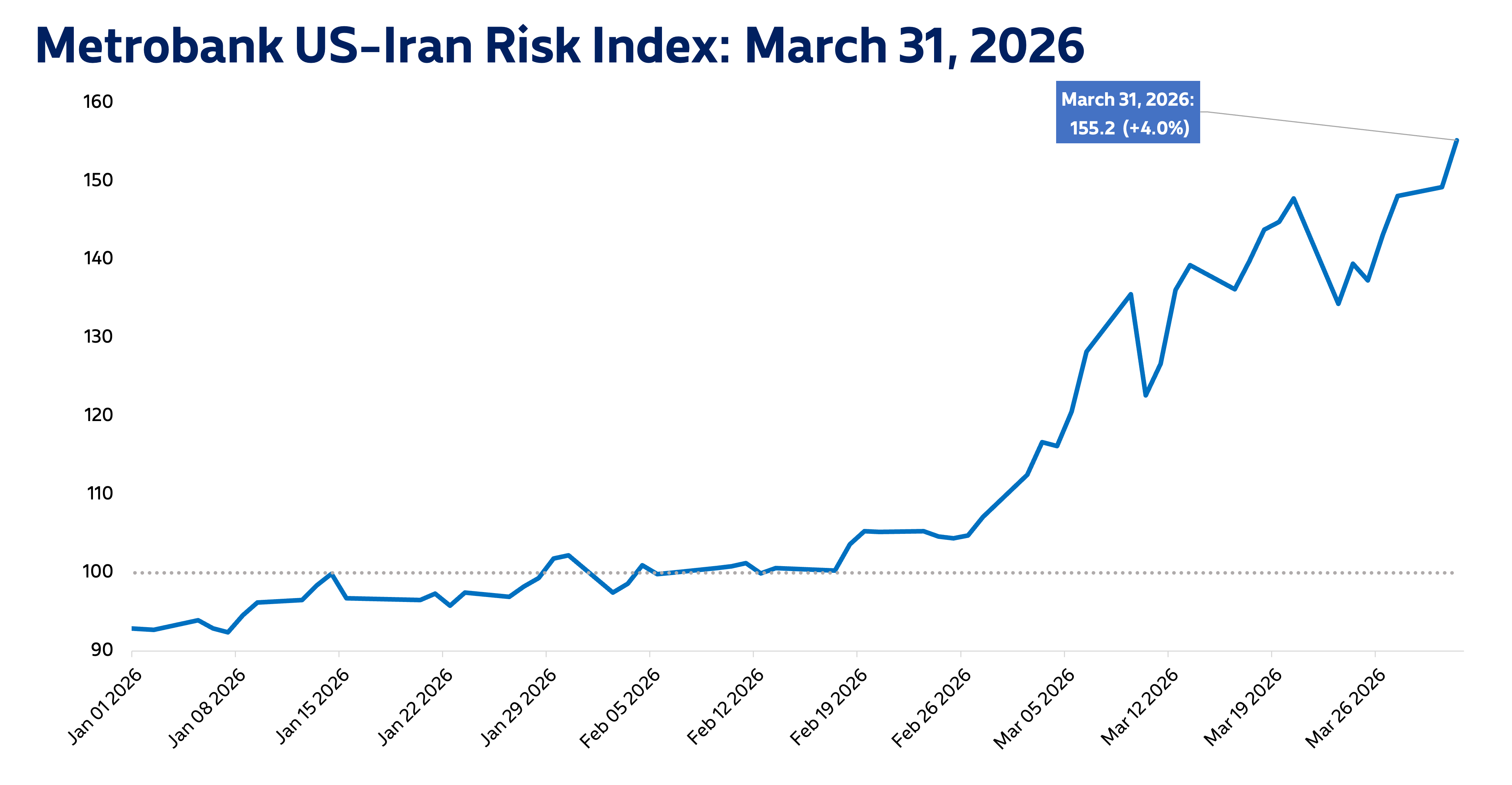
Metrobank’s US-Iran Risk Index measures the amount of risk that the ongoing conflict presents to financial markets. It considers the general risk sentiment of investors and inflationary pressure brought by the conflict. A value of 100 denotes a normal level of risk based on market levels prior to the conflict’s escalation, while values greater than 100 imply increasing levels of risk.
What now?
| Asset Class | Outlook | Strategy |
|---|---|---|
| Local Fixed Income | Bearish | Stay defensive on duration amid elevated foreign exchange volatility. Focus on liquid 2–5-year tenors and add only on pronounced yield spikes. Avoid extending duration, especially at the long end of the yield curve, until peso conditions and global risks show clear signs of stabilization. |
| Local Equities | Bearish | Expect bargain hunting of cheaper names in the near term. However, gains may remain capped amid oil-price volatility and developments in the Middle East. Buy on dips and take profit during rallies. |
| Global Fixed Income | Bearish | Stay in high-quality, short-duration bonds as the defensive play amid ongoing geopolitical tensions. Expect yields to stay elevated, as inflation remains a major concern for global markets. |
| Global Equities | Neutral | Maintain a defensive approach by prioritizing high-dividend sectors while taking advantage of volatility to accumulate select quality-growth names. |
| USD/PHP | Rangebound | Buy US dollars on dips or near the 59.85-60.15 support levels, as short-term fundamentals favor a mildly firmer USD after the US Federal Reserve (Fed) maintained its policy. Still, elevated energy prices and geopolitical risk will provide demand for USD. The market is expected to trade on headlines for the lack of high-impact US and Philippine data release this week. |
| G10 Currencies / US Dollar | Bearish | Major currencies EUR, GBP, and JPY see some recovery following their respective central banks’ decision to pause. However, inflation concerns driven by higher-for-longer oil prices continue to weigh on global growth prospects, weakening G10 economies dependent on energy imports while safe-haven trades favor the USD. |
| Gold | Slightly Bearish | Consistently elevated oil prices have driven hotter US inflation and delayed Fed rate cut expectations, contributing to a stronger US dollar and lower gold prices. However, gold has recently risen back to around USD 4,700 amid signs of de-escalation. However, given the unpredictability of the situation, re-escalation of the conflict, higher oil prices, and a potentially more hawkish Fed could potentially bring gold lower to our target entry levels of USD 3,800 to USD 4,200. Our long-term view is still for gold to outperform as global central banks diversify their reserve assets away from USD and US Treasuries. |
(Disclaimer: This is general investment information only and does not constitute an offer or guarantee, with all investment decisions made at your own risk. The bank takes no responsibility for any potential losses.)