Price spikes turn consumers cautious


For years, Filipino consumers have helped fuel economic growth. A growing economy and remittances from overseas workers supported household spending, especially on non-essential goods.
However, rising prices and global economic uncertainty turned Filipino consumers more cautious, threatening overall economic growth.
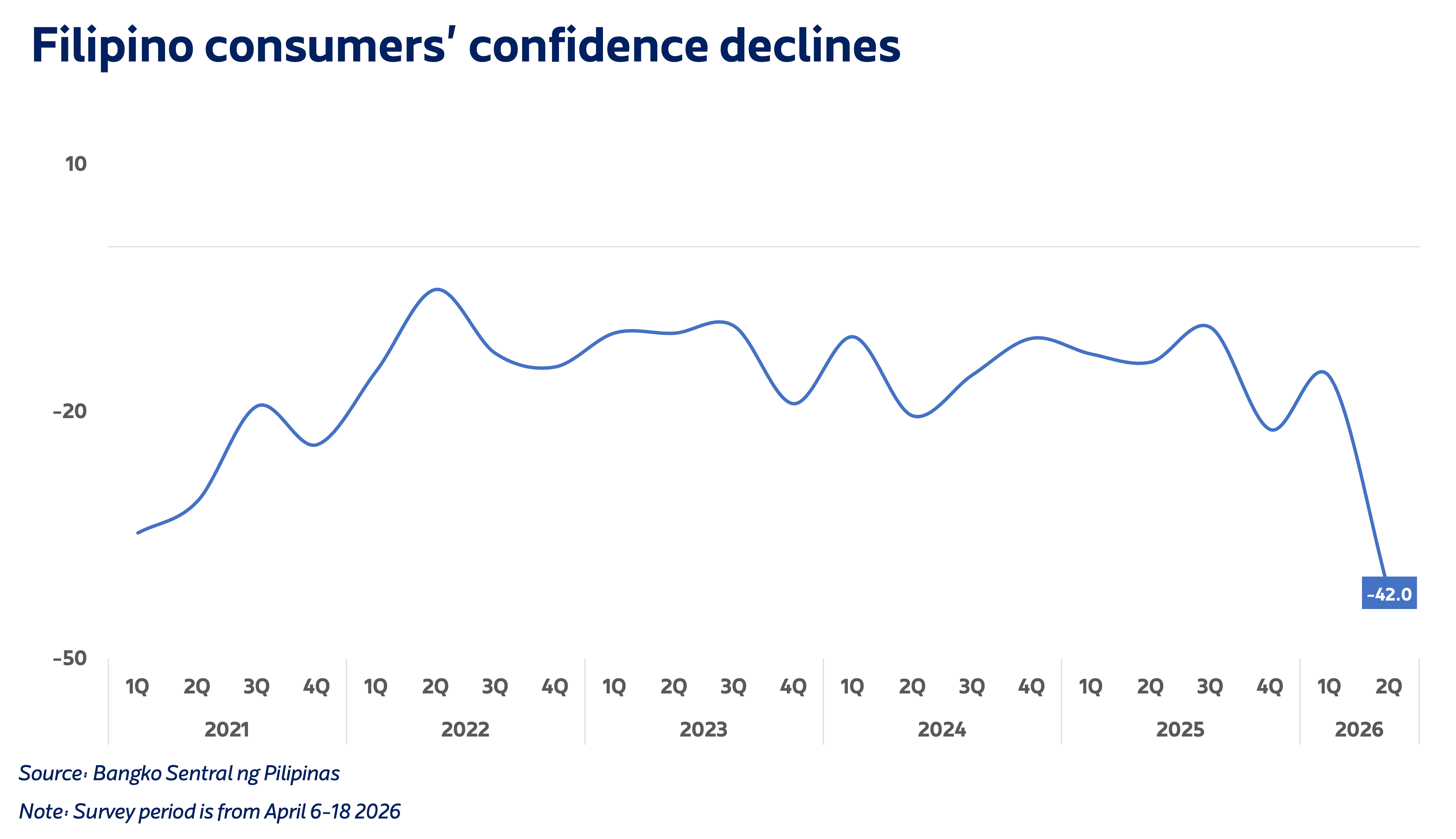
The consumer confidence index, which measures households’ view of the economy and their finances, fell to -42 last quarter from the preceding quarter’s -15.8, a Bangko Sentral ng Pilipinas (BSP) survey showed.

The decline, which is seen across income levels, shows pressure from surging prices tied to the Middle East conflict and governance issues that stunted government projects.
Related article: US-Iran conflict shows remittances’ vulnerability to shocks
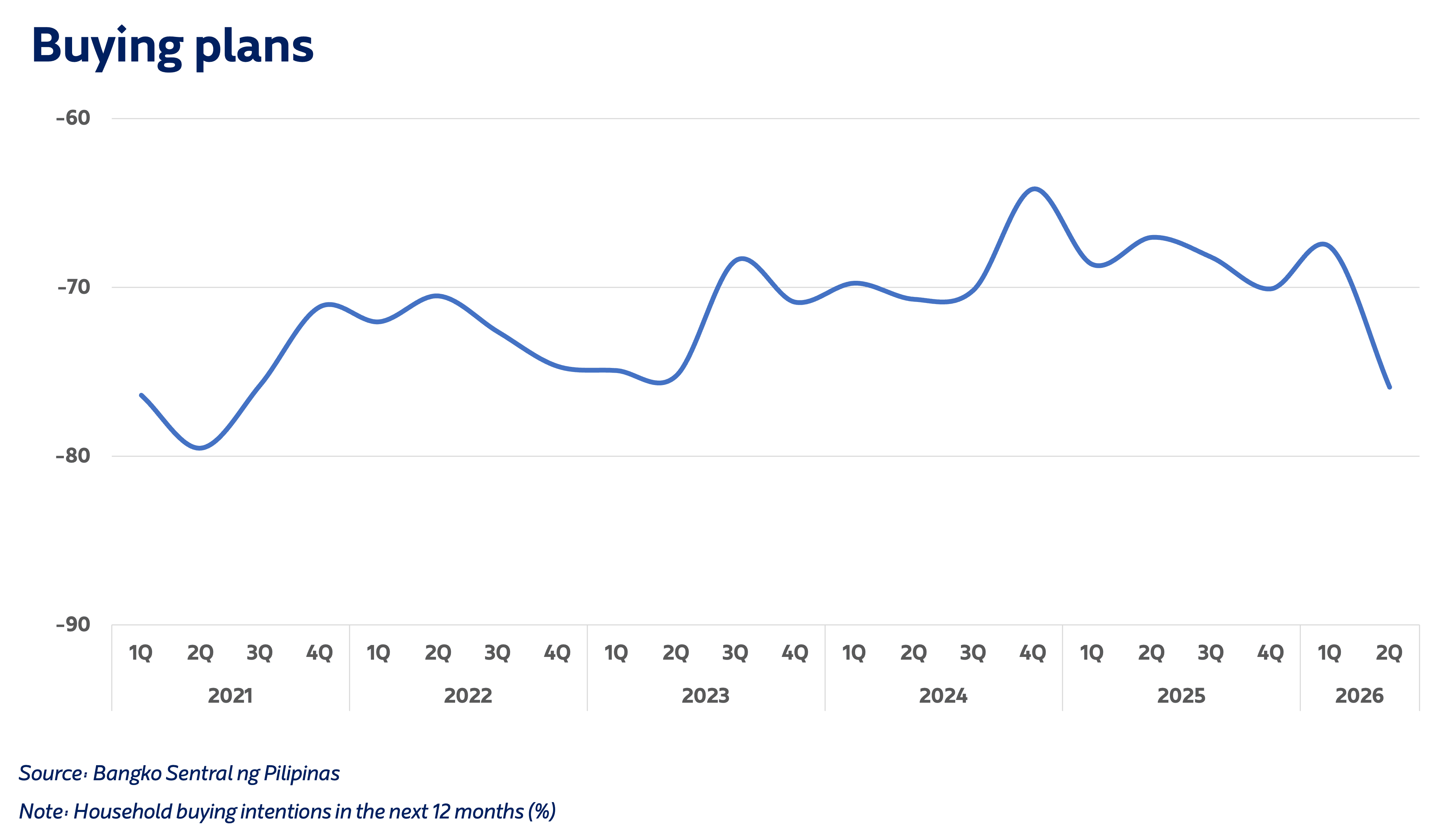
More households do not plan to buy big-ticket items like appliances and vehicles through the next year, BSP’s survey showed. They also intend to save less, possibly because they spend more on essential goods.

This presents a challenge to the Philippines, where household consumption accounts for 70% of the economy. Consumer spending in the first quarter of 2026 has fallen below its historical average of 6% and is at its lowest since the Covid-19 pandemic, statistics agency data showed.
To address the issue, the government plans to accelerate spending to spur private consumption by creating jobs and stabilizing wages. It unveiled a record quarterly domestic borrowing plan of PHP 1.12 trillion this quarter, in part to accelerate infrastructure projects.
However, addressing fiscal and infrastructure issues may take time. The capital injection depends on government agencies’ ability to spend their budgets.
On the inflation front, knock-on effects of higher energy costs and the El Niño weather phenomenon on prices of goods pose major price risk. While the recent US-Iran peace agreement offers some relief by cooling near-term energy costs, Metrobank expects Philippine inflation to hover above the 6% mark in the near-to-medium term, prompting the BSP to raise borrowing costs throughout the year.
Overall, elevated inflation, tight monetary policy, and fiscal concerns may continue to affect near-term economic growth.
Given weak economic expectations, investors should adopt a defensive strategy across both fixed income and equities:
For more economic insights to help you make more confident financial decisions, visit Wealth Insights’ analysis section.
SOPHIA THERESE “PIA” BONIFACIO is a Research Officer at Metrobank, covering local and offshore macroeconomic research. She obtained her Bachelor’s degree in Economics with a Specialization in Financial Economics, cum laude, from the Ateneo de Manila University and is a Certified UITF Sales Person (CUSP). Pia enjoys long road trips and loves a good cup of hojicha latte.