Economy2 MIN READ

Metrobank US-Iran Risk Index: Volatility remains

Risk levels remain volatile as tensions expand.
July 27, 2026 by Metrobank Research, Investment Counselor Department
Share this article:

Featured Article Image

Metrobank’s US-Iran Risk Index settled at 129.6 on July 24, 3.1% lower than its value of 133.7 the day prior, though higher than its value of 120.9 the week before.

Global oil prices continued to surge last week, as disputes on the Strait of Hormuz continued, pressuring oil supply. Supply constraints spread beyond Hormuz, with the Iran-aligned Houthis from Yemen reportedly attacking oil tankers along the Red Sea, according to Reuters.

Brent crude closed above USD 100 per barrel on July 23, according to data compiled by Bloomberg. The commodity fell back down below USD 100 per barrel the following day, after a push from China to end the war, according to Reuters. This illustrates volatility in oil markets.

Meanwhile, the benchmark 10-year US Treasury yield faced more upward pressure, as inflation concerns mounted and market players priced in higher-for-longer interest rates from the US Federal Reserve (Fed).  

Higher US interest rates and more expensive oil strengthened the greenback, eventually pushing the dollar-peso exchange rate to a new record close of 61.85 on July 24.

Early Monday trade has seen oil prices continue to decline due to a halt in US-Iran attacks over the weekend. While market players take this as a signal for relief, expect upside pressure to persist in the short-to-medium term. With tensions now extending to the Red Sea, supply of the commodity may not normalize anytime soon, which may fan global inflation expectations.

Domestically, Metrobank sees full-year inflation in the Philippines remaining elevated, placing upward pressure on Philippine bond yields.

Related article: Is the Philippine inflation story over?

Moreover, Metrobank expects the Bangko Sentral ng Pilipinas to remain hawkish. Finally, Metrobank forecasts the dollar-peso exchange rate to stay elevated, as a hawkish Fed and corporate demand strengthens the dollar. 
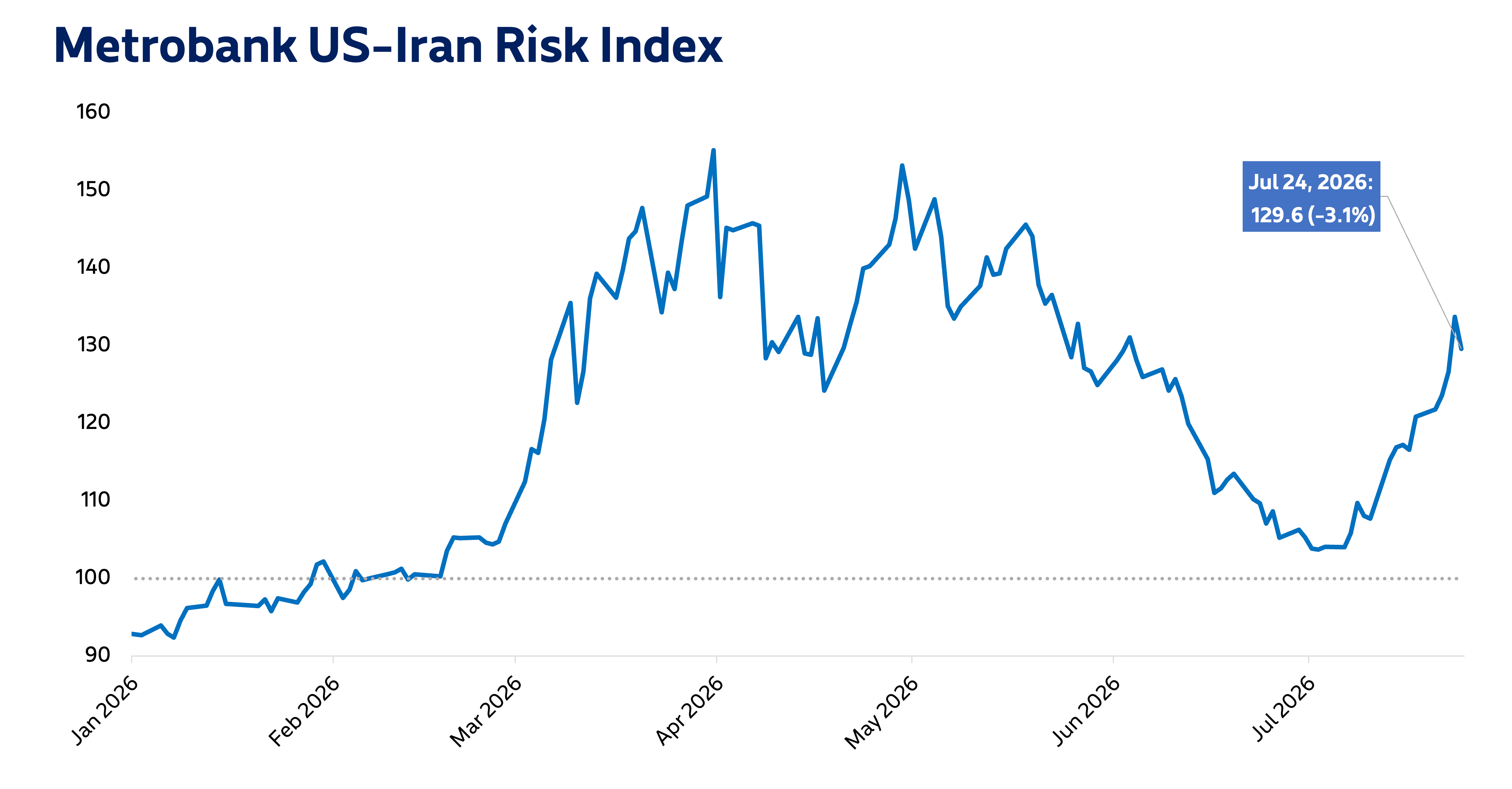
Metrobank’s US-Iran Risk Index measures the amount of risk that the ongoing conflict presents to financial markets. It considers the general risk sentiment of investors and inflationary pressure brought by the conflict. A value of 100 denotes a normal level of risk based on market levels prior to the conflict’s escalation, while values greater than 100 imply increasing levels of risk.

What now?

What now?
Category
Local Fixed Income
Outlook
Slightly Bearish
Strategy
Persistent geopolitical risks may favor defensive positioning in the front end of the peso yield curve, though elevated yields in the belly (3-5 Years) may be attractive entry points. It may be advisable to refrain from longer tenors due to inflationary pressure and market volatility. 
Category
Local Equities
Outlook
Neutral to Slightly Bearish
Strategy
A cautious and selective approach may be considered, as the Philippine Stock Exchange index (PSEi) may trade sideways with a downward bias amid geopolitical uncertainties, rising fuel prices, and the upcoming Fed decision. With support at 6,200-6,150 and resistance at 6,300-6,350, investors may accumulate fundamentally strong value stocks on pullbacks, while closely monitoring earnings results for the first quarter of 2026 as potential catalysts.
Category
Global Fixed Income
Outlook
Slightly Bearish
Strategy
Being selective in quality credit may be considered, while favoring the 2–7-year segment of the curve, where returns remain attractive relative to longer tenors. Moderating US inflation expectations provide support for bonds. Although a resilient US growth, a higher-for-longer Fed narrative, and re-escalation of conflict in the Middle East may contribute to potential re-steepening of the yield curve. 
Category
Global Equities
Outlook
Slightly Bearish
Strategy
A cautious stance on global equities may be considered, as market players navigate a period of consolidation amid heightened uncertainty surrounding Big Tech earnings, AI investment returns, and the Fed’s policy outlook. While the longer-term outlook remains supported, near-term volatility may persist, as investors reassess valuations, monetary policy expectations, and geopolitical developments. Investors may consider being selective, favoring high-quality names with strong earnings visibility and sustainable cash flow generation. 
Category
USD/PHP
Outlook
Neutral / Range-bound
Strategy
The USD/PHP may trade within 61.65–61.85 this week, as market players weigh the Middle East geopolitical tensions, oil prices, and the upcoming Fed meeting. The safe-haven dollar demand may provide support on dips. 
Category
G10 Currencies / US Dollar
Outlook
Neutral to Mildly Bullish USD
Strategy
The USD may remain favored, as market players prioritize safety, liquidity, and yield differentials. While most currencies have shown localized resilience, geopolitical uncertainty, elevated energy prices, and the dollar’s relative yield advantage continue to support USD demand. As a result, gains across G10 currencies may remain selective, as broad dollar weakness has yet to emerge despite localized improvements elsewhere. 
Category
Gold
Outlook
Neutral to Slightly Bullish
Strategy
Gold remains supported at USD 3,950-4,000 from persistent geopolitical uncertainty in the Middle East, ongoing safe-haven demand, and US monetary policy expectations ahead of the upcoming Fed meeting. While recent volatility in oil prices has eased immediate inflation concerns, market players continue to monitor geopolitical developments and Fed guidance closely. Technically, the metal is recovering momentum, with price targeting the USD 4,170–4,200 area while holding above key support at USD 3,950. For deeper corrections, a buying target at the USD 3,700-3,800 level may be considered.
(Disclaimer: This is general investment information only and does not constitute an offer or guarantee, with all investment decisions made at your own risk. The bank takes no responsibility for any potential losses.)
Read More Articles About: