Economy2 MIN READ

Philippine business sentiment shows cautious revival

Businesses turn less pessimistic as energy shocks fade, though muted economic growth and high inflation may keep expansion plans on hold.
July 9, 2026 by Sophia Therese Bonifacio
Share this article:
Featured Article Image

Philippine businesses appear to show a cautious revival, as retreating prices and energy costs give relief to consumers and improve financial conditions for companies. However, diving deeper, firms remain in wait-and-see mode.  

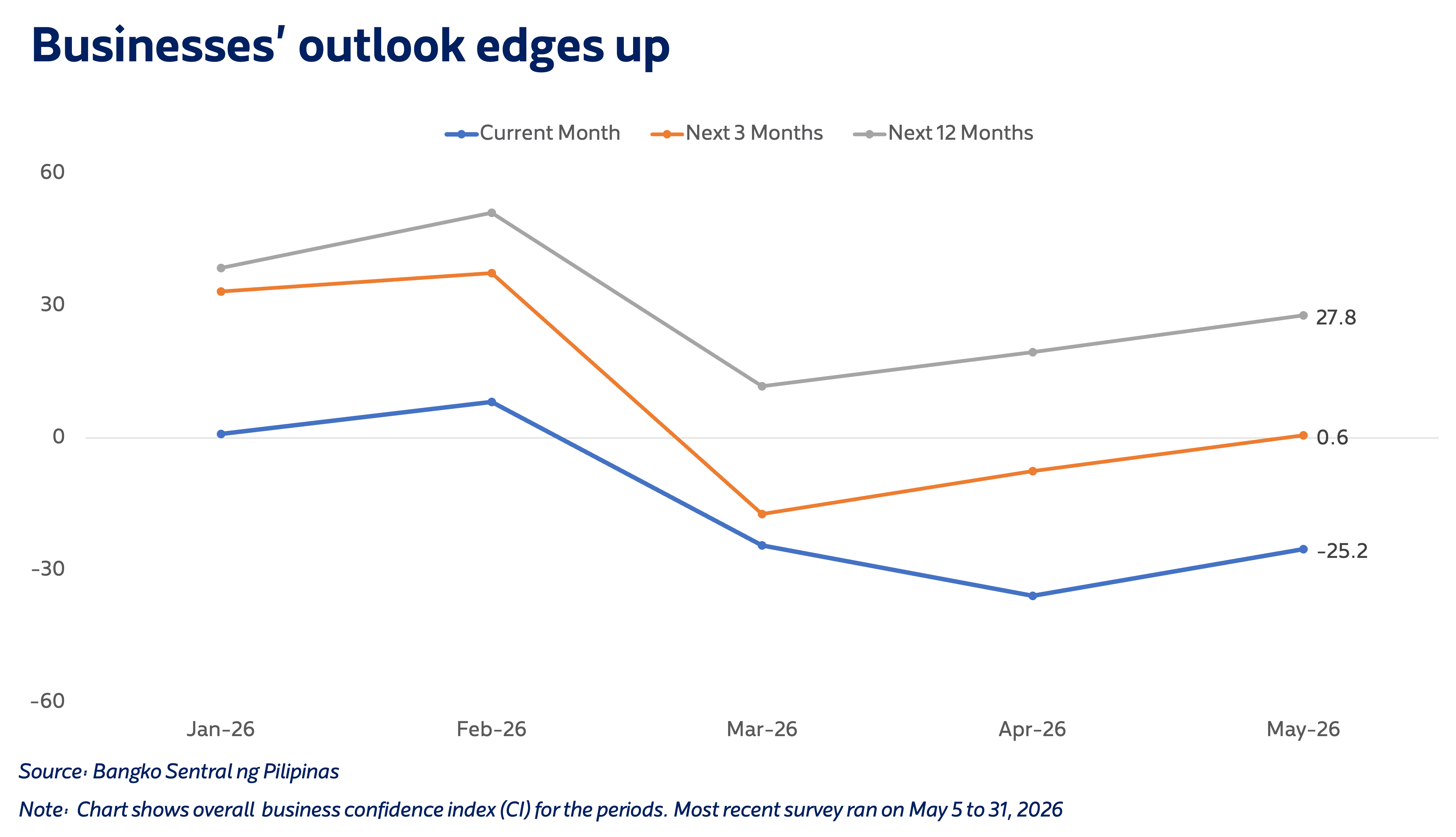
The business confidence index, which measures companies’ view of the economy and their finances, notably improved in May, according to the Bangko Sentral ng Pilipinas (BSP)’s latest Business Expectations Survey (BES).  

However, “slowflation” – muted economic growth coupled with high inflation – may be keeping their outlook in check.  
 

Stabilizing conditions

Following the peak economic impact of the recent Middle East conflict, financial conditions began stabilizing. The volume of business activity and total orders booked improved in May from the previous month, with the Philippines’ S&P Global Manufacturing Purchasing Managers’ Index rising to 50.9 in June. A reading above 50 indicates an expanding factory activity, while below 50 a contraction.  

Forward-looking indicators also reflect this. The BES showed that the outlook for overall business activity and hiring intentions for the next 12 months recovered. This is largely anchored on easing inflation pressure and a firmer prospect of a resolution to the US-Iran conflict at the time. 

Wait-and-see

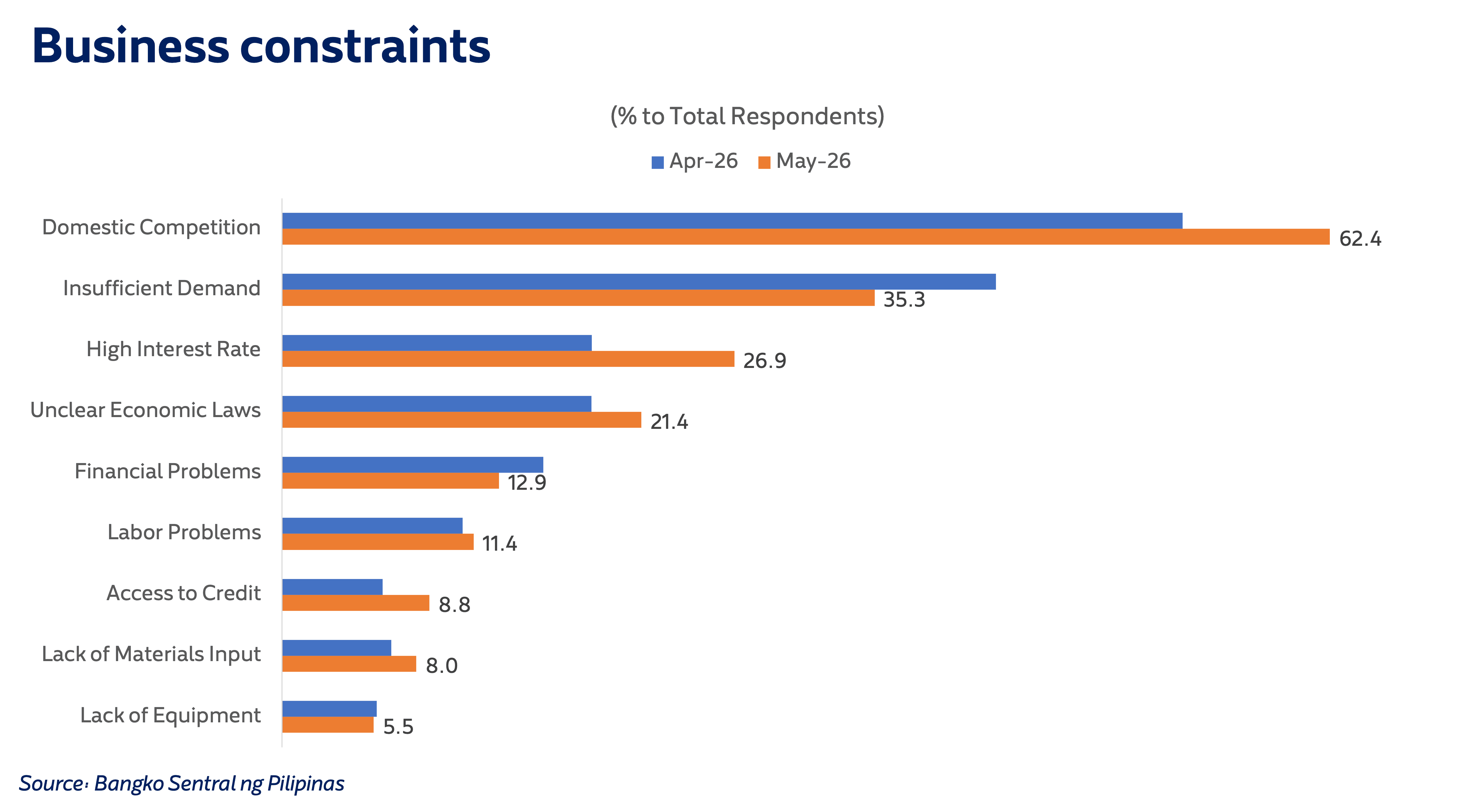
Despite the broader improvement in sentiment, firms appear unconvinced that household consumption and private investments will recover back to historical levels. Fewer businesses signal expansion, with majority in a “wait-and-see” stance amid stiff market competition, insufficient consumer demand, and elevated interest rates. Furthermore, renewed conflict in the Middle East poses a significant risk to market sentiment. 

Underlying “slowflation”

Businesses are bracing for sticky costs, with year-ahead inflation expectations rising to 5.9% in May from 4.2% in April, the BES showed. Global supply chains, particularly maritime traffic through the Strait of Hormuz, continue to operate well below pre-conflict averages.

With consumers and businesses displaying a reluctance to spend and invest, the broader economic outlook remains subdued. Economic growth in the second quarter is expected to remain muted, capturing the peak of recent domestic and global headwinds. Acknowledging this slowed momentum, the government officially recalibrated its 2026 economic growth forecast, downgrading it to 3.5-4.5% from 5.0-6.0%.

Given this, defensiveness will remain the core investment strategy until economic growth demonstrates a sustainable, broad-based recovery. For now, capital preservation may be achieved through short-term bonds and high-quality, non-cyclical stocks that may weather a challenging economic environment.

A more robust recovery is a story for 2027, contingent upon inflation firmly returning to the BSP’s 2-4% target range. This could allow the central bank to pivot toward monetary policy easing, lowering borrowing costs and, eventually, stimulating the economy. 

(Disclaimer: This is general investment information only and does not constitute an offer or guarantee, with all investment decisions made at your own risk. The bank takes no responsibility for any potential losses.)

SOPHIA THERESE “PIA” BONIFACIO is a Research Officer at Metrobank, covering local and offshore macroeconomic research. She obtained her Bachelor’s degree in Economics with a Specialization in Financial Economics, cum laude, from the Ateneo de Manila University and is a Certified UITF Sales Person (CUSP). Pia enjoys long road trips and loves a good cup of hojicha latte. 

Read More Articles About: