Markets have celebrated the shift in tone by the US Federal Reserve—from talking tough and doubling down on the higher-US-rates-for-longer message in November, to telegraphing that a pivot could be underway even earlier than anticipated.
US Treasuries have rallied quite significantly, with the 2-year US yield lower by as much as 88 basis points (bps) and the 10-year yield lower by 110 bps since the Fed’s peak hawkishness in mid-October. With the rally in global yields, the past year has also been good to holders of long-dated peso government securities (GS).
Lock-in gains
Late October, we flagged an opportunity to buy long-term peso GS with tenors of 10 years and beyond as the local market tracked the sell-off in global yields. Our trade recommendation came out around the time when US 10-year benchmark yields hovered around 5% and long-term peso yields were closing in on new highs for the year.
Investors who were able to execute this recommendation would find it opportunistic to lock-in the gains from this trade idea at current levels.
Below is an indicative sell-back computation* on FXTN 15-1, for an investor who was able to buy at 7% offer yield in early November, right after the off-cycle hike by the BSP.
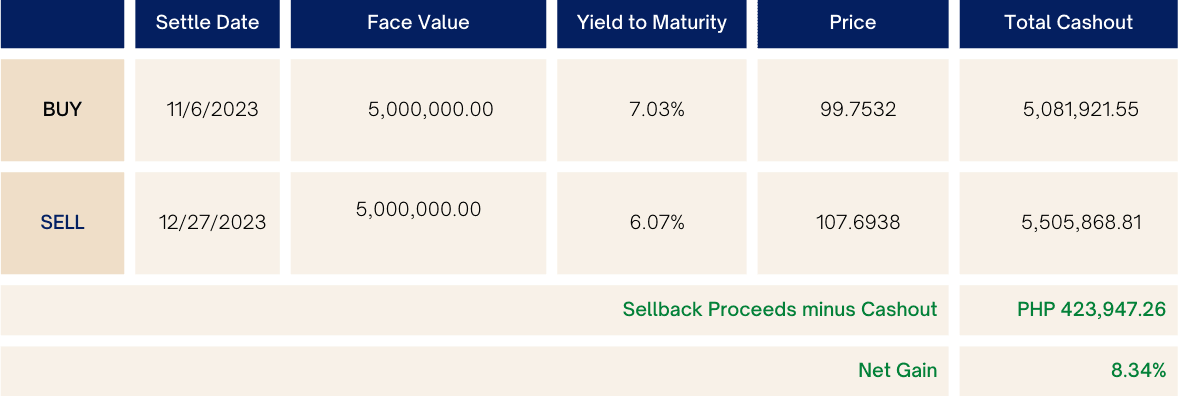
*Based on indicative prices as of December 22, 2023
Some cheapening pressure on the prices of these longer-term bonds may ensue from the upcoming bond supply in 2024. The Bureau of the Treasury (BTr) has programmed a larger borrowing program for next year at PHP 1.8 trillion (vs PHP 1.6 trillion this year) and we think that the BTr will likely be willing to award at higher rates in the upcoming auctions, as indicated by its preference for front-loading funding requirements.
Ahead of the PHP 700 billion worth of maturities in March (from RTB 3-11 and RTB 5-12), we think that the BTr may opt to raise funds via a primary issuance for a jumbo RTB as early as February.
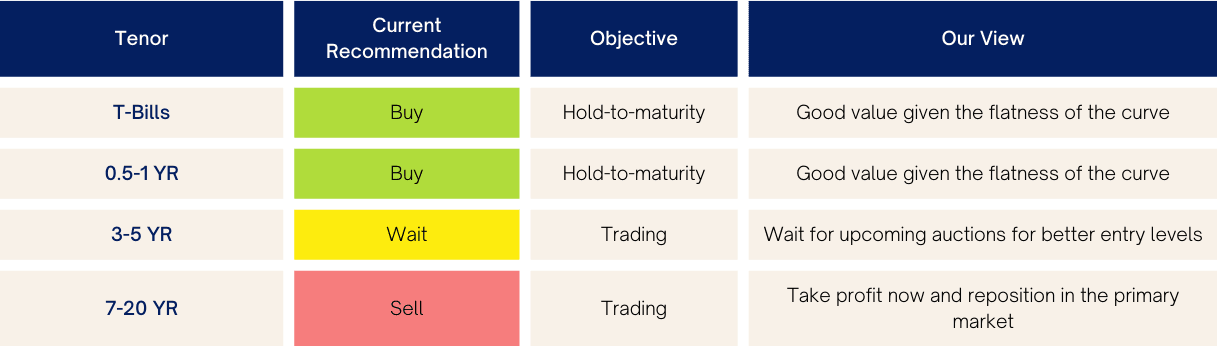
Therefore, now is a good time to take profit on longer-dated bonds before tactically repositioning in the weekly auctions and primary issuances at more favorable levels next year.
But the question is: between now and next year’s auctions, where should investors park investible funds for decent gains?
Shift to short
Whereas the US central bank appears to see a clearer path for a pivot, the BSP faces a stickier dilemma and will therefore lag the Fed’s pace of rate cuts. Our estimates show that above-target inflation will persist for 2024, which warrants a more hawkish stance from the BSP.
Given the outlook of higher-peso-rates-for-longer, we have seen short-term peso yields move higher to levels close to that of long-dated securities.
Recent peso weakness has also contributed to the upward pressure in short-term yields, as offshore market participants unload their bullish peso positions.
Due to this recent retracement, we see an opportunity to park investable funds and sell-back proceeds in short-term peso GS. Particularly, we recommend tactical investors to buy the 3-month RTB 3-11 and RTB 5-12 at a target entry level of 5.975%, as these are now hovering around the same levels as medium-term bonds.
Stay nimble for the next cycle
With the move higher in short-term peso rates, the peso yield curve has become flat—long-term bonds currently have little to no premium over shorter-dated bonds. From here, investors can wait for better levels to reinstate positions in bonds with tenors of three years and beyond.
Overall, our view remains to be falling peso yields. We continue to look at the anticipated upticks in yields as opportunities for gains in the peso GS space through 2024.
Metrobank Treasury’s views on the peso yield curve