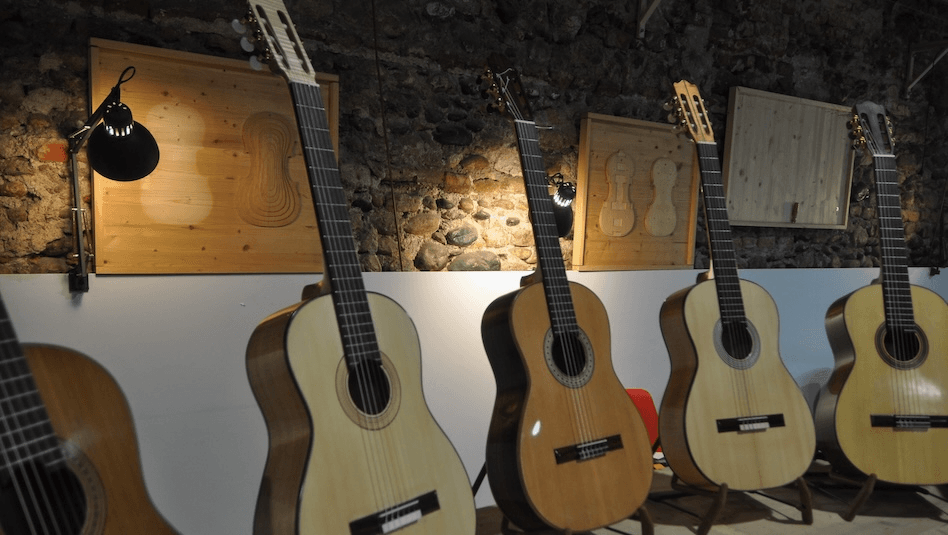
Fine guitars and the pursuit of emotional resonance


The modern guitar, a staple in the most popular genres of music, is an instrument with a history stretching back thousands of years. Few objects capture its mainstream allure as the preferred companion of bards and rockstars alike, or occupy the space between music, craftsmanship, and tangible investment quite as naturally.
This is the difference between mass-market guitars and those most desirable to enthusiasts, because the latter are not necessarily the prettiest, newest, or even the rarest in isolation. They are objects with a compelling story, exceptional originality, and a demonstrable place in music history.
“An instrument like the guitar is more than the material object; with it comes its history, the provenance of the guitar, who owned it, who the maker is,” said Ivar-Nicholas Fojas, D.M.A., professor of guitar at the University of Santo Tomas Conservatory of Music and luthier who studied guitar-making techniques under Adolfo Timuat Toyoda and master luthier Jeremy Copper.
“It’s like collecting artwork, really. It only increases in value; it only appreciates throughout the years.”
Fine and vintage guitars have become a legitimate alternative investment, with reports claiming the market was valued at about USD 17.4 billion in 2024.
“Financially, I’d rather put my money in guitars than in any [other] investment. If you decide to sell it later on, it’s almost guaranteed to have considerable profit,” Mr. Fojas said.
Perhaps the most popularly discussed starting point for electric-guitar collecting is the 1950s and early 1960s, when American manufacturers produced instruments that would subsequently define the visual and sonic language of popular music.
However, the art of guitar collecting has much deeper roots. For the truly legendary pieces, Mr. Fojas pointed to the works of Antonio de Torres Jurado, touted as the most important Spanish guitar maker of the 19th century, whose designs have become the blueprint for most acoustic guitars on the market today.
Similarly, the guitars of German luthier Hermann Hauser Sr., or the more contemporary pieces of Dominique Field or Matthias Dammann command similar esteem. Mr. Fojas said that the name behind a particular instrument typically carried the most weight for collectors.
“I think I’ll put it on top if you’re collecting. If you’re a performer, probably the sound is more important. But these two are almost synonymous,” he said.
Provenance can be a defining factor as well. A guitar that once belonged to a celebrated musician, even one from an otherwise ordinary model, can leap up in value.
Recent auction results illustrate the point. Christie’s reported the sale of Eric Clapton’s 1939 Martin 000-42 for USD 4.101 million in March 2026, while the broader Jim Irsay Collection auction produced several extraordinary results for historically significant guitars.
For serious collectors, however, the definition of a historically significant guitar is not necessarily tied to specific names in musical canon. Like fine art or sculpture, personal significance plays a role.
A serious collector can consider curating around a central thesis. One collector might focus on the evolution of electric guitar designs; another might want guitars associated with British blues, or guitars connected to a particular artist or musical movement.
Unlike an artwork or statue, a guitar can function as a genuine financial asset and still invite you to interact with it.
As instruments built to make music, guitars demand a more intimate relationship with their owners. A guitar stored for years without being played can change its neck, fretwork, bridge, hardware, and electronics, particularly when it is exposed to fluctuations in temperature and humidity.
“Wood has memory,” Mr. Fojas pointed out. “Guitars are more durable than you think, but they can get damaged without us touching or handling them. The environment can do a number on a fine guitar.”
Mr. Fojas suggested collectors invest in quality cases for their guitar collection. The ones he personally uses are custom-made from carbon fiber and are hermetically sealed against moisture or contaminants.
He also recommends storing them in a room at 50% relative humidity. In a humid environment like the Philippines, that means storing them with desiccants such as silica gel. Otherwise, he suggests humidifiers such as sponge-in-case units and hydrometers.
Music is a hobby that is inextricable from emotion, and Mr. Fojas said that collecting guitars, in essence, is the pursuit of emotional resonance.
“Musicians or players will go to any length, any end just to find that voice, that sound that reflects themselves,” he said.
That emotional connection is what separates guitar collecting from other alternative investments and tangible assets. Mr. Fojas said that money in the bank is materially insubstantial, appreciated only as numbers on a screen. Not so for guitars.
“If you invest in a guitar, you can play that guitar every day, every night,” he said. “It’s a joy to have a fine instrument, really.”
Editor’s Note: This article is part of a special collaboration between Metrobank and BusinessWorld. Our aim is to explore the facets of living well for Wealth Insights readers, who value the finer things in life.