What began as student-led protests over education funding spread to other perceived social and economic troubles. Do they reflect deeper economic problems?
November 3, 2026 by Anna Cudia
Share this article:
Share this article:
Protests are not new to France, particularly when they involve public services and living standards.
What began as demonstrations against perceived underfunding of education and public services quickly expanded into broader concerns about purchasing power and the cost of living. The movement then spread to parts of Europe, including Italy, Belgium, Portugal, and Albania.
When things like these happen, markets tend to pay attention.
Why markets reacted
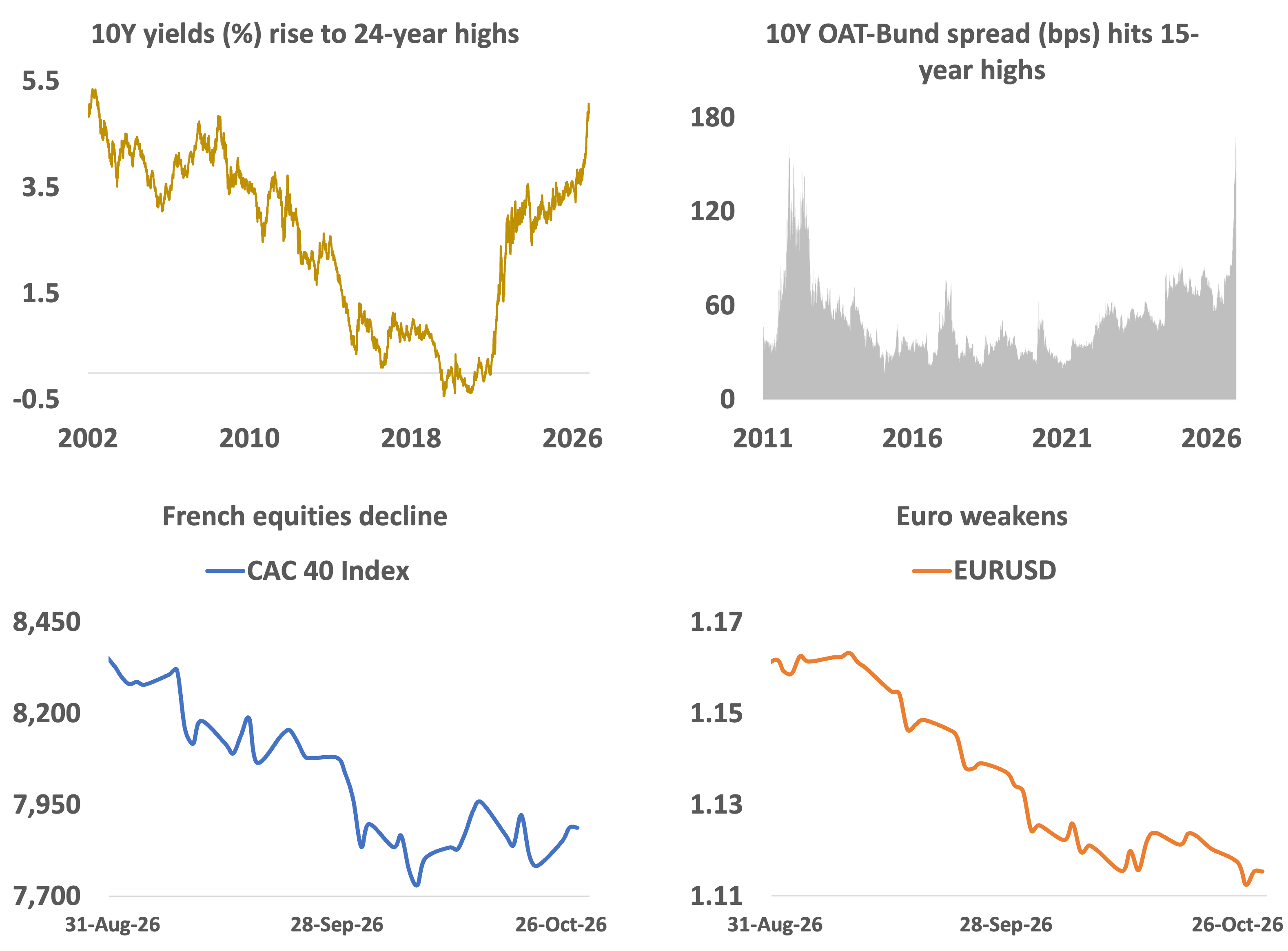
Investors were less concerned about the protests themselves than what they revealed about France’s fiscal and political challenges. French 10-year government bond yields rose toward levels not seen since 2002. OAT-Bund spreads, or the difference between French and German government-issued bond yields, widened. French equities and the euro weakened.
Source: Bloomberg
France already faced weak growth, large fiscal deficits, and political uncertainty ahead of the April 2027 presidential election. The unrest raises doubts about the government’s ability to implement reforms and reduce deficits.
Investors are also watching to see whether stress in French assets could spill over into the broader euro area. Unlike during the eurozone sovereign debt crisis, the region now has institutional backstops, such as the European Stability Mechanism, that help limit the risk of systemic contagion.
The contrast with the Eurozone sovereign debt crisis is important. In the aftermath of the 2008 Global Financial Crisis, concerns about Portugal, Italy, Ireland, Greece, and Spain (P.I.I.G.S.) raised broader questions about the viability of the euro and whether the region possessed adequate crisis-management tools.
However, many of these countries were considered peripheral economies compared with core euro-area anchors such as France and Germany. Today, the concern is not whether France faces the same challenges as Greece did more than a decade ago, but rather that fiscal and political strains are emerging in one of the euro area’s largest economies and key contributors.
While investors are not questioning the survival of the common currency, they are closely watching whether France can restore confidence in its fiscal trajectory while maintaining social and political stability.
France’s limited fiscal flexibility
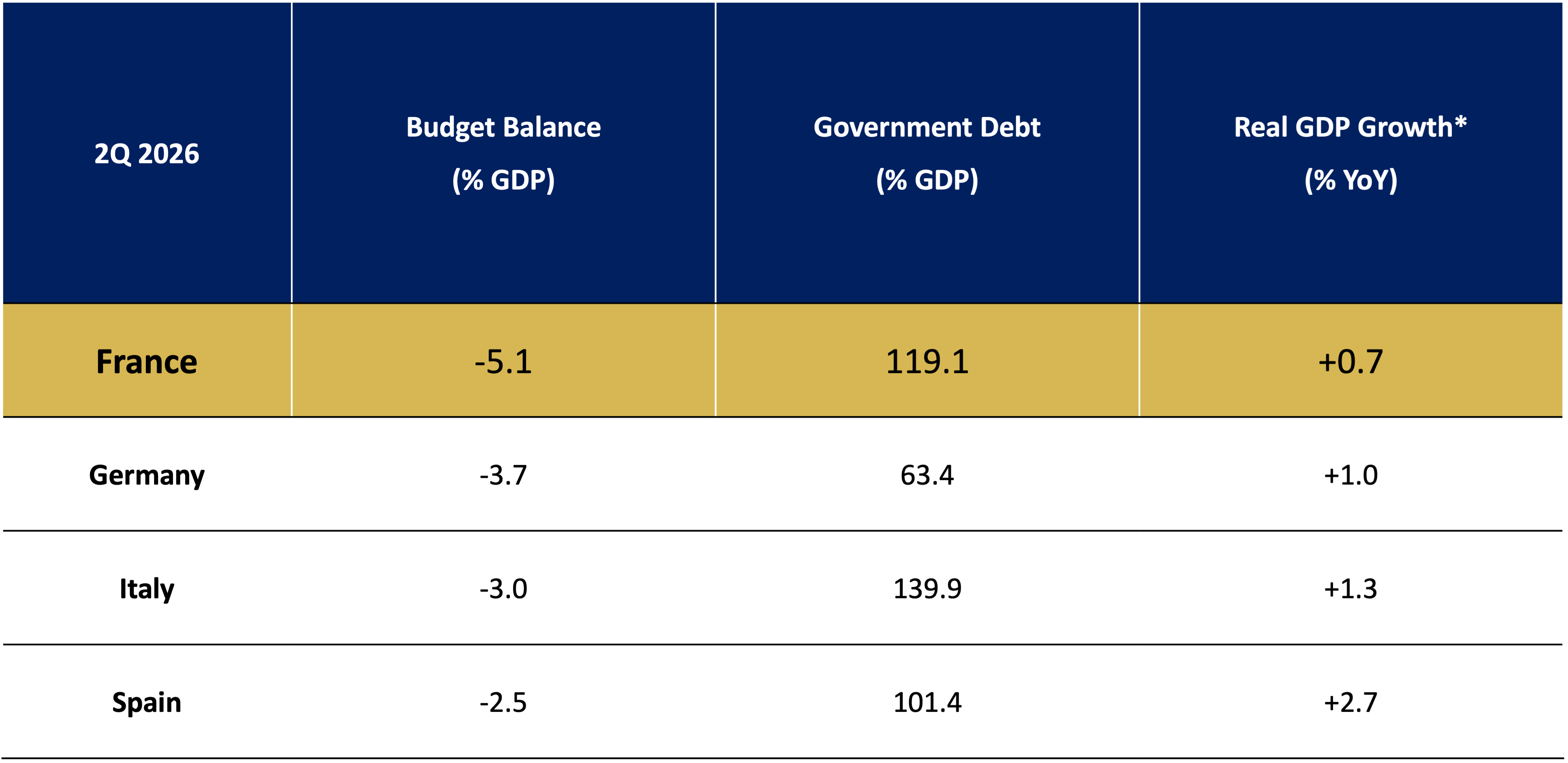
France’s fiscal position was already under scrutiny before the protests. Among the euro area's largest economies, it has the widest budget deficit, debt exceeding 119% of GDP, and the weakest growth rate. This combination leaves investors more sensitive to developments that could complicate fiscal consolidation and helps explain the recent rise in French borrowing costs.
*Note: Real GDP growth based on chain-linked volume measures, percentage change versus the same quarter of the previous year. Source: Eurostat
Implications for bonds, equities, and the euro
Fixed income. French government bonds have seen the most immediate impact, with investors demanding a wider premium over German Bunds. Fiscal credibility remains the key variable.
Equities. Consumer-facing sectors may face near-term disruption, particularly retail, tourism, and leisure. However, broader corporate fundamentals remain relatively resilient.
Euro. Political and fiscal uncertainty has weighed on the currency, although its longer-term direction remains driven primarily by European Central Bank policy and broader US dollar dynamics.
For now, markets appear to be pricing higher political and fiscal uncertainty rather than an immediate deterioration in France’s economic fundamentals.
The confidence channel matters most
Historical experience suggests that the economic cost of social unrest often extends beyond physical damage. Research by the International Monetary Fund finds that major episodes of unrest can leave GDP below its pre-crisis path for several quarters, as confidence weakens, investment is delayed, and financial conditions tighten.
The French protests therefore add another layer of uncertainty to an already fragile economic backdrop.
Looking beyond the protests
The direct economic cost of the unrest may ultimately prove manageable. The bigger question is whether France can restore confidence while addressing fiscal and social pressures amid weak growth and rising borrowing costs.
For investors, the event serves as a reminder that market risks do not always originate from the economy itself. Sometimes they arise from the political constraints that shape how governments respond to economic challenges.
In France’s case, markets appear less concerned with the immediate cost of the protests and more focused on whether policymakers can place public finances on a credible path while maintaining social stability.
(Looking to generate regular income and diversify your portfolio? Metrobank Wealth Manager gives you access to fixed income investment opportunities, supported by expert insights. Speak with your Relationship Manager, Wealth Specialist, or Markets Sales Personnel to discover fixed income solutions that match your investment objectives and risk profile.)
(Disclaimer: This is general investment information only and does not constitute an offer or guarantee, with all investment decisions made at your own risk. The bank takes no responsibility for any potential losses.)
ANNA DOMINIQUE CUDIA, MBA, CSS, oversees Metrobank’s Macro Research Department, steering macroeconomic and financial market analyses for clients. She previously led the Markets Research Department of Metrobank’s Trust Banking Group and was part of Investor Relations, supporting multi-billion peso and US dollar capital-raising initiatives. She holds an MBA in Finance, with distinction, from the University of London, and industry certifications in finance. Outside of work, she enjoys travel and exploring new perspectives.