


Work, class suspensions likely dampened Q3 growth
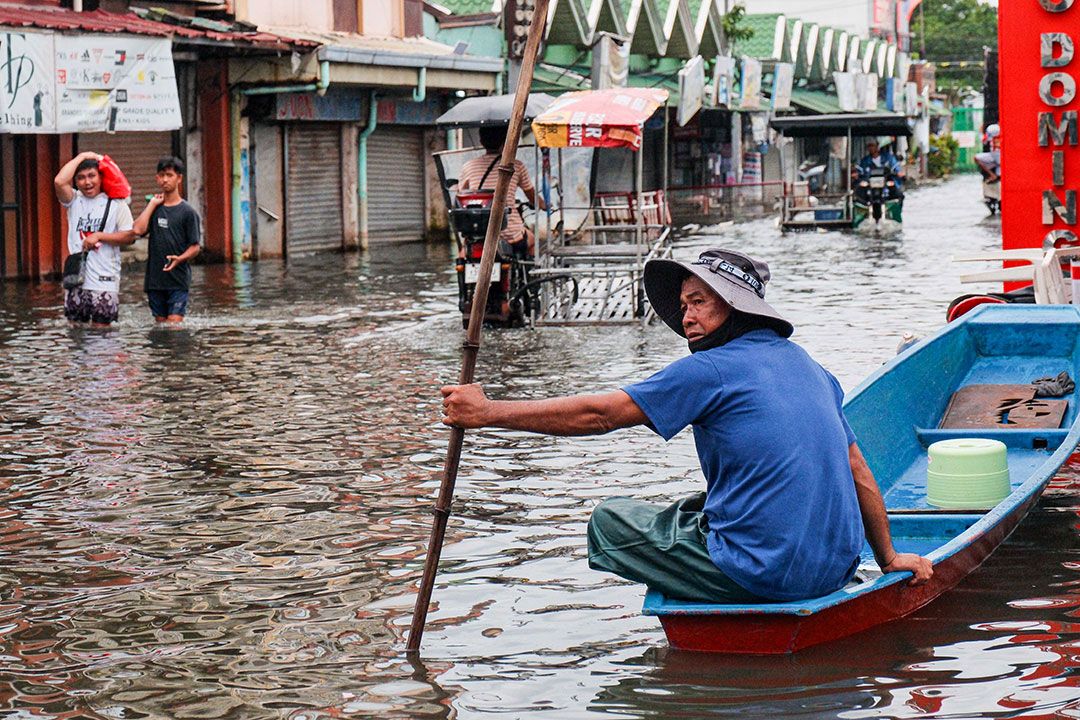
Economic growth likely took a hit in the third quarter as persistent rains disrupted work and classes but could rebound in the fourth quarter as infrastructure spending accelerates, Economy Secretary Arsenio M. Balisacan said.
“This month, and in the previous three weeks, there’s a lot of suspension because of the habagat (southwest monsoon). Of course that affected the economic activity,” Mr. Balisacan told reporters at the House of Representatives on Tuesday.
He also cited the impact of heavy rains and flooding on rice production, particularly in Central Luzon.
“The floods would have affected that. It’s okay if the floods last for only just a week as rice can tolerate it. But if it lasts for a long time, they’ll be affected. So, we’ll see. I haven’t seen any reports on that yet,” he said.
Agricultural damage caused by tropical cyclones Luis, Maymay, Neneng, and Pilandok, as well as the enhanced southwest monsoon reached PHP 4.38 billion, according to the final bulletin from the Department of Agriculture’s (DA) Disaster Risk Reduction and Management Operations Center.
Sought for comment, Philippine Institute for Development Studies President Philip Arnold P. Tuaño said previous studies have shown that a major flooding event could result in output losses equivalent to about 0.6% of gross domestic product (GDP) in cities.
“That is for a big flooding event. What we have now seems to be cumulative,” Mr. Tuaño said in an interview.”
He said heavy rains brought by the southwest monsoon have led to suspensions that affect consumption as well as demand across industries.
“It is not just the final demand, but also the intermediate demand for goods, so that is the input to industries,” he said.
“But the issue now is not just flooding. It’s also the so-called slow-onset events in climate change,” Mr. Tuaño said, noting that these could also hurt worker productivity.
Rebound in Q4 seen
Despite the weather disruptions, Mr. Balisacan said he remains optimistic about economic growth in the second half of the year, with faster growth expected in the October-to-December period.
The Philippine economy grew by 2.6% in the first half, well below the government’s 3.5% to 4.5% target for the year 2026. The economy would need to expand by at least 4.4% in the second half to reach the lower end of the government’s full-year target.
Mr. Balisacan said faster infrastructure spending is expected to be a key growth driver in the second half, particularly in the fourth quarter.
In the first half, the National Government’s (NG) infrastructure and other capital outlays slid by 40.8% to PHP 367.4 billion from PHP 620.2 billion a year ago.
To meet the full-year program of PHP 931.54 billion, the government would need to spend about PHP 564.14 billion on infrastructure and other capital outlays in the second half, equivalent to roughly PHP 94 billion a month.
Meanwhile, Mr. Balisacan said the government is preparing for a stronger El Niño through the reconvened El Niño Task Force under the DA.
“We are doing our best… because the weather is so unpredictable,” he said.
Last week, the Philippine Atmospheric, Geophysical and Astronomical Services Administration (PAGASA) said El Niño could cause drought conditions in Camarines Sur and dry conditions and dry spells in 61 provinces across the country by November.
The phenomenon, which is expected to persist through the first half of 2027, may reach a very strong state before the end of the year.
To cushion the economy from climate-related shocks such as El Niño, PIDS’ Mr. Tuaño said the government should strengthen early warning systems and provide social protection and productivity support. — Justine Irish D. Tabile
This article originally appeared on bworldonline.com