


Wall Street ends higher after Democrats win Congress; data center stocks tumble
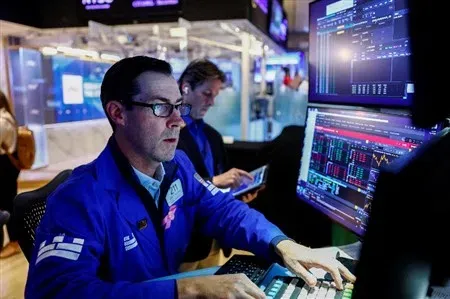
Wall Street closed sharply higher on Wednesday as Democrats' sweeping midterm election victory eased political uncertainty and boosted risk appetite, though data center shares fell on fears of tighter AI regulation.
Democrats seized control of both the Senate and House of Representatives, scoring wins in Republican strongholds for the first time in generations in a voter backlash against President Donald Trump.
Some large technology stocks rose on expectations that a slower expansion of AI infrastructure will favor them competitively, while smaller companies carrying out aspects of the AI infrastructure buildout fell on fears that a slowdown will strain their finances. A sharp decline in oil prices, driven by bets that a shift in power will hasten the end of the Iran war, boosted positive sentiment for the broad stock market.
"Stocks are sharply higher today as election clarity reduces uncertainty," said Terry Sandven, chief equity strategist at US Bank Wealth Management in Minneapolis. "The election introduces a degree of gridlock to the economic backdrop and that oftentimes is favorable for equity prices, and we are seeing some of that today."
AI HEAVYWEIGHTS RISE, DATA CENTER OPERATORS FALL
AI stocks were split. Shares of cash-rich AI heavyweights rose, while chipmakers and data center operators fell after Democrats made gains in key data center states including Texas and Georgia, where public opposition to the industry's rapid expansion has been growing.
The move reflected expectations that a slowdown in expanding AI infrastructure could ease cash demands on tech companies, while pressuring operators and suppliers whose growth depends on a rapid buildout.
"It's pretty clear that the AI trade will face some headwinds there ... If you push out the pace or change the pace of the data center buildout, you begin to change the fundamental trajectory for many of those suppliers," said Scott Chronert, head of US equity strategy at Citi Research.
Among AI heavyweights, Microsoft rose 6.7%, Amazon.com added 6.1%, Alphabet gained 3.2% and Meta Platforms rose 1.4%. Shares of data center operators slumped, with Hut 8 down 23%, IREN off 11%, Core Scientific falling 10% and Applied Digital lower by 6.7%.
The Philadelphia SE Semiconductor index hit a six-month low, dropping 3.1%.
AMD rose 1% after forecasting faster-than-expected 2027 growth as its data center sales surged.
The AI trade has come under pressure recently as investors grow more concerned over Big Tech's soaring AI spending. The tech-heavy Nasdaq-100 index confirmed on Monday it was in a technical correction.
The S&P 500 gained 119.7 points, or 1.6%, to end at 7,688.62 points, while the Nasdaq Composite added 364.50 points, or 1.4%, to 25,736.51. The Dow Jones Industrial Average rose 1,569.40 points, or 3%, to 53,356.12.
All but two of the S&P 500 sector indexes rose, with consumer discretionary jumping 4.3% and energy falling 4.8%.
The dollar weakened against most currencies and yields on long-dated Treasuries moved lower.
Elon Musk-led SpaceX, down 3.9%, and Tesla, down 3.3%, were among the laggards. Musk spent nearly half a billion dollars backing Republican candidates, including efforts to keep Republicans in control in Texas, the home state of both companies.
Defense stocks Northrop Grumman, RTX, and Lockheed Martin fell as Trump's USD 1.5 trillion defense budget request could now face a tougher road in Congress.
Solar and clean energy stocks rose, as investors bet a Democratic sweep would help keep federal support for clean energy development in place. The Invesco Solar ETF climbed nearly 6%.
(Reporting by Shashwat Chauhan and Utkarsh Hathi in Bengaluru, and by Noel Randewich in San Francisco; Additional reporting by Jiaxing Li and Medha Singh; Editing by Mrigank Dhaniwala, Saumyadeb Chakrabarty, Maju Samuel, Rod Nickel, and Colin Barr)
This article originally appeared on reuters.com