


S&P 500 falls from record high on Middle East worries
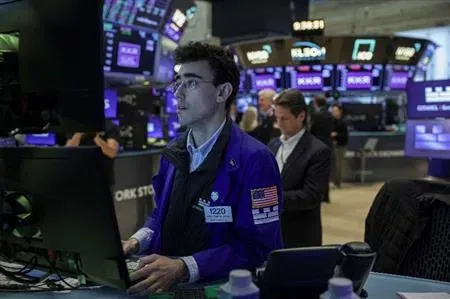
Wall Street ended lower on Monday, with the S&P 500 retreating from record highs, after a South Korean ship was hit by an explosion in the Strait of Hormuz and Tehran demonstrated its grip on Middle East oil, dampening optimism about strong first-quarter earnings reports.
Energy stocks rose after reports of the latest confrontations. An explosion reported aboard a South Korean merchant ship appeared likely to persuade commercial shippers the strait was still unsafe after US President Donald Trump said the US Navy would open it.
Tehran said it forced a US warship to turn back after it attempted to enter the strait, while the United Arab Emirates reported a fire at an oil installation following an Iranian drone attack.
The renewed nervousness about the Middle East conflict comes after the S&P 500 and Nasdaq hit record highs last Friday amid a stronger-than-expected quarterly earnings season.
"With the market at all-time highs, there's not a lot of room for error, and it feels like the kind of big asymmetric risk is still to the downside, even if it's maybe not the most probable outcome that we get back into a hot war," said Ross Mayfield, an investment strategist at Baird Private Wealth Management.
S&P 500 companies are expected to post aggregate earnings growth of 28% year/year for the first quarter, double the expectation of 14% at the start of April, according to LSEG. Wall Street's AI heavyweights account for much of that optimism.
Berkshire Hathaway reported on Saturday that it was a net seller of stocks for the 14th consecutive quarter. Investors closely watch the conglomerate, often viewed as a bellwether of the US economy, for its insight into valuations and broader market conditions.
Shares of GameStop tumbled 10% and eBay rose about 5% after the video game retailer unveiled a proposal to buy the online marketplace for about USD 56 billion in a cash-and-stock deal. GameStop's stock market value is about USD 11 billion.
The S&P 500 declined 0.41% to end the session at 7,200.75 points.
The Nasdaq declined 0.19% to 25,067.80 points, while the Dow Jones Industrial Average declined 1.13% to 48,941.90 points.
Ten of the 11 S&P 500 sector indexes declined, led lower by materials, down 1.57%, followed by a 1.17% loss in industrials. The energy index added 0.85%.
Delivery firm FedEx dropped 9.1% and United Parcel Service fell 10.5% after Amazon.com said it was rolling out "Amazon Supply Chain Services," opening up its logistics network for other businesses to use.
The declines in FedEx and UPS dragged the Dow Jones Transportation Average index down 4.8% to its lowest level in nearly a month.
Palantir climbed 1.4% ahead of the data analytics and defense software company's quarterly report after the bell.
Cruise operator Norwegian dropped 8.6% after slashing its annual forecast due to higher fuel costs related to the Middle East conflict.
Declining stocks outnumbered rising ones within the S&P 500 by a 2.2-to-one ratio.
The S&P 500 posted 26 new highs and 22 new lows; the Nasdaq recorded 126 new highs and 87 new lows.
Volume on US exchanges was relatively light, with 16.3 billion shares traded, compared with an average of 17.7 billion shares over the previous 20 sessions.
(Reporting by Noel Randewich in San Francisco; Additional reporting by Niket Nishant and Utkarsh Hathi in Bengaluru; Editing by Pooja Desai and Matthew Lewis)
This article originally appeared on reuters.com