


Renewed Middle East conflict revives fuel excise tax suspension debate
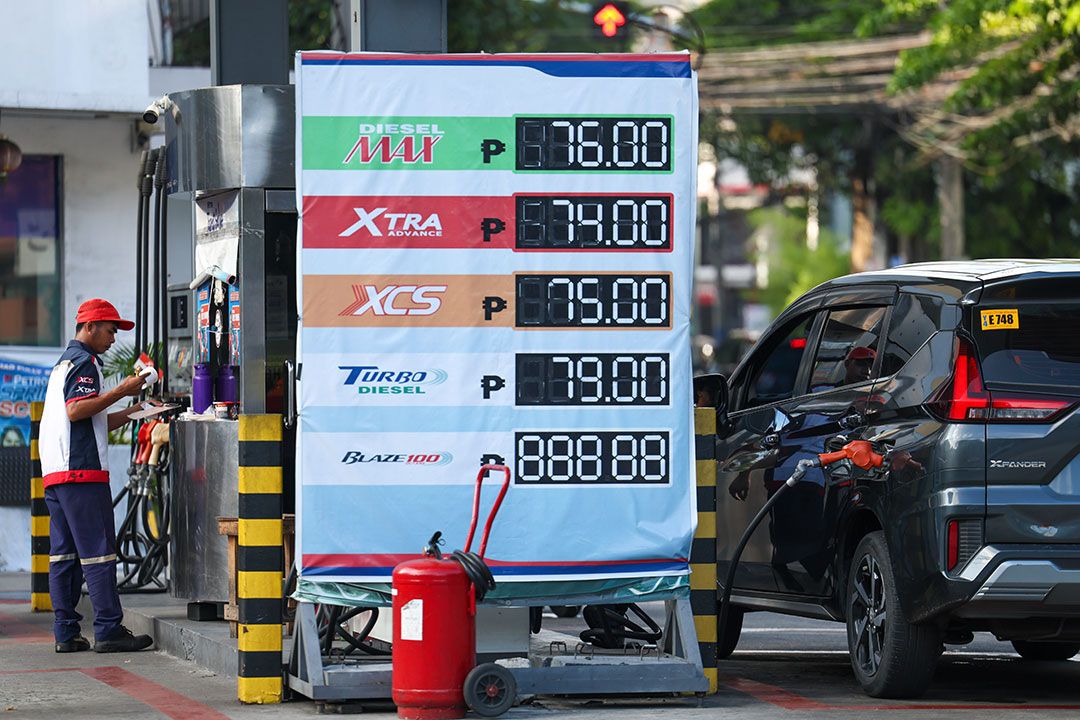
Renewed upward pressure on global oil prices has revived calls for the Philippine government to suspend excise taxes on petroleum products, although experts remain divided on whether such a move would be effective.
This comes as fuel retailers are expected to hike diesel prices by as much as PHP 10.50 per liter and gasoline prices by as much as PHP 4 per liter this week.
“At this point, I would not immediately recommend suspending the fuel excise tax,” Jonathan L. Ravelas, a senior adviser at Reyes Tacandong & Co., told BusinessWorld.
“A better approach is to focus on targeted interventions that ease the burden on vulnerable sectors while preserving much needed government revenues,” he added.
Mr. Ravelas said the government should instead expand fuel subsidies for public transport, farmers, and fisherfolk; provide targeted cash assistance to low-income households; and accelerate energy conservation measures.
He said the government’s focus should be on reducing fuel and power consumption rather than merely absorbing higher prices, as conservation remains “the quickest and most effective response to an oil price shock.”
“Excise tax suspension should remain a contingency measure if oil prices stay elevated for a prolonged period and begin to pose a significant risk to inflation, economic growth, and consumer welfare,” he said. “Until then, targeted assistance and conservation measures offer a more sustainable solution.”
The country, a net importer of crude oil, has been under a year-long energy emergency since late March as the Middle East crisis threatens its fuel supply.
Under Republic Act No. 12316, the President has the authority to suspend or reduce excise taxes on petroleum products. A suspension of fuel excise tax collection has been estimated to lower pump prices by PHP 6 per liter for diesel and PHP 10 per liter for gasoline.
President Ferdinand R. Marcos, Jr. suspended the excise tax on liquefied petroleum gas (LPG) and kerosene for three months starting April 13. This reduced LPG prices by PHP 3.36 per kilo and kerosene prices by PHP 5.60 per liter.
The three-month suspension of excise tax on LPG and kerosene was lifted on July 8, after the average Dubai crude oil price dropped below the USD 80 per barrel threshold.
“While reinstated just about a couple of weeks ago, a possible suspension may again be necessary to help cushion the potential further increases on the said socially sensitive products,” Jetti Petroleum, Inc. President Leo P. Bellas told BusinessWorld.
Based on the five-day trading at the regional benchmark Mean of Platts Singapore, pump prices of diesel are projected to increase by PHP 10 to PHP 10.50 per liter this week while gasoline prices are seen rising by PHP 3.50 to PHP 4 per liter.
The projected increases could push both gasoline and diesel prices beyond PHP 100 per liter, well-above the prewar price levels of around PHP 50 to PHP 60 per liter.
“The breakdown of the US-Iran truce and tanker attacks in the Strait of Hormuz revived concerns about shipments of products from the Middle East,” Mr. Bellas said.
“With the renewed risk of supply disruptions, gasoline prices strengthened as global stock balances remain tight, with inventories falling as demand remains firm,” he added.
Adding to the risks posed by the ongoing Middle East conflict, Iran has reportedly directed its Houthi allies in Yemen to shut the Red Sea export route should the US launch attacks on its power infrastructure, Mr. Bellas said.
While tensions in the Middle East have renewed upward pressure on oil prices, it is still too early to call for a suspension of excise taxes on fuel, according to Top Line Business Development Corp. Senior Vice-President and Chief Operating Officer Brigitte Carmel C. Lim.
“However, if the increases become sustained and significantly impact consumers, temporarily suspending excise taxes may be considered to help ease the burden on motorists and households,” she said in a Viber message.
Noel M. Baga, co-convenor of the Center for Energy Research and Policy, said fuel price volatility is not the core issue.
“The Philippines remains vulnerable to sudden external supply shocks because of its heavy dependence on imported fuel, the absence of effective automatic price controls, and the lack of a Strategic Petroleum Reserve,” Mr. Baga told BusinessWorld.
“Building those buffers is what protects consumers from the next shock, not only this one,” he added.
The Philippine government is already laying down plans to build the country’s strategic petroleum reserve program, which includes putting up new stockpiling facilities. — Sheldeen Joy Talavera, Reporter
This article originally appeared on bworldonline.com