


US yields climb, stocks fall as inflation data boosts chances for larger Fed rate hike
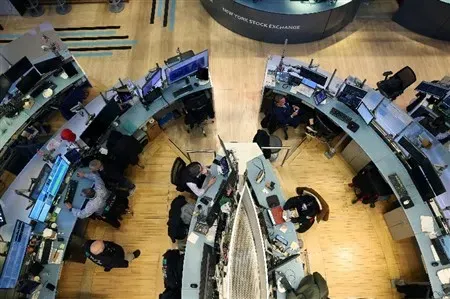
US Treasury yields jumped and Wall Street stocks fell on Tuesday after a hotter-than-anticipated US inflation reading boosted chances for a Federal Reserve interest-rate hike of half a percentage point next month.
The 2-year note yield, which typically moves in step with Fed rate expectations, was last up 18.44 basis points at 4.731%. It was its biggest one-day jump since the April 2025 "tariff tantrum," when US President Donald Trump announced trade levies on imports from around the world. The yield on benchmark US 10-year notes rose 12.55 bps to 4.988%.
The US Consumer Price Index rose 0.4% in October after advancing 0.6% in September, according to official data. Economists polled by Reuters had forecast the CPI climbing 0.3% over the month.
In addition, core CPI — which strips out volatile food and energy prices and is often referred to as "underlying inflation" — landed at 0.3%, higher than the 0.2% consensus.
Expectations that the Fed may raise rates half a point at its December policy meeting jumped after the data. Before the data landed, Fed Governor Christopher Waller said in London that a core reading of 0.3% for October would prompt him to consider a half-point hike at the Fed's December 8 to 9 meeting.
The Fed more typically hikes or cuts rates in 25-basis-point increments.
Lower oil prices recently have helped ease some of the inflation concerns that have been on investors' radar since the US-Israeli war with Iran erupted at the end of February.
"It’s not just headline CPI that is too high, but the oil shock has seeped into core," said Brian Jacobsen, chief economic strategist at Annex Wealth Management in Menomonee Falls, Wisconsin.
"The Fed is probably now more concerned about the idea of AI crowding out other activity and pushing up prices. Forget about oil. The new Fed worry is the cost of hiring plumbers and electricians."
Also weighing on Wall Street, Nvidia’s stock fell sharply for a second straight day. Investors worried about CEO Jensen Huang's future at the chip company after it initiated an internal probe into spy claims involving Chinese businesswoman Alice Huang.
Wall Street's decline followed a sharp rally on Monday. Stocks had bounced back from a selloff last week that was tied to worries about increased AI regulation in the wake of a Democratic sweep in the US midterm elections. The tech-heavy Nasdaq closed 2.7% higher on Monday.
The Dow Jones Industrial Average fell 157.86 points, or 0.30%, to 52,231.89, the S&P 500 fell 29.01 points, or 0.38%, to 7,520.93 and the Nasdaq Composite fell 187.26 points, or 0.74%, to 25,065.87.
MSCI's gauge of stocks across the globe fell 1.30 points, or 0.12%, to 1,107.66.
The pan-European STOXX 600 index climbed 0.3%.
Earnings reports due this week from tech companies will be another test for markets as investors fret about the cost of the AI buildout and its profitability. After the closing bell, CoreWeave beat Wall Street estimates for quarterly revenue and raised its annual forecasts.
Anthropic's blockbuster IPO was seen valuing the Claude chatbot creator at up to USD 1.4 trillion, slightly short of earlier expectations, setting up a test of Wall Street's faith in the AI boom it helped ignite. The company is kicking off the roadshow for a share sale.
GOLD FALLS, DOLLAR GAINS
Gold prices fell after the inflation data, with spot gold down 2.62% at USD 4,030.56 an ounce. The dollar gained.
The dollar index, which measures the greenback against a basket of currencies including the yen and the euro, rose 0.56% to 102.25, with the euro down 0.54% at USD 1.1162. Against the Japanese yen, the dollar strengthened 0.58% to 158.81.
Oil prices ended lower after US officials downplayed the need for additional military action against Iran, easing fears of additional Middle East supply disruptions.
Brent futures fell USD 1.08, or 1.2%, to settle at USD 91.49 a barrel. US West Texas Intermediate (WTI) crude fell 81 cents, or 0.9%, to settle at USD 86.04. Both crude benchmarks closed at their lowest since August 31 for a second day.
(Reporting by Caroline Valetkevitch in New York and Shashwat Chauhan in Bengaluru; additional reporting by Ankur Banerjee in Singapore; Editing by DJ Yap, Lincoln Feast, Peter Graff, Joe Bavier, Jonathan Spicer, and David Gregorio)
This article originally appeared on reuters.com