The impact of interest rates on bond prices


In the world of finance, bonds and interest rates are two interconnected elements. A firm grasp of the relationship between bond prices and interest rates is fundamental to understanding the dynamics of the financial market and making wise investment decisions.
This article aims to shed light on how interest rates affect bond prices.
Bonds are a loan agreement between an investor and the issuer, like a company, government, or government agency. The investor essentially receives a stream of fixed interest payments periodically for a specified period, then the return of the principal amount on the maturity date.

The market value of a bond is called the bond price and is driven by investor supply and demand. The bond’s original price when it is sold for the first time it is offered is called its par value. If the bond price is above the face value, it is considered bought at premium, while if it is below face value, it is bought at discount. These are relevant to the fixed income investors since they would pay less cash if the bond is considered at a discount compared to a bond that is at premium.
When the bond matures, the annualized total return of a bond is called yield-to-maturity (YTM).
Bonds and interest rates share an inverse relationship. So, if interest rates rise, what will typically happen to bond prices? Higher interest rates affect the value of an existing bond’s yield. Bond prices go down as interest rates go up, and vice versa.
When interest rates are hiked due to policy changes by a central bank, bond prices fall, and vice versa. In the case of the Philippines, the Bangko Sentral ng Pilipinas (BSP) is the one that controls the rates. This inverse relationship is a fundamental concept in bond investing and is often referred to as interest rate risk.
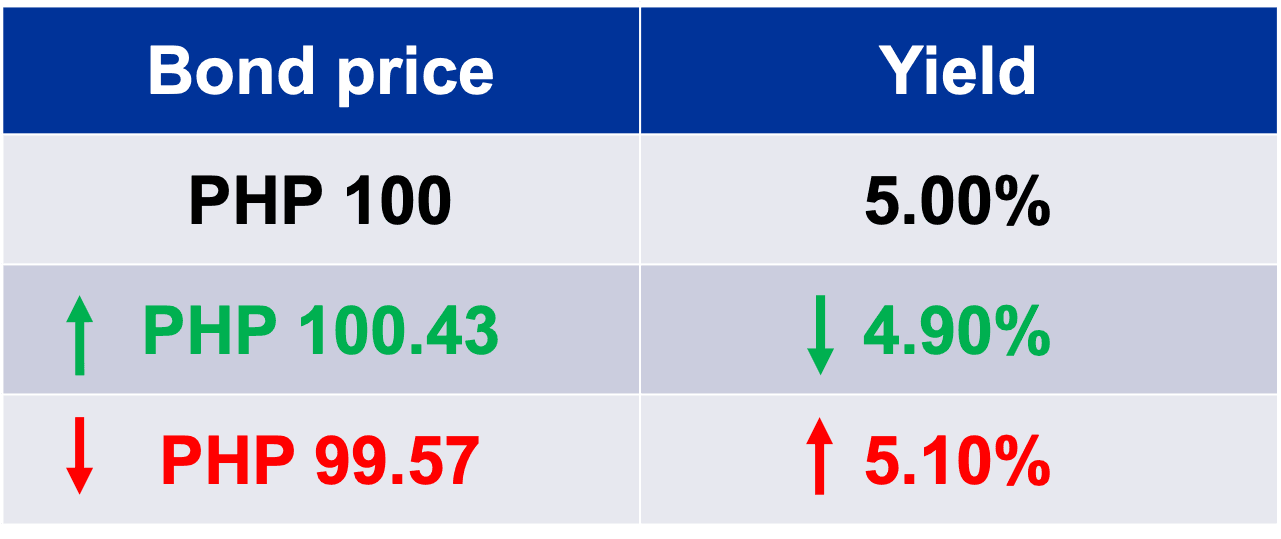
Let’s see sample scenarios:
The relationship of interest rate yield and bond prices for a 5–year bond with an annual coupon rate of 5% can be seen in the example below:

Let’s look into what affects bond prices:
While bonds are virtually zero risk investments, they are still affected by certain conditions. Let’s look into what affects bond prices:
Bonds offer a secure investment for investors, but they are not immune to shifts in the market. As an investor, it’s important to understand what happens to bond prices if interest rates rise or fall so you can make the best decisions to meet your financial goals.
Get updated insights about investment outlook with Metrobank. Get in touch with us about any investment concerns.
(Bookmark and visit Metrobank Wealth Insights at www.wealthinsights.ph daily for investment insights and ideas. If you are a Metrobank client, please get in touch with your relationship manager or investment specialist for assistance in accessing exclusive content. Not a client yet? Please sign up here or visit any Metrobank branch so you can begin your wealth journey with us.)
ALEXANDER VILLAFANIA is a writer for Metrobank’s Wealth Insights. For almost 20 years, he authored stories on science, technology, and education as a journalist for several local news organizations. He has since transitioned to writing more about financial literacy, believing that helping people develop a healthy relationship with money is key to enabling positive socio-economic and environmental change.
JOSHUA TATLONGHARI is a Financial Markets Analyst at Metrobank’s Institutional Investor Coverage Division. He holds an undergraduate degree in finance from the University of Santo Tomas and is currently taking a Master’s degree in Applied Economics at De La Salle University-Manila. He spends his free time working out and watching documentary videos relating to finance and the economy.
HANS NIGEL P. MARCELO is an intern at the Institutional Investors Coverage Division of Metrobank, taking on roles in relationship management and research and business analytics. He is currently taking his undergraduate studies at the De La Salle University – Manila.